Finite-temperature micromagnetic model bridging atomic- and macro-scale magnetism
Pith reviewed 2026-06-29 06:40 UTC · model grok-4.3
The pith
The LLBe model couples atomic-scale and macro-scale magnetic simulations across the Curie temperature using the Landau-Lifshitz and Bernoulli equations.
A machine-rendered reading of the paper's core claim, the machinery that carries it, and where it could break.
Core claim
The Landau-Lifshitz-Bernoulli (LLBe) model, obtained by combining the Landau-Lifshitz equation with the Bernoulli differential equation, produces magnetization dynamics that match Maxwell magnetostatics of paramagnets at high temperatures and recover the conventional Landau-Lifshitz micromagnetics of ferromagnets at low temperatures, thereby enabling direct coupling of atomic and continuum scales without additional parameters.
What carries the argument
The Landau-Lifshitz-Bernoulli (LLBe) model formed by joining the Landau-Lifshitz equation to the Bernoulli differential equation.
If this is right
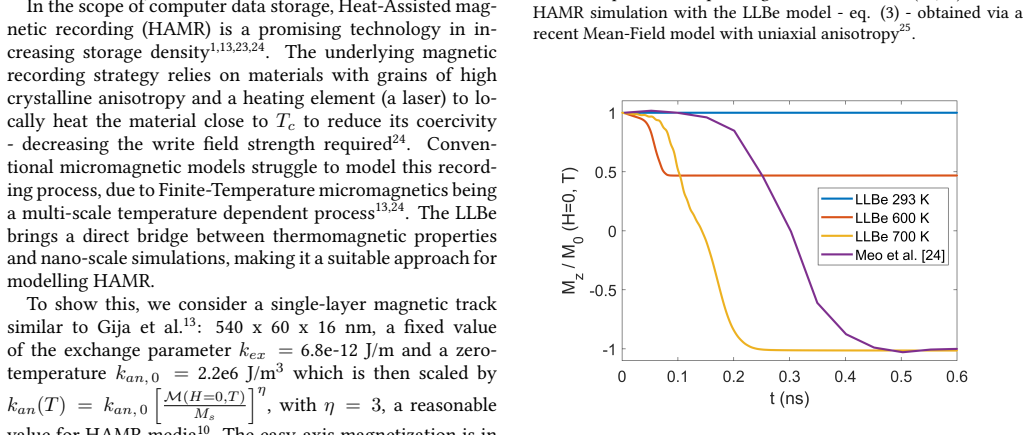
- The model can be used to simulate heat-assisted magnetic recording on a thin track with spatially varying local heating while remaining consistent from atomic to continuum scales.
- Bulk magnetic properties such as magnetization curves can be predicted from atomic inputs at any temperature without switching modeling frameworks.
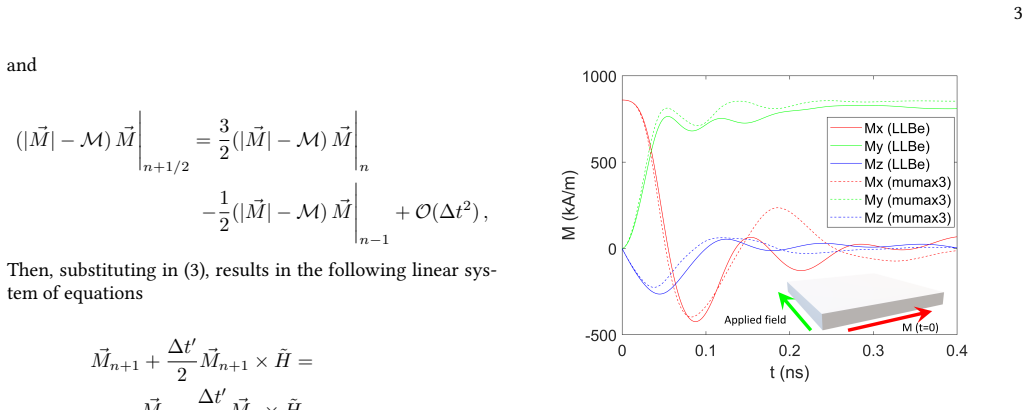
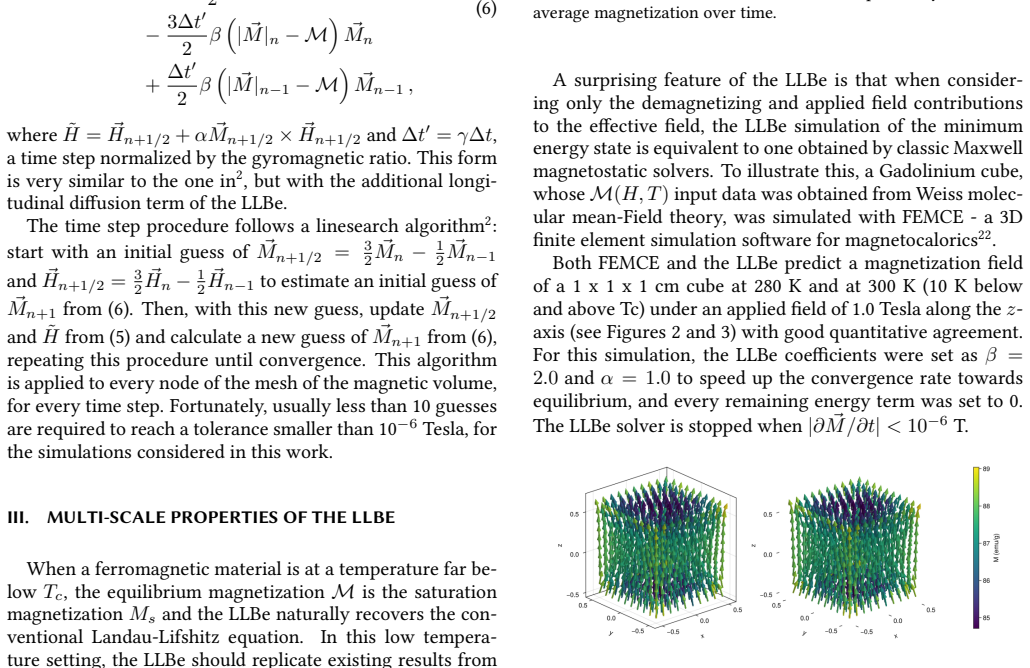
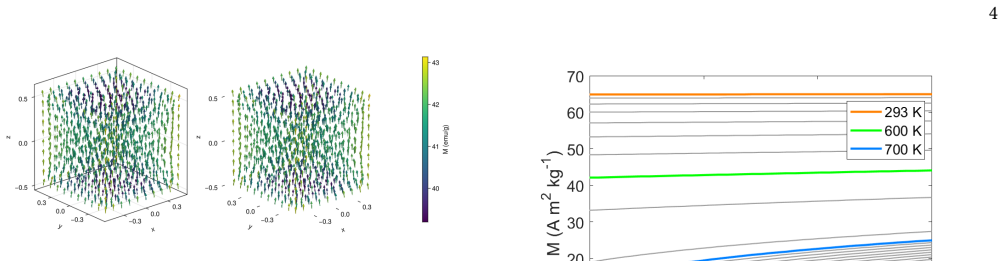
- The same code base reproduces both zero-temperature micromagnetics (as in MUMAX3) and high-temperature classic magnetostatics (as in FEMCE).
- No extra empirical parameters are required to maintain consistency when the temperature crosses the Curie point.
Where Pith is reading between the lines
- The framework could be applied to model thermal stability limits in nanoscale magnetic devices operating near their Curie temperature.
- One could test whether the same equation pair produces consistent results when the underlying atomic model is replaced by a different spin Hamiltonian.
- The approach might extend naturally to other materials whose magnetic order vanishes at a critical temperature, such as antiferromagnets or ferrimagnets.
- Coupling the LLBe solver to a molecular-dynamics code would allow simultaneous treatment of structural and magnetic degrees of freedom during rapid heating.
Load-bearing premise
The specific mathematical combination of the Landau-Lifshitz equation and the Bernoulli differential equation will generate physically consistent magnetization dynamics across the Curie temperature without introducing artifacts or scale-coupling problems.
What would settle it
A direct numerical comparison, on the same mesh and material parameters, between an LLBe run and an established atomistic spin-dynamics code at a temperature just below the Curie point, checking whether the predicted magnetization and susceptibility agree within statistical error.
Figures
read the original abstract
A multi-scale finite-temperature micromagnetic model is presented, based on the Landau-Lifshitz equation and the Bernoulli differential equation. This model accurately reproduces classic Maxwell magnetostatics of paramagnets for high temperatures and accurately reproduces standard micromagnetics described by the conventional Landau-Lifshitz model in ferromagnets. The Landau-Lifshitz-Bernoulli (LLBe) model can, by design, directly couple atomic-scale simulations with micromagnetics and output consistent predictions of bulk magnetic properties at finite temperatures, from below to above the material's Curie temperature. The LLBe model is validated against established solvers: MUMAX3 for zero-temperature micromagnetics, and FEMCE for high-temperature classic magnetostatics. We present an application of the LLBe model by simulating Heat-Assisted magnetic recording on a thin magnetic track with local heating, demonstrating the multi-scale finite-temperature capabilities of the LLBe.
Editorial analysis
A structured set of objections, weighed in public.
Referee Report
Summary. The manuscript introduces the Landau-Lifshitz-Bernoulli (LLBe) model, a finite-temperature micromagnetic framework that combines the Landau-Lifshitz equation with the Bernoulli differential equation. The central claim is that the LLBe model reproduces the zero-temperature micromagnetics limit (standard LL dynamics in ferromagnets) and the high-temperature paramagnetic limit (Maxwell magnetostatics) by construction, enabling direct multi-scale coupling between atomic and continuum descriptions across the Curie temperature. Validation is reported against MUMAX3 (zero T) and FEMCE (high T), with an application example simulating local-heating heat-assisted magnetic recording (HAMR) on a thin track.
Significance. If the LLBe construction maintains physical consistency and scale-bridging without hidden parameters or transition artifacts, the result would be significant for finite-temperature micromagnetic simulations in materials science, particularly for processes that cross the Curie point such as HAMR. Explicit validation against two established solvers and the absence of free parameters in the reported limits are strengths that would support adoption for multi-scale modeling.
minor comments (3)
- The abstract states that the model 'accurately reproduces' both limits and is 'validated against' MUMAX3 and FEMCE, but the manuscript should include quantitative metrics (e.g., L2 error norms or magnetization curves with error bars) for these comparisons to allow readers to assess the degree of agreement.
- Notation for the combined LLBe equation and the precise form of the Bernoulli term should be presented with explicit reference to the standard LL form (e.g., Eq. (1) or equivalent) so that the reduction to each asymptotic regime can be verified directly.
- The application section on HAMR would benefit from a brief statement of the temperature profile used and the spatial scale at which atomic-to-macro coupling is performed, to clarify how the multi-scale capability is exercised in practice.
Simulated Author's Rebuttal
We thank the referee for their positive summary, significance assessment, and recommendation of minor revision. No major comments were listed in the report, so we have no specific points to address point-by-point. We will incorporate any minor editorial or technical suggestions during revision.
Circularity Check
No significant circularity identified
full rationale
The provided abstract and description present the LLBe model as a direct combination of the Landau-Lifshitz equation with the Bernoulli differential equation, with explicit validation against independent external solvers (MUMAX3 at zero T, FEMCE at high T) for the two asymptotic regimes. No equations or steps are shown that reduce a claimed prediction to a fitted input, self-citation chain, or definitional tautology; the 'by design' phrasing refers to the model's intended scale-bridging construction rather than a circular reduction of results. The central claims rest on the model's independent numerical behavior and cross-checks, making the derivation self-contained against external benchmarks.
Axiom & Free-Parameter Ledger
axioms (1)
- domain assumption The combination of the Landau-Lifshitz equation and the Bernoulli differential equation produces consistent finite-temperature magnetization dynamics across the Curie temperature
Reference graph
Works this paper leans on
-
[1]
Tomorrow’s micromagnetic simulations,
1J. Leliaert and J. Mulkers, “Tomorrow’s micromagnetic simulations, ” Jour- nal of Applied Physics125, 180901 (2019). 2O. Bottauscio, M. Chiampi, and A. Manzin, “A finite element procedure for dynamic micromagnetic computations, ” IEEE Transactions on Magnetics 44, 3149–3152 (2008). 3J. Leliaert, M. Dvornik, J. Mulkers, J. De Clercq, M. V. Milo ˇsevi´c, a...
discussion (0)
Sign in with ORCID, Apple, or X to comment. Anyone can read and Pith papers without signing in.