Rate Maximization for Multi-Waveguide PASS: A Hierarchical User Scheduling and Joint Optimization Framework
Pith reviewed 2026-06-29 05:40 UTC · model grok-4.3
The pith
Explicit modeling of waveguide losses and coupling enables hierarchical scheduling plus joint power-position optimization to raise sum rates in multi-waveguide pinching-antenna systems.
A machine-rendered reading of the paper's core claim, the machinery that carries it, and where it could break.
Core claim
The paper claims that the hierarchical user scheduling algorithm combined with one-dimensional search for pinching-antenna positions and Lagrangian duality plus fractional programming for power allocation maximizes the system sum rate in multi-waveguide PASS, outperforming random pairing and maximum ratio transmission while highlighting the impact of propagation loss and coupling.
What carries the argument
The hierarchical user scheduling (HUS) algorithm, which assigns users by distance minimization and spatial separation, paired with a joint optimization that searches PA positions in one dimension and solves power allocation via duality and fractional programming.
Load-bearing premise
The explicit models of in-waveguide propagation loss and coupling effects are accurate enough representations of physical reality for the optimization to improve actual sum rates.
What would settle it
Comparison of measured sum rates in a hardware prototype of multi-waveguide PASS against the rates predicted by the HUS and joint optimization under the same user positions and power settings.
Figures
read the original abstract
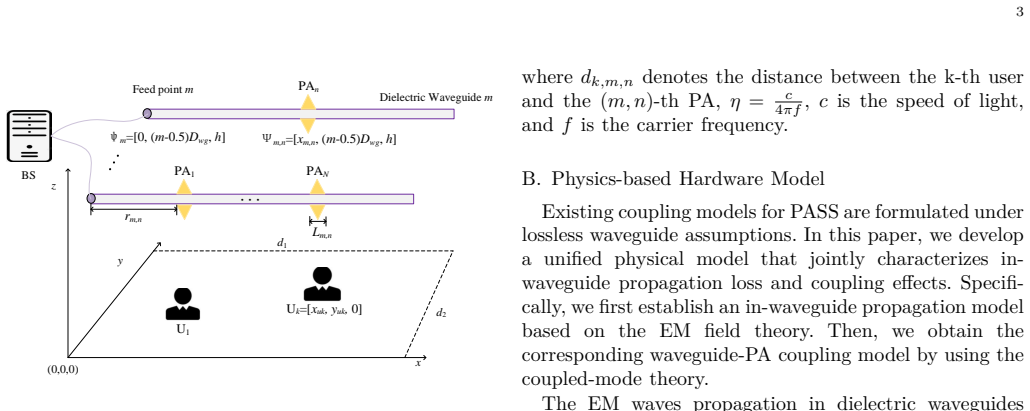
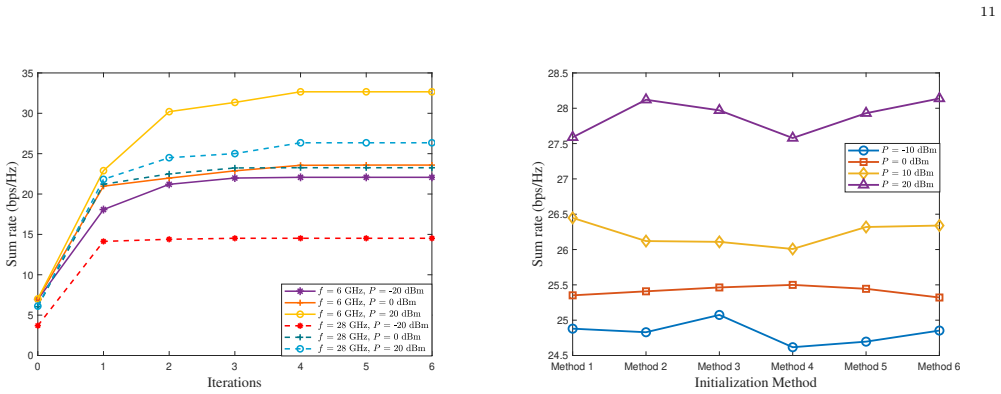
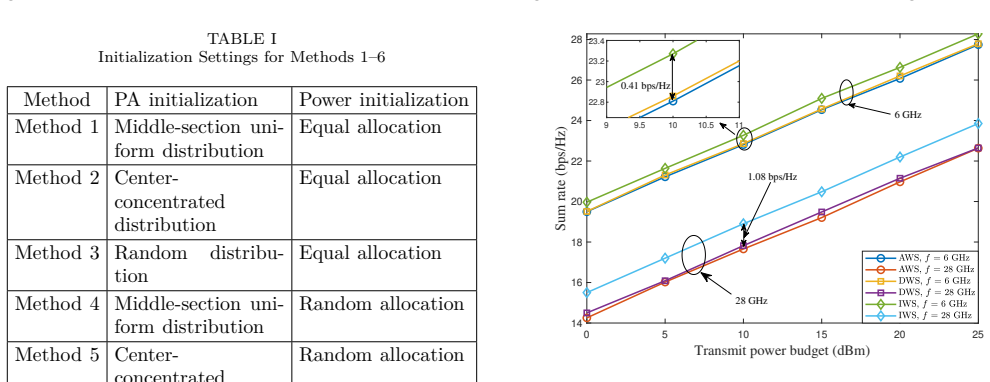
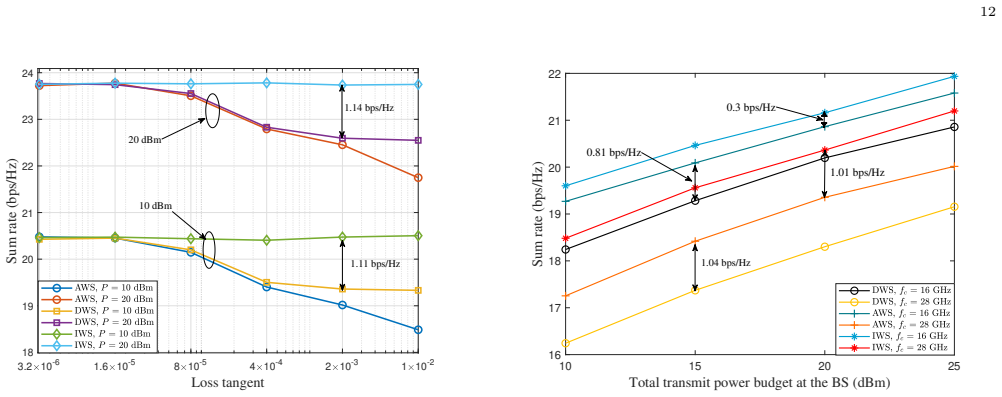
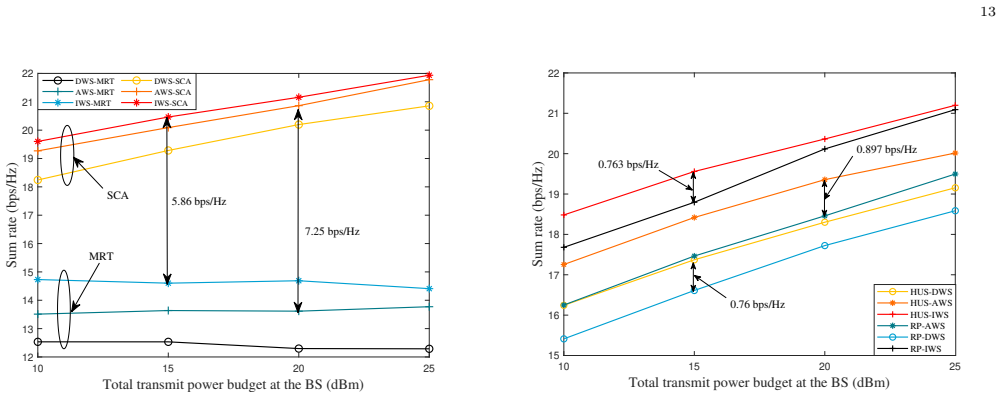
Pinching-antenna systems (PASS) have emerged as a promising flexible-antenna architecture capable of dynamically reconfiguring wireless channels by activating dielectric particles along waveguides. The sum rate maximization problem in multi-waveguide PASS is investigated in this study. Both in-waveguide propagation loss and coupling effects are explicitly modeled. To tackle the optimization problem, a hierarchical user scheduling (HUS) algorithm is proposed. The HUS algorithm minimizes the sum of squared distances between users and their associated waveguides to mitigate path loss. Additionally, spatially separated users are assigned within each time slot to reduce inter-user interference. Furthermore, a joint optimization framework integrating power allocation and pinching-antenna (PA) positioning is developed to further improve system sum rate. Specifically, PAs' positions are optimized via one-dimensional search, while the power allocation problem is solved by using the Lagrangian duality and fractional programming. Numerical results show that the HUS algorithm clearly outperforms random pairing, and the proposed power allocation algorithm shows a marked performance improvement over the maximum ratio transmission algorithm. Moreover, the results explicitly demonstrate the considerable impact of in-waveguide propagation loss and coupling effects on the performance of PASS.
Editorial analysis
A structured set of objections, weighed in public.
Referee Report
Summary. The paper studies sum-rate maximization in multi-waveguide pinching-antenna systems (PASS). It explicitly incorporates in-waveguide propagation loss and coupling into the channel model, proposes a hierarchical user scheduling (HUS) algorithm that pairs users to waveguides by minimizing sum of squared distances while enforcing spatial separation, and develops a joint optimization that uses one-dimensional search over PA positions together with Lagrangian duality and fractional programming for power allocation. Numerical results are reported to show that HUS outperforms random pairing, the proposed power allocation outperforms maximum-ratio transmission, and that the modeled loss and coupling terms materially affect the achievable sum rate.
Significance. If the loss and coupling models prove representative of physical PASS hardware, the HUS-plus-joint-optimization framework supplies a concrete, implementable procedure for improving multi-user rates under realistic waveguide impairments. The explicit modeling of those impairments and the use of standard convex-optimization tools are positive features; however, the significance remains conditional on the unvalidated accuracy of the channel model.
major comments (2)
- [Numerical Results] Numerical Results section: the central claim that the results 'explicitly demonstrate the considerable impact' of in-waveguide propagation loss and coupling rests entirely on simulations conducted inside the assumed model; no measurement data, Maxwell-equation derivation, or sensitivity check against alternative physical models is supplied, so the reported performance deltas and the asserted impact are not shown to survive outside the simulation assumptions.
- [Channel Model / Abstract] Channel Model and Abstract: the propagation-loss and coupling coefficients are introduced as given parameters without derivation, fitting procedure, or reference to empirical validation; because these coefficients directly scale the effective channel gains used in every subsequent rate expression and optimization, their unvalidated status is load-bearing for both the algorithm-performance claims and the impact statement.
minor comments (3)
- [Numerical Results] Numerical Results: figures lack error bars, Monte-Carlo repetition counts, or convergence curves for the 1-D search and fractional-programming iterations.
- [Hierarchical User Scheduling] Algorithm 1 (HUS): the description of the spatially-separated assignment step should include an explicit complexity statement and a statement of how ties or infeasible assignments are handled.
- [Joint Optimization Framework] Notation: the distinction between the instantaneous rate expression before and after the fractional-programming transformation should be clarified with an equation reference.
Simulated Author's Rebuttal
We thank the referee for the constructive feedback on the channel model and numerical results. We address each major comment below and outline the revisions we will make to clarify the scope of the claims.
read point-by-point responses
-
Referee: [Numerical Results] Numerical Results section: the central claim that the results 'explicitly demonstrate the considerable impact' of in-waveguide propagation loss and coupling rests entirely on simulations conducted inside the assumed model; no measurement data, Maxwell-equation derivation, or sensitivity check against alternative physical models is supplied, so the reported performance deltas and the asserted impact are not shown to survive outside the simulation assumptions.
Authors: We agree that the reported performance differences are obtained under the proposed channel model. The numerical results are intended to illustrate the sensitivity of the sum-rate optimization to these impairment terms within the model. We will revise the abstract and Numerical Results section to explicitly qualify the impact statement as holding under the assumed model. We will also add a short discussion of the physical motivation for the loss and coupling terms drawn from standard waveguide propagation theory. revision: yes
-
Referee: [Channel Model / Abstract] Channel Model and Abstract: the propagation-loss and coupling coefficients are introduced as given parameters without derivation, fitting procedure, or reference to empirical validation; because these coefficients directly scale the effective channel gains used in every subsequent rate expression and optimization, their unvalidated status is load-bearing for both the algorithm-performance claims and the impact statement.
Authors: The coefficients follow standard expressions for waveguide attenuation and inter-PA coupling. In the revised manuscript we will insert a brief derivation subsection (or appendix) that starts from the underlying transmission-line equations and cites the relevant electromagnetic literature. This will make the origin of the parameters explicit without altering the algorithmic contributions. revision: yes
- Empirical measurement data or hardware validation confirming that the adopted loss and coupling coefficients accurately represent physical PASS implementations.
Circularity Check
No significant circularity; derivation applies standard methods to explicit input models
full rationale
The paper states explicit models for in-waveguide loss and coupling as given inputs, then applies Lagrangian duality, fractional programming, and 1-D search to optimize under them. Numerical comparisons (HUS vs random, proposed PA vs MRT) are performed inside those models. No equation reduces to a self-definition, no fitted parameter is relabeled as a prediction, and no load-bearing claim rests on a self-citation chain. The framework is self-contained against its stated assumptions; the reported performance deltas and sensitivity results follow directly from the chosen models without circular reduction.
Axiom & Free-Parameter Ledger
axioms (1)
- domain assumption In-waveguide propagation loss and coupling effects can be explicitly modeled and incorporated into the rate expressions used for optimization.
Reference graph
Works this paper leans on
-
[1]
Scaling Up MIMO: Opportunities and Challenges with Very Large Arrays,
F. Rusek, D. Persson, B. K. Lau, E. G. Larsson, T. L. Marzetta, O. Edfors, and F. Tufvesson, “Scaling Up MIMO: Opportunities and Challenges with Very Large Arrays,” IEEE Signal Process- ing Mag., vol. 30, no. 1, pp. 40–60, Dec. 2013
2013
-
[2]
Massive MIMO for Next Generation Wireless Systems,
E. G. Larsson, O. Edfors, F. Tufvesson, and T. L. Marzetta, “Massive MIMO for Next Generation Wireless Systems,” IEEE Commun. Mag., vol. 52, no. 2, pp. 186–195, Feb. 2014
2014
-
[3]
A Vision of 6G Wire- less Systems: Applications, Trends, Technologies, and Open Research Problems,
W. Saad, M. Bennis, and M. Chen, “A Vision of 6G Wire- less Systems: Applications, Trends, Technologies, and Open Research Problems,” IEEE Network, vol. 34, no. 3, pp. 134– 142, Oct. 2020. 15
2020
-
[4]
Enhanced Over-the-Air Federated Learning Using AI-based Fluid Antenna System,
M. Ahmadzadeh, S. Pakravan, G. A. Hodtani, M. Zeng, J.-Y. Chouinard, and L. A. Rusch, “Enhanced Over-the-Air Federated Learning Using AI-based Fluid Antenna System,” arXiv, vol. 2407.03481, 2025
-
[5]
Movable Antenna-Enhanced Multiuser Commu- nication: Jointly Optimal Discrete Antenna Positioning and Beamforming,
Y. Wu, D. Xu, D. W. K. Ng, W. Gerstacker, and R. Schober, “Movable Antenna-Enhanced Multiuser Commu- nication: Jointly Optimal Discrete Antenna Positioning and Beamforming,” in 2023 IEEE Global Commun. Conf., Feb. 2023, pp. 7508–7513
2023
-
[6]
Robust Resource Allocation for Over-The-Air Computation Networks with Fluid Antenna Array,
S. Pakravan, M. Ahmadzadeh, M. Zeng, G. A. Hodtani, J.- Y. Chouinard, and L. A. Rusch, “Robust Resource Allocation for Over-The-Air Computation Networks with Fluid Antenna Array,” in 2024 Proc. IEEE Globecom Workshops, Dec. 2024, pp. 1–6
2024
-
[7]
Reconfigurable Intelligent Surfaces: Principles and Opportunities,
Y. Liu, X. Liu, X. Mu, T. Hou, J. Xu, M. Di Renzo, and N. Al-Dhahir, “Reconfigurable Intelligent Surfaces: Principles and Opportunities,” IEEE Commun. Surveys & Tuts., vol. 23, no. 3, pp. 1546–1577, May 2021
2021
-
[8]
Movable Antenna Enabled Near-Field Communications: Channel Modeling and Performance Optimization,
L. Zhu, W. Ma, Z. Xiao, and R. Zhang, “Movable Antenna Enabled Near-Field Communications: Channel Modeling and Performance Optimization,” IEEE Trans. Commun., vol. 73, no. 9, pp. 7240–7256, 2025
2025
-
[9]
Intelligent Reflecting Surface Aided Multi-User Communication: Capacity Region and Deployment Strategy,
S. Zhang and R. Zhang, “Intelligent Reflecting Surface Aided Multi-User Communication: Capacity Region and Deployment Strategy,” IEEE Trans. Commun., vol. 69, no. 9, pp. 5790–5806, May 2021
2021
-
[10]
Movable Antenna Enhanced Wireless Sensing via Antenna Position Optimization,
W. Ma, L. Zhu, and R. Zhang, “Movable Antenna Enhanced Wireless Sensing via Antenna Position Optimization,” IEEE Trans. Wireless Commun., vol. 23, no. 11, pp. 16 575–16 589, 2024
2024
-
[11]
Smart Radio Environments Empowered by Reconfigurable Intelligent Surfaces: How It Works, State of Research, and The Road Ahead,
M. Di Renzo, A. Zappone, M. Debbah, M.-S. Alouini, C. Yuen, J. de Rosny, and S. Tretyakov, “Smart Radio Environments Empowered by Reconfigurable Intelligent Surfaces: How It Works, State of Research, and The Road Ahead,” IEEE J. Sel. Areas Commun., vol. 38, no. 11, pp. 2450–2525, Nov. 2020
2020
-
[12]
Smart and Reconfigurable Wireless Communications: From IRS Modeling to Algorithm Design,
X. Yu, V. Jamali, D. Xu, D. W. K. Ng, and R. Schober, “Smart and Reconfigurable Wireless Communications: From IRS Modeling to Algorithm Design,” IEEE Wireless Commun., vol. 28, no. 6, pp. 118–125, Jan. 2021
2021
-
[13]
Movable Antennas for Wireless Communication: Opportunities and Challenges,
L. Zhu, W. Ma, and R. Zhang, “Movable Antennas for Wireless Communication: Opportunities and Challenges,” IEEE Com- mun. Mag., vol. 62, no. 6, pp. 114–120, jun 2024
2024
-
[14]
Pinching antenna: Using a dielectric waveguide as an antenna,
H. O. Y. Suzuki and K. Kawai, “Pinching antenna: Using a dielectric waveguide as an antenna,” NTT DOCOMO Technical J, vol. 23, no. 3, pp. 5–12, Jan. 2022
2022
-
[15]
Pinching Antennas: Principles, Applications and Challenges,
Z. Yang, N. Wang, Y. Sun, Z. Ding, R. Schober, G. K. Karagiannidis, V. W. S. Wong, and O. A. Dobre, “Pinching Antennas: Principles, Applications and Challenges,” arXiv, vol. 2501.10753, 2025
-
[16]
Minimum Data Rate Maximization for Uplink Pinching- Antenna Systems,
S. A. Tegos, P. D. Diamantoulakis, Z. Ding, and G. K. Karagian- nidis, “Minimum Data Rate Maximization for Uplink Pinching- Antenna Systems,” IEEE Wireless Commun. Lett., vol. 14, no. 5, pp. 1516–1520, May 2025
2025
-
[17]
Pinching-Antenna Systems (PASS): Architecture Designs, Op- portunities, and Outlook,
Y. Liu, Z. Wang, X. Mu, C. Ouyang, X. Xu, and Z. Ding, “Pinching-Antenna Systems (PASS): Architecture Designs, Op- portunities, and Outlook,” arXiv, vol. 2501.18409, 2025
-
[18]
Pinching-Antenna Systems (PASS): A Tutorial,
Y. Liu, H. Jiang, X. Xu, Z. Wang, J. Guo, C. Ouyang, X. Mu, Z. Ding, A. Nallanathan, G. K. Karagiannidis, and R. Schober, “Pinching-Antenna Systems (PASS): A Tutorial,” arXiv, vol. 2508.07572, 2025
-
[19]
Flexible-antenna systems: A pinching-antenna perspective,
Z. Ding, R. Schober, and H. V. Poor, “Flexible-antenna systems: A pinching-antenna perspective,” arXiv, vol. 2412.02376, 2024
-
[20]
X. Xu, X. Mu, Y. Liu, and A. Nallanathan, “Joint Transmit and Pinching Beamforming for Pinching Antenna Systems (PASS): Optimization-Based or Learning-Based?” arXiv, vol. 2502.08637, 2025
-
[21]
Waveguide Di- vision Multiple Access for Pinching-Antenna Systems (PASS),
J. Zhao, X. Mu, K. Cai, Y. Zhu, and Y. Liu, “Waveguide Di- vision Multiple Access for Pinching-Antenna Systems (PASS),” arXiv, vol. 2502.17781, 2025
-
[22]
Antenna Acti- vation and Resource Allocation in Multi-Waveguide Pinching- Antenna Systems,
K. Wang, Z. Ding, and G. K. Karagiannidis, “Antenna Acti- vation and Resource Allocation in Multi-Waveguide Pinching- Antenna Systems,” arXiv, vol. 2505.02864, 2025
-
[23]
Array Gain for Pinching-Antenna Systems (PASS),
C. Ouyang, Z. Wang, Y. Liu, and Z. Ding, “Array Gain for Pinching-Antenna Systems (PASS),” arXiv, vol. 2501.05657, 2025
-
[24]
Antenna Activation for NOMA Assisted Pinching-Antenna Systems,
K. Wang, Z. Ding, and R. Schober, “Antenna Activation for NOMA Assisted Pinching-Antenna Systems,” arXiv, vol. 2412.13969, 2024
-
[25]
On the Performance of Uplink Pinching Antenna Systems (PASS),
T. Hou, Y. Liu, and A. Nallanathan, “On the Performance of Uplink Pinching Antenna Systems (PASS),” IEEE Trans. Commun., pp. 1–1, 2025
2025
-
[26]
Uplink Sum Rate Maximization for Pinching Antenna-Assisted Multiuser MISO,
J. Zhang, H. Xu, C. Ouyang, Q. Zou, and H. Yang, “Uplink Sum Rate Maximization for Pinching Antenna-Assisted Multiuser MISO,” arXiv, vol. 2504.16577, 2025
-
[27]
J. Zhao, H. Song, X. Mu, K. Cai, Y. Zhu, and Y. Liu, “Pinching- Antenna Systems-Enabled Multi-User Communications: Trans- mission Structures and Beamforming Optimization,” arXiv, vol. 2508.14458, 2025
-
[28]
Performance Analysis of Pinching-Antenna Systems,
D. Tyrovolas, S. A. Tegos, P. D. Diamantoulakis, S. Ioannidis, C. K. Liaskos, and G. K. Karagiannidis, “Performance Analysis of Pinching-Antenna Systems,” arXiv, vol. 2502.06701, 2025
-
[29]
S. Hu, R. Zhao, Y. Liao, D. W. K. Ng, and J. Yuan, “Sum-Rate Maximization for Pinching Antenna-assisted NOMA Systems with Multiple Dielectric Waveguides,” arXiv, vol. 2503.10060, 2025
-
[30]
Pinching Antenna- Aided Wireless Powered Communication Networks,
Y. Li, H. Xu, M. Zeng, and Y. Liu, “Pinching Antenna- Aided Wireless Powered Communication Networks,” arXiv, vol. 2506.00355, 2025
-
[31]
Multiuser Beamforming for Pinching-Antenna Systems: An Element-wise Optimization Framework,
M. Sun, C. Ouyang, S. Wu, and Y. Liu, “Multiuser Beamforming for Pinching-Antenna Systems: An Element-wise Optimization Framework,” arXiv, vol. 2506.03770, 2025
-
[32]
Modeling and Beamforming Optimization for Pinching-Antenna Systems,
Z. Wang, C. Ouyang, X. Mu, Y. Liu, and Z. Ding, “Modeling and Beamforming Optimization for Pinching-Antenna Systems,” arXiv, vol. 2502.05917, 2025
-
[33]
Pinching-Antenna Systems (PASS): Power Radiation Model and Optimal Beamforming Design
X. Xu, X. Mu, Z. Wang, Y. Liu, and A. Nallanathan, “Pinching- Antenna Systems (PASS): Power Radiation Model and Optimal Beamforming Design,” arXiv, vol. 2505.00218, 2025
work page internal anchor Pith review Pith/arXiv arXiv 2025
-
[34]
Beam Focusing for Near-Field Multiuser MIMO Communications,
H. Zhang, N. Shlezinger, F. Guidi, D. Dardari, M. F. Imani, and Y. C. Eldar, “Beam Focusing for Near-Field Multiuser MIMO Communications,” IEEE Trans. Wireless Commun., vol. 21, no. 9, pp. 7476–7490, Sep. 2022
2022
-
[35]
D. M. Pozar, Microwave Engineering, 4th ed. Hoboken, NJ, USA: John Wiley & Sons, 2011
2011
-
[36]
Okamoto, Fundamentals of Optical Waveguides
K. Okamoto, Fundamentals of Optical Waveguides. Elsevier, 2021
2021
-
[37]
MIMO-PASS: Uplink and Downlink Transmission via MIMO Pinching-Antenna Systems,
A. Bereyhi, C. Ouyang, S. Asaad, Z. Ding, and H. V. Poor, “MIMO-PASS: Uplink and Downlink Transmission via MIMO Pinching-Antenna Systems,” arXiv, vol. 2503.03117, 2025
-
[38]
Fractional Programming for Communica- tion Systems—Part II: Uplink Scheduling via Matching,
K. Shen and W. Yu, “Fractional Programming for Communica- tion Systems—Part II: Uplink Scheduling via Matching,” IEEE Trans. Signal Process., vol. 66, no. 10, pp. 2631–2644, May 2018
2018
-
[39]
Fractional Programming for Communication Systems— Part I: Power Control and Beamforming,
——, “Fractional Programming for Communication Systems— Part I: Power Control and Beamforming,” IEEE Trans. Signal Process., vol. 66, no. 10, pp. 2616–2630, May 2018
2018
discussion (0)
Sign in with ORCID, Apple, or X to comment. Anyone can read and Pith papers without signing in.