A Unified Two-Stage Generative Diffusion Framework for Channel Estimation and Port Selection in Multiuser MIMO-FAS
Pith reviewed 2026-06-29 01:06 UTC · model grok-4.3
The pith
A two-stage diffusion framework decomposes joint MAP inference to recover multiuser FAS channels and select ports sequentially.
A machine-rendered reading of the paper's core claim, the machinery that carries it, and where it could break.
Core claim
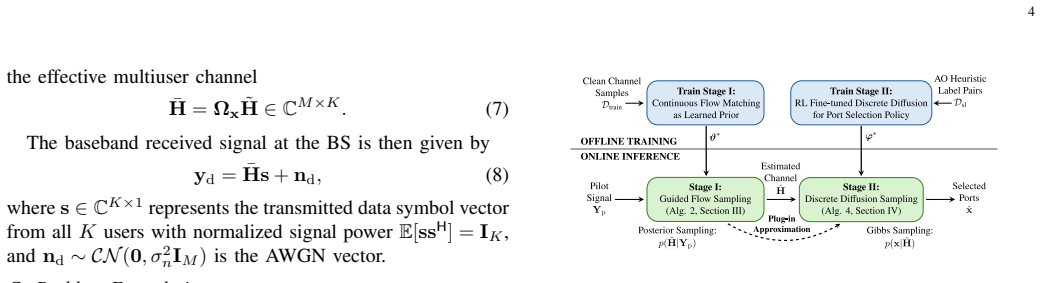
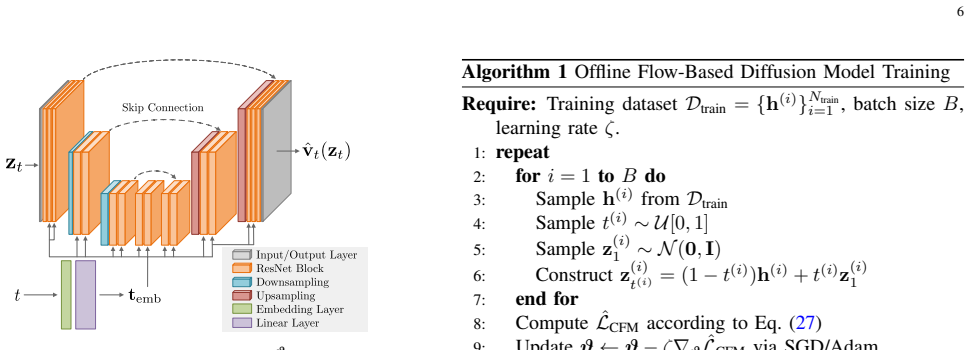
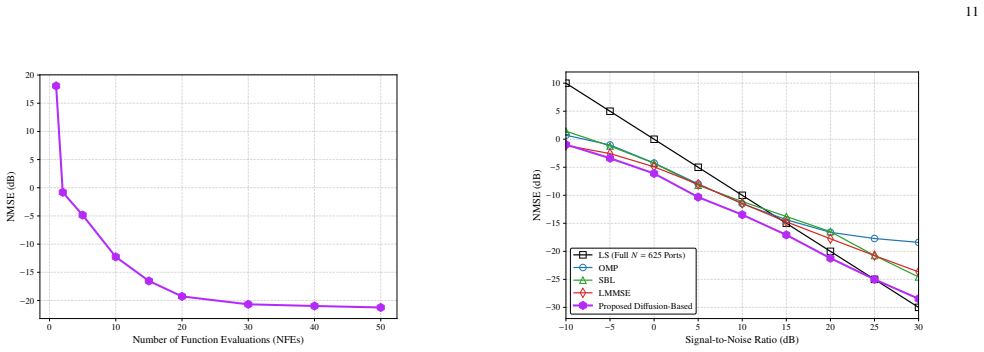
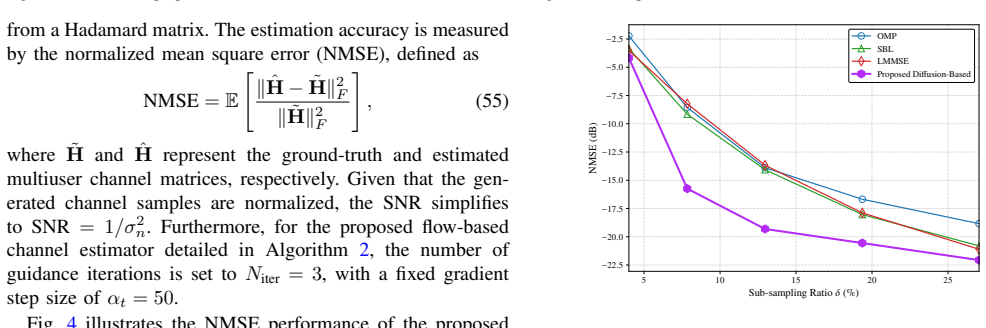
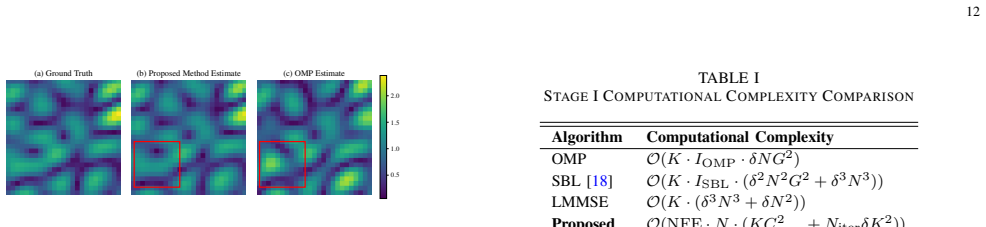
The central claim is that a plug-in approximation allows the joint MAP problem for channel estimation and port selection to be decomposed into two sequential sampling stages without losing essential statistical dependencies. Stage I employs a continuous flow-based diffusion model as an implicit prior for 2D FAS channels together with parallel guided generation to sample from the approximate posterior. Stage II uses a discrete diffusion model trained via supervised learning on heuristic labels followed by reinforcement fine-tuning to approximate the conditional port-selection distribution, overcoming local optima of conventional heuristics. Simulations show this yields accurate multiuser chan
What carries the argument
The plug-in approximation that decomposes the joint MAP inference problem into two sequential sampling stages, with a continuous flow-based diffusion model for channel recovery and a discrete diffusion model for port selection.
If this is right
- Channel estimation remains accurate even when the number of RF chains is far smaller than the number of fluid-antenna ports.
- Port selection escapes the local optima that trap conventional heuristic algorithms.
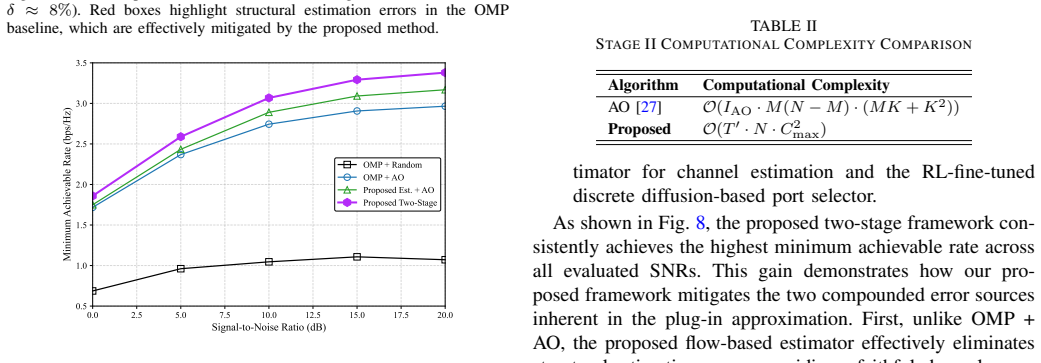
- The minimum achievable rate across users increases substantially compared with separate estimation-plus-selection pipelines.
- The same diffusion priors can be reused across different sub-sampling ratios without retraining.
Where Pith is reading between the lines
- The sequential decomposition suggests diffusion models can serve as tractable surrogates for high-dimensional combinatorial wireless optimization problems beyond FAS.
- If the approximation holds, similar two-stage generative pipelines could be tested on other coupled estimation-and-selection tasks such as beam selection or user scheduling.
- The framework implies that reinforcement fine-tuning of discrete diffusion models may generalize to other discrete wireless resource-allocation decisions.
Load-bearing premise
The plug-in approximation that decomposes the joint MAP inference problem into two sequential sampling stages preserves the essential statistical dependencies between channel estimation and port selection.
What would settle it
A direct numerical comparison, on identical FAS channel realizations, between the two-stage method's achieved minimum rate and the minimum rate obtained by an exact joint MAP solver or by exhaustive search over feasible port selections.
Figures
read the original abstract
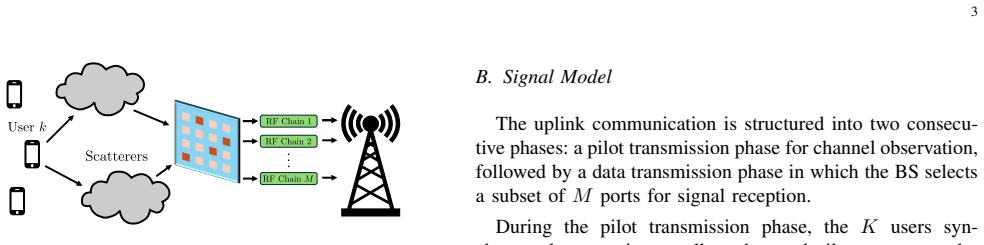
Fluid antenna systems (FAS) have emerged as a promising technology for next-generation wireless systems. However, practical multiuser multiple-input multiple-output FAS (MIMO-FAS) faces two inherently coupled challenges: acquiring accurate high-dimensional channel state information (CSI) from limited RF chains and solving the combinatorial port selection problem, where the effectiveness of the latter highly depends on the result of the former. In this paper, we propose a unified two-stage diffusion framework that formulates the joint task as a maximum-a-posteriori (MAP) inference problem and decomposes it into two sequential sampling stages through a plug-in approximation. For Stage I, a continuous flow-based diffusion model serves as a powerful implicit prior for 2D FAS channels, and a parallel guided generation scheme realizes approximate posterior sampling, enabling accurate multiuser channel recovery even under severely low sub-sampling ratios. For Stage II, a discrete diffusion model is trained to approximate the conditional port selection distribution by combining supervised learning on heuristic labels with reinforcement fine-tuning, effectively overcoming the local optima of conventional heuristic algorithms. Extensive simulations demonstrate that the proposed framework simultaneously achieves exceptional channel estimation accuracy and globally optimized port selection, substantially improving the minimum achievable rate.
Editorial analysis
A structured set of objections, weighed in public.
Referee Report
Summary. The paper proposes a unified two-stage generative diffusion framework for channel estimation and port selection in multiuser MIMO-FAS. It formulates the joint task as a MAP inference problem and decomposes it into two sequential sampling stages using a plug-in approximation: a continuous flow-based diffusion model for channel recovery and a discrete diffusion model for port selection trained with supervised learning on heuristic labels and reinforcement fine-tuning. Simulations are said to show exceptional channel estimation accuracy and improved minimum achievable rates.
Significance. If the two-stage approach with the plug-in approximation is validated to closely approximate the joint optimal solution, this work could represent a significant contribution to applying generative diffusion models to coupled estimation and optimization problems in wireless communications, particularly for fluid antenna systems where CSI acquisition and port selection are interdependent.
major comments (1)
- [Abstract / two-stage decomposition] The plug-in approximation that decomposes the joint MAP inference into sequential continuous then discrete diffusion stages (as described in the abstract) lacks error bounds, fixed-point guarantees, or comparison to joint sampling; this is load-bearing for the central claim that the framework achieves 'globally optimized port selection' and 'substantially improving the minimum achievable rate,' since treating the Stage-I posterior as fixed may discard correlations between CSI errors and optimal ports.
minor comments (1)
- [Abstract] The abstract references 'extensive simulations' demonstrating the gains but provides no details on baseline comparisons, error bars, or simulation parameters, which would strengthen the presentation of results.
Simulated Author's Rebuttal
We thank the referee for the constructive feedback on the two-stage decomposition. We address the major comment below.
read point-by-point responses
-
Referee: [Abstract / two-stage decomposition] The plug-in approximation that decomposes the joint MAP inference into sequential continuous then discrete diffusion stages (as described in the abstract) lacks error bounds, fixed-point guarantees, or comparison to joint sampling; this is load-bearing for the central claim that the framework achieves 'globally optimized port selection' and 'substantially improving the minimum achievable rate,' since treating the Stage-I posterior as fixed may discard correlations between CSI errors and optimal ports.
Authors: The plug-in approximation is adopted because the joint MAP over continuous channels and discrete ports is intractable to sample directly; the decomposition follows from conditioning the port-selection distribution on the channel posterior, which is a standard technique for coupled continuous-discrete inference. Stage II is not a simple plug-in of a point estimate but a conditional discrete diffusion trained end-to-end with reinforcement fine-tuning that directly optimizes the minimum rate objective, thereby incorporating the effect of residual CSI uncertainty. While the manuscript does not supply theoretical error bounds or fixed-point guarantees, the empirical results across multiple channel models and SNR regimes show consistent gains over both separate estimation-plus-heuristic-selection baselines and joint-optimization heuristics, indicating that the discarded correlations do not dominate performance in the regimes of interest. A full joint diffusion sampler remains computationally prohibitive for the antenna-port dimensions considered. We will add a dedicated paragraph in Section III clarifying the approximation rationale, its relation to the MAP objective, and the role of reinforcement fine-tuning in mitigating error propagation. revision: partial
Circularity Check
No significant circularity; derivation relies on standard approximations and empirical validation
full rationale
The paper formulates the joint channel estimation and port selection task as MAP inference then applies a plug-in approximation to split into sequential diffusion stages. Stage I uses a continuous flow-based model for posterior sampling, while Stage II trains a discrete diffusion model via supervised learning on heuristic labels followed by reinforcement fine-tuning. No equations, self-citations, or steps in the provided abstract reduce any claimed prediction or result to its inputs by construction (e.g., no fitted parameter renamed as independent prediction, no self-definitional loop, no load-bearing uniqueness theorem from prior self-work). The central claims rest on simulation results rather than tautological reductions, making the derivation self-contained against external benchmarks.
Axiom & Free-Parameter Ledger
Reference graph
Works this paper leans on
-
[1]
Edge artificial intelligence for 6G: Vision, enabling technologies, and applications,
K. B. Letaief, Y . Shi, J. Lu, and J. Lu, “Edge artificial intelligence for 6G: Vision, enabling technologies, and applications,”IEEE J. Sel. Areas Commun., vol. 40, no. 1, pp. 5–36, Jan. 2022
2022
-
[2]
A vision of 6G wireless systems: Applications, trends, technologies, and open research problems,
W. Saad, M. Bennis, and M. Chen, “A vision of 6G wireless systems: Applications, trends, technologies, and open research problems,”IEEE Netw., vol. 34, no. 3, pp. 134–142, May 2020
2020
-
[3]
On the road to 6G: Visions, requirements, key technologies, and testbeds,
C.-X. Wanget al., “On the road to 6G: Visions, requirements, key technologies, and testbeds,”IEEE Commun. Surveys Tuts., vol. 25, no. 2, pp. 905–974, 2nd Quart. 2023
2023
-
[4]
A tutorial on extremely large-scale MIMO for 6G: Fundamentals, signal processing, and applications,
Z. Wanget al., “A tutorial on extremely large-scale MIMO for 6G: Fundamentals, signal processing, and applications,”IEEE Commun. Surveys Tuts., vol. 26, no. 3, pp. 1560–1605, 3rd Quart. 2024
2024
-
[5]
MIMO evolution beyond 5G through reconfig- urable intelligent surfaces and fluid antenna systems,
A. Shojaeifardet al., “MIMO evolution beyond 5G through reconfig- urable intelligent surfaces and fluid antenna systems,”Proc. IEEE, vol. 110, no. 9, pp. 1244–1265, Sep. 2022
2022
-
[6]
Fluid antenna system for 6G: When Bruce Lee inspires wireless communications,
K.-K. Wong, K.-F. Tong, Y . Zhang, and Z. Zhongbin, “Fluid antenna system for 6G: When Bruce Lee inspires wireless communications,”IET Electron. Lett., vol. 56, no. 24, pp. 1288–1290, Nov. 2020
2020
-
[7]
Fluid antenna systems,
K.-K. Wong, A. Shojaeifard, K.-F. Tong, and Y . Zhang, “Fluid antenna systems,”IEEE Trans. Wireless Commun., vol. 20, no. 3, pp. 1950–1962, Mar. 2021
1950
-
[8]
Performance limits of fluid antenna systems,
K. K. Wong, A. Shojaeifard, K.-F. Tong, and Y . Zhang, “Performance limits of fluid antenna systems,”IEEE Commun. Lett., vol. 24, no. 11, pp. 2469–2472, Nov. 2020
2020
-
[9]
Fluid antenna system: New insights on outage probability and diversity gain,
W. K. New, K.-K. Wong, H. Xu, K.-F. Tong, and C.-B. Chae, “Fluid antenna system: New insights on outage probability and diversity gain,” IEEE Trans. Wireless Commun., vol. 23, no. 1, pp. 128–140, Jan. 2024
2024
-
[10]
Outage performance of fluid antenna system (FAS)-aided terahertz communication networks,
L. Tlebaldiyeva, S. Arzykulov, K. M. Rabie, X. Li, and G. Nauryzbayev, “Outage performance of fluid antenna system (FAS)-aided terahertz communication networks,” inProc. IEEE Int. Conf. Commun. (ICC). IEEE, 2023, pp. 1922–1927
2023
-
[11]
A new analytical ap- proximation of the fluid antenna system channel,
M. Khammassi, A. Kammoun, and M.-S. Alouini, “A new analytical ap- proximation of the fluid antenna system channel,”IEEE Trans. Wireless Commun., vol. 22, no. 12, pp. 8843–8858, Dec. 2023
2023
-
[12]
Fluid antenna system liberating multiuser MIMO for ISAC via deep reinforcement learning,
C. Wanget al., “Fluid antenna system liberating multiuser MIMO for ISAC via deep reinforcement learning,”IEEE Trans. Wireless Commun., vol. 23, no. 9, pp. 10 879–10 894, Sep. 2024
2024
-
[13]
An information-theoretic characterization of MIMO-FAS: Optimization, diversity-multiplexing tradeoff and q-outage capacity,
W. K. New, K.-K. Wong, H. Xu, K.-F. Tong, and C.-B. Chae, “An information-theoretic characterization of MIMO-FAS: Optimization, diversity-multiplexing tradeoff and q-outage capacity,”IEEE Trans. Wireless Commun., vol. 23, no. 6, pp. 5541–5556, Jun. 2024
2024
-
[14]
Movable-antenna array enhanced beam- forming: Achieving full array gain with null steering,
L. Zhu, W. Ma, and R. Zhang, “Movable-antenna array enhanced beam- forming: Achieving full array gain with null steering,”IEEE Commun. Lett., vol. 27, no. 12, pp. 3340–3344, Dec. 2023
2023
-
[15]
A tutorial on fluid antenna system for 6G networks: Encompassing communication theory, optimization methods and hard- ware designs,
W. K. Newet al., “A tutorial on fluid antenna system for 6G networks: Encompassing communication theory, optimization methods and hard- ware designs,”IEEE Commun. Surveys Tuts., vol. 27, no. 4, pp. 2325– 2377, Aug. 2025
2025
-
[16]
Compressed sensing based channel estimation for movable antenna communications,
W. Ma, L. Zhu, and R. Zhang, “Compressed sensing based channel estimation for movable antenna communications,”IEEE Commun. Lett., vol. 27, no. 10, pp. 2747–2751, Oct. 2023
2023
-
[17]
Channel estimation for movable antenna communication systems: A framework based on compressed sensing,
Z. Xiaoet al., “Channel estimation for movable antenna communication systems: A framework based on compressed sensing,”IEEE Trans. Wireless Commun., vol. 23, no. 9, pp. 11 814–11 830, Sep. 2024
2024
-
[18]
Sparse Bayesian learning-based channel estimation for fluid antenna systems,
B. Xu, Y . Chen, Q. Cui, X. Tao, and K.-K. Wong, “Sparse Bayesian learning-based channel estimation for fluid antenna systems,”IEEE Wireless Commun. Lett., vol. 14, no. 2, pp. 325–329, Feb. 2025
2025
-
[19]
Fluid antenna with linear MMSE channel estimation for large-scale cellular networks,
C. Skouroumounis and I. Krikidis, “Fluid antenna with linear MMSE channel estimation for large-scale cellular networks,”IEEE Trans. Com- mun., vol. 71, no. 2, pp. 1112–1125, Feb. 2023
2023
-
[20]
Successive Bayesian reconstructor for channel estimation in fluid antenna systems,
Z. Zhang, J. Zhu, L. Dai, and R. W. Heath, “Successive Bayesian reconstructor for channel estimation in fluid antenna systems,”IEEE Trans. Wireless Commun., vol. 24, no. 3, pp. 1992–2006, Mar. 2025
1992
-
[21]
Iterative sparse asymptotic minimum variance based channel estimation in fluid antenna system,
Z. Chen, J. Li, X. Y . Zhang, K.-K. Wong, C.-B. Chae, and Y . Zhang, “Iterative sparse asymptotic minimum variance based channel estimation in fluid antenna system,”arXiv preprint arXiv:2507.05625, 2025
-
[22]
H. Guo, J. Zhang, J. Rao, R. Murch, and V . K. Lau, “Channel estimation and analog precoding for pixel-based fluid-antenna-assisted multiuser MIMO-OFDM systems,”arXiv preprint arXiv:2509.09373, 2025
-
[23]
Channel estimation for FAS-assisted multiuser mmWave systems,
H. Xuet al., “Channel estimation for FAS-assisted multiuser mmWave systems,”IEEE Commun. Lett., vol. 28, no. 3, pp. 632–636, Mar. 2024
2024
-
[24]
Antenna positioning and beamforming design for fluid antenna-assisted multi- user downlink communications,
H. Qin, W. Chen, Z. Li, Q. Wu, N. Cheng, and F. Chen, “Antenna positioning and beamforming design for fluid antenna-assisted multi- user downlink communications,”IEEE Wireless Commun. Lett., vol. 13, no. 4, pp. 1073–1077, Apr. 2024
2024
-
[25]
Sum- rate maximization for fluid antenna enabled multiuser communications,
Z. Cheng, N. Li, J. Zhu, X. She, C. Ouyang, and P. Chen, “Sum- rate maximization for fluid antenna enabled multiuser communications,” IEEE Commun. Lett., vol. 28, no. 5, pp. 1206–1210, May 2024
2024
-
[26]
Joint beamforming and antenna position optimization for fluid antenna- assisted MU-MIMO networks,
T. Liao, W. Guo, H. He, S. Song, J. Zhang, and K. B. Letaief, “Joint beamforming and antenna position optimization for fluid antenna- assisted MU-MIMO networks,”IEEE J. Sel. Areas Commun., vol. 44, pp. 1209–1226, Sep. 2025
2025
-
[27]
Exploit- ing movable antennas in multicast communications,
Z. Cheng, N. Li, J. Zhu, C. Ouyang, and X. Zhang, “Exploit- ing movable antennas in multicast communications,”arXiv preprint arXiv:2405.07281, 2024
-
[28]
Multiuser commu- nications with movable-antenna base station: Joint antenna positioning, receive combining, and power control,
Z. Xiao, X. Pi, L. Zhu, X.-G. Xia, and R. Zhang, “Multiuser commu- nications with movable-antenna base station: Joint antenna positioning, receive combining, and power control,”IEEE Trans. Wireless Commun., vol. 23, no. 12, pp. 19 744–19 759, Dec. 2024
2024
-
[29]
Globally optimal movable antenna-enabled multiuser communication: Discrete antenna positioning, power consumption, and imperfect CSI,
Y . Wu, D. Xu, D. W. K. Ng, W. Gerstacker, and R. Schober, “Globally optimal movable antenna-enabled multiuser communication: Discrete antenna positioning, power consumption, and imperfect CSI,”IEEE Trans. Commun., vol. 73, no. 10, pp. 9903–9923, Oct. 2025
2025
-
[30]
A reconfigurable aperture antenna based on switched links between electrically small metallic patches,
L. N. Pringleet al., “A reconfigurable aperture antenna based on switched links between electrically small metallic patches,”IEEE Trans. Antennas Propag., vol. 52, no. 6, pp. 1434–1445, Jun. 2004
2004
-
[31]
Experimental simulation of multi-static radar with a pair of separated movable antennas,
A. Zhuravlev, V . Razevig, S. Ivashov, A. Bugaev, and M. Chizh, “Experimental simulation of multi-static radar with a pair of separated movable antennas,” inProc. IEEE COMCAS. IEEE, 2015, pp. 1–5
2015
-
[32]
A novel pixel-based reconfigurable antenna applied in fluid antenna systems with high switching speed,
J. Zhanget al., “A novel pixel-based reconfigurable antenna applied in fluid antenna systems with high switching speed,”IEEE Open J. Antennas Propag., vol. 6, no. 1, pp. 212–228, Feb. 2025
2025
-
[33]
Neural ordinary differential equations,
R. T. Chen, Y . Rubanova, J. Bettencourt, and D. K. Duvenaud, “Neural ordinary differential equations,”Proc. Advances in Neural Information Processing Systems (NeurIPS), vol. 31, 2018
2018
-
[34]
Flow Matching for Generative Modeling
Y . Lipman, R. T. Chen, H. Ben-Hamu, M. Nickel, and M. Le, “Flow matching for generative modeling,”arXiv preprint arXiv:2210.02747, 2022
work page internal anchor Pith review Pith/arXiv arXiv 2022
-
[35]
Building Normalizing Flows with Stochastic Interpolants
M. S. Albergo and E. Vanden-Eijnden, “Building normalizing flows with stochastic interpolants,”arXiv preprint arXiv:2209.15571, 2022
work page internal anchor Pith review Pith/arXiv arXiv 2022
-
[36]
Flow Straight and Fast: Learning to Generate and Transfer Data with Rectified Flow
X. Liu, C. Gong, and Q. Liu, “Flow straight and fast: Learning to generate and transfer data with rectified flow,”arXiv preprint arXiv:2209.03003, 2022
work page internal anchor Pith review Pith/arXiv arXiv 2022
-
[37]
FlowDPS: Flow-driven posterior sampling for inverse problems,
J. Kim, B. S. Kim, and J. C. Ye, “FlowDPS: Flow-driven posterior sampling for inverse problems,” inProc. IEEE/CVF Int. Conf. Comput. Vis. (ICCV), 2025, pp. 12 328–12 337
2025
-
[38]
Tse and P
D. Tse and P. Viswanath,Fundamentals of wireless communication. Cambridge Univ. Press, 2005
2005
-
[39]
Accurate and fast channel estimation for fluid antenna systems with diffusion models,
E. Tang, W. Guo, H. He, S. Song, J. Zhang, and K. B. Letaief, “Accurate and fast channel estimation for fluid antenna systems with diffusion models,” inProc. IEEE Global Commun. Conf. (GLOBECOM), Dec. 2025, pp. 2066–2071
2025
-
[40]
Diffusion Posterior Sampling for General Noisy Inverse Problems
H. Chung, J. Kim, M. T. Mccann, M. L. Klasky, and J. C. Ye, “Diffusion posterior sampling for general noisy inverse problems,”arXiv preprint arXiv:2209.14687, 2022
work page internal anchor Pith review Pith/arXiv arXiv 2022
-
[41]
Structured denoising diffusion models in discrete state-spaces,
J. Austin, D. D. Johnson, J. Ho, D. Tarlow, and R. Van Den Berg, “Structured denoising diffusion models in discrete state-spaces,”Proc. Advances in Neural Information Processing Systems (NeurIPS), vol. 34, pp. 17 981–17 993, 2021
2021
-
[42]
Denoising diffusion probabilistic models,
J. Ho, A. Jain, and P. Abbeel, “Denoising diffusion probabilistic models,” Proc. Advances in Neural Information Processing Systems (NeurIPS), vol. 33, pp. 6840–6851, 2020
2020
-
[43]
DIFUSCO: Graph-based diffusion solvers for combinatorial optimization,
Z. Sun and Y . Yang, “DIFUSCO: Graph-based diffusion solvers for combinatorial optimization,”Proc. Advances in Neural Information Processing Systems (NeurIPS), vol. 36, pp. 3706–3731, 2023
2023
-
[44]
QuaDRiGa—quasi deterministic radio channel generator, user manual and documentation,
S. Jaeckel, L. Raschkowski, K. B ¨orner, L. Thiele, F. Burkhardt, and E. Eberlein, “QuaDRiGa—quasi deterministic radio channel generator, user manual and documentation,” 2017
2017
-
[45]
Study on channel model for frequencies from 0.5 to 100 GHz,
3GPP, “Study on channel model for frequencies from 0.5 to 100 GHz,” 3rd Generation Partnership Project (3GPP), 3GPP Tech. Rep. 38.901 V17.0.0, Apr. 2022
2022
-
[46]
Improved denoising diffusion probabilis- tic models,
A. Q. Nichol and P. Dhariwal, “Improved denoising diffusion probabilis- tic models,” inProc. Int. Conf. Mach. Learn. (ICML). PMLR, 2021, pp. 8162–8171
2021
discussion (0)
Sign in with ORCID, Apple, or X to comment. Anyone can read and Pith papers without signing in.