Channel-agnostic finite-temperature phase estimation averaged over variable grids: reconstruction of Green's function for dynamical mean-field theory
Pith reviewed 2026-06-29 06:58 UTC · model grok-4.3
The pith
The QAVG-DMFT scheme reconstructs the one-particle Green's function for dynamical mean-field theory using modified quantum phase estimation circuits that do not require knowledge of the excitation channel.
A machine-rendered reading of the paper's core claim, the machinery that carries it, and where it could break.
Core claim
The QAVG-DMFT scheme reconstructs the one-particle Green's function by using modified QPE circuits suitable for finite temperature that extract spectral amplitudes and excitation energies without knowing the excitation channel invoked at each measurement, followed by classical estimation via averaging over variable grids and optimization of trial parameters modeling probability distributions.
What carries the argument
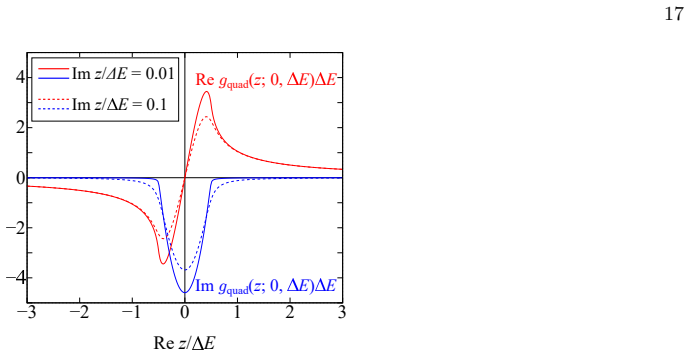
The QAVG (QPE averaged over variable grids) procedure that estimates the Green's function from QPE sampling data without channel information through optimization and probability distribution modeling.
If this is right
- The scheme enables reconstruction of Green's functions for DMFT calculations on quantum computers at finite temperature.
- Application to SrVO3 demonstrates that the method can reconstruct the Green's function via numerical simulations.
- The channel-agnostic nature allows extraction of spectral information even when the excitation channel is unknown.
- Classical post-processing with variable grids helps in faithful reconstruction despite missing channel data.
Where Pith is reading between the lines
- If the method scales, it could allow simulation of larger correlated systems beyond current classical capabilities.
- Similar channel-agnostic approaches might apply to other quantum algorithms involving phase estimation.
- The optimization of trial parameters could be extended to include more sophisticated models for better accuracy.
Load-bearing premise
The data collected from the modified QPE circuits without channel information contain sufficient information for the classical QAVG procedure to reconstruct a faithful Green's function through optimization of trial parameters and modeling of probability distributions.
What would settle it
Numerical simulation results for SrVO3 where the reconstructed Green's function significantly deviates from the expected one would indicate the claim is false.
Figures
read the original abstract
For treating correlated electronic systems on quantum computers, we propose a quantum-classical hybrid scheme for dynamical mean-field theory (DMFT). In the quantum part of the scheme, we use modified quantum phase estimation (QPE) circuits suitable for the one-particle Green's function (GF) at a finite temperature so that we can extract spectral amplitudes and the excitation energies without knowing the excitation channel invoked at each measurement. In the classical part of the scheme, we adopt an approach that estimates reasonably the GF based on the data collected from the QPE sampling. We dub the approach the QPE averaged over variable grids (QAVG), that may help one to reconstruct the GF via optimization of trial parameters and modeling the probability distributions for various settings of the QPE circuits. We apply the QAVG-DMFT scheme to SrVO$_3$ to demonstrate its validity via numerical simulations.
Editorial analysis
A structured set of objections, weighed in public.
Referee Report
Summary. The manuscript proposes QAVG-DMFT, a quantum-classical hybrid scheme for dynamical mean-field theory. Modified quantum phase estimation circuits extract finite-temperature one-particle Green's function spectral amplitudes and excitation energies in a channel-agnostic manner. The classical QAVG procedure then reconstructs the Green's function by averaging over variable grids, optimizing trial parameters, and modeling probability distributions. Validity is demonstrated through numerical simulations on SrVO3.
Significance. If the reconstruction from channel-agnostic data is shown to be faithful and unique, the approach would offer a practical route to Green's function calculations on quantum hardware for DMFT, addressing a key bottleneck in simulating correlated materials. The numerical test on SrVO3 supplies concrete evidence of implementability, and the channel-agnostic QPE modification is a clear technical contribution.
major comments (2)
- [QAVG reconstruction section] QAVG reconstruction section: the claim that optimization of trial parameters on channel-agnostic (energy, amplitude) pairs recovers a faithful Green's function is load-bearing for the central result. Because each measured pair can arise from multiple channels, the manuscript must demonstrate that the probability-distribution modeling and optimization procedure yields a unique solution rather than an effective but incorrect GF; no such uniqueness argument or ablation against a channel-labeled baseline is supplied.
- [Numerical demonstration on SrVO3 (results section)] Numerical demonstration on SrVO3 (results section): the validity claim rests on the simulations, yet no quantitative error metrics, comparison to exact or known DMFT Green's functions, or convergence with grid settings are reported. This leaves open whether the reconstructed GF matches the target within controlled tolerances.
minor comments (2)
- Notation for the modified QPE circuit and the probability distributions in QAVG should be defined more explicitly with equations to aid reproducibility.
- The abstract states that simulations 'demonstrate validity' but supplies no error analysis; the main text should include a dedicated paragraph on validation metrics.
Simulated Author's Rebuttal
We thank the referee for the constructive report and positive assessment of the work's significance. We address each major comment below and will revise the manuscript accordingly to strengthen the presentation.
read point-by-point responses
-
Referee: [QAVG reconstruction section] QAVG reconstruction section: the claim that optimization of trial parameters on channel-agnostic (energy, amplitude) pairs recovers a faithful Green's function is load-bearing for the central result. Because each measured pair can arise from multiple channels, the manuscript must demonstrate that the probability-distribution modeling and optimization procedure yields a unique solution rather than an effective but incorrect GF; no such uniqueness argument or ablation against a channel-labeled baseline is supplied.
Authors: We agree that a demonstration of uniqueness is important for the central claim. The manuscript shows faithful recovery via numerical simulation on SrVO3, where the optimization of trial parameters under the modeled probability distributions converges to the known DMFT Green's function. To address the concern directly, we will add a discussion in the QAVG section explaining how the use of multiple variable grids and QPE settings creates an overdetermined system of constraints that selects a unique solution consistent with the channel-agnostic data. We will also include an ablation comparing reconstruction accuracy against a channel-labeled baseline (implemented in simulation) to quantify any ambiguity introduced by channel-agnostic measurements. revision: yes
-
Referee: [Numerical demonstration on SrVO3 (results section)] Numerical demonstration on SrVO3 (results section): the validity claim rests on the simulations, yet no quantitative error metrics, comparison to exact or known DMFT Green's functions, or convergence with grid settings are reported. This leaves open whether the reconstructed GF matches the target within controlled tolerances.
Authors: We acknowledge that the current results section relies primarily on visual agreement between the reconstructed and target Green's functions. In the revised manuscript we will add quantitative error metrics (e.g., integrated absolute deviation and L2-norm differences), explicit comparisons to published DMFT results for SrVO3, and convergence plots showing how reconstruction error decreases with the number of grid settings and QPE circuit parameters. revision: yes
Circularity Check
No significant circularity in derivation chain
full rationale
The paper describes a hybrid scheme in which modified QPE circuits sample spectral amplitudes and energies (channel-agnostic), after which the classical QAVG procedure performs optimization of trial parameters and probability modeling to reconstruct the Green's function. This reconstruction step is an independent classical post-processing task applied to sampled data rather than a redefinition or tautological fit of the input quantities themselves. No equations or steps reduce by construction to the sampled inputs, no self-citation is invoked as a load-bearing uniqueness theorem, and the numerical demonstration on SrVO3 is presented as external validation. The derivation therefore remains self-contained against the described inputs.
Axiom & Free-Parameter Ledger
Reference graph
Works this paper leans on
-
[1]
QFT-based QPE Among various versions of QPE, we denote the stan- dard QFT-based QPE [ 10–12] simply as the QPE in the present study. The protocol of QPE for a Hermitian operator A is de- signed so that, when any one |a⟩ of the eigenstates of A is input to the QPE circuit, repeated measurements on ancillae provide an estimation of the eigenvalue a. The acc...
-
[2]
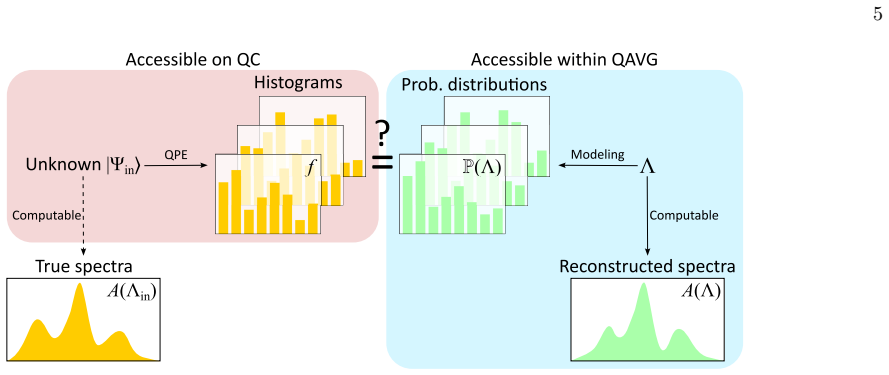
Generic QA VG The generic scheme of QA VG is illustrated in Fig. 2. Let us consider an unknown many-qubit state |Ψin⟩ for which we want to calculate a related quantity A such as the spectral function or the GF. The phrase ‘unknown’ means that we can prepare the state by obeying some definite protocol, but we do not know an expression that describes the st...
-
[3]
Those approaches assume that the energy eigenvalue of ground states is known for con- structing the histograms from the measurements
Circuit construction There already exist approaches for obtaining the one- particle GF [ 33] and the linear-response functions [ 34] of a second-quantized many-electron system at zero temper- ature via QPE sampling. Those approaches assume that the energy eigenvalue of ground states is known for con- structing the histograms from the measurements. They ar...
-
[4]
For collecting data to evaluate the cost function in terms of the diagonal component Gmm for the mth WBO, we use the diagonal excitation circuit Cm as Cexc
Excitation The explicit construction of the excitation circuit Cexc contained in CGF−QPE depends on the pair of WBOs rep- resenting the component of the GF. For collecting data to evaluate the cost function in terms of the diagonal component Gmm for the mth WBO, we use the diagonal excitation circuit Cm as Cexc. For the pair of mth and m′th WBOs (m ̸= m′)...
-
[5]
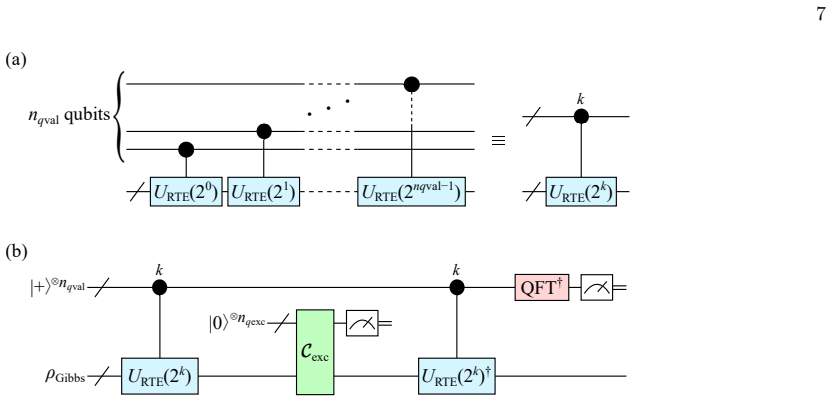
Channel-agnostic extraction of excitation energies When one of the energy eigenstates |Ψλ0 ⟩ together with the ancillary state |+⟩⊗nqval is input to CGF−QPE, the con- trolled RTE gates before Cexc give rise to the phase fac- tor indicating −Eλ0 . Cexc then prepares a superposition |Ψexc⟩ of the energy eigenstates as explained above, after which the contro...
-
[6]
Also, let {f (p,mm′) ξσj }ξ,σ,j be that for CGF−QPE with the off-diagonal excitation cir- cuit Cmm′
Cost functions Let {f (p,m) ξj }ξ,j be the histogram obtained from the repeated measurements on the ancillae for the QPE in CGF−QPE consisting of the diagonal excitation circuit Cm and the pth setting. Also, let {f (p,mm′) ξσj }ξ,σ,j be that for CGF−QPE with the off-diagonal excitation cir- cuit Cmm′ . When we finish the measurements by us- ing all the CG...
-
[7]
As described in Appendix E, the GF in natural-orbital (NO) representation can be expressed by the transition amplitudes that form orthonormalized sys- tems
Trial parameters based on natural orbitals Since the target systems for DMFT calculations in the present study are isolated and non-relativistic, the tran- sition amplitudes can be assumed to be real without loss of generality. As described in Appendix E, the GF in natural-orbital (NO) representation can be expressed by the transition amplitudes that form...
-
[8]
In other words, we need to define probability distributions for the QPE mea- surement results that would be obtained when the GF of an input state was eGrec(z; Λ) in Eqs
Modeling probability distributions for QPE In order for the trial parameters introduced just above to be located in the framework of QA VG, we need to model the probability distributions. In other words, we need to define probability distributions for the QPE mea- surement results that would be obtained when the GF of an input state was eGrec(z; Λ) in Eqs...
-
[9]
We per- formed the DFT calculations for SrVO 3 in a cubic per- ovskite structure with its lattice constant 3.841Å[55]
functional for exchange correlation energies. We per- formed the DFT calculations for SrVO 3 in a cubic per- ovskite structure with its lattice constant 3.841Å[55]. We sampled Nk = 6×6×6 k points for the self-consistent field calculations, from which we constructed the ML WOs by using Wannier90 [56]. Since the electronic structure near the Fermi level of ...
2047
-
[10]
We confirm here that this approach is suitable for the present system being consid- ered
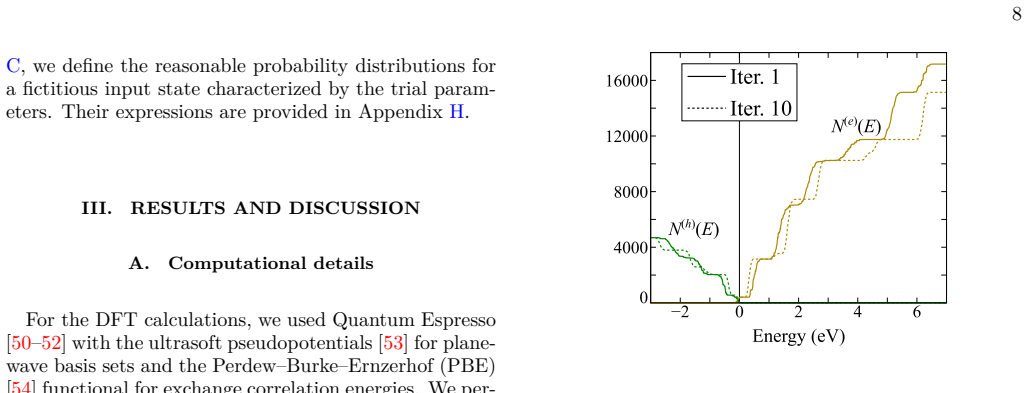
Excitation channels As described above, the QA VG approach in the present study uses fictitious physical quantities instead of the genuine physical quantities. We confirm here that this approach is suitable for the present system being consid- ered. To this end, we define the accumulated number of electron excitation channels as N (e)(E) ≡ X exp(−βEλ0 )>ε...
-
[11]
As expected in the dis- 9 cussion above, many excitation channels enter the spec- tra due to the finite temperature
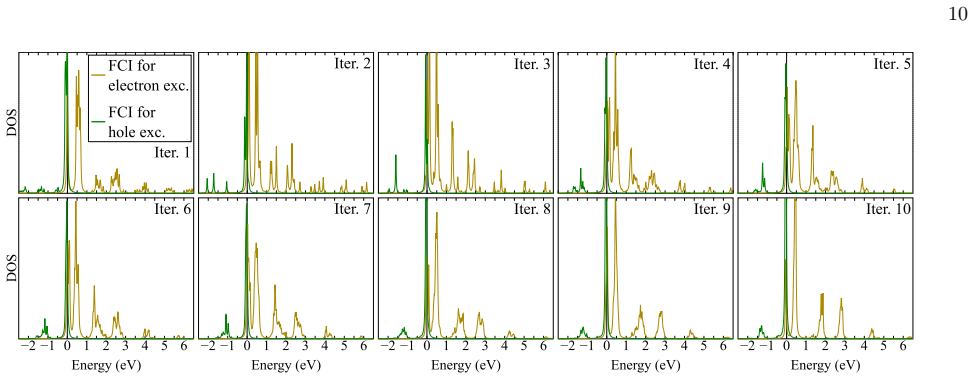
One-shot QA VG after FCI-DMFT Figure 5 shows the FCI-GF of the AIM at each itera- tion during the FCI-DMFT loop. As expected in the dis- 9 cussion above, many excitation channels enter the spec- tra due to the finite temperature. In addition, we see the clusters, each of which consists of crowded spectral peaks, at late iterations. These features in the p...
-
[12]
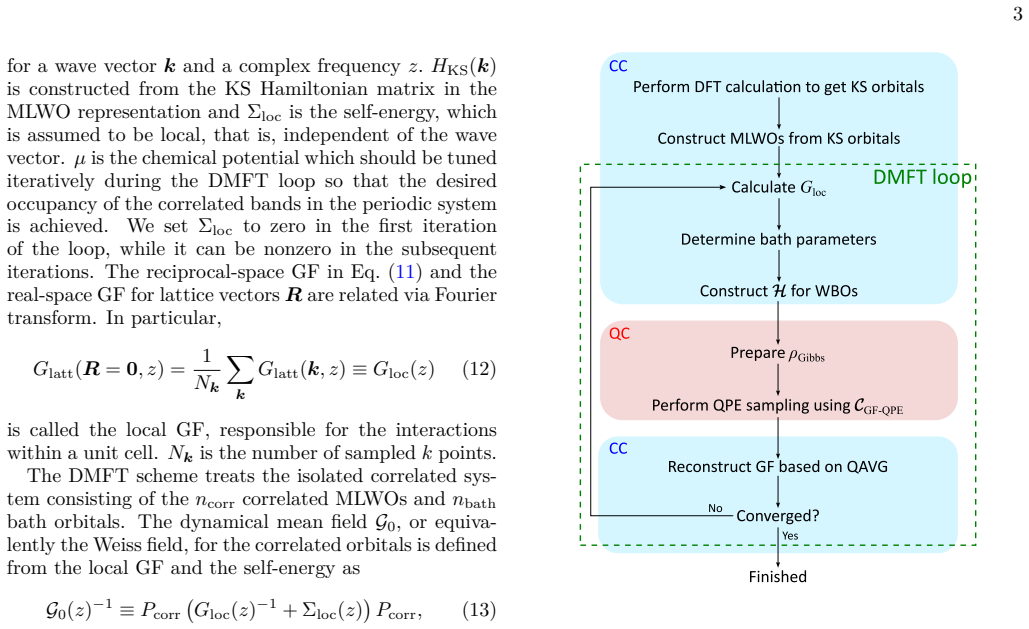
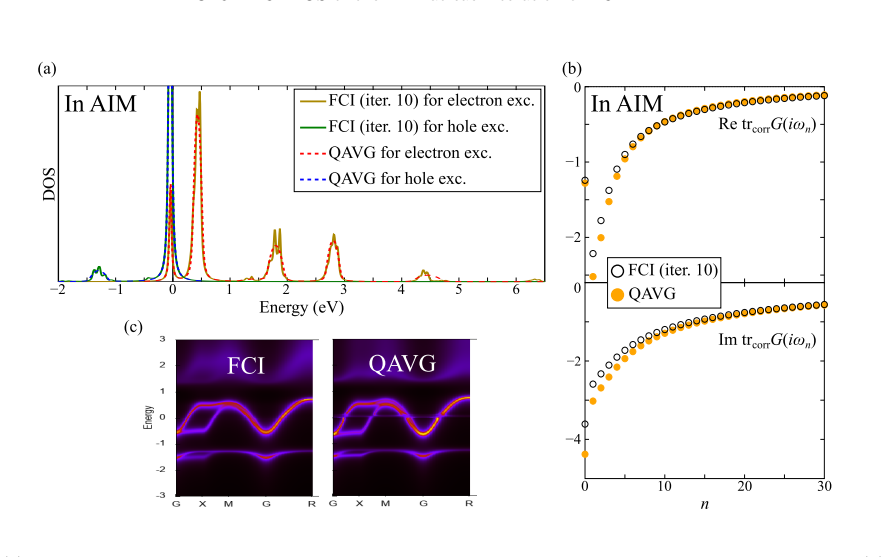
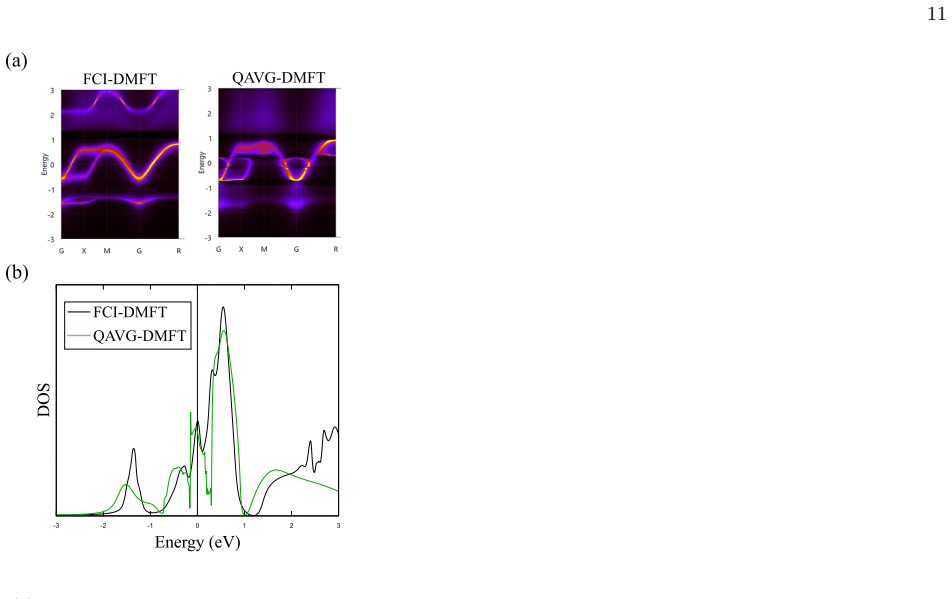
Iterative QA VG-DMFT Here we examine the iterative QA VG-DMFT, that is, the GF of the AIM is reconstructed at each iteration as illustrated in Fig. 1. In the QA VG calculations, we intro- duced at most 8 and 4 independent fictitious excitation energies for the electron and hole parts, respectively. We assumed each of the independent fictitious excitation ...
2026
-
[13]
8(a), equipped with a single ancilla (nqexc = 1)
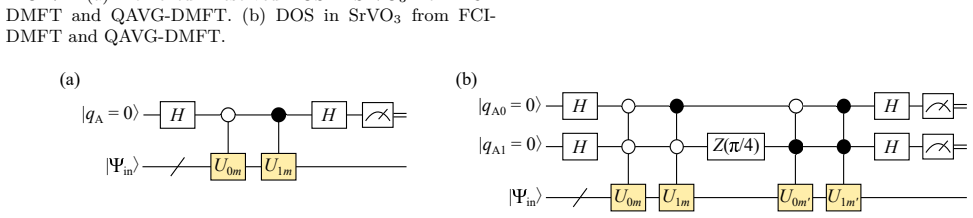
Diagonal excitation circuits The diagonal excitation circuit Cm for the mth WBO is shown in Fig. 8(a), equipped with a single ancilla (nqexc = 1). One can confirm that an arbitrary input state |Ψin⟩ undergoes the unitary gates and the state of the entire system is am|Ψin⟩|0⟩ + a† m|Ψin⟩|1⟩ (A1) immediately before the measurement. 11 FIG. 7. (a) Momentum-r...
-
[14]
(A2) The off-diagonal excitation circuit Cmm′ is shown in Fig
Off-diagonal excitation circuits For the pair of mth and m′th WBOs (m ̸= m′), we define the following four auxiliary operators [ 33]: a± mm′ ≡ am ± e−iπ/4am′ 2 , a ±† mm′ ≡ a† m ± eiπ/4a† m′ 2 . (A2) The off-diagonal excitation circuit Cmm′ is shown in Fig. 8(b), equipped with two ancillae (nqexc = 2). One can confirm that an arbitrary input state |Ψin⟩ u...
-
[15]
We want to derive the expression of the final state when ρGibbs is input to the channel- agnostic circuit CGF−QPE in Fig
Gibbs state as an input The density operator of the Gibbs state at an inverse temperature β is given by ρGibbs = e−βH/Z =P λ e−βEλ |Ψλ⟩⟨Ψλ|/Z. We want to derive the expression of the final state when ρGibbs is input to the channel- agnostic circuit CGF−QPE in Fig. 3(b). Since the Gibbs state is a classical mixture of the energy eigenstate, we can find the...
-
[16]
Diagonal excitation For the case of the diagonal circuit Cm, the probability that a hole excitation occurs on the Gibbs state is nothing but the probability that the ancilla is observed to be |0⟩ [see Eq. ( A1)]. The probability is thus P(m) h = 1 Z X λ0 e−βEλ0 ⟨Ψλ0 |a† mam|Ψλ0 ⟩ = ⟨a† mam⟩, (B1) where the brakets sandwiching the operators indicate the th...
-
[17]
Off-diagonal excitation For the case of the off-diagonal circuit Cmm′ , the probabilities P(mm′) ξσ (ξ ∈ {e, h}, σ ∈ {+, −}) of the four possible measurement outcomes |qA1⟩|qA0⟩ are calculated from Eq. ( A3) as |0⟩|0⟩ : P(mm′) h+ ≡ ⟨a+† m′ma+ m′m⟩ = γmm + γm′m′ 4 + 1 2 Re eiπ/4γmm′ , |0⟩|1⟩ : P(mm′) e+ ≡ ⟨a+ mm′ a+† mm′ ⟩ = 1 2 − γmm + γm′m′ 4 − 1 2 Re e−...
-
[18]
We already know the action of CGF−QPE on an energy eigenstate, as provided in Eq
Diagonal excitation and QPE Let us assume that the number nqval of the ancillae in the QPE circuit for binary representation of excitation energies is sufficiently large. We already know the action of CGF−QPE on an energy eigenstate, as provided in Eq. ( 19). When the Gibbs state is input to CGF−QPE involving Cm for the mth WBO, the probability that ξ exci...
-
[19]
Off-diagonal excitation and QPE When the Gibbs state is input to CGF−QPE involving Cmm′ for the pair of mth and m′th WBOs, the probability that eσ (σ = + , −) excitation occurs and an excitation energy ε in binary representation is observed is calculated, from Eq. ( 19), as P(mm′) eσ (ε) = 1 Z X λ0,λ e−βEλ0 |⟨Ψλ|aσ† mm′ |Ψλ0 ⟩|2δEλ−Eλ0 ,ε = S(e) mm(ε) + S...
-
[20]
Diagonal excitation Recalling the relation in Eq. ( B3) for the measured diagonal matrix elements and the number of shots, the numbers of observed electron and hole excitations are M (m) e = Md(1 − γmeas,mm) and M (m) h = Mdγmeas,mm, respectively, for each m. The summations of them over the WBOs are P m′ M (m′) e = Md(nsorb −trγmeas) andP m′ M (m′) h = Md...
-
[21]
( B8), P(mm′) e = P(mm′) e+ + P(mm′) e− = 1 − (γmm + γm′m′ )/2 for the pair of mth and m′th WBOs, while that for a hole exci- tation is P(mm′) h = 1 − P(mm′) e
Off-diagonal excitation For the off-diagonal excitation circuit, the probability for observing an electron excitation is, from Eq. ( B8), P(mm′) e = P(mm′) e+ + P(mm′) e− = 1 − (γmm + γm′m′ )/2 for the pair of mth and m′th WBOs, while that for a hole exci- tation is P(mm′) h = 1 − P(mm′) e . The numbers of observed electron and hole excitations are thus M...
-
[22]
( B2), are called the natural orbitals (NOs) [ 59]
Definition The one-electron states {|ψν⟩}nsorb−1 ν=0 that diagonalize the one-electron matrix element γ, defined in Eq. ( B2), are called the natural orbitals (NOs) [ 59]. The eigenvalues {nν}ν of γ, that fall between 0 and 1, are the occupancies of the corresponding NOs. Specifically, the column vector c(ν) for the νth eigenstate satisfies γc(ν) = nνc(ν)...
-
[23]
(E3) We see b(λ0→λ,e) m as the (λ0, λ)th component of a complex vector b(e) m
T ransition amplitudes We define the transition amplitudes for the mth WBO as b(λ0→λ,e) m ≡ r e−βEλ0 Z ⟨Ψλ|a† m|Ψλ0 ⟩, b(λ0→λ,h) m ≡ r e−βEλ0 Z ⟨Ψλ|am|Ψλ0 ⟩. (E3) We see b(λ0→λ,e) m as the (λ0, λ)th component of a complex vector b(e) m . We can derive the following sum rule for those electron transition vectors: b(e)∗ m · b(e) m′ = ⟨ama† m′ ⟩ = δmm′ − γm′...
-
[24]
Green’s function The partial GF in the WBO representation is given by Eq. ( 2). We can obtain that in the NO representation. Specifically, the electron part in the NO representation is eG(e) νν ′ (z) = √ 1 − nν √ 1 − nν′ X λ0,λ eb(λ0→λ,e)∗ ν eb(λ0→λ,e) ν′ z − (Eλ − Eλ0 ) , (E8) while the hole part is eG(h) νν ′ (z) = √nν √nν′ X λ0,λ eb(λ0→λ,h)∗ ν′ eb(λ0→λ...
-
[25]
( E11), we can get the reconstructed GF Grec(z; Λe) in the WBO representation from Eqs
Reconstructed GF in WBO representation By employing the relation between the true GFs in the WBO and NO representations in Eq. ( E11), we can get the reconstructed GF Grec(z; Λe) in the WBO representation from Eqs. ( 28) and ( 29) as G(e) rec(z; Λe) = nch−1X ℓ=0 Z ∞ −∞ dEρeℓ(E − εeℓ) W (e) ℓ z − E , G(h) rec (z; Λh) = nch−1X ℓ=0 Z ∞ −∞ dEρhℓ(E − εhℓ) W (h...
-
[26]
( C1), while the reconstructed spectral matrix is given by Eq
Diagonal excitation and QPE The true probability distribution for the diagonal excitation circuit Cm and the spectral matrix are related via Eq. ( C1), while the reconstructed spectral matrix is given by Eq. ( H3). It is thus reasonable to model the probability distribution for ξ excitations and subsequent QPE measurements for a fictitious input state as ...
-
[27]
( C2) and ( C3)
Off-diagonal excitation and QPE The ture probability distribution for the off-diagonal excitation circuit Cmm′ and the spectral matrix are related via Eqs. ( C2) and ( C3). We therefore model the probability distribution for ξσ excitations and subsequent QPE measurements for a fictitious input state as P(p,mm′) ξσj (Λξ) ≡ Z ∞ −∞ dE S(ξ) rec,mm(E) + S(ξ) r...
-
[28]
Kotliar, S
G. Kotliar, S. Y. Savrasov, K. Haule, V. S. Oudovenko, O. Parcollet, and C. A. Marianetti, Electronic struc- ture calculations with dynamical mean-field theory, Rev. Mod. Phys. 78, 865 (2006)
2006
-
[29]
Backes, Y
S. Backes, Y. Murakami, S. Sakai, and R. Arita, Dynam- ical mean-field theory for the hubbard-holstein model on a quantum device, Phys. Rev. B 107, 165155 (2023)
2023
- [30]
- [31]
-
[32]
Selisko, M
J. Selisko, M. Amsler, C. Wever, Y. Kawashima, G. Sam- sonidze, R. Ul Haq, F. Tacchino, I. Tavernelli, and T. Eckl, Dynamical mean field theory for real materials on a quantum computer, npj Computational Materials 11, 325 (2025)
2025
-
[33]
P. J. Ollitrault, A. Kandala, C.-F. Chen, P. K. Barkout- sos, A. Mezzacapo, M. Pistoia, S. Sheldon, S. Woerner, J. M. Gambetta, and I. Tavernelli, Quantum equation of motion for computing molecular excitation energies on a noisy quantum processor, Phys. Rev. Res. 2, 043140 (2020)
2020
-
[34]
Rizzo, F
J. Rizzo, F. Libbi, F. Tacchino, P. J. Ollitrault, N. Marzari, and I. Tavernelli, One-particle green’s func- tions from the quantum equation of motion algorithm, Phys. Rev. Res. 4, 043011 (2022)
2022
-
[35]
Greene-Diniz, D
G. Greene-Diniz, D. Z. Manrique, K. Yamamoto, E. Plekhanov, N. Fitzpatrick, M. Krompiec, R. Sakuma, and D. M. Ramo, Quantum Computed Green’s Functions using a Cumulant Expansion of the Lanczos Method, Quantum 8, 1383 (2024)
2024
-
[36]
H. J. Vallury, M. A. Jones, C. D. Hill, and L. C. L. Hollenberg, Quantum computed moments correction to variational estimates, Quantum 4, 373 (2020)
2020
-
[37]
D. S. Abrams and S. Lloyd, Simulation of many-body fermi systems on a universal quantum computer, Phys. Rev. Lett. 79, 2586 (1997)
1997
-
[38]
D. S. Abrams and S. Lloyd, Quantum algorithm provid- ing exponential speed increase for finding eigenvalues and eigenvectors, Phys. Rev. Lett. 83, 5162 (1999)
1999
-
[39]
M. A. Nielsen and I. L. Chuang, Quantum Computation and Quantum Information: 10th Anniversary Edition , 10th ed. (Cambridge University Press, New York, NY, USA, 2011)
2011
-
[40]
Bluvstein, S
D. Bluvstein, S. J. Evered, A. A. Geim, S. H. Li, H. Zhou, T. Manovitz, S. Ebadi, M. Cain, M. Kali- nowski, D. Hangleiter, J. P. Bonilla Ataides, N. Maskara, I. Cong, X. Gao, P. Sales Rodriguez, T. Karolyshyn, G. Semeghini, M. J. Gullans, M. Greiner, V. Vuletić, and M. D. Lukin, Logical quantum processor based on reconfigurable atom arrays, Nature 626, 58 (2024)
2024
-
[41]
Acharya, D
R. Acharya, D. A. Abanin, L. Aghababaie-Beni, I. Aleiner, T. I. Andersen, M. Ansmann, F. Arute, K. Arya, A. Asfaw, N. Astrakhantsev, J. Atalaya, R. Babbush, D. Bacon, B. Ballard, J. C. Bardin, J. Bausch, A. Bengtsson, A. Bilmes, S. Blackwell, S. Boixo, G. Bortoli, A. Bourassa, J. Bovaird, L. Brill, M. Broughton, D. A. Browne, B. Buchea, B. B. Buck- ley, D...
2025
-
[42]
Helios: A 98-qubit trapped-ion quantum computer
A. Ransford, M. S. Allman, J. Arkinstall, J. P. Campora, III, S. F. Cooper, R. D. Delaney, J. M. Dreiling, B. Estey, C. Figgatt, A. Hall, A. A. Husain, A. Isanaka, C. J. Kennedy, N. Kotibhaskar, I. S. Madjarov, K. Mayer, A. R. Milne, A. J. Park, A. P. Reed, R. Ancona, M. P. Andersen, P. Andres-Martinez, W. Angenent, L. Ar- gueta, B. Arkin, L. Ascarrunz, W...
work page internal anchor Pith review Pith/arXiv arXiv 2025
-
[43]
Nishi, Y
H. Nishi, Y. Takei, T. Kosugi, S. Mieda, Y. Natsume, T. Aoyagi, and Y.-i. Matsushita, Encoded probabilis- tic imaginary-time evolution on a trapped-ion quantum computer for ground and excited states of spin qubits, Phys. Rev. Appl. 23, 034016 (2025)
2025
-
[44]
Nishi, T
H. Nishi, T. Kosugi, S. Hirose, T. Okayama, and Y.-i. Matsushita, Logical quantum phase estimation for x-ray absorption spectra, Phys. Rev. Appl. 25, 034026 (2026)
2026
-
[45]
Sales Rodriguez, J
P. Sales Rodriguez, J. M. Robinson, P. N. Jepsen, Z. He, C. Duckering, C. Zhao, K.-H. Wu, J. Campo, K. Bagnall, M. Kwon, T. Karolyshyn, P. Weinberg, M. Cain, S. J. Evered, A. A. Geim, M. Kalinowski, S. H. Li, T. Manovitz, J. Amato-Grill, J. I. Basham, L. Bernstein, B. Braverman, A. Bylinskii, A. Choukri, R. J. DeAngelo, F. Fang, C. Fieweger, P. Frederick,...
2025
- [46]
-
[47]
Kosugi, H
T. Kosugi, H. Nishi, K. Kasebayashi, H. Takahashi, and Y.-i. Matsushita, Error-corrected phase estimation aver- aged over variable grids on a trapped-ion quantum computer: hyperacuity spectra of a CO molecule adsorbed onto χ- Fe5C2 (2026), to be published
2026
-
[48]
Capone, L
M. Capone, L. de’ Medici, and A. Georges, Solving the dynamical mean-field theory at very low temperatures 22 using the lanczos exact diagonalization, Phys. Rev. B 76, 245116 (2007)
2007
-
[49]
Stefanucci and R
G. Stefanucci and R. van Leeuwen, Nonequilibrium Many-Body Theory of Quantum Systems (Cambridge University Press, 2013)
2013
-
[50]
Damascelli, Probing the electronic structure of com- plex systems by arpes, Physica Scripta 2004, 61 (2004)
A. Damascelli, Probing the electronic structure of com- plex systems by arpes, Physica Scripta 2004, 61 (2004)
2004
-
[51]
Moser, An experimentalist’s guide to the matrix ele- ment in angle resolved photoemission, Journal of Elec- tron Spectroscopy and Related Phenomena 214, 29 (2017)
S. Moser, An experimentalist’s guide to the matrix ele- ment in angle resolved photoemission, Journal of Elec- tron Spectroscopy and Related Phenomena 214, 29 (2017)
2017
-
[52]
T. Kosugi, H. Nishi, Y. Kato, and Y.-i. Matsushita, Periodicity-free unfolding method of electronic energy spectra, Journal of the Physical Society of Japan 86, 124717 (2017) , https://doi.org/10.7566/JPSJ.86.124717
-
[53]
Y. Furukawa, T. Kosugi, H. Nishi, and Y.-i. Matsushita, Band structures in coupled-cluster singles-and-doubles green’s function (gfccsd), The Journal of Chemical Physics 148, 204109 (2018) , https://doi.org/10.1063/1.5029537
-
[54]
T. Kosugi, H. Nishi, Y. Furukawa, and Y.-i. Mat- sushita, Comparison of green’s functions for transi- tion metal atoms using self-energy functional the- ory and coupled-cluster singles and doubles (ccsd), The Journal of Chemical Physics 148, 224103 (2018) , https://doi.org/10.1063/1.5029535
-
[55]
H. Nishi, T. Kosugi, Y. Furukawa, and Y.-i. Mat- sushita, Quasiparticle energy spectra of isolated atoms from coupled-cluster singles and doubles (ccsd): Comparison with exact ci calculations, The Journal of Chemical Physics 149, 034106 (2018) , https://doi.org/10.1063/1.5029536
-
[56]
Kosugi and Y.-I
T. Kosugi and Y.-I. Matsushita, One-particle green’s function of interacting two electrons using analytic so- lutions for a three-body problem: comparison with exact kohn?sham system, Journal of Physics: Condensed Mat- ter 30, 435604 (2018)
2018
-
[57]
Marzari, A
N. Marzari, A. A. Mostofi, J. R. Yates, I. Souza, and D. Vanderbilt, Maximally localized wannier functions: Theory and applications, Rev. Mod. Phys. 84, 1419 (2012)
2012
-
[58]
Nomura, M
Y. Nomura, M. Kaltak, K. Nakamura, C. Taranto, S. Sakai, A. Toschi, R. Arita, K. Held, G. Kresse, and M. Imada, Effective on-site interaction for dynamical mean-field theory, Phys. Rev. B 86, 085117 (2012)
2012
-
[59]
Shinaoka, J
H. Shinaoka, J. Otsuki, M. Kawamura, N. Takemori, and K. Yoshimi, DCore: Integrated DMFT software for cor- related electrons, SciPost Phys. 10, 117 (2021)
2021
-
[60]
Kosugi and Y.-i
T. Kosugi and Y.-i. Matsushita, Construction of green’s functions on a quantum computer: Quasiparticle spectra of molecules, Phys. Rev. A 101, 012330 (2020)
2020
-
[61]
Kosugi and Y.-i
T. Kosugi and Y.-i. Matsushita, Linear-response func- tions of molecules on a quantum computer: Charge and spin responses and optical absorption, Phys. Rev. Re- search 2, 033043 (2020)
2020
-
[62]
A. N. Chowdhury and R. D. Somma, Quantum algo- rithms for gibbs sampling and hitting-time estimation, Quantum Info. Comput. 17, 41–64 (2017)
2017
-
[63]
Motta, C
M. Motta, C. Sun, A. T. K. Tan, M. J. O’Rourke, E. Ye, A. J. Minnich, F. G. S. L. Brandão, and G. K.-L. Chan, Determining eigenstates and thermal states on a quan- tum computer using quantum imaginary time evolution, Nature Physics 16, 205 (2020)
2020
-
[64]
J. Cohn, F. Yang, K. Najafi, B. Jones, and J. K. Freericks, Minimal effective gibbs ansatz: A simple protocol for ex- tracting an accurate thermal representation for quantum simulation, Phys. Rev. A 102, 022622 (2020)
2020
-
[65]
S. Lu, M. C. Bañuls, and J. I. Cirac, Algorithms for quantum simulation at finite energies, PRX Quantum 2, 020321 (2021)
2021
-
[66]
Kosugi, Y
T. Kosugi, Y. Nishiya, H. Nishi, and Y.-i. Matsushita, Imaginary-time evolution using forward and backward real-time evolution with a single ancilla: First-quantized eigensolver algorithm for quantum chemistry, Phys. Rev. Research 4, 033121 (2022)
2022
-
[67]
Coopmans, Y
L. Coopmans, Y. Kikuchi, and M. Benedetti, Predicting gibbs-state expectation values with pure thermal shad- ows, PRX Quantum 4, 010305 (2023)
2023
-
[68]
P. Rall, C. Wang, and P. Wocjan, Thermal State Prepa- ration via Rounding Promises, Quantum 7, 1132 (2023)
2023
-
[69]
Brunner, L
E. Brunner, L. Coopmans, G. Matos, M. Rosenkranz, F. Sauvage, and Y. Kikuchi, Lindblad engineering for quantum Gibbs state preparation under the eigenstate thermalization hypothesis, Quantum 9, 1843 (2025)
2025
-
[70]
Adiabatic preparation of thermal states and entropy-noise relation on noisy quantum computers
E. Granet and H. Dreyer, Adiabatic preparation of ther- mal states and entropy-noise relation on noisy quan- tum computers, arXiv e-prints , arXiv:2509.05206 (2025) , arXiv:2509.05206 [quant-ph]
work page internal anchor Pith review Pith/arXiv arXiv 2025
-
[71]
A. E. Russo, K. M. Rudinger, B. C. A. Morrison, and A. D. Baczewski, Evaluating energy differences on a quantum computer with robust phase estimation, Phys. Rev. Lett. 126, 210501 (2021)
2021
-
[72]
Sugisaki, K
K. Sugisaki, K. Toyota, K. Sato, D. Shiomi, and T. Takui, Quantum algorithm for the direct calculations of vertical ionization energies, The Journal of Physical Chemistry Letters 12, 2880 (2021)
2021
-
[73]
Sugisaki, K
K. Sugisaki, K. Toyota, K. Sato, D. Shiomi, and T. Takui, A quantum algorithm for spin chemistry: a bayesian exchange coupling parameter calculator with broken- symmetry wave functions, Chem. Sci. 12, 2121 (2021)
2021
-
[74]
Sugisaki, C
K. Sugisaki, C. Sakai, K. Toyota, K. Sato, D. Shiomi, and T. Takui, Bayesian phase difference estimation: a general quantum algorithm for the direct calculation of energy gaps, Phys. Chem. Chem. Phys. 23, 20152 (2021)
2021
-
[75]
W.-R. Lee, R. Scott, and V. W. Scarola, Hybrid quantum-gap-estimation algorithm using a filtered time series, Phys. Rev. A 109, 052403 (2024)
2024
-
[76]
Sakurai, W
R. Sakurai, W. Mizukami, and H. Shinaoka, Hybrid quantum-classical algorithm for computing imaginary- time correlation functions, Phys. Rev. Res. 4, 023219 (2022)
2022
-
[77]
Giannozzi, O
P. Giannozzi, O. Andreussi, T. Brumme, O. Bunau, M. B. Nardelli, M. Calandra, R. Car, C. Cavazzoni, D. Ceresoli, M. Cococcioni, N. Colonna, I. Carnimeo, A. D. Corso, S. de Gironcoli, P. Delugas, R. A. D. Jr, A. Ferretti, A. Floris, G. Fratesi, G. Fugallo, R. Gebauer, U. Gerstmann, F. Giustino, T. Gorni, J. Jia, M. Kawa- mura, H.-Y. Ko, A. Kokalj, E. Küçük...
2017
-
[78]
Giannozzi, S
P. Giannozzi, S. Baroni, N. Bonini, M. Calandra, R. Car, C. Cavazzoni, D. Ceresoli, G. L. Chiarotti, M. Cococ- cioni, I. Dabo, A. Dal Corso, S. de Gironcoli, S. Fabris, 23 G. Fratesi, R. Gebauer, U. Gerstmann, C. Gougoussis, A. Kokalj, M. Lazzeri, L. Martin-Samos, N. Marzari, F. Mauri, R. Mazzarello, S. Paolini, A. Pasquarello, L. Paulatto, C. Sbraccia, S...
2009
-
[79]
P. Giannozzi, O. Baseggio, P. Bonfà, D. Brunato, R. Car, I. Carnimeo, C. Cavazzoni, S. de Gironcoli, P. Delugas, F. Ferrari Ruffino, A. Ferretti, N. Marzari, I. Timrov, A. Urru, and S. Baroni, Quantum espresso toward the exascale, The Journal of Chemical Physics 152, 154105 (2020), https://doi.org/10.1063/5.0005082
-
[80]
Vanderbilt, Soft self-consistent pseudopotentials in a generalized eigenvalue formalism, Phys
D. Vanderbilt, Soft self-consistent pseudopotentials in a generalized eigenvalue formalism, Phys. Rev. B 41, 7892 (1990)
1990
discussion (0)
Sign in with ORCID, Apple, or X to comment. Anyone can read and Pith papers without signing in.