Transition metal (group V) doping induced spin and valley polarization in MoS₂ monolayer
Pith reviewed 2026-06-29 06:31 UTC · model grok-4.3
The pith
V doping induces half-metallicity, 121 meV valley polarization, and enhanced piezoelectricity in MoS2 monolayer.
A machine-rendered reading of the paper's core claim, the machinery that carries it, and where it could break.
Core claim
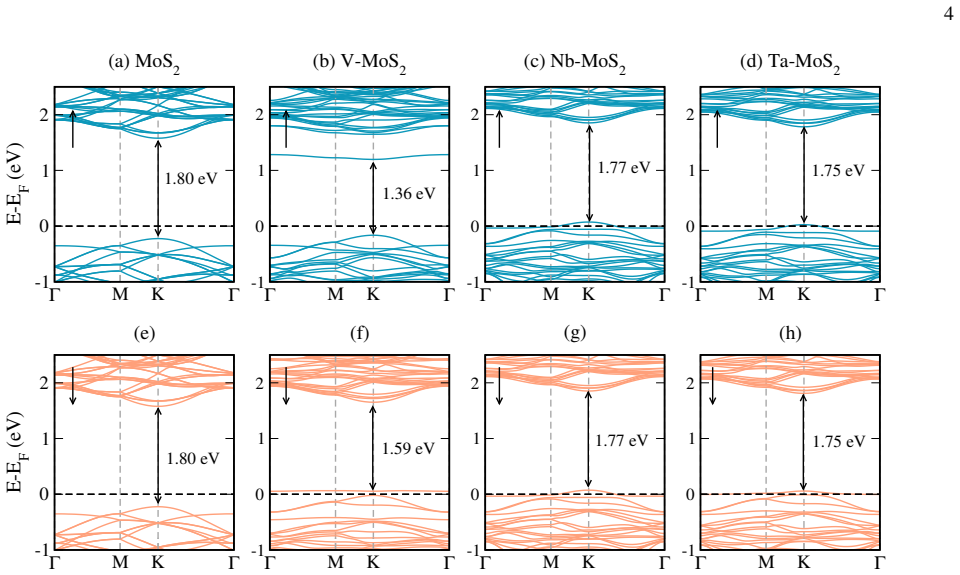
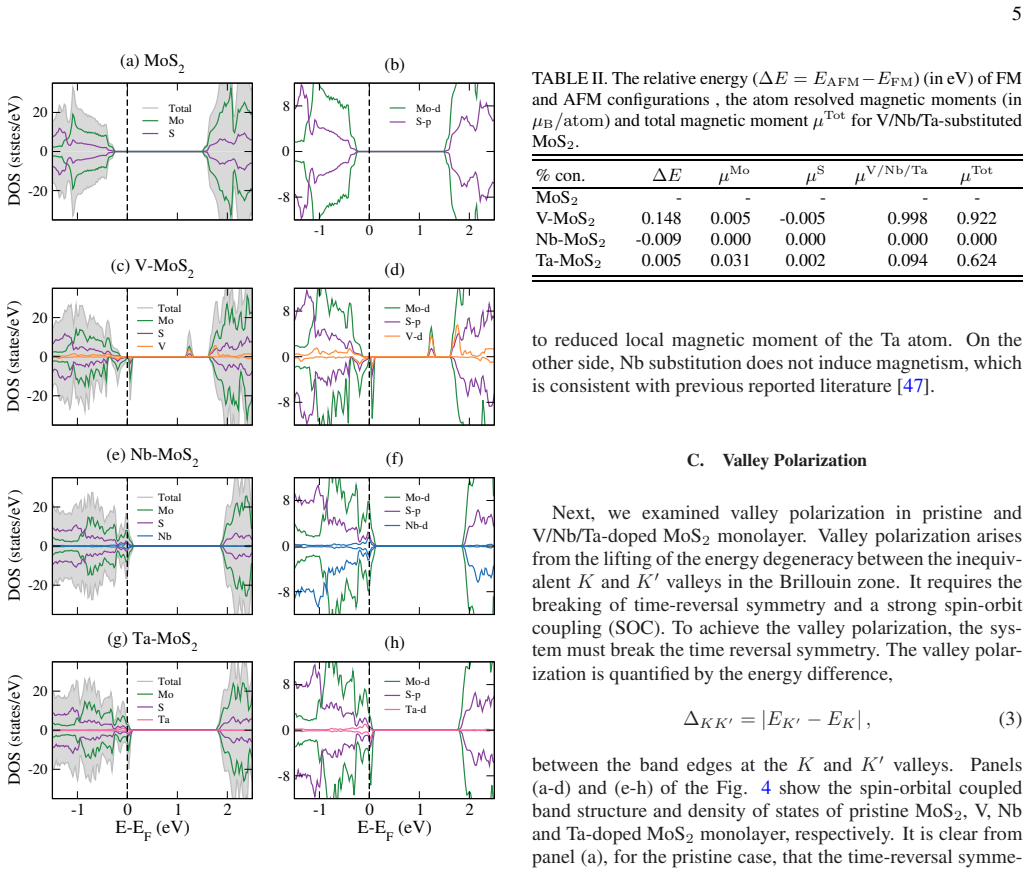
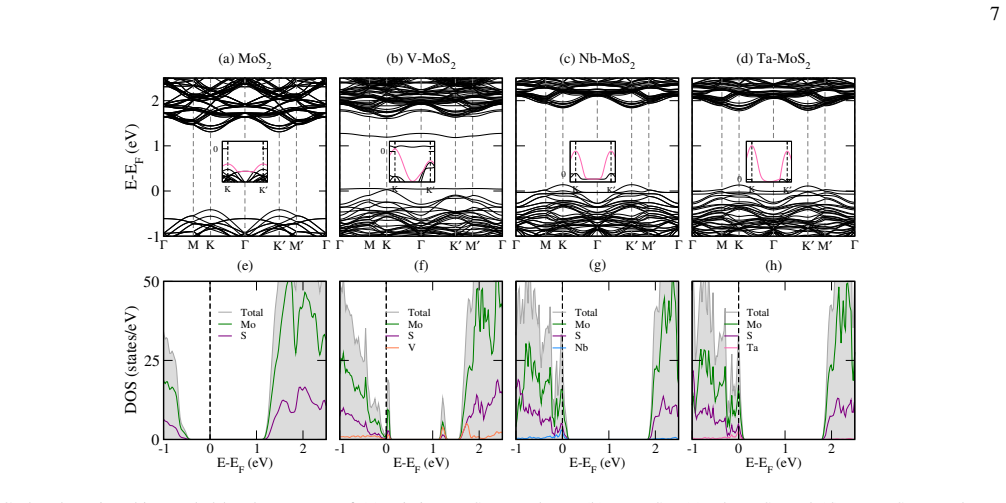
The central claim is that substitutional V doping in MoS2 creates half-metallicity with an induced magnetic moment of 0.922 μB and a valley polarization of 121 meV, while Ta doping produces a moment of 0.624 μB and 21 meV valley polarization; both cases also exhibit increased piezoelectric response, all arising from strong SOC, broken inversion symmetry, and structural asymmetry.
What carries the argument
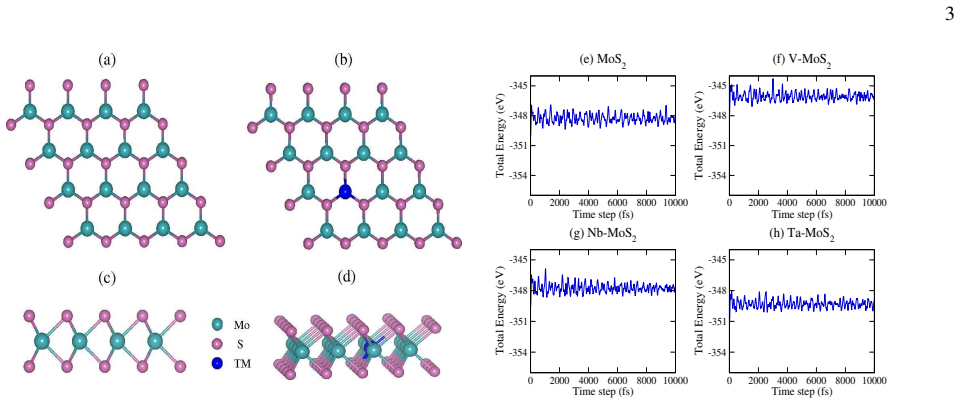
Substitutional group-V transition-metal doping, especially vanadium, which supplies localized magnetic moments and breaks inversion symmetry to generate valley splitting under SOC.
If this is right
- V-doped MoS2 can function as a single material supporting both spin-polarized transport and valley-selective optics.
- The 121 meV valley splitting sets an energy scale for valleytronic devices operable at room temperature.
- Enhanced piezoelectric coefficients allow mechanical control of the spin and valley degrees of freedom in the same monolayer.
- Nb and Ta doping produce metallic conduction that could be combined with the magnetic or piezoelectric responses for hybrid devices.
- The coupled spin-valley-mechanical response supplies a route to engineer multifunctional 2D platforms.
Where Pith is reading between the lines
- Experimental growth and transport measurements on V-doped MoS2 would test whether the predicted half-metallicity survives at realistic defect densities.
- The same doping strategy might be applied to other transition-metal dichalcogenides to generate comparable valley splittings.
- Varying the dopant concentration could tune the valley polarization continuously, offering a control knob not explored in the present fixed-concentration calculations.
- Stacking the doped monolayer with other 2D layers could further modulate the piezoelectric and spin-valley coupling.
Load-bearing premise
First-principles calculations with spin-orbit coupling correctly predict the half-metallic gap and the size of the valley polarization without large errors from functional choice, supercell size, or dopant concentration.
What would settle it
Direct experimental detection of zero valley splitting or absence of half-metallicity in a V-doped MoS2 sample would falsify the central claim.
Figures
read the original abstract
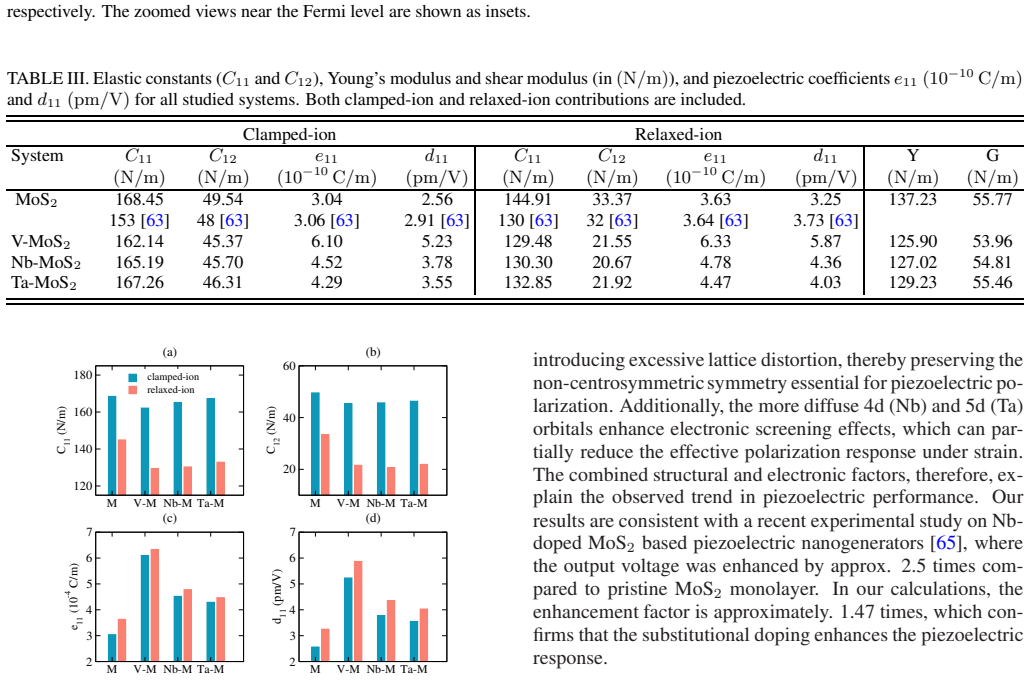
Doping in two-dimensional materials has emerged as an effective tool for modulating their electronic properties and thereby enabling their multifunctional applications. In this work, we present a first-principles study on induced effective magnetic moment and metallicity in MoS$_2$ monolayer by substitutional doping of group-5 transition metal (TM) elements -- V, Nb and Ta. From our study, we observe that the V doping induces half-metallicity, whereas metallic characteristics are observed in the case of Nb and Ta doping. Moreover, V and Ta-doped MoS$_2$ monolayers are observed to show total induced magnetic moments of 0.922 and 0.624 $\mu_{\rm B}$, respectively. Importantly, the combined effects of strong spin-orbit coupling (SOC), broken inversion symmetry, and structural asymmetry is observed to lead to a permanent valley polarization in the V- and Ta-MoS$_2$ systems. In particular, we observed a valley polarization of 121 and 21 meVs for V and Ta-doped MoS$_2$, respectively. Furthermore, an enhanced piezoelectric coefficient for the doped systems is observed compared to pristine MoS$_2$. Notably, the simultaneous presence of half-metallicity, substantial valley polarization, and enhanced piezoelectricity in V-doped MoS$_2$ establishes this system as a promising multifunctional platform for next-generation spintronic, valleytronic, and piezoelectric nanodevices. Overall, our findings provide fundamental insights into engineering coupled spin-valley-mechanical degrees of freedom in two-dimensional materials for advanced quantum and nanoelectronic applications.
Editorial analysis
A structured set of objections, weighed in public.
Referee Report
Summary. The manuscript reports first-principles DFT calculations on substitutional doping of MoS2 monolayer with group-V transition metals (V, Nb, Ta). It claims that V doping produces half-metallicity together with an induced moment of 0.922 μB and a valley polarization of 121 meV, while Nb and Ta doping produce metallic behavior (moment 0.624 μB for Ta); all three dopants enhance the piezoelectric coefficient relative to pristine MoS2. The central conclusion is that V-doped MoS2 constitutes a multifunctional platform combining spin, valley, and piezoelectric degrees of freedom.
Significance. If the reported half-metallicity, valley splittings, and piezoelectric enhancements prove robust, the work supplies concrete numerical targets (121 meV valley polarization, 0.922 μB moment) that could guide experimental searches for coupled spin-valley-mechanical functionality in doped TMD monolayers. The study is computational and does not include machine-checked proofs or parameter-free derivations, but the explicit numerical predictions constitute falsifiable outputs.
major comments (2)
- [Computational Methods] Computational Methods section: The exchange-correlation functional is not identified and no hybrid-functional (e.g., HSE06) benchmarks are presented. Because half-metallicity and the 121 meV valley splitting are known to be sensitive to the choice of XC functional in TMDs, the quantitative claims that underwrite the multifunctional-platform conclusion rest on an unverified assumption.
- [Results] Results section on doped monolayers: The supercell size (and therefore the dopant concentration) is not stated, nor is any convergence test with respect to supercell size reported. The reported magnetic moments (0.922 μB for V, 0.624 μB for Ta) and valley polarizations (121 meV for V, 21 meV for Ta) can be altered by spurious dopant-dopant interactions in small cells; this directly affects the load-bearing numerical values.
minor comments (1)
- [Abstract] Abstract: the unit is written 'meVs'; it should read 'meV'.
Simulated Author's Rebuttal
We thank the referee for the constructive comments on our manuscript. We address each major point below and will revise the manuscript to improve the clarity and completeness of the computational details.
read point-by-point responses
-
Referee: [Computational Methods] Computational Methods section: The exchange-correlation functional is not identified and no hybrid-functional (e.g., HSE06) benchmarks are presented. Because half-metallicity and the 121 meV valley splitting are known to be sensitive to the choice of XC functional in TMDs, the quantitative claims that underwrite the multifunctional-platform conclusion rest on an unverified assumption.
Authors: We agree that the exchange-correlation functional must be explicitly identified. We will revise the Computational Methods section to state the functional used in our DFT calculations. We will also add a short discussion acknowledging the known sensitivity of half-metallicity and valley splittings to the choice of XC functional in TMDs, while noting that all comparisons in the study were performed consistently with the same functional. Hybrid-functional benchmarks were not performed in the original work; we will mention this as a limitation and a possible direction for future validation. revision: yes
-
Referee: [Results] Results section on doped monolayers: The supercell size (and therefore the dopant concentration) is not stated, nor is any convergence test with respect to supercell size reported. The reported magnetic moments (0.922 μB for V, 0.624 μB for Ta) and valley polarizations (121 meV for V, 21 meV for Ta) can be altered by spurious dopant-dopant interactions in small cells; this directly affects the load-bearing numerical values.
Authors: We agree that the supercell size and dopant concentration should be stated explicitly for reproducibility. We will revise the Results section to report the supercell dimensions and corresponding doping concentration used in the calculations. We will also include a brief discussion of possible finite-size effects arising from dopant-dopant interactions and note that the quoted magnetic moments and valley polarizations correspond to the supercell employed. No explicit convergence tests with respect to supercell size were reported in the original manuscript; we will acknowledge this and, if additional data become available, include them in the revision. revision: yes
Circularity Check
No circularity: direct DFT outputs with no fitted predictions or self-referential steps
full rationale
The paper reports first-principles DFT results for magnetic moments, half-metallicity, valley polarizations (121 meV, 21 meV), and piezoelectric coefficients in doped MoS2. These are presented as direct computational outputs without any equations that reduce a claimed prediction to a fitted input by construction, without self-citation load-bearing on central claims, and without ansatz smuggling or renaming of known results. The derivation chain consists entirely of standard DFT methodology applied to the doped supercells; no load-bearing step collapses to the paper's own inputs.
Axiom & Free-Parameter Ledger
free parameters (1)
- doping concentration
axioms (1)
- domain assumption Density functional theory with spin-orbit coupling accurately predicts electronic structure, magnetism, and valley splitting in doped MoS2
Reference graph
Works this paper leans on
-
[1]
Our computed spin-polarized electronic stru c- ture also validates it
From panels (a) and (b), it is clear that for pristine MoS 2, spin-up and spin-down states are ob- served to be symmetric, which indicates an intrinsic nonmag - netic nature. Our computed spin-polarized electronic stru c- ture also validates it. Here we observed that, the valence- a nd conduction-band edges are dominated by 4d orbitals of Mo and 3p orbita...
-
[2]
To calculate the relaxed-ion coefficients, the atomic positions are fully relaxed at each strain value
002. To calculate the relaxed-ion coefficients, the atomic positions are fully relaxed at each strain value. In contras t, when the calculation is performed at each strain without al- lowing atomic relaxation, the resulting coefficients are re - ferred to as clamped-ion coefficients. However, the experi- mentally observed quantities are relaxed-ion coefficien...
2022
-
[3]
Li and H
X. Li and H. Zhu, Two-dimensional MoS 2: Properties, prepa- ration, and applications, Journal of Materiomics 1, 33 (2015)
2015
-
[4]
S. R. Burse, H. B. Tyagaraj, M. Safarkhani, S. J. Marje, G. S. K, A. Al Ghaferi, E. Alhajri, N. R. Chodankar, Y . S. Huh, and Y .-K. Han, Unleashing potential: engineering advancement s in two-dimensional MoS 2 for improved energy applications, Advanced Composites and Hybrid Materials 8, 216 (2025)
2025
-
[5]
Ramasubramaniam and D
A. Ramasubramaniam and D. Naveh, Mn-doped monolayer mos2: An atomically thin dilute magnetic semiconductor, Physical Review B 87, 195201 (2013)
2013
-
[6]
Mishra, W
R. Mishra, W. Zhou, S. J. Pennycook, S. T. Pan- telides, and J. C. Idrobo, Long-range ferromagnetic order- ing in manganese-doped two-dimensional dichalcogenides, Physical Review B 88, 144409 (2013)
2013
-
[7]
O. V . Yazyev and L. Helm, Defect-induced magnetism in graphene, Physical Review B 75, 125408 (2007)
2007
-
[8]
K. T. Chan, J. B. Neaton, and M. L. Cohen, First- principles study of metal adatom adsorption on graphene, Physical Review B 77, 235430 (2008)
2008
-
[9]
Huang, M
B. Huang, M. Y oon, B. G. Sumpter, S. H. Wei, and F. Liu, Magnetism in transition-metal-doped hexagonal boron nitr ide monolayers, Physical Review B 92, 125443 (2015)
2015
-
[10]
Hashmi and J
A. Hashmi and J. Hong, Transition metal doped phosphorene: First-principles study, The Journal of Physical Chemistry C 119, 9198 (2015)
2015
-
[11]
Y . C. Cheng, Z. Y . Zhu, W. B. Mi, Z. B. Guo, and U. Schwingenschl¨ ogl, Prediction of two-dimensional dilu ted magnetic semiconductors: Doped monolayer mos 2 systems, Physical Review B 87, 100401 (2013)
2013
-
[12]
Zhang, S
K. Zhang, S. Feng, J. Wang, A. Azcatl, N. Lu, R. Addou, N. Wang, C. Zhou, J. Lerach, V . Bojan, M. J. Kim, L. Q. Chen, R. M. Wallace, M. Terrones, J. Zhu, and J. A. Robinson, Man- ganese doping of monolayer mos 2: The substrate is critical, Nano Letters 15, 6586 (2015)
2015
-
[13]
Y . Ma, Y . Dai, M. Guo, C. Niu, Y . Zhu, and B. Huang, Evi- dence of the existence of magnetism in pristine vx 2 monolayers (x= s, se) and their strain-induced tunable magnetic proper ties, ACS Nano 6, 1695 (2012)
2012
-
[14]
J. R. Schaibley, H. Y u, G. Clark, P . Rivera, J. S. Ross, K. L. Seyler, W. Yao, and X. Xu, V alleytronics in 2d materials, Nature Reviews Materials 1, 16055 (2016)
2016
-
[15]
K. F. Mak and J. Shan, Light–valley interactions in 2d semico n- ductors, Nature Photonics 12, 451 (2018)
2018
-
[16]
Xiao, G.-B
D. Xiao, G.-B. Liu, W. Feng, X. Xu, and W. Yao, Coupled spin and valley physics in monolayers of mos 2 and other group-vi dichalcogenides, Physical Review Letters 108, 196802 (2012)
2012
-
[17]
K. F. Mak, K. L. McGill, J. Park, and P . L. McEuen, The valley hall effect in mos 2 transistors, Science 344, 1489 (2014)
2014
-
[18]
S. A. Vitale, D. Nezich, J. O. V arghese, P . Kim, N. Gedik, P . Jarillo-Herrero, D. Xiao, and M. Rothschild, V al- leytronics: Opportunities, challenges, and paths forward , Small 14, 1801483 (2018)
2018
-
[19]
Z. Ye, D. Sun, and T. F. Heinz, Electrical generation and control of the valley carriers in a monolayer transition metal dicha lco- genide, Nature Nanotechnology 12, 227 (2017)
2017
-
[20]
T. Cao, G. Wang, W. Han, H. Ye, C. Zhu, J. Shi, Q. Niu, P . Tan, E. Wang, B. Liu, and J. Feng, V alley-selective circular dichroism of monolayer molybdenum disulphide, Nature Communications 3, 887 (2012)
2012
-
[21]
H. Zeng, J. Dai, W. Yao, D. Xiao, and X. Cui, V al- ley polarization in mos 2 monolayers by optical pumping, Nature Nanotechnology 7, 490 (2012)
2012
-
[22]
G. Li, A. Luican, J. M. B. Lopes dos Santos, A. H. Cas- tro Neto, A. Reina, J. Kong, and E. Y . Andrei, Gate controllin g of quantum well states in quadruple-layer epitaxial graphe ne, Nature Communications 4, 1744 (2013)
2013
-
[23]
Cheng and U
Y . Cheng and U. Schwingenschl¨ ogl, V alley-polarized metals and quantum anomalous hall effect in silicene, Physical Review B 89, 155429 (2014)
2014
-
[24]
C. Zhao, T. Norden, P . Zhang, P . Zhao, Y . Cheng, F. Sun, J. P . Parry, P . Taheri, J. Wang, Y . Yang, T. Scrace, K. Kang, S. Yang, G.-x. Miao, R. Sabirianov, G. Kioseoglou, W. Huang, A. Petrou, and H. Zeng, Enhanced valley split- ting in monolayer wse 2 due to magnetic exchange field, Nature Nanotechnology 12, 757 (2017)
2017
-
[25]
Zhang, Y
X.-X. Zhang, Y . Y ou, S. Y . F. Zhao, and T. F. Heinz, Magnetic brightening and control of dark excitons in monolayer wse 2, Physical Review Letters 115, 257403 (2015)
2015
-
[26]
Zhang, S
J. Zhang, S. Jia, I. Kholmanov, L. Dong, D. Er, W. Chen, H. Guo, Z. Jin, V . B. Shenoy, L. Shi, and J. Lou, Janus monolayer transition-metal dichalcogenides , ACS Nano 11, 8192 (2017)
2017
-
[27]
L. Dong, J. Lou, and V . B. Shenoy, Large in-plane and verti- cal piezoelectricity in janus transition metal dichalchog enides, ACS Nano 11, 8242 (2017)
2017
-
[28]
W. Wu, L. Wang, Y . Li, F. Zhang, L. Lin, S. Niu, D. Chenet, X. Zhang, Y . Hao, T. F. Heinz, J. Hone, and Z. L. Wang, Piezo- 9 electricity of single-atomic-layer MoS 2 for energy conversion and piezotronics, Nature 514, 470 (2014)
2014
-
[29]
H. Zhu, Y . Wang, J. Xiao, M. Liu, S. Xiong, Z. J. Wong, Z. Ye, Y . Ye, X. Yin, and X. Zhang, Observa- tion of piezoelectricity in free-standing monolayer MoS 2, Nature Nanotechnology 10, 151 (2015)
2015
-
[30]
M. N. Blonsky, H. L. Zhuang, A. K. Singh, and R. G. Hennig, Ab initio prediction of piezoelectricity in two-dimension al ma- terials, ACS Nano 9, 9885 (2015)
2015
-
[31]
Hinchet, U
R. Hinchet, U. Khan, C. Falconi, and S.-W. Kim, Piezoelec- tric properties in two-dimensional materials: Simulation s and experiments, Materials Today 21, 611 (2018)
2018
-
[32]
Kresse and J
G. Kresse and J. Furthm¨ uller, Efficiency of ab-initio total en- ergy calculations for metals and semiconductors using a pla ne- wave basis set, Comput. Mater. Sci. 6, 15 (1996)
1996
-
[33]
Kresse and J
G. Kresse and J. Furthm¨ uller, Efficient iterative schemes f or ab initio total-energy calculations using a plane-wave bas is set, Phys. Rev. B 54, 11169 (1996)
1996
-
[34]
J. P . Perdew, K. Burke, and M. Ernzerhof, Gen- eralized Gradient Approximation Made Simple, Phys. Rev. Lett. 77, 3865 (1996)
1996
-
[35]
P . E. Bl¨ ochl, Projector augmented-wave method, Phys. Rev. B 50, 17953 (1994)
1994
-
[36]
S. L. Dudarev, G. A. Botton, S. Y . Savrasov, C. J. Humphreys, and A. P . Sutton, Electron-energy-loss spectra and the structural stability of nickel oxide: An LSDA+U study, Phys. Rev. B 57, 1505 (1998)
1998
-
[37]
Cococcioni and S
M. Cococcioni and S. de Gironcoli, Linear response approach to the calculation of the effective interaction parameters in the LDA + U method, Phys. Rev. B 71, 035105 (2005)
2005
-
[38]
M. Wu, X. Yao, Y . Hao, H. Dong, Y . Cheng, H. Liu, F. Lu, W. Wang, K. Cho, and W.-H. Wang, Electronic structures, mag- netic properties and band alignments of 3d transition metal atoms doped monolayer MoS 2, Phys. Lett. A 382, 111 (2018)
2018
-
[39]
Q. Y ue, S. Chang, S. Qin, and J. Li, Functionalization of mono- layer MoS 2 by substitutional doping: a first-principles study, Phys. Lett. A 377, 1362 (2013)
2013
-
[40]
Boakye, H
D. Boakye, H. Martin, L. K. Labik, A. Britwum, O. A. Nunoo, V . W. Elloh, B. Kwakye-Awuah, A. Yaya, and E. K. Abavare, Electronic and Magnetic Properties of Transition Metal-Doped MoS 2 Monolayer: First-Principles Calculations, physica status solidi (b) 260, 2200337 (2023)
2023
-
[41]
V . Wang, N. Xu, J.-C. Liu, G. Tang, and W.-T. Geng, V aspkit: A user-friendly interface facilitating high- throughput computing and analysis using vasp code, Computer Physics Communications 267, 108033 (2021)
2021
-
[42]
Nos´ e, A unified formulation of the con- stant temperature molecular dynamics methods, The Journal of Chemical Physics 81, 511 (1984)
S. Nos´ e, A unified formulation of the con- stant temperature molecular dynamics methods, The Journal of Chemical Physics 81, 511 (1984)
1984
-
[43]
Santra, M
S. Santra, M. S. Ali, S. Karmakar, and D. Chat- topadhyay, Molybdenum disulfide: A nanomaterial that is paving the way toward a sustainable future, Materials Today Sustainability 25, 100659 (2024)
2024
-
[44]
Lucovsky, R
G. Lucovsky, R. M. White, J. A. Benda, and J. F. Rev- elli, Infrared-Reflectance Spectra of Layered Group- IV and Group-VI Transition-Metal Dichalcogenides, Phys. Rev. B 7, 3859 (1973)
1973
-
[45]
Q. Fang, M. Li, X. Zhao, L. Y uan, B. Wang, C. Xia, and F. Ma, van der Waals graphene/MoS 2 heterostructures: tuning the electronic properties and schottky barrier by applying a bi- axial strain, Mater. Adv. 3, 624 (2022)
2022
-
[46]
X. Zhao, B. Qiu, G. Hu, W. Y ue, J. Ren, and X. Y uan, Transition-metal doping/adsorption induced valley po- larization in janus WSSe: First-principles calculations, Applied Surface Science 490, 172 (2019)
2019
-
[47]
W. Chen, Q. Chen, J. Zhang, L. Zhou, W. Tang, Z. Wang, J. Deng, and S. Wang, Electronic and magnetic properties of transition-metal-doped monolayer B2S2 within GGA+U frame- work, RSC Adv. 14, 3390 (2024)
2024
-
[48]
L.-Z. Liu, X.-S. Y u, S.-X. Wang, L.-L. Zhang, X.-C. Zhao, B.-C. Lei, H.-M. Yin, and Y .-N. Huang, First Principles Study of the Photoelectric Properties of Alkaline Earth Met al (Be/Mg/Ca/Sr/Ba)-Doped Monolayers of MoS 2, Molecules 28, 10.3390/molecules28166122 (2023)
-
[49]
Dolui, I
K. Dolui, I. Rungger, C. Das Pemmaraju, and S. Sanvito, Possi - ble doping strategies for mos 2 monolayers: An ab initio study, Phys. Rev. B 88, 075420 (2013)
2013
-
[50]
B. Liu, X. Zhang, J. Xiong, X. Pang, S. Liu, Z. Yang, Q. Y u, H. Li, S. Zhu, and J. Wu, Spin transport of half- metal mn 2x3 with high curie temperature: an ideal giant magnetoresistance device from electrical and thermal driv es, Frontiers of Physics 19, 43201 (2024)
2024
-
[51]
Y oshimura, N
A. Y oshimura, N. Koratkar, and V . Meunier, Substitutional transition metal doping in MoS 2: a first-principles study, Nano Express 1, 010008 (2020)
2020
-
[52]
M. Li, X. Wu, W. Guo, Y . Liu, C. Xiao, T. Ou, Y . Zheng, and Y . Wang, Controllable p-type doping of monolayer MoS2 with tantalum by one-step chemical vapor deposition, Journal of Materials Chemistry C 10, 7662 (2022)
2022
-
[53]
K. R. Sahoo, M. Talluri, D. Maity, S. Mundlia, A. Lal, M. S. Devapriya, A. Haldar, C. Murapaka, and T. N. Narayanan, V anadium doped magnetic MoS 2 monolayers of improved electrical conductivity as spin-orbit torque lay er, Advanced Functional Materials 35, 2502408 (2025)
2025
-
[54]
Cappelluti, R
E. Cappelluti, R. Rold´ an, J. A. Silva-Guill´ en, P . Or- dej´ on, and F. Guinea, Tight-binding model and direct- gap/indirect-gap transition in single-layer and multilay er mos2, Phys. Rev. B 88, 075409 (2013)
2013
-
[55]
Y . Miao, H. Bao, W. Fan, and F. Ma, Modulation of the electronic structure and magnetism performance of V-doped monolayer MoS 2 by strain engineering, Journal of Physics and Chemistry of Solids 142, 109459 (2020)
2020
-
[56]
Fan, Y .-R
X.-L. Fan, Y .-R. An, and W.-J. Guo, Ferromag- netism in transitional metal-doped MoS 2 monolayer, Nanoscale Research Letters 11, 154 (2016)
2016
-
[57]
Kumawat, C
S. Kumawat, C. K. Vishwakarma, M. Zeeshan, I. Mal, S. Ku- mar, and B. K. Mani, Emergence of half-metallic ferromag- netism and valley polarization in transition metal substit uted WSTe monolayer, Phys. Rev. Mater. 9, 054003 (2025)
2025
-
[58]
Boakye, H
D. Boakye, H. Martin, L. K. Labik, A. Britwum, O. A. Nunoo, V . W. Elloh, B. Kwakye-Awuah, A. Yaya, and E. K. K. Abavare, Electronic and magnetic properties of transition metal-doped mos2 monolayer: First-principles calculatio ns, physica status solidi (b) 260, 2200337 (2023)
2023
-
[59]
Y . Miao, H. Bao, W. Fan, and F. Ma, Modulation of the electronic structure and magnetism performance of v-doped monolayer mos2 by strain engineering, Journal of Physics and Chemistry of Solids 142, 109459 (2020)
2020
-
[60]
Singh and U
N. Singh and U. Schwingenschl¨ ogl, A Route to Per- manent V alley Polarization in Monolayer MoS 2, Advanced Materials 29, 1600970 (2017)
2017
-
[61]
MacNeill, C
D. MacNeill, C. Heikes, K. F. Mak, Z. Anderson, A. Korm´ anyos, V . Z´ olyomi, J. Park, and D. C. Ralph, Break- ing of valley degeneracy by magnetic field in monolayer mos 2, Phys. Rev. Lett. 114, 037401 (2015)
2015
-
[62]
Maity, R
D. Maity, R. Sharma, K. R. Sahoo, J. J. Panda, A. Lal, A. B. Puthirath, P . M. Ajayan, and T. N. Narayanan, On the electronic and spin-valley cou- 10 pling of vanadium doped mos 2(1− x)se2x monolayers, Journal of Physics: Condensed Matter 35, 505002 (2023)
2023
-
[63]
Norden, C
T. Norden, C. Zhao, P . Zhang, R. Sabirianov, A. Petrou, and H. Zeng, Giant valley splitting in monolayer ws 2 by magnetic proximity effect, Nature communications 10, 4163 (2019)
2019
-
[64]
Zhang, H
W. Zhang, H. Zhu, W. Zhang, J. Wang, T. Zhang, S. Yang, B. Shao, and X. Zuo, Manipulation of valley-pseudospin in 2d wte2/cri3 van der waals heterostructure by magnetic proximity effect, Applied Surface Science 647, 158986 (2024)
2024
-
[65]
K.-A. N. Duerloo, M. T. Ong, and E. J. Reed, In- trinsic piezoelectricity in two-dimensional materials, The Journal of Physical Chemistry Letters 3, 2871 (2012)
2012
-
[66]
Mouhat and F
F. Mouhat and F. m. c.-X. Coudert, Necessary and suffi- cient elastic stability conditions in various crystal syst ems, Phys. Rev. B 90, 224104 (2014)
2014
-
[67]
Dhakar, P
N. Dhakar, P . Zhao, H. Y . Lee, S.-W. Kim, B. Ku- mar, and S. Kumar, Significant enhancement in thz emis- sion and piezoelectricity in atomically thin Nb-doped MoS 2, ACS Applied Materials & Interfaces 16, 47477 (2024)
2024
discussion (0)
Sign in with ORCID, Apple, or X to comment. Anyone can read and Pith papers without signing in.