EMAG: Differentiable 4D Gaussian Mixture Splatting for EEG Spatial Super-Resolution
Pith reviewed 2026-06-29 08:43 UTC · model grok-4.3
The pith
A mixture of anisotropic 4D Gaussians on a spherical grid reconstructs high-density EEG from sparse low-density electrodes via differentiable rendering.
A machine-rendered reading of the paper's core claim, the machinery that carries it, and where it could break.
Core claim
EMAG places multiple anisotropic 4D Gaussians at each point of a spherical brain grid; each Gaussian is parameterized by a full 4x4 precision matrix that encodes anisotropic spatial spreads and explicit space-time coupling. Scalp potentials are obtained by summing the differentiable field contributions of all Gaussians at electrode locations, allowing the entire pipeline to be trained without any explicit source-localization labels. On the Localize-MI, SEED, and SEED-IV benchmarks the resulting reconstructions exceed prior super-resolution methods at most factors between 2x and 16x.
What carries the argument
Mixture of anisotropic 4D space-time Gaussians, each defined by a 4x4 precision matrix placed on a spherical brain grid, whose differentiable summation produces electrode voltages.
If this is right
- Outperforms the prior state-of-the-art EEG super-resolution method at most factors on Localize-MI, SEED, and SEED-IV.
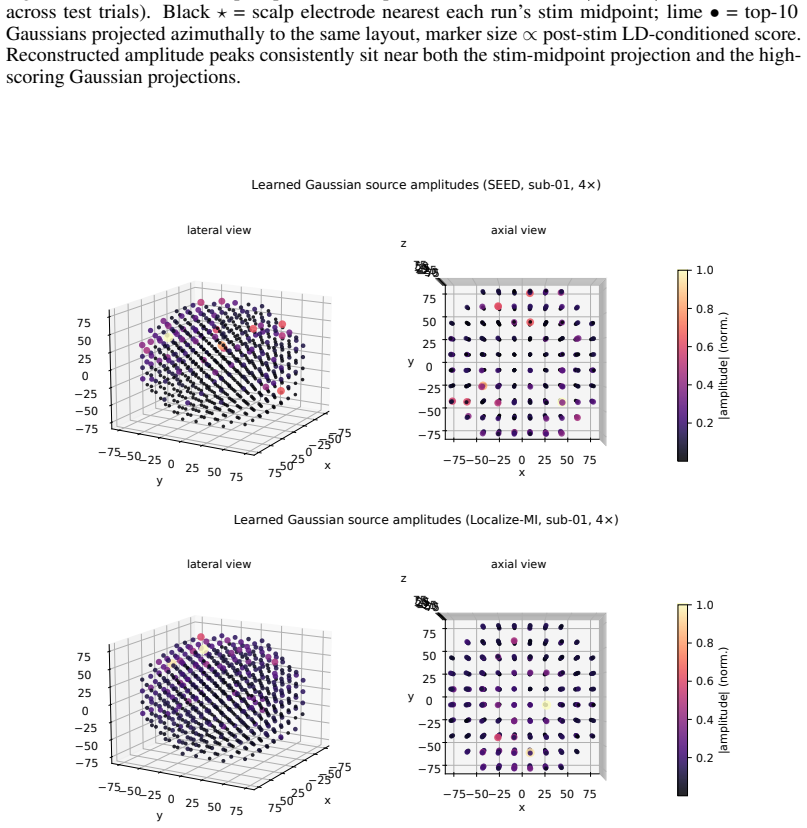
- Yields direct visualizations of the learned source configurations without additional post-processing.
- Supports downstream tasks such as source localization and biomarker discovery from the explicit Gaussian parameters.
- Trains without any supervised source-localization targets.
Where Pith is reading between the lines
- The same 4D Gaussian splatting could be tested on simultaneous EEG-fMRI recordings to check whether the recovered sources align with BOLD activation maps.
- Because the representation separates spatial and temporal axes, it may allow controlled experiments on how temporal smoothing affects spatial resolution in real-time BCI settings.
- The spherical-grid placement could be replaced by a data-driven point set to test whether performance gains come from the Gaussian form or from the grid geometry.
Load-bearing premise
Brain electrical sources can be accurately represented as a mixture of anisotropic 4D space-time Gaussians placed on a spherical grid.
What would settle it
EMAG would be falsified if it produced lower reconstruction accuracy than simple interpolation baselines on a new EEG recording set whose electrode layout or head geometry differs markedly from the training benchmarks.
Figures
read the original abstract
High-density electroencephalography (HD-EEG) enables fine-grained measurement of cortical activity but requires expensive hardware and lengthy setup times, limiting its clinical and research accessibility. We propose EMAG (EEG Mixture of Anisotropic Gaussians), a differentiable framework that reconstructs HD-EEG signals from a sparse subset of low-density (LD) electrodes by representing brain electrical sources as a mixture of anisotropic 4D space-time Gaussians. EMAG places a mixture of multiple Gaussians at each point of a spherical brain grid, each parameterized by a full 4 x 4 precision matrix, enabling anisotropic spatial spreads and explicit coupling between spatial and temporal dimensions. The forward model renders scalp EEG via differentiable Gaussian field contributions at electrode locations, enabling end-to-end training without explicit source localization supervision. We evaluate EMAG on three public EEG benchmarks (Localize-MI, SEED, and SEED-IV) at super-resolution factors of 2x through 8/16x. EMAG outperforms the current state-of-the-art EEG super-resolution method at most super-resolution factors on three standard benchmarks (Localize-MI, SEED, SEED-IV). The explicit Gaussian parameterization further enables direct visualization and interpretability of learned brain source configurations, potentially opening avenues for clinical and neuroscientific applications, such as source localization or biomarker discovery.
Editorial analysis
A structured set of objections, weighed in public.
Referee Report
Summary. The paper proposes EMAG, a differentiable framework representing brain electrical sources as mixtures of anisotropic 4D space-time Gaussians placed at points on a spherical brain grid. Each Gaussian uses a full 4x4 precision matrix to capture anisotropic spatial spreads and space-time coupling. Scalp EEG is reconstructed from sparse low-density electrodes via differentiable Gaussian field contributions at electrode locations, enabling end-to-end training without explicit source localization supervision. The method is evaluated on Localize-MI, SEED, and SEED-IV at 2x to 8/16x super-resolution factors and claims to outperform the current SOTA EEG super-resolution method at most factors.
Significance. If the Gaussian mixture model and differentiable rendering accurately capture the underlying source dynamics and forward propagation, the work could advance accessible HD-EEG reconstruction while providing interpretable visualizations of learned source configurations. The explicit parameterization and lack of need for source supervision are potential strengths for neuroscientific applications. However, the significance is tempered by the absence of biophysical grounding in the provided description.
major comments (2)
- [Abstract] Abstract: the central modeling choice replaces the standard quasi-static Maxwell forward problem (lead-field matrix from realistic head geometry and conductivity) with differentiable Gaussian field contributions on a spherical grid. This is load-bearing for the reconstruction claim, yet no validation against biophysical simulators is described, leaving open the possibility that benchmark gains arise from data fitting rather than faithful volume conduction modeling.
- [Abstract] Abstract: the weakest assumption—that mixtures of anisotropic 4D Gaussians on a spherical grid suffice for accurate scalp potential reconstruction without explicit supervision—is not accompanied by any reported comparison to physics-based forward models or ablation on grid resolution/precision matrix constraints, undermining the interpretability and generalization claims at high super-resolution factors.
Simulated Author's Rebuttal
We thank the referee for the constructive feedback on the biophysical aspects of EMAG. We address the two major comments point by point below and commit to revisions that strengthen the manuscript's claims.
read point-by-point responses
-
Referee: [Abstract] Abstract: the central modeling choice replaces the standard quasi-static Maxwell forward problem (lead-field matrix from realistic head geometry and conductivity) with differentiable Gaussian field contributions on a spherical grid. This is load-bearing for the reconstruction claim, yet no validation against biophysical simulators is described, leaving open the possibility that benchmark gains arise from data fitting rather than faithful volume conduction modeling.
Authors: EMAG is explicitly designed as a data-driven, end-to-end differentiable surrogate that learns effective source representations and scalp mappings directly from observed EEG without requiring explicit source localization or biophysical forward modeling. This choice prioritizes accessibility and training on real datasets over explicit Maxwell-equation compliance. We agree that the absence of validation against biophysical simulators (e.g., lead-field matrices from realistic head models) leaves open the possibility that gains are due to data fitting. In the revised manuscript we will add such validation experiments on simulated data generated with standard forward models to quantify how well the learned Gaussian contributions approximate volume conduction. revision: yes
-
Referee: [Abstract] Abstract: the weakest assumption—that mixtures of anisotropic 4D Gaussians on a spherical grid suffice for accurate scalp potential reconstruction without explicit supervision—is not accompanied by any reported comparison to physics-based forward models or ablation on grid resolution/precision matrix constraints, undermining the interpretability and generalization claims at high super-resolution factors.
Authors: The empirical results on three benchmarks at 2x–16x factors provide evidence that the Gaussian-mixture representation suffices for the super-resolution task. We acknowledge that direct comparisons to physics-based forward models and ablations on grid resolution and precision-matrix constraints are missing. The revised manuscript will incorporate both: (i) side-by-side reconstruction comparisons against lead-field-based baselines on simulated data, and (ii) ablations varying grid density and precision-matrix constraints to support the interpretability and generalization statements. revision: yes
Circularity Check
No circularity; modeling choice and empirical benchmarks are independent
full rationale
The paper introduces a 4D Gaussian mixture representation and differentiable rendering as a modeling choice for EEG super-resolution, trained end-to-end on sparse-to-dense reconstruction without explicit localization labels. No quoted equations or steps reduce a claimed prediction to a fitted input by construction, nor rely on self-citation chains, uniqueness theorems, or renamed known results. Performance claims are benchmark comparisons (Localize-MI, SEED, SEED-IV) external to the model definition itself. The derivation is self-contained against standard supervised learning practices.
Axiom & Free-Parameter Ledger
invented entities (1)
-
Mixture of anisotropic 4D space-time Gaussians on spherical brain grid
no independent evidence
Reference graph
Works this paper leans on
-
[1]
Eeg channel selection techniques in motor imagery applications: A review and new perspectives.Bioengineering, 9(12):726, 2022
Abdullah, Ibrahima Faye, and Md Rafiqul Islam. Eeg channel selection techniques in motor imagery applications: A review and new perspectives.Bioengineering, 9(12):726, 2022
2022
-
[2]
Deep eeg super-resolution: Upsampling eeg spatial resolu- tion with generative adversarial networks
Isaac A Corley and Yufei Huang. Deep eeg super-resolution: Upsampling eeg spatial resolu- tion with generative adversarial networks. In2018 IEEE EMBS international conference on biomedical & health informatics (BHI), pages 100–103. IEEE, 2018
2018
-
[3]
Dynamic statistical parametric mapping: combining fmri and meg for high-resolution imaging of cortical activity.neuron, 26(1):55–67, 2000
Anders M Dale, Arthur K Liu, Bruce R Fischl, Randy L Buckner, John W Belliveau, Jeffrey D Lewine, and Eric Halgren. Dynamic statistical parametric mapping: combining fmri and meg for high-resolution imaging of cortical activity.neuron, 26(1):55–67, 2000
2000
-
[4]
Anterior cerebral asymmetry and the nature of emotion.Brain and cognition, 20(1):125–151, 1992
Richard J Davidson. Anterior cerebral asymmetry and the nature of emotion.Brain and cognition, 20(1):125–151, 1992
1992
-
[5]
Differential entropy feature for eeg-based emotion classification
Ruo-Nan Duan, Jia-Yi Zhu, and Bao-Liang Lu. Differential entropy feature for eeg-based emotion classification. In2013 6th international IEEE/EMBS conference on neural engineering (NER), pages 81–84. IEEE, 2013
2013
-
[6]
4d-rotor gaussian splatting: towards efficient novel view synthesis for dynamic scenes
Yuanxing Duan, Fangyin Wei, Qiyu Dai, Yuhang He, Wenzheng Chen, and Baoquan Chen. 4d-rotor gaussian splatting: towards efficient novel view synthesis for dynamic scenes. InACM SIGGRAPH 2024 Conference Papers, pages 1–11, 2024
2024
-
[7]
Mne software for processing meg and eeg data.neuroimage, 86:446–460, 2014
Alexandre Gramfort, Martin Luessi, Eric Larson, Denis A Engemann, Daniel Strohmeier, Christian Brodbeck, Lauri Parkkonen, and Matti S Hämäläinen. Mne software for processing meg and eeg data.neuroimage, 86:446–460, 2014
2014
-
[8]
Review on solving the inverse problem in eeg source analysis.Journal of neuroengineering and rehabilitation, 5(1): 25, 2008
Roberta Grech, Tracey Cassar, Joseph Muscat, Kenneth P Camilleri, Simon G Fabri, Michalis Zervakis, Petros Xanthopoulos, Vangelis Sakkalis, and Bart Vanrumste. Review on solving the inverse problem in eeg source analysis.Journal of neuroengineering and rehabilitation, 5(1): 25, 2008
2008
-
[9]
Review on solving the forward problem in eeg source analysis.Journal of neuroengineering and rehabilitation, 4(1):46, 2007
Hans Hallez, Bart Vanrumste, Roberta Grech, Joseph Muscat, Wim De Clercq, Anneleen Vergult, Yves D’Asseler, Kenneth P Camilleri, Simon G Fabri, Sabine Van Huffel, et al. Review on solving the forward problem in eeg source analysis.Journal of neuroengineering and rehabilitation, 4(1):46, 2007
2007
-
[10]
Interpreting magnetic fields of the brain: minimum norm estimates.Medical & biological engineering & computing, 32(1):35–42, 1994
Matti S Hämäläinen and Risto J Ilmoniemi. Interpreting magnetic fields of the brain: minimum norm estimates.Medical & biological engineering & computing, 32(1):35–42, 1994
1994
-
[11]
Electromagnetic source imaging via a data-synthesis-based convolutional encoder–decoder network.IEEE Transactions on Neural Networks and Learning Systems, 35(5):6423–6437, 2022
Gexin Huang, Ke Liu, Jiawen Liang, Chang Cai, Zheng Hui Gu, Feifei Qi, Yuanqing Li, Zhu Liang Yu, and Wei Wu. Electromagnetic source imaging via a data-synthesis-based convolutional encoder–decoder network.IEEE Transactions on Neural Networks and Learning Systems, 35(5):6423–6437, 2022
2022
-
[12]
Self-attention-based diffusion model for time-series imputation in partial blackout scenarios
Mohammad Rafid Ul Islam, Prasad Tadepalli, and Alan Fern. Self-attention-based diffusion model for time-series imputation in partial blackout scenarios. InProceedings of the AAAI Conference on Artificial Intelligence, volume 39, pages 17564–17572, 2025
2025
-
[13]
Multi-modal electrophys- iological source imaging with attention neural networks based on deep fusion of eeg and meg
Meng Jiao, Shihao Yang, Xiaochen Xian, Neel Fotedar, and Feng Liu. Multi-modal electrophys- iological source imaging with attention neural networks based on deep fusion of eeg and meg. IEEE Transactions on Neural Systems and Rehabilitation Engineering, 32:2492–2502, 2024
2024
-
[14]
Shahar Ain Kedem, Itamar Zimerman, and Eliya Nachmani. Neural brain fields: A nerf-inspired approach for generating nonexistent eeg electrodes.arXiv preprint arXiv:2601.00012, 2025
-
[15]
3d gaussian splatting for real-time radiance field rendering.ACM Trans
Bernhard Kerbl, Georgios Kopanas, Thomas Leimkühler, George Drettakis, et al. 3d gaussian splatting for real-time radiance field rendering.ACM Trans. Graph., 42(4):139–1, 2023
2023
-
[16]
Miniaturization for wearable eeg systems: recording hardware and data processing.Biomedical Engineering Letters, 12(3):239–250, 2022
Minjae Kim, Seungjae Yoo, and Chul Kim. Miniaturization for wearable eeg systems: recording hardware and data processing.Biomedical Engineering Letters, 12(3):239–250, 2022
2022
-
[17]
Adam: A Method for Stochastic Optimization
Diederik P Kingma and Jimmy Ba. Adam: A method for stochastic optimization.arXiv preprint arXiv:1412.6980, 2014. 10
work page internal anchor Pith review Pith/arXiv arXiv 2014
-
[18]
Eegnet: a compact convolutional neural network for eeg-based brain–computer interfaces.Journal of neural engineering, 15(5):056013, 2018
Vernon J Lawhern, Amelia J Solon, Nicholas R Waytowich, Stephen M Gordon, Chou P Hung, and Brent J Lance. Eegnet: a compact convolutional neural network for eeg-based brain–computer interfaces.Journal of neural engineering, 15(5):056013, 2018
2018
-
[19]
Estformer: Transformer utilizing spatiotemporal dependencies for eeg super-resolution.arXiv e-prints, pages arXiv–2312, 2023
Dongdong Li, Zhongliang Zeng, Zhe Wang, and Hai Yang. Estformer: Transformer utilizing spatiotemporal dependencies for eeg super-resolution.arXiv e-prints, pages arXiv–2312, 2023
2023
-
[20]
Hongjun Liu, Leyu Zhou, Zijianghao Yang, and Chao Yao. Step-aware residual-guided diffusion for eeg spatial super-resolution.arXiv preprint arXiv:2510.19166, 2025
-
[21]
Assigning channel weights using an attention mechanism: an eeg interpolation algorithm.Frontiers in neuroscience, 17:1251677, 2023
Renjie Liu, Zaijun Wang, Jiang Qiu, and Xue Wang. Assigning channel weights using an attention mechanism: an eeg interpolation algorithm.Frontiers in neuroscience, 17:1251677, 2023
2023
-
[22]
Rdpi: a refine diffusion probability generation method for spatiotemporal data imputation
Zijin Liu, Xiang Zhao, and You Song. Rdpi: a refine diffusion probability generation method for spatiotemporal data imputation. InProceedings of the AAAI Conference on Artificial Intelligence, volume 39, pages 12255–12263, 2025
2025
-
[23]
Eeg source imaging: a practical review of the analysis steps.Frontiers in neurology, 10:325, 2019
Christoph M Michel and Denis Brunet. Eeg source imaging: a practical review of the analysis steps.Frontiers in neurology, 10:325, 2019
2019
-
[24]
Simultaneous human intracerebral stimulation and hd-eeg, ground-truth for source localization methods
Ezequiel Mikulan, Simone Russo, Sara Parmigiani, Simone Sarasso, Flavia Maria Zauli, Annal- isa Rubino, Pietro Avanzini, Anna Cattani, Alberto Sorrentino, Steve Gibbs, et al. Simultaneous human intracerebral stimulation and hd-eeg, ground-truth for source localization methods. Scientific data, 7(1):127, 2020
2020
-
[25]
Nerf: Representing scenes as neural radiance fields for view synthesis
Ben Mildenhall, Pratul P Srinivasan, Matthew Tancik, Jonathan T Barron, Ravi Ramamoor- thi, and Ren Ng. Nerf: Representing scenes as neural radiance fields for view synthesis. Communications of the ACM, 65(1):99–106, 2021
2021
-
[26]
Standardized low-resolution brain electromagnetic tomography (sloreta): technical details.Methods find exp clin pharmacol, 24(Suppl D):5–12, 2002
Roberto Domingo Pascual-Marqui et al. Standardized low-resolution brain electromagnetic tomography (sloreta): technical details.Methods find exp clin pharmacol, 24(Suppl D):5–12, 2002
2002
-
[27]
Eeg channel reconstruction using con- volutional neural networks in limited bcis: A proposed method for neuromarketing applications
Mario Quiles Pérez, Sergio López Bernal, Eduardo Horna Prat, Luis Montesano Del Campo, Lorenzo Fernández Maimó, and Alberto Huertas Celdrán. Eeg channel reconstruction using con- volutional neural networks in limited bcis: A proposed method for neuromarketing applications. Applied Soft Computing, 181:113455, 2025
2025
-
[28]
Spherical splines for scalp potential and current density mapping.Electroencephalography and clinical neurophysiology, 72(2):184–187, 1989
François Perrin, Jacques Pernier, Olivier Bertrand, and Jean Francois Echallier. Spherical splines for scalp potential and current density mapping.Electroencephalography and clinical neurophysiology, 72(2):184–187, 1989
1989
-
[29]
Brain computer interface: control signals review.Neurocomputing, 223:26–44, 2017
Rabie A Ramadan and Athanasios V Vasilakos. Brain computer interface: control signals review.Neurocomputing, 223:26–44, 2017
2017
-
[30]
Eeg channel interpolation using deep encoder-decoder networks
Sari Saba-Sadiya, Tuka Alhanai, Taosheng Liu, and Mohammad M Ghassemi. Eeg channel interpolation using deep encoder-decoder networks. In2020 IEEE International Conference on Bioinformatics and Biomedicine (BIBM), pages 2432–2439. IEEE, 2020
2020
-
[31]
Rui Sun, Abbas Sohrabpour, Gregory A Worrell, and Bin He. Deep neural networks constrained by neural mass models improve electrophysiological source imaging of spatiotemporal brain dynamics.Proceedings of the National Academy of Sciences, 119(31):e2201128119, 2022
2022
-
[32]
Fourier features let networks learn high frequency functions in low dimensional domains.Advances in neural information processing systems, 33:7537–7547, 2020
Matthew Tancik, Pratul Srinivasan, Ben Mildenhall, Sara Fridovich-Keil, Nithin Raghavan, Utkarsh Singhal, Ravi Ramamoorthi, Jonathan Barron, and Ren Ng. Fourier features let networks learn high frequency functions in low dimensional domains.Advances in neural information processing systems, 33:7537–7547, 2020
2020
-
[33]
Identifying relevant eeg channels for subject- independent emotion recognition using attention network layers.Frontiers in psychiatry, 16: 1494369, 2025
Camilo E Valderrama and Anshul Sheoran. Identifying relevant eeg channels for subject- independent emotion recognition using attention network layers.Frontiers in psychiatry, 16: 1494369, 2025. 11
2025
-
[34]
Attention is all you need.Advances in neural information processing systems, 30, 2017
Ashish Vaswani, Noam Shazeer, Niki Parmar, Jakob Uszkoreit, Llion Jones, Aidan N Gomez, Łukasz Kaiser, and Illia Polosukhin. Attention is all you need.Advances in neural information processing systems, 30, 2017
2017
-
[35]
Generating realistic neurophysiological time series with denoising diffusion probabilistic models.Patterns, 5(9), 2024
Julius Vetter, Jakob H Macke, and Richard Gao. Generating realistic neurophysiological time series with denoising diffusion probabilistic models.Patterns, 5(9), 2024
2024
-
[36]
Generative ai enables eeg super-resolution via spatio-temporal adaptive diffusion learning.IEEE Transactions on Consumer Electronics, 71(1):1034–1045, 2025
Shuqiang Wang, Tong Zhou, Yanyan Shen, Ye Li, Guoheng Huang, and Yong Hu. Generative ai enables eeg super-resolution via spatio-temporal adaptive diffusion learning.IEEE Transactions on Consumer Electronics, 71(1):1034–1045, 2025
2025
-
[37]
Brain-computer interfaces (bcis) for communication and control
Jonathan R Wolpaw. Brain-computer interfaces (bcis) for communication and control. InPro- ceedings of the 9th international ACM SIGACCESS conference on Computers and accessibility, pages 1–2, 2007
2007
-
[38]
4d gaussian splatting for real-time dynamic scene rendering
Guanjun Wu, Taoran Yi, Jiemin Fang, Lingxi Xie, Xiaopeng Zhang, Wei Wei, Wenyu Liu, Qi Tian, and Xinggang Wang. 4d gaussian splatting for real-time dynamic scene rendering. In Proceedings of the IEEE/CVF conference on computer vision and pattern recognition, pages 20310–20320, 2024
2024
-
[39]
Shunyang Zhang, Senzhang Wang, Xianzhen Tan, Ruochen Liu, Jian Zhang, and Jianxin Wang. Sasdim: Self-adaptive noise scaling diffusion model for spatial time series imputation.arXiv preprint arXiv:2309.01988, 2023
-
[40]
Wei-Long Zheng and Bao-Liang Lu. Investigating critical frequency bands and channels for eeg-based emotion recognition with deep neural networks.IEEE Transactions on autonomous mental development, 7(3):162–175, 2015
2015
-
[41]
Emotionmeter: A multimodal framework for recognizing human emotions.IEEE transactions on cybernetics, 49 (3):1110–1122, 2018
Wei-Long Zheng, Wei Liu, Yifei Lu, Bao-Liang Lu, and Andrzej Cichocki. Emotionmeter: A multimodal framework for recognizing human emotions.IEEE transactions on cybernetics, 49 (3):1110–1122, 2018. A Implementation details Brain grid.The brain domain spans [−90,90]mm in each spatial dimension. The brain grid at resolution R consists of all points on a unif...
2018
-
[42]
loading the EMAG model trained on subjecti(split seeds)
-
[43]
feeding it subject j’s LD test recordings (the same LD subset and test split that was used when evaluating subject j in the main results, so T (s) jj exactly reproduces the within-subject number)
-
[44]
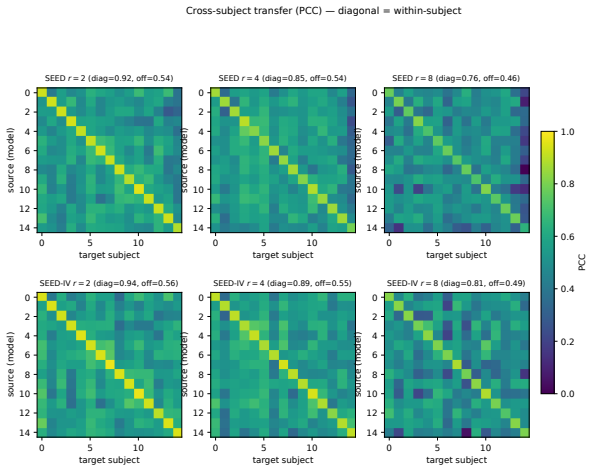
recording NMSE, PCC and SNR between the model’s output and subject j’s HD ground truth. We report within(s) = 1 S X i T (s) ii ,cross (s) = 1 S(S−1) X i̸=j T (s) ij , and average across seeds. Each non-diagonal cell T (s) ij uses no information from subject j during training: subject i’s 4D Gaussian field is applied verbatim to subjectj’s LD signal, with ...
-
[45]
Guidelines: • The answer [N/A] means that the paper does not involve crowdsourcing nor research with human subjects
Institutional review board (IRB) approvals or equivalent for research with human subjects Question: Does the paper describe potential risks incurred by study participants, whether such risks were disclosed to the subjects, and whether Institutional Review Board (IRB) approvals (or an equivalent approval/review based on the requirements of your country or ...
discussion (0)
Sign in with ORCID, Apple, or X to comment. Anyone can read and Pith papers without signing in.