Quantum algorithms for density functional theory with minimal readout
Pith reviewed 2026-06-29 06:34 UTC · model grok-4.3
The pith
A qubit-efficient encoding lets quantum computers compute all Kohn-Sham orbitals at once and evaluate total energy via the Harris functional without reading out the electronic density.
A machine-rendered reading of the paper's core claim, the machinery that carries it, and where it could break.
Core claim
By encoding the set of occupied Kohn-Sham orbitals in a qubit-efficient register and measuring only the quantities needed for the Harris functional, the total electronic energy is obtained without reconstructing the density matrix or its diagonal, removing the dominant readout cost that limits earlier quantum DFT algorithms and yielding a potential exponential reduction in measurement overhead relative to classical self-consistent field procedures.
What carries the argument
Qubit-efficient encoding of the full set of occupied Kohn-Sham orbitals together with a simultaneous-preparation circuit that feeds directly into Harris-functional energy evaluation.
If this is right
- Total energy is obtained from orbital measurements alone.
- Self-consistent iterations become possible with multiple independent wavefunction copies.
- The approach applies to any functional whose energy expression can be written in terms of the orbitals without explicit density reconstruction.
- Numerical tests on small systems confirm that the encoding overhead remains modest.
Where Pith is reading between the lines
- If the same encoding can be reused across a sequence of nuclear geometries, geometry optimization could also avoid repeated density readouts.
- The method may combine with existing quantum phase estimation routines to obtain excited-state corrections at similar readout cost.
- Because the Harris functional is variational only near the self-consistent density, the second multi-copy method may be required for quantitative accuracy on systems far from the initial guess.
Load-bearing premise
The encoding and circuit preserve the accuracy and asymptotic scaling of the classical Harris functional without introducing hidden classical post-processing or extra qubit overhead that would cancel the claimed readout advantage.
What would settle it
An explicit resource count or circuit simulation on a molecule with more than ten electrons that shows the total number of measurements or qubits required exceeds that of a standard classical DFT calculation by more than a polynomial factor.
Figures
read the original abstract
While quantum computers have shown significant promise for electronic structure calculations, their potential to accelerate density functional theory (DFT) calculations remains unclear. In this work, we present a qubit-efficient encoding scheme for wavefunctions in Kohn--Sham (KS) DFT, together with a quantum algorithm that computes all occupied orbitals simultaneously. We further show that our algorithm is particularly well suited to the Harris functional, enabling the total energy to be evaluated with a potential exponential speedup over classical approaches by entirely avoiding the costly readout of the electronic density. In addition, we propose a second method for achieving self-consistent DFT calculations using multiple copies of the wavefunction, which likewise circumvents density readout. The applicability of our algorithms is demonstrated through several numerical examples, and their efficiency is compared with that of existing approaches.
Editorial analysis
A structured set of objections, weighed in public.
Referee Report
Summary. The manuscript presents a qubit-efficient encoding scheme for Kohn-Sham wavefunctions together with a quantum algorithm that computes all occupied orbitals simultaneously. It argues that the construction is particularly well suited to the Harris functional, permitting evaluation of the total energy with a potential exponential speedup over classical methods by entirely avoiding readout of the electronic density. A second approach for self-consistent DFT calculations that likewise circumvents density readout is proposed, using multiple copies of the wavefunction. Applicability is illustrated through numerical examples whose efficiency is compared with existing methods.
Significance. If the qubit-efficient encoding and simultaneous-orbital construction can be shown to deliver the claimed speedup for the Harris functional without hidden overheads that negate the advantage, the work would address a recognized bottleneck (density readout) in quantum electronic-structure algorithms and could therefore be of interest to the quantum-algorithms community.
Simulated Author's Rebuttal
We thank the referee for their summary of our manuscript and for highlighting the potential interest of our qubit-efficient approach to Kohn-Sham DFT. The recommendation is listed as uncertain, with the key condition being demonstration of the claimed speedup for the Harris functional without hidden overheads. We address this point below and note that no explicit major comments were enumerated in the report.
read point-by-point responses
-
Referee: If the qubit-efficient encoding and simultaneous-orbital construction can be shown to deliver the claimed speedup for the Harris functional without hidden overheads that negate the advantage, the work would address a recognized bottleneck (density readout) in quantum electronic-structure algorithms.
Authors: Our manuscript demonstrates the qubit-efficient encoding and simultaneous computation of all occupied orbitals, which directly enables evaluation of the Harris functional without any density readout. The numerical examples compare the efficiency of our approach against existing methods and illustrate that the avoidance of density readout removes a dominant classical cost. We argue that the construction yields a potential exponential advantage precisely because the total energy is obtained from expectation values on the prepared states without requiring full density reconstruction. If the referee identifies specific hidden overheads not addressed in the current analysis, we would be grateful for clarification so that they can be examined in a revision. revision: no
Circularity Check
No significant circularity; derivation is algorithmic and self-contained
full rationale
The paper introduces a qubit-efficient encoding for KS wavefunctions and a simultaneous-orbital quantum algorithm, then shows its compatibility with the Harris functional to avoid density readout. These are constructive algorithmic steps whose validity rests on the stated quantum-circuit constructions and numerical demonstrations rather than on any fitted parameter renamed as prediction, self-referential definition, or load-bearing self-citation. No equation reduces to its own input by construction, and the speedup claim follows directly from the avoidance of readout without hidden circular assumptions. The central claims therefore remain independent of the inputs they purport to derive.
Axiom & Free-Parameter Ledger
axioms (1)
- domain assumption Standard assumptions of quantum computing (coherent unitary evolution and projective measurement) suffice for the algorithm.
Reference graph
Works this paper leans on
-
[1]
Moreover, even if the final KS orbitals have been successfully prepared on the quantum registers, to compute the total energy using Eq
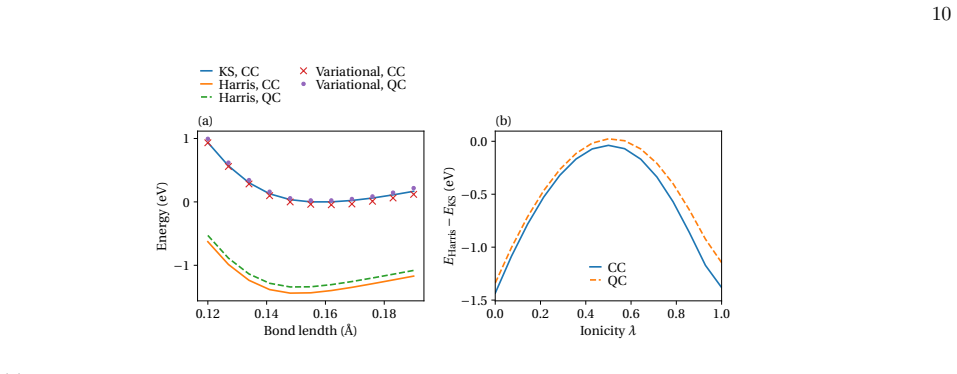
Harris functional As discussed above, the density readout is an expensive operation in quantum computing, but this is required for SCF calculation because the 𝐻KS depends on the electronic density which is unknown a priori . Moreover, even if the final KS orbitals have been successfully prepared on the quantum registers, to compute the total energy using ...
-
[2]
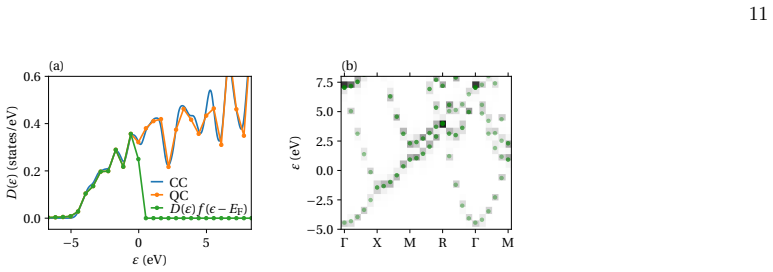
𝒌-point sampling For periodic system, it is also possible to perform 𝒌-point sampling under Harris functional in quantum computing. Since the wavefunctions at different 𝒌 points belong to independent eigen systems, the calculation at each 𝒌 point is independent from each other and can be performed sequentially, one 𝒌 point at a time. Here, the KS potentia...
-
[3]
almost always
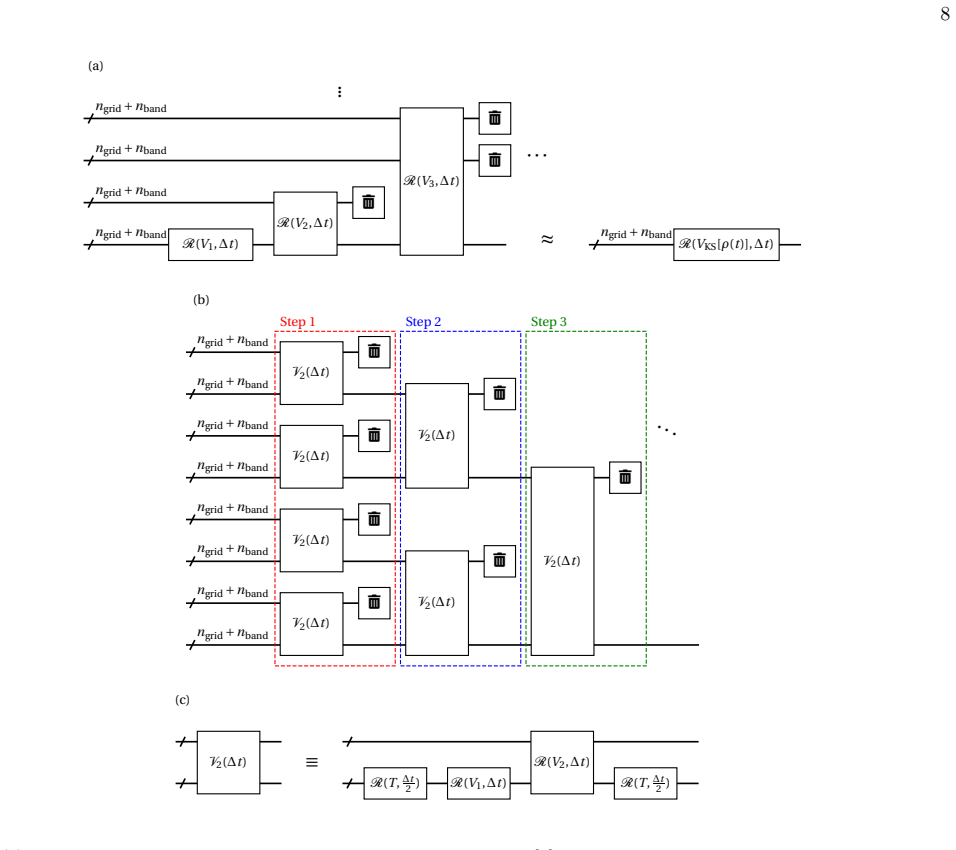
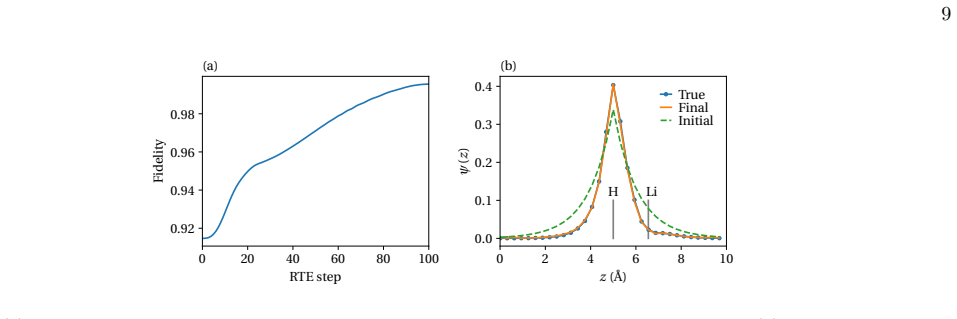
Variational method for improving accuracy When the true electron density is very different from the density sum of isolated atoms (used as 𝜌in), the Harris functional may not be accurate enough and improving its accuracy in this case is highly desirable. Here we propose a simple yet effective variational method for such cases. While the KS functional [Eq....
-
[4]
Instead, we have found that the adiabatic real-time evolution (adiabatic RTE, ATE) algorithm [ 20] can be employed to compute all the higher states and works with our QE encoding
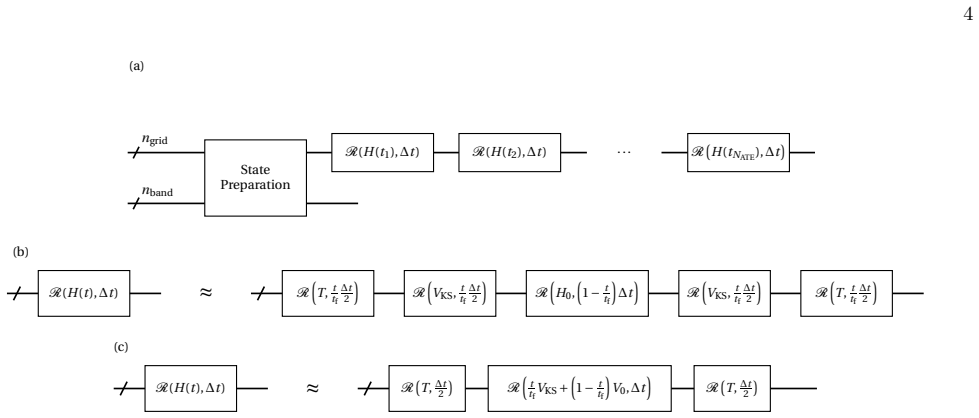
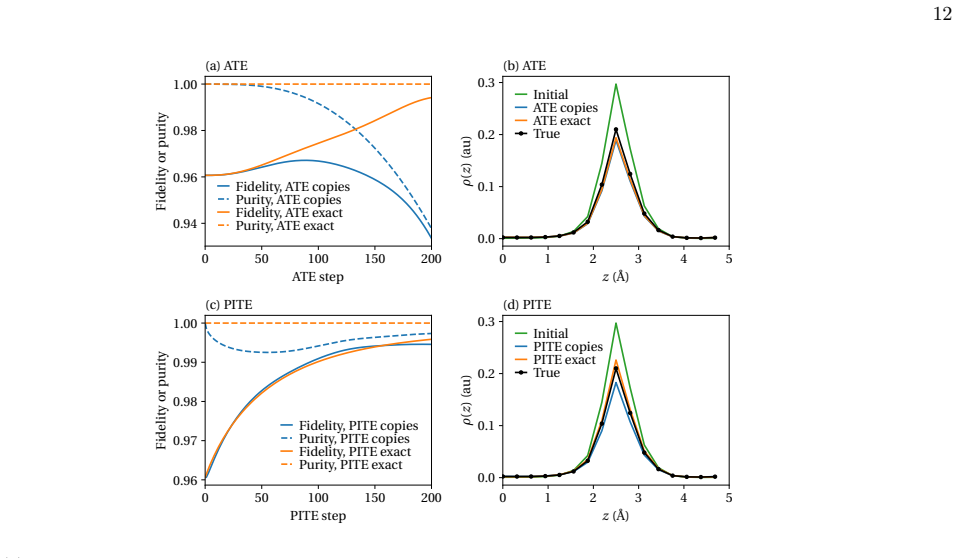
Adiabatic real-time evolution As the lowest 𝑁band eigen states of the KS Hamiltonian must all be solved, the PITE algorithm that can effi- ciently solve the lowest eigen-state is in general not applicable here because all orbitals will collapse to the lowest state. Instead, we have found that the adiabatic real-time evolution (adiabatic RTE, ATE) algorithm...
-
[5]
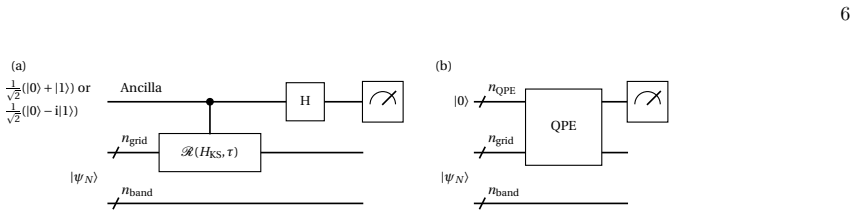
Result readout After the final state |𝜓𝑁 (𝑡f)⟩ = ∑𝑖𝒓 𝜓KS 𝑖 (𝒓)|𝑖⟩|𝒓⟩has been prepared on quantum registers, we can then evaluate the total energy using Eq. ( 4). We here only focus on the band energy 2 ∑occupied 𝜀𝑖 since the electronic density readout is not required in Harris functional and can be efficiently evaluated classically (the electronic density ...
-
[6]
Ȑ ” denotes tracing out and the operator 𝑉𝑛 is given by Eq. ( 25) of the main text. The approximation becomes more accurate as higher order terms (omitted here by “ ⋯
Level crossing during ATE The ATE requires the adiabatic condition to be satisfied during time evolution. However, this is not always easy to ensure in practice, especially for metallic systems. When level crossing (or near crossing) occurs, the orbitals in question will get hybridized and the eigenstates of 𝐻KS will no longer be obtainable. However, if h...
2026
-
[7]
D. R. Hartree, in Mathematical Proceedings of the Cambridge Philosophical Society , Vol. 24 (Cambridge university press,
-
[8]
Fock, Zeitschrift für Physik 61, 126 (1930)
V. Fock, Zeitschrift für Physik 61, 126 (1930)
1930
-
[9]
J. C. Slater, Physical Review 35, 210 (1930)
1930
-
[10]
Hohenberg and W
P. Hohenberg and W. Kohn, Physical review 136, B864 (1964)
1964
-
[11]
Kohn and L
W. Kohn and L. J. Sham, Physical review 140, A1133 (1965)
1965
-
[12]
D. S. Abrams and S. Lloyd, Physical Review Letters 79, 2586 (1997)
1997
-
[13]
Babbush, W
R. Babbush, W. J. Huggins, D. W. Berry, S. F. Ung, A. Zhao, D. R. Reichman, H. Neven, A. D. Baczewski, and J. Lee, Nature Communications 14, 4058 (2023)
2023
-
[14]
T. E. Baker and D. Poulin, Physical Review Research 2, 043238 (2020)
2020
-
[15]
Kosugi, H
T. Kosugi, H. Nishi, and Y.-i. Matsushita, npj Quantum Information 9, 112 (2023)
2023
-
[16]
Kosugi, Y
T. Kosugi, Y. Nishiya, H. Nishi, and Y.-i. Matsushita, Physical Review Research 4, 033121 (2022)
2022
-
[17]
W. C. Witt, B. G. Del Rio, J. M. Dieterich, and E. A. Carter, Journal of Materials Research 33, 777 (2018)
2018
-
[18]
Y. Nishiya, H. Nishi, T. Kosugi, and Y.-i. Matsushita, arXiv preprint arXiv:2407.16191 (2024)
- [19]
-
[20]
Senjean, S
B. Senjean, S. Yalouz, and M. Saubanère, SciPost Physics 14, 055 (2023)
2023
-
[21]
Harris, Physical Review B 31, 1770 (1985)
J. Harris, Physical Review B 31, 1770 (1985)
1985
-
[22]
W. M. C. Foulkes and R. Haydock, Physical review B 39, 12520 (1989)
1989
-
[23]
Robertson and B
I. Robertson and B. Farid, Physical review letters 66, 3265 (1991)
1991
-
[24]
Read and R
A. Read and R. Needs, Journal of Physics: Condensed Matter 1, 7565 (1989)
1989
-
[25]
Finnis, Journal of Physics: Condensed Matter 2, 331 (1990)
M. Finnis, Journal of Physics: Condensed Matter 2, 331 (1990)
1990
-
[26]
Nishiya, H
Y. Nishiya, H. Nishi, Y. Couzinié, T. Kosugi, and Y.-i. Matsushita, Physical Review A 109, 022423 (2024)
2024
-
[27]
J. J. Sakurai and J. Napolitano, Modern Quantum Mechanics (Cambridge University Press, 2020)
2020
-
[28]
A. M. Childs, D. Maslov, Y. Nam, N. J. Ross, and Y. Su, Proceedings of the National Academy of Sciences 115, 9456 (2018)
2018
-
[29]
Suzuki, Communications in Mathematical Physics 51, 183 (1976)
M. Suzuki, Communications in Mathematical Physics 51, 183 (1976). 14
1976
-
[30]
Benenti and G
G. Benenti and G. Strini, American Journal of Physics 76, 657 (2008)
2008
-
[31]
Huang, T
X. Huang, T. Kosugi, H. Nishi, and Y.-i. Matsushita, Quantum Information Processing 24, 1 (2025)
2025
-
[32]
Quantum Amplitude Amplification and Estimation
G. Brassard, P. Hoyer, M. Mosca, and A. Tapp, arXiv preprint quant-ph/0005055 (2000)
work page internal anchor Pith review Pith/arXiv arXiv 2000
-
[33]
A. Y. Kitaev, arXiv preprint quant-ph/9511026 (1995)
work page internal anchor Pith review Pith/arXiv arXiv 1995
-
[34]
Kato, Journal of the Physical Society of Japan 5, 435 (1950)
T. Kato, Journal of the Physical Society of Japan 5, 435 (1950)
1950
-
[35]
M. S. Sarandy, L.-A. Wu, and D. A. Lidar, Quantum Information Processing 3, 331 (2004)
2004
-
[36]
P. A. Dirac, in Mathematical proceedings of the Cambridge philosophical society , Vol. 26 (Cambridge University Press,
-
[37]
J. P. Perdew and Y. Wang, Physical review B 45, 13244 (1992)
1992
- [38]
-
[39]
S. K. Leyton and T. J. Osborne, arXiv preprint arXiv:0812.4423 (2008)
work page internal anchor Pith review Pith/arXiv arXiv 2008
-
[40]
Holmes, N
Z. Holmes, N. J. Coble, A. T. Sornborger, and Y. Subaşı, Physical Review Research 5, 013105 (2023)
2023
-
[41]
Goedecker, M
S. Goedecker, M. Teter, and J. Hutter, Physical Review B 54, 1703 (1996)
1996
-
[42]
Klco and M
N. Klco and M. J. Savage, Physical Review A 102, 012612 (2020)
2020
-
[43]
Prodan and W
E. Prodan and W. Kohn, Proceedings of the National Academy of Sciences 102, 11635 (2005)
2005
-
[44]
Galli and M
G. Galli and M. Parrinello, Physical review letters 69, 3547 (1992)
1992
-
[45]
Yang, Physical review letters 66, 1438 (1991)
W. Yang, Physical review letters 66, 1438 (1991)
1991
-
[46]
Suryanarayana, Chemical Physics Letters 679, 146 (2017)
P. Suryanarayana, Chemical Physics Letters 679, 146 (2017)
2017
-
[47]
Motta, C
M. Motta, C. Sun, A. T. Tan, M. J. O nRourke, E. Ye, A. J. Minnich, F. G. Brandao, and G. K.-L. Chan, Nature Physics 16, 205 (2020)
2020
-
[48]
Higgott, D
O. Higgott, D. Wang, and S. Brierley, Quantum 3, 156 (2019). Appendix A: Level crossing We here prove the assertion in subsection II D 3. When level crossings occur during ATE, the Eq. ( 16) becomes |QPE⟩ = ∑ 𝑘𝑖𝑗𝒓 √ Δ𝑉 𝑁band 𝒰𝑖𝑗𝜓KS 𝑗 (𝒓)𝐹𝑗𝑘|𝑘⟩|𝑖⟩|𝒓⟩, (A1) and Eq. ( 17) will be Pr(𝑘) = 1 𝑁band 𝑁band ∑ 𝑖𝑗 |𝒰𝑖𝑗|2|𝐹𝑗𝑘|2. (A2) If Eq. ( 20) is satisfied, by the...
2019
discussion (0)
Sign in with ORCID, Apple, or X to comment. Anyone can read and Pith papers without signing in.