The observer power spectrum for lightcone statistics, integrated relativistic observables and wide angle effects
Pith reviewed 2026-06-29 06:10 UTC · model grok-4.3
The pith
Fourier transforming over observer positions produces a diagonal power spectrum for any lightcone observable.
A machine-rendered reading of the paper's core claim, the machinery that carries it, and where it could break.
Core claim
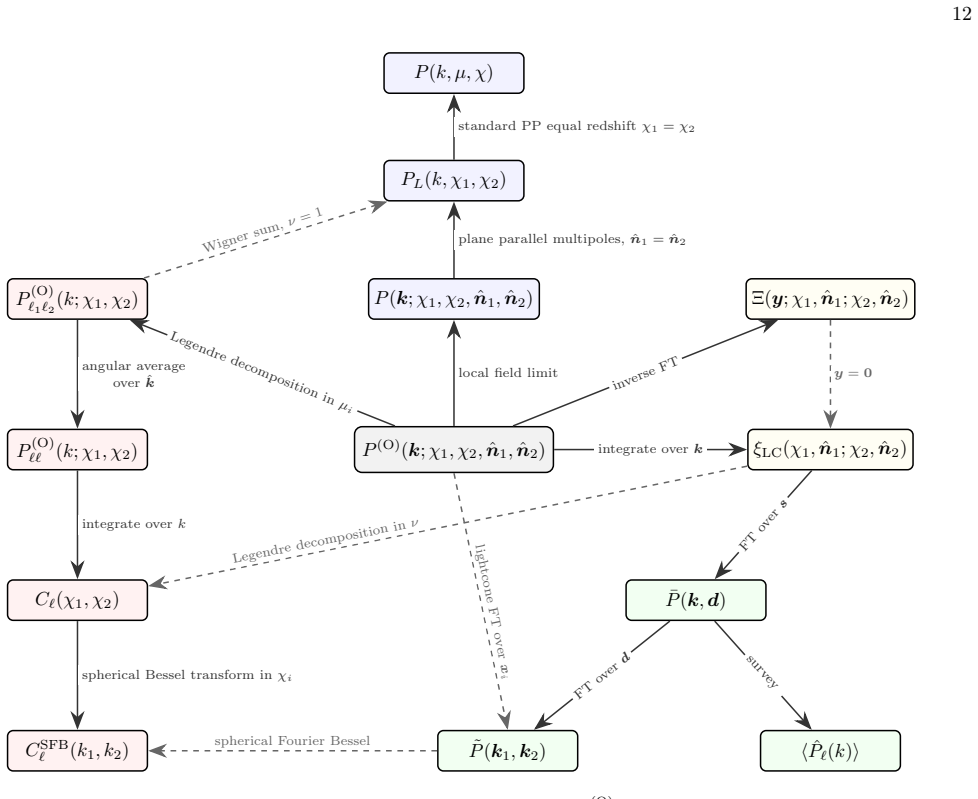
The observer power spectrum is obtained by Fourier transforming the observable over observer locations on a spatial hypersurface at fixed lightcone coordinates. Statistical homogeneity on that hypersurface guarantees the spectrum is diagonal for any observable, local or integrated, and free of mode-mixing generated by lightcone geometry. Every conventional two-point statistic is recovered by projecting this spectrum, and the same object supplies the relativistic kernel containing density, redshift-space distortions, Doppler, magnification, and integrated Sachs-Wolfe terms.
What carries the argument
The observer power spectrum, defined by Fourier transformation over observer positions on a spatial hypersurface with fixed lightcone coordinates.
If this is right
- All standard two-point statistics in large-scale structure analysis are recovered as projections of the single diagonal observer spectrum.
- The construction applies unchanged to higher-order statistics.
- The relativistic kernel for observed galaxy number counts is obtained directly, incorporating density, redshift-space distortions, Doppler, lensing, and integrated Sachs-Wolfe contributions.
- Mode-mixing corrections arising from lightcone geometry are eliminated by construction.
Where Pith is reading between the lines
- Survey pipelines could replace separate wide-angle and integrated-effect corrections with a single projection step from the observer spectrum.
- The same diagonal object supplies a natural starting point for covariance estimation in analyses that include multiple relativistic effects simultaneously.
- Because the spectrum is defined on the observer slice, it may simplify comparisons between different survey geometries that share the same observer hypersurface.
Load-bearing premise
The spatial hypersurface on which observers sit must be statistically homogeneous.
What would settle it
Compute the observer power spectrum from a set of mock catalogs on a homogeneous observer slice and verify that the matrix elements between distinct wave-vectors are consistent with zero for an integrated observable such as lensing magnification.
Figures
read the original abstract
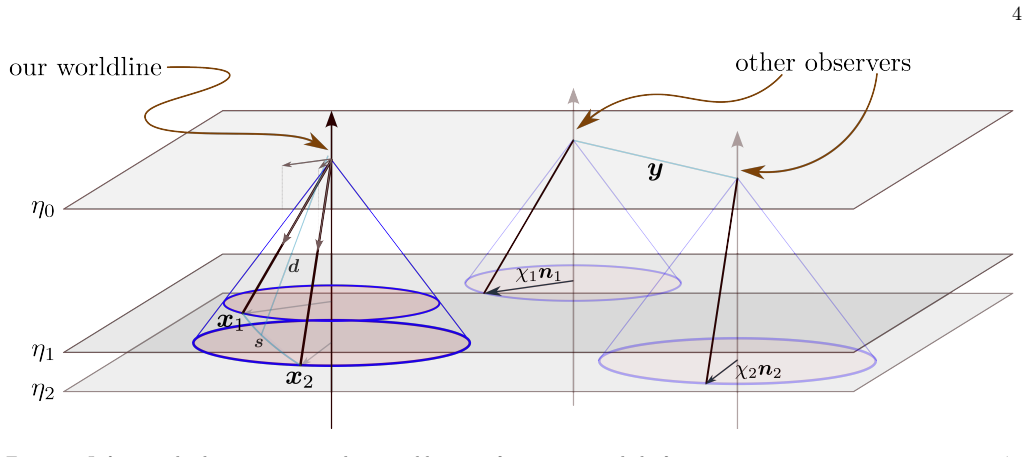
The statistics of large-scale structure are naturally described by power spectra in Fourier space. For fields on spatial hypersurfaces, translational invariance makes different Fourier modes uncorrelated and the power spectrum diagonal. Cosmological observables, however, are measured on our past lightcone, where wide-angle effects, radial evolution and integrated effects such as lensing break this symmetry: Fourier-space statistics become non-diagonal, with mode-mixing generated by the geometry of the lightcone itself. We define a more natural observer power spectrum by Fourier transforming over observer positions on a spatial hypersurface with fixed lightcone coordinates, rather than over source positions on a single lightcone. This forms a field on the observer hypersurface with a moveable light-ray leg. Statistical homogeneity of the observer hypersurface implies that this spectrum is diagonal for any observable, whether local or integrated and does not suffer from mode-mixing. We show how the various two-point statistics used in large-scale structure analysis are each recovered as projections of the observer spectrum. This extends directly to higher-order statistics. We illustrate it by constructing the relativistic kernel for the observed galaxy number count fluctuation, including density, redshift-space distortions, Doppler, lensing magnification, and integrated Sachs-Wolfe contributions.
Editorial analysis
A structured set of objections, weighed in public.
Referee Report
Summary. The paper claims that defining an 'observer power spectrum' by Fourier transforming over observer positions on a spatial hypersurface (with fixed lightcone coordinates for direction and radial distance) yields a field whose two-point statistics are diagonal due to statistical homogeneity on that hypersurface. This holds for any observable, local or integrated (e.g., lensing, ISW), avoiding mode-mixing from lightcone geometry that affects standard source-position Fourier transforms. Standard LSS two-point statistics are recovered as projections of this spectrum; the construction extends to higher orders. The paper illustrates by deriving the full relativistic kernel for galaxy number count fluctuations, including density, RSD, Doppler, magnification, and integrated terms.
Significance. If the central construction holds, the observer power spectrum offers a unified, homogeneity-respecting framework for lightcone statistics that cleanly incorporates wide-angle and integrated relativistic effects without ad-hoc mode-mixing corrections. A strength is the direct grounding in the standard homogeneity assumption on the observer hypersurface (no new parameters or entities beyond the definition itself) and the explicit demonstration that conventional statistics emerge as projections. The extension to higher-order statistics and the concrete relativistic kernel construction are also positive features.
minor comments (2)
- [Abstract] Abstract: the central claim that the spectrum 'is diagonal for any observable' would be clearer if the abstract briefly referenced the explicit two-point function on the observer hypersurface (e.g., the form that depends only on observer separation) rather than stating the implication alone.
- The manuscript would benefit from a short dedicated subsection (perhaps after the definition) that explicitly verifies the absence of off-diagonal terms for one integrated contribution, such as the lensing magnification term in the galaxy kernel, even if the general argument from homogeneity is used.
Simulated Author's Rebuttal
We thank the referee for their positive and accurate summary of the manuscript, as well as for the recommendation of minor revision. No major comments were raised in the report, so we have no specific points requiring rebuttal or clarification at this stage. We will incorporate any minor suggestions during revision.
Circularity Check
No significant circularity detected
full rationale
The paper defines an observer power spectrum via Fourier transform over observer positions on a spatial hypersurface at fixed lightcone coordinates. It then applies the standard cosmological assumption of statistical homogeneity on that hypersurface to conclude the resulting spectrum is diagonal for any observable. This follows directly from translational invariance under the homogeneity assumption and does not reduce any claimed result to a fitted parameter, self-referential definition, or self-citation chain. The derivation remains self-contained against external benchmarks with no load-bearing steps that collapse by construction.
Axiom & Free-Parameter Ledger
axioms (1)
- domain assumption The observer hypersurface is statistically homogeneous
invented entities (1)
-
observer power spectrum
no independent evidence
Reference graph
Works this paper leans on
-
[1]
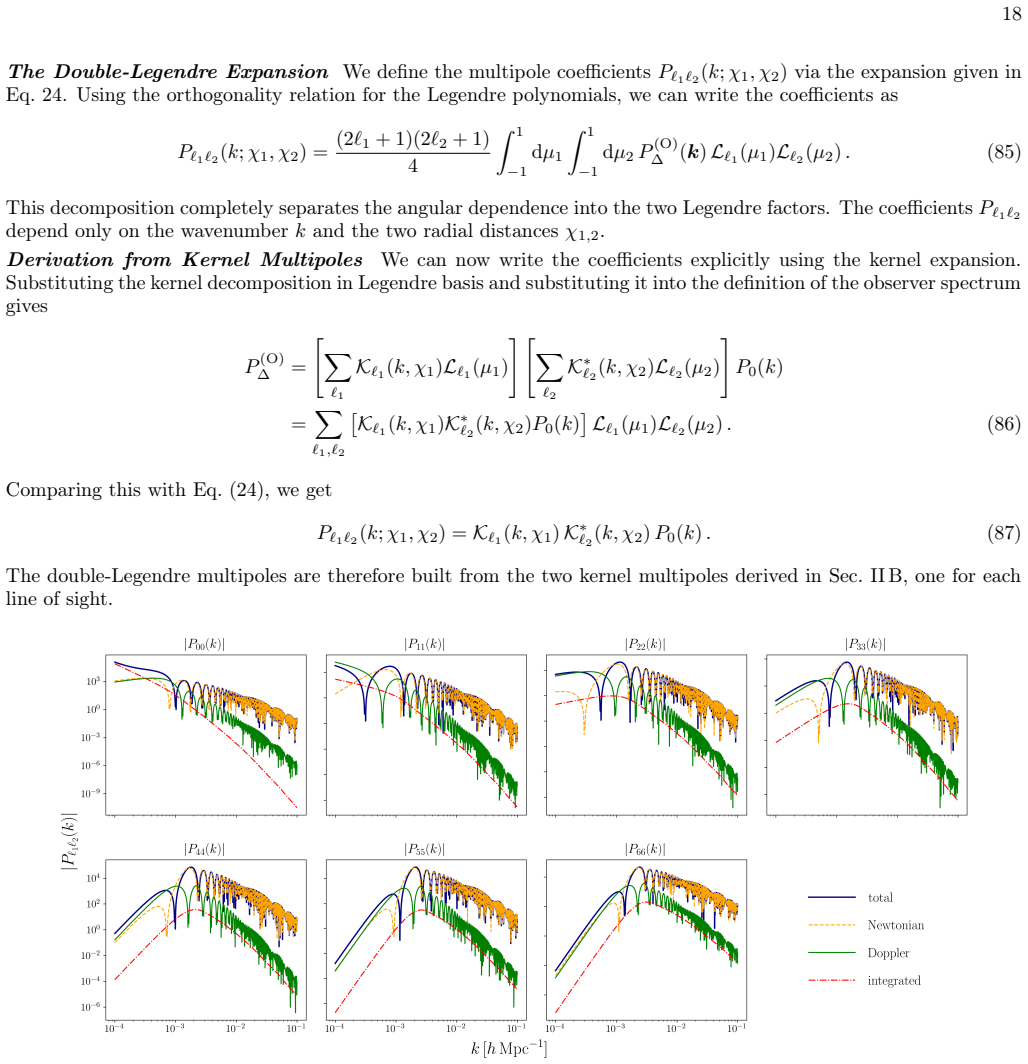
X ℓ1 Kℓ1(k, χ1)Lℓ1(µ1) #
⟨X(x0; 1)X(x ′ 0; 2)⟩. Statistical homogeneity implies the configuration space two point correlation function (2pcf) is⟨X(x0; 1)X(x ′ 0; 2)⟩= Ξ(x ′ 0 − 4 Figure 1.Left:a single observer atx 0 on the spatial hypersurfaceη0 receives light from two sources at positionsx1 =x 0 +χ 1 ˆn1 andx 2 =x 0 +χ 2 ˆn2 on their past lightcone, intersecting the hypersurfac...
-
[2]
Kaiser,Clustering in real space and in redshift space,MNRAS227(July, 1987) 1–21
N. Kaiser,Clustering in real space and in redshift space,MNRAS227(July, 1987) 1–21
1987
-
[3]
H. A. Feldman, N. Kaiser, and J. A. Peacock,Power-Spectrum Analysis of Three-dimensional Redshift Surveys,ApJ426 (May, 1994) 23, [astro-ph/9304022]
work page internal anchor Pith review Pith/arXiv arXiv 1994
-
[4]
A Measurement of the Quadrupole Power Spectrum in the Clustering of the 2dF QSO Survey
K. Yamamoto, M. Nakamichi, A. Kamino, B. A. Bassett, and H. Nishioka,A Measurement of the Quadrupole Power Spectrum in the Clustering of the 2dF QSO Survey,PASJ58(Feb., 2006) 93–102, [astro-ph/0505115]
work page internal anchor Pith review Pith/arXiv arXiv 2006
-
[5]
Measuring line-of-sight dependent Fourier-space clustering using FFTs
D. Bianchi, H. Gil-Marín, R. Ruggeri, and W. J. Percival,Measuring line-of-sight-dependent Fourier-space clustering using FFTs,MNRAS453(Oct., 2015) L11–L15, [arXiv:1505.05341]
work page internal anchor Pith review Pith/arXiv arXiv 2015
-
[6]
Fast Estimators for Redshift-Space Clustering
R. Scoccimarro,Fast estimators for redshift-space clustering,Phys. Rev. D92(Oct., 2015) 083532, [arXiv:1506.02729]
work page internal anchor Pith review Pith/arXiv arXiv 2015
-
[7]
K. Yamamoto and Y. Suto,Two-Point Correlation Function of High-Redshift Objects: An Explicit Formulation on a Light-Cone Hypersurface,ApJ517(May, 1999) 1–12, [astro-ph/9812486]
work page internal anchor Pith review Pith/arXiv arXiv 1999
-
[8]
K. Yamamoto, H. Nishioka, and Y. Suto,The Cosmological Light-Cone Effect on the Power Spectrum of Galaxies and Quasars in Wide-Field Redshift Surveys,ApJ527(Dec., 1999) 488–497, [astro-ph/9908006]
work page internal anchor Pith review Pith/arXiv arXiv 1999
-
[9]
The CLASSgal code for Relativistic Cosmological Large Scale Structure
E. Di Dio, F. Montanari, J. Lesgourgues, and R. Durrer,The CLASSgal code for relativistic cosmological large scale structure,JCAP2013(Nov., 2013) 044, [arXiv:1307.1459]
work page internal anchor Pith review Pith/arXiv arXiv 2013
-
[10]
V. Tansella, C. Bonvin, R. Durrer, B. Ghosh, and E. Sellentin,The full-sky relativistic correlation function and power spectrum of galaxy number counts. Part I: theoretical aspects,JCAP2018(Mar., 2018) 019, [arXiv:1708.00492]
work page internal anchor Pith review Pith/arXiv arXiv 2018
-
[11]
E. Castorina and E. Di Dio,The observed galaxy power spectrum in General Relativity,JCAP2022(Jan., 2022) 061, [arXiv:2106.08857]
-
[12]
Asymmetric galaxy correlation functions
C. Bonvin, L. Hui, and E. Gaztañaga,Asymmetric galaxy correlation functions,Phys. Rev. D89(Apr., 2014) 083535, [arXiv:1309.1321]
work page internal anchor Pith review Pith/arXiv arXiv 2014
-
[13]
E. Gaztanaga, C. Bonvin, and L. Hui,Measurement of the dipole in the cross-correlation function of galaxies,JCAP 2017(Jan., 2017) 032, [arXiv:1512.03918]
-
[14]
J. Fonseca and C. Clarkson,Anti-symmetric clustering signals in the observed power spectrum,JCAP2021(Dec., 2021) 003, [arXiv:2107.10803]
-
[15]
A. S. Szalay, T. Matsubara, and S. D. Landy,Redshift-Space Distortions of the Correlation Function in Wide-Angle Galaxy Surveys,ApJ498(May, 1998) L1–L4, [astro-ph/9712007]
work page internal anchor Pith review Pith/arXiv arXiv 1998
-
[16]
T. Matsubara,The Correlation Function in Redshift Space: General Formula with Wide-Angle Effects and Cosmological Distortions,ApJ535(May, 2000) 1–23, [astro-ph/9908056]
work page internal anchor Pith review Pith/arXiv arXiv 2000
-
[17]
Wide Angle Redshift Distortions Revisited
I. Szapudi,Wide-Angle Redshift Distortions Revisited,ApJ614(Oct., 2004) 51–55, [astro-ph/0404477]
work page internal anchor Pith review Pith/arXiv arXiv 2004
-
[18]
Pápai and I
P. Pápai and I. Szapudi,Non-perturbative effects of geometry in wide-angle redshift distortions,MNRAS389(Sept.,
-
[19]
292–296, [arXiv:0802.2940]
work page internal anchor Pith review Pith/arXiv arXiv
-
[20]
Reimberg, F
P. Reimberg, F. Bernardeau, and C. Pitrou,Redshift-space distortions with wide angular separations,JCAP2016(Jan.,
-
[21]
048–048, [arXiv:1506.06596]
work page internal anchor Pith review Pith/arXiv arXiv
-
[22]
Beyond the plane-parallel approximation for redshift surveys
E. Castorina and M. White,Beyond the plane-parallel approximation for redshift surveys,MNRAS476(June, 2018) 4403–4417, [arXiv:1709.09730]
work page internal anchor Pith review Pith/arXiv arXiv 2018
-
[23]
F. Beutler, E. Castorina, and P. Zhang,Interpreting measurements of the anisotropic galaxy power spectrum,JCAP2019 (Mar., 2019) 040, [arXiv:1810.05051]
- [24]
-
[25]
D. Bertacca, R. Maartens, A. Raccanelli, and C. Clarkson,Beyond the plane-parallel and Newtonian approach: wide-angle redshift distortions and convergence in general relativity,JCAP2012(Oct., 2012) 025, [arXiv:1205.5221]
work page internal anchor Pith review Pith/arXiv arXiv 2012
-
[26]
Wide Angle Effects in Future Galaxy Surveys
J. Yoo and U. Seljak,Wide-angle effects in future galaxy surveys,MNRAS447(Feb., 2015) 1789–1805, 23 [arXiv:1308.1093]
work page internal anchor Pith review Pith/arXiv arXiv 2015
-
[27]
S. Jolicoeur, S. L. Guedezounme, R. Maartens, P. Paul, C. Clarkson, and S. Camera,Relativistic and wide-angle corrections to galaxy power spectra,JCAP2024(Aug., 2024) 027, [arXiv:2406.06274]
-
[28]
K. B. Fisher, C. A. Scharf, and O. Lahav,A spherical harmonic approach to redshift distortion and a measurement of Omega(0) from the 1.2-Jy IRAS Redshift Survey,MNRAS266(Jan., 1994) 219, [astro-ph/9309027]
work page internal anchor Pith review Pith/arXiv arXiv 1994
-
[29]
A. F. Heavens and A. N. Taylor,A spherical harmonic analysis of redshift space,MNRAS275(July, 1995) 483–497, [astro-ph/9409027]
work page internal anchor Pith review Pith/arXiv arXiv 1995
-
[30]
A. J. S. Hamilton,Linear Redshift Distortions: a Review, inThe Evolving Universe(D. Hamilton, ed.), vol. 231 of Astrophysics and Space Science Library, p. 185, Jan., 1998.astro-ph/9708102
work page internal anchor Pith review Pith/arXiv arXiv 1998
-
[31]
All-Sky Analysis of the General Relativistic Galaxy Power Spectrum
J. Yoo and V. Desjacques,All-sky analysis of the general relativistic galaxy power spectrum,Phys. Rev. D88(July, 2013) 023502, [arXiv:1301.4501]
work page internal anchor Pith review Pith/arXiv arXiv 2013
-
[32]
V. Tansella, G. Jelic-Cizmek, C. Bonvin, and R. Durrer,COFFE: a code for the full-sky relativistic galaxy correlation function,JCAP2018(Oct., 2018) 032, [arXiv:1806.11090]
- [33]
- [34]
- [35]
-
[36]
J. Yoo, A. L. Fitzpatrick, and M. Zaldarriaga,New perspective on galaxy clustering as a cosmological probe: General relativistic effects,Phys. Rev. D80(Oct., 2009) 083514, [arXiv:0907.0707]
work page internal anchor Pith review Pith/arXiv arXiv 2009
-
[37]
J. Yoo,General relativistic description of the observed galaxy power spectrum: Do we understand what we measure?, Phys. Rev. D82(Oct., 2010) 083508, [arXiv:1009.3021]
work page internal anchor Pith review Pith/arXiv arXiv 2010
-
[38]
What galaxy surveys really measure
C. Bonvin and R. Durrer,What galaxy surveys really measure,Phys. Rev. D84(Sept., 2011) 063505, [arXiv:1105.5280]
work page internal anchor Pith review Pith/arXiv arXiv 2011
-
[39]
The linear power spectrum of observed source number counts
A. Challinor and A. Lewis,Linear power spectrum of observed source number counts,Phys. Rev. D84(Aug., 2011) 043516, [arXiv:1105.5292]
work page internal anchor Pith review Pith/arXiv arXiv 2011
-
[40]
Jeong, F
D. Jeong, F. Schmidt, and C. M. Hirata,Large-scale clustering of galaxies in general relativity,Phys. Rev. D85(Jan.,
-
[41]
023504, [arXiv:1107.5427]
work page internal anchor Pith review Pith/arXiv arXiv
-
[42]
R. Maartens, J. Fonseca, S. Camera, S. Jolicoeur, J.-A. Viljoen, and C. Clarkson,Magnification and evolution biases in large-scale structure surveys,JCAP2021(Dec., 2021) 009, [arXiv:2107.13401]
-
[43]
F. Beutler and E. Di Dio,Modeling relativistic contributions to the halo power spectrum dipole,JCAP2020(July, 2020) 048, [arXiv:2004.08014]
-
[44]
M. Foglieni, M. Pantiri, E. Di Dio, and E. Castorina,Large Scale Limit of the Observed Galaxy Power Spectrum,Phys. Rev. Lett.131(Sept., 2023) 111201, [arXiv:2303.03142]
- [46]
- [47]
-
[48]
M. Bartelmann and P. Schneider,Weak gravitational lensing,Phys. Rept.340(Jan., 2001) 291–472, [astro-ph/9912508]
work page internal anchor Pith review Pith/arXiv arXiv 2001
-
[49]
C. Guandalin, J. Adamek, P. Bull, C. Clarkson, L. R. Abramo, and L. Coates,Observing relativistic features in large-scale structure surveys - I. Multipoles of the power spectrum,MNRAS501(Feb., 2021) 2547–2561, [arXiv:2009.02284]
-
[50]
Observed galaxy number counts on the lightcone up to second order: I. Main result
D. Bertacca, R. Maartens, and C. Clarkson,Observed galaxy number counts on the lightcone up to second order: I. Main result,JCAP2014(Sept., 2014) 037, [arXiv:1405.4403]
work page internal anchor Pith review Pith/arXiv arXiv 2014
-
[51]
Observed galaxy number counts on the lightcone up to second order: II. Derivation
D. Bertacca, R. Maartens, and C. Clarkson,Observed galaxy number counts on the lightcone up to second order: II. Derivation,JCAP2014(Nov., 2014) 013, [arXiv:1406.0319]
work page internal anchor Pith review Pith/arXiv arXiv 2014
-
[52]
J. Yoo and M. Zaldarriaga,Beyond the linear-order relativistic effect in galaxy clustering: Second-order gauge-invariant formalism,Phys. Rev. D90(July, 2014) 023513, [arXiv:1406.4140]
work page internal anchor Pith review Pith/arXiv arXiv 2014
-
[53]
Observed galaxy number counts on the lightcone up to second order: III. Magnification Bias
D. Bertacca,Observed galaxy number counts on the light cone up to second order: III. Magnification bias,Classical and Quantum Gravity32(Oct., 2015) 195011, [arXiv:1409.2024]
work page internal anchor Pith review Pith/arXiv arXiv 2015
-
[54]
M. Noorikuhani and R. Scoccimarro,Wide-angle and relativistic effects in Fourier-space clustering statistics,Phys. Rev. D107(2023), no. 8 083528, [arXiv:2207.12383]
- [55]
-
[56]
C. Addis, S. L. Guedezounme, J. Hammond, C. Clarkson, F. Montano, S. Camera, S. Jolicoeur, and R. Maartens, Unbiased analysis of primordial non-Gaussianity: the multipoles of the full relativistic power spectrum,arXiv:2511.09466
work page internal anchor Pith review Pith/arXiv arXiv
-
[57]
Relativistic Effect in Galaxy Clustering
J. Yoo,Relativistic effect in galaxy clustering,Classical and Quantum Gravity31(Dec., 2014) 234001, [arXiv:1409.3223]
work page internal anchor Pith review Pith/arXiv arXiv 2014
-
[58]
V. Desjacques, Y. B. Ginat, and R. Reischke,Statistics of a single sky: constrained random fields and the imprint of Bardeen potentials on galaxy clustering,MNRAS504(July, 2021) 5612–5620, [arXiv:2009.02036]
discussion (0)
Sign in with ORCID, Apple, or X to comment. Anyone can read and Pith papers without signing in.