When Do Graph Foundation Models Transfer? A Data-Centric Theory
Pith reviewed 2026-06-29 08:27 UTC · model grok-4.3
The pith
Graph foundation model output shifts decompose into finite-sample approximation terms and an intrinsic structural domain discrepancy.
A machine-rendered reading of the paper's core claim, the machinery that carries it, and where it could break.
Core claim
Using a graphon-based continuous limit for dense graphs, the paper shows that for both set-based and message-passing tokenizations any Lipschitz backbone admits an explicit decomposition of cross-domain output shift into graph-specific finite-sample approximation terms and an intrinsic, relabeling-invariant domain discrepancy that captures structural mismatch.
What carries the argument
The graphon-based continuous limit together with the resulting decomposition of output shift into finite-sample terms and domain discrepancy.
Load-bearing premise
Graph domains admit a graphon-based continuous limit for dense graphs.
What would settle it
Measure output shifts on families of dense graphs whose graphon limits are known and check whether the observed shifts fail to separate into the predicted finite-sample terms plus a relabeling-invariant discrepancy.
Figures


read the original abstract
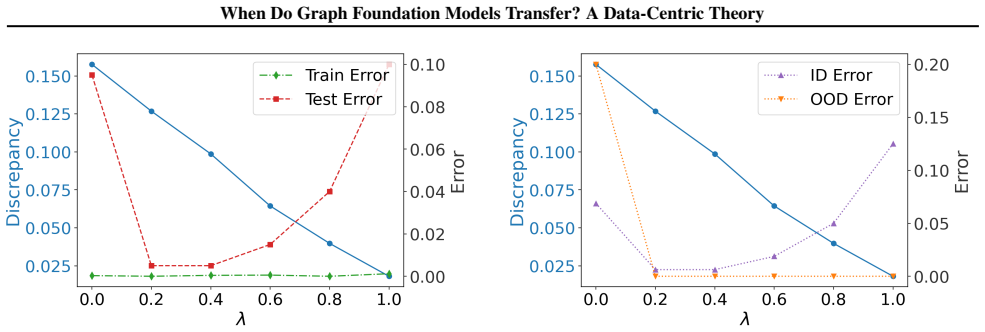
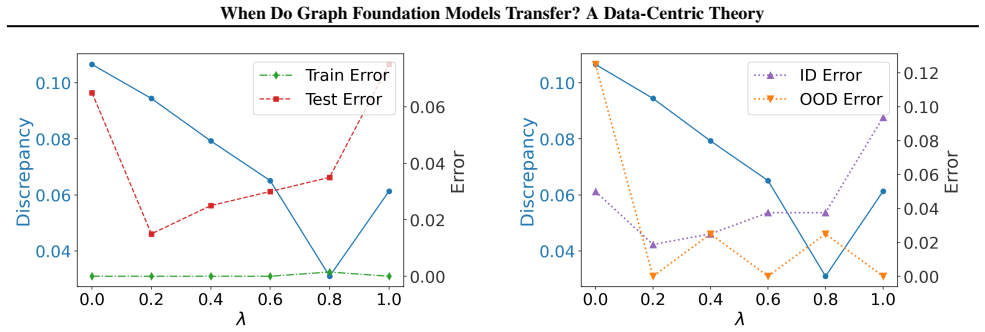
Graph foundation models (GFMs) aim to reuse a single backbone across diverse graph domains, yet their transfer is often uneven and can exhibit negative transfer. While most prior work improves transfer through architectural or adaptation choices, we ask a data-centric question: which properties of two graph domains determine how much a fixed representation model changes its outputs? Using a graphon-based continuous limit for dense graphs, we show that for both set-based and message-passing tokenizations, any Lipschitz backbone admits an explicit decomposition of cross-domain output shift into (i) graph-specific finite-sample approximation terms and (ii) an intrinsic, relabeling-invariant domain discrepancy capturing structural mismatch. A key ingredient is positional-encoding (PE) stability: we establish stability guarantees for spectral PEs and highlight contrasting behaviors of eigenvector- versus subspace-based PEs. Experiments on synthetic and real graphs validate the theory and translate the decomposition into guidance for data curation in GFM transfer.
Editorial analysis
A structured set of objections, weighed in public.
Referee Report
Summary. The paper claims that, under a graphon-based continuous limit for dense graphs together with Lipschitz assumptions on the backbone, both set-based and message-passing tokenizations admit an explicit decomposition of cross-domain output shift into (i) graph-specific finite-sample approximation terms and (ii) an intrinsic, relabeling-invariant domain discrepancy; it further establishes stability guarantees for spectral positional encodings and validates the theory on synthetic and real graphs to guide data curation for graph foundation models.
Significance. If the central decomposition holds under the stated assumptions, the work supplies a data-centric theoretical lens for predicting and improving GFM transfer that is currently missing from the literature. Credit is due for the explicit decomposition separating finite-sample effects from structural mismatch and for the contrasting stability analysis of eigenvector- versus subspace-based PEs.
major comments (2)
- [Abstract / theoretical setup] Abstract and theoretical-setup paragraph: the explicit decomposition of cross-domain output shift into finite-sample terms and relabeling-invariant domain discrepancy is derived under the graphon continuous limit that requires edge densities bounded away from zero as n o∞. For the sparse regimes (average degree O(1) or log n) typical of most GFM applications, the appropriate limiting objects differ and the claimed separation need not hold, rendering the decomposition inapplicable to the data regimes the theory is intended to address.
- [Abstract] Abstract: the claim that any Lipschitz backbone admits the stated decomposition is presented without an accompanying error-bound or convergence-rate analysis that would quantify how the finite-sample terms behave when the graphon assumption is only approximately satisfied; this gap makes it impossible to assess whether the decomposition remains useful once the dense-graph hypothesis is relaxed.
Simulated Author's Rebuttal
We thank the referee for the careful review and for highlighting the importance of clearly delineating the scope of the graphon-based analysis. We respond to each major comment below.
read point-by-point responses
-
Referee: [Abstract / theoretical setup] Abstract and theoretical-setup paragraph: the explicit decomposition of cross-domain output shift into finite-sample terms and relabeling-invariant domain discrepancy is derived under the graphon continuous limit that requires edge densities bounded away from zero as n→∞. For the sparse regimes (average degree O(1) or log n) typical of most GFM applications, the appropriate limiting objects differ and the claimed separation need not hold, rendering the decomposition inapplicable to the data regimes the theory is intended to address.
Authors: The manuscript already states that the results are obtained under a graphon continuous limit for dense graphs. The decomposition and the separation into finite-sample terms and relabeling-invariant discrepancy are derived precisely in that regime. We will revise the abstract and the opening of the theoretical-setup section to state the dense-graph assumption more explicitly and will add a short paragraph in the discussion section acknowledging that sparse-graph regimes require different limiting objects. This makes the intended scope unambiguous while preserving the contribution for the dense case where the stated separation holds. revision: partial
-
Referee: [Abstract] Abstract: the claim that any Lipschitz backbone admits the stated decomposition is presented without an accompanying error-bound or convergence-rate analysis that would quantify how the finite-sample terms behave when the graphon assumption is only approximately satisfied; this gap makes it impossible to assess whether the decomposition remains useful once the dense-graph hypothesis is relaxed.
Authors: The abstract presents the decomposition as holding exactly under the graphon limit (with finite-sample terms already accounting for the distance to that limit). We do not claim quantitative guarantees once the graphon assumption is relaxed. We will revise the abstract to include an explicit qualifier that the result is exact in the limit. A general convergence-rate analysis for approximate graphons lies outside the current technical development; we will note this limitation and flag it as future work in the conclusion. revision: partial
Circularity Check
No significant circularity; derivation is self-contained under stated assumptions
full rationale
The paper derives an explicit decomposition of cross-domain output shift for Lipschitz backbones under a graphon-based continuous limit assumption for dense graphs. This produces finite-sample approximation terms plus an intrinsic relabeling-invariant domain discrepancy from structural mismatch, for both set-based and message-passing tokenizations. The derivation relies on establishing PE stability guarantees rather than fitting parameters or renaming inputs. No self-citation load-bearing steps, self-definitional reductions, or fitted-input-called-prediction patterns appear in the abstract or claim description; the central result is a mathematical decomposition under explicit assumptions and is independent of the target quantities by construction.
Axiom & Free-Parameter Ledger
axioms (2)
- domain assumption Graph domains can be modeled via graphon-based continuous limits for dense graphs
- domain assumption Any backbone is Lipschitz continuous
Reference graph
Works this paper leans on
-
[1]
write newline
" write newline "" before.all 'output.state := FUNCTION n.dashify 't := "" t empty not t #1 #1 substring "-" = t #1 #2 substring "--" = not "--" * t #2 global.max substring 't := t #1 #1 substring "-" = "-" * t #2 global.max substring 't := while if t #1 #1 substring * t #2 global.max substring 't := if while FUNCTION format.date year duplicate empty "emp...
-
[2]
Graph based anomaly detection and description: a survey
Akoglu, L., Tong, H., and Koutra, D. Graph based anomaly detection and description: a survey. Data mining and knowledge discovery, 29 0 (3): 0 626--688, 2015
2015
-
[3]
T., Cohn, H., and Zhao, Y
Borgs, C., Chayes, J. T., Cohn, H., and Zhao, Y. An l^p theory of sparse graph convergence i: Limits, sparse random graph models, and power law distributions. Transactions of the American Mathematical Society, 372 0 (5): 0 3019--3062, 2019
2019
-
[4]
R., Soman, J., Regep, C., Liu, G., Hayter, J
Gaudelet, T., Day, B., Jamasb, A. R., Soman, J., Regep, C., Liu, G., Hayter, J. B., Vickers, R., Roberts, C., Tang, J., et al. Utilizing graph machine learning within drug discovery and development. Briefings in bioinformatics, 22 0 (6), 2021
2021
-
[5]
S., Riley, P
Gilmer, J., Schoenholz, S. S., Riley, P. F., Vinyals, O., and Dahl, G. E. Neural message passing for quantum chemistry. In International conference on machine learning, pp.\ 1263--1272. Pmlr, 2017
2017
-
[6]
M., Rasch, M
Gretton, A., Borgwardt, K. M., Rasch, M. J., Sch \"o lkopf, B., and Smola, A. A kernel two-sample test. The journal of machine learning research, 13 0 (1): 0 723--773, 2012
2012
-
[7]
G-mixup: Graph data augmentation for graph classification
Han, X., Jiang, Z., Liu, N., and Hu, X. G-mixup: Graph data augmentation for graph classification. In Proceedings of the 39th International Conference on Machine Learning (ICML), volume 162 of Proceedings of Machine Learning Research, pp.\ 8230--8248. PMLR, 2022. URL https://proceedings.mlr.press/v162/han22c.html
2022
-
[9]
On the stability of expressive positional encodings for graphs,
Huang, Y., Lu, W., Robinson, J., Yang, Y., Zhang, M., Jegelka, S., and Li, P. On the stability of expressive positional encodings for graphs. In International Conference on Learning Representations (ICLR), 2024. URL https://arxiv.org/abs/2310.02579
-
[10]
Convergence and stability of graph convolutional networks on large random graphs
Keriven, N., Bietti, A., and Vaiter, S. Convergence and stability of graph convolutional networks on large random graphs. In Advances in Neural Information Processing Systems, volume 33, pp.\ 21512--21523, 2020
2020
-
[11]
Kipf, T. N. and Welling, M. Semi-supervised classification with graph convolutional networks. In International Conference on Learning Representations (ICLR), 2017
2017
-
[12]
L., L \'e tourneau, V., and Tossou, P
Kreuzer, D., Beaini, D., Hamilton, W. L., L \'e tourneau, V., and Tossou, P. Rethinking graph transformers with spectral attention. In Advances in Neural Information Processing Systems (NeurIPS), 2021. URL https://arxiv.org/abs/2106.03893
-
[13]
arXiv preprint arXiv:2202.13013 , year=
Lim, D., Robinson, J. D., Zhao, L., Smidt, T., Sra, S., Maron, H., and Jegelka, S. Sign and basis invariant networks for spectral graph representation learning. In International Conference on Learning Representations (ICLR), 2022. URL https://arxiv.org/abs/2202.13013
-
[14]
One for all: Towards training one graph model for all classification tasks
Liu, H., Feng, J., Kong, L., Liang, N., Tao, D., Chen, Y., and Zhang, M. One for all: Towards training one graph model for all classification tasks. In The Twelfth International Conference on Learning Representations
-
[15]
Large networks and graph limits, volume 60
Lov \'a sz, L. Large networks and graph limits, volume 60. American Mathematical Soc., 2012
2012
-
[16]
Position: Graph foundation models are already here
Mao, H., Chen, Z., Tang, W., Zhao, J., Ma, Y., Zhao, T., Shah, N., Galkin, M., and Tang, J. Position: Graph foundation models are already here. In Forty-first International Conference on Machine Learning, 2024
2024
-
[17]
Transferability of graph neural networks: an extended graphon approach
Maskey, S., Levie, R., and Kutyniok, G. Transferability of graph neural networks: an extended graphon approach. Applied and Computational Harmonic Analysis, 63: 0 48--83, 2023
2023
-
[18]
Generalization bounds for message passing networks on mixture of graphons, 2024
Maskey, S., Kutyniok, G., and Levie, R. Generalization bounds for message passing networks on mixture of graphons, 2024. URL https://arxiv.org/abs/2404.03473
-
[19]
Gromov--wasserstein distances and the metric approach to object matching
M \'e moli, F. Gromov--wasserstein distances and the metric approach to object matching. Foundations of computational mathematics, 11 0 (4): 0 417--487, 2011
2011
-
[20]
Graphon neural networks and the transferability of graph neural networks
Ruiz, L., Chamon, L., and Ribeiro, A. Graphon neural networks and the transferability of graph neural networks. Advances in Neural Information Processing Systems, 33: 0 1702--1712, 2020
2020
-
[21]
All in one: Multi-task prompting for graph neural networks
Sun, X., Cheng, H., Li, J., Liu, B., and Guan, J. All in one: Multi-task prompting for graph neural networks. In Proceedings of the 29th ACM SIGKDD Conference on Knowledge Discovery and Data Mining, pp.\ 2120--2131, 2023
2023
-
[22]
Equivariant and stable positional encoding for more powerful graph neural networks
Wang, H., Yin, H., Zhang, M., and Li, P. Equivariant and stable positional encoding for more powerful graph neural networks. In International Conference on Learning Representations (ICLR), 2022. URL https://arxiv.org/abs/2203.00199
-
[23]
P., Liu, S., Wei, R., and Li, P
Wang, H. P., Liu, S., Wei, R., and Li, P. Generalization principles for inference over text-attributed graphs with large language models. In Forty-second International Conference on Machine Learning, 2025
2025
-
[24]
Gft: Graph foundation model with transferable tree vocabulary
Wang, Z., Zhang, Z., Chawla, N., Zhang, C., and Ye, Y. Gft: Graph foundation model with transferable tree vocabulary. Advances in Neural Information Processing Systems, 37: 0 107403--107443, 2024
2024
-
[25]
Xia, L. and Huang, C. Anygraph: Graph foundation model in the wild. arXiv preprint arXiv:2408.10700, 2024
-
[26]
Xu, H., Luo, D., Zha, H., and Duke, L. C. Gromov-wasserstein learning for graph matching and node embedding. In International conference on machine learning, pp.\ 6932--6941. PMLR, 2019 a
2019
-
[27]
How powerful are graph neural networks? In International Conference on Learning Representations (ICLR), 2019 b
Xu, K., Hu, W., Leskovec, J., and Jegelka, S. How powerful are graph neural networks? In International Conference on Learning Representations (ICLR), 2019 b
2019
-
[28]
L., and Leskovec, J
Ying, R., He, R., Chen, K., Eksombatchai, P., Hamilton, W. L., and Leskovec, J. Graph convolutional neural networks for web-scale recommender systems. In Proceedings of the 24th ACM SIGKDD international conference on knowledge discovery & data mining, pp.\ 974--983, 2018
2018
-
[29]
Yun, S., Jeong, M., Kim, R., Kang, J., and Kim, H. J. Graph transformer networks. In Advances in Neural Information Processing Systems, pp.\ 11960--11970, 2019
2019
-
[30]
R., and Smola, A
Zaheer, M., Kottur, S., Ravanbakhsh, S., Poczos, B., Salakhutdinov, R. R., and Smola, A. J. Deep sets. In Guyon, I., Luxburg, U. V., Bengio, S., Wallach, H., Fergus, R., Vishwanathan, S., and Garnett, R. (eds.), Advances in Neural Information Processing Systems 30, pp.\ 3391--3401. Curran Associates, Inc., 2017. URL http://papers.nips.cc/paper/6931-deep-sets.pdf
2017
discussion (0)
Sign in with ORCID, Apple, or X to comment. Anyone can read and Pith papers without signing in.