Optical Cooling of Nuclear Spins in a CdTe/CdZnTe Quantum Well: The Impact of Kinetic Local Fields on Cooling Efficiency
Pith reviewed 2026-06-29 06:48 UTC · model grok-4.3
The pith
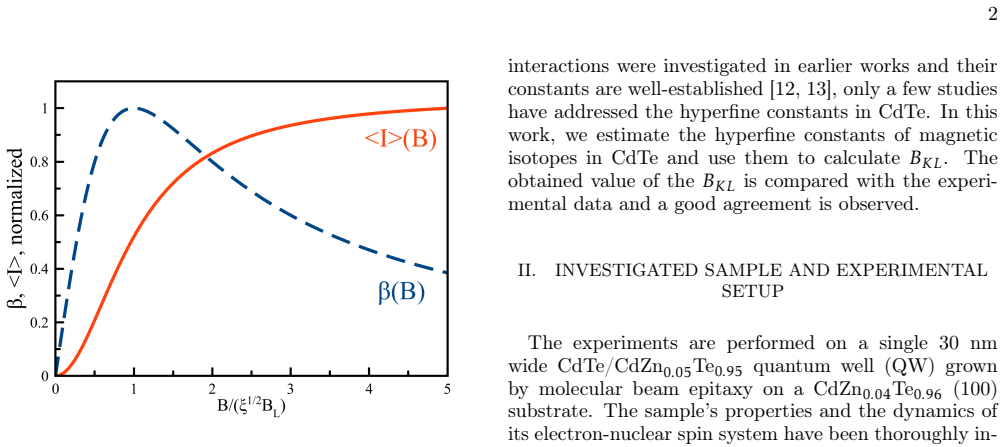
Nuclear spin cooling in a CdTe quantum well peaks at an external magnetic field set by the kinetic local field B_KL of about 1 Gauss.
A machine-rendered reading of the paper's core claim, the machinery that carries it, and where it could break.
Core claim
Our results confirm that there is indeed an optimal external magnetic field for optical cooling. We associate it with the kinetic local field B_KL defined by the heating rate of the spin-spin reservoir due to the fluctuations of the hyperfine interaction. For our sample we find that B_KL=1.0±0.4 G and it is independent of the electron polarization and pump power. The measured values of the kinetic local fields are in good agreement with a theoretical calculation B_KL = 0.7 G, taking into account indirect spin-spin interactions of Cd and Te nuclear spins and their considerably different hyperfine constants. The hyperfine constants of the magnetic isotopes of Cd and Te in CdTe are estimated.
What carries the argument
The kinetic local field B_KL, defined by the heating rate of the spin-spin reservoir due to fluctuations of the hyperfine interaction.
If this is right
- The cooling efficiency reaches its maximum when the applied magnetic field equals B_KL.
- B_KL can be measured by locating the field that maximizes cooling efficiency.
- B_KL does not depend on the degree of electron polarization or the optical pump power.
- A theoretical model that includes indirect spin-spin interactions between Cd and Te nuclei and their different hyperfine constants predicts B_KL close to the experimental value.
- The hyperfine constants for the magnetic isotopes of Cd and Te in CdTe can be estimated from the match between measured and calculated B_KL.
Where Pith is reading between the lines
- If B_KL controls the cooling limit in this system, similar optimal fields should exist in other quantum wells or semiconductors where optical pumping cools nuclear spins.
- The proposed measurement technique for B_KL could be used to characterize nuclear spin dynamics in materials for spin-based quantum technologies.
- Accounting for the difference in hyperfine constants between isotopes may be necessary to model cooling in other II-VI compounds accurately.
- The observed independence from pump power implies that the dominant fluctuations are internal to the nuclear system rather than driven by the optical excitation rate.
Load-bearing premise
The maximum in cooling efficiency occurs because of the kinetic local field B_KL from hyperfine fluctuations rather than some other unaccounted mechanism.
What would settle it
A measurement showing that the field value maximizing cooling efficiency changes with pump power or polarization, or that no maximum occurs near the calculated 0.7-1 G, would falsify the identification with a fixed B_KL.
Figures
read the original abstract
The efficiency of optical cooling of nuclear spins in a CdTe/CdZnTe quantum well is investigated as a function of an external magnetic field. Our results confirm that there is indeed an optimal external magnetic field for optical cooling. We associate it with the kinetic local field $B_{KL}$ defined by the heating rate of the spin-spin reservoir due to the fluctuations of the hyperfine interaction. We also propose an experimental technique for measuring $B_{KL}$. For our sample we find that $B_{KL}=1.0\pm0.4$ G and it is independent of the electron polarization and pump power. The measured values of the kinetic local fields are in good agreement with a theoretical calculation $B_{KL} = 0.7$ G, taking into account indirect spin-spin interactions of Cd and Te nuclear spins and their considerably different hyperfine constants. The hyperfine constants of the magnetic isotopes of Cd and Te in CdTe are estimated.
Editorial analysis
A structured set of objections, weighed in public.
Referee Report
Summary. The manuscript examines the efficiency of optical cooling of nuclear spins in a CdTe/CdZnTe quantum well versus external magnetic field. It reports confirmation of an optimal field, associates it with the kinetic local field B_KL defined via the heating rate of the spin-spin reservoir from hyperfine fluctuations, proposes an experimental technique to measure B_KL, finds B_KL = 1.0 ± 0.4 G independent of electron polarization and pump power, and shows agreement with a theoretical value of 0.7 G that incorporates indirect spin-spin interactions between Cd and Te nuclei along with their differing hyperfine constants (which are also estimated in the work).
Significance. If substantiated, the results would provide direct experimental support for the kinetic local field as the origin of the optimal cooling field, introduce a practical measurement technique for B_KL, and deliver hyperfine constant estimates for Cd and Te in CdTe. The reported independence from polarization and power, together with the numerical match to theory that includes indirect interactions, would strengthen the mechanistic interpretation of nuclear spin cooling limits in quantum wells.
minor comments (1)
- [Abstract] Abstract: the theoretical B_KL = 0.7 G is stated without an associated uncertainty; reporting the uncertainty (or range) from the hyperfine constants and indirect-interaction model would allow a more quantitative comparison to the experimental 1.0 ± 0.4 G.
Simulated Author's Rebuttal
We thank the referee for the positive assessment of our manuscript, the accurate summary of our findings, and the recommendation for minor revision. No specific major comments were provided in the report.
Circularity Check
No significant circularity; derivation is self-contained
full rationale
The paper measures B_KL experimentally as 1.0±0.4 G (independent of polarization and power) and reports a separate theoretical estimate of 0.7 G that incorporates indirect spin-spin interactions plus estimated hyperfine constants for Cd and Te. No equation or section is shown in which the hyperfine constants are fitted directly to the cooling-efficiency optimum or to the measured B_KL value itself; the theoretical value is presented as an a-priori calculation whose agreement with experiment is offered as corroboration rather than a tautology. The definition of B_KL (heating rate of the spin-spin reservoir due to hyperfine fluctuations) is introduced as an independent physical quantity, not defined in terms of the observed optimum. No self-citation chain, ansatz smuggling, or renaming of a known result is required for the central claim. The derivation therefore remains externally falsifiable and does not reduce to its own inputs by construction.
Axiom & Free-Parameter Ledger
free parameters (1)
- hyperfine constants of Cd and Te
axioms (1)
- domain assumption The optimal external magnetic field for optical cooling corresponds to the kinetic local field B_KL
invented entities (1)
-
kinetic local field B_KL
no independent evidence
Reference graph
Works this paper leans on
-
[1]
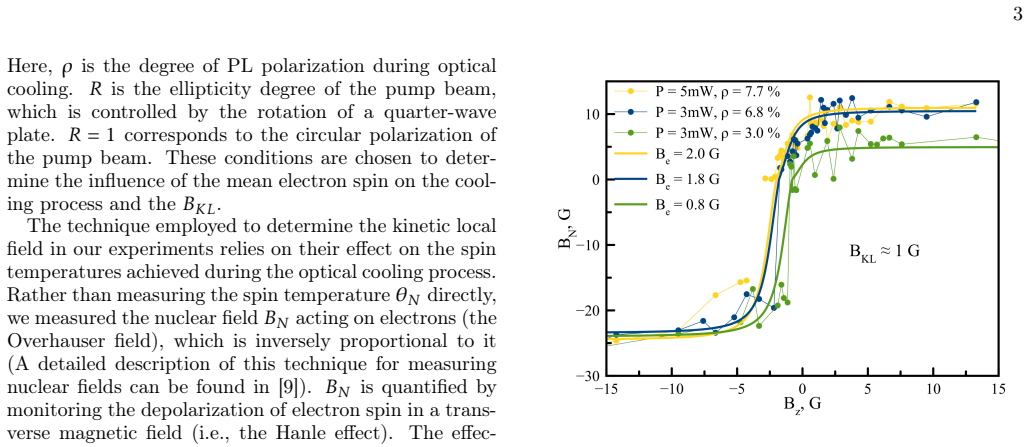
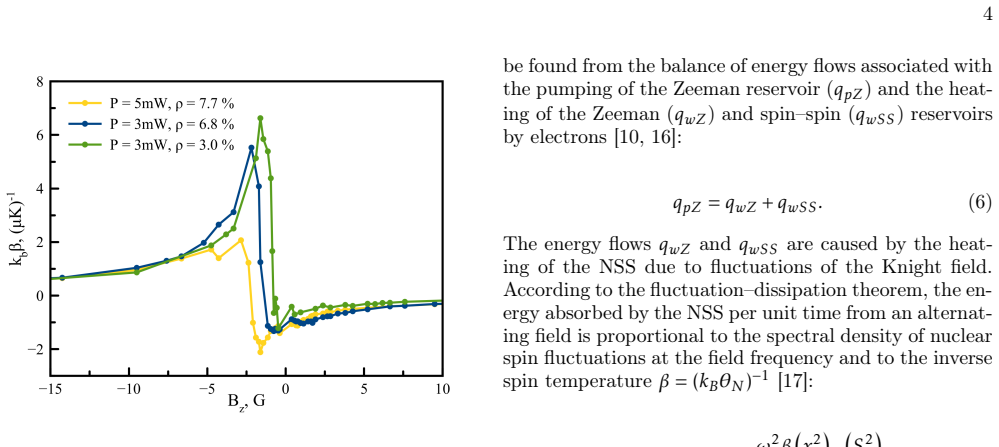
Circularly polarized optical pumping (R= 1,ρ= 6.8 %) with a pump power of 3 mW
-
[2]
Circularly polarized optical pumping (R= 1,ρ= 7.7%) with a pump power of 5 mW
-
[3]
measuring
Elliptically polarized optical pumping (R= 0.64, ρ= 3.0 %) with a pump power of 3 mW; 3 Here,ρis the degree of PL polarization during optical cooling.Ris the ellipticity degree of the pump beam, which is controlled by the rotation of a quarter-wave plate.R= 1corresponds to the circular polarization of the pump beam. These conditions are chosen to deter- m...
-
[4]
Goldman, Spin Temperature and Nuclear Magnetic Resonance in Solids (Clarendon Press, Oxford, 1970)
M. Goldman, Spin Temperature and Nuclear Magnetic Resonance in Solids (Clarendon Press, Oxford, 1970)
1970
-
[5]
A.Abragam, Principles of Nuclear Magnetism (Claren- don Press, Oxford, 1961)
1961
-
[6]
I. A. Merkulov, Formation of a nuclear spin polaron under optical orientation in gaas-type semiconductors, Physics of the Solid State 40, 930 (1998)
1998
-
[7]
Vladimirova, D
M. Vladimirova, D. Scalbert, M. S. Kuznetsova, and K. V. Kavokin, Electron-induced nuclear magnetic order- ing inn-type semiconductors, Phys. Rev. B 103, 205207 (2021)
2021
-
[8]
Fischer, I
A. Fischer, I. Kleinjohann, F. B. Anders, and M. M. Glazov, Kinetic approach to nuclear-spin polaron forma- tion, Phys. Rev. B 102, 165309 (2020)
2020
-
[9]
R. I. Dzhioev, K. V. Kavokin, V. L. Korenev, M. V. Lazarev, B. Y. Meltser, M. N. Stepanova, B. P. Za- kharchenya, D. Gammon, and D. S. Katzer, Low- temperature spin relaxation in n-type gaas, Phys. Rev. B 66, 245204 (2002)
2002
-
[10]
Dyakonov and V
M. Dyakonov and V. Perel, Optical orientation in a sys- tem of electrons and lattice nuclei in semiconductors. the- ory, Journal of Experimental and Theoretical Physics 65, 362 (1973)
1973
-
[11]
V. M. Litvyak, R. V. Cherbunin, V. K. Kalevich, and K. V. Kavokin, Local field of spin-spin interactions in the nuclear spin system ofn-gaas, Phys. Rev. B 108, 235204 (2023)
2023
-
[12]
V. M. Litvyak, M. S. Kuznetsova, V. S. Berdnikov, P. S. Bazhin, and K. V. Kavokin, Measurement of nu- clear local field by adiabatic demagnetization method for CdTe/CdZnTe quantum well, Semiconductors 59, 72 (2025)
2025
-
[13]
D. S. Smirnov and K. V. Kavokin, Cooling and heating nuclear spins by strongly localized electrons, Phys. Rev. Lett. 134, 016201 (2025)
2025
-
[14]
I. A. Merkulov and V. G. Fleisher, Optical Orientation of the Coupled Electron-Nuclear Spin System of a Semi- conductor,inOpticalOrientation,editedbyF.Meierand B. P. Zakharchenya (North-Holland, Amsterdam, 1984) Chap. 5, pp. 173–258
1984
-
[15]
Nolle, Direct and indirect dipole-dipole coupling be- tween 111Cd, 113Cd and 125Te in solid CdTe, Zeitschrift f¨ ur Physik B Condensed Matter 34, 175 (1979)
A. Nolle, Direct and indirect dipole-dipole coupling be- tween 111Cd, 113Cd and 125Te in solid CdTe, Zeitschrift f¨ ur Physik B Condensed Matter 34, 175 (1979)
1979
-
[16]
V. M. Litvyak, P. S. Bazhin, R. Andr´ e, M. Vladimirova, and K. V. Kavokin, Nuclear spin-spin interactions in CdTe probed by zero- and ultralow-field optically de- tected NMR, Phys. Rev. B 110, 245303 (2024)
2024
-
[17]
B. F. Gribakin, V. M. Litvyak, M. Kotur, R. Andr´ e, M. Vladimirova, D. R. Yakovlev, and K. V. Kavokin, Nu- clear spin relaxation mediated by donor-bound and free electrons in wide CdTe quantum wells, Phys. Rev. B 109, 195302 (2024)
2024
-
[18]
V. M. Litvyak, R. V. Cherbunin, V. K. Kalevich, A. I. Lihachev, A. V. Nashchekin, M. Vladimirova, and K. V. Kavokin, Warm-up spectroscopy of quadrupole-split nu- clear spins inn-GaAs epitaxial layers, Phys. Rev. B 104, 235201 (2021)
2021
-
[19]
M. I. Dyakonov and V. I. Perel, Optical Orientation, editedbyB.ZakharchenyaandF.Meyer(North-Holland, Amsterdam, 1984)
1984
-
[20]
Landau and E
L. Landau and E. Lifshitz, Statistical Physics, 3rd ed., Course of Theoretical Physics, Vol. 5 (Butterworth- Heinemann, 1980)
1980
-
[21]
We consider such a coincidence to be merely accidental, related to the specific values of the indirect interaction and the hyperfine constants
Surprisingly, this result is in goodagreementwith the one obtained in [7] √ξ= √ 3, with only direct dipole-dipole interactions included, despite the fact that the constants of the indirect scalar coupling in CdTe are larger than the direct ones and should strongly affect the values of BL andB KL. We consider such a coincidence to be merely accidental, rel...
-
[22]
D.C.LookandD.L.Moore,Nuclear-magnetic-resonance measurement of the conduction-electrongfactor in cdte, Phys. Rev. B 5, 3406 (1972)
1972
-
[23]
Nakamura, D
A. Nakamura, D. Paget, C. Hermann, C. Weisbuch, G. Lampel, and B. Cavenett, Optical detection of elec- tron spin resonance in cdte, Solid State Communications 30, 411 (1979)
1979
-
[24]
Morton and K
J. Morton and K. Preston, Atomic parameters for para- magnetic resonance data, Journal of Magnetic Resonance (1969) 30, 577 (1978)
1969
-
[25]
J. H. Mackey and D. E. Wood, Empirical correction to Hartree-Fock-Slater S-Electron densities for calculation of contact hyperfine splittings, The Journal of Chemical 8 Physics 52, 4914 (1970)
1970
-
[26]
Cronenberger, H
S. Cronenberger, H. Boukari, D. Ferrand, J. Cibert, and D. Scalbert, Long-range spin jump diffusion revealed by dynamic light scattering, Phys. Rev. B 103, 205208 (2021)
2021
-
[27]
A. L. Zibinskiy, S. Cronenberger, B. Gribakin, R. Baye, D. Scalbert, R. Andr´ e, D. S. Smirnov, and M. Vladimirova, Spin noise of localized electrons in a cdte/cdmgte quantum well, Phys. Rev. B 113, 205418 (2026)
2026
-
[28]
S. Cronenberger, C. Abbas, D. Scalbert, and H. Boukari, Spatiotemporal electronic spin fluctuations in random nuclear fields in n-cdte (2019), arXiv:1910.11805 [cond- mat.mes-hall]
-
[29]
Paget, G
D. Paget, G. Lampel, B. Sapoval, and V. I. Safarov, Low field electron-nuclear spin coupling in gallium arsenide under optical pumping conditions, Phys. Rev. B 15, 5780 (1977). 9 Table II. The parameters of the magnetic nuclei in CdTe. isotope I x, %γ N rad s−1 G−1 ψ (0) 2 ,10 25 cm−3 A,µeVb N, G 111Cd 1/2 12.8−5.698·10 3 4.20 -24.5 170 113Cd 1/2 12.2−5.9...
1977
discussion (0)
Sign in with ORCID, Apple, or X to comment. Anyone can read and Pith papers without signing in.