Estimates of ground state energies for the quantum SK and 2D-EA models, using deGennes-Suzuki-Kubo mean-field annealing dynamics
Pith reviewed 2026-06-30 11:08 UTC · model grok-4.3
The pith
Solving the deGennes-Suzuki-Kubo mean-field dynamics during quantum annealing provides ground state energy estimates for the Sherrington-Kirkpatrick model up to system size 40000.
A machine-rendered reading of the paper's core claim, the machinery that carries it, and where it could break.
Core claim
Numerically integrating the deGennes-Suzuki-Kubo mean-field quantum Ising dynamics from the quantum paramagnetic state to low transverse field produces spin configurations that estimate the ground state energies of the SK model for N up to 40000 and of the 2D EA model. The method has algorithmic cost O(N^3).
What carries the argument
deGennes-Suzuki-Kubo mean-field quantum Ising dynamics: a system of differential equations for the evolution of mean magnetizations under a time-dependent transverse field in the quantum Ising model.
If this is right
- The ground state energy of the SK model can be estimated at system sizes up to 40,000 spins.
- The computational cost for these estimates scales as O(N^3).
- The same procedure applies to the Edwards-Anderson model on square lattices.
- Annealing begins from the quantum paramagnetic phase for both models.
Where Pith is reading between the lines
- This method could be applied to estimate ground states in higher-dimensional or other lattice spin glasses where exact solutions are unavailable.
- Comparing the obtained energies to theoretical predictions like the Parisi value for SK could test the method's accuracy at large N.
- If the dynamics are faithful, they might help understand the quantum phase transition in these models.
Load-bearing premise
The deGennes-Suzuki-Kubo mean-field quantum Ising dynamics, when solved numerically, produce spin configurations whose energies match the true ground state energies of the models.
What would settle it
For small system sizes where the exact ground state energy is known by other methods, the energies from this dynamics deviate by more than the expected numerical precision.
Figures
read the original abstract
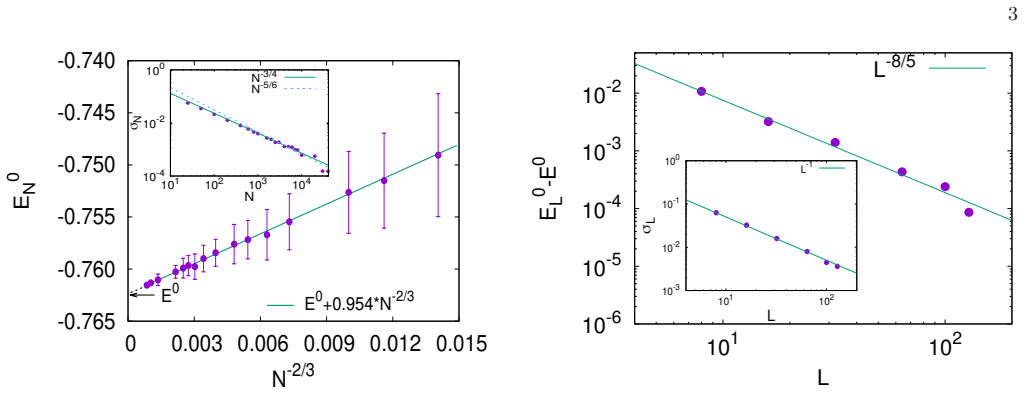
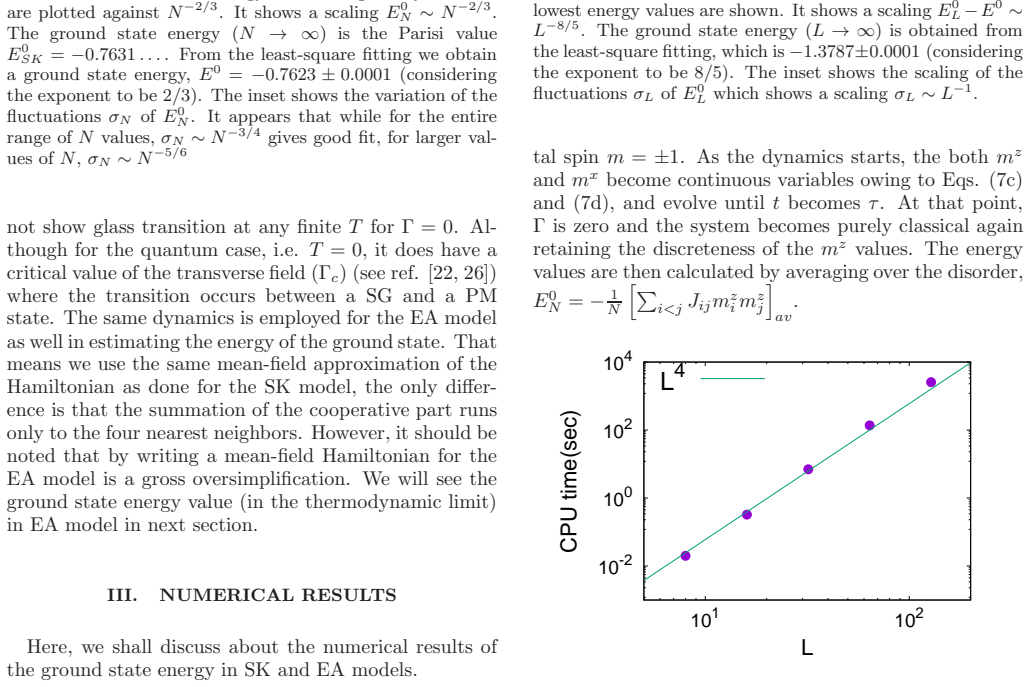
We perform large scale quantum annealing of the Sherrington-Kirkpatrick (SK) spin glass up to a system size $N=40000$ to estimate its ground state energy using the deGennes-Suzuki-Kubo mean-field quantum Ising dynamics, extending the earlier results (reported in Eur. Phys. J. B {\bf 98}, 226 (2025)). Here we numerically solve the deGennes-Suzuki-Kubo annealing dynamics to obtain the spin configurations and subsequently the ground state energy for a given system size at the end of the annealing, starting from a quantum paramagnetic state. The method shows high efficiency, with an overall algorithmic cost of $O(N^3)$ in estimating the energy of the ground state. We later extend this quantum annealing study to estimate the ground state energies (starting again from the quantum paramagnetic phase, annealing down to any desired low value of the transverse field) for the Edwards-Anderson (EA) spin glass model on a square lattice.
Editorial analysis
A structured set of objections, weighed in public.
Referee Report
Summary. The paper claims to estimate ground-state energies of the Sherrington-Kirkpatrick (SK) spin glass up to N=40000 and the 2D Edwards-Anderson (EA) model by numerically integrating the deGennes-Suzuki-Kubo mean-field quantum Ising annealing dynamics from the quantum paramagnetic initial state down to low transverse field, obtaining classical spin configurations whose energies are reported as ground-state estimates, with overall cost O(N^3), extending prior results in Eur. Phys. J. B 98, 226 (2025).
Significance. If the dynamics reliably reach the true classical ground states, the work would supply concrete numerical estimates at system sizes far beyond exact diagonalization or branch-and-bound reach, particularly for all-to-all SK where the mean-field closure becomes exact in the N→∞ limit. The reported scale (N=40000) and the deterministic, parameter-free character of the flow constitute a computational strength.
major comments (3)
- [Numerical results / Method description] The manuscript provides no benchmarks of the final energies against exact or high-precision reference values for any small-N instances (N≤20 for SK or small 2D lattices for EA) where such comparisons are computationally feasible. This omission is load-bearing for the central claim that the mean-field flow yields accurate ground-state estimates.
- [EA model results section] For the 2D EA model the mean-field closure is uncontrolled; the text contains no quantitative error analysis, comparison to SDP relaxations, or Monte-Carlo bounds that would establish the deviation of the reported energies from the true ground state.
- [Discussion of SK results] The assumption that the deterministic annealing trajectory reaches the global minimum of the classical energy (rather than a local minimum) is stated but not supported by any analysis of possible trapping or by comparison with known ground-state energies at intermediate N.
minor comments (1)
- [Complexity paragraph] The O(N^3) complexity statement should be accompanied by a brief breakdown of the dominant operations (integration of N coupled ODEs with dense N×N couplings) to clarify whether the quoted scaling includes the full annealing schedule.
Simulated Author's Rebuttal
We thank the referee for their careful reading of the manuscript and for the constructive comments. We respond to each major comment below, indicating the revisions we will make to address the concerns.
read point-by-point responses
-
Referee: The manuscript provides no benchmarks of the final energies against exact or high-precision reference values for any small-N instances (N≤20 for SK or small 2D lattices for EA) where such comparisons are computationally feasible. This omission is load-bearing for the central claim that the mean-field flow yields accurate ground-state estimates.
Authors: We agree that providing benchmarks against exact results for small systems is important to validate the method. Although our primary results focus on large N, we will revise the manuscript to include a new section or subsection with comparisons to known ground-state energies for small N instances of both models, using available exact or high-precision data from the literature. This will help assess the accuracy of the mean-field dynamics. revision: yes
-
Referee: For the 2D EA model the mean-field closure is uncontrolled; the text contains no quantitative error analysis, comparison to SDP relaxations, or Monte-Carlo bounds that would establish the deviation of the reported energies from the true ground state.
Authors: We recognize that the mean-field approximation for the 2D EA model is uncontrolled. The reported energies are estimates from the annealing dynamics. In the revised version, we will add a quantitative discussion of the expected errors, including comparisons to Monte Carlo bounds and SDP relaxations from the literature for the 2D EA model to better contextualize the deviation from the true ground state. revision: yes
-
Referee: The assumption that the deterministic annealing trajectory reaches the global minimum of the classical energy (rather than a local minimum) is stated but not supported by any analysis of possible trapping or by comparison with known ground-state energies at intermediate N.
Authors: For the SK model, the mean-field dynamics becomes exact in the thermodynamic limit, supporting the expectation that the trajectory reaches the global minimum. To strengthen this, we will include in the revision comparisons of our results with known ground-state energy estimates at intermediate system sizes (e.g., N around 100-1000) from other methods, and discuss the deterministic nature of the flow which appears to avoid trapping in our simulations. revision: yes
Circularity Check
Direct numerical integration of specified dynamics; no reduction to inputs by construction
full rationale
The paper's central procedure is forward numerical integration of the deGennes-Suzuki-Kubo mean-field equations starting from the quantum paramagnetic state and annealing the transverse field to zero (or low value), then reading off the final classical energy. No parameters are fitted to data, no output is renamed as a prediction of itself, and no uniqueness theorem or ansatz is imported via self-citation to force the result. The self-citation to Eur. Phys. J. B 98, 226 (2025) merely notes prior application of the same method and does not bear the load of the current computation. The method is therefore self-contained against external benchmarks and exhibits no circularity.
Axiom & Free-Parameter Ledger
axioms (1)
- domain assumption The deGennes-Suzuki-Kubo mean-field quantum Ising dynamics accurately estimates ground state energies for SK and EA models when solved numerically.
Reference graph
Works this paper leans on
-
[1]
The same initial spin configurations are also taken here
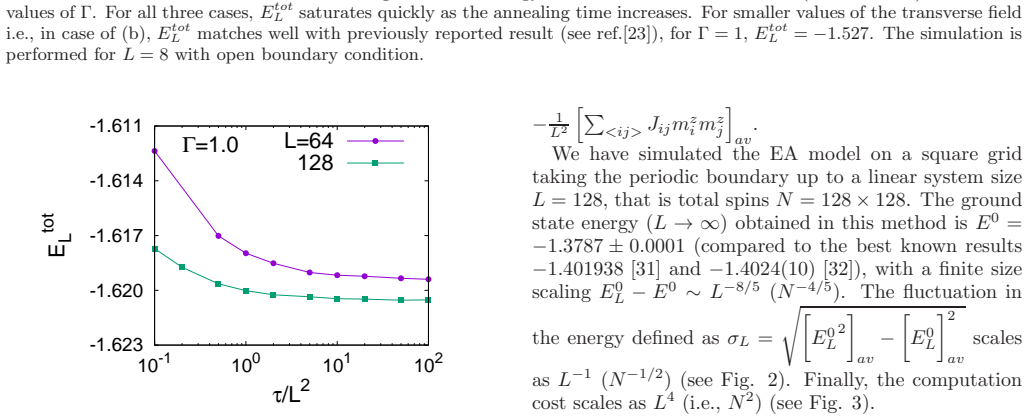
Annealed ground state energy Similarly, Eq.(7d) for mz is numerically solved as well in case of an EA model, keeping T fixed at zero and linearly decreasing the transverse field (Γ from Γ 0 = 4 to Γ = 0) according to above procedure. The same initial spin configurations are also taken here. However, for the EA model, τ is chosen as 100 L2 (not 5N as in case ...
-
[2]
(7c) and (7d), for mx and mz re- spectively, are numerically solved, again keeping T = 0 and linearly decreasing from Γ( t = 0) = 4 to Γ( t = τ) = 0
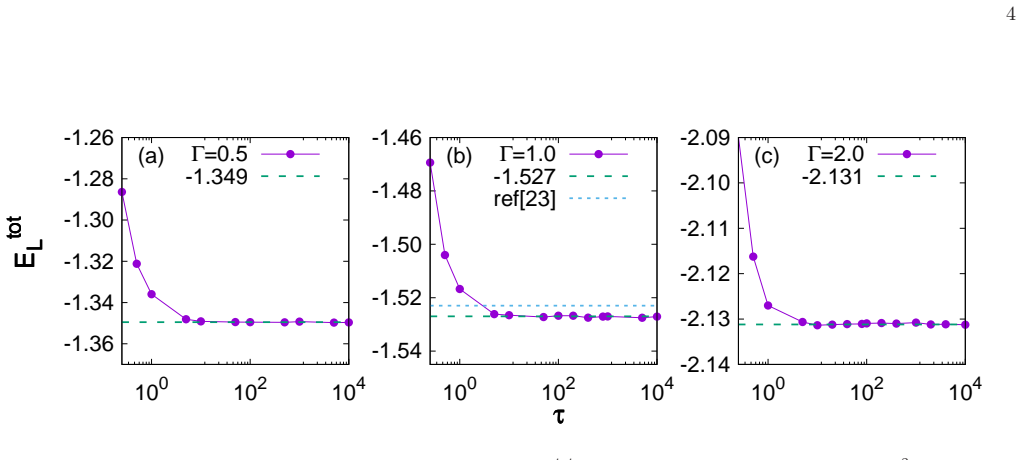
Annealed ground state energy for finite Γ Here both Eqs. (7c) and (7d), for mx and mz re- spectively, are numerically solved, again keeping T = 0 and linearly decreasing from Γ( t = 0) = 4 to Γ( t = τ) = 0 . 5, 1, 2. As there is a finite transverse field present in the system during the dynamics, both spin components mx and mz are present. In other words, bo...
-
[3]
Sherrington and S
D. Sherrington and S. Kirkpatrick, Solvable Model of a Spin-Glass, Phys. Rev. Lett. 35, 1792 (1975)
1975
-
[4]
S. F. Edwards and P. W. Anderson, Theory of spin glasses J. Phys. F: Met. Phys. 5, 965 (1975)
1975
-
[5]
Mezard, A
M. Mezard, A. Montanari, Information, Physics, and Computation, Oxford University Press, Inc., USA, 2009
2009
-
[6]
Binder and A
K. Binder and A. P. Young, Spin glasses: Experimental facts, theoretical concepts, and open questions , Rev. Mod. Phys. 58, 801 (1986)
1986
-
[7]
Parisi, Infinite Number of Order Parameters for Spin- Glasses, Phys
G. Parisi, Infinite Number of Order Parameters for Spin- Glasses, Phys. Rev. Lett. 43, 1754 (1979)
1979
-
[8]
Parisi, A sequence of approximated solutions to the S-K model for spin glasses , J
G. Parisi, A sequence of approximated solutions to the S-K model for spin glasses , J. Phys. A 13, 1101 (1980)
1980
-
[9]
Oppermann, M
R. Oppermann, M. J. Schmidt and D. Sherrington, Dou- ble Criticality of the Sherrington-Kirkpatrick Model at T=0, Phys. Rev. Lett. 98, 127201 (2007)
2007
-
[10]
Kirkpatrick, C
S. Kirkpatrick, C. D. Gelatt and M. P. Vecchi, Optimiza- tion by Simulated Annealing , Science 220 671 (1983)
1983
-
[11]
Boettcher, Extremal Optimization for Sherrington- Kirkpatrick Spin Glasses , Eur
S. Boettcher, Extremal Optimization for Sherrington- Kirkpatrick Spin Glasses , Eur. Phys. J. B 46, 501 (2005)
2005
-
[12]
Boettcher, Simulations of ground state fluctuations in mean-field Ising spin glasses , J
S. Boettcher, Simulations of ground state fluctuations in mean-field Ising spin glasses , J. Stat. Mech. 2010, P07002 (2010)
2010
-
[13]
Duxbury, C
P. Duxbury, C. Lavor , L. L. de Salles-Neto, A continu- ous nonlinear optimization perspective on the Spin Glass Problem, Physica A 686, 131356 (2026)
2026
-
[14]
P. Ray, B. K. Chakrabarti and A. Chakrabarti, Sherrington-Kirkpatrick model in a transverse field: Ab- sence of replica symmetry breaking due to quantum fluc- tuations, Phys. Rev. B 39, 11828 (1989)
1989
-
[15]
Das and B
A. Das and B. K. Chakrabarti, Colloquium: Quantum annealing and analog quantum computation , Rev. Mod. Phys. 80, 1061–1081 (2008)
2008
-
[16]
Suzuki and R
M. Suzuki and R. Kubo, Dynamics of the Ising model near the critical point. I , J. Phys. Soc. Jap. 24, 51-60 (1968)
1968
-
[17]
D. J. Thouless , P. W. Anderson and R. G. Palmer, So- lution of ’Solvable model of a spin glass’ , Phil. Mag., 35, 593 (1977)
1977
-
[18]
S. Das, S. Biswas, and B. K. Chakrabarti, Classical Annealing of Sherrington- Kirkpatrick Spin Glass Using Kubo-Suzuki Mean-field Ising Dynamics , Phys. Rev. E 112, 014104 (2025)
2025
-
[19]
S. Das, S. Biswas and B. K. Chakrabarti, Quantum An- nealing in SK Model Employing Suzuki-Kubo-deGennes Quantum Ising Mean Field Dynamics , Eur. Phys. J. B 98, 226 (2025)
2025
-
[20]
P. G. de Gennes, Collective motions of hydrogen bonds , Solid State Commun. 1, 132–137 (1963)
1963
-
[21]
Brout, K
R. Brout, K. A. M¨ uller, and H. Thomas, Tunnelling and collective excitations in a microscopic model of ferroelec - tricity, Solid State Commun. 4, 507–510 (1966)
1966
-
[22]
S. Das, S. Biswas, M. Acharyya and B. K. Chakrabarti, de Gennes–Suzuki–Kubo Quantum Ising Mean-Field Dy- namics: Applications to Quantum Hysteresis, Heat En- gines, and Annealing , Condens. Matter 10, 58 (2025). 6
2025
-
[23]
Ishii and T
H. Ishii and T. Yamamoto, Effect of a transverse field on the spin glass freezing in the Sherrington-Kirkpatrick model, J . Phys. C: Solid State Phys. 18, 6225 (1985)
1985
-
[24]
B. K. Chakrabarti, Critical behavior of the Ising spin- glass models in a transverse field , Phys. Rev. B 24, 4062 (1981)
1981
-
[25]
Y. Pang, A. Jayakumar, E. McKinney, C. Coffrin, M. Vuffray and A. Y. Lokhov Autoregressive pairwise Graph- ical Models efficiently find ground state representations of stoquastic Hamiltonians , IEEE International Conference on Quantum Computing and Engineering (QCE) (2025)
2025
-
[26]
Acharyya and B
M. Acharyya and B. K. Chakrabarti, Magnetic hysteresis loops as Lissajous plots of relaxationally delayed respons e to periodic field variation , Physica A 202, pp. 467–481 (1994)
1994
-
[27]
Acharyya, B
M. Acharyya, B. K. Chakrabarti, and R. B. Stinchcombe, Hysteresis in Ising model in transverse field , J. Phys. A: Math. Gen. 27, pp. 1533–1540 (1994)
1994
-
[28]
Bernaschi, I
M. Bernaschi, I. Gonz´ alez-Adalid Pemart ´ ın, V. Mart ´ın- Mayor and G. Parisi, The quantum transition of the two- dimensional Ising spin glass , Nature 631, 749 (2024)
2024
-
[29]
Ground-state energy and frustration of the Sherrington-Kirkpatrick model and related models
S. Kobe, Ground-state energy and frustration of the Sherrington-Kirkpatrick model and related models , https://arxiv.org/pdf/cond-mat/0311657
work page internal anchor Pith review Pith/arXiv arXiv
-
[30]
Montanari, Optimization of the Sherrington– Kirkpatrick Hamiltonian , SIAM J
A. Montanari, Optimization of the Sherrington– Kirkpatrick Hamiltonian , SIAM J. Comput. (2019) https://doi.org/10.1137/20M132016X
-
[31]
C. M. Newman and D. L. Stein, Nature of Ground State Incongruence in Two-Dimensional Spin Glasses , Phys. Rev. Lett. 84, 17 (2000)
2000
-
[32]
J. W. Landry and S. N. Coppersmith, Ground states of two-dimensional ± J Edwards-Anderson spin glasses , Phys. Rev. B 65, 134404 (2002)
2002
-
[33]
I. A. Campbell, A. K. Hartmann, and H. G. Katzgraber, Energy size effects of two-dimensional Ising spin glasses Phys. Rev. B 70, 054429 (2004)
2004
-
[34]
Perez-Moreloa, A.J
D.J. Perez-Moreloa, A.J. Ramirez-Pastor, and F. Rom´ a , Ground-state energy and entropy of the two-dimensional Edwards–Anderson spin-glass model with different bond distributions, Physica A 391, 937-947 (2012)
2012
discussion (0)
Sign in with ORCID, Apple, or X to comment. Anyone can read and Pith papers without signing in.