Transient Signatures of Star-Envelope Collisions in Little Red Dots
Pith reviewed 2026-06-29 06:07 UTC · model grok-4.3
The pith
Collisions between red supergiants and gaseous envelopes around black holes in little red dots produce luminous transients.
A machine-rendered reading of the paper's core claim, the machinery that carries it, and where it could break.
Core claim
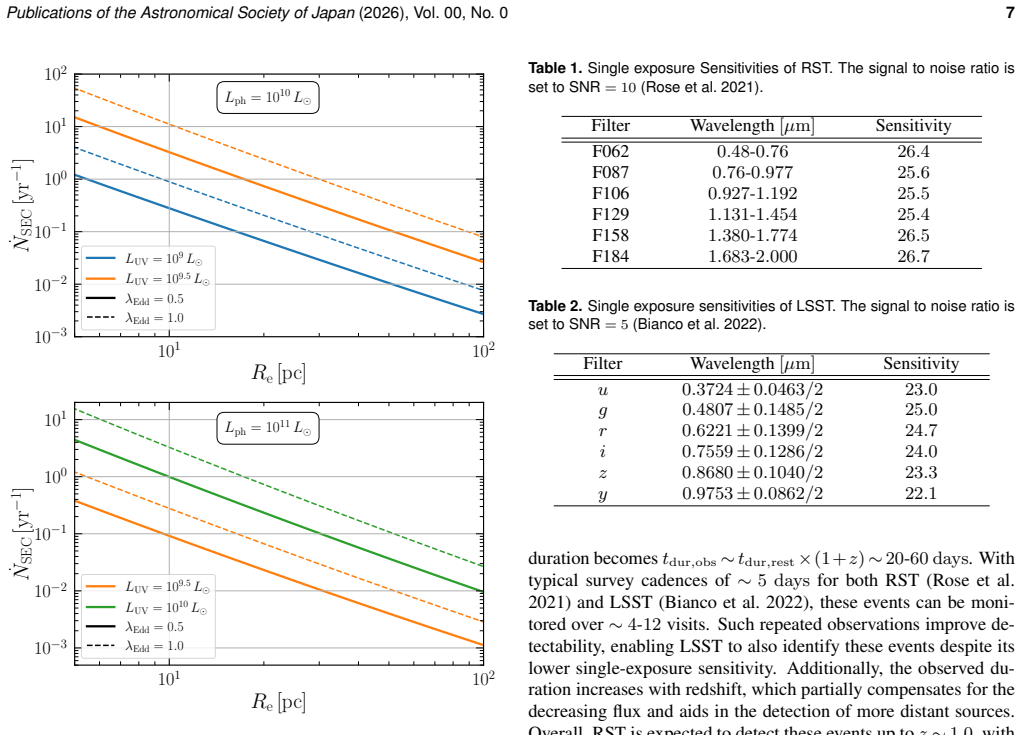
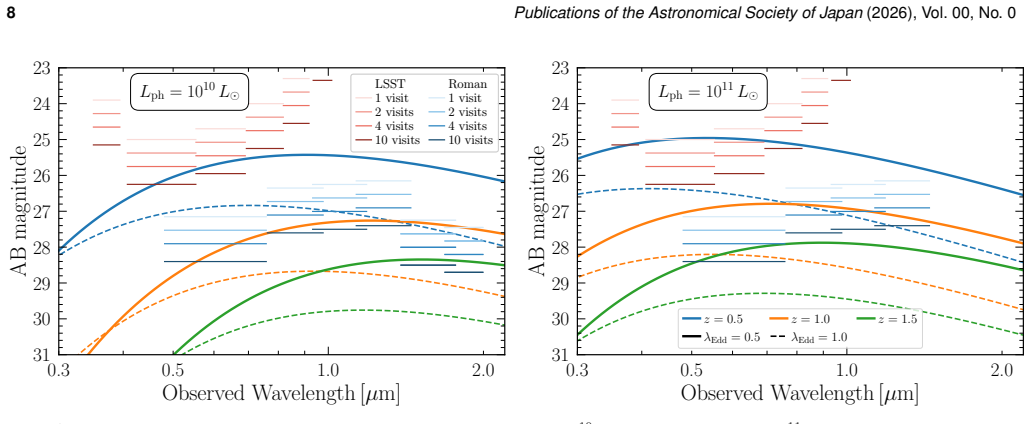
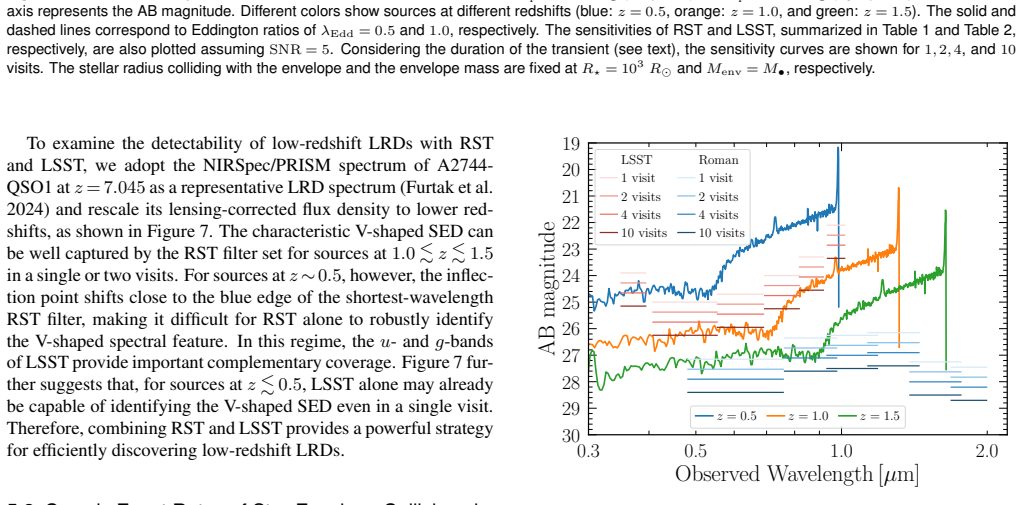
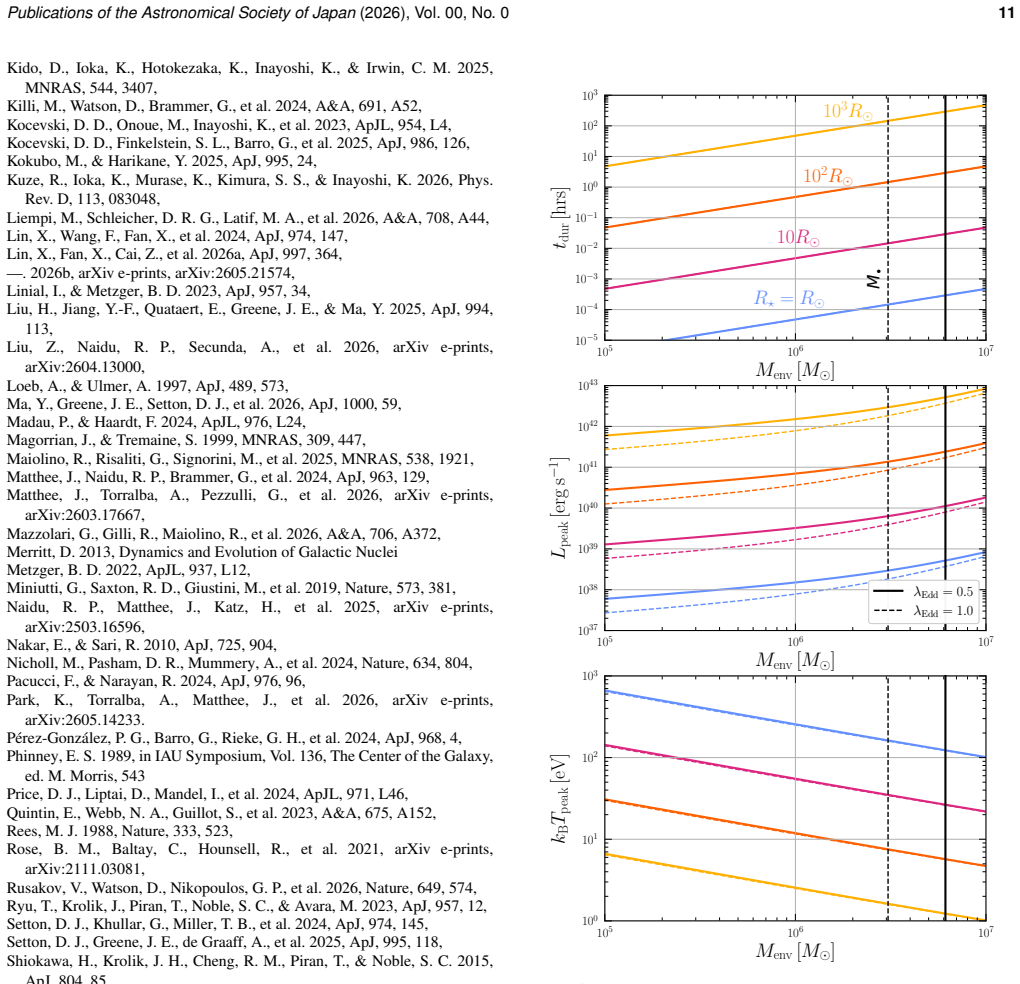
The central claim is that star-envelope collisions in little red dots, particularly those involving red supergiants of radius about 1000 solar radii and envelopes with mass similar to the central black hole, produce high-luminosity, long-duration transients. For clusters of size less than or equal to 10 parsecs, the rate reaches 0.3 events per year per little red dot. These transients are observable with future wide-field surveys at redshifts below 1, and their detection would confirm the envelope plus cluster scenario while constraining the envelope mass.
What carries the argument
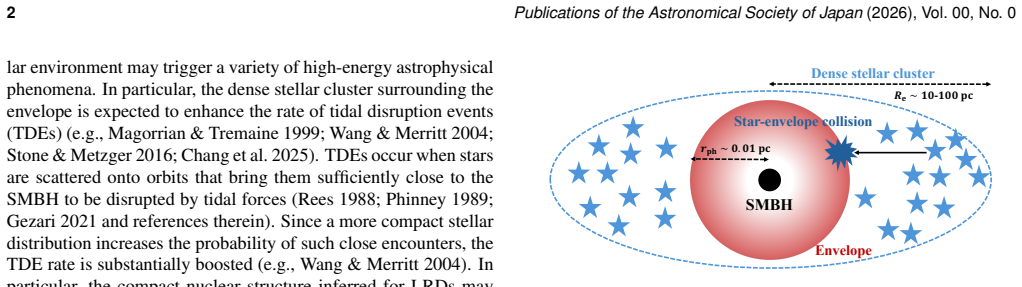
The plunging orbit collision of a star with the surface of the gaseous envelope surrounding the supermassive black hole, treated as a transient luminous event whose properties depend on stellar radius and envelope mass.
If this is right
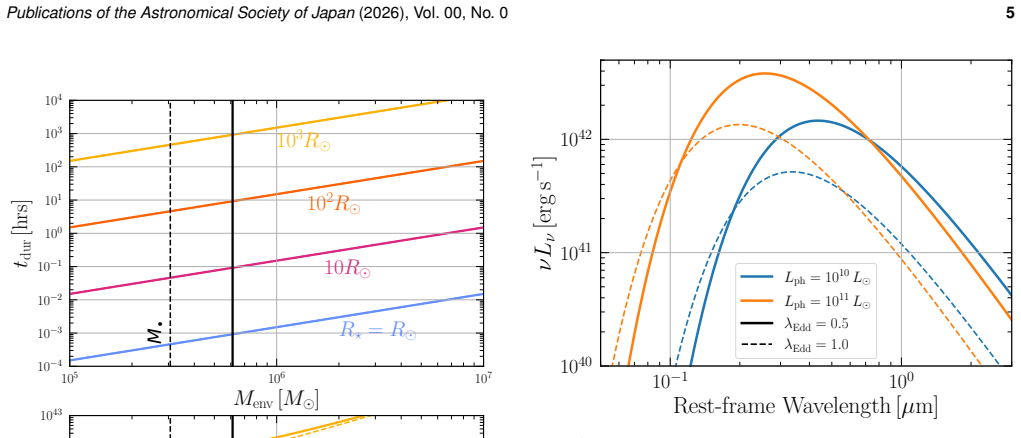
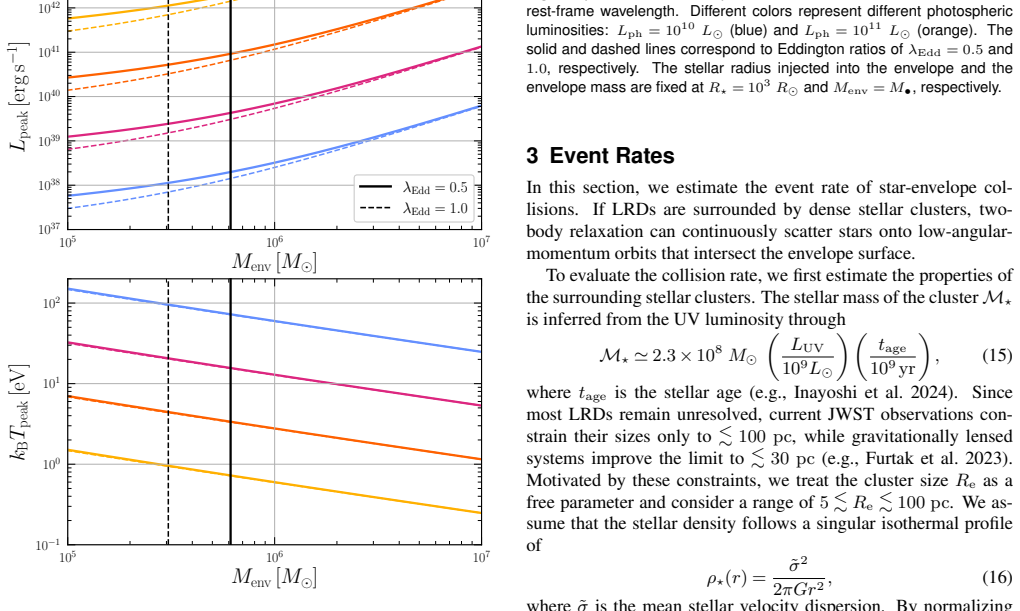
- Collisions with red supergiants and massive envelopes are the brightest and longest lasting.
- Event rates reach approximately 0.3 per year per little red dot in compact clusters.
- Such transients are detectable with future wide-field surveys at redshifts less than or equal to 1.
- Detection would confirm the gaseous envelope and stellar cluster model for little red dots.
- These events would provide a direct probe of the otherwise hard-to-measure envelope mass.
Where Pith is reading between the lines
- Non-detections in low-redshift surveys could limit the fraction of little red dots that have such envelopes.
- The transients might contribute to the observed variability in some active galactic nuclei at high redshift.
- Similar collisions could occur in other dense stellar environments around black holes, producing analogous signals.
Load-bearing premise
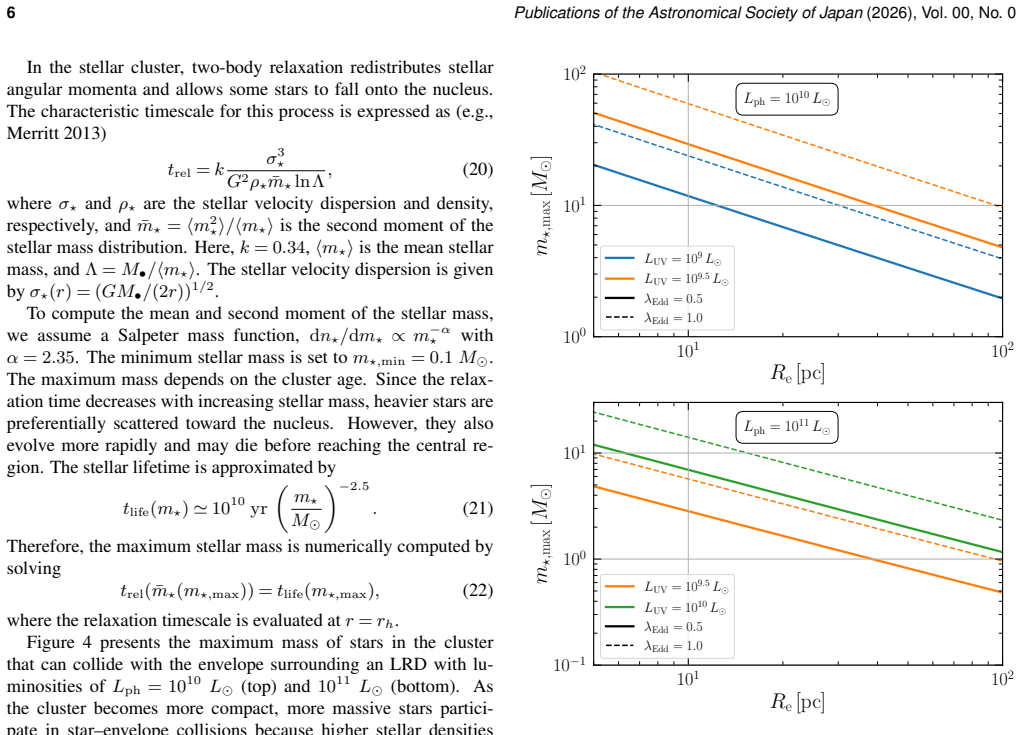
Stars within the cluster can be scattered onto orbits that plunge through the gaseous envelope, and the clusters are compact enough that massive stars reach collision before they evolve away.
What would settle it
A search with future wide-field surveys finding no such transients among low-redshift little red dot candidates would indicate that either the envelopes are absent or the collision rates are much lower than calculated.
Figures
read the original abstract
Little red dots (LRDs) are compact high-redshift objects, newly discovered by the James Webb Space Telescope. Although LRDs exhibit broad Balmer emission lines suggestive of the presence of active galactic nuclei (AGN), their spectral features differ significantly from those of ordinary AGN. Recent studies suggest that their characteristics can be explained if accreting supermassive black holes (SMBHs) are embedded within dense gaseous envelopes and surrounded by compact stellar clusters. In this scenario, stars in the cluster can scatter onto plunging orbits that intersect the envelope and collide with its surface. Here we investigate the observational properties of such star-envelope collisions as luminous transient events. We find that collisions involving red supergiants with radii of $\sim 10^{3}~R_\odot$, together with gaseous envelopes whose masses are comparable to those of the central SMBHs, are the most promising targets due to their high luminosities and long durations. For compact clusters with sizes of $\lesssim 10~{\rm pc}$, such massive stars can participate in star-envelope collisions within their lifetimes at event rates reaching $\sim 0.3~{\rm yr}^{-1}$ per LRD. We show that these transients are detectable with future wide-field surveys such as the Nancy Grace Roman Space Telescope if they occur at relatively low redshifts ($z \lesssim 1$). Detection of such transients would provide strong evidence for the envelope+stellar-cluster scenario of LRDs and offer a unique probe of the envelope mass, which is otherwise difficult to constrain from LRD spectra alone.
Editorial analysis
A structured set of objections, weighed in public.
Referee Report
Summary. The paper claims that star-envelope collisions in the Little Red Dots (LRDs) scenario—where accreting SMBHs sit inside dense gaseous envelopes surrounded by compact stellar clusters—produce luminous transient events. Collisions involving red supergiants (radii ∼10^3 R_⊙) and envelopes with masses comparable to the central SMBHs are identified as the most promising due to high luminosities and long durations. For clusters with sizes ≲10 pc, such massive stars can reach collision within their lifetimes, yielding event rates up to ∼0.3 yr^{-1} per LRD. These transients are predicted to be detectable with the Roman Space Telescope at z≲1, providing evidence for the envelope+cluster model and a probe of envelope mass.
Significance. If the luminosities, durations, and rates hold under the stated assumptions, the work supplies a concrete, observationally testable signature that could confirm or refute the gaseous-envelope plus stellar-cluster interpretation of LRDs. It also supplies an independent route to constrain envelope mass, a quantity otherwise difficult to extract from LRD spectra alone. The emphasis on RSGs and the explicit cluster-size cutoff gives observers a well-defined target population.
major comments (2)
- [Abstract and event-rate section] Abstract and the section deriving event rates: the headline rate ∼0.3 yr^{-1} per LRD for clusters ≲10 pc is load-bearing for the claim that RSG-envelope collisions are 'the most promising targets.' This rate presupposes that two-body relaxation (or resonant scattering) can populate plunging orbits with pericenters small enough to intersect the envelope surface before the RSGs evolve off the main sequence (∼10 Myr). The manuscript must explicitly evaluate the relaxation time t_relax ≈ (N/ln N)(r^3/GM)^{1/2} or the angular-momentum diffusion time against the stellar lifetime for the adopted cluster mass, radius, and stellar number; if t_relax exceeds the lifetime for a non-negligible fraction of stars, the quoted rate cannot be realized even if the luminosity calculation is correct.
- [Luminosity and duration calculation section] Section on collision luminosity and duration: the statement that RSGs with radii ∼10^3 R_⊙ and envelopes whose masses are comparable to the SMBH mass yield the highest luminosities and longest durations is central to identifying them as optimal targets. The energy-release or shock-heating calculation (presumably based on the kinetic energy of the star or the envelope binding energy) should be shown explicitly, together with the dependence on envelope mass and stellar radius, so that the reader can verify why other stellar types or envelope masses are less favorable.
minor comments (2)
- [Abstract] The abstract states 'gaseous envelopes whose masses are comparable to those of the central SMBHs' without a numerical range; adding a parenthetical interval (e.g., 10^6–10^8 M_⊙) would clarify the parameter space explored.
- [Introduction or methods] Notation for cluster size (≲10 pc) and RSG radius (∼10^3 R_⊙) is used consistently, but the manuscript should define the precise meaning of 'cluster size' (half-mass radius, virial radius, etc.) at first use.
Simulated Author's Rebuttal
We thank the referee for the careful and constructive review. The two major comments identify important omissions in the presentation of our assumptions and calculations. We have revised the manuscript to address both points explicitly, adding the requested timescale comparison and the full derivation of luminosity and duration. These changes strengthen the paper without altering its conclusions.
read point-by-point responses
-
Referee: [Abstract and event-rate section] Abstract and the section deriving event rates: the headline rate ∼0.3 yr^{-1} per LRD for clusters ≲10 pc is load-bearing for the claim that RSG-envelope collisions are 'the most promising targets.' This rate presupposes that two-body relaxation (or resonant scattering) can populate plunging orbits with pericenters small enough to intersect the envelope surface before the RSGs evolve off the main sequence (∼10 Myr). The manuscript must explicitly evaluate the relaxation time t_relax ≈ (N/ln N)(r^3/GM)^{1/2} or the angular-momentum diffusion time against the stellar lifetime for the adopted cluster mass, radius, and stellar number; if t_relax exceeds the lifetime for a non-negligible fraction of stars, the quoted rate cannot be realized even if the luminosity calculation is correct.
Authors: We agree that an explicit evaluation of the relaxation timescale is required to support the quoted rate. In the revised manuscript we have added a dedicated paragraph (and accompanying equation) in the event-rate section that computes t_relax = (N / ln N) (r^3 / G M)^{1/2} for the fiducial cluster parameters used throughout the paper (N ≈ 10^5–10^6 stars, r ≲ 10 pc, central mass M ≈ 10^7–10^8 M_⊙). For these values we obtain t_relax ≈ 1–4 Myr, which is shorter than the ∼10 Myr main-sequence lifetime of the RSG progenitors. We also estimate the fraction of stars that can reach plunging orbits within one relaxation time and confirm that this fraction is sufficient to realize the reported event rate of ∼0.3 yr^{-1} per LRD. The calculation is now shown explicitly so readers can verify the assumption. revision: yes
-
Referee: [Luminosity and duration calculation section] Section on collision luminosity and duration: the statement that RSGs with radii ∼10^3 R_⊙ and envelopes whose masses are comparable to the SMBH mass yield the highest luminosities and longest durations is central to identifying them as optimal targets. The energy-release or shock-heating calculation (presumably based on the kinetic energy of the star or the envelope binding energy) should be shown explicitly, together with the dependence on envelope mass and stellar radius, so that the reader can verify why other stellar types or envelope masses are less favorable.
Authors: We accept that the original manuscript summarized the outcome without displaying the underlying derivation. The revised version expands the luminosity-and-duration section to include the explicit expressions: the kinetic energy deposited is E_kin ≈ (1/2) m_star v_peri^2 (with v_peri set by the SMBH potential at the envelope surface), while the duration is set by the shock-crossing time t_dur ≈ R_env / c_s, which scales with envelope mass as t_dur ∝ M_env^{1/2}. The resulting luminosity L ≈ E_kin / t_dur therefore increases with stellar radius (larger R_star implies larger cross-section and higher v_peri for a given impact parameter) and peaks when M_env ≈ M_BH. We now show these scalings in equations and a short table comparing RSGs, main-sequence stars, and different envelope masses, confirming why the RSG + M_env ∼ M_BH combination is optimal. revision: yes
Circularity Check
No circularity; rates from standard stellar dynamics applied to external LRD parameters
full rationale
The claimed event rates (~0.3 yr^{-1} per LRD) are obtained by applying textbook two-body relaxation and resonant scattering timescales to assumed cluster sizes (≲10 pc) and stellar lifetimes (~10 Myr for RSGs), then intersecting with envelope radii. These are independent physical calculations, not fitted to LRD spectra or transient data and not reduced to self-defined quantities. No self-citation chains, ansatze smuggled via prior work, or fitted-input predictions appear in the derivation. The model is self-contained against external benchmarks (standard relaxation theory, stellar evolution tracks).
Axiom & Free-Parameter Ledger
free parameters (3)
- envelope mass
- cluster size upper limit
- red supergiant radius
axioms (2)
- domain assumption Stars in the cluster can scatter onto plunging orbits that intersect the envelope surface.
- domain assumption The envelope remains intact and dense enough for collisions to produce luminous transients.
Reference graph
Works this paper leans on
-
[1]
B., Casey, C
Akins, H. B., Casey, C. M., Lambrides, E., et al. 2025, ApJ, 991, 37,
2025
-
[2]
2021, Nature, 592, 704,
Arcodia, R., Merloni, A., Nandra, K., et al. 2021, Nature, 592, 704,
2021
-
[3]
2024, A&A, 684, A64,
Arcodia, R., Liu, Z., Merloni, A., et al. 2024, A&A, 684, A64,
2024
-
[4]
2025, ApJ, 989, 13,
Arcodia, R., Baldini, P., Merloni, A., et al. 2025, ApJ, 989, 13,
2025
-
[5]
Arnett, W. D. 1980, ApJ, 237, 541,
1980
-
[6]
Asada, Y ., Inayoshi, K., Fei, Q., Fujimoto, S., & Willott, C. 2026, arXiv e-prints, arXiv:2601.10573,
work page internal anchor Pith review Pith/arXiv arXiv 2026
-
[7]
2026, A&A, 706, L15,
Baldini, P., Rau, A., Merloni, A., et al. 2026, A&A, 706, L15,
2026
-
[8]
C., & Dexter, J
Begelman, M. C., & Dexter, J. 2026, ApJ, 996, 48,
2026
-
[9]
2025, ApJL, 984, L55,
Bellovary, J. 2025, ApJL, 984, L55,
2025
-
[10]
B., Ivezi´c, Ž., Jones, R
Bianco, F. B., Ivezi´c, Ž., Jones, R. L., et al. 2022, ApJS, 258, 1,
2022
-
[11]
D., Gilfanov, M
Bykov, S. D., Gilfanov, M. R., Sunyaev, R. A., & Medvedev, P. S. 2025, MNRAS, 540, 30,
2025
-
[12]
2021, ApJL, 921, L40,
Chakraborty, J., Kara, E., Masterson, M., et al. 2021, ApJL, 921, L40,
2021
-
[13]
2025, arXiv e-prints, arXiv:2503.19013,
Chakraborty, J., Kara, E., Arcodia, R., et al. 2025, arXiv e-prints, arXiv:2503.19013,
-
[14]
Chang, J. N. Y ., Dai, L., Pfister, H., Kar Chowdhury, R., & Natarajan, P. 2025, ApJL, 980, L22,
2025
-
[15]
Chisholm, J., Berg, D. A., Boylan-Kolchin, M., et al. 2026, arXiv e-prints, arXiv:2602.15935,
-
[16]
Coughlin, E. R., & Begelman, M. C. 2014, ApJ, 781, 82, de Graaff, A., Rix, H.-W., Naidu, R. P., et al. 2025a, A&A, 701, A168, de Graaff, A., Hviding, R. E., Naidu, R. P., et al. 2025b, arXiv e-prints, arXiv:2511.21820, D’Eugenio, F., Maiolino, R., Perna, M., et al. 2025, arXiv e-prints, arXiv:2503.11752,
-
[17]
R., & Kochanek, C
Evans, C. R., & Kochanek, C. S. 1989, ApJL, 346, L13,
1989
-
[18]
2023, A&A, 675, A100,
Franchini, A., Bonetti, M., Lupi, A., et al. 2023, A&A, 675, A100,
2023
-
[19]
J., Zitrin, A., Plat, A., et al
Furtak, L. J., Zitrin, A., Plat, A., et al. 2023, ApJ, 952, 142,
2023
-
[20]
J., Labbé, I., Zitrin, A., et al
Furtak, L. J., Labbé, I., Zitrin, A., et al. 2024, Nature, 628, 57,
2024
-
[21]
2021, ARA&A, 59, 21,
Gezari, S. 2021, ARA&A, 59, 21,
2021
-
[22]
Giustini, M., Miniutti, G., & Saxton, R. D. 2020, A&A, 636, L2,
2020
-
[23]
J., Duncan, K
Gloudemans, A. J., Duncan, K. J., Eilers, A.-C., et al. 2025, ApJ, 986, 130,
2025
-
[24]
Golubchik, M., Furtak, L. J., Allingham, J. F. V ., et al. 2025, arXiv e-prints, arXiv:2512.02117,
work page internal anchor Pith review Pith/arXiv arXiv 2025
-
[25]
Greene, J. E., Labbe, I., Goulding, A. D., et al. 2024, ApJ, 964, 39, Hernández-García, L., Chakraborty, J., Sánchez-Sáez, P., et al. 2025, arXiv e-prints, arXiv:2504.07169,
-
[26]
2025, arXiv e-prints, arXiv:2506.11231,
Huang, X., Linial, I., & Jiang, Y .-F. 2025, arXiv e-prints, arXiv:2506.11231,
-
[27]
E., de Graaff, A., Miller, T
Hviding, R. E., de Graaff, A., Miller, T. B., et al. 2025, A&A, 702, A57,
2025
-
[28]
2025, ApJL, 988, L22,
Inayoshi, K. 2025, ApJL, 988, L22,
2025
- [29]
-
[30]
2024, ApJ, 966, 164,
Inayoshi, K., Kashiyama, K., Li, W., et al. 2024, ApJ, 966, 164,
2024
-
[31]
S., & Noda, H
Inayoshi, K., Kimura, S. S., & Noda, H. 2025, PASJ, 77, 811,
2025
-
[32]
2025, ApJL, 980, L27,
Inayoshi, K., & Maiolino, R. 2025, ApJL, 980, L27,
2025
-
[33]
2025, MNRAS, 544, 3900,
Ji, X., Maiolino, R., Übler, H., et al. 2025, MNRAS, 544, 3900,
2025
-
[34]
Ji, X., Pezzulli, G., D’Eugenio, F., et al. 2026, arXiv e-prints, arXiv:2604.03370, Juodžbalis, I., Ji, X., Maiolino, R., et al. 2024, MNRAS, 535, 853, Kar Chowdhury, R., Chang, J. N. Y ., Dai, L., & Natarajan, P. 2024, ApJL, 966, L33, Publications of the Astronomical Society of Japan(2026), Vol. 00, No. 011
work page internal anchor Pith review Pith/arXiv arXiv 2026
-
[35]
Kido, D., Ioka, K., Hotokezaka, K., Inayoshi, K., & Irwin, C. M. 2025, MNRAS, 544, 3407,
2025
-
[36]
2024, A&A, 691, A52,
Killi, M., Watson, D., Brammer, G., et al. 2024, A&A, 691, A52,
2024
-
[37]
D., Onoue, M., Inayoshi, K., et al
Kocevski, D. D., Onoue, M., Inayoshi, K., et al. 2023, ApJL, 954, L4,
2023
-
[38]
D., Finkelstein, S
Kocevski, D. D., Finkelstein, S. L., Barro, G., et al. 2025, ApJ, 986, 126,
2025
-
[39]
2025, ApJ, 995, 24,
Kokubo, M., & Harikane, Y . 2025, ApJ, 995, 24,
2025
-
[40]
S., & Inayoshi, K
Kuze, R., Ioka, K., Murase, K., Kimura, S. S., & Inayoshi, K. 2026, Phys. Rev. D, 113, 083048,
2026
-
[41]
Liempi, M., Schleicher, D. R. G., Latif, M. A., et al. 2026, A&A, 708, A44,
2026
-
[42]
2024, ApJ, 974, 147,
Lin, X., Wang, F., Fan, X., et al. 2024, ApJ, 974, 147,
2024
-
[43]
(LRDs)$^2$: The Low-ReDshift Little Red Dots Survey. II. DESI DR1 Sample
Lin, X., Fan, X., Cai, Z., et al. 2026a, ApJ, 997, 364, —. 2026b, arXiv e-prints, arXiv:2605.21574,
work page internal anchor Pith review Pith/arXiv arXiv
-
[44]
Linial, I., & Metzger, B. D. 2023, ApJ, 957, 34,
2023
-
[45]
E., & Ma, Y
Liu, H., Jiang, Y .-F., Quataert, E., Greene, J. E., & Ma, Y . 2025, ApJ, 994, 113,
2025
-
[46]
How I Wonder What You Are -- JWST's Little Red Dots do not TWINKLE
Liu, Z., Naidu, R. P., Secunda, A., et al. 2026, arXiv e-prints, arXiv:2604.13000,
work page internal anchor Pith review Pith/arXiv arXiv 2026
-
[47]
1997, ApJ, 489, 573,
Loeb, A., & Ulmer, A. 1997, ApJ, 489, 573,
1997
-
[48]
E., Setton, D
Ma, Y ., Greene, J. E., Setton, D. J., et al. 2026, ApJ, 1000, 59,
2026
-
[49]
2024, ApJL, 976, L24,
Madau, P., & Haardt, F. 2024, ApJL, 976, L24,
2024
-
[50]
1999, MNRAS, 309, 447,
Magorrian, J., & Tremaine, S. 1999, MNRAS, 309, 447,
1999
-
[51]
2025, MNRAS, 538, 1921,
Maiolino, R., Risaliti, G., Signorini, M., et al. 2025, MNRAS, 538, 1921,
2025
-
[52]
P., Brammer, G., et al
Matthee, J., Naidu, R. P., Brammer, G., et al. 2024, ApJ, 963, 129,
2024
-
[53]
2026, arXiv e-prints, arXiv:2603.17667
Matthee, J., Torralba, A., Pezzulli, G., et al. 2026, arXiv e-prints, arXiv:2603.17667,
-
[54]
2026, A&A, 706, A372,
Mazzolari, G., Gilli, R., Maiolino, R., et al. 2026, A&A, 706, A372,
2026
-
[55]
2013, Dynamics and Evolution of Galactic Nuclei
Merritt, D. 2013, Dynamics and Evolution of Galactic Nuclei
2013
-
[56]
Metzger, B. D. 2022, ApJL, 937, L12,
2022
-
[57]
D., Giustini, M., et al
Miniutti, G., Saxton, R. D., Giustini, M., et al. 2019, Nature, 573, 381,
2019
-
[58]
A "Black Hole Star" Reveals the Remarkable Gas-Enshrouded Hearts of the Little Red Dots
Naidu, R. P., Matthee, J., Katz, H., et al. 2025, arXiv e-prints, arXiv:2503.16596,
work page internal anchor Pith review Pith/arXiv arXiv 2025
-
[59]
2010, ApJ, 725, 904,
Nakar, E., & Sari, R. 2010, ApJ, 725, 904,
2010
-
[60]
R., Mummery, A., et al
Nicholl, M., Pasham, D. R., Mummery, A., et al. 2024, Nature, 634, 804,
2024
-
[61]
2024, ApJ, 976, 96,
Pacucci, F., & Narayan, R. 2024, ApJ, 976, 96,
2024
-
[62]
Park, K., Torralba, A., Matthee, J., et al. 2026, arXiv e-prints, arXiv:2605.14233. Pérez-González, P. G., Barro, G., Rieke, G. H., et al. 2024, ApJ, 968, 4,
work page internal anchor Pith review Pith/arXiv arXiv 2026
-
[63]
Phinney, E. S. 1989, in IAU Symposium, V ol. 136, The Center of the Galaxy, ed. M. Morris, 543
1989
-
[64]
J., Liptai, D., Mandel, I., et al
Price, D. J., Liptai, D., Mandel, I., et al. 2024, ApJL, 971, L46,
2024
-
[65]
A., Guillot, S., et al
Quintin, E., Webb, N. A., Guillot, S., et al. 2023, A&A, 675, A152,
2023
-
[66]
Rees, M. J. 1988, Nature, 333, 523,
1988
-
[67]
M., Baltay, C., Hounsell, R., et al
Rose, B. M., Baltay, C., Hounsell, R., et al. 2021, arXiv e-prints, arXiv:2111.03081,
-
[68]
P., et al
Rusakov, V ., Watson, D., Nikopoulos, G. P., et al. 2026, Nature, 649, 574,
2026
-
[69]
C., & Avara, M
Ryu, T., Krolik, J., Piran, T., Noble, S. C., & Avara, M. 2023, ApJ, 957, 12,
2023
-
[70]
J., Khullar, G., Miller, T
Setton, D. J., Khullar, G., Miller, T. B., et al. 2024, ApJ, 974, 145,
2024
-
[71]
J., Greene, J
Setton, D. J., Greene, J. E., de Graaff, A., et al. 2025, ApJ, 995, 118,
2025
-
[72]
H., Cheng, R
Shiokawa, H., Krolik, J. H., Cheng, R. M., Piran, T., & Noble, S. C. 2015, ApJ, 804, 85,
2015
-
[73]
Steinberg, E., & Stone, N. C. 2024, Nature, 625, 463,
2024
-
[74]
C., & Metzger, B
Stone, N. C., & Metzger, B. D. 2016, MNRAS, 455, 859,
2016
-
[75]
Sun, W. Q., Naidu, R. P., Matthee, J., et al. 2026, arXiv e-prints, arXiv:2601.20929,
work page internal anchor Pith review Pith/arXiv arXiv 2026
-
[76]
2026, MNRAS, 545, staf2243,
Suzuguchi, T., & Matsumoto, T. 2026, MNRAS, 545, staf2243,
2026
-
[77]
2023, MNRAS, 526, 69,
Tagawa, H., & Haiman, Z. 2023, MNRAS, 526, 69,
2023
-
[78]
Tang, M., Stark, D. P., Mason, C. A., et al. 2026, arXiv e-prints, arXiv:2604.03563,
work page internal anchor Pith review Pith/arXiv arXiv 2026
-
[79]
J., Kokorev, V ., Kocevski, D
Taylor, A. J., Kokorev, V ., Kocevski, D. D., et al. 2025, ApJL, 989, L7,
2025
-
[80]
L., Fan, X., Wang, F., & Yang, J
Tee, W. L., Fan, X., Wang, F., & Yang, J. 2025, ApJL, 983, L26,
2025
discussion (0)
Sign in with ORCID, Apple, or X to comment. Anyone can read and Pith papers without signing in.