Field-induced multipolar character in the dipolar ground state of the honeycomb rare-earth chalcohalide NdOF
Pith reviewed 2026-06-29 05:27 UTC · model grok-4.3
The pith
Magnetic field drives continuous evolution of the NdOF ground-state doublet from dipolar to dipolar-multipolar character.
A machine-rendered reading of the paper's core claim, the machinery that carries it, and where it could break.
Core claim
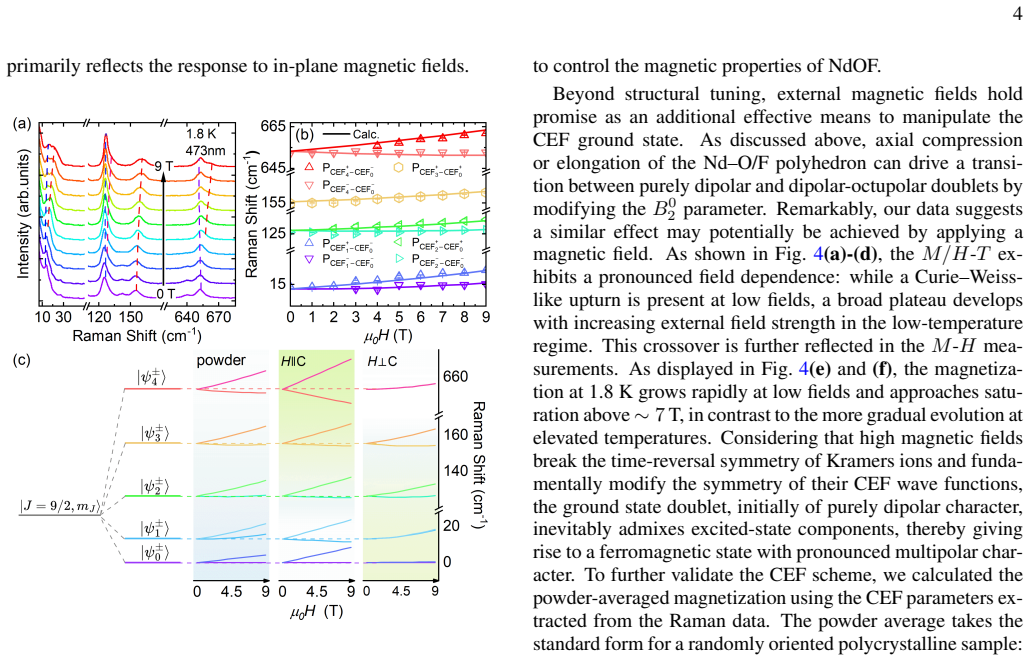
The Zeeman-CEF analysis reproduces the observed nonlinear field splitting of the Raman excitations into seven branches and accounts for the magnetization and susceptibility solely through the CEF Hamiltonian of the isolated J=9/2 manifold, thereby establishing a field-driven continuous evolution of the ground-state doublet from dipolar to dipolar-multipolar character.
What carries the argument
The crystalline electric field (CEF) Hamiltonian for the total angular momentum J=9/2 manifold, which produces the field-induced mixing within the ground doublet.
If this is right
- The ground-state doublet acquires multipolar character continuously with increasing magnetic field.
- Pressure supplies a complementary tuning knob that can further adjust the multipolar components.
- NdOF functions as a model system in which external fields can be used to induce multipolar moments in rare-earth magnets.
Where Pith is reading between the lines
- The same field-tuning mechanism could be tested in other rare-earth honeycomb compounds whose CEF schemes are already known.
- Combining magnetic field with hydrostatic pressure might map a phase diagram in which multipolar interactions dominate over dipolar ones.
- The induced multipolar character is expected to modify the effective spin-spin interactions on the honeycomb lattice, potentially altering ordering temperatures or frustration effects.
Load-bearing premise
The standard CEF Hamiltonian for the isolated J=9/2 manifold fully accounts for the nonlinear field splitting and magnetization without significant additional interactions.
What would settle it
Observation that the field-induced splitting of the CEF excitations deviates from the seven predicted branches, or that the magnetization curves cannot be reproduced by the extracted CEF parameters, would falsify the claim.
Figures
read the original abstract
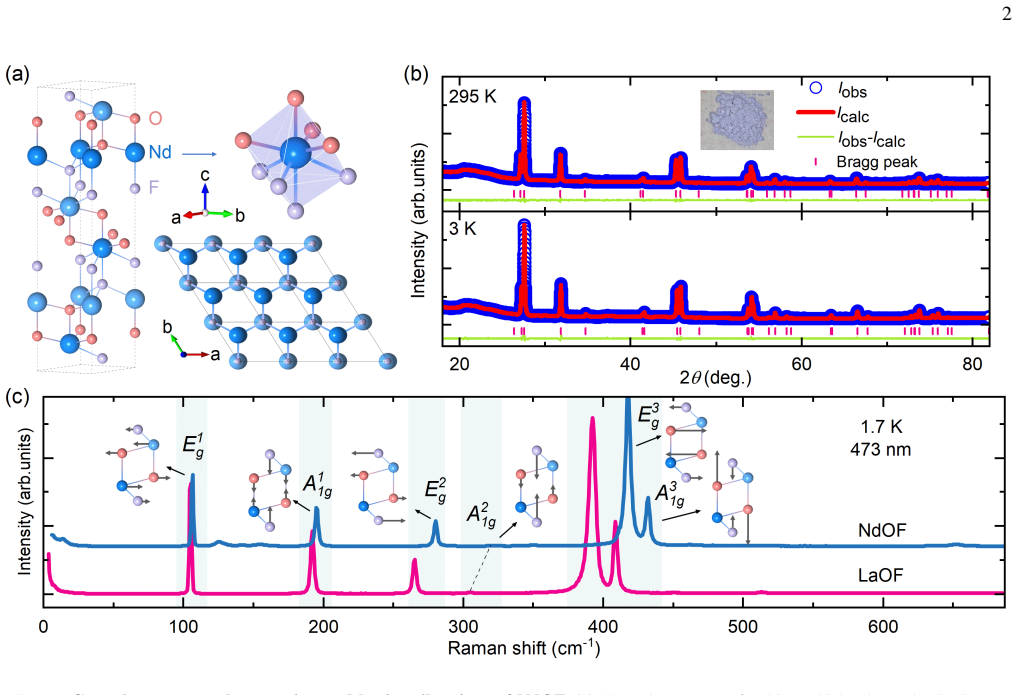
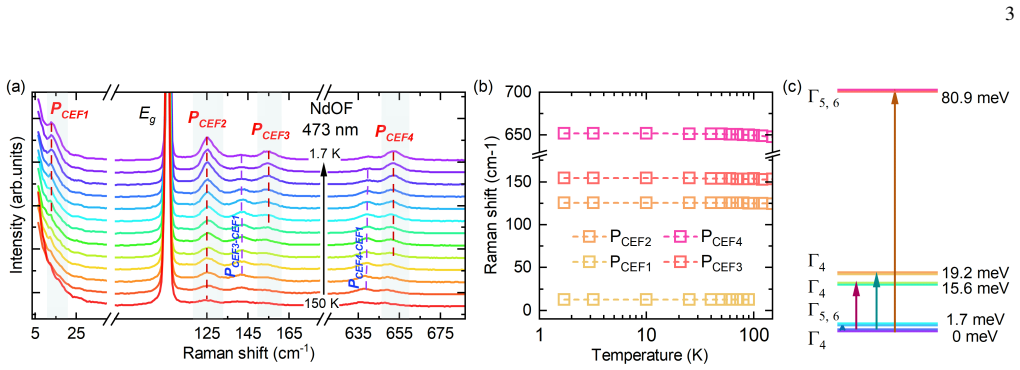
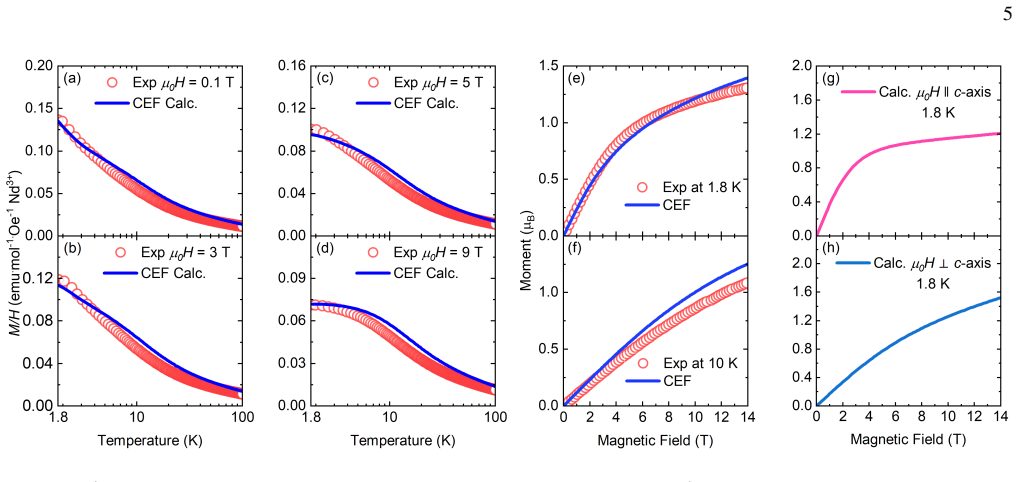
Field-tunable reconstruction of crystalline electric field (CEF) doublets offers a promising avenue for inducing multipolar character, while its observation in real materials has been little explored so far. Here we establish the honeycomb rare-earth chalcohalide NdOF as such a platform. Raman spectroscopy identifies four CEF excitations at 1.7, 15.6, 19.2, and 80.9~meV, and a Zeeman--CEF analysis reproduces their nonlinear field splitting into seven branches. Magnetization and susceptibility over 0.1--9~T are well described by a CEF model for the total angular momentum $J = 9/2$ manifold, confirming the robustness of the extracted CEF scheme. These results demonstrate a field-driven continuous evolution of the ground-state doublet from dipolar to dipolar-multipolar character, with pressure providing a complementary tuning knob, establishing NdOF as a model system for exploring the controlled induction of multipolar components in rare-earth magnets.
Editorial analysis
A structured set of objections, weighed in public.
Referee Report
Summary. The manuscript reports Raman spectroscopy on the honeycomb rare-earth chalcohalide NdOF, identifying four CEF excitations at 1.7, 15.6, 19.2, and 80.9 meV. A standard Zeeman-CEF model for the isolated J=9/2 manifold is stated to reproduce the nonlinear field splitting of these modes into seven branches as well as the magnetization and susceptibility data over 0.1-9 T. The authors conclude that the ground-state doublet evolves continuously from dipolar to dipolar-multipolar character under applied field, with pressure as a complementary tuning parameter, establishing NdOF as a model system for controlled induction of multipolar components.
Significance. If the CEF+Zeeman Hamiltonian for the J=9/2 manifold indeed reproduces both the Raman field dependence and the bulk magnetization without requiring additional interactions, the result would be significant as a concrete experimental demonstration of field-tunable multipolar character in a dipolar ground state. The combination of spectroscopic tracking of excitations and thermodynamic data to validate the CEF scheme strengthens the case for NdOF as a platform for exploring multipolar physics in rare-earth magnets.
major comments (1)
- [Abstract and Zeeman-CEF analysis] Abstract and Zeeman-CEF analysis: the central claim that the model reproduces the nonlinear splitting into seven branches and the magnetization data is load-bearing, yet the manuscript provides no quantitative fit metrics (e.g., reduced chi-squared, parameter uncertainties, or comparison of calculated vs. measured branch positions), preventing independent assessment of whether the reproduction is robust or allows post-hoc adjustment of the CEF parameters.
minor comments (1)
- The statement that pressure provides a complementary tuning knob is mentioned only in the abstract and conclusion; a brief discussion or reference to supporting calculations or data in the main text would clarify this point.
Simulated Author's Rebuttal
We thank the referee for the positive assessment and recommendation of minor revision. The single major comment concerns the lack of quantitative fit metrics for the Zeeman-CEF model. We address this below.
read point-by-point responses
-
Referee: [Abstract and Zeeman-CEF analysis] Abstract and Zeeman-CEF analysis: the central claim that the model reproduces the nonlinear splitting into seven branches and the magnetization data is load-bearing, yet the manuscript provides no quantitative fit metrics (e.g., reduced chi-squared, parameter uncertainties, or comparison of calculated vs. measured branch positions), preventing independent assessment of whether the reproduction is robust or allows post-hoc adjustment of the CEF parameters.
Authors: We agree that the manuscript does not supply explicit quantitative metrics such as reduced chi-squared values, parameter uncertainties, or tabulated comparisons of calculated versus measured branch positions. The reproduction is currently demonstrated via visual agreement in the figures. In the revised manuscript we will add the fitted CEF parameters (with uncertainties), the reduced chi-squared for the joint fit to the Raman field dependence and magnetization/susceptibility data, and a table comparing calculated and experimental positions of the seven branches at selected field values. This will permit independent evaluation of robustness. revision: yes
Circularity Check
No significant circularity detected
full rationale
The paper fits a standard CEF + Zeeman Hamiltonian for the isolated J=9/2 manifold to independent Raman excitation energies and magnetization/susceptibility data; the field-induced multipolar character is then read out from the resulting ground-state wavefunctions under applied field. This is a conventional forward application of a fitted model rather than any self-definitional loop, fitted-input-called-prediction, or load-bearing self-citation. No equations or claims in the abstract reduce the central result to its own inputs by construction, and the reproduction of seven observed branches plus bulk data constitutes external validation of the scheme.
Axiom & Free-Parameter Ledger
free parameters (1)
- CEF Hamiltonian parameters
axioms (1)
- domain assumption The Nd3+ total angular momentum manifold J=9/2 is isolated and the CEF scheme is sufficient to describe the low-energy physics
Reference graph
Works this paper leans on
-
[1]
Li, Y .-D
F.-Y . Li, Y .-D. Li, Y . Yu, A. Paramekanti, and G. Chen, Ki- taev materials beyond iridates: Order by quantum disorder and weyl magnons in rare-earth double perovskites, Phys. Rev. B 95, 085132 (2017)
2017
-
[2]
Morita, M
K. Morita, M. Kishimoto, and T. Tohyama, Ground-state phase diagram of the Kitaev-Heisenberg model on a kagome lattice, Phys. Rev. B98, 134437 (2018)
2018
-
[3]
Luo and G
Z.-X. Luo and G. Chen, Honeycomb rare-earth magnets with anisotropic exchange interactions, SciPost Phys. Core3, 004 (2020)
2020
-
[4]
Abragam and B
A. Abragam and B. Bleaney,Electron paramagnetic resonance of transition ions(OUP oxford, 2012)
2012
-
[5]
Huang, G
Y .-P. Huang, G. Chen, and M. Hermele, Quantum spin ices and topological phases from dipolar-octupolar doublets on the py- rochlore lattice, Phys. Rev. Lett.112, 167203 (2014)
2014
-
[6]
Y .-D. Li, X. Wang, and G. Chen, Anisotropic spin model of strong spin-orbit-coupled triangular antiferromagnets, Phys. Rev. B94, 035107 (2016)
2016
-
[7]
Y .-D. Li, X. Wang, and G. Chen, Hidden multipolar orders of dipole-octupole doublets on a triangular lattice, Phys. Rev. B 94, 201114 (2016)
2016
-
[8]
Rayyan, D
A. Rayyan, D. Churchill, and H.-Y . Kee, Field-induced kitaev multipolar liquid in spin-orbit coupledd 2 honeycomb mott in- sulators, Phys. Rev. B107, L020408 (2023)
2023
-
[9]
Y . Shen, C. Liu, Y . Qin, S. Shen, Y .-D. Li, R. Bewley, A. Schneidewind, G. Chen, and J. Zhao, Intertwined dipolar and multipolar order in the triangular-lattice magnet tmmggao4, Nature communications10, 4530 (2019)
2019
-
[10]
Liu, Y .-D
C. Liu, Y .-D. Li, and G. Chen, Selective measurements of inter- twined multipolar orders: Non-kramers doublets on a triangular lattice, Phys. Rev. B98, 045119 (2018)
2018
-
[11]
V . S. de Carvalho, H. Freire, and R. G. Pereira, Multipolar spin liquid in an exactly solvable model forjeff= 3 2 moments, Phys. Rev. B108, 094418 (2023)
2023
-
[12]
Zhang, M
Z. Zhang, M. Shu, M. Xie, W. Zhuo, Y . Cai, C. Balz, J. Ji, F. Jin, J. Ma, and Q. Zhang, Emergent dispersive multipolar excitations innaerse 2, Phys. Rev. Lett.135, 256503 (2025)
2025
-
[13]
Zhang, J
Z. Zhang, J. Jiao, W. Zhuo, M. Xie, D. T. Adroja, T. Shiroka, G. Deng, A. Zhang, F. Jin, J. Ji, J. Ma, and Q. Zhang, Gapless spinon excitations emerging from a multipolar transverse field in the triangular-lattice ising antiferromagnetnatmse 2, Phys. Rev. B111, L180405 (2025)
2025
-
[14]
J. G. Rau and M. J. Gingras, Frustrated quantum rare-earth py- rochlores, Annual Review of Condensed Matter Physics10, 357 (2019)
2019
-
[15]
J. S. Gardner, M. J. P. Gingras, and J. E. Greedan, Magnetic pyrochlore oxides, Rev. Mod. Phys.82, 53 (2010)
2010
-
[16]
Hosoi, E
M. Hosoi, E. Z. Zhang, A. S. Patri, and Y . B. Kim, Uncovering footprints of dipolar-octupolar quantum spin ice from neutron scattering signatures, Phys. Rev. Lett.129, 097202 (2022)
2022
-
[17]
Z. Zhou, F. Desrochers, and Y . B. Kim, Magnetic field re- sponse of dipolar-octupolar quantum spin ice, Phys. Rev. B110, 174441 (2024)
2024
-
[18]
A. S. Patri, M. Hosoi, and Y . B. Kim, Distinguishing dipolar and octupolar quantum spin ices using contrasting magnetostriction signatures, Phys. Rev. Res.2, 023253 (2020)
2020
-
[19]
J. Ji, M. Sun, Y . Cai, Y . Wang, Y . Sun, W. Ren, Z. Zhang, F. Jin, and Q. Zhang, Rare-earth chalcohalides: A family of van der 7 waals layered kitaev spin liquid candidates, Chinese Physics Letters38, 047502 (2021)
2021
-
[20]
Y . Cai, W. Ren, X. Dai, J. Kang, W. Zhuo, M. Xie, A. Zhang, J. Ji, F. Jin, Z. Zhang, and Q. Zhang, Crystalline electric field excitations and their nonlinear splitting under magnetic fields in ybocl, Phys. Rev. Res.6, 043061 (2024)
2024
-
[21]
Zhang, Y
Z. Zhang, Y . Cai, J. Kang, Z. Ouyang, Z. Zhang, A. Zhang, J. Ji, F. Jin, and Q. Zhang, Anisotropic exchange coupling and ground state phase diagram of Kitaev compound YbOCl, Phys. Rev. Res.4, 033006 (2022)
2022
-
[22]
Zhang, Y
Z. Zhang, Y . Cai, J. Jiao, J. Kang, D. Yu, B. Roessli, A. Zhang, J. Ji, F. Jin, J. Ma, and Q. Zhang, Ground state magnetic struc- ture and magnetic field effects in the layered honeycomb anti- ferromagnet YbOCl, Phys. Rev. Res.6, 033274 (2024)
2024
-
[23]
Y . Cai, M. Xie, J. Kang, W. Zhuo, W. Ren, X. Dai, A. Zhang, J. Ji, F. Jin, Z. Zhang, and Q. Zhang, Anomalous enhancement of magnetism by nonmagnetic doping in the honeycomb-lattice antiferromagnetErOCl, Phys. Rev. B112, 134448 (2025)
2025
-
[24]
Field driven evolution from dipolar to multipolar crystalline electric field ground state in the honeycomb antiferromagnet NdOF
See Supplementary Material for “ Field driven evolution from dipolar to multipolar crystalline electric field ground state in the honeycomb antiferromagnet NdOF ”
-
[25]
H. M. Rietveld, A profile refinement method for nuclear and magnetic structures, Applied Crystallography2, 65 (1969)
1969
-
[26]
Rodr ´ıguez-Carvajal, Recent advances in magnetic structure determination by neutron powder diffraction, Physica B: Con- densed Matter192, 55 (1993)
J. Rodr ´ıguez-Carvajal, Recent advances in magnetic structure determination by neutron powder diffraction, Physica B: Con- densed Matter192, 55 (1993)
1993
-
[27]
H ¨ols¨a, E
J. H ¨ols¨a, E. S¨ailynoja, H. Rahiala, and J. Valkonen, Character- ization of the non-stoichiometry in lanthanum oxyfluoride by FT-IR absorption, Raman scattering, X-ray powder diffraction and thermal analysis, Polyhedron16, 3421 (1997)
1997
-
[28]
H ¨ols¨a, B
J. H ¨ols¨a, B. Piriou, and M. R¨as¨anen, IR-and Raman-active nor- mal vibrations of rare earth oxyfluorides, REOF; RE= Y , La, and Gd, Spectrochimica Acta Part A: Molecular Spectroscopy 49, 465 (1993)
1993
-
[29]
Kresse and J
G. Kresse and J. Furthm ¨uller, Efficient iterative schemes for ab initio total-energy calculations using a plane-wave basis set, Phys. Rev. B54, 11169 (1996)
1996
-
[30]
Kresse and J
G. Kresse and J. Furthm ¨uller, Efficiency of ab-initio total en- ergy calculations for metals and semiconductors using a plane- wave basis set, Computational materials science6, 15 (1996)
1996
-
[31]
A. Togo, L. Chaput, T. Tadano, and I. Tanaka, Implementation strategies in phonopy and phono3py, Journal of Physics: Con- densed Matter35, 353001 (2023)
2023
-
[32]
Togo, First-principles phonon calculations with phonopy and phono3py, Journal of the Physical Society of Japan92, 012001 (2023)
A. Togo, First-principles phonon calculations with phonopy and phono3py, Journal of the Physical Society of Japan92, 012001 (2023)
2023
-
[33]
J. P. Perdew, K. Burke, and M. Ernzerhof, Generalized gradient approximation made simple, Phys. Rev. Lett.77, 3865 (1996)
1996
-
[34]
Baroni, S
S. Baroni, S. de Gironcoli, A. Dal Corso, and P. Giannozzi, Phonons and related crystal properties from density-functional perturbation theory, Rev. Mod. Phys.73, 515 (2001)
2001
-
[35]
A. T. Boothroyd, S. M. Doyle, D. M. Paul, and R. Osborn, Crystal-field excitations inNd 2CuO4,Pr 2CuO4, and related n-type superconductors, Phys. Rev. B45, 10075 (1992)
1992
-
[36]
Liu and B
G. Liu and B. Jacquier,Spectroscopic properties of rare earths in optical materials, V ol. 83 (Springer Science & Business Me- dia, 2006)
2006
-
[37]
A. J. Princep, D. Prabhakaran, A. T. Boothroyd, and D. T. Adroja, Crystal-field states of Pr 3+ in the candidate quantum spin ice Pr2Sn2O7, Phys. Rev. B88, 104421 (2013)
2013
-
[38]
Zhang, K
J. Zhang, K. Fritsch, Z. Hao, B. V . Bagheri, M. J. P. Gin- gras, G. E. Granroth, P. Jiramongkolchai, R. J. Cava, and B. D. Gaulin, Neutron spectroscopic study of crystal field excitations inTb 2Ti2O7 andTb 2Sn2O7, Phys. Rev. B89, 134410 (2014)
2014
-
[39]
A. J. Princep, H. C. Walker, D. T. Adroja, D. Prabhakaran, and A. T. Boothroyd, Crystal field states ofTb3+ in the pyrochlore spin liquidTb 2Ti2O7 from neutron spectroscopy, Phys. Rev. B91, 224430 (2015)
2015
-
[40]
Y . Li, D. Adroja, R. I. Bewley, D. V oneshen, A. A. Tsirlin, P. Gegenwart, and Q. Zhang, Crystalline Electric-Field Ran- domness in the Triangular Lattice Spin-LiquidYbMgGaO 4, Phys. Rev. Lett.118, 107202 (2017)
2017
-
[41]
H ¨ols¨a, E
J. H ¨ols¨a, E. S¨ailynoja, P. Ylh¨a, E. Antic-Fidancev, M. Lemaˆıtre- Blaise, and P. Porcher, Analysis and simulation of the optical spectra of the stoichiometric ndof, Journal of the Chemical So- ciety, Faraday Transactions94, 481 (1998)
1998
-
[42]
M. T. Hutchings, Point-charge calculations of energy levels of magnetic ions in crystalline electric fields, inSolid state physics, V ol. 16 (Elsevier, 1964) pp. 227–273
1964
-
[43]
J. Xu, V . K. Anand, A. K. Bera, M. Frontzek, D. L. Abernathy, N. Casati, K. Siemensmeyer, and B. Lake, Magnetic struc- ture and crystal-field states of the pyrochlore antiferromagnet Nd2Zr2O7, Phys. Rev. B92, 224430 (2015)
2015
-
[44]
Lhotel, S
E. Lhotel, S. Petit, S. Guitteny, O. Florea, M. Ciomaga Hat- nean, C. Colin, E. Ressouche, M. R. Lees, and G. Balakrish- nan, Fluctuations and all-in–all-out ordering in dipole-octupole nd2zr2o7, Phys. Rev. Lett.115, 197202 (2015)
2015
-
[45]
M. C. Hatnean, M. R. Lees, O. A. Petrenko, D. S. Kee- ble, G. Balakrishnan, M. J. Gutmann, V . V . Klekovkina, and B. Z. Malkin, Structural and magnetic investigations of single- crystalline neodymium zirconate pyrochloreNd 2Zr2O7, Phys. Rev. B91, 174416 (2015)
2015
-
[46]
Bertin, P
A. Bertin, P. Dalmas de R´eotier, B. F˚ak, C. Marin, A. Yaouanc, A. Forget, D. Sheptyakov, B. Frick, C. Ritter, A. Amato, C. Baines, and P. J. C. King,Nd 2Sn2O7: An all-in–all-out py- rochlore magnet with no divergence-free field and anomalously slow paramagnetic spin dynamics, Phys. Rev. B92, 144423 (2015)
2015
-
[47]
V . K. Anand, A. K. Bera, J. Xu, T. Herrmannsd ¨orfer, C. Rit- ter, and B. Lake, Observation of long-range magnetic ordering in pyrohafnateNd 2Hf2O7: A neutron diffraction study, Phys. Rev. B92, 184418 (2015)
2015
discussion (0)
Sign in with ORCID, Apple, or X to comment. Anyone can read and Pith papers without signing in.