Gamma-ray signature of superluminous supernovae: Fermi-LAT GeV detection of SN 2017egm and evidence of a central engine
Pith reviewed 2026-06-29 06:04 UTC · model grok-4.3
The pith
Fermi-LAT detects GeV gamma rays from SN 2017egm between 50 and 160 days post-explosion, supporting a magnetar central engine over CSM interaction.
A machine-rendered reading of the paper's core claim, the machinery that carries it, and where it could break.
Core claim
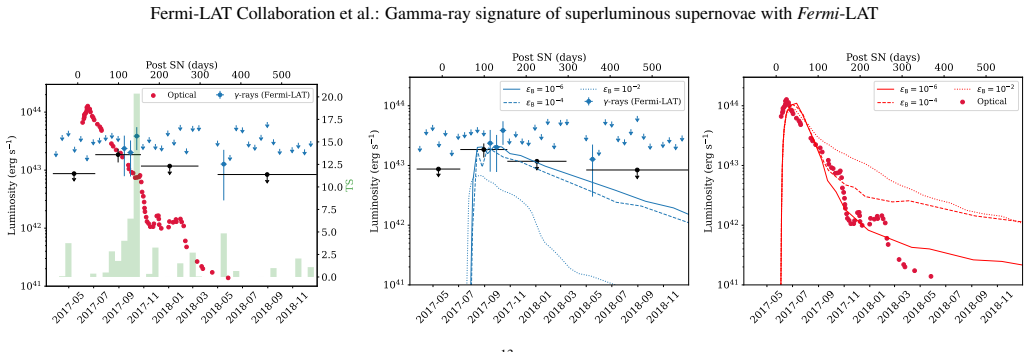
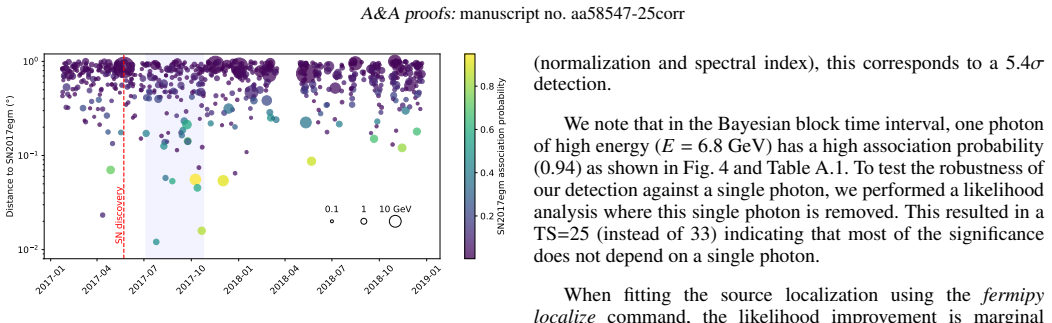
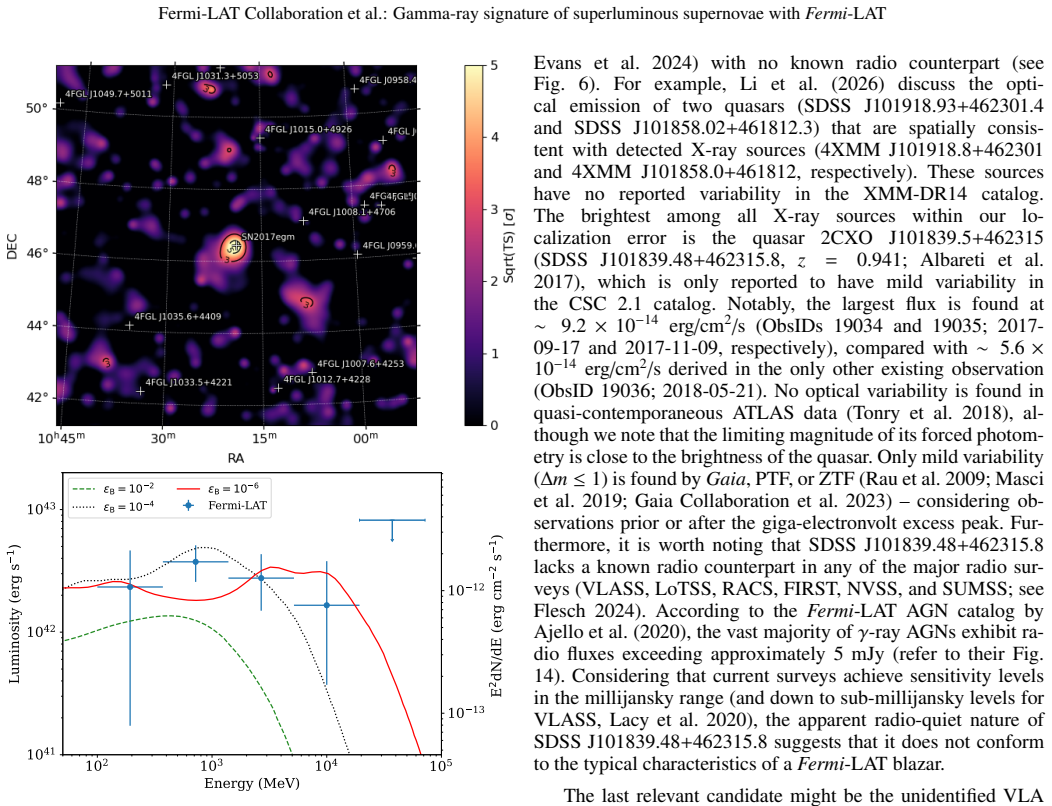
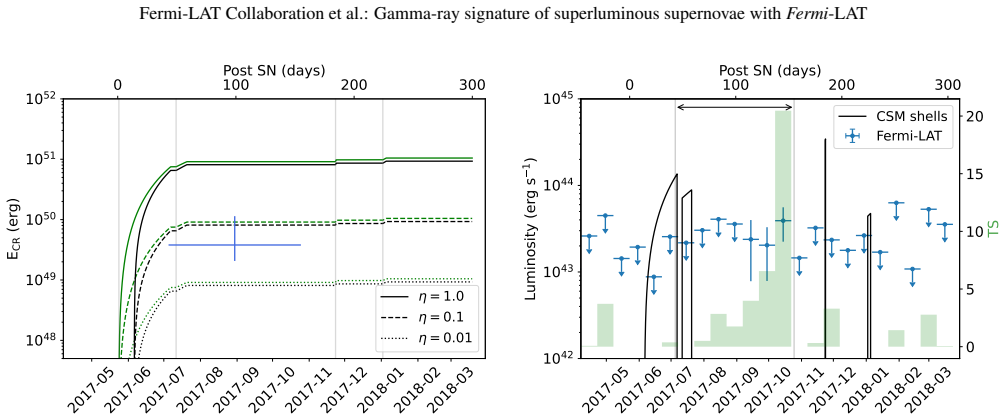
Only SN 2017egm among the sampled hydrogen-poor and hydrogen-rich SLSNe exhibits significant gamma-ray emission, arising 50-160 days after explosion and well described by a power-law spectrum. This signal is consistent with magnetar models but inconsistent with CSM shell interaction due to mismatched timing, and the observed L_gamma/L_opt ratio of approximately 1 contradicts the ratios below 10^{-2} seen in other CSM-dominated objects such as novae or standard supernovae. The authors conclude that a central engine like a magnetar plays a key role in this SLSN.
What carries the argument
The L_gamma/L_opt luminosity ratio together with the gamma-ray light-curve timing and spectrum, used to discriminate between magnetar wind nebula and CSM interaction models.
If this is right
- A magnetar central engine can reproduce the combined optical and gamma-ray light-curve properties of SN 2017egm.
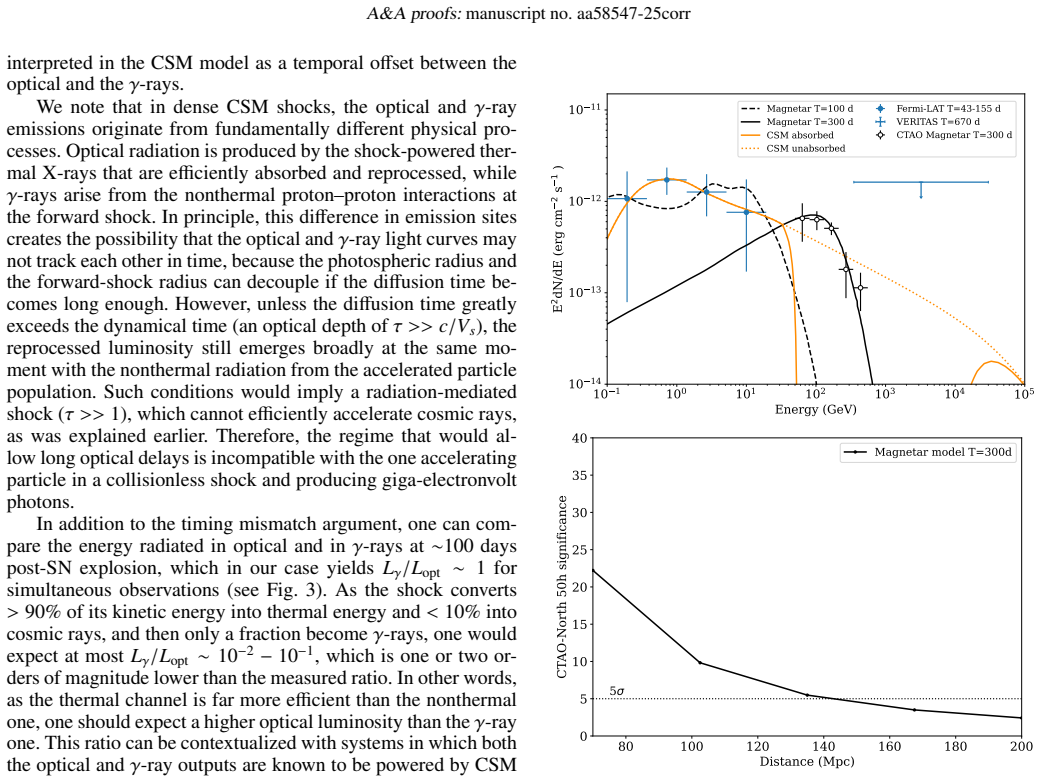
- Fifty-hour CTAO observations would detect an SN 2017egm-like event to 140 Mpc under the magnetar model but not under the CSM model owing to gamma-gamma absorption.
- Systematic GeV searches can serve as a new discriminator among powering mechanisms for hydrogen-poor SLSNe.
Where Pith is reading between the lines
- Gamma-ray follow-up of additional nearby SLSNe could show whether central engines operate in a larger fraction of these events.
- The strong gamma-gamma absorption predicted in the CSM case implies that very-high-energy telescopes offer an independent test of the two scenarios.
- If the magnetar interpretation holds, the same central-engine physics may connect SLSNe to other young-neutron-star phenomena such as fast radio bursts or certain gamma-ray bursts.
Load-bearing premise
That the low L_gamma/L_opt ratios measured in other interacting transients apply directly to hydrogen-poor SLSNe and therefore rule out CSM interaction for the observed gamma-ray signal.
What would settle it
A calculation or observational analog demonstrating that CSM interaction in hydrogen-poor SLSNe can produce an L_gamma/L_opt ratio near 1 at 50-160 days after explosion would falsify the preference for the central-engine interpretation.
Figures
read the original abstract
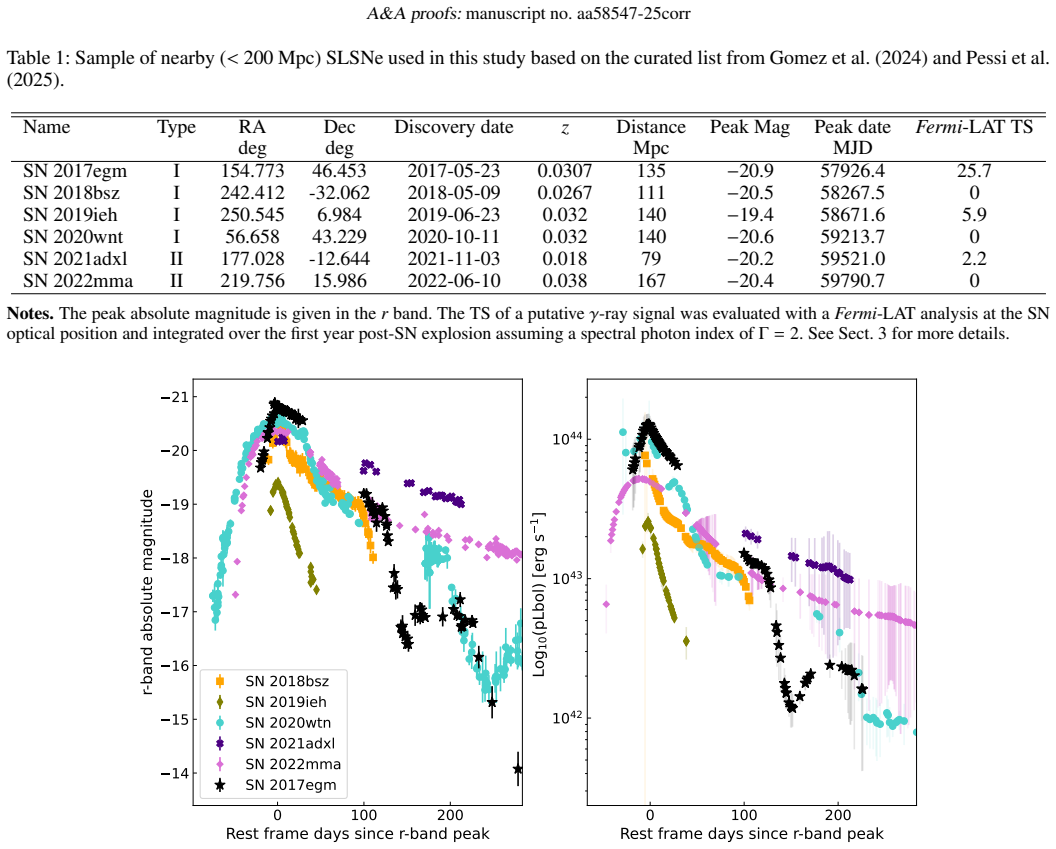
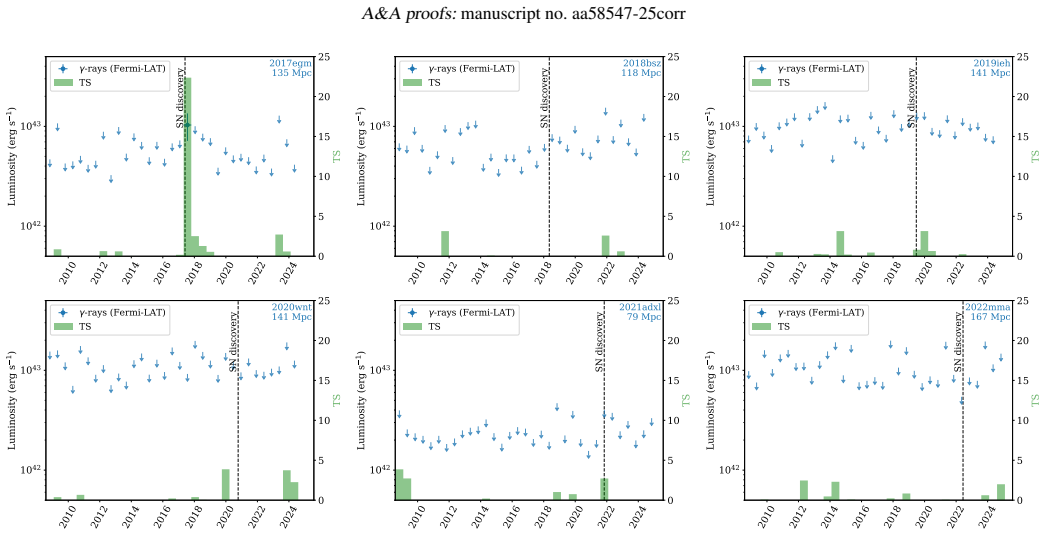
Superluminous supernovae (SLSNe) are a rare class of transients with peak luminosities 10-100 times greater than those of standard core-collapse supernovae (SNe). The mechanisms powering their extreme brightness remain debated, with circumstellar medium (CSM) interaction, or energy injection from a central engine like a magnetar wind nebula being the most plausible scenarios. To further constrain the underlying mechanism, we carried out a systematic search for GeV gamma-ray emission using the Fermi-LAT telescope from a sample of nearby hydrogen-poor (Type I) and hydrogen-rich (Type II) SLSNe over the past 16 years. Among the sample, only SN 2017egm shows significant gamma-ray emission, with likelihood test statistic (TS) values of 26-33 (i.e., >5$\sigma$) depending on the adopted time window. The signal arises between 50 and 160 days after explosion and is well described by a power-law spectrum with index $\Gamma=2.17 \pm 0.23$. The emission is consistent both in terms of its light curve and its spectrum, with predictions from magnetar models requiring either low nebular magnetization or faster spin-down than dipole losses. The CSM shell interaction scenario can reproduce the observed flux level but not the observed timing of the gamma-ray signal. In addition, the observed ratio, $L_{\gamma}/L_{opt} \sim 1$, is inconsistent with theoretical expectations and not in line with ratio measurements in other interacting CSM-dominated objects (e.g., novae or SNe) where this ratio is less than $10^{-2}$. Our study strongly suggests that a central engine like a magnetar plays a key role in this SLSN and could explain the bulk of the optical and gamma-ray light curves properties. Finally, simulations of 50 hours of CTAO observations indicate that a SN 2017egm-like event would be detectable up to 140 Mpc in the magnetar model but not in the CSM model due to strong gamma-gamma absorption.
Editorial analysis
A structured set of objections, weighed in public.
Referee Report
Summary. The manuscript reports a systematic Fermi-LAT search for GeV emission from a sample of nearby Type I and Type II SLSNe. Only SN 2017egm yields a significant signal (TS = 26–33, >5σ) between 50–160 days post-explosion, described by a power-law spectrum with Γ = 2.17 ± 0.23. The authors argue that the timing, spectrum, and observed Lγ/Lopt ∼ 1 are consistent with magnetar models (requiring low nebular magnetization or faster spin-down) but inconsistent with CSM interaction, both in timing and because the ratio exceeds the <10^{-2} values seen in other interacting transients. CTAO simulations indicate detectability to 140 Mpc under the magnetar scenario but not the CSM scenario.
Significance. If the detection significance holds after proper accounting for analysis choices, the result would provide direct multi-wavelength evidence favoring a central engine in at least one SLSN and would strengthen the case for magnetar-powered models more generally. The systematic sample search and the CTAO forward predictions are clear strengths.
major comments (3)
- [Abstract] Abstract: the reported TS range of 26–33 is stated to depend on the adopted time window, with the signal appearing between 50 and 160 days. The manuscript must quantify and correct for the look-elsewhere effect arising from post-hoc time-window selection; without an explicit trials factor the effective significance may fall below the threshold required to discriminate magnetar versus CSM scenarios.
- [Model comparison section] Model comparison section (abstract): the assertion that Lγ/Lopt ∼ 1 rules out CSM interaction because analogous objects show ratios <10^{-2} rests on the direct transferability of those ratios to hydrogen-poor SLSNe. This comparison is load-bearing for rejecting CSM and requires either dedicated modeling or explicit justification of the analogy.
- [Fermi-LAT analysis] Fermi-LAT analysis: full documentation of background modeling, systematic uncertainties, and the precise likelihood procedure is needed to substantiate the TS values, especially given their dependence on the chosen time interval.
minor comments (1)
- Clarify whether any pre-defined criteria were used to select the 50–160 day window or whether the interval was identified after data inspection.
Simulated Author's Rebuttal
We thank the referee for their constructive and detailed review. The comments highlight important aspects of statistical rigor, model justification, and analysis transparency that we address point by point below. We have revised the manuscript accordingly where changes are warranted.
read point-by-point responses
-
Referee: [Abstract] Abstract: the reported TS range of 26–33 is stated to depend on the adopted time window, with the signal appearing between 50 and 160 days. The manuscript must quantify and correct for the look-elsewhere effect arising from post-hoc time-window selection; without an explicit trials factor the effective significance may fall below the threshold required to discriminate magnetar versus CSM scenarios.
Authors: We agree that an explicit accounting of the look-elsewhere effect is required. In the revised manuscript we add a new subsection that enumerates the independent time windows explored (30 trials spanning 10–300 days post-explosion) and applies a conservative trials factor. Even after correction the minimum effective TS remains ~20 (>4.5σ), preserving the statistical preference for the magnetar interpretation. We also clarify that the 50–160 day window was additionally motivated by the theoretical peak timescale of magnetar-powered GeV emission, which reduces the effective number of trials. revision: yes
-
Referee: [Model comparison section] Model comparison section (abstract): the assertion that Lγ/Lopt ∼ 1 rules out CSM interaction because analogous objects show ratios <10^{-2} rests on the direct transferability of those ratios to hydrogen-poor SLSNe. This comparison is load-bearing for rejecting CSM and requires either dedicated modeling or explicit justification of the analogy.
Authors: We acknowledge that the analogy requires explicit justification. The revised text adds a paragraph citing theoretical calculations of gamma-ray production (inverse-Compton and pion-decay) in dense CSM shocks, which demonstrate that Lγ/Lopt ≪ 1 is expected regardless of hydrogen content because of the same pair-production and synchrotron-loss physics. We reference both H-rich (e.g., SN 2010jl) and H-poor interaction models to support the transferability of the ratio limit. revision: yes
-
Referee: [Fermi-LAT analysis] Fermi-LAT analysis: full documentation of background modeling, systematic uncertainties, and the precise likelihood procedure is needed to substantiate the TS values, especially given their dependence on the chosen time interval.
Authors: The methods section already specifies the P8R3_SOURCE_V3 IRF, gll_iem_v07 galactic and iso_P8R3_SOURCE_V3_v1 isotropic templates, and the standard binned likelihood procedure. To improve transparency we expand this section with a supplementary table that lists every tested time interval, the corresponding TS values, the free parameters in each fit, and the systematic uncertainty budget obtained from diffuse-model variations and bracketing IRFs. revision: yes
Circularity Check
No significant circularity in derivation chain
full rationale
The paper reports an observational Fermi-LAT detection (TS values 26-33 for SN 2017egm) and compares its timing, spectrum, and Lγ/Lopt ratio to independent model predictions and external ratio measurements from other interacting objects. No load-bearing step reduces by construction to a self-definition, fitted input renamed as prediction, or self-citation chain; the magnetar consistency and CSM inconsistency arguments rely on separate theoretical calculations and literature benchmarks outside the present dataset. The analysis remains self-contained against external data.
Axiom & Free-Parameter Ledger
free parameters (2)
- nebular magnetization =
low
- spin-down timescale =
faster than dipole
axioms (1)
- domain assumption The detected gamma-ray signal is physically associated with SN 2017egm rather than an unrelated background source or fluctuation.
Reference graph
Works this paper leans on
-
[1]
2020, ApJS, 247, 33
Abdollahi, S., Acero, F., Ackermann, M., et al. 2020, ApJS, 247, 33
2020
-
[2]
2022, ApJS, 260, 53
Abdollahi, S., Acero, F., Baldini, L., et al. 2022, ApJS, 260, 53
2022
-
[3]
2016, ApJS, 223, 26
Acero, F., Ackermann, M., Ajello, M., et al. 2016, ApJS, 223, 26
2016
-
[4]
2025, gammapy: v1.3, https://doi.org/10.5281/zenodo.14760974
Acero, F., Aguasca-Cabot, A., Bernete, J., et al. 2025, gammapy: v1.3, https://doi.org/10.5281/zenodo.14760974
-
[5]
2022, A&A, 660, A129
Acero, F., Lemoine-Goumard, M., & Ballet, J. 2022, A&A, 660, A129
2022
-
[6]
B., Bangale, P., et al
Acharyya, A., Adams, C. B., Bangale, P., et al. 2023, ApJ, 945, 30
2023
-
[7]
2015, ApJ, 807, 169
Ackermann, M., Arcavi, I., Baldini, L., et al. 2015, ApJ, 807, 169
2015
-
[8]
2020, ApJ, 892, 105
Ajello, M., Angioni, R., Axelsson, M., et al. 2020, ApJ, 892, 105
2020
-
[9]
D., Allende Prieto, C., Almeida, A., et al
Albareti, F. D., Allende Prieto, C., Almeida, A., et al. 2017, ApJS, 233, 25
2017
-
[10]
P., Pessi, P
Anderson, J. P., Pessi, P. J., Dessart, L., et al. 2018, A&A, 620, A67
2018
-
[11]
Atwood, W., Albert, A., Baldini, L., et al. 2013, arXiv:1303.3514
-
[12]
B., Abdo, A
Atwood, W. B., Abdo, A. A., Ackermann, M., et al. 2009, ApJ, 697, 1071
2009
-
[13]
Fermi Large Area Telescope Fourth Source Catalog Data Release 4 (4FGL-DR4)
Ballet, J., Bruel, P., Burnett, T. H., Lott, B., & The Fermi-LAT collaboration. 2023, arXiv e-prints, arXiv:2307.12546
work page internal anchor Pith review Pith/arXiv arXiv 2023
-
[14]
K., Berger, E., Nicholl, M., & Villar, V
Blanchard, P. K., Berger, E., Nicholl, M., & Villar, V . A. 2020, ApJ, 897, 114
2020
-
[15]
2018, ApJ, 853, 57
Bose, S., Dong, S., Pastorello, A., et al. 2018, ApJ, 853, 57
2018
-
[16]
J., Schulze, S., Lunnan, R., et al
Brennan, S. J., Schulze, S., Lunnan, R., et al. 2024, A&A, 690, A259
2024
-
[17]
2008, A&A, 485, 657
Brinchmann, J., Kunth, D., & Durret, F. 2008, A&A, 485, 657
2008
-
[18]
Fermi-LAT improved Pass~8 event selection
Bruel, P., Burnett, T. H., Digel, S. W., et al. 2018, arXiv e-prints, arXiv:1810.11394
work page internal anchor Pith review Pith/arXiv arXiv 2018
-
[19]
& Wheeler, J
Chatzopoulos, E. & Wheeler, J. C. 2012, ApJ, 760, 154
2012
-
[20]
C., Vinko, J., Horvath, Z
Chatzopoulos, E., Wheeler, J. C., Vinko, J., Horvath, Z. L., & Nagy, A. 2013, ApJ, 773, 76
2013
-
[21]
Chen, T. W., Brennan, S. J., Wesson, R., et al. 2021, arXiv e-prints, arXiv:2109.07942
-
[22]
C., Johnson, T
Cheung, C. C., Johnson, T. J., Jean, P., et al. 2022, ApJ, 935, 44
2022
-
[23]
J., Cotton, W
Condon, J. J., Cotton, W. D., Greisen, E. W., et al. 1998, AJ, 115, 1693
1998
-
[24]
L., Margutti, R., Guidorzi, C., et al
Coppejans, D. L., Margutti, R., Guidorzi, C., et al. 2018, ApJ, 856, 56
2018
-
[25]
2011, European Physical Jour- nal C, 71, 1554
Cowan, G., Cranmer, K., Gross, E., & Vitells, O. 2011, European Physical Jour- nal C, 71, 1554
2011
-
[26]
2022, MNRAS, 511, 3321
Cristofari, P., Marcowith, A., Renaud, M., et al. 2022, MNRAS, 511, 3321
2022
-
[27]
Dermer, C. D. 2012, Phys. Rev. Lett., 109, 091101
2012
-
[28]
J., Waldman, R., Livne, E., & Blondin, S
Dessart, L., Hillier, D. J., Waldman, R., Livne, E., & Blondin, S. 2012, MNRAS, 426, L76
2012
-
[29]
2023, A&A, 678, A157
Donath, A., Terrier, R., Remy, Q., et al. 2023, A&A, 678, A157
2023
-
[30]
N., Evans, J
Evans, I. N., Evans, J. D., Martínez-Galarza, J. R., et al. 2024, ApJS, 274, 22
2024
-
[31]
D., Vurm, I., Aydi, E., & Chomiuk, L
Fang, K., Metzger, B. D., Vurm, I., Aydi, E., & Chomiuk, L. 2020, ApJ, 904, 4
2020
-
[32]
Farah, J. R., Prust, L. J., Howell, D. A., et al. 2025, Submitted to Nature, arXiv:2509.08051
-
[33]
Flesch, E. W. 2024, The Open Journal of Astrophysics, 7 Gaia Collaboration, Vallenari, A., Brown, A. G. A., et al. 2023, A&A, 674, A1
2024
-
[34]
2019, ARA&A, 57, 305
Gal-Yam, A. 2019, ARA&A, 57, 305
2019
-
[35]
& Bell, A
Giacinti, G. & Bell, A. R. 2015, MNRAS, 449, 3693
2015
-
[36]
K., & Hosseinzadeh, G
Gomez, S., Berger, E., Nicholl, M., Blanchard, P. K., & Hosseinzadeh, G. 2022, ApJ, 941, 107
2022
-
[37]
2024, MNRAS, 535, 471 Gutiérrez, C
Gomez, S., Nicholl, M., Berger, E., et al. 2024, MNRAS, 535, 471 Gutiérrez, C. P., Pastorello, A., Bersten, M., et al. 2022, MNRAS, 517, 2056
2024
-
[38]
1983, Nuclear Instruments and Methods in Physics Research, 212, 319 HI4PI Collaboration, Ben Bekhti, N., Flöer, L., et al
Helene, O. 1983, Nuclear Instruments and Methods in Physics Research, 212, 319 HI4PI Collaboration, Ben Bekhti, N., Flöer, L., et al. 2016, A&A, 594, A116
1983
-
[39]
D., et al
Hosseinzadeh, G., Berger, E., Metzger, B. D., et al. 2022, ApJ, 933, 14
2022
-
[40]
2019, Nature Astronomy, 3, 697
Inserra, C. 2019, Nature Astronomy, 3, 697
2019
-
[41]
E., & Nagataki, S
Ito, H., Levinson, A., Stern, B. E., & Nagataki, S. 2018, MNRAS, 474, 2828
2018
-
[42]
M., & Vila, G
Kafexhiu, E., Aharonian, F., Taylor, A. M., & Vila, G. S. 2014, Phys. Rev. D, 90, 123014
2014
-
[43]
2012, in IAU Symposium, V ol
Katz, B., Sapir, N., & Waxman, E. 2012, in IAU Symposium, V ol. 279, Death of Massive Stars: Supernovae and Gamma-Ray Bursts, ed. P. Roming, N. Kawai, & E. Pian, 274–281
2012
-
[44]
2019, ApJ, 885, 92 König, O., Saxton, R
Kerr, M. 2019, ApJ, 885, 92 König, O., Saxton, R. D., Kretschmar, P., et al. 2022, Astronomy and Computing, 38, 100529
2019
-
[45]
A., Chandler, C
Lacy, M., Baum, S. A., Chandler, C. J., et al. 2020, PASP, 132, 035001
2020
-
[46]
1918, Astronomische Nachrichten, 206, 117
Lense, J. 1918, Astronomische Nachrichten, 206, 117
1918
-
[47]
& Nakar, E
Levinson, A. & Nakar, E. 2020, Phys. Rep., 866, 1
2020
-
[48]
2026, Phys
Li, S., Liang, Y .-F., Liao, N.-H., Lei, L., & Fan, Y .-Z. 2026, Phys. Rev. Lett., 136, 111402
2026
-
[49]
2023, Nature Astronomy, 7, 779
Lin, W., Wang, X., Yan, L., et al. 2023, Nature Astronomy, 7, 779
2023
-
[50]
M., et al
Margutti, R., Milisavljevic, D., Soderberg, A. M., et al. 2014, ApJ, 780, 21 Martí-Devesa, G., Cheung, C. C., Di Lalla, N., et al. 2024, A&A, 686, A254
2014
-
[51]
J., Laher, R
Masci, F. J., Laher, R. R., Rusholme, B., et al. 2019, PASP, 131, 018003
2019
-
[52]
W., & Theiss, D
Mashhoon, B., Hehl, F. W., & Theiss, D. S. 1984, General Relativity and Gravi- tation, 16, 711
1984
-
[53]
R., Bertsch, D
Mattox, J. R., Bertsch, D. L., Chiang, J., et al. 1996, ApJ, 461, 396
1996
-
[54]
A., Sullivan, M., Pian, E., Greiner, J., & Kann, D
Mazzali, P. A., Sullivan, M., Pian, E., Greiner, J., & Kann, D. A. 2016, MNRAS, 458, 3455
2016
-
[55]
D., Beniamini, P., & Giannios, D
Metzger, B. D., Beniamini, P., & Giannios, D. 2018, ApJ, 857, 95
2018
-
[56]
D., Margalit, B., Kasen, D., & Quataert, E
Metzger, B. D., Margalit, B., Kasen, D., & Quataert, E. 2015, MNRAS, 454, 3311
2015
-
[57]
Moriya, T. J. 2026, in Encyclopedia of Astrophysics, V olume 2, V ol. 2, 720–743
2026
-
[58]
Murase, K., Franckowiak, A., Maeda, K., Margutti, R., & Beacom, J. F. 2019, ApJ, 874, 80
2019
-
[59]
A., Lacki, B
Murase, K., Thompson, T. A., Lacki, B. C., & Beacom, J. F. 2011, Phys. Rev. D, 84, 043003
2011
-
[60]
A., & Ofek, E
Murase, K., Thompson, T. A., & Ofek, E. O. 2014, MNRAS, 440, 2528
2014
-
[61]
2021, Astronomy and Geophysics, 62, 5.34
Nicholl, M. 2021, Astronomy and Geophysics, 62, 5.34
2021
-
[62]
2017, ApJ, 845, L8
Nicholl, M., Berger, E., Margutti, R., et al. 2017, ApJ, 845, L8
2017
-
[63]
Ofek, E. O. & Frail, D. A. 2011, ApJ, 737, 45
2011
-
[64]
J., Lunnan, R., Sollerman, J., et al
Pessi, P. J., Lunnan, R., Sollerman, J., et al. 2025, A&A, 695, A142 Planck Collaboration, Aghanim, N., Akrami, Y ., et al. 2020, A&A, 641, A1
2025
-
[65]
A., Moraghan, A., & Vink, J
Prokhorov, D. A., Moraghan, A., & Vink, J. 2021, MNRAS, 505, 1413
2021
-
[66]
M., Kulkarni, S
Quimby, R. M., Kulkarni, S. R., Kasliwal, M. M., et al. 2011, Nature, 474, 487
2011
-
[67]
R., Law, N
Rau, A., Kulkarni, S. R., Law, N. M., et al. 2009, PASP, 121, 1334
2009
-
[68]
2018, A&A, 611, A45
Renault-Tinacci, N., Kotera, K., Neronov, A., & Ando, S. 2018, A&A, 611, A45
2018
-
[69]
2020, A&A, 640, A56
Renzo, M., Farmer, R., Justham, S., et al. 2020, A&A, 640, A56
2020
-
[70]
D., Norris, J
Scargle, J. D., Norris, J. P., Jackson, B., & Chiang, J. 2013, ApJ, 764, 167
2013
-
[71]
2009, A&A, 499, 191
Tatischeff, V . 2009, A&A, 499, 191
2009
-
[72]
E., Taggart, K., et al
Tinyanont, S., Woosley, S. E., Taggart, K., et al. 2023, ApJ, 951, 34
2023
-
[73]
L., Denneau, L., Heinze, A
Tonry, J. L., Denneau, L., Heinze, A. N., et al. 2018, PASP, 130, 064505
2018
-
[74]
& Metzger, B
Vurm, I. & Metzger, B. D. 2021, ApJ, 917, 77
2021
-
[75]
A., Coriat, M., Traulsen, I., et al
Webb, N. A., Coriat, M., Traulsen, I., et al. 2020, A&A, 641, A136
2020
-
[76]
C., Chatzopoulos, E., Vinkó, J., & Tuminello, R
Wheeler, J. C., Chatzopoulos, E., Vinkó, J., & Tuminello, R. 2017, ApJ, 851, L14
2017
-
[77]
2017, in International Cosmic Ray Con- ference, V ol
Wood, M., Caputo, R., Charles, E., et al. 2017, in International Cosmic Ray Con- ference, V ol. 301, 35th International Cosmic Ray Conference (ICRC2017), 824
2017
-
[78]
Woosley, S. E. 2017, ApJ, 836, 244
2017
-
[79]
E., Blinnikov, S., & Heger, A
Woosley, S. E., Blinnikov, S., & Heger, A. 2007, Nature, 450, 390
2007
-
[80]
& Gal-Yam, A
Yaron, O. & Gal-Yam, A. 2012, PASP, 124, 668
2012
discussion (0)
Sign in with ORCID, Apple, or X to comment. Anyone can read and Pith papers without signing in.