On the Geometry of Games and their Solvers
Pith reviewed 2026-06-29 07:46 UTC · model grok-4.3
The pith
A learned low-dimensional map of games reveals continuous regions where particular solver dynamics succeed or overlap.
A machine-rendered reading of the paper's core claim, the machinery that carries it, and where it could break.
Core claim
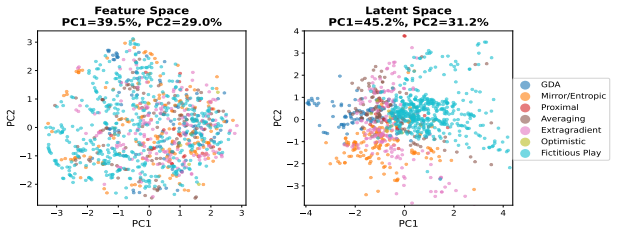
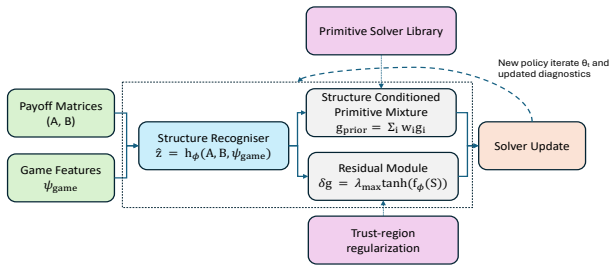
Solvability is governed by latent structural properties defining a continuous solver-aligned geometry of games. We formalise this perspective through structure-aware solver synthesis: a learned structure recogniser maps each game to a low-dimensional solver-aligned representation, and a policy maps this representation to effective primitive mechanisms, adapting solver behaviour across regimes. A bounded residual acts as a local corrector and diagnostic signal. The framework yields both an adaptive solver and an analytical lens in which games with similar optimisation dynamics cluster together, revealing continuous regions of algorithmic validity and overlapping solver behaviour.
What carries the argument
The learned structure recogniser that embeds games into a low-dimensional solver-aligned representation used to select or combine primitive mechanisms.
If this is right
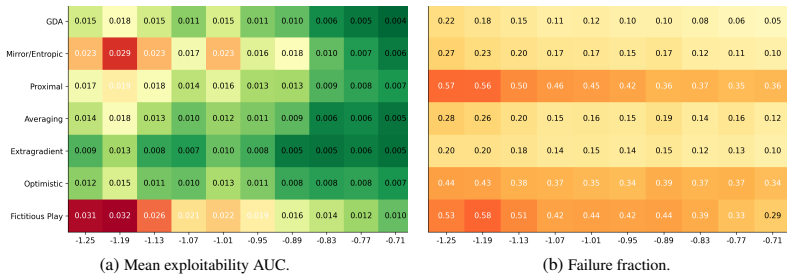
- Fixed solver primitives exhibit systematic regime mismatch across the game landscape.
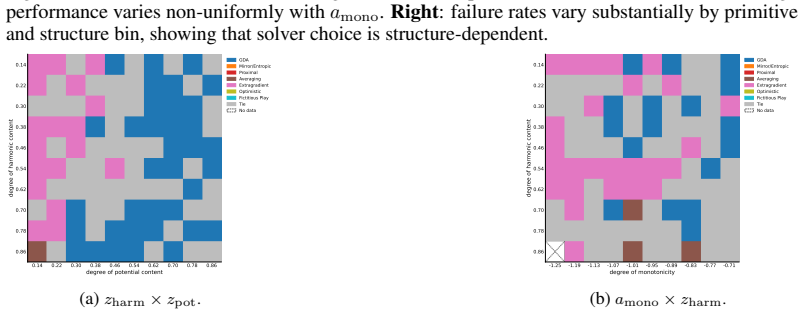
- Mixtures of primitives become necessary in overlapping regimes rather than any single dominant solver.
- The learned representation organises game space into a structured cartography aligned with observed solver behaviour.
- A bounded residual term serves as both local corrector and signal for incomplete solver bases.
Where Pith is reading between the lines
- The same representation could be used to interpolate solver behaviour for entirely new game families without retraining from scratch.
- Training dynamics in GANs or other minimax learners might be diagnosed by projecting the underlying game into the same geometry.
- If the geometry is stable, one could search for new primitive mechanisms by optimising directly in the representation space rather than hand-designing them.
Load-bearing premise
That games possess latent structural properties which can be captured in a low-dimensional representation sufficient to predict which solver dynamics will be effective on them.
What would settle it
Measuring whether distances in the learned representation fail to predict relative performance of different solvers on a diverse held-out collection of games.
Figures
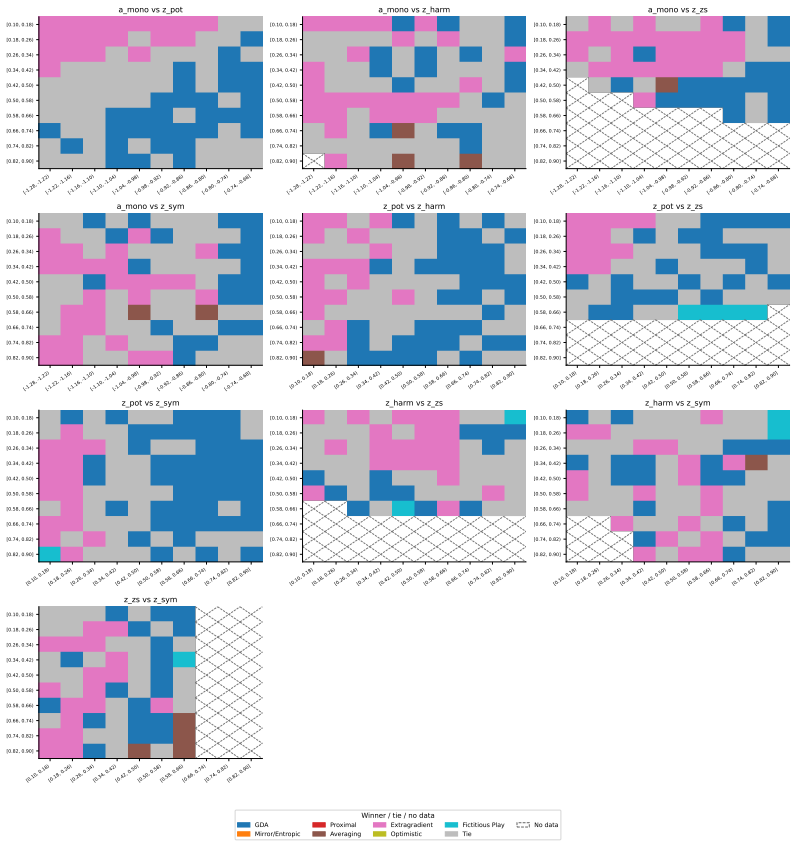
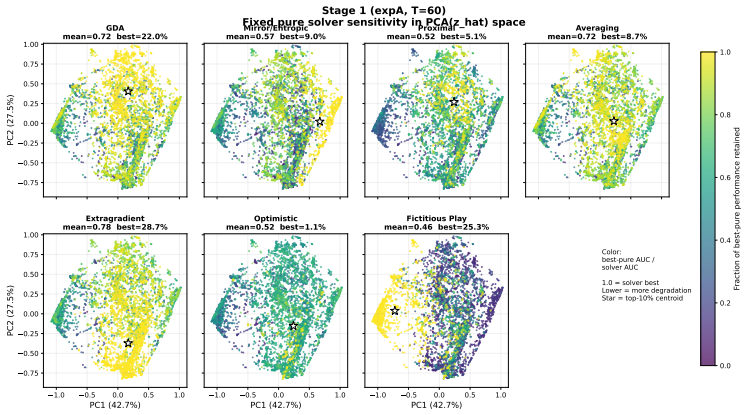
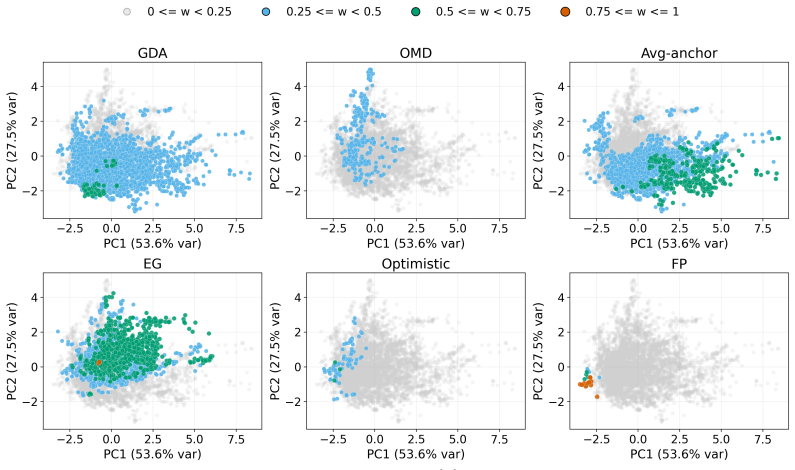
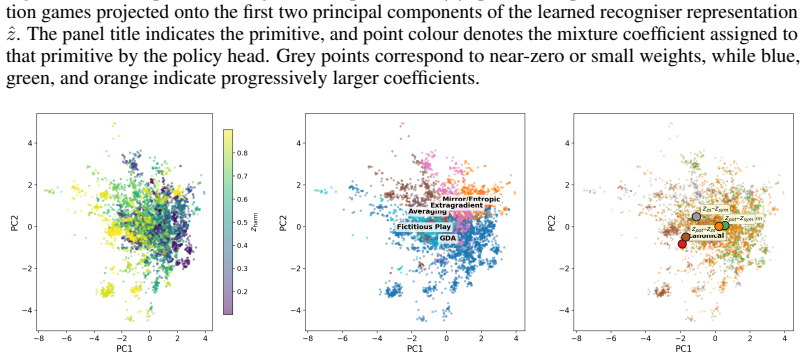
read the original abstract
A central challenge in game theory and learning systems such as GANs is understanding which algorithms can efficiently compute equilibria across the heterogeneous landscape of games. Equilibrium computation is typically studied solver by solver and game class by game class, yielding strong local guarantees but a fragmented view of solver behaviour. Existing discrete taxonomies often provide an incomplete account of where algorithms succeed. We study this problem through a solver-game map linking games to effective solver dynamics. Classical theory identifies isolated regions of this map but provides limited insight into intermediate or overlapping regimes, suggesting that solvability is governed by latent structural properties defining a continuous solver-aligned geometry of games. We formalise this perspective through structure-aware solver synthesis. A learned structure recogniser maps each game to a low-dimensional solver-aligned representation, and a policy maps this representation to effective primitive mechanisms, adapting solver behaviour across regimes. This reveals regions where particular solver dynamics are effective and where mixtures of primitives are required rather than a single dominant solver. A bounded residual acts as a local corrector and diagnostic signal for incomplete solver bases or representations. The framework yields both an adaptive solver and an analytical lens: games with similar optimisation dynamics cluster together, revealing continuous regions of algorithmic validity and overlapping solver behaviour. Empirically, we show that fixed primitives exhibit systematic regime mismatch, while the learned representation organises game space into a structured cartography aligned with solver behaviour. These results suggest viewing equilibrium computation as the joint problem of learning solver mechanisms and mapping the geometry of solvability.
Editorial analysis
A structured set of objections, weighed in public.
Referee Report
Summary. The manuscript proposes a framework called structure-aware solver synthesis for equilibrium computation across heterogeneous games. A learned structure recogniser maps each game to a low-dimensional solver-aligned representation; a policy then maps this representation to combinations of primitive solver mechanisms. The approach is claimed to yield both an adaptive solver and an analytical lens that clusters games according to optimisation dynamics, revealing continuous regions of algorithmic validity and overlapping solver regimes. Fixed primitives are said to exhibit systematic regime mismatch, while the learned representation produces a structured cartography aligned with solver behaviour. A bounded residual is introduced as a local corrector and diagnostic signal.
Significance. If the central claims are substantiated with independent validation, the work could provide a valuable shift from discrete taxonomies of games and solvers toward a continuous geometry of solvability. This would be useful for designing adaptive equilibrium-finding methods in AI systems such as GANs. The attempt to formalise latent structural properties that predict solver dynamics is a constructive direction, though the manuscript supplies no derivations, datasets, or metrics to evaluate whether the geometry is discovered rather than constructed.
major comments (3)
- [Abstract] Abstract: the claim that 'the learned representation organises game space into a structured cartography aligned with solver behaviour' is presented without any description of the training objective, loss function, datasets, or quantitative metrics used to establish alignment. This makes it impossible to determine whether the alignment reflects independent latent properties or is tautological by construction.
- [Abstract] Abstract: the 'solver-aligned representation' is defined via the output of the learned model itself, with no mention of external benchmarks or validation separate from the solver-success signal used in training. This directly undermines the central assumption that latent structural properties exist and are captured independently.
- [Abstract] Abstract: the 'bounded residual' is introduced as 'a local corrector and diagnostic signal for incomplete solver bases or representations' but receives no mathematical definition, update rule, or empirical illustration, leaving a load-bearing component of the framework undefined.
Simulated Author's Rebuttal
We thank the referee for the detailed comments, which correctly identify areas where the abstract is insufficiently precise. We agree that the claims require more supporting detail and will revise both the abstract and relevant sections of the manuscript to supply the missing methodological information, definitions, and validation procedures.
read point-by-point responses
-
Referee: [Abstract] Abstract: the claim that 'the learned representation organises game space into a structured cartography aligned with solver behaviour' is presented without any description of the training objective, loss function, datasets, or quantitative metrics used to establish alignment. This makes it impossible to determine whether the alignment reflects independent latent properties or is tautological by construction.
Authors: We agree that the abstract does not supply these details. The revised abstract will briefly state the training objective (a supervised loss aligning embeddings to solver performance), the dataset construction, and the quantitative alignment metrics (e.g., correlation between embedding geometry and solver success rates). This addition will make clear how the claimed cartography is evaluated. revision: yes
-
Referee: [Abstract] Abstract: the 'solver-aligned representation' is defined via the output of the learned model itself, with no mention of external benchmarks or validation separate from the solver-success signal used in training. This directly undermines the central assumption that latent structural properties exist and are captured independently.
Authors: We accept the point that the abstract provides no indication of separate validation. The revision will describe the input features to the structure recogniser (payoff-derived structural descriptors) and will add mention of held-out validation on solver types and game classes not seen during training, to demonstrate that the representation captures properties beyond the direct training signal. revision: yes
-
Referee: [Abstract] Abstract: the 'bounded residual' is introduced as 'a local corrector and diagnostic signal for incomplete solver bases or representations' but receives no mathematical definition, update rule, or empirical illustration, leaving a load-bearing component of the framework undefined.
Authors: We agree that the abstract leaves the bounded residual without definition or illustration. The revised version will include a concise mathematical definition, the update rule, and reference to empirical results demonstrating its corrective and diagnostic role. revision: yes
Circularity Check
No significant circularity; derivation remains self-contained
full rationale
The abstract and description outline a learned structure recogniser that produces a solver-aligned representation used to map to solver primitives, with empirical clustering as output. No equations, training objectives, or self-citations are quoted that would reduce the representation or predictions to the inputs by construction. No load-bearing self-citation chains or fitted parameters renamed as independent predictions appear. The framework is presented as jointly learning mechanisms and geometry, but without explicit reduction to tautology in the given text, the central claims retain independent empirical content.
Axiom & Free-Parameter Ledger
axioms (1)
- domain assumption Games possess latent structural properties that define a continuous solver-aligned geometry
invented entities (2)
-
solver-aligned representation
no independent evidence
-
bounded residual
no independent evidence
Reference graph
Works this paper leans on
-
[1]
Andrychowicz, M
M. Andrychowicz, M. Denil, S. Gomez, M. W. Hoffman, D. Pfau, T. Schaul, B. Shillingford, and N. de Freitas. Learning to learn by gradient descent by gradient descent. InAdvances in Neural Information Processing Systems, volume 29, 2016. URL https://proceedings.neurips. cc/paper/2016/hash/fb87582825f9d28a8d42c5e5e5e8b23d-Abstract.html
2016
-
[2]
K. Antonakopoulos, E. V . Belmega, and P. Mertikopoulos. Adaptive extra-gradient methods for min-max optimization and games.arXiv preprint arXiv:2010.12100, 2020
-
[3]
Balduzzi, S
D. Balduzzi, S. Racaniere, J. Martens, J. Foerster, K. Tuyls, and T. Graepel. The mechanics of n-player differentiable games. InProceedings of the 35th International Conference on Machine Learning, volume 80 ofProceedings of Machine Learning Research, pages 354–363. PMLR,
-
[4]
URLhttps://proceedings.mlr.press/v80/balduzzi18a.html
-
[5]
Beck and M
A. Beck and M. Teboulle. Mirror descent and nonlinear projected subgradient methods for convex optimization.Operations Research Letters, 31(3):167–175, 2003
2003
-
[6]
U. Berger. Brown’s original fictitious play.Journal of Economic Theory, 135(1):572–578, 2007
2007
-
[7]
IVOA Recommendation: Simple Line Access Protocol Version 1.0
O. Candogan, I. Menache, A. Ozdaglar, and P. A. Parrilo. Flows and decompositions of games: Harmonic and potential games.Mathematics of Operations Research, 36(3):474–503, 2011. doi: 10.1287/moor.1110.0500. URLhttps://doi.org/10.1287/moor.1110.0500
work page internal anchor Pith review Pith/arXiv arXiv doi:10.1287/moor.1110.0500 2011
-
[8]
Candogan, A
O. Candogan, A. Ozdaglar, and P. A. Parrilo. Near-potential games: Geometry and dynamics. ACM Transactions on Economics and Computation (TEAC), 1(2):1–32, 2013
2013
-
[9]
X. Chen, X. Deng, et al. Settling the complexity of two-player nash equilibrium. InFOCS, volume 6, pages 261–272, 2006
2006
- [10]
-
[11]
Daskalakis and I
C. Daskalakis and I. Panageas. The limit points of (optimistic) gradient descent in min-max optimization.Advances in neural information processing systems, 31, 2018
2018
-
[12]
Daskalakis, A
C. Daskalakis, A. Ilyas, V . Syrgkanis, and H. Zeng. Training GANs with optimism. In International Conference on Learning Representations, 2018. URL https://openreview. net/forum?id=SJJySbbAZ
2018
-
[13]
X. Deng, N. Li, D. Mguni, J. Wang, and Y . Yang. On the complexity of computing markov perfect equilibrium in general-sum stochastic games.National Science Review, 10(1):nwac256, 2023
2023
-
[14]
Gidel, H
G. Gidel, H. Berard, G. Vignoud, P. Vincent, and S. Lacoste-Julien. A variational inequality perspective on generative adversarial networks. InInternational Conference on Learning Representations, 2019. URLhttps://openreview.net/forum?id=r1laEnA5Ym. 11
2019
-
[15]
Krishna and T
V . Krishna and T. Sjöström. On the convergence of fictitious play.Mathematics of Operations Research, 23(2):479–511, 1998
1998
-
[16]
Q. D. La, Y . H. Chew, and B.-H. Soong. Potential games. InPotential Game Theory: Applica- tions in Radio Resource Allocation, pages 23–69. Springer, 2016
2016
-
[17]
D. S. Leslie, S. Perkins, and Z. Xu. Best-response dynamics in zero-sum stochastic games. Journal of Economic Theory, 189:105095, 2020
2020
-
[18]
H. Li, W. Huang, Z. Duan, D. H. Mguni, K. Shao, J. Wang, and X. Deng. A survey on algorithms for nash equilibria in finite normal-form games.Computer Science Review, 51:100613, 2024
2024
-
[19]
A. Matsui. Best response dynamics and socially stable strategies.Journal of Economic Theory, 57(2):343–362, 1992
1992
-
[20]
Mokhtari, A
A. Mokhtari, A. Ozdaglar, and S. Pattathil. A unified analysis of extra-gradient and opti- mistic gradient methods for saddle point problems: Proximal point approach. InInternational Conference on Artificial Intelligence and Statistics, pages 1497–1507. PMLR, 2020
2020
-
[21]
Monderer and L
D. Monderer and L. S. Shapley. Fictitious play property for games with identical interests. Journal of economic theory, 68(1):258–265, 1996
1996
-
[22]
D. Monderer and L. S. Shapley. Potential games.Games and Economic Behavior, 14(1): 124–143, 1996. doi: 10.1006/game.1996.0044. URL https://doi.org/10.1006/game. 1996.0044
-
[23]
A. Nemirovski. Prox-method with rate of convergence O(1/t) for variational inequalities with lipschitz continuous monotone operators and smooth convex-concave saddle point problems. SIAM Journal on Optimization, 15(1):229–251, 2004. doi: 10.1137/S1052623403425629. URL https://doi.org/10.1137/S1052623403425629
-
[24]
C. H. Papadimitriou and T. Roughgarden. Computing equilibria in multi-player games. In SODA, volume 5, pages 82–91, 2005
2005
-
[25]
Schulman, S
J. Schulman, S. Levine, P. Abbeel, M. Jordan, and P. Moritz. Trust region policy optimization. InInternational conference on machine learning, pages 1889–1897. PMLR, 2015
2015
-
[26]
Sparrow, S
C. Sparrow, S. van Strien, and C. Harris. Fictitious play in 3× 3 games: The transition between periodic and chaotic behaviour.Games and Economic Behavior, 63(1):259–291, 2008
2008
-
[27]
Swenson, R
B. Swenson, R. Murray, and S. Kar. On best-response dynamics in potential games.SIAM Journal on Control and Optimization, 56(4):2734–2767, 2018
2018
-
[28]
Y . Yang, C. Ma, Z. Ding, S. McAleer, C. Jin, J. Wang, and T. Sandholm. Game-theoretic multiagent reinforcement learning.arXiv preprint arXiv:2011.00583, 2020. 12 Table 3: Summary results on the 10D payoff benchmark. Gap Closure uses the same definition as Table 1. Method Val AUC↓Val Final↓Gap Closure Per-game oracle 0.02512 0.00696 100.0% Learned (soft) ...
discussion (0)
Sign in with ORCID, Apple, or X to comment. Anyone can read and Pith papers without signing in.