Restoring Velocity Immunity via Dynamic Mirror Compensation in a Large-Area Dual-Atom-Interferometer Gyroscope
Pith reviewed 2026-06-28 23:56 UTC · model grok-4.3
The pith
Actively rotating Raman mirrors during pulses restores velocity immunity broken by Earth's rotation in atom-interferometer gyroscopes.
A machine-rendered reading of the paper's core claim, the machinery that carries it, and where it could break.
Core claim
The central discovery is that actively rotating the Raman mirrors to cancel the time-dependent angular offset induced by Earth's rotation restores the inherent velocity immunity of the Mach-Zehnder atom interferometer phase shift. This is implemented via a decouplable calibration-compensation chain on a dual-atom-interferometer gyroscope with 21.1 cm² interference area, resulting in a 40-fold reduction in the phase's dependence on atomic velocity and limiting the velocity contribution to scale-factor stability to 0.13 ppm.
What carries the argument
Dynamical mirror compensation by actively rotating the Raman mirrors to cancel rotation-induced time-dependent angular offsets.
If this is right
- The phase dependence on atomic velocity is reduced 40-fold after compensation.
- The velocity contribution to scale-factor stability is 0.13 ppm.
- The gyroscope achieves a rotation sensitivity of 1.3×10^{-8} rad/s/Hz^{1/2}.
- The stability reaches 1.9×10^{-10} rad/s at 4500 s integration time.
- A common-mode noise rejection ratio of up to 459 is demonstrated during a seismic event.
Where Pith is reading between the lines
- This compensation could allow scaling to even larger interference areas without velocity-induced instabilities.
- The technique may extend to other rotation-sensitive atom interferometry applications in navigation and geophysics.
- By addressing the Coriolis-induced velocity sensitivity, the method supports improved long-term stability in inertial sensors.
Load-bearing premise
The calibration and compensation steps can be decoupled without introducing additional velocity-dependent or rotation-dependent errors.
What would settle it
Measurement showing that the phase-velocity dependence remains above 1/40 of the uncompensated value or that velocity-induced scale-factor variations exceed 0.13 ppm after applying the mirror rotation compensation.
Figures
read the original abstract
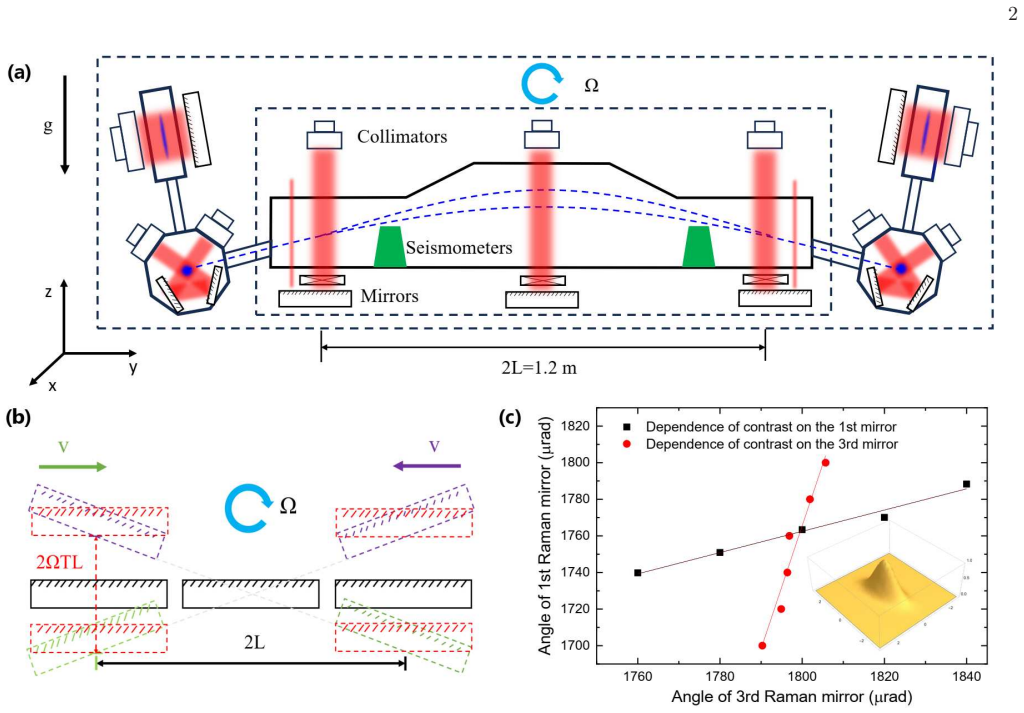
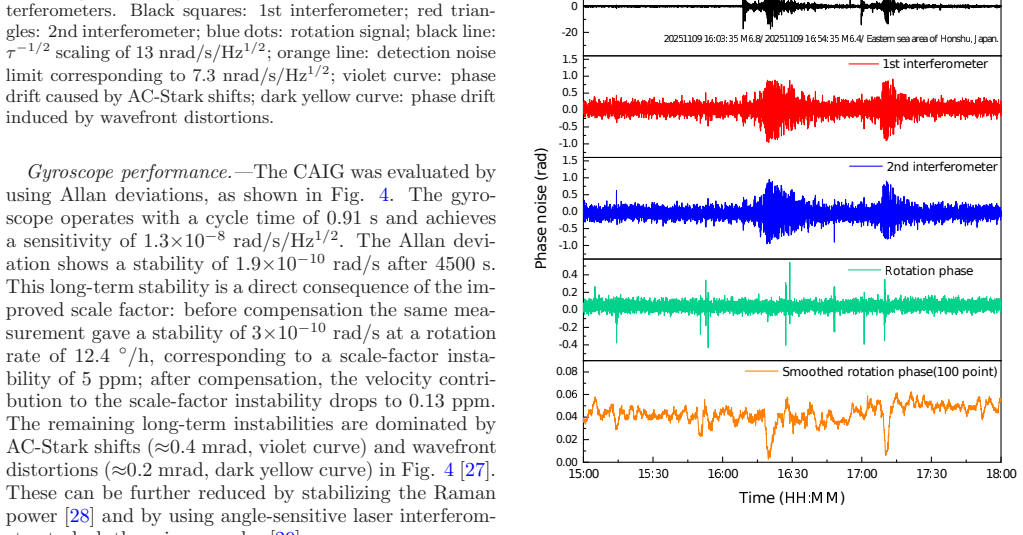
We propose and demonstrate a dynamical mirror compensation scheme to restore velocity immunity in a large-area dual-atom-interferometer gyroscope. In an ideal Mach-Zehnder configuration, the phase shift is inherently immune to atomic velocity, but this property is broken by the Earth's rotation via the Coriolis effect. We overcome this by actively rotating the Raman mirrors during the pulse sequence to cancel the time-dependent angular offset. The implementation relies on a decouplable calibration-compensation chain to remove rotation-induced time-dependent terms. The scheme is validated on a dual-atom-interferometer gyroscope with an interference area of 21.1 cm^2. After compensation, the phase's dependence on atomic velocity is reduced 40-fold, and the velocity contribution to scale-factor stability is evaluated to be 0.13 ppm. The sensor achieves a rotation sensitivity of 1.3\times10^{-8} rad/s/Hz^{1/2} and a stability of 1.9\times10^{-10} rad/s at 4500 s integration, together with a common-mode noise rejection ratio of up to 459, demonstrated in a seismic event. This work removes a key obstacle to scale-factor stabilization in atom-interferometer gyroscopes and paves the way for their applications in inertial navigation and geophysics.
Editorial analysis
A structured set of objections, weighed in public.
Referee Report
Summary. The manuscript proposes and demonstrates a dynamical mirror compensation scheme to restore velocity immunity in a large-area (21.1 cm²) dual-atom-interferometer gyroscope. Earth's rotation breaks the inherent velocity immunity of the Mach-Zehnder phase via the Coriolis effect; the authors actively rotate the Raman mirrors during the pulse sequence using a decouplable calibration-compensation chain to cancel the resulting time-dependent angular offset. Post-compensation, the phase's dependence on atomic velocity is reduced 40-fold and the velocity contribution to scale-factor stability is 0.13 ppm. The sensor reports a rotation sensitivity of 1.3×10^{-8} rad/s/Hz^{1/2} and a stability of 1.9×10^{-10} rad/s at 4500 s integration, together with a common-mode rejection ratio up to 459 during a seismic event.
Significance. If the reported compensation scheme functions without reintroducing velocity- or rotation-dependent phase errors, the work removes a recognized obstacle to scale-factor stabilization in large-area atom-interferometer gyroscopes and supports their use in inertial navigation and geophysics. The experimental demonstration on a dual-interferometer apparatus with quantified sensitivity and stability metrics would constitute a concrete technical advance.
major comments (2)
- [Section 2] Section 2 / Methods: The central claim that the calibration-compensation chain is fully decouplable rests on the assumption that active mirror rotation couples to the interferometer phase solely through the intended Coriolis cancellation and does not alter effective wavevector projection, pulse timing, or beam steering in a velocity-dependent manner. Finite mirror inertia or residual steering effects could reintroduce velocity-dependent terms not captured by the 40-fold reduction metric; explicit modeling of these residuals or an auxiliary measurement isolating mirror dynamics from the atomic velocity distribution is required to substantiate the 0.13 ppm scale-factor contribution.
- [Results] Results / Abstract: The post-compensation velocity contribution to scale-factor stability is stated as 0.13 ppm, yet the manuscript provides no explicit error budget, velocity-distribution measurement protocol, or baseline comparison (pre- vs. post-compensation) that would allow independent verification that this term is correctly isolated from other systematics such as laser phase noise or mirror vibration.
minor comments (1)
- [Abstract] The abstract and text use “decouplable calibration-compensation chain” without a concise definition or block diagram; a short schematic would clarify the sequence of calibration and compensation steps.
Simulated Author's Rebuttal
We thank the referee for the constructive and detailed comments on our manuscript. These have prompted us to strengthen the presentation of the decoupling assumptions and the supporting data for the scale-factor contribution. We address each major comment below.
read point-by-point responses
-
Referee: [Section 2] Section 2 / Methods: The central claim that the calibration-compensation chain is fully decouplable rests on the assumption that active mirror rotation couples to the interferometer phase solely through the intended Coriolis cancellation and does not alter effective wavevector projection, pulse timing, or beam steering in a velocity-dependent manner. Finite mirror inertia or residual steering effects could reintroduce velocity-dependent terms not captured by the 40-fold reduction metric; explicit modeling of these residuals or an auxiliary measurement isolating mirror dynamics from the atomic velocity distribution is required to substantiate the 0.13 ppm scale-factor contribution.
Authors: We agree that the manuscript would benefit from explicit modeling of residual mirror dynamics. The calibration-compensation chain is constructed so that mirror rotation occurs only during the free-evolution intervals and is calibrated independently of the atomic velocity distribution; however, to address possible inertia or steering residuals, the revised manuscript will add a quantitative model of these effects together with auxiliary mirror-motion measurements. This analysis shows that any reintroduced velocity-dependent phase terms remain below the reported 0.13 ppm level, consistent with the observed 40-fold suppression. revision: yes
-
Referee: [Results] Results / Abstract: The post-compensation velocity contribution to scale-factor stability is stated as 0.13 ppm, yet the manuscript provides no explicit error budget, velocity-distribution measurement protocol, or baseline comparison (pre- vs. post-compensation) that would allow independent verification that this term is correctly isolated from other systematics such as laser phase noise or mirror vibration.
Authors: The 0.13 ppm value is obtained by multiplying the measured 40-fold reduction in velocity sensitivity by the independently characterized atomic velocity spread. In the revised manuscript we will insert an explicit error-budget table, a description of the velocity-distribution measurement protocol (time-of-flight imaging), and direct pre- versus post-compensation phase-versus-velocity data sets. These additions will isolate the velocity term from laser phase noise and vibration contributions. revision: yes
Circularity Check
No circularity: experimental measurements of compensation scheme
full rationale
The paper reports direct experimental validation of a physical compensation technique on a dual-atom-interferometer gyroscope. Claims of 40-fold reduction in velocity dependence, 0.13 ppm scale-factor contribution, and achieved sensitivity/stability are presented as measured outcomes from the implemented setup, not as predictions or derivations that reduce to fitted inputs or self-citations by construction. No equations, ansatzes, or uniqueness theorems are invoked that loop back to the reported results. The calibration-compensation chain is described as a practical implementation whose performance is externally benchmarked by the interferometer data.
Axiom & Free-Parameter Ledger
axioms (2)
- domain assumption In an ideal Mach-Zehnder atom interferometer the phase shift is inherently immune to atomic velocity.
- domain assumption Earth's rotation induces a time-dependent Coriolis effect that breaks velocity immunity.
Reference graph
Works this paper leans on
-
[1]
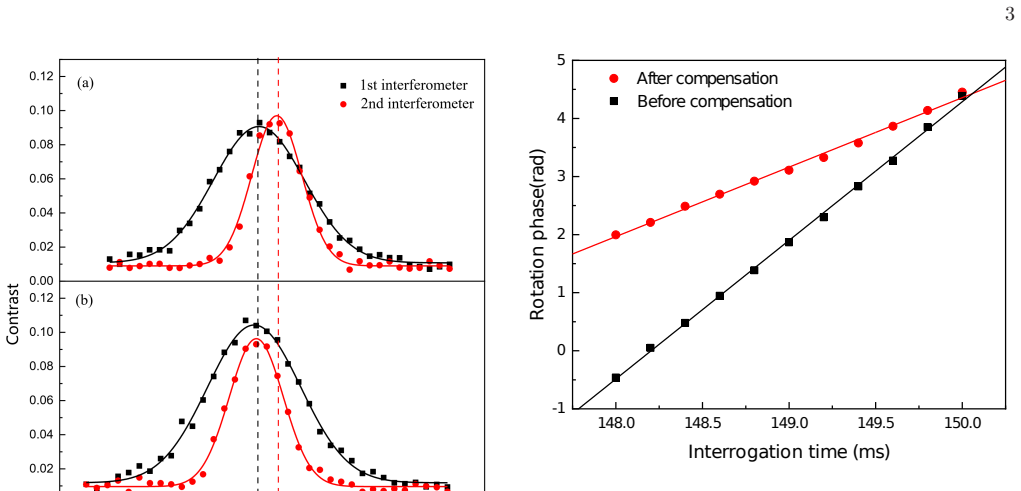
To verify the restoration of velocity immunity, we measure the rotation phase while varying the interroga- tion time T as shown in Fig
and ( 3) simplifies to ϕ Ω = 2keff Ω LT, (4) which no longer contains any atomic position or velocity terms. To verify the restoration of velocity immunity, we measure the rotation phase while varying the interroga- tion time T as shown in Fig
-
[2]
After 4 compensation, the slope decreases to 1.19 ± 0.03 rad/ms (black dots), consistent with a purely linear φ T ∝ T scal- ing as predicted by Eq
Before compensation, the slope is 2.39 ± 0.03 rad/ms (black squares), reflect- ing both rotation and spurious velocity couplings. After 4 compensation, the slope decreases to 1.19 ± 0.03 rad/ms (black dots), consistent with a purely linear φ T ∝ T scal- ing as predicted by Eq. ( 4). From the change in slope, we infer a reduction of the velocity dependence ...
-
[3]
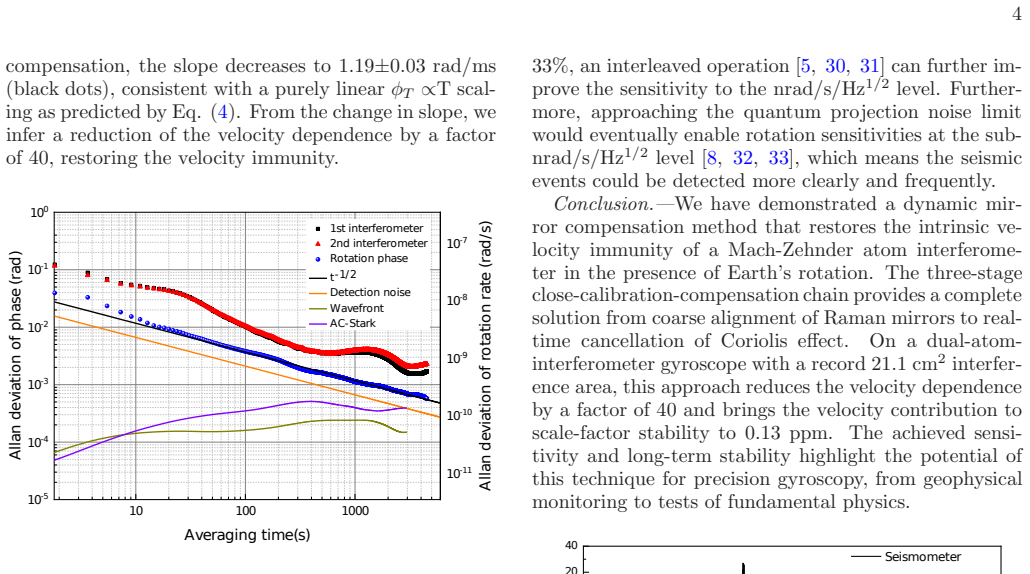
The Allan devi- ation shows a stability of 1.9 × 10− 10 rad/s after 4500 s
The gyro- scope operates with a cycle time of 0.91 s and achieves a sensitivity of 1.3 × 10− 8 rad/s/Hz1/ 2. The Allan devi- ation shows a stability of 1.9 × 10− 10 rad/s after 4500 s. This long-term stability is a direct consequence of the im- proved scale factor: before compensation the same mea- surement gave a stability of 3 × 10− 10 rad/s at a rotati...
2025
-
[4]
K. U. Schreiber and J. P. R. Wells. Large ring lasers for rotation sensing, Rev. Sci. Instrum. 84, 041101 (2013)
2013
-
[5]
H. C. Lef` evre, The fiber-optic gyroscope: Challenges to become the ultimate rotation-sensing technology, Opt. Fiber Technol. 19, 828 (2013)
2013
-
[6]
M. O. Scully, and J. P. Dowling, Quantum-noise limits to matter-wave interferometry Phys. Rev. A 48, 3186 (1993)
1993
-
[7]
D. S. Durfee, Y. K. Shaham, and M. A. Kasevich, Long- term stability of an area-reversible atom-interferometer Sagnac gyroscope, Phys. Rev. Lett. 97, 240801 (2006)
2006
-
[8]
Savoie, M
D. Savoie, M. Altorio, B. Fang, L. A. Sidorenkov, R. Geiger, and A. Landragin, Interleaved atom interferom- etry for high-sensitivity inertial measurements, Sci. Adv . 4, eaau7948 (2018)
2018
-
[9]
R. B. Hurst, T, M. Mayerbacher, A. Gebauer, K. U. Schreiber, and J. R. Wells, High-accuracy absolute ro- tation rate measurements with a large ring laser gyro: establishing the scale factor, Appl. Opt. 56, 1124(2017)
2017
-
[10]
Anderson, H
R. Anderson, H. Bilger, and G. Stedman, ”Sagnac” ef- fect: A century of Earth-rotated interferometers, Am. J. Phys. 62, 975 (1994)
1994
-
[11]
Gauguet, B
A. Gauguet, B. Canuel, T. Lef` evre, W. Chaibi, and A. Landragin, Characterization and limits of a cold-atom Sagnac interferometer, Phys. Rev. A 80, 063604 (2009)
2009
-
[12]
P. Berg, S. Abend, G. Tackmann, C. Schubert, E. Giese, W. P. Schleich, F. A. Narducci, W. Ertmer, and E. M. Rasel, Composite-light-pulse technique for high- precision atom interferometry, Phys. Rev. Lett. 114, 063002 (2015)
2015
-
[13]
Z. W. Yao, H. H. Chen, S. B. Lu, R. B. Li, Z. X. Lu, X. L. Chen, G. H. Yu, M. Jiang, C. Sun, W. T. Ni, J. Wang, and M. S. Zhan, Self-alignment of a large-area dual-atom-interferometer gyroscope using parameter-decoupled phase-seeking calibrations, Phys. Rev. A. 103, 023319 (2021)
2021
-
[14]
T. L. Gustavson, A. Landragin and M. A. Kasevich, Ro- tation sensing with a dual atom-interferometer Sagnac gyroscope, Class. Quantum Grav. 17, 2385 (2000)
2000
-
[15]
J. M. Kwolek and A. T. Black, Continuous sub-doppler- cooled atomic beam interferometer for inertial sensing, Phys. Rev. Appl. 17, 024061 (2022)
2022
-
[16]
Z. X. Meng, P. Q. Yan, S. Z. Wang, X. J. Li, H. B. Xue, and Y. Y. Feng, Closed-loop dual-atom-interferometer in- ertial sensor with continuous cold atomic beams, Phys. Rev. Appl. 21, 034050 (2024)
2024
-
[17]
S. Y. Lan, P. C. Kuan, B. Estey, P. Haslinger, and H. M¨uller, Influence of the Coriolis force in atom interfer- ometry, Phys. Rev. Lett. 108, 090402 (2012)
2012
-
[18]
Asenbaum, C
P. Asenbaum, C. Overstreet, M. Kim, J. Curti, and M. A. Kasevich. Atom-interferometric test of the equivalence principle at the 10 − 12 level, Phys. Rev. Lett. 125, 191101 (2020)
2020
-
[19]
H. H. Chen, Z. W. Yao, Z. X. Lu, S. B. Lu, M. Jiang, S. K. Li, X. L. Chen, S. Chuan, Y. F. Mao, Y. Li, R. B. Li, J. Wang, and M. S. Zhan, Self-calibrated atom- interferometer gyroscope by modulating atomic veloci- ties, Rev. Sci. Instrum. 95, 053201 (2024)
2024
-
[20]
J. K. Stockton, K. Takase, and M. A. Kasevich, Absolute geodetic rotation measurement using atom interferome- try, Phys. Rev. Lett. 107, 133001 (2011)
2011
-
[21]
Gautier, M
R. Gautier, M. Guessoum, L. A. Sidorenkov, Q. Bouton, A. Landragin and R. Geiger. Accurate measurement of the Sagnac effect for matter waves, Sci. Adv. 8, eabn8009 (2022)
2022
-
[22]
W. J. Xu, L. L. Chen, M. J. Nie, M. K. Zhou and Z. K. Hu. Limits on the sensitivity of a cold atom interferom- etry gyroscope, Opt. Express 32, 42856(2024)
2024
-
[23]
Jiang, S, B, Lu, X
M. Jiang, S, B, Lu, X. L. Chen, J. H. Fu, Z. W. Yao, S. K. Li, M. Ke, S. M. Song, R. B. Li, J. Wang, and M. S. Zhan, Rapid and robust laser-frequency auto-locking using Bayesian optimization and discrete- wavelet-transformation algorithms, in preparation
-
[24]
Z. X. Lu, Z. W. Yao, H. H. Chen, Y. F. Mao, S. B. Lu, M. Jiang, S. K. Li, M. Ke, J. Gu, A. Q. Zhang, R. B. Li, J. Wang, and M. S. Zhan, Real-time compensation scheme for the accurate measurement of the differential phase in a dual-atom-interferometer gyroscope, Phys. Rev. A 111, 033305 (2025)
2025
-
[25]
Roura, W
A. Roura, W. Zeller and W. P Schleich, Overcoming loss of contrast in atom interferometry due to gravity gradi- ents, New J. Phys. 16, 123012 (2014)
2014
-
[26]
Tackmann, P
G. Tackmann, P. Berg, C. Schubert, S. Abend, M. Gilowski, W. Ertmer and E. M. Rasel, Self-alignment of a compact large-area atomic Sagnac interferometer, New J. Phys. 14, 015002 (2012)
2012
-
[27]
J. Li, X. Chen, D. Zhang, W. Wang, Y. Zhou, M. He, J. Fang, L. Zhou, C. He, J. Jiang, H. Sun, Q. Chen, L. Qin, X. Li, Y. Wang, X. Zhang, J. Zhong, R. Li, M. An, L. Zhang, S. Wang, Z. Li, J. Wang, and M. Zhan. Realization of a cold atom gyroscope in space, Nat. Sci. Rev. 12, nwaf012 (2025)
2025
-
[28]
L. Li, L. L. Chen, Q. Luo, H. Zhou, M. K. Zhou, and Z. K. Hu. Coriolis effect due to laser beam tilting in an atom interferometer, Opt. Express 33, 462 (2025)
2025
-
[29]
W. T. Duan, C. He, S. T. Yan, Y. H. Ji, L. Zhou, X. Chen, J. Wang, and M. S. Zhan. Suppression of Coriolis error in weak equivalence principle test using 85Rb− 87Rb dual- species atom interferometer, Chin. Phys. B 29, 070305 (2020)
2020
-
[30]
Altorio, L
M. Altorio, L. A. Sidorenkov, R. Gautier, D. Savoie, A. Landragin, and R. Geiger. Accurate trajectory alignment in cold-atom interferometers with separated laser beams, Phys. Rev. A 101, 033606 (2020)
2020
-
[31]
W. Lyu, J. Q. Zhong, X. W. Zhang, W. Liu, L. Zhu, W. H. Xu, X. Chen, B. Tang, J. Wang, and M. S. Zhan. Com- pact high-resolution absolute-gravity gradiometer based on atom interferometers, Phys. Rev. Appl. 18, 054091 (2022)
2022
-
[32]
Schuldt, M
T. Schuldt, M. Gohlke, D. Weise, U. Johann, A. Peters and C. Braxmaier. Picometer and nanoradian optical het- erodyne interferometry for translation and tilt metrology of the LISA gravitational reference sensor, Class. Quan- tum Grav. 26, 085008 (2009). 6
2009
-
[33]
G. W. Biedermann, K. Takase, X. Wu, L. Deslauriers, S. Roy, and M. A. Kasevich. Zero-dead-time operation of interleaved atomic clocks, Phys. Rev. Lett. 111, 170802 (2013)
2013
-
[34]
Dutta, D
I. Dutta, D. Savoie, B. Fang, B. Venon, C. L. Garrido Alzar, R. Geiger, and A. Landragin, Continuous cold- atom inertial sensor with 1 nrad / sec rotation stability, Phys. Rev. Lett. 116, 183003 (2016)
2016
-
[35]
G. W. Biedermann, X. Wu, L. Deslauriers, K. Takase, and M. A. Kasevich. Low-noise simultaneous fluorescence detection of two atomic states, Opt. Lett. 34, 347 (2009)
2009
-
[36]
Janvier, V
C. Janvier, V. M´ enoret, and B. Desruelle. Compact differential gravimeter at the quantum projection-noise limit, Phys. Rev. A 105, 022801 (2022)
2022
discussion (0)
Sign in with ORCID, Apple, or X to comment. Anyone can read and Pith papers without signing in.