When Should AI Read the Room? Public Perceptions of Social Intelligence in AI Agents
Pith reviewed 2026-06-29 00:30 UTC · model grok-4.3
The pith
US adults already report encountering AI agents they see as socially intelligent based on observable behaviors, yet support such agents more for others than for their own use.
A machine-rendered reading of the paper's core claim, the machinery that carries it, and where it could break.
Core claim
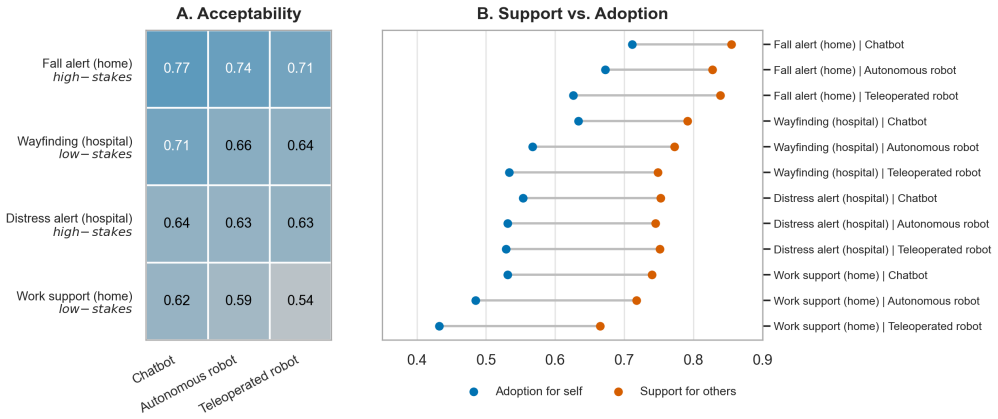
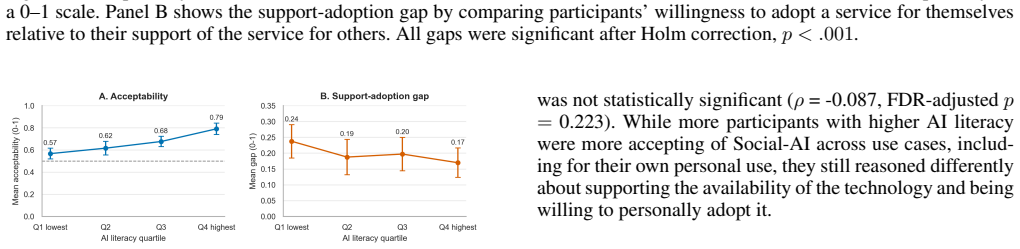
Participants widely reported having already encountered AI agents they perceived as socially intelligent and grounded their judgments in observable behaviors, more than beliefs about AI agency or intent. The analysis identifies a support-adoption gap: participants supported the existence of Social-AI agents for others far more than for their own personal use. The survey further maps contextual factors that influence acceptance and documents layperson concerns about the technologies.
What carries the argument
The support-adoption gap in acceptability judgments, identified through the mixed-methods survey responses on perceived social intelligence and personal versus general use.
If this is right
- Deployment of Social-AI should prioritize contexts where observable behaviors align with public expectations of social intelligence.
- Governance decisions must weigh the documented difference between societal support and personal adoption preferences.
- Risk assessments for end users should incorporate the specific concerns raised about these agents in everyday settings.
- Agent roles in social environments need calibration to the abilities participants associate with social intelligence.
Where Pith is reading between the lines
- Designers could test whether making specific observable behaviors more prominent increases personal adoption rates.
- Similar surveys in other countries or demographic groups might reveal whether the support-adoption gap is culturally specific.
- Policy on AI in public spaces could use the identified concerns to set boundaries on agent capabilities.
Load-bearing premise
Self-reported answers from this sample of 200 US adults accurately reflect genuine perceptions of social intelligence and can be generalized beyond the surveyed group without meaningful response bias or sampling limits.
What would settle it
A replication study using behavioral observation tasks instead of self-report, or a nationally representative sample drawn differently, that finds participants do not ground social-intelligence judgments in observable behaviors or shows no support-adoption gap.
Figures
read the original abstract
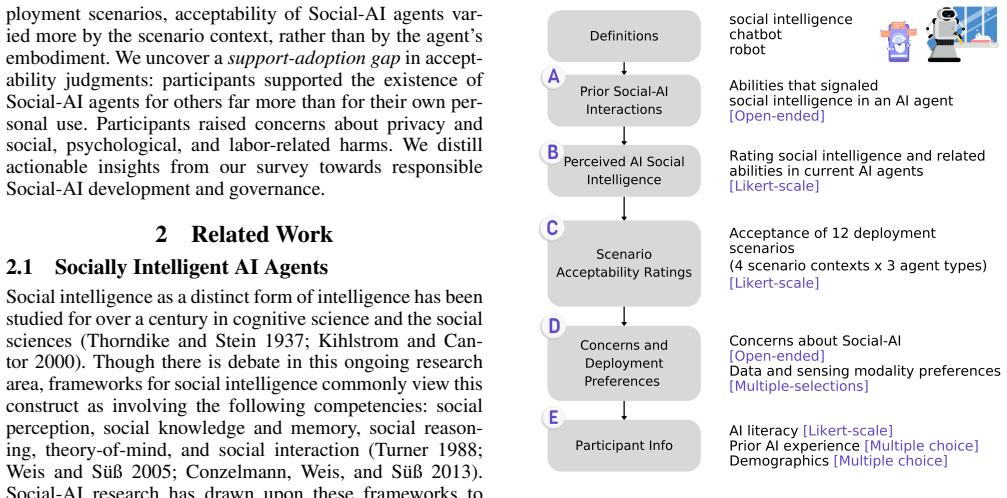
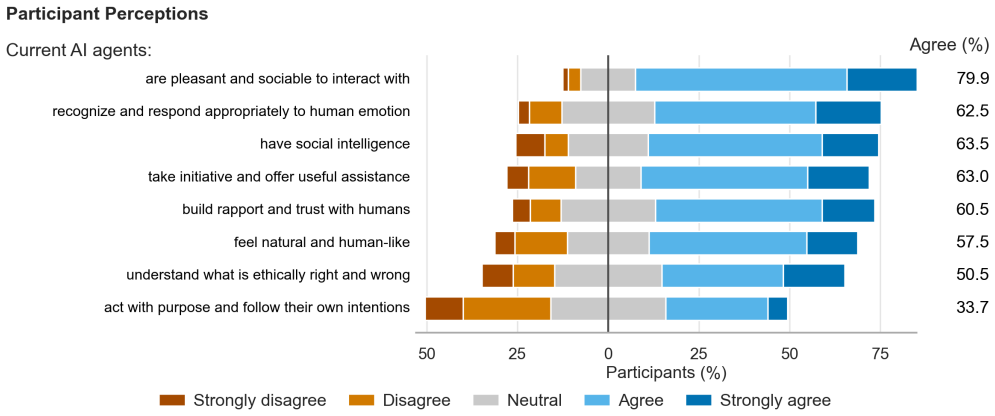
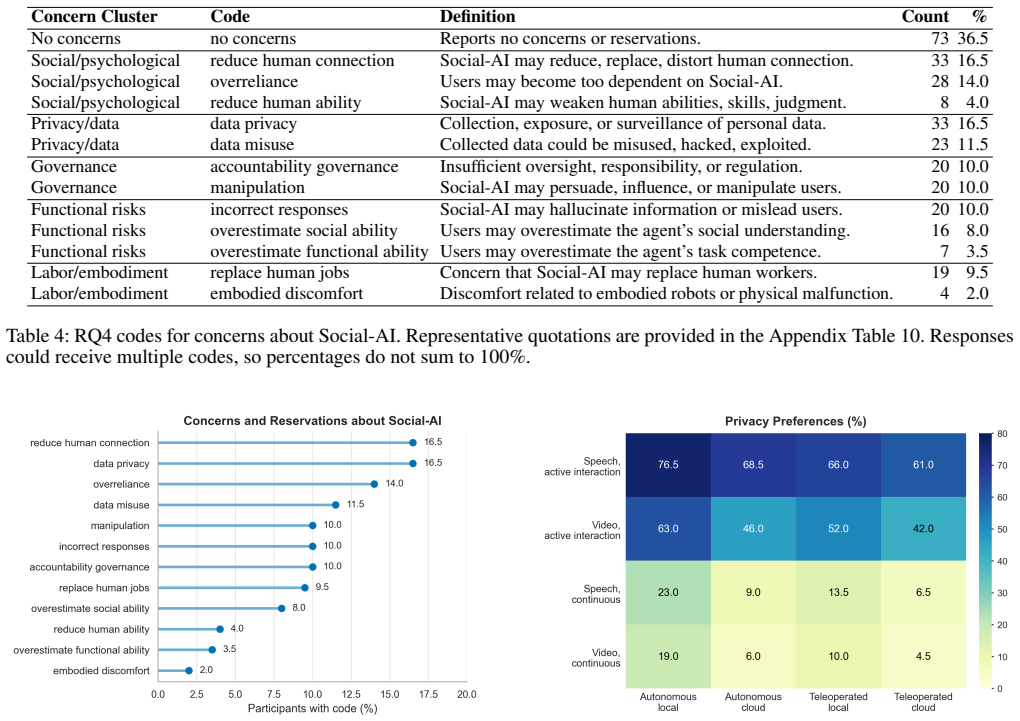
AI researchers have been advancing socially intelligent AI agents (Social-AI) across embodiments, from chatbots to physical robots. As Social-AI is increasingly deployed in everyday settings, decisions about the roles these agents should play will depend on how laypeople perceive them. However, public perceptions of social intelligence in AI agents and the acceptability of these agents remain largely understudied. We present a mixed-methods survey of adults in the United States (N=200) that examines social intelligence as a perceived construct in AI agents. Our survey investigates the extent to which participants believe current AI agents have social intelligence, abilities of agents that participants associate with social intelligence, contextual factors influencing participant acceptance of Social-AI agents, and concerns participants hold about these technologies. Participants widely reported having already encountered AI agents they perceived as socially intelligent and grounded their judgments in observable behaviors, more than beliefs about AI agency or intent. We identified a support-adoption gap in acceptability judgments: participants supported the existence of Social-AI agents for others far more than for their own personal use. Our analysis uncovers layperson concerns about Social-AI, informing AI governance regarding appropriate deployment contexts, agent roles, and risks to end users.
Editorial analysis
A structured set of objections, weighed in public.
Referee Report
Summary. The manuscript reports a mixed-methods survey of N=200 US adults examining public perceptions of social intelligence in AI agents. It claims that participants widely report prior encounters with socially intelligent AI, ground those judgments in observable behaviors more than beliefs about agency or intent, exhibit a support-adoption gap (greater support for others than personal use), and hold specific concerns that inform governance on deployment contexts and risks.
Significance. If substantiated, the work supplies empirical data on an understudied topic, identifying the support-adoption gap and the primacy of observable behaviors as potentially actionable inputs for AI governance and deployment decisions.
major comments (2)
- [Abstract and Methods] Abstract/Methods: The abstract states high-level findings on reported encounters and the support-adoption gap but supplies no details on the survey instrument, sampling method, statistical analysis, or exclusion criteria. This prevents verification that the data support the stated claims.
- [Results and Discussion] Results/Discussion: The generalizability claim to 'public perceptions' rests on an N=200 US adult sample with no reported validation against self-report bias or behavioral measures; this is load-bearing for the title and strongest claims.
Simulated Author's Rebuttal
We thank the referee for their constructive comments, which help clarify the scope and limitations of our survey-based study. We address each major comment below, indicating where revisions will be made to the manuscript.
read point-by-point responses
-
Referee: [Abstract and Methods] Abstract/Methods: The abstract states high-level findings on reported encounters and the support-adoption gap but supplies no details on the survey instrument, sampling method, statistical analysis, or exclusion criteria. This prevents verification that the data support the stated claims.
Authors: The abstract is written to be concise per standard journal guidelines, focusing on core findings. Full details on the survey instrument (including all items and scales), sampling (quota-based US adult sample via online platform), statistical analysis (descriptive statistics, thematic analysis of open responses), and exclusion criteria (e.g., attention checks and incomplete responses) are provided in the dedicated Methods section. To address the concern, we will revise the abstract to briefly note the mixed-methods design and N=200 sample, and add a cross-reference to the Methods section for verification. revision: yes
-
Referee: [Results and Discussion] Results/Discussion: The generalizability claim to 'public perceptions' rests on an N=200 US adult sample with no reported validation against self-report bias or behavioral measures; this is load-bearing for the title and strongest claims.
Authors: We agree that N=200 is modest and that self-report methods carry inherent bias risks; the manuscript already positions the work as an exploratory study of perceptions rather than a definitive population survey. We will revise the Results and Discussion sections to explicitly qualify generalizability claims, highlight the self-report limitation, and temper language in the title and abstract to reflect the sample scope. Behavioral validation measures would require an entirely different experimental design and are outside the current study's remit as a perception survey. revision: partial
Circularity Check
Empirical survey paper with no derivations, equations, or fitted predictions
full rationale
The paper reports findings from a mixed-methods survey (N=200 US adults) on perceptions of social intelligence in AI agents. It contains no equations, no parameter fitting, no predictive models, and no derivation chain. Claims rest directly on participant self-reports and qualitative coding rather than any reduction to prior inputs by construction. No self-citation load-bearing steps, uniqueness theorems, or ansatzes appear in the core analysis. This matches the default expectation of no significant circularity for non-theoretical empirical work.
Axiom & Free-Parameter Ledger
axioms (1)
- domain assumption Self-reported perceptions in a survey of 200 US adults reflect genuine and generalizable views on AI social intelligence.
Reference graph
Works this paper leans on
-
[1]
, " * write output.state after.block = add.period write newline
ENTRY address archivePrefix author booktitle chapter edition editor eid eprint howpublished institution isbn journal key month note number organization pages publisher school series title type volume year label extra.label sort.label short.list INTEGERS output.state before.all mid.sentence after.sentence after.block FUNCTION init.state.consts #0 'before.a...
-
[2]
write newline
" write newline "" before.all 'output.state := FUNCTION n.dashify 't := "" t empty not t #1 #1 substring "-" = t #1 #2 substring "--" = not "--" * t #2 global.max substring 't := t #1 #1 substring "-" = "-" * t #2 global.max substring 't := while if t #1 #1 substring * t #2 global.max substring 't := if while FUNCTION word.in bbl.in capitalize " " * FUNCT...
-
[3]
C.; Dinkar, T.; Rieser, V.; and Talat, Z
Abercrombie, G.; Curry, A. C.; Dinkar, T.; Rieser, V.; and Talat, Z. 2023. Mirages. on anthropomorphism in dialogue systems. In Proceedings of the 2023 Conference on Empirical Methods in Natural Language Processing, 4776--4790
2023
-
[4]
AI, N. 2024. Artificial intelligence risk management framework: Generative artificial intelligence profile. NIST Trustworthy and Responsible AI Gaithersburg, MD, USA
2024
-
[5]
Andalibi, N.; and Ingber, A. S. 2025. Public Perceptions About Emotion AI Use Across Contexts in the United States. In Proceedings of the 2025 CHI Conference on Human Factors in Computing Systems, 1--16
2025
-
[6]
C.; Gabriel, I.; and Mohamed, S
Birhane, A.; Isaac, W.; Prabhakaran, V.; Diaz, M.; Elish, M. C.; Gabriel, I.; and Mohamed, S. 2022. Power to the people? Opportunities and challenges for participatory AI. In Proceedings of the 2nd ACM Conference on Equity and Access in Algorithms, Mechanisms, and Optimization, 1--8
2022
-
[7]
Bondi, E.; Xu, L.; Acosta-Navas, D.; and Killian, J. A. 2021. Envisioning communities: a participatory approach towards AI for social good. In Proceedings of the 2021 AAAI/ACM Conference on AI, Ethics, and Society, 425--436
2021
-
[8]
L.; Vervier, L.; and Ziefle, M
Brauner, P.; Glawe, F.; Liehner, G. L.; Vervier, L.; and Ziefle, M. 2026. Charting the AI perception gap: divergent views on risk, benefit, and value between experts and the public challenge the societal acceptance of AI. AI & society, 1--29
2026
-
[9]
Brown, B.; Bu, F.; Mandel, I.; and Ju, W. 2024. Trash in motion: Emergent interactions with a robotic trashcan. In Proceedings of the 2024 CHI Conference on Human Factors in Computing Systems, 1--17
2024
-
[10]
S.; Franyutti-Cintron, A
Chen, A.; Kim, S. S.; Franyutti-Cintron, A. N.; Dharmasiri, A.; Mukherjee, K.; Russakovsky, O.; and Fan, J. E. 2026. Presenting Large Language Models as Companions Affects What Mental Capacities People Attribute to Them. In Proceedings of the 2026 CHI Conference on Human Factors in Computing Systems, 1--30
2026
-
[11]
Conzelmann, K.; Weis, S.; and S \"u , H.-M. 2013. New findings about social intelligence. Journal of Individual Differences
2013
-
[12]
M.; and Strauss, A
Corbin, J. M.; and Strauss, A. 1990. Grounded theory research: Procedures, canons, and evaluative criteria. Qualitative sociology, 13(1): 3--21
1990
-
[13]
Cronbach, L. J. 1951. Coefficient alpha and the internal structure of tests. psychometrika, 16(3): 297--334
1951
-
[14]
Delgado, F.; Yang, S.; Madaio, M.; and Yang, Q. 2023. The participatory turn in ai design: Theoretical foundations and the current state of practice. In Proceedings of the 3rd ACM Conference on Equity and Access in Algorithms, Mechanisms, and Optimization, 1--23
2023
-
[15]
Deng, E.; Mutlu, B.; and Matari \'c , M. J. 2019. Embodiment in socially interactive robots. Foundations and Trends in Robotics , 7(4): 251--356
2019
-
[16]
Dennler, N.; Ruan, C.; Hadiwijoyo, J.; Chen, B.; Nikolaidis, S.; and Matari \'c , M. 2023. Design metaphors for understanding user expectations of socially interactive robot embodiments. ACM Transactions on Human-Robot Interaction, 12(2): 1--41
2023
-
[17]
J.; Baguley, T.; and Brunsden, V
Dunn, T. J.; Baguley, T.; and Brunsden, V. 2014. From alpha to omega: A practical solution to the pervasive problem of internal consistency estimation. British journal of psychology, 105(3): 399--412
2014
-
[18]
Fei-Fei, L.; and Krishna, R. 2022. Searching for computer vision north stars. Daedalus, 151(2): 85--99
2022
-
[19]
Gambino, A.; Fox, J.; and Ratan, R. A. 2020. Building a stronger CASA: Extending the computers are social actors paradigm. Human-Machine Communication, 1: 71--85
2020
-
[20]
K.; Lee, J
Gordon, G.; Spaulding, S.; Westlund, J. K.; Lee, J. J.; Plummer, L.; Martinez, M.; Das, M.; and Breazeal, C. 2016. Affective personalization of a social robot tutor for children’s second language skills. In Proceedings of the AAAI conference on artificial intelligence, volume 30
2016
-
[21]
Gweon, H.; Fan, J.; and Kim, B. 2023. Socially intelligent machines that learn from humans and help humans learn. Philosophical Transactions of the Royal Society A: Mathematical, Physical and Engineering Sciences, 381(2251)
2023
-
[22]
Heerink, M.; Kr \"o se, B.; Evers, V.; and Wielinga, B. 2010. Assessing acceptance of assistive social agent technology by older adults: the almere model
2010
-
[23]
Henschel, A.; Laban, G.; and Cross, E. S. 2021. What makes a robot social? A review of social robots from science fiction to a home or hospital near you. Current Robotics Reports, 2(1): 9--19
2021
- [24]
-
[25]
S.; Haimson, O
Ingber, A. S.; Haimson, O. L.; and Andalibi, N. 2025. Distinguishing Emotion AI: Factors Shaping Perceptions Including Input Data, Emotion Data Recipients, and Identity. In Proceedings of the 2025 ACM Conference on Fairness, Accountability, and Transparency, 498--510
2025
-
[26]
E.; Rueben, M.; Smart, W
Kaminski, M. E.; Rueben, M.; Smart, W. D.; and Grimm, C. M. 2016. Averting robot eyes. Md. L. Rev., 76: 983
2016
-
[27]
A.; et al
Kian, M.; Zong, M.; Fischer, K.; Velentza, A.-M.; Singh, A.; Shrestha, K.; Sang, P.; Upadhyay, S.; Browning, W.; Faruki, M. A.; et al. 2025. Engagement and Disclosures in LLM-Powered Cognitive Behavioral Therapy Exercises: A Factorial Design Comparing the Influence of a Robot vs. Chatbot Over Time. In 2025 34th IEEE International Conference on Robot and H...
2025
-
[28]
F.; and Cantor, N
Kihlstrom, J. F.; and Cantor, N. 2000. Social intelligence
2000
-
[29]
Krosnick, J. A. 2017. Questionnaire design. In The Palgrave handbook of survey research, 439--455. Springer
2017
- [30]
-
[31]
Li, M.; Shi, W.; Ziems, C.; and Yang, D. 2024. Social intelligence data infrastructure: Structuring the present and navigating the future. In Findings of the Association for Computational Linguistics: ACL 2024, 2789--2805
2024
-
[32]
V.; and Wright, J
Marsden, P. V.; and Wright, J. D. 2010. Handbook of survey research. Emerald Group Publishing
2010
-
[33]
P.; and Morency, L.-P
Mathur, L.; Liang, P. P.; and Morency, L.-P. 2024. Advancing Social Intelligence in AI Agents: Technical Challenges and Open Questions. In Al-Onaizan, Y.; Bansal, M.; and Chen, Y.-N., eds., Proceedings of the 2024 Conference on Empirical Methods in Natural Language Processing, 20541--20560. Miami, Florida, USA: Association for Computational Linguistics
2024
-
[34]
P.; and Morency, L.-P
Mathur, L.; Qian, M.; Liang, P. P.; and Morency, L.-P. 2025. Social Genome: Grounded Social Reasoning Abilities of Multimodal Models. In Christodoulopoulos, C.; Chakraborty, T.; Rose, C.; and Peng, V., eds., Proceedings of the 2025 Conference on Empirical Methods in Natural Language Processing, 24868--24891. Suzhou, China: Association for Computational Li...
2025
-
[35]
McDonald, R. P. 2013. Test theory: A unified treatment. psychology press
2013
-
[36]
McNemar, Q. 1947. Note on the sampling error of the difference between correlated proportions or percentages. Psychometrika, 12(2): 153--157
1947
-
[37]
Mun, J.; Jiang, L.; Liang, J.; Cheong, I.; DeCario, N.; Choi, Y.; Kohno, T.; and Sap, M. 2024. Particip-ai: A democratic surveying framework for anticipating future ai use cases, harms and benefits. In Proceedings of the AAAI/ACM Conference on AI, Ethics, and Society, volume 7, 997--1010
2024
-
[38]
Mun, J.; Yeong, W. B. A.; Deng, W. H.; Borg, J. S.; and Sap, M. 2025. Why (Not) Use AI? Analyzing People’s Reasoning and Conditions for AI Acceptability. In Proceedings of the AAAI/ACM Conference on AI, Ethics, and Society, volume 8, 1771--1784
2025
-
[39]
Mushkani, R.; Berard, H.; Ammar, T.; Chatonnier, C.; and Koseki, S. 2025. Co-Producing AI: Toward an Augmented, Participatory Lifecycle. In Proceedings of the AAAI/ACM Conference on AI, Ethics, and Society, volume 8, 1785--1799
2025
-
[40]
Nakanishi, J.; Kuramoto, I.; Baba, J.; Ogawa, K.; Yoshikawa, Y.; and Ishiguro, H. 2020. Continuous hospitality with social robots at a hotel. SN Applied Sciences, 2(3): 452
2020
-
[41]
Nass, C.; and Moon, Y. 2000. Machines and mindlessness: Social responses to computers. Journal of social issues, 56(1): 81--103
2000
-
[42]
Nass, C.; Steuer, J.; and Tauber, E. R. 1994. Computers are social actors. In Proceedings of the SIGCHI conference on Human factors in computing systems, 72--78
1994
-
[43]
Natale, S. 2019. If software is narrative: Joseph Weizenbaum, artificial intelligence and the biographies of ELIZA. new media & society, 21(3): 712--728
2019
-
[44]
Paepcke, S.; and Takayama, L. 2010. Judging a bot by its cover: An experiment on expectation setting for personal robots. In 2010 5th ACM/IEEE international Conference on human-robot interaction (HRI), 45--52. IEEE
2010
-
[45]
W.; Grover, I.; Spaulding, S.; Gomez, L.; and Breazeal, C
Park, H. W.; Grover, I.; Spaulding, S.; Gomez, L.; and Breazeal, C. 2019. A model-free affective reinforcement learning approach to personalization of an autonomous social robot companion for early literacy education. In Proceedings of the AAAI conference on artificial intelligence, volume 33, 687--694
2019
-
[46]
Parts, J.; Leoste, J.; Tammem \"a e, K.; and Rakic, S. 2025. A Systematic Scoping Review of Privacy Challenges and Privacy Enhancing Technologies in Teleoperated Robotics. IEEE Access, 13: 216724--216747
2025
-
[47]
Sap, M.; Rashkin, H.; Chen, D.; Le Bras, R.; and Choi, Y. 2019. Social IQa: Commonsense reasoning about social interactions. In Proceedings of the 2019 conference on empirical methods in natural language processing and the 9th international joint conference on natural language processing (EMNLP-IJCNLP), 4463--4473
2019
-
[48]
Sartori, L.; and Bocca, G. 2023. Minding the gap (s): public perceptions of AI and socio-technical imaginaries. AI & society, 38(2): 443--458
2023
-
[49]
D.; Boyd, D.; Friedler, S
Selbst, A. D.; Boyd, D.; Friedler, S. A.; Venkatasubramanian, S.; and Vertesi, J. 2019. Fairness and abstraction in sociotechnical systems. In Proceedings of the conference on fairness, accountability, and transparency, 59--68
2019
-
[50]
W.; Miner, A
Sharma, A.; Lin, I. W.; Miner, A. S.; Atkins, D. C.; and Althoff, T. 2023. Human--AI collaboration enables more empathic conversations in text-based peer-to-peer mental health support. Nature Machine Intelligence, 5(1): 46--57
2023
-
[51]
The AI risk repository: A meta-review, database, and taxonomy of risks from artificial intelligence
Slattery, P.; Saeri, A. K.; Grundy, E. A.; Graham, J.; Noetel, M.; Uuk, R.; Dao, J.; Pour, S.; Casper, S.; and Thompson, N. 2024. The ai risk repository: A comprehensive meta-review, database, and taxonomy of risks from artificial intelligence. arXiv preprint arXiv:2408.12622
work page internal anchor Pith review Pith/arXiv arXiv 2024
-
[52]
Spearman, C. 1961. The proof and measurement of association between two things
1961
-
[53]
A.; Laban, G.; Lim, A.; and Gunes, H
Spitale, M.; Axelsson, M.; Jeong, S.; Tutt \"o s \' , P.; Stamatis, C. A.; Laban, G.; Lim, A.; and Gunes, H. 2025. Past, present, and future: A survey of the evolution of affective robotics for well-being. IEEE Transactions on Affective Computing
2025
-
[54]
Takayama, L.; Ju, W.; and Nass, C. 2008. Beyond dirty, dangerous and dull: what everyday people think robots should do. In Proceedings of the 3rd ACM/IEEE international conference on Human robot interaction, 25--32
2008
-
[55]
Taylor, S.; Jaques, N.; Nosakhare, E.; Sano, A.; and Picard, R. 2017. Personalized multitask learning for predicting tomorrow's mood, stress, and health. IEEE Transactions on Affective Computing, 11(2): 200--213
2017
-
[56]
Thomaz, A. 2023. Robots in real life: Putting hri to work. In Proceedings of the 2023 ACM/IEEE International Conference on Human-Robot Interaction, 3--3
2023
-
[57]
L.; and Stein, S
Thorndike, R. L.; and Stein, S. 1937. An evaluation of the attempts to measure social intelligence. Psychological bulletin, 34(5): 275
1937
-
[58]
Turner, J. H. 1988. A theory of social interaction. Stanford University Press
1988
-
[59]
Ullstein, C.; Jarvers, S.; Hohendanner, M.; Papakyriakopoulos, O.; and Grossklags, J. 2025. Participatory AI and the EU AI Act. In Proceedings of the AAAI/ACM Conference on AI, Ethics, and Society, volume 8, 2550--2562
2025
-
[60]
Bureau of Labor Statistics
U.S. Bureau of Labor Statistics . 2018. The 2018 Standard Occupational Classification System
2018
-
[61]
P.; and Yuan, T
Wang, B.; Rau, P.-L. P.; and Yuan, T. 2023. Measuring user competence in using artificial intelligence: validity and reliability of artificial intelligence literacy scale. Behaviour & information technology, 42(9): 1324--1337
2023
-
[62]
Weis, S.; and S \"u , H.-M. 2005. Social intelligence--A review and critical discussion of measurement concepts. Emotional intelligence: An international handbook, 203--230
2005
-
[63]
Weizenbaum, J. 1983. ELIZA—a computer program for the study of natural language communication between man and machine. Communications of the ACM, 26(1): 23--28
1983
-
[64]
Wilcoxon, F. 1945. Individual comparisons by ranking methods. Biometrics bulletin, 1(6): 80--83
1945
-
[65]
Zhou, X.; Zhu, H.; Mathur, L.; Zhang, R.; Yu, H.; Qi, Z.; Morency, L.-P.; Bisk, Y.; Fried, D.; Neubig, G.; et al. 2024. Sotopia: Interactive evaluation for social intelligence in language agents. In International Conference on Learning Representations, volume 2024, 40975--41019
2024
discussion (0)
Sign in with ORCID, Apple, or X to comment. Anyone can read and Pith papers without signing in.