Thermodynamic and magnetocaloric properties of a triangular spin-1/2 cluster with Dzyaloshinskii-Moriya interaction
Pith reviewed 2026-06-29 06:03 UTC · model grok-4.3
The pith
The Dzyaloshinskii-Moriya interaction in a triangular spin-1/2 cluster produces both direct and inverse magnetocaloric effects through nontrivial field-dependent entropy changes.
A machine-rendered reading of the paper's core claim, the machinery that carries it, and where it could break.
Core claim
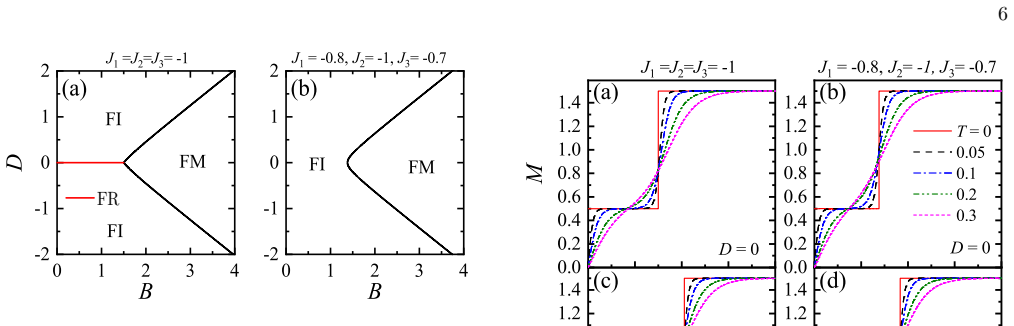
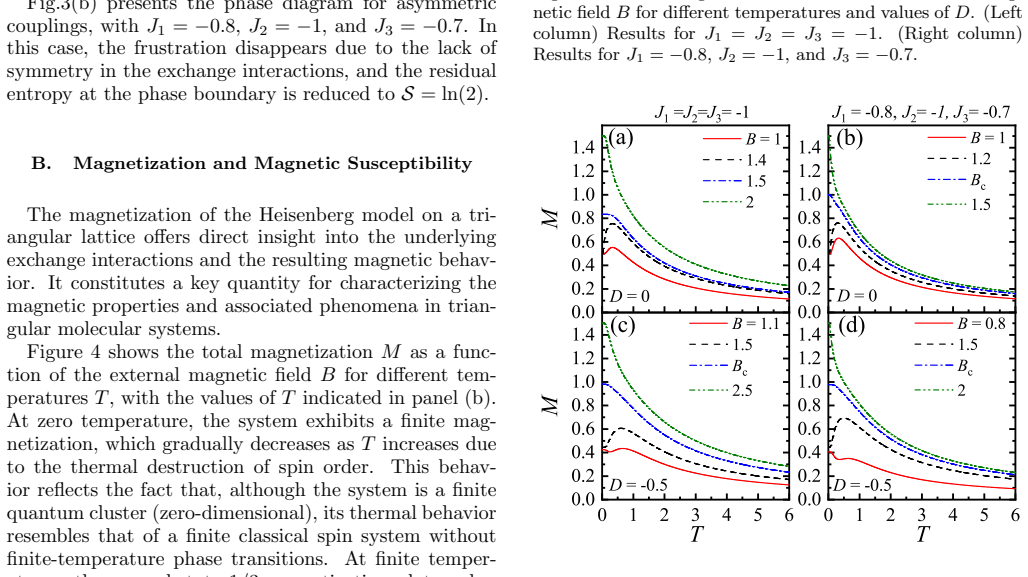
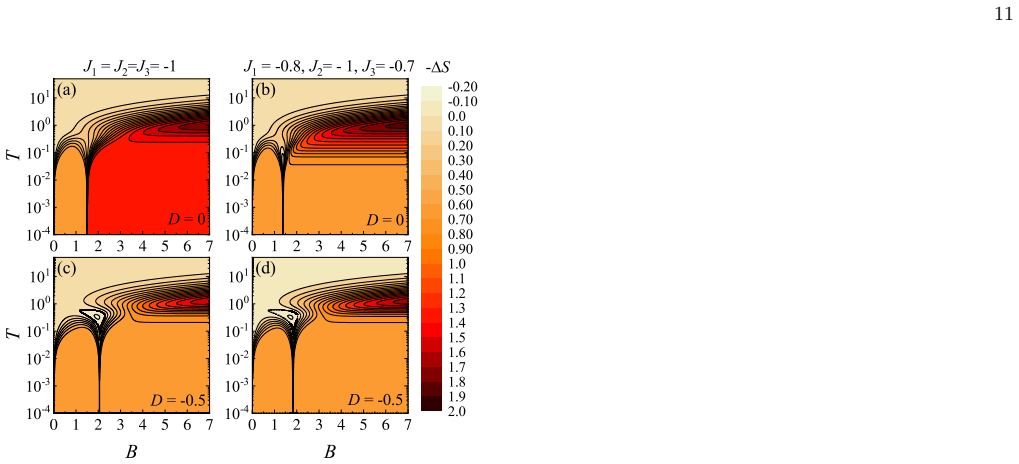
The triangular spin-1/2 cluster governed by the Heisenberg Hamiltonian plus Dzyaloshinskii-Moriya terms exhibits ferromagnetic, ferrimagnetic, and frustrated ground-state phases. At low temperature the magnetization displays a 1/3 plateau that vanishes with rising temperature. Entropy carries residual contributions from ground-state degeneracies, specific heat shows Schottky peaks, and the magnetocaloric effect contains both direct and inverse regimes whose detailed field dependence is shaped by the strength of the DM interaction.
What carries the argument
The spin-1/2 Heisenberg Hamiltonian with antisymmetric Dzyaloshinskii-Moriya exchange on each bond of the triangle, whose exact eigenvalues are used to compute all thermodynamic quantities for the finite cluster.
If this is right
- A 1/3 magnetization plateau appears at low temperature and disappears with thermal fluctuations.
- Residual entropy persists at zero temperature because of ground-state degeneracies.
- Both direct and inverse magnetocaloric regimes exist and depend on the direction and range of field change.
- Schottky anomalies appear in the specific heat at intermediate temperatures.
- The DM term produces additional low-temperature features in entropy and susceptibility tied to the phase boundaries.
Where Pith is reading between the lines
- If the DM strength can be tuned by chemical substitution or pressure, the same cluster could be switched between cooling and heating modes by modest field adjustments.
- The finite-cluster phase boundaries may serve as a guide for locating similar field-induced transitions in larger frustrated lattices that contain DM interactions.
- The same Hamiltonian could be applied to other small clusters such as tetrahedra to test whether DM-induced MCE complexity is geometry-specific.
- Susceptibility peaks near the predicted phase transitions offer a direct experimental signature that could be checked in Cu3-based compounds.
Load-bearing premise
The three-spin cluster with only Heisenberg plus DM terms already contains all the physics needed to describe the observed thermodynamic and magnetocaloric behavior.
What would settle it
An experimental entropy-change curve versus magnetic field that remains simple and monotonic even when the DM strength is varied would falsify the claim of nontrivial DM-driven variations.
Figures


read the original abstract
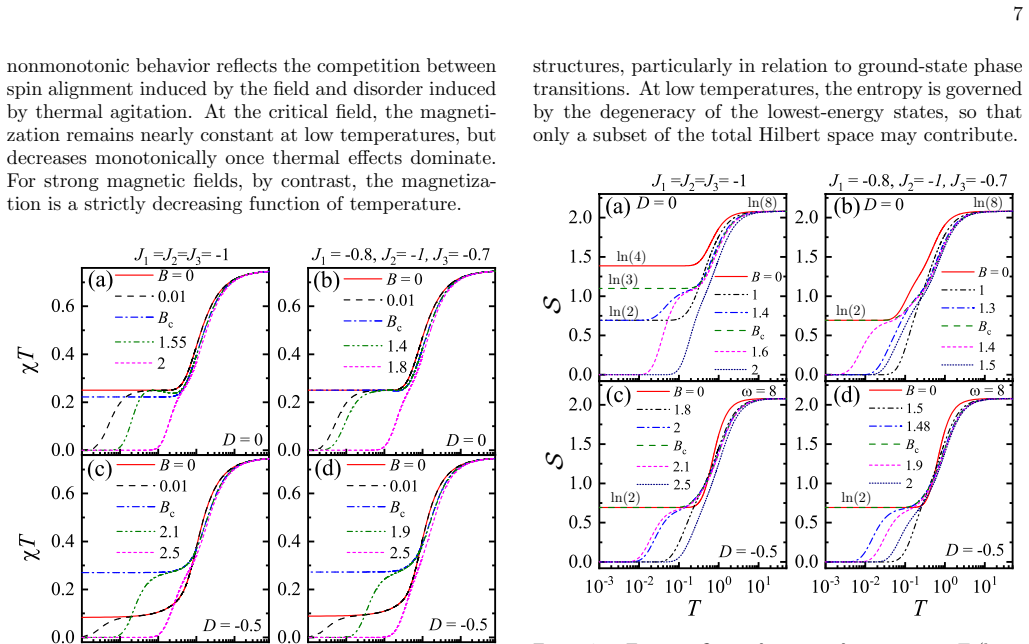
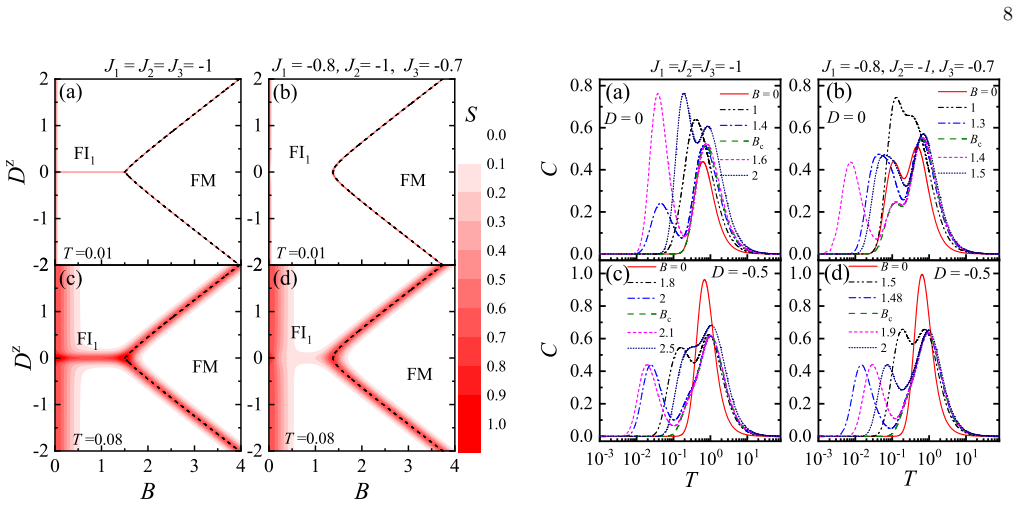
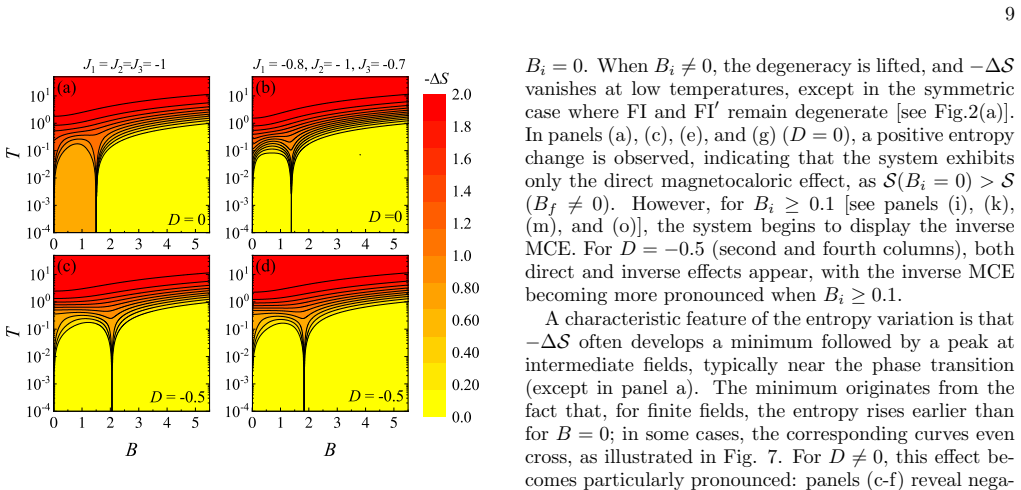
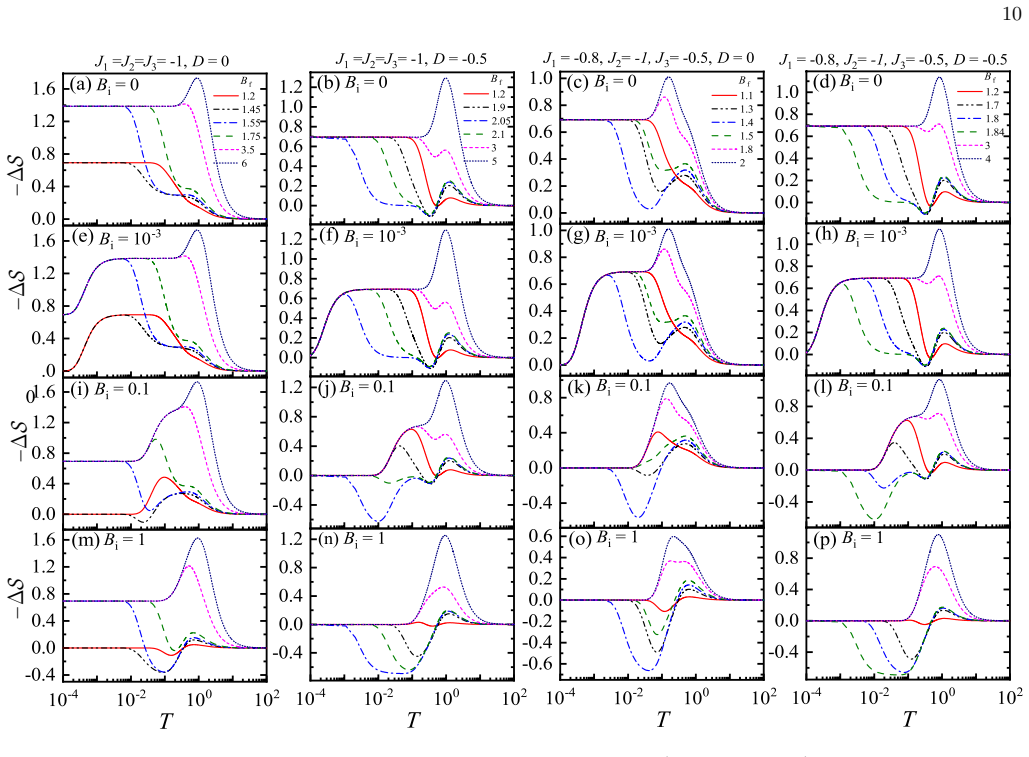
We present a theoretical investigation of the magnetic and thermodynamic properties of the triangular spin-1/2 cluster with Dzyaloshinskii-Moriya (DM) interaction, described by a spin-1/2 Heisenberg Hamiltonian with antisymmetric exchange interactions. The energy spectrum and ground-state phase diagram reveal the presence of ferromagnetic (FM), ferrimagnetic (FI), and frustrated (FR) phases, strongly influenced by the total spin and the DM interaction. We analyze magnetization and susceptibility, showing that at low temperatures the system exhibits a characteristic 1/3 magnetization plateau, while thermal fluctuations suppress magnetic order at higher temperatures. The entropy and specific heat display residual entropies due to ground-state degeneracies, Schottky-type anomalies at intermediate temperatures, and additional low-temperature features related to phase transitions. Particular attention is given to the magnetocaloric effect (MCE), characterized by both direct and inverse regimes depending on the magnetic field variation. We find that the DM interaction enhances the complexity of the MCE, leading to nontrivial entropy variations as a function of the magnetic field. These results provide insights into the role of frustration and anisotropy in tuning the MCE of properties triangular spin clusters, with relevance to \mathrm{Cu}_{3}-based molecular magnets.
Editorial analysis
A structured set of objections, weighed in public.
Referee Report
Summary. The manuscript theoretically investigates the thermodynamic and magnetocaloric properties of an isolated triangular spin-1/2 cluster governed by the Heisenberg Hamiltonian augmented by Dzyaloshinskii-Moriya (DM) antisymmetric exchange. Using exact diagonalization, the authors obtain the energy spectrum and ground-state phase diagram (FM, FI, FR phases), magnetization curves exhibiting a 1/3 plateau at low T, susceptibility, entropy (with residual values from degeneracies), specific heat (Schottky anomalies), and the magnetocaloric effect, reporting both direct and inverse regimes whose complexity is enhanced by the DM term. Results are compared with and without DM and are positioned as relevant to Cu3-based molecular magnets.
Significance. If the calculations hold, the work supplies a clean, parameter-controlled demonstration that DM interaction qualitatively alters entropy-field dependence in a minimal frustrated cluster. Because the system is finite (N=3), the thermodynamics is exactly computable from the 8-dimensional Hilbert space with no extrapolation required; the internal with/without-DM comparison therefore constitutes a falsifiable, reproducible prediction for molecular-magnet experiments.
minor comments (3)
- The abstract and introduction should explicitly state the Hamiltonian (including the precise form of the DM term, e.g., vector D orientation) and the numerical method (exact diagonalization of the 8×8 matrix) so that the reported spectra and MCE curves can be reproduced from the text alone.
- Figure captions and axis labels for entropy and MCE plots should indicate the specific parameter values (J, D, T) used; without them the claim that DM produces “nontrivial entropy variations” cannot be verified quantitatively.
- A short paragraph comparing the obtained 1/3 plateau and residual entropy to existing literature on the pure Heisenberg triangle (D=0) would strengthen the novelty statement regarding the DM-induced enhancement.
Simulated Author's Rebuttal
We thank the referee for the positive assessment of our work on the thermodynamic and magnetocaloric properties of the triangular spin-1/2 cluster with DM interaction. The recommendation for minor revision is appreciated. No specific major comments were listed in the report, so we provide no point-by-point responses below.
Circularity Check
No significant circularity; derivation is self-contained exact diagonalization
full rationale
The paper performs exact diagonalization on the finite three-spin Hamiltonian (Heisenberg + DM + Zeeman) to obtain the complete energy spectrum, from which all thermodynamic quantities (entropy, specific heat, magnetization, MCE) are computed directly via the partition function. No parameters are fitted to data and then relabeled as predictions; no thermodynamic-limit extrapolation is invoked; all comparisons (with/without DM) are internal parameter sweeps. The provided abstract and description contain no self-citations that bear load on the central claims, nor any ansatz smuggling or renaming of known results. The finite-cluster spectrum is the full thermodynamics for an isolated molecular magnet, rendering the derivation non-circular by construction.
Axiom & Free-Parameter Ledger
free parameters (2)
- Heisenberg exchange J
- DM interaction strength D
axioms (2)
- domain assumption The physical system is faithfully represented by the spin-1/2 Heisenberg Hamiltonian plus DM term on a triangle
- standard math Thermodynamic quantities are obtained from the exact finite-size spectrum
Reference graph
Works this paper leans on
-
[1]
Gatteschi, R
D. Gatteschi, R. Sessoli, and J. Villain, Molecular Nano- magnets (Oxford University Press, New York, 2006)
2006
-
[2]
D. Gatteschi and R. Sessoli, Angew. Chem., Int. Ed.42, 268, (2003). https://doi.org/10.1002/anie.200390099
-
[3]
https://doi.org/10.3390/cryst9030132
Maria Balanda and Magdalena Fitta,Crystals9, 132, (2019). https://doi.org/10.3390/cryst9030132
-
[4]
M. Leuenberger, D. Loss, Nature410, 789 (2001). https://doi.org/10.1038/35071024
-
[5]
J. Lehmann, A. Gaita-Ari˜ no, E. Coronado, and D. Loss, Nat. Nanotechnol.2, 312 (2007). https://doi.org/10.1038/nnano.2007.110
-
[6]
L. Thomas, F. Lionti, R. Ballou, D. Gatteschi, R. Ses- soli, and B. Barbara, Nature (London)383, 145 (1996). https://doi.org/10.1038/383145a0
-
[7]
R. Sessoli, D. Gatteschi, A. Caneschi and M. A. Novak, Nature365, 141, ( 1993). https://doi.org/10.1038/365141a0
-
[8]
D. Gatteschi, Adv. Mater.6, 635, (1994). https://doi.org/10.1002/adma.19940060903
-
[9]
Coronado, P
E. Coronado, P. Delhaes, D. Gatteschi and J. Miller, (eds.),Localized and Itinerant Molecular Magnetism: From Molecular Assemblies to the Devices, NATO ASI Series E: Applied Sciences Vol. 321 (Kluwer Academic, Dordrecht, 1996)
1996
-
[10]
J. R. Friedman, M. P. Sarachik, J. Tejada, and R. Ziolo, Phys. Rev. Lett.76, 3830 (1996). https://doi.org/10.1103/PhysRevLett.76.3830
-
[11]
M.-H. Julien, Z. H. Jang, A. Lascialfari, F. Borsa, M. Horvati´ c, A. Caneschi, and D. Gatteschi, Phys. Rev. Lett.83, 227 (1999). https://doi.org/10.1103/PhysRevLett.83.227
-
[12]
S. Carretta, P. Santini, G. Amoretti, F. Troiani, and M. Affronte, Phys. Rev. B76, 024408 (2007). https://doi.org/10.1103/PhysRevB.76.024408
-
[13]
L. Bogani and W. Wernsdorfer, Nat. Mater.7, 179 (2008). https://doi.org/10.1038/nmat2133
-
[14]
J. M. Clemente-Juan, E. Coronado, and A. Gaita-Arino, Chem. Soc. Rev.41, 7464 (2012). https://doi.org/10.1039/C2CS35205B
-
[15]
E. Coronado, Nat. Rev. Mater.5, 87 (2020). https://doi.org/10.1038/s41578-019-0146-8
-
[16]
X. Wang and P. Zanardi, Phys. Lett. A301, 1 (2002). https://doi.org/10.1016/S0375-9601(02)00885-X
-
[17]
X. Wang, Phys. Rev. A66, 034302 (2002). https://doi.org/10.1103/PhysRevA.66.034302
-
[18]
W. Wernsdorfer and R. Sessoli, Science284, 133 (1999). https://doi.org/10.1126/science.284.5411.133
-
[19]
K. L. Taft, C. D. Delfs, G. C. Papaefthymiou, S. Foner, D. Gatteschi, and S. J. Lippard, J. Am. Chem. Soc.116, 823 (1994). https://doi.org/10.1021/ja00082a001
-
[20]
V. Franco, J. S. Bl´ azquez, J. J. Ipus, J. Y. Law, L. M. Moreno-Ram´ ırez, and A. Conde, Prog. Mater. Sci.93, 112 (2018). https://doi.org/10.1016/j.pmatsci.2017.10.005
-
[21]
J. Romero G´ omez, R. Ferreiro Garcia, A. De Miguel Catoira, and M. Romero G´ omez, Re- new. Sustain. Energy Rev.17, 74 (2013). https://doi.org/10.1016/j.rser.2012.09.027
-
[22]
A. M. Tishin and Y. I. Spichkin,The Magnetocaloric Effect and Its Applications(CRC Press, Boca Raton, FL, 2003)
2003
-
[23]
K. Szalowski and P. Kowalewska, Materials13, 485 (2020). https://doi.org/10.3390/ma13020485
-
[24]
P. Kowalewska and K. Szalowski, J. 12 Magn. Magn. Mater.496, 165933 (2020). https://doi.org/10.1016/j.jmmm.2019.165933
-
[25]
J. Torrico and J. A. Plascak, Phys. Rev. E102, 062116 (2020). https://doi.org/10.1103/PhysRevE.102.062116
-
[26]
J. Torrico and J. A. Plascak, J. Magn. Magn. Mater.552, 169151 (2022). https://doi.org/10.1016/j.jmmm.2022.169151
-
[27]
R. Sessoli, Angew. Chem. Int. Ed.51, 43 (2012). https://doi.org/10.1002/anie.201104448
-
[28]
Y. Z. Zheng, G. J. Zhou, Z. Zheng, and R. E. P. Winpenny, Chem. Soc. Rev.43, 1462 (2014). https://doi.org/10.1039/C3CS60337G
-
[29]
J. Schnack, J. Low Temp. Phys.142, 279 (2006). https://doi.org/10.1007/BF02679508
-
[30]
J. Schnack, R. Schmidt, and J. Richter, Phys. Rev. B76, 054413 (2007). https://doi.org/10.1103/PhysRevB.76.054413
-
[31]
P. J. von Ranke, N. A. de Oliveira, B. P. Alho, E. J. R. Plaza, V. S. R. de Sousa, L. Caron, and M. S. Reis, J. Phys. Condens. Matter21, 056004 (2009). https://doi.org/10.1088/0953-8984/21/5/056004
-
[32]
P. J. von Ranke, B. P. Alho, E. N´ obrega, and N. A. de Oliveira, Phys. B (Amsterdam)404, 3045 (2009). https://doi.org/10.1016/j.physb.2009.07.009
-
[33]
J. M. Florez, P. Vargas, C. Garcia, and C. A. Ross, J. Phys. Condens. Matter25, 226004 (2013). https://doi.org/10.1088/0953-8984/25/22/226004
-
[34]
K. Szalowski and T. Balcerzak, J. Phys. Condens. Mat- ter26, 386003 (2014). https://doi.org/10.1088/0953- 8984/26/38/386003
-
[35]
Szalowski, Materials13, 4399 (2020)
K. Szalowski, Materials13, 4399 (2020). https://doi.org/10.3390/ma13194399
-
[36]
O. Rojas, G. Mirzoyan, Z. Adamyan, V. V. Papoyan, G. Amatuni, and N. Ananikian, Sci. Rep.15, 11758 (2025). https://doi.org/10.1038/s41598-025-92130-5
-
[37]
O. Rojas and M. Rojas, Ann. Phys. (Berl.)537, 2400291 (2025). https://doi.org/10.1103/gj3r-n25m
-
[38]
G. A. Antonio, J. Torrico, A. S. da Mata, S. M. de Souza, and O. Rojas, Phys. Rev. B108, 134415 (2023). https://doi.org/10.1103/PhysRevB.108.134415
-
[39]
K. Iida, Y. Qiu, and T. J. Sato, Phys. Rev. B84, 094449 (2011). https://doi.org/10.1103/PhysRevB.84.094449
-
[40]
E. T. Spielberg, T. Stollenwerk, T. Boden- stein, et al., Inorg. Chem.54, 3432 (2015). https://doi.org/10.1021/ic503095t
-
[41]
B. Kintzel, M. Huber, J. Schnack, et al., Chem. Commun. 54, 12934 (2018). https://doi.org/10.1039/c8cc06741d
-
[42]
J. Liu, H. Li, Y. Han, et al., Phys. Rev. Lett.122, 037202 (2019). https://doi.org/10.1103/PhysRevLett.122.037202
-
[43]
A. N. Ponomaryov, S. A. Zvyagin, J. Wos- nitza, et al., New J. Phys.17, 033042 (2015). https://doi.org/10.1088/1367-2630/17/3/033042
-
[44]
K.-Y. Choi, Y. H. Matsuda, H. Nojiri, et al., Phys. Rev. Lett.96, 107202 (2006). https://doi.org/10.1103/PhysRevLett.96.107202
-
[45]
K.-Y. Choi, H. Nojiri, Y. H. Matsuda, et al., Phys. Rev. B77, 024406 (2008). https://doi.org/10.1103/PhysRevB.77.024406
-
[46]
J. Luzon, K. Bernot, I. J. Hewitt, C. E. Anson, A. K. Powell, and R. Ses- soli, Phys. Rev. Lett.100, 247205 (2008). https://doi.org/10.1103/PhysRevLett.100.247205
-
[47]
U. Kortz, A. M¨ uller, J. van Slageren, J. Schnack, N. S. Dalal, and M. Dressel, Inorg. Chem.43, 144 (2004). https://doi.org/10.1021/ic034697b
-
[48]
R. Nath, A. A. Tsirlin, H. Rosner, et al., Phys. Rev. B87, 214417 (2013). https://doi.org/10.1103/PhysRevB.87.214417
-
[49]
I. Rousochatzakis, Y. Ajiro, H. Mitamura, P. K¨ oger- ler, and M. Luban, Phys. Rev. Lett.94, 147204 (2005). https://doi.org/10.1103/PhysRevLett.94.147204
-
[50]
J. T. Haraldsen, T. Barnes, J. W. Sinclair, J. R. Thompson, R. L. Sacci, and J. F. C. Turner, Phys. Rev. B80, 064406 (2009). https://doi.org/10.1103/PhysRevB.80.064406
-
[51]
Z. Fu, H. Xiang, X. Wang, et al., EPL112, 27003 (2015). https://doi.org/10.1209/0295-5075/112/27003
-
[52]
V. V. Kostyuchenko and A. I. Popov, JETP107, 595 (2008). https://doi.org/10.1134/S1063776108100063
-
[53]
N. P. Konstantinidis, Phys. Rev. B66, 174426 (2002). https://doi.org/10.1103/PhysRevB.66.174426
-
[54]
J. A. Plascak, J. Magn. Magn. Mater.468, 224 (2018). https://doi.org/10.1016/j.jmmm.2018.08.014
-
[55]
V. K. Pecharsky, K. A. Gschneidner Jr., A. O. Pecharsky, and A. M. Tishin, Phys. Rev. B64, 144406 (2001). https://doi.org/10.1103/PhysRevB.64.144406
discussion (0)
Sign in with ORCID, Apple, or X to comment. Anyone can read and Pith papers without signing in.