Low-Overhead Receiver Design for Data-Dependent Superimposed Training via Deep Learning
Pith reviewed 2026-06-29 00:38 UTC · model grok-4.3
The pith
A mix of orthogonal and data-dependent pilots with a Vision Transformer neural receiver enables effective interference mitigation for superimposed training in time-varying channels.
A machine-rendered reading of the paper's core claim, the machinery that carries it, and where it could break.
Core claim
The paper claims that strategically limiting data-dependent superimposed training to a subset of resource elements, combined with a Vision Transformer-based neural receiver, captures the orthogonal structure between pilots and perturbation-bearing data as well as channel correlations, thereby relaxing the quasi-static assumption and enabling non-iterative pilot-data decoupling with performance gains in the low-to-medium SNR regime under time-varying channels.
What carries the argument
The Vision Transformer-based neural receiver that captures the orthogonal structure between pilots and perturbation-bearing data as well as underlying channel correlations under the proposed mix transmission scheme.
If this is right
- Non-iterative pilot-data decoupling is achieved for quasi-static block-fading channels by exploiting data-dependent algebraic structures.
- Demapping reliability and interference suppression improve when the mix scheme combines orthogonal-pilot properties with zero-pilot-overhead advantages.
- Significant performance gains occur in the low-to-medium SNR regime under time-varying channels.
- Superior computational efficiency is obtained compared with state-of-the-art SIP receivers.
Where Pith is reading between the lines
- The selective application of superimposed training suggests that hybrid pilot designs could be explored for other training methods that face similar coupling problems.
- If the transformer captures temporal correlations effectively, the same architecture might be tested on multi-antenna setups where spatial correlations also matter.
- The reported efficiency advantage could be verified by measuring actual decoding latency on embedded hardware rather than floating-point operation counts alone.
Load-bearing premise
The neural receiver can reliably extract the orthogonal pilot-data structure and channel correlations from the received signal even when the channel changes from one symbol to the next.
What would settle it
A side-by-side simulation or measurement in a fast-fading channel model where the proposed receiver shows no error-rate improvement or higher runtime than iterative state-of-the-art superimposed-pilot receivers.
Figures
read the original abstract
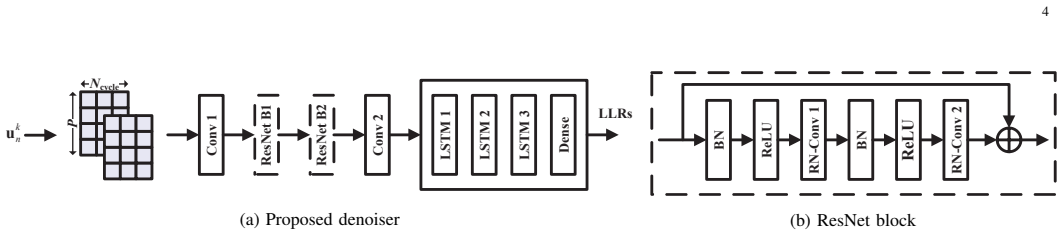
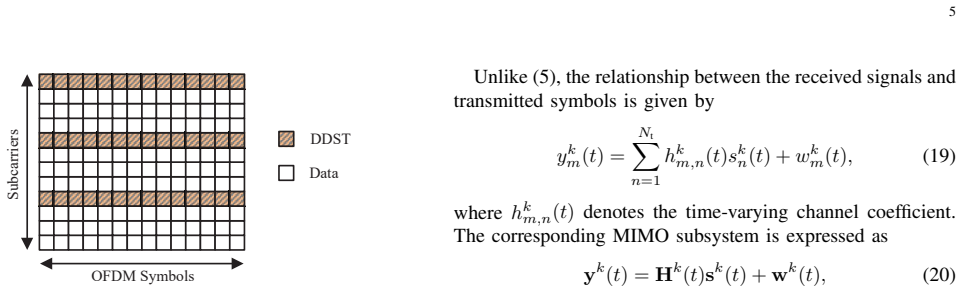
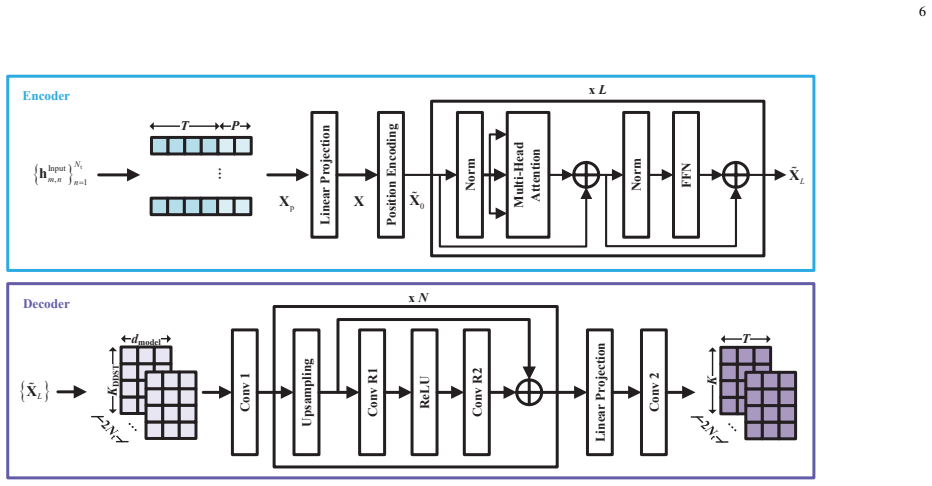
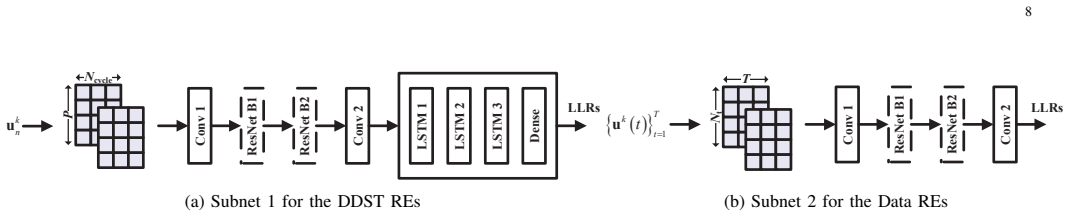
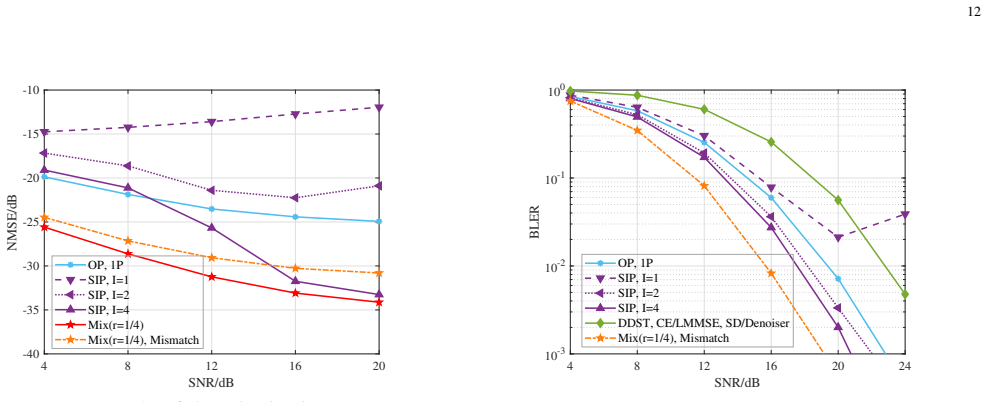
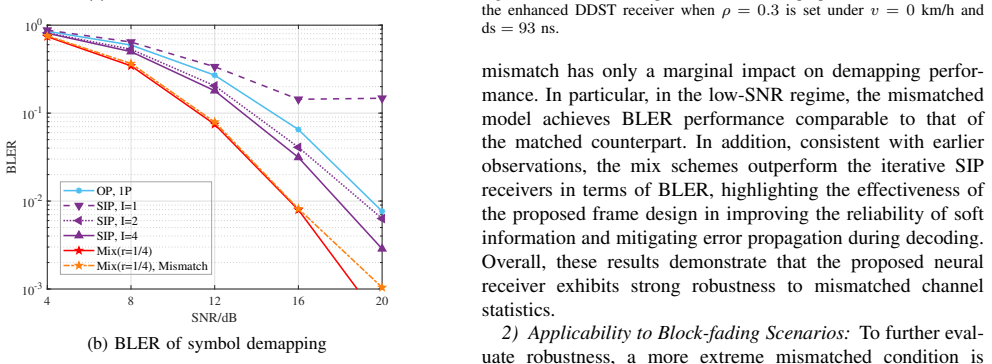
Superimposed pilot (SIP) transmission improves spectral efficiency by eliminating the dedicated pilot overhead required in orthogonal pilot (OP)-based schemes. However, SIP suffers from severe pilot-data coupling, which leads to a critical performance-complexity bottleneck at the receiver. To address this issue, this paper proposes a low-overhead transmission framework that revitalizes data-dependent superimposed training (DDST) with enhanced interference mitigation strategies. First, for quasi-static block-fading channels, an enhanced DDST receiver is developed to achieve non-iterative pilot-data decoupling by exploiting data-dependent algebraic structures. Second, to overcome the sensitivity of conventional DDST to channel variations and symbol misidentification in fast time-varying environments, a mix transmission scheme is developed. By strategically applying DDST to a subset of resource elements, the proposed scheme combines the interference-free transmission property of OP with the zero-pilot-overhead advantage of SIP, thereby improving demapping reliability and interference suppression. Furthermore, under the proposed mix scheme, a Vision Transformer-based neural receiver is designed to capture the orthogonal structure between pilots and perturbation-bearing data, as well as the underlying channel correlations, thereby relaxing the stringent quasi-static assumption required for interference disentanglement. Simulation results demonstrate that the proposed framework achieves significant performance gains in the low-to-medium SNR regime under time-varying channels while providing superior computational efficiency compared with state-of-the-art SIP receivers.
Editorial analysis
A structured set of objections, weighed in public.
Referee Report
Summary. The paper proposes a low-overhead DDST framework for SIP transmission. For quasi-static channels it develops an enhanced non-iterative algebraic receiver; for time-varying channels it introduces a mix scheme that applies DDST only to a subset of resource elements and pairs it with a Vision Transformer neural receiver. The ViT is claimed to capture pilot-data orthogonality and channel correlations, thereby relaxing the quasi-static block-fading assumption and enabling reliable demapping. Simulations are said to show significant gains in the low-to-medium SNR regime together with better computational efficiency than existing iterative SIP receivers.
Significance. If the robustness claims hold, the work would provide a concrete route to zero-pilot-overhead transmission in mobile scenarios by hybridizing algebraic DDST structures with learned receivers, potentially improving spectral efficiency without sacrificing demapping reliability under Doppler spread.
major comments (2)
- [Abstract / neural receiver design] Abstract and neural-receiver design section: the central claim that the Vision Transformer 'captures the orthogonal structure between pilots and perturbation-bearing data, as well as the underlying channel correlations, thereby relaxing the stringent quasi-static assumption' is load-bearing for both the mix-scheme performance and the efficiency comparison. No evidence is supplied that the network was tested on channel statistics (Doppler spectrum, coherence time) outside the training distribution; if the reported gains rely on matched statistics, the relaxation of the quasi-static assumption does not generalize and the low-to-medium SNR advantage is not substantiated.
- [Simulation results] Simulation results paragraph: the abstract states 'significant performance gains' and 'superior computational efficiency' but supplies neither error bars, number of Monte-Carlo trials, nor explicit rules for data exclusion or channel-model mismatch experiments. Without these, it is impossible to verify whether the claimed superiority over state-of-the-art SIP receivers survives realistic channel variation.
Simulated Author's Rebuttal
We thank the referee for the constructive feedback. We address each major comment below, clarifying the current manuscript content and indicating where revisions will strengthen the presentation of results and claims.
read point-by-point responses
-
Referee: [Abstract / neural receiver design] Abstract and neural-receiver design section: the central claim that the Vision Transformer 'captures the orthogonal structure between pilots and perturbation-bearing data, as well as the underlying channel correlations, thereby relaxing the stringent quasi-static assumption' is load-bearing for both the mix-scheme performance and the efficiency comparison. No evidence is supplied that the network was tested on channel statistics (Doppler spectrum, coherence time) outside the training distribution; if the reported gains rely on matched statistics, the relaxation of the quasi-static assumption does not generalize and the low-to-medium SNR advantage is not substantiated.
Authors: The referee is correct that the manuscript does not present explicit out-of-distribution testing on channel statistics. The ViT was trained on realizations drawn from a Doppler range representative of time-varying channels and evaluated on held-out samples from the same distribution. To substantiate the generalization claim and the relaxation of the quasi-static assumption, we will add a dedicated subsection with experiments using Doppler spectra and coherence times outside the training distribution. revision: yes
-
Referee: [Simulation results] Simulation results paragraph: the abstract states 'significant performance gains' and 'superior computational efficiency' but supplies neither error bars, number of Monte-Carlo trials, nor explicit rules for data exclusion or channel-model mismatch experiments. Without these, it is impossible to verify whether the claimed superiority over state-of-the-art SIP receivers survives realistic channel variation.
Authors: We agree that reproducibility details are insufficient in the current version. We will revise the simulation section to report the number of Monte-Carlo trials, include error bars on all curves, and state the data-exclusion criteria. We will also add explicit channel-model mismatch experiments to show whether the reported gains persist under realistic variations beyond the training conditions. revision: yes
Circularity Check
No circularity: derivation chain is self-contained with no self-referential reductions
full rationale
The provided abstract and context describe a proposed DDST framework with an enhanced receiver for quasi-static channels, a mix transmission scheme, and a Vision Transformer neural receiver for time-varying channels. No equations, parameter fitting steps, or self-citations are presented that reduce any claimed prediction or result to its inputs by construction. The performance claims are tied to simulation results rather than algebraic identities or fitted quantities renamed as outputs. The design choices (e.g., applying DDST to subsets of REs) are presented as engineering decisions supported by external simulation benchmarks, not internal self-definition. This is the common case of an independent proposal without load-bearing circular steps.
Axiom & Free-Parameter Ledger
Reference graph
Works this paper leans on
-
[1]
Noncooperative cellular wireless with unlimited num- bers of base station antennas,
T. L. Marzetta, “Noncooperative cellular wireless with unlimited num- bers of base station antennas,”IEEE Trans. Wireless Commun., vol. 9, no. 11, pp. 3590–3600, Nov. 2010
2010
-
[2]
Generative diffusion models for high dimensional channel estimation,
X. Zhou, L. Liang, J. Zhang, P. Jiang, Y . Li, and S. Jin, “Generative diffusion models for high dimensional channel estimation,”IEEE Trans. Wireless Commun., vol. 24, no. 7, pp. 5840–5854, Jul. 2025
2025
-
[3]
Pilot overhead reduction for antenna ports in MIMO OFDM systems using high-resolution map,
S. Trushkov, V . Kuptsov, O. Shmonin, K. Ponur, G. Serebryakov, and A. Blagodarnyi, “Pilot overhead reduction for antenna ports in MIMO OFDM systems using high-resolution map,” inProc. IEEE Int. Black Sea Conf. Commun. Netw. (BlackSeaCom), Tbilisi, Georgia, Jun. 2024, pp. 66–71
2024
-
[4]
NR; Physical channels and modulation,
3GPP, “NR; Physical channels and modulation,” 3GPP TS 38.211, Tech. Rep., 2023
2023
-
[5]
Superim- posed pilots for cell-free massive MIMO over spatial-correlated Rician fading channels,
M. Xie, X. Yu, K. Wang, J. Zhang, X. Dang, and C. Yuen, “Superim- posed pilots for cell-free massive MIMO over spatial-correlated Rician fading channels,”IEEE Trans. Wireless Commun., vol. 23, no. 12, pp. 19 537–19 552, Dec. 2024
2024
-
[6]
End-to-end learning for OFDM: From neural receivers to pilotless communication,
F. Ait Aoudia and J. Hoydis, “End-to-end learning for OFDM: From neural receivers to pilotless communication,”IEEE Trans. Wireless Commun., vol. 21, no. 2, pp. 1049–1063, Feb. 2022
2022
-
[7]
Interference cancellation based neural receiver for su- perimposed pilot in multi-layer transmission,
H. Xiaoet al., “Interference cancellation based neural receiver for su- perimposed pilot in multi-layer transmission,”China Commun., vol. 22, no. 1, pp. 75–88, Jan. 2025
2025
-
[8]
X. Zhouet al., “Conditional diffusion model-enabled scenario-specific neural receivers for superimposed pilot schemes,”arXiv preprint arXiv:2511.01173, 2025
-
[9]
On orthogonal and superimposed pilot schemes in massive MIMO NOMA systems,
J. Ma, C. Liang, C. Xu, and L. Ping, “On orthogonal and superimposed pilot schemes in massive MIMO NOMA systems,”IEEE J. Sel. Areas Commun., vol. 35, no. 12, pp. 2696–2707, Dec. 2017
2017
-
[10]
Superimposed pilot optimization design and channel estimation for multiuser massive MIMO systems,
X. Jing, M. Li, H. Liu, S. Li, and G. Pan, “Superimposed pilot optimization design and channel estimation for multiuser massive MIMO systems,”IEEE Trans. V eh. Technol., vol. 67, no. 12, pp. 11 818–11 832, Dec. 2018
2018
-
[11]
Enhancing wideband mul- tiuser MIMO uplink using superimposed pilots: Joint receiver design,
C. Qian, R. Gu, W. Xu, J. Xu, and X. You, “Enhancing wideband mul- tiuser MIMO uplink using superimposed pilots: Joint receiver design,” IEEE Wireless Commun. Lett., vol. 13, no. 4, pp. 1138–1142, Apr. 2024
2024
-
[12]
Learning-aided iterative receiver for superimposed pilots: Design and experimental evaluation,
X. Liet al., “Learning-aided iterative receiver for superimposed pilots: Design and experimental evaluation,”IEEE Trans. Wireless Commun., vol. 25, pp. 13 864–13 880, 2026
2026
-
[13]
AI-driven iterative receiver for superimposed pilot schemes in MIMO-OFDM systems,
X. Li, X. Zhou, J. Zhang, C.-K. Wen, and S. Jin, “AI-driven iterative receiver for superimposed pilot schemes in MIMO-OFDM systems,” in Proc. IEEE Wireless Commun. Netw. Conf. (WCNC), Milan, Italy, Mar. 2025, pp. 1–6
2025
-
[14]
Score-based conditional flow models for MIMO receiver design with superimposed pilots,
R. Zhanget al., “Score-based conditional flow models for MIMO receiver design with superimposed pilots,”IEEE Open J. Commun. Soc., vol. 7, pp. 3331–3345, 2026
2026
-
[15]
Channel estimation and symbol detection for block transmission using data-dependent superimposed training,
M. Ghogho, D. McLernon, E. Alameda-Hernandez, and A. Swami, “Channel estimation and symbol detection for block transmission using data-dependent superimposed training,”IEEE Signal Process. Lett., vol. 12, no. 3, pp. 226–229, Mar. 2005
2005
-
[16]
Reduced-overhead channel estimation and iterative detection of FTN signaling based on pilot superimposition and spectral interference alignment,
Y . Wu and S. Sugiura, “Reduced-overhead channel estimation and iterative detection of FTN signaling based on pilot superimposition and spectral interference alignment,” inProc. IEEE Global Commun. Conf. (GLOBECOM), Taipei, Taiwan, Dec. 2025, pp. 5820–5825
2025
-
[17]
Estimation of doubly-selective channels in block transmissions using data-dependent superimposed training,
M. Ghogho and A. Swami, “Estimation of doubly-selective channels in block transmissions using data-dependent superimposed training,” in Proc. 14th Eur . Signal Process. Conf. (EUSIPCO), Florence, Italy, Sept. 2006, pp. 1–5
2006
-
[18]
On doubly selective channel estimation using sperimposed training and discrete prolate spheroidal sequences,
S. He and J. K. Tugnait, “On doubly selective channel estimation using sperimposed training and discrete prolate spheroidal sequences,”IEEE Trans. Signal Process., vol. 56, no. 7, pp. 3214–3228, Jul. 2008
2008
-
[19]
En- hanced time-varying channel estimation based on two dimensional basis projection and self-interference suppression,
R. Carrasco-Alvarez, R. Parra-Michel, and A. G. Orozco-Lugo, “En- hanced time-varying channel estimation based on two dimensional basis projection and self-interference suppression,” inProc. IEEE 11th Int. Workshop Signal Process. Adv. Wireless Commun. (SPA WC), Marrakech, Morocco, Jun. 2010, pp. 1–5
2010
-
[20]
Investigation on data identification problem for data-dependent superimposed training,
K.-C. Chan, W.-C. Huang, C.-P. Li, and H.-J. Li, “Investigation on data identification problem for data-dependent superimposed training,” inProc. IEEE 75th V eh. Technol. Conf. (VTC Spring), Yokohama, Japan, May 2012, pp. 1–5
2012
-
[21]
Constellation rotation and symbol detection for data-dependent superimposed training,
G. Dou, C. Li, J. Gao, and F. Guo, “Constellation rotation and symbol detection for data-dependent superimposed training,”Electron. Lett., vol. 50, no. 25, pp. 1939–1940, Dec. 2014
1939
-
[22]
Joint model and data-driven receiver design for data-dependent superimposed training scheme with imperfect hardware,
C. Qing, L. Dong, L. Wang, J. Wang, and C. Huang, “Joint model and data-driven receiver design for data-dependent superimposed training scheme with imperfect hardware,”IEEE Trans. Wireless Commun., vol. 21, no. 6, pp. 3779–3791, Jun. 2022
2022
-
[23]
Channel estimation for MIMO systems using data-dependent superimposed training,
M. Ghogho and A. Swami, “Channel estimation for MIMO systems using data-dependent superimposed training,” inProc. 42nd Annu. Allerton Conf. Commun., Control, Comput. (Allerton), Monticello, IL, USA, Sept. 2004, pp. 70–79
2004
-
[24]
Performance of linear receivers based on superimposed training,
A. Kammoun, K. Abed-Meraim, and S. Affes, “Performance of linear receivers based on superimposed training,” inProc. IEEE 8th Int. Workshop Signal Process. Adv. Wireless Commun. (SPA WC), Helsinki, Finland, Jun. 2007, pp. 1–5
2007
-
[25]
Deep receiver for multi-layer data transmission with superimposed pilots,
J. Zou, J. Xiao, Q. Mao, S. Liu, B. Xiao, and Y . Liang, “Deep receiver for multi-layer data transmission with superimposed pilots,” inProc. IEEE Int. Conf. Acoust., Speech Signal Process. (ICASSP), Hyderabad, India, Apr. 2025, pp. 1–5
2025
-
[26]
S. M. Kay,Fundamentals of statistical signal processing. Upper Saddle River, NJ, USA: Prentice-Hall, 1993
1993
-
[27]
DeepRx: Fully convolu- tional deep learning receiver,
M. Honkala, D. Korpi, and J. M. J. Huttunen, “DeepRx: Fully convolu- tional deep learning receiver,”IEEE Trans. Wireless Commun., vol. 20, no. 6, pp. 3925–3940, Jun. 2021
2021
-
[28]
Deep learning for an effective nonorthogonal multiple access scheme,
G. Gui, H. Huang, Y . Song, and H. Sari, “Deep learning for an effective nonorthogonal multiple access scheme,”IEEE Trans. V eh. Technol., vol. 67, no. 9, pp. 8440–8450, Sept. 2018
2018
-
[29]
DeepMuD: Multi- user detection for uplink grant-free NOMA IoT networks via deep learning,
A. Emir, F. Kara, H. Kaya, and H. Yanikomeroglu, “DeepMuD: Multi- user detection for uplink grant-free NOMA IoT networks via deep learning,”IEEE Wireless Commun. Lett., vol. 10, no. 5, pp. 1133–1137, May 2021
2021
-
[31]
CE-ViT: A robust channel estimator based on vision transformer for OFDM systems,
F. Liu, J. Zhang, P. Jiang, C.-K. Wen, and S. Jin, “CE-ViT: A robust channel estimator based on vision transformer for OFDM systems,” inProc. IEEE Global Commun. Conf. (GLOBECOM), Kuala Lumpur, Malaysia, Dec. 2023, pp. 4798–4803
2023
-
[32]
Attention is all you need,
A. Vaswaniet al., “Attention is all you need,” inProc. Adv. Neural Inf. Process. Syst. (NIPS), Long Beach, CA, USA, Jun. 2017, pp. 5998– 6008
2017
-
[33]
Incorporating convolution designs into visual transform- ers,
K. Yuanet al., “Incorporating convolution designs into visual transform- ers,” inProc. IEEE/CVF Int. Conf. Comput. Vis. (ICCV), Oct. 2021, pp. 579–588
2021
-
[34]
LocalViT: Analyzing locality in vision transformers,
Y . Liet al., “LocalViT: Analyzing locality in vision transformers,” in Proc. IEEE/RSJ Int. Conf. Intell. Robots Syst. (IROS), Detroit, MI, USA, Oct. 2023, pp. 9598–9605
2023
-
[35]
Attention based neural networks for wireless channel estimation,
D. Luan and J. Thompson, “Attention based neural networks for wireless channel estimation,” inProc. IEEE 95th V eh. Technol. Conf. (VTC2022- Spring), Helsinki, Finland, Jun. 2022, pp. 1–5
2022
-
[36]
Hybrid transformer-CNN for real image denoising,
M. Zhao, G. Cao, X. Huang, and L. Yang, “Hybrid transformer-CNN for real image denoising,”IEEE Signal Process. Lett., vol. 29, pp. 1252– 1256, 2022
2022
-
[37]
Study on channel model for frequencies from 0.5 to 100 GHz,
3GPP, “Study on channel model for frequencies from 0.5 to 100 GHz,” 3GPP TR 38.901, Tech. Rep., 2022
2022
-
[38]
Sionna: An open-source library for next-generation physical layer research,
J. Hoydiset al., “Sionna: An open-source library for next-generation physical layer research,”arXiv preprint arXiv:2203.11854, 2022
-
[39]
ASIC implementation of soft- input soft-output MIMO detection using MMSE parallel interference cancellation,
C. Studer, S. Fateh, and D. Seethaler, “ASIC implementation of soft- input soft-output MIMO detection using MMSE parallel interference cancellation,”IEEE J. Solid-State Circuits, vol. 46, no. 7, pp. 1754– 1765, Jul. 2011
2011
-
[40]
Channel estimation for OFDM,
Y . Liu, Z. Tan, H. Hu, L. J. Cimini, and G. Y . Li, “Channel estimation for OFDM,”IEEE Commun. Surveys Tut., vol. 16, no. 4, pp. 1891–1908, May 2014
1908
discussion (0)
Sign in with ORCID, Apple, or X to comment. Anyone can read and Pith papers without signing in.