Quantum Networks Using Color Defects in Diamond: Principles, Progress, and Perspectives
Pith reviewed 2026-06-29 06:47 UTC · model grok-4.3
The pith
Diamond color defects supply the spin and optical properties required to build quantum network nodes.
A machine-rendered reading of the paper's core claim, the machinery that carries it, and where it could break.
Core claim
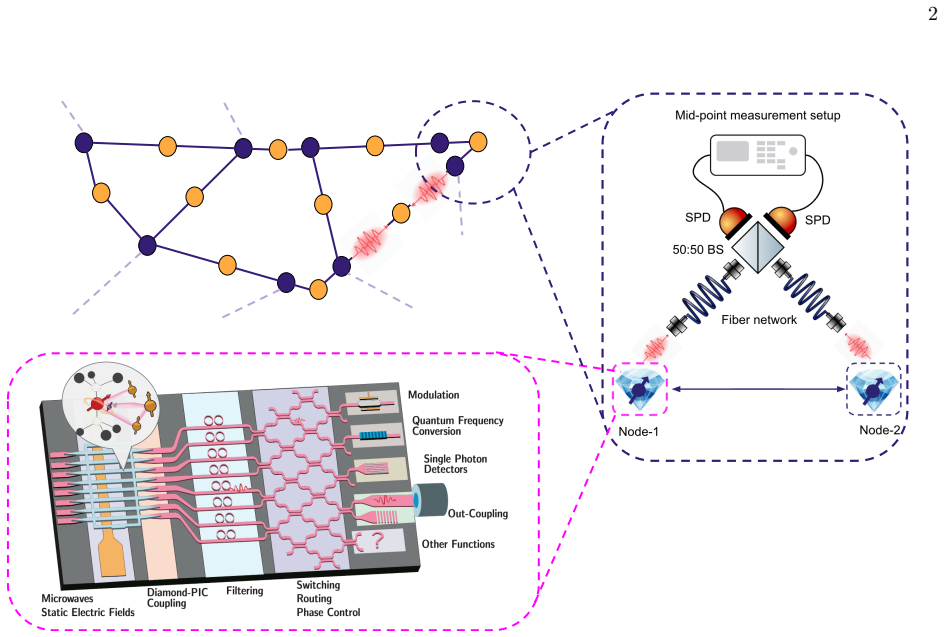
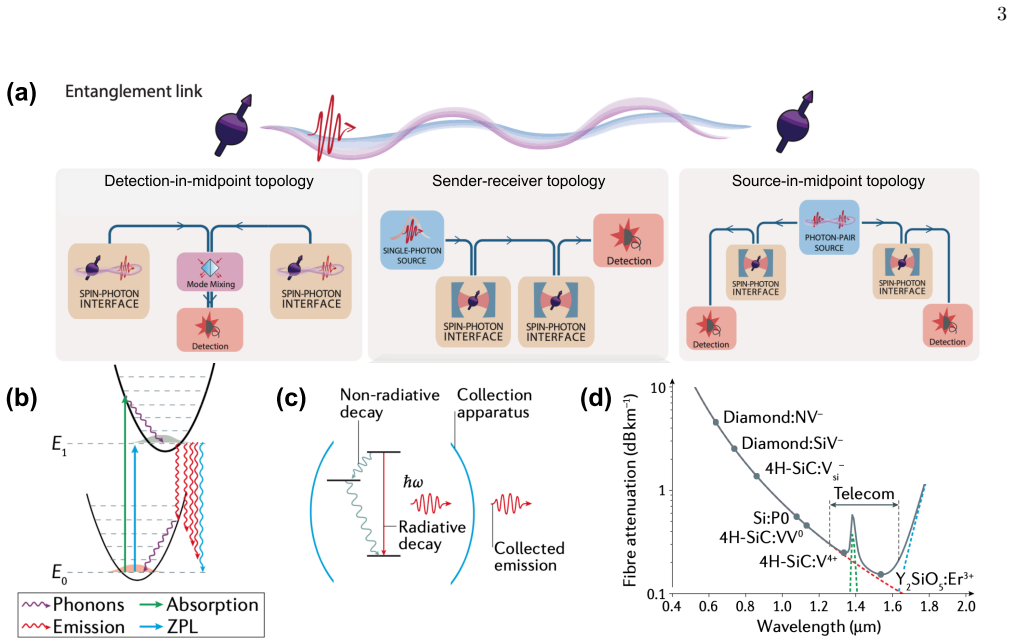
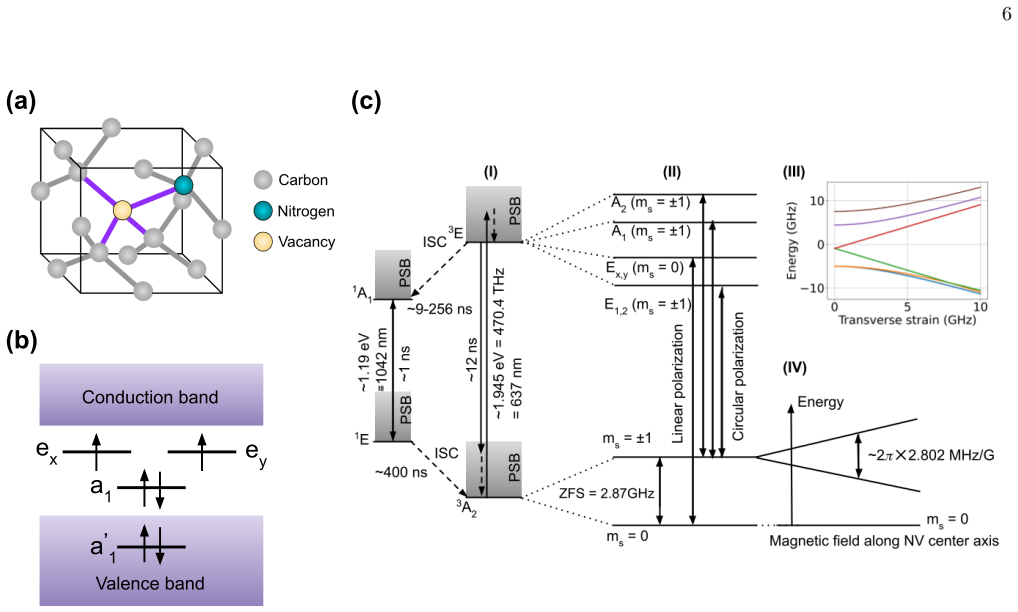
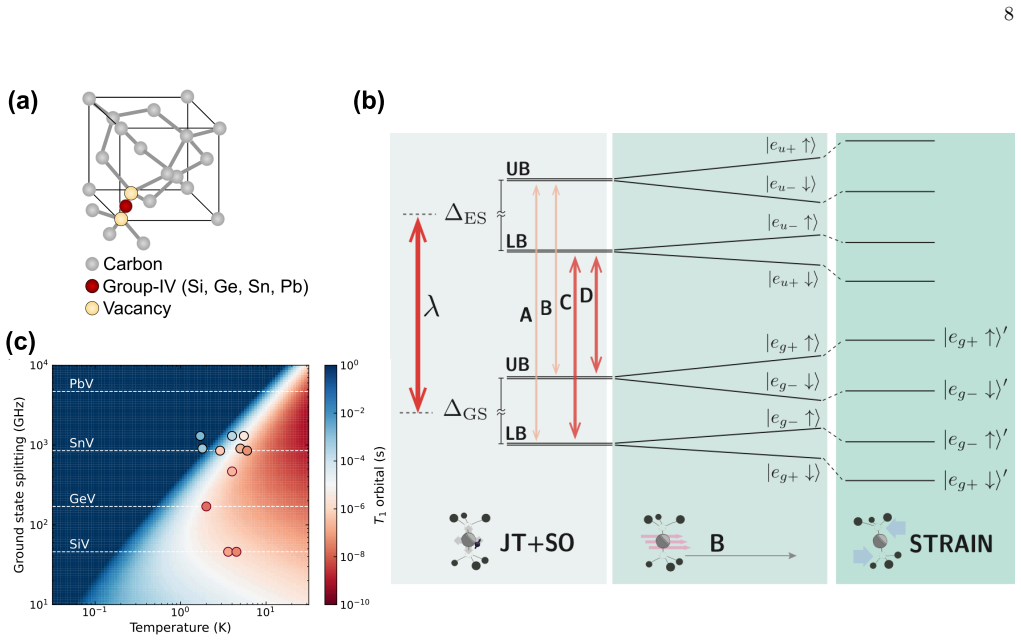
Diamond color defects are promising candidates for quantum network nodes because of their excellent optical properties, fast spin-qubit control, and long spin coherence times. Recent advances in the heterogeneous integration of diamond nanophotonic structures with photonic integrated circuits have made these systems more efficient and well-suited for scalable quantum processor architectures. The review discusses the optical and spin properties of these systems, recent progress in the building blocks of quantum networks, demonstrations of metropolitan-scale quantum networks, and the challenges at both fundamental and experimental levels together with potential solutions.
What carries the argument
Color defects in diamond that function as spin qubits with optical readout and control.
If this is right
- Metropolitan-scale quantum networks can be assembled using these defect nodes.
- Applications in quantum communication, distributed quantum computing, sensing, and metrology become reachable.
- Heterogeneous integration improves efficiency and moves the systems closer to scalable processor architectures.
- Identified fundamental and experimental challenges can be addressed with the solutions outlined.
Where Pith is reading between the lines
- Continued integration progress could allow diamond defects to be combined with silicon-based photonic circuits on the same chip.
- The platform could serve as a reference point when evaluating other solid-state quantum emitters for network use.
- Long coherence times open the possibility that these defects could function as quantum memories inside repeater stations for longer-distance links.
Load-bearing premise
The body of cited demonstrations and selected literature accurately reflects the present state of research on these defects without major omissions.
What would settle it
A clear experimental result showing that spin coherence times drop sharply once defects are placed inside large-scale photonic circuits would falsify the claim of suitability for scalable networks.
Figures
read the original abstract
Large-scale quantum networks will enable entirely new applications of quantum information science in fields such as quantum communication, distributed quantum computing, sensing, and metrology. To build nodes of such networks, diamond color defects are one of the promising candidates. Their excellent optical properties, fast spin-qubit control, and long spin coherence times make them well-suited for quantum information processing and quantum memory applications. Additionally, recent advances in the heterogeneous integration of diamond nanophotonic structures with photonic integrated circuits have made these systems more efficient and well-suited for scalable quantum processor architectures. In this comprehensive review, we discuss the optical and spin properties of these systems, recent progress in the building blocks of quantum networks, and demonstrations of metropolitan-scale quantum networks, as well as the challenges associated with these systems at both the fundamental and experimental levels, along with potential solutions.
Editorial analysis
A structured set of objections, weighed in public.
Referee Report
Summary. The manuscript is a review paper claiming that diamond color defects are promising candidates for quantum network nodes. It highlights their excellent optical properties, fast spin-qubit control, and long spin coherence times as making them suitable for quantum information processing and memory, notes recent heterogeneous integration advances with photonic circuits for scalability, and covers optical/spin properties, progress in network building blocks, metropolitan-scale demonstrations, fundamental and experimental challenges, and potential solutions.
Significance. If the cited literature accurately represents the field, the review would consolidate established results on diamond defect properties and integration progress into a single reference, aiding researchers working on quantum networks by outlining both demonstrated capabilities and remaining scaling challenges.
minor comments (1)
- [Abstract] The abstract states that the review discusses 'demonstrations of metropolitan-scale quantum networks' but does not specify which color defects (e.g., NV, SiV) or which specific experiments are included; adding a sentence clarifying the primary defect types and the time window of covered demonstrations would improve scope clarity.
Simulated Author's Rebuttal
We thank the referee for their positive evaluation of the manuscript and their recommendation to accept it for publication.
Circularity Check
No significant circularity in this review paper
full rationale
This manuscript is a review summarizing established optical and spin properties of diamond color defects, recent integration advances, and network demonstrations drawn entirely from external cited literature. It introduces no new derivations, theorems, equations, fitted parameters, or predictions that could reduce to self-referential inputs. No self-citation chains serve as load-bearing justifications for uniqueness or ansatzes, and no renaming of known results occurs. The argument is therefore self-contained against external benchmarks with no internal reduction to its own assumptions.
Axiom & Free-Parameter Ledger
Reference graph
Works this paper leans on
-
[1]
M. Ruf, N. H. Wan, H. Choi, D. Englund, and R. Hanson, Quantum networks based on color centers in diamond, Journal of Applied Physics130(2021)
2021
-
[2]
H. J. Kimble, The quantum internet, Nature453, 1023 (2008)
2008
-
[3]
Bersin, M
E. Bersin, M. Grein, M. Sutula, R. Murphy, Y. Q. Huan, M. Stevens, A. Suleymanzade, C. Lee, R. Riedinger, D. J. Starling,et al., Development of a boston-area 50-km fiber quantum network testbed, Physical Review Applied21, 014024 (2024)
2024
-
[4]
Wehner, D
S. Wehner, D. Elkouss, and R. Hanson, Quantum internet: A vision for the road ahead, Science362, eaam9288 (2018)
2018
- [5]
-
[6]
Liao, W.-Q
S.-K. Liao, W.-Q. Cai, W.-Y. Liu, L. Zhang, Y. Li, J.-G. Ren, J. Yin, Q. Shen, Y. Cao, Z.-P. Li,et al., Satellite-to-ground quantum key distribution, Nature549, 43 (2017)
2017
-
[7]
M. K. Bhaskar, R. Riedinger, B. Machielse, D. S. Levonian, C. T. Nguyen, E. N. Knall, H. Park, D. Englund, M. Lonˇ car, D. D. Sukachev,et al., Experimental demonstration of memory-enhanced quantum communication, Nature580, 60 (2020)
2020
-
[8]
N. H. Nickerson, J. F. Fitzsimons, and S. C. Benjamin, Freely scalable quantum technologies using cells of 5-to-50 qubits with very lossy and noisy photonic links, Physical Review X4, 041041 (2014)
2014
-
[9]
H. Choi, M. Pant, S. Guha, and D. Englund, Percolation-based architecture for cluster state creation using photon- mediated entanglement between atomic memories, npj Quantum Information5, 104 (2019)
2019
-
[10]
Gottesman, T
D. Gottesman, T. Jennewein, and S. Croke, Longer-baseline telescopes using quantum repeaters, Physical review letters 109, 070503 (2012)
2012
-
[11]
Komar, E
P. Komar, E. M. Kessler, M. Bishof, L. Jiang, A. S. Sørensen, J. Ye, and M. D. Lukin, A quantum network of clocks, Nature Physics10, 582 (2014). 22
2014
-
[12]
Pasini, Nanophotonics with diamond color centers: Quantum optics and entanglement protocols, Dissertation (TU Delft) (2024)
M. Pasini, Nanophotonics with diamond color centers: Quantum optics and entanglement protocols, Dissertation (TU Delft) (2024)
2024
-
[13]
Zhang, Y
G. Zhang, Y. Cheng, J.-P. Chou, and A. Gali, Material platforms for defect qubits and single-photon emitters, Applied Physics Reviews7(2020)
2020
-
[14]
Atat¨ ure, D
M. Atat¨ ure, D. Englund, N. Vamivakas, S.-Y. Lee, and J. Wrachtrup, Material platforms for spin-based photonic quantum technologies, Nature Reviews Materials3, 38 (2018)
2018
-
[15]
Wolfowicz, F
G. Wolfowicz, F. J. Heremans, C. P. Anderson, S. Kanai, H. Seo, A. Gali, G. Galli, and D. D. Awschalom, Quantum guidelines for solid-state spin defects, Nature Reviews Materials6, 906 (2021)
2021
-
[16]
Chatterjee, P
A. Chatterjee, P. Stevenson, S. De Franceschi, A. Morello, N. P. de Leon, and F. Kuemmeth, Semiconductor qubits in practice, Nature Reviews Physics3, 157 (2021)
2021
-
[17]
Katsumi, K
R. Katsumi, K. Takada, F. Jelezko, and T. Yatsui, Recent progress in hybrid diamond photonics for quantum information processing and sensing, Communications Engineering4, 85 (2025)
2025
-
[18]
Sinha, S
U. Sinha, S. N. Sahoo, A. Singh, K. Joarder, R. Chatterjee, and S. Chakraborti, Single-photon sources, Optics and Photonics News30, 32 (2019)
2019
-
[19]
M. D. Eisaman, J. Fan, A. Migdall, and S. V. Polyakov, Invited review article: Single-photon sources and detectors, Review of scientific instruments82(2011)
2011
-
[20]
Pezzagna and J
S. Pezzagna and J. Meijer, Quantum computer based on color centers in diamond, Applied Physics Reviews8(2021)
2021
-
[21]
N. Kalb, A. A. Reiserer, P. C. Humphreys, J. J. Bakermans, S. J. Kamerling, N. H. Nickerson, S. C. Benjamin, D. J. Twitchen, M. Markham, and R. Hanson, Entanglement distillation between solid-state quantum network nodes, Science 356, 928 (2017)
2017
-
[22]
Pompili, S
M. Pompili, S. L. Hermans, S. Baier, H. K. Beukers, P. C. Humphreys, R. N. Schouten, R. F. Vermeulen, M. J. Tiggelman, L. dos Santos Martins, B. Dirkse,et al., Realization of a multinode quantum network of remote solid-state qubits, Science 372, 259 (2021)
2021
-
[23]
Schr¨ oder, S
T. Schr¨ oder, S. L. Mouradian, J. Zheng, M. E. Trusheim, M. Walsh, E. H. Chen, L. Li, I. Bayn, and D. Englund, Quantum nanophotonics in diamond, Journal of the Optical Society of America B33, B65 (2016)
2016
-
[24]
Pelucchi, G
E. Pelucchi, G. Fagas, I. Aharonovich, D. Englund, E. Figueroa, Q. Gong, H. Hannes, J. Liu, C.-Y. Lu, N. Matsuda, et al., The potential and global outlook of integrated photonics for quantum technologies, Nature Reviews Physics4, 194 (2022)
2022
-
[25]
Orphal-Kobin, C
L. Orphal-Kobin, C. G. Torun, J. M. Bopp, G. Pieplow, and T. Schr¨ oder, Coherent microwave, optical, and mechanical quantum control of spin qubits in diamond, Advanced Quantum Technologies8, 2300432 (2025)
2025
-
[26]
Reiserer and G
A. Reiserer and G. Rempe, Cavity-based quantum networks with single atoms and optical photons, Reviews of modern physics87, 1379 (2015)
2015
-
[27]
R. E. Evans, M. K. Bhaskar, D. D. Sukachev, C. T. Nguyen, A. Sipahigil, M. J. Burek, B. Machielse, G. H. Zhang, A. S. Zibrov, E. Bielejec,et al., Photon-mediated interactions between quantum emitters in a diamond nanocavity, Science 362, 662 (2018)
2018
-
[28]
Bernien, B
H. Bernien, B. Hensen, W. Pfaff, G. Koolstra, M. S. Blok, L. Robledo, T. H. Taminiau, M. Markham, D. J. Twitchen, L. Childress,et al., Heralded entanglement between solid-state qubits separated by three metres, Nature497, 86 (2013)
2013
-
[29]
C. M. Knaut, A. Suleymanzade, Y.-C. Wei, D. R. Assumpcao, P.-J. Stas, Y. Q. Huan, B. Machielse, E. N. Knall, M. Sutula, G. Baranes,et al., Entanglement of nanophotonic quantum memory nodes in a telecom network, Nature629, 573 (2024)
2024
-
[30]
A. J. Stolk, K. L. van der Enden, M.-C. Slater, I. te Raa-Derckx, P. Botma, J. Van Rantwijk, J. B. Biemond, R. A. Hagen, R. W. Herfst, W. D. Koek,et al., Metropolitan-scale heralded entanglement of solid-state qubits, Science advances10, eadp6442 (2024)
2024
-
[31]
Hermans, M
S. Hermans, M. Pompili, H. Beukers, S. Baier, J. Borregaard, and R. Hanson, Qubit teleportation between non- neighbouring nodes in a quantum network, Nature605, 663 (2022)
2022
-
[32]
Iuliano, M.-C
M. Iuliano, M.-C. Slater, A. J. Stolk, M. J. Weaver, T. Chakraborty, E. Loukiantchenko, G. C. do Amaral, N. Alfasi, M. O. Sholkina, W. Tittel,et al., Qubit teleportation between a memory-compatible photonic time-bin qubit and a solid-state quantum network node, npj Quantum Information10, 107 (2024)
2024
-
[33]
Pfaff, B
W. Pfaff, B. J. Hensen, H. Bernien, S. B. van Dam, M. S. Blok, T. H. Taminiau, M. J. Tiggelman, R. N. Schouten, M. Markham, D. J. Twitchen,et al., Unconditional quantum teleportation between distant solid-state quantum bits, Science345, 532 (2014)
2014
-
[34]
S. W. Ding, M. Haas, X. Guo, K. Kuruma, C. Jin, Z. Li, D. D. Awschalom, N. Delegan, F. J. Heremans, A. A. High, et al., High-q cavity interface for color centers in thin film diamond, nature communications15, 6358 (2024)
2024
-
[35]
Pregnolato, M
T. Pregnolato, M. E. Stucki, J. M. Bopp, A. Gokhale, O. Kr¨ uger, T. Schr¨ oder,et al., Fabrication of sawfish photonic crystal cavities in bulk diamond, APL Photonics9(2024)
2024
-
[36]
Abulnaga, S
A. Abulnaga, S. Karg, S. Mukherjee, A. Gupta, K. W. Baldwin, L. N. Pfeiffer, and N. P. de Leon, Design and fabrication of robust hybrid photonic crystal cavities, Nanophotonics14, 1927 (2025)
1927
-
[37]
Chakravarthi, N
S. Chakravarthi, N. S. Yama, A. Abulnaga, D. Huang, C. Pederson, K. Hestroffer, F. Hatami, N. P. de Leon, and K.-M. C. Fu, Hybrid integration of gap photonic crystal cavities with silicon-vacancy centers in diamond by stamp-transfer, Nano Letters23, 3708 (2023)
2023
-
[38]
K. G. Fehler, L. Antoniuk, N. Lettner, A. P. Ovvyan, R. Waltrich, N. Gruhler, V. A. Davydov, V. N. Agafonov, W. H. Pernice, and A. Kubanek, Hybrid quantum photonics based on artificial atoms placed inside one hole of a photonic crystal cavity, ACS photonics8, 2635 (2021). 23
2021
-
[39]
K. C. Chen, I. Christen, H. Raniwala, M. Colangelo, L. De Santis, K. Shtyrkova, D. Starling, R. Murphy, L. Li, K. Berggren,et al., A scalable cavity-based spin–photon interface in a photonic integrated circuit, Optica Quantum 2, 124 (2024)
2024
-
[40]
N. H. Wan, T.-J. Lu, K. C. Chen, M. P. Walsh, M. E. Trusheim, L. De Santis, E. A. Bersin, I. B. Harris, S. L. Mouradian, I. R. Christen,et al., Large-scale integration of artificial atoms in hybrid photonic circuits, Nature583, 226 (2020)
2020
-
[41]
J.-H. Kim, S. Aghaeimeibodi, J. Carolan, D. Englund, and E. Waks, Hybrid integration methods for on-chip quantum photonics, Optica7, 291 (2020)
2020
-
[42]
K. J. Palm, M. Dong, D. A. Golter, G. Clark, M. Zimmermann, K. C. Chen, L. Li, A. Menssen, A. J. Leenheer, D. Dominguez,et al., Modular chip-integrated photonic control of artificial atoms in diamond waveguides, Optica10, 634 (2023)
2023
-
[43]
Janitz, M
E. Janitz, M. K. Bhaskar, and L. Childress, Cavity quantum electrodynamics with color centers in diamond, Optica7, 1232 (2020)
2020
-
[44]
H. K. Beukers, M. Pasini, H. Choi, D. Englund, R. Hanson, and J. Borregaard, Remote-entanglement protocols for stationary qubits with photonic interfaces, PRX Quantum5, 010202 (2024)
2024
-
[45]
Y. Lei, F. Kimiaee Asadi, T. Zhong, A. Kuzmich, C. Simon, and M. Hosseini, Quantum optical memory for entanglement distribution, Optica10, 1511 (2023)
2023
-
[46]
Nakazato, R
T. Nakazato, R. Reyes, N. Imaike, K. Matsuda, K. Tsurumoto, Y. Sekiguchi, and H. Kosaka, Quantum error correction of spin quantum memories in diamond under a zero magnetic field, Communications Physics5, 102 (2022)
2022
-
[47]
Bartling, J
H. Bartling, J. Yun, K. Schymik, M. Van Riggelen, L. Enthoven, H. Van Ommen, M. Babaie, F. Sebastiano, M. Markham, D. Twitchen,et al., Universal high-fidelity quantum gates for spin qubits in diamond, Physical Review Applied23, 034052 (2025)
2025
-
[48]
C. E. Bradley, J. Randall, M. H. Abobeih, R. C. Berrevoets, M. J. Degen, M. A. Bakker, M. Markham, D. J. Twitchen, and T. H. Taminiau, A ten-qubit solid-state spin register with quantum memory up to one minute, Physical Review X 9, 031045 (2019)
2019
-
[49]
Daiss, S
S. Daiss, S. Langenfeld, S. Welte, E. Distante, P. Thomas, L. Hartung, O. Morin, and G. Rempe, A quantum-logic gate between distant quantum-network modules, Science371, 614 (2021)
2021
-
[50]
Jones, D
C. Jones, D. Kim, M. T. Rakher, P. G. Kwiat, and T. D. Ladd, Design and analysis of communication protocols for quantum repeater networks, New Journal of Physics18, 083015 (2016)
2016
-
[51]
Togan, Y
E. Togan, Y. Chu, A. S. Trifonov, L. Jiang, J. Maze, L. Childress, M. G. Dutt, A. S. Sørensen, P. R. Hemmer, A. S. Zibrov,et al., Quantum entanglement between an optical photon and a solid-state spin qubit, Nature466, 730 (2010)
2010
-
[52]
Waltrich, M
R. Waltrich, M. Klotz, V. N. Agafonov, and A. Kubanek, Two-photon interference from silicon-vacancy centers in remote nanodiamonds, Nanophotonics12, 3663 (2023)
2023
-
[53]
Nguyen, D
C. Nguyen, D. Sukachev, M. Bhaskar, B. Machielse, D. Levonian, E. Knall, P. Stroganov, C. Chia, M. Burek, R. Riedinger, et al., An integrated nanophotonic quantum register based on silicon-vacancy spins in diamond, Physical Review B100, 165428 (2019)
2019
-
[54]
K. Chen, E. Bersin, and D. Englund, A polarization encoded photon-to-spin interface. npj quant, Info7, 2 (2021)
2021
-
[55]
Bhunia, A
S. Bhunia, A. Majumder, S. Chatterjee, R. Sarkar, D. Nag, K. Saha, S. Mahapatra, and A. Laha, Ultrafast green single photon emission from an ingan quantum dot-in-a-gan nanowire at room temperature, Applied Physics Letters125(2024)
2024
-
[56]
Beukers, Quantum networks with diamond color centers: Local control and multi-node entanglement, Dissertation (TU Delft) (2025)
H. Beukers, Quantum networks with diamond color centers: Local control and multi-node entanglement, Dissertation (TU Delft) (2025)
2025
-
[57]
Esmann, S
M. Esmann, S. C. Wein, and C. Ant´ on-Solanas, Solid-state single-photon sources: recent advances for novel quantum materials, Advanced Functional Materials34, 2315936 (2024)
2024
-
[58]
I. P. Radko, M. Boll, N. M. Israelsen, N. Raatz, J. Meijer, F. Jelezko, U. L. Andersen, and A. Huck, Determining the internal quantum efficiency of shallow-implanted nitrogen-vacancy defects in bulk diamond, Optics Express24, 27715 (2016)
2016
-
[59]
M. H. Abobeih, J. Cramer, M. A. Bakker, N. Kalb, M. Markham, D. J. Twitchen, and T. H. Taminiau, One-second coherence for a single electron spin coupled to a multi-qubit nuclear-spin environment, Nature communications9, 2552 (2018)
2018
-
[60]
M. W. Doherty, N. B. Manson, P. Delaney, F. Jelezko, J. Wrachtrup, and L. C. Hollenberg, The nitrogen-vacancy colour centre in diamond, Physics Reports528, 1 (2013)
2013
-
[61]
Santori, P
C. Santori, P. Tamarat, P. Neumann, J. Wrachtrup, D. Fattal, R. G. Beausoleil, J. Rabeau, P. Olivero, A. D. Greentree, S. Prawer,et al., Coherent population trapping of single spins in diamond under optical excitation, Physical review letters 97, 247401 (2006)
2006
-
[62]
Ruf, Cavity-enhanced quantum network nodes in diamond, PhD Thesis, Delft University of Technology (2021)
M. Ruf, Cavity-enhanced quantum network nodes in diamond, PhD Thesis, Delft University of Technology (2021)
2021
-
[63]
D. D. Sukachev, A. Sipahigil, C. T. Nguyen, M. K. Bhaskar, R. E. Evans, F. Jelezko, and M. D. Lukin, Silicon-vacancy spin qubit in diamond: a quantum memory exceeding 10 ms with single-shot state readout, Physical review letters119, 223602 (2017)
2017
-
[64]
C. Hepp, T. M¨ uller, V. Waselowski, J. N. Becker, B. Pingault, H. Sternschulte, D. Steinm¨ uller-Nethl, A. Gali, J. R. Maze, M. Atat¨ ure,et al., Electronic structure of the silicon vacancy color center in diamond, Physical Review Letters 112, 036405 (2014)
2014
-
[65]
P.-J. Stas, Y. Q. Huan, B. Machielse, E. N. Knall, A. Suleymanzade, B. Pingault, M. Sutula, S. W. Ding, C. M. Knaut, D. R. Assumpcao,et al., Robust multi-qubit quantum network node with integrated error detection, Science378, 557 (2022). 24
2022
-
[66]
Senkalla, G
K. Senkalla, G. Genov, M. H. Metsch, P. Siyushev, and F. Jelezko, Germanium vacancy in diamond quantum memory exceeding 20 ms, Physical Review Letters132, 026901 (2024)
2024
-
[67]
Grimm, K
N. Grimm, K. Senkalla, P. J. Vetter, J. Frey, P. Gundlapalli, T. Calarco, G. Genov, M. M. M¨ uller, and F. Jelezko, Coherent control of a long-lived nuclear memory spin in a germanium-vacancy multi-qubit node, Physical review letters 134, 043603 (2025)
2025
-
[68]
Narita, P
Y. Narita, P. Wang, K. Ikeda, K. Oba, Y. Miyamoto, T. Taniguchi, S. Onoda, M. Hatano, and T. Iwasaki, Multiple tin- vacancy centers in diamond with nearly identical photon frequency and linewidth, Physical Review Applied19, 024061 (2023)
2023
-
[69]
M. H. Metsch, K. Senkalla, B. Tratzmiller, J. Scheuer, M. Kern, J. Achard, A. Tallaire, M. B. Plenio, P. Siyushev, and F. Jelezko, Initialization and readout of nuclear spins via a negatively charged silicon-vacancy center in diamond, Physical review letters122, 190503 (2019)
2019
-
[70]
Karapatzakis, J
I. Karapatzakis, J. Resch, M. Schrodin, P. Fuchs, M. Kieschnick, J. Heupel, L. Kussi, C. S¨ urgers, C. Popov, J. Meijer, et al., Microwave control of the tin-vacancy spin qubit in diamond with a superconducting waveguide, Physical Review X14, 031036 (2024)
2024
-
[71]
Resch, I
J. Resch, I. Karapatzakis, M. Elshorbagy, M. Schrodin, P. Fuchs, P. Graßhoff, L. Kussi, C. S¨ urgers, C. Popov, C. Becher, et al., High-fidelity control of a c 13 nuclear spin coupled to a tin-vacancy center in diamond, Physical Review X16, 011060 (2026)
2026
-
[72]
D. M. Lukin, M. A. Guidry, and J. Vuˇ ckovi´ c, Integrated quantum photonics with silicon carbide: challenges and prospects, PRX quantum1, 020102 (2020)
2020
-
[73]
H. Zhao, M. T. Pettes, Y. Zheng, and H. Htoon, Site-controlled telecom-wavelength single-photon emitters in atomically- thin mote2, Nature communications12, 6753 (2021)
2021
-
[74]
Somaschi, V
N. Somaschi, V. Giesz, L. De Santis, J. Loredo, M. P. Almeida, G. Hornecker, S. L. Portalupi, T. Grange, C. Anton, J. Demory,et al., Near-optimal single-photon sources in the solid state, Nature Photonics10, 340 (2016)
2016
-
[75]
Ranˇ ci´ c, M
M. Ranˇ ci´ c, M. P. Hedges, R. L. Ahlefeldt, and M. J. Sellars, Coherence time of over a second in a telecom-compatible quantum memory storage material, Nature Physics14, 50 (2018)
2018
-
[76]
Saglamyurek, J
E. Saglamyurek, J. Jin, V. B. Verma, M. D. Shaw, F. Marsili, S. W. Nam, D. Oblak, and W. Tittel, Quantum storage of entangled telecom-wavelength photons in an erbium-doped optical fibre, Nature Photonics9, 83 (2015)
2015
-
[77]
Gritsch, L
A. Gritsch, L. Weiss, J. Fr¨ uh, S. Rinner, and A. Reiserer, Narrow optical transitions in erbium-implanted silicon waveg- uides, Physical Review X12, 041009 (2022)
2022
-
[78]
Heinze, C
G. Heinze, C. Hubrich, and T. Halfmann, Stopped light and image storage by electromagnetically induced transparency¡? format?¿ up to the regime of one minute, Physical review letters111, 033601 (2013)
2013
-
[79]
Duranti, S
S. Duranti, S. Wengerowsky, L. Feldmann, A. Seri, B. Casabone, and H. De Riedmatten, Efficient cavity-assisted storage of photonic qubits in a solid-state quantum memory, Optics Express32, 26884 (2024)
2024
-
[80]
Ma, Y.-Z
Y. Ma, Y.-Z. Ma, Z.-Q. Zhou, C.-F. Li, and G.-C. Guo, One-hour coherent optical storage in an atomic frequency comb memory, Nature communications12, 2381 (2021)
2021
discussion (0)
Sign in with ORCID, Apple, or X to comment. Anyone can read and Pith papers without signing in.