Charting the thermodynamic stability of hybrid perovskite alloys with machine learning
Pith reviewed 2026-06-29 06:37 UTC · model grok-4.3
The pith
Machine learning shows tin-based hybrid perovskites have narrower stable composition regions than lead-based ones.
A machine-rendered reading of the paper's core claim, the machinery that carries it, and where it could break.
Core claim
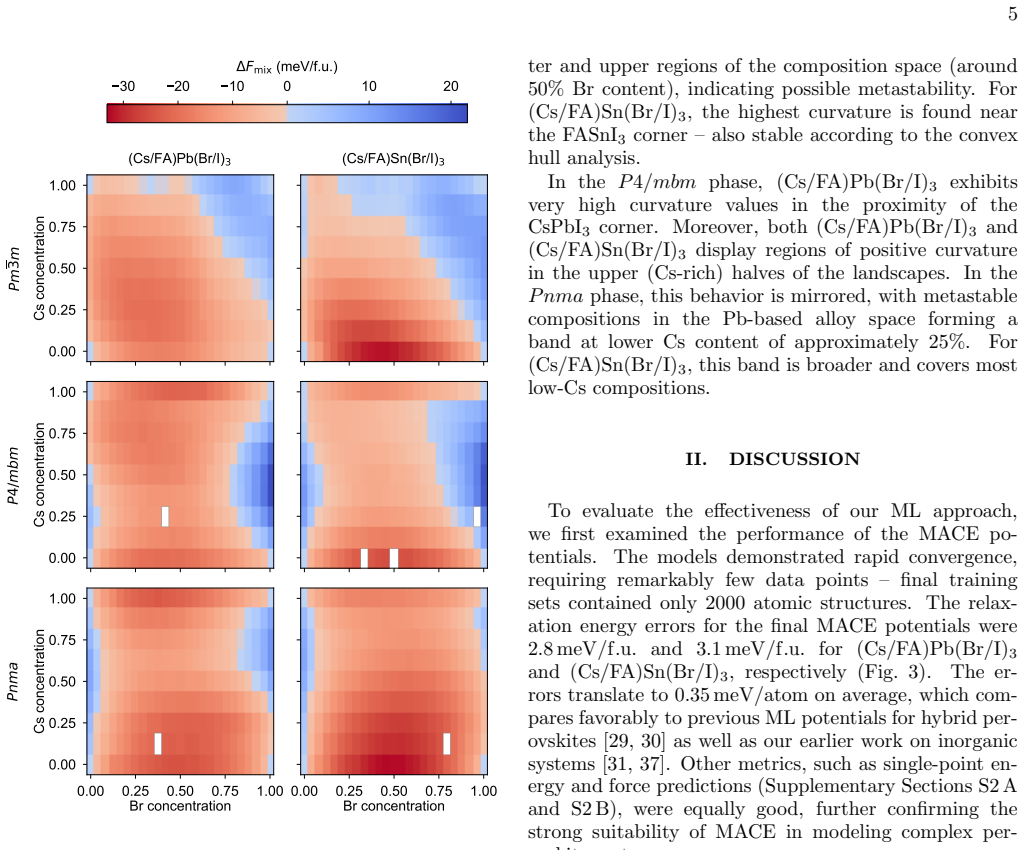
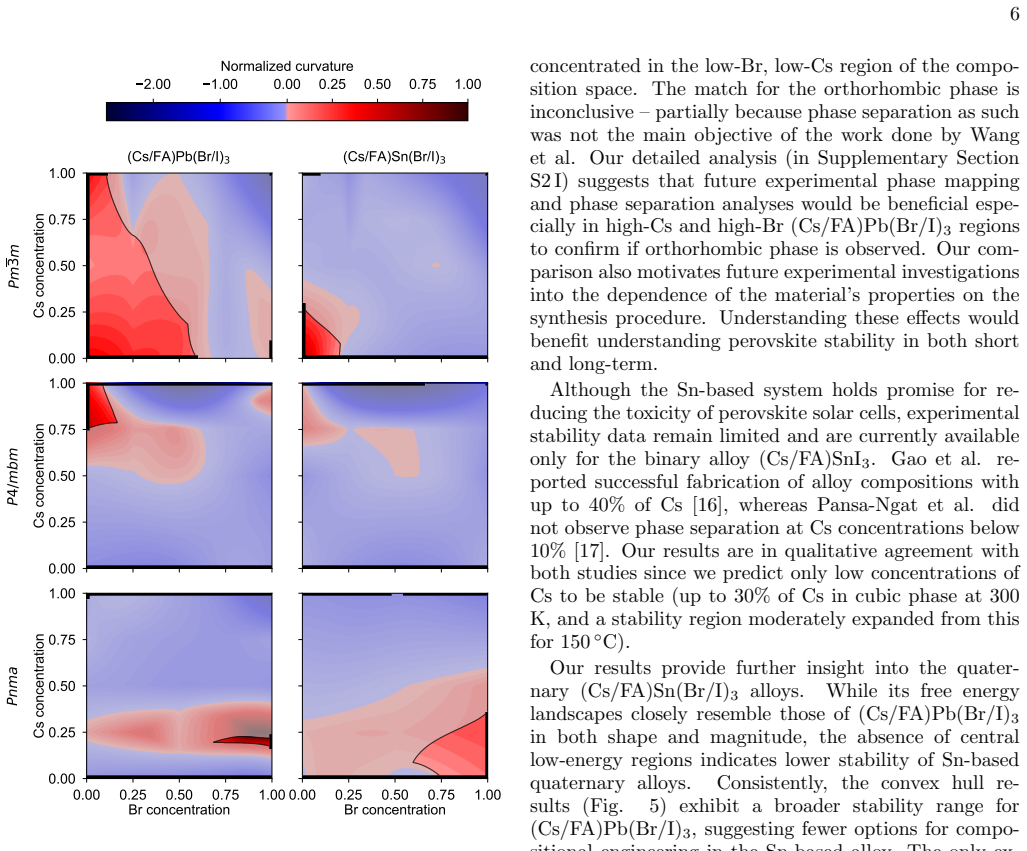
A two-level machine-learning approach combining graph neural network interatomic potentials and secondary energy-prediction models maps the free-energy landscapes of (Cs/FA)Pb(Br/I)3 and (Cs/FA)Sn(Br/I)3 perovskites and reveals narrower stable composition regions for the Sn-based system, maximum stability at high I content, and no stabilization near the center of the composition space.
What carries the argument
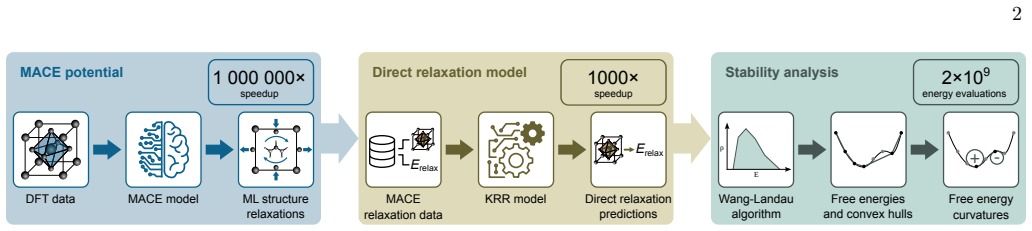
Two-level ML strategy: graph neural network interatomic potentials for DFT-trained relaxations plus secondary models for direct energy prediction on unrelaxed structures, enabling free-energy calculations across full composition space while including alloy disorder and FA orientations.
If this is right
- Compositional engineering choices are more restricted for tin-based perovskites than for lead-based ones.
- Highest stability occurs in iodine-rich compositions for both systems.
- Mixed Br/I alloys near the middle of the composition space receive no additional stabilization.
- The computed stability maps can directly inform synthesis targets for stable perovskite solar cells.
Where Pith is reading between the lines
- Targeted experiments at high-iodine Sn compositions could test the predicted stability maximum.
- The same modeling workflow could be applied to other quaternary alloys where direct DFT sampling remains prohibitive.
- If stability trends correlate with device lifetimes, the narrower Sn windows would constrain tin-perovskite photovoltaic designs more tightly than lead ones.
Load-bearing premise
The machine-learning models accurately reproduce the free-energy landscapes that include alloy disorder and formamidinium molecular orientations.
What would settle it
An experimental phase diagram that finds stable Sn-based compositions near the center of the (Cs/FA)Sn(Br/I)3 space or broader stable windows than the lead analog would contradict the reported stability maps.
Figures
read the original abstract
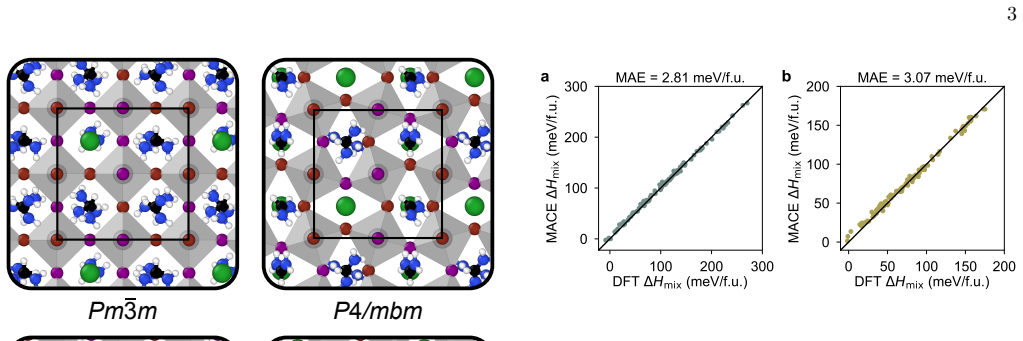
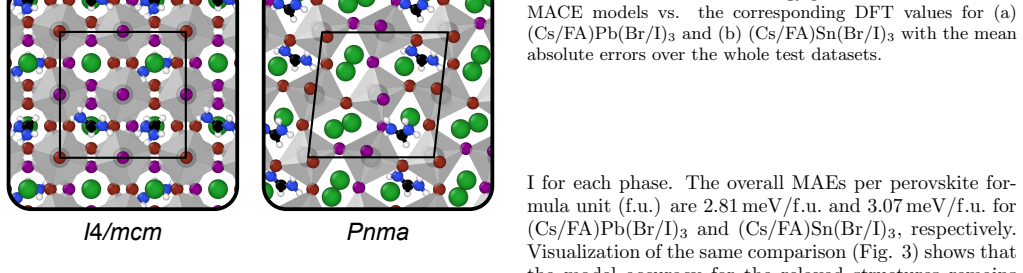
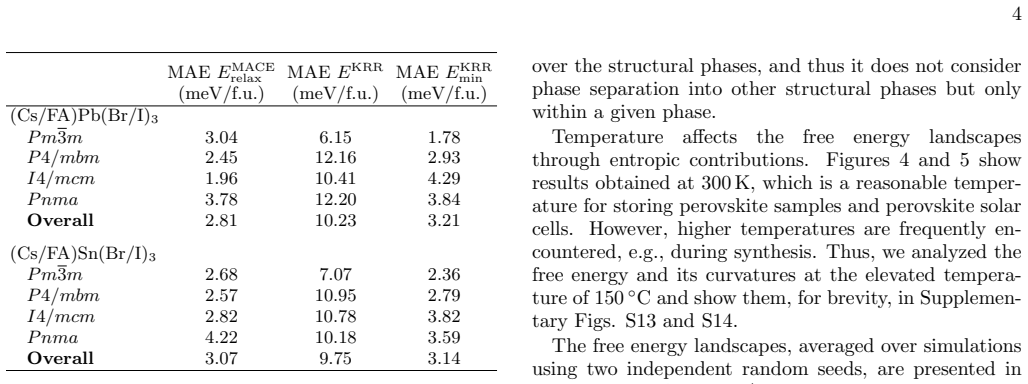
Alloy-based perovskite solar cells offer tunable properties and improved stability, but their complexity has impeded accurate modeling, hindering development. We present a machine-learning (ML) accelerated atomistic modeling approach for the phase stability of (Cs/FA)Pb(Br/I)3 and (Cs/FA)Sn(Br/I)3 perovskites, with FA being formamidinium. To make such quaternary alloys tractable, we adopt a two-level ML strategy, combining 1) graph neural network interatomic potentials trained on density functional theory data for efficient structure relaxations with 2) secondary ML models for direct energy prediction from unrelaxed structures. These models enable computations of free energy landscapes across compositions and phases, capturing alloy disorder and FA molecular orientations. Our results reveal narrower stable composition regions for the Sn-based system compared to its Pb-based counterpart, limiting options for compositional engineering. Maximum stability occurs at high I content, and no stabilization is observed near the center of the composition space. Our results guide the design of stable perovskites.
Editorial analysis
A structured set of objections, weighed in public.
Referee Report
Summary. The manuscript presents a two-level machine-learning strategy to compute thermodynamic stability of quaternary hybrid perovskites (Cs/FA)Pb(Br/I)3 and (Cs/FA)Sn(Br/I)3. Graph neural network interatomic potentials trained on DFT data enable efficient relaxations, while secondary ML models predict energies directly from unrelaxed structures; together these allow sampling of free-energy landscapes that incorporate alloy disorder and FA molecular orientations. The central results are that Sn-based alloys exhibit narrower stable composition windows than Pb-based counterparts, maximum stability occurs at high iodine content, and no stabilization is found near the center of the composition space.
Significance. If the ML models reproduce DFT-quality energies and configurational sampling across the full composition space, the work supplies concrete guidance for compositional engineering of stable perovskite alloys and demonstrates a scalable route to mapping phase stability in complex multicomponent systems. The two-level approach is a clear methodological strength for rendering quaternary alloys computationally tractable.
major comments (2)
- [Results and Methods] The load-bearing assumption is that the secondary ML models, when combined with the GNN potentials, accurately reproduce free-energy differences arising from random alloy occupations and FA orientations over the entire (Cs/FA)(Pb/Sn)(Br/I)3 space. No quantitative validation (MAE on held-out mixed-composition supercells, convergence of free-energy differences with supercell size, or direct ML-vs-DFT formation-energy comparisons for representative quaternary cells) is reported in the results or methods sections; without these metrics the reported narrowing of Sn stability windows and the location of maximum stability remain vulnerable to systematic bias.
- [Free-energy landscapes] The claim that 'no stabilization is observed near the center of the composition space' is presented as a key finding, yet the manuscript does not show how the configurational entropy term is computed or converged when both A-site (Cs/FA) and X-site (Br/I) disorder plus FA orientations are sampled simultaneously; an explicit test of whether the secondary model preserves the correct entropy scaling with composition is required to support this conclusion.
minor comments (2)
- [Methods] Notation for the two ML levels is introduced without a clear diagram or table summarizing training data sizes, hyperparameters, and validation splits for each level.
- [Figures] Figure captions should explicitly state the supercell size and number of sampled configurations used to generate each free-energy surface.
Simulated Author's Rebuttal
We thank the referee for the constructive comments, which highlight important aspects of validation and entropy treatment. We address each major comment below and will incorporate additional quantitative checks and methodological details in the revised manuscript.
read point-by-point responses
-
Referee: [Results and Methods] The load-bearing assumption is that the secondary ML models, when combined with the GNN potentials, accurately reproduce free-energy differences arising from random alloy occupations and FA orientations over the entire (Cs/FA)(Pb/Sn)(Br/I)3 space. No quantitative validation (MAE on held-out mixed-composition supercells, convergence of free-energy differences with supercell size, or direct ML-vs-DFT formation-energy comparisons for representative quaternary cells) is reported in the results or methods sections; without these metrics the reported narrowing of Sn stability windows and the location of maximum stability remain vulnerable to systematic bias.
Authors: We agree that explicit quantitative validation metrics for the secondary models on mixed-composition cells would strengthen the claims. In the revised manuscript we will add: (i) MAE values for the secondary ML models evaluated on held-out supercells spanning the full quaternary composition space, (ii) direct ML-versus-DFT formation-energy comparisons for representative quaternary cells, and (iii) a brief convergence test of free-energy differences with supercell size. These will be placed in a new subsection of the Methods and referenced in the Results to demonstrate that systematic bias does not affect the reported stability trends. revision: yes
-
Referee: [Free-energy landscapes] The claim that 'no stabilization is observed near the center of the composition space' is presented as a key finding, yet the manuscript does not show how the configurational entropy term is computed or converged when both A-site (Cs/FA) and X-site (Br/I) disorder plus FA orientations are sampled simultaneously; an explicit test of whether the secondary model preserves the correct entropy scaling with composition is required to support this conclusion.
Authors: We acknowledge the need for explicit documentation of the entropy calculation. The configurational entropy is obtained from the standard ideal-mixing expression applied to the sampled A-site and X-site occupations, with FA orientations included via the secondary model. In the revision we will add a dedicated paragraph in the Methods section that (a) details the sampling procedure for simultaneous A/X disorder and orientations, (b) shows how the entropy term is evaluated, and (c) provides a direct test comparing entropy scaling from the secondary model against DFT on smaller cells. This will confirm that the model preserves the expected composition dependence and thereby supports the observation of no central stabilization. revision: yes
Circularity Check
No significant circularity detected
full rationale
The paper trains graph neural network interatomic potentials and secondary energy models on external DFT reference data, then uses those models to compute free-energy landscapes over the (Cs/FA)(Pb/Sn)(Br/I)3 composition space. No load-bearing step equates a reported stability region, phase boundary, or free-energy difference to a fitted parameter by construction, nor does any central claim reduce to a self-citation whose supporting result is itself unverified. The derivation chain remains independent of the target outputs and is benchmarked against separate DFT calculations.
Axiom & Free-Parameter Ledger
free parameters (2)
- GNN interatomic potential parameters
- Secondary energy prediction model parameters
axioms (1)
- domain assumption Density functional theory calculations provide sufficiently accurate reference energies and forces for training the ML models.
Reference graph
Works this paper leans on
-
[1]
C. Liu, Y. Yang, H. Chen, J. Xu, A. Liu, A. S. Bati, H. Zhu, L. Grater, S. S. Hadke, C. Huang,et al., Bimolec- ularly passivated interface enables efficient and stable in- verted perovskite solar cells, Science382, 810 (2023)
2023
-
[2]
Liang, Y
Z. Liang, Y. Zhang, H. Xu, W. Chen, B. Liu, J. Zhang, H. Zhang, Z. Wang, D.-H. Kang, J. Zeng,et al., Homoge- nizing out-of-plane cation composition in perovskite solar cells, Nature624, 557 (2023)
2023
-
[3]
J. Liu, Y. He, L. Ding, H. Zhang, Q. Li, L. Jia, J. Yu, T. W. Lau, M. Li, Y. Qin, X. Gu, F. Zhang, Q. Li, Y. Yang, S. Zhao, X. Wu, J. Liu, T. Liu, Y. Gao, Y. Wang, X. Dong, H. Chen, P. Li, T. Zhou, M. Yang, X. Ru, F. Peng, S. Yin, M. Qu, D. Zhao, Z. Zhao, M. Li, P. Guo, H. Yan, C. Xiao, P. Xiao, J. Yin, X. Zhang, 9 Z. Li, B. He, and X. Xu, Perovskite/sili...
2024
-
[4]
M. V. Khenkin, E. A. Katz, A. Abate, G. Bardizza, J. J. Berry, C. Brabec, F. Brunetti, V. Bulovi´ c, Q. Burlingame, A. Di Carlo, R. Cheacharoen, Y.-B. Cheng, A. Colsmann, S. Cros, K. Domanski, M. Dusza, C. J. Fell, S. R. Forrest, Y. Galagan, D. Di Girolamo, M. Gr¨ atzel, A. Hagfeldt, E. von Hauff, H. Hoppe, J. Ket- tle, H. K¨ obler, M. S. Leite, S. F. Liu...
2020
-
[5]
T. A. Chowdhury, M. A. B. Zafar, M. S.-U. Islam, M. Shahinuzzaman, M. A. Islam, and M. U. Khandaker, Stability of perovskite solar cells: issues and prospects, RSC Adv.13, 1787 (2023)
2023
-
[6]
Ke and M
W. Ke and M. G. Kanatzidis, Prospects for low-toxicity lead-free perovskite solar cells, Nat. Commun.10, 965 (2019)
2019
-
[7]
Zhang, Y
Y. Zhang, Y. Ma, Y. Wang, X. Zhang, C. Zuo, L. Shen, and L. Ding, Lead-free perovskite photode- tectors: progress, challenges, and opportunities, Adv. Mater.33, 2006691 (2021)
2021
-
[8]
Saliba, Polyelemental, multicomponent perovskite semiconductor libraries through combinatorial screening, Adv
M. Saliba, Polyelemental, multicomponent perovskite semiconductor libraries through combinatorial screening, Adv. Energy Mater.9, 1803754 (2019)
2019
-
[9]
Liang, F
Y. Liang, F. Li, X. Cui, T. Lv, C. Stampfl, S. P. Ringer, X. Yang, J. Huang, and R. Zheng, Toward stabilization of formamidinium lead iodide perovskites by defect control and composition engineering, Nat. Commun.15, 1707 (2024)
2024
-
[10]
S. Sun, A. Tiihonen, F. Oviedo, Z. Liu, J. Thapa, Y. Zhao, N. T. P. Hartono, A. Goyal, T. Heumueller, C. Batali, A. Encinas, J. J. Yoo, R. Li, Z. Ren, I. M. Peters, C. J. Brabec, M. G. Bawendi, V. Stevanovic, J. Fisher III, and T. Buonassisi, A data fusion approach to optimize compositional stability of halide perovskites, Matter4, 1305 (2021)
2021
-
[11]
F. J. Berger, I. Poli, E. Aktas, S. Martani, D. Meggio- laro, L. Gregori, M. D. Albaqami, A. Abate, F. De Ange- lis, and A. Petrozza, How halide alloying influences the optoelectronic quality in tin-halide perovskite solar ab- sorbers, ACS Energy Letters8, 3876 (2023)
2023
-
[12]
D. P. McMeekin, G. Sadoughi, W. Rehman, G. E. Eperon, M. Saliba, M. T. H¨ orantner, A. Haghighirad, N. Sakai, L. Korte, B. Rech, M. B. Johnston, L. M. Herz, and H. J. Snaith, A mixed-cation lead mixed-halide per- ovskite absorber for tandem solar cells, Science351, 151 (2016)
2016
-
[13]
P. E. Marchezi, E. M. Ther´ ezio, R. Szostak, H. C. Loureiro, K. Bruening, A. Gold-Parker, M. A. Melo, C. J. Tassone, H. C. Tolentino, M. F. Toney,et al., Degra- dation mechanisms in mixed-cation and mixed-halide Csx FA1 –x Pb (Bry I1 –y )3 perovskite films under ambient conditions, J. Mater. Chem.A8, 9302 (2020)
2020
-
[14]
T. Wang, R. Li, H. Ardekani, L. Serrano-Luj´ an, J. Wang, M. Ramezani, R. Wilmington, M. Chauhan, R. W. Epps, K. Darabi, B. Guo, D. Sun, M. Abolhasani, K. Gun- dogdu, and A. Amassian, Sustainable materials acceler- ation platform reveals stable and efficient wide-bandgap metal halide perovskite alloys, Matter6, 2963 (2023)
2023
-
[15]
Hidalgo, J
J. Hidalgo, J. Breternitz, D. M. T¨ obbens, D. K. LaFollette, C. N. B. Pedorella, M.-J. Sher, S. Schorr, and J.-P. Correa-Baena, Br-induced suppression of low- temperature phase transitions in mixed-cation mixed- halide perovskites, Chem. Mater.36, 10167 (2024)
2024
-
[16]
W. Gao, C. Ran, J. Li, H. Dong, B. Jiao, L. Zhang, X. Lan, X. Hou, and Z. Wu, Robust stability of efficient lead-free formamidinium tin iodide perovskite solar cells realized by structural regulation, J. Phys. Chem. Lett.9, 6999 (2018)
2018
-
[17]
Pansa-Ngat, H
P. Pansa-Ngat, H. Nakajima, R. Supruangnet, S. Suwanna, P. Pakawatpanurut, S. Sahasithiwat, and P. Kanjanaboos, Phase evolution in lead-free cs- doped fasni3 hybrid perovskites and optical properties, J. Phys. Chem. C125, 16903 (2021)
2021
-
[18]
S. W. Park, J. H. Heo, H. J. Lee, H. Kim, S. H. Im, and K.-H. Hong, Compositional design for high-efficiency all- inorganic tin halide perovskite solar cells, ACS Energy Letters8, 5061 (2023)
2023
-
[19]
J. M. Sanchez, F. Ducastelle, and D. Gratias, Generalized cluster description of multicomponent systems, Physica A128, 334 (1984)
1984
-
[20]
Yamamoto, S
K. Yamamoto, S. Iikubo, J. Yamasaki, Y. Ogomi, and S. Hayase, Structural stability of iodide perovskite: A combined cluster expansion method and first-principles study, J. Phys. Chem. C121, 27797 (2017)
2017
-
[21]
J. S. Bechtel and A. Van der Ven, First-principles ther- modynamics study of phase stability in inorganic halide perovskite solid solutions, Phys. Rev. Mater.2, 045401 (2018)
2018
-
[22]
P. Maleka, R. Dima, D. Tshwane, O. Ntwaeaborwa, and R. Maphanga, Phase separation of Br-doped CsPbI 3: A combined cluster expansion, Monte Carlo, and DFT study, Molecules29, 10.3390/molecules29010092 (2024)
-
[23]
Zunger, S.-H
A. Zunger, S.-H. Wei, L. G. Ferreira, and J. E. Bernard, Special quasirandom structures, Phys. Rev. Lett.65, 353 (1990)
1990
-
[24]
L. T. Schelhas, Z. Li, J. A. Christians, A. Goyal, P. Kairys, S. P. Harvey, D. H. Kim, K. H. Stone, J. M. Luther, K. Zhu,et al., Insights into operational stability and processing of halide perovskite active layers, Energy & Environmental Science12, 1341 (2019)
2019
-
[25]
W. J. Baldwin, X. Liang, J. Klarbring, M. Dubajic, D. Dell’Angelo, C. Sutton, C. Caddeo, S. D. Stranks, A. Mattoni, A. Walsh, and G. Cs´ anyi, Dynamic local structure in caesium lead iodide: Spatial correlation and transient domains, Small20, 2303565 (2023)
2023
-
[26]
J. C. Thomas, J. S. Bechtel, A. R. Natarajan, and A. Van der Ven, Machine learning the density functional theory potential energy surface for the inorganic halide perovskite CsPbBr3, Phys. Rev. B100, 134101 (2019)
2019
-
[27]
Chen and C.-W
H.-A. Chen and C.-W. Pao, Fast and accurate artificial neural network potential model for MAPbI 3 perovskite materials, ACS Omega4, 10950 (2019)
2019
-
[28]
Jinnouchi, J
R. Jinnouchi, J. Lahnsteiner, F. Karsai, G. Kresse, and M. Bokdam, Phase transitions of hybrid perovskites sim- ulated by machine-learning force fields trained on the fly with bayesian inference, Phys. Rev. Lett.122, 225701 10 (2019)
2019
-
[29]
Bokdam, J
M. Bokdam, J. Lahnsteiner, and D. D. Sarma, Explor- ing librational pathways with on-the-fly machine-learning force fields: Methylammonium molecules in MAPbX 3 (X = I, Br, Cl) perovskites, J. Phys. Chem. C125, 21077 (2021)
2021
-
[30]
Karimitari, W
N. Karimitari, W. J. Baldwin, E. W. Muller, Z. J. L. Bare, W. J. Kennedy, G. Cs´ anyi, and C. Sutton, Ac- curate crystal structure prediction of new 2D hybrid organic–inorganic perovskites, J. Am. Chem. Soc.146, 27392 (2024), pMID: 39344597
2024
-
[32]
A. V. Krautsou, I. S. Humonen, V. D. Lazarev, R. A. Eremin, and S. A. Budennyy, Impact of crystal structure symmetry in training datasets on GNN-based energy as- sessments for chemically disordered CsPbI3, Sci. Rep.15, 8856 (2025)
2025
-
[33]
Chen, P.-H
H.-A. Chen, P.-H. Tang, G.-J. Chen, C.-C. Chang, and C.-W. Pao, Microstructure maps of complex perovskite materials from extensive monte carlo sampling using ma- chine learning enabled energy model, J. Phys. Chem. Lett.12, 3591 (2021)
2021
-
[34]
R. Luo, X. Jia, X. Niu, S. Liu, X. Guo, J. Li, Z.-J. Zhao, Y. Hou, and J. Gong, Machine learning-driven in- sights for phase-stable FAxCs1–xPb(IyBr1–y)3 perovskites in tandem solar cells, JACS Au5, 1771 (2025)
2025
-
[38]
Wang and D
F. Wang and D. P. Landau, Efficient, multiple-range ran- dom walk algorithm to calculate the density of states, Phys. Rev. Lett.86, 2050 (2001)
2050
-
[39]
V. Blum, R. Gehrke, F. Hanke, P. Havu, V. Havu, X. Ren, K. Reuter, and M. Scheffler, Ab initio molecular simulations with numeric atom-centered orbitals, Com- put. Phys. Commun.180, 2175 (2009)
2009
-
[40]
V. Havu, V. Blum, P. Havu, and M. Scheffler, Efficient O(N) integration for all-electron electronic structure cal- culation using numeric basis functions, J. Comput. Phys. 228, 8367 (2009)
2009
-
[41]
X. Ren, P. Rinke, V. Blum, J. Wieferink, A. Tkatchenko, S. Andrea, K. Reuter, V. Blum, and M. Scheffler, Resolution-of-identity approach to Hartree-Fock, hybrid density functionals, RPA, MP2, and GW with numeric atom-centered orbital basis functions, New J. Phys.14, 053020 (2012)
2012
-
[42]
S. V. Levchenko, X. Ren, J. Wieferink, R. Johanni, P. Rinke, V. Blum, and M. Scheffler, Hybrid function- als for large periodic systems in an all-electron, numeric atom-centered basis framework, Comput. Phys. Com- mun.192, 60 (2015)
2015
-
[43]
J. P. Perdew, K. Burke, and M. Ernzerhof, Generalized gradient approximation made simple, Phys. Rev. Lett. 77, 3865 (1996)
1996
-
[44]
Hermann and A
J. Hermann and A. Tkatchenko, Density functional model for van der waals interactions: Unifying many- body atomic approaches with nonlocal functionals, Phys. Rev. Lett.124, 146401 (2020)
2020
-
[45]
E. v. Lenthe, E. J. Baerends, and J. G. Snijders, Rel- ativistic regular two-component hamiltonians, J. Chem. Phys.99, 4597 (1993)
1993
-
[46]
A. H. Larsen, J. J. Mortensen, J. Blomqvist, I. E. Castelli, R. Christensen, M. Du lak, J. Friis, M. N. Groves, B. Hammer, C. Hargus, E. D. Hermes, P. C. Jennings, P. B. Jensen, J. Kermode, J. R. Kitchin, E. L. Kolsbjerg, J. Kubal, K. Kaasbjerg, S. Lysgaard, J. B. Maronsson, T. Maxson, T. Olsen, L. Pastewka, A. Pe- terson, C. Rostgaard, J. Schiøtz, O. Sch...
2017
-
[47]
Fletcher,Practical methods of optimization, 2nd ed
R. Fletcher,Practical methods of optimization, 2nd ed. (John Wiley & Sons, 2000). Supplemental Material: Charting the thermodynamic stability of hybrid perovskite alloys with machine learning Jarno Laakso, 1 Armi Tiihonen, 2 and Patrick Rinke 1, 3, 4, 5 1Department of Applied Physics, Aalto University, Espoo, Finland 2Department of Mechanical Engineering,...
2000
-
[48]
Direct relaxation model S4
MACE model hyperparameters S3 B. Direct relaxation model S4
-
[49]
Wang-Landau Algorithm S6 S2
Data generation S5 C. Wang-Landau Algorithm S6 S2. Results S8 A. Convergence tests for MACE potentials trained on initial clustering-based data S8 B. Convergence tests for active learning of MACE potentials S8 C. Analysis of initial dataset generation for direct relaxation models via clustering S9 D. Hyperparameter optimization for direct relaxation model...
-
[50]
Model training The DFT data generation workflow, shown in Fig. S1, consists of two main steps, where clustering is first used to select a diverse set of atomistic structures for DFT labeling, and then the model accuracy is improved iteratively through active learning. To enable the modeling of various perovskite phases, we incorporated structures from fou...
-
[51]
When the MACE model improves, both of these metrics should decrease
the average DFT energy of the relaxed geometries. When the MACE model improves, both of these metrics should decrease
-
[52]
The environments were expanded in a basis of five radial functions (num cutoff basis = 5) and spherical harmonics up to quantum numberl= 2 (max ell = 2)
MACE model hyperparameters The MACE models employed a cutoff radius of 5 ˚A to define the local atomic environments (r max = 5.0). The environments were expanded in a basis of five radial functions (num cutoff basis = 5) and spherical harmonics up to quantum numberl= 2 (max ell = 2). A correlation order of two (correlation = 2) was used to include pairwis...
-
[53]
ML methodology We initially attempted using the standard MACE model for learning the mapping between unrelaxed structures and relaxed energies. However, this approach yielded suboptimal results, likely due to the fact that the learning task is now inherently non-differentiable and thus atomic forces and stresses could not be utilized in the model fitting....
-
[54]
The workflow, that is depicted in Fig
Data generation The data generation workflow utilized for the direct relaxation models was similar to the one used for training the MACE potentials. The workflow, that is depicted in Fig. S3, consisted of two main stages: 1) initial data generation through clustering and MC sampling, and 2) improving model predictions with active learning. We began by sam...
2000
-
[55]
I. Batatia, S. Batzner, D. P. Kov´ acs, A. Musaelian, G. N. C. Simm, R. Drautz, C. Ortner, B. Kozinsky, and G. Cs´ anyi, The design space of E(3)-equivariant atom-centered interatomic potentials (2022), arXiv:2205.06643
-
[56]
Batatia, D
I. Batatia, D. P. Kov´ acs, G. N. C. Simm, C. Ortner, and G. Cs´ anyi, MACE: Higher order equivariant message passing neural networks for fast and accurate force fields, inAdvances in Neural Information Processing Systems, edited by A. H. Oh, A. Agarwal, D. Belgrave, and K. Cho (2022)
2022
-
[57]
H. Homm, J. Laakso, and P. Rinke, Efficient dataset generation for machine learning halide perovskite alloys, Phys. Rev. Mater.9, 053802 (2025)
2025
-
[58]
Huo and M
H. Huo and M. Rupp, Unified representation of molecules and crystals for machine learning, Mach. Learn.: Sci. Technol. 3, 045017 (2022)
2022
-
[59]
Himanen, M
L. Himanen, M. O. J. J¨ ager, E. V. Morooka, F. F. Canova, Y. S. Ranawat, D. Z. Gao, P. Rinke, and A. S. Foster, Dscribe: Library of descriptors for machine learning in materials science, Comp. Phys. Commun.247, 106949 (2020)
2020
-
[60]
Laakso, L
J. Laakso, L. Himanen, H. Homm, E. V. Morooka, M. O. J. J¨ ager, M. Todorovi´ c, and P. Rinke, Updates to the dscribe library: New descriptors and derivatives, J. Chem. Phys.158, 234802 (2023)
2023
-
[61]
P. S. Bradley, K. P. Bennett, and A. Demiriz, Constrained k-means clustering, Microsoft Research, Redmond20, 0 (2000)
2000
-
[62]
Levy-Kramer, k-means-constrained (2018)
J. Levy-Kramer, k-means-constrained (2018)
2018
-
[63]
Wang and D
F. Wang and D. P. Landau, Efficient, multiple-range random walk algorithm to calculate the density of states, Phys. Rev. Lett.86, 2050 (2001)
2050
-
[64]
Laakso, M
J. Laakso, M. Todorovi´ c, J. Li, G.-X. Zhang, and P. Rinke, Compositional engineering of perovskites with machine learning, Phys. Rev. Mater.6, 113801 (2022)
2022
-
[65]
T. Wang, R. Li, H. Ardekani, L. Serrano-Luj´ an, J. Wang, M. Ramezani, R. Wilmington, M. Chauhan, R. W. Epps, K. Darabi, B. Guo, D. Sun, M. Abolhasani, K. Gundogdu, and A. Amassian, Sustainable materials acceleration platform reveals stable and efficient wide-bandgap metal halide perovskite alloys, Matter6, 2963 (2023)
2023
discussion (0)
Sign in with ORCID, Apple, or X to comment. Anyone can read and Pith papers without signing in.