On hyperbolic corners and unit-area triangles in planar sets of large measure
Pith reviewed 2026-06-28 23:52 UTC · model grok-4.3
The pith
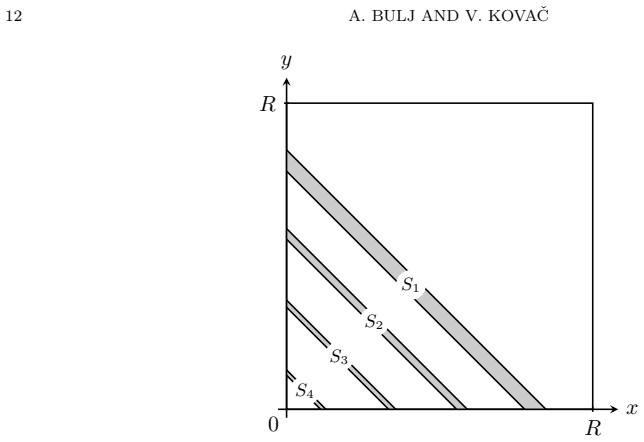
Measurable sets in [0,R]² avoiding vertices of axis-aligned right triangles of area 1/2 have measure O(R²/(log R)^c) for any c<1/4.
A machine-rendered reading of the paper's core claim, the machinery that carries it, and where it could break.
Core claim
For large R, any measurable A subset of [0,R]² that contains no triple (x,y), (x+t,y), (x,y+1/t) with t>0 satisfies |A| = O_c(R²/(log R)^c) whenever c<1/4. The same conclusion holds with any c<1/2 when A avoids all triangles of one fixed positive area. The proofs use a hyperbolic variant of the two-dimensional trilinear smoothing inequality together with, in the fixed-area case, induction on scales that alternately controls density and Riesz energy.
What carries the argument
Hyperbolic variant of the two-dimensional trilinear smoothing inequality, which bounds integrals over the hyperbolic corner configurations (x,y), (x+t,y), (x,y+1/t).
If this is right
- Avoiding the specific area-1/2 configuration forces the measure to be o(R²) with at least a small logarithmic factor.
- Avoiding all triangles of one fixed area yields a quantitatively stronger logarithmic upper bound.
- The fixed-area result supplies partial progress on Erdős's question whether the measure must remain O(1).
- A separate construction shows that measure Ω(R log R) is achievable while avoiding the area-1/2 configuration.
Where Pith is reading between the lines
- The induction-on-scales technique that controls both density and Riesz energy may transfer to other geometric-configuration problems that mix additive and multiplicative structure.
- Closing the gap between the proven upper bound O(R² / (log R)^c) and the lower bound Ω(R log R) would require either a stronger smoothing inequality or a different method.
- If analogous hyperbolic smoothing inequalities exist in higher dimensions, similar measure bounds could apply to corner-avoiding sets in R^d.
Load-bearing premise
The hyperbolic variant of the trilinear smoothing inequality must hold with the quantitative bounds needed to close the density estimates.
What would settle it
An explicit set A inside [0,R]² of measure larger than C R² / (log R)^{1/4} that still contains no triple of the form (x,y), (x+t,y), (x,y+1/t), or a counterexample showing the hyperbolic smoothing inequality fails to deliver the required decay.
Figures
read the original abstract
For large $R$, we consider measurable sets $A\subseteq [0,R]^2$ that avoid triples of points of the form $(x,y)$, $(x+t,y)$, $(x,y+1/t)$ with $x,y\in\mathbb{R}$ and $t>0$, i.e., the vertices of upward-oriented, axis-aligned right triangles of area $1/2$. We prove that the measures of such sets satisfy $|A|= O_c(R^2/(\log R)^c)$ for any constant $c<1/4$. An ingredient in the proof is a hyperbolic variant of the two-dimensional trilinear smoothing inequality by Christ, Durcik, and Roos. The aforementioned upper bound is complemented with an example of a set of measure $\Omega(R\log R)$ avoiding the same point configuration. Next, we study measurable sets $A\subseteq [0,R]^2$ that avoid triples of points spanning a triangle of a given fixed area and establish a sharpening of the aforementioned upper bound to any $c<1/2$. This makes partial progress on a question by Erd\H{o}s, who conjectured an upper bound $O(1)$, and improves over a quantitatively weak $o(R^2)$ result by Graham. The latter proof additionally uses induction on scales to interchangeably control the density and the Riesz energy of the set $A$.
Editorial analysis
A structured set of objections, weighed in public.
Referee Report
Summary. The paper proves that for large R, measurable sets A ⊆ [0,R]² avoiding the configuration (x,y), (x+t,y), (x,y+1/t) (t>0) satisfy |A| = O_c(R²/(log R)^c) for any c<1/4, complemented by a construction of measure Ω(R log R). For sets avoiding triangles of any fixed area the bound improves to any c<1/2. The proofs rely on a hyperbolic variant of the Christ-Durcik-Roos trilinear smoothing inequality together with an induction-on-scales argument that controls both density and Riesz energy.
Significance. If the hyperbolic smoothing inequality holds with constants permitting the stated iteration, the results give the first polylogarithmic improvements over the trivial bound for the hyperbolic-corner problem and advance Erdős' unit-area triangle question beyond Graham's o(R²) result, reaching nearly R²/(log R)^{1/2} in the fixed-area case.
major comments (1)
- [§4–5] The induction-on-scales argument in §4–5 invokes the hyperbolic variant of the Christ-Durcik-Roos trilinear smoothing inequality; the manuscript must establish explicit dependence of the constants on the hyperbolic parameter and on the scale of the tested configuration (x,y),(x+t,y),(x,y+1/t) so that the iteration yields a positive power c<1/4 (or c<1/2) without the smoothing constant deteriorating faster than any fixed power of log R.
minor comments (1)
- [abstract] The abstract states the bounds but does not indicate the precise range of t or the hyperbolic angle over which the smoothing inequality is proved; a brief statement of the parameter regime would clarify applicability to the induction.
Simulated Author's Rebuttal
We thank the referee for the careful reading, the positive evaluation of the results, and the specific suggestion regarding constant dependence. We address the major comment below and will incorporate the requested details in the revision.
read point-by-point responses
-
Referee: [§4–5] The induction-on-scales argument in §4–5 invokes the hyperbolic variant of the Christ-Durcik-Roos trilinear smoothing inequality; the manuscript must establish explicit dependence of the constants on the hyperbolic parameter and on the scale of the tested configuration (x,y),(x+t,y),(x,y+1/t) so that the iteration yields a positive power c<1/4 (or c<1/2) without the smoothing constant deteriorating faster than any fixed power of log R.
Authors: We agree that explicit control on the constants is required to justify the iteration and obtain the stated exponents. The current manuscript invokes the hyperbolic smoothing inequality (Theorem 3.1) but does not spell out the dependence on the hyperbolic parameter t and the dyadic scale in sufficient detail for the induction. In the revised version we will expand the proof of the smoothing inequality (or add an appendix) to record that the constant is at most C_ε (1 + |log t|)^C (scale)^ε for any ε>0, with C independent of t and the scale. This growth is slow enough that, when fed into the induction-on-scales argument of §§4–5, the accumulated loss remains smaller than any fixed power of log R, yielding the claimed c<1/4 for the area-1/2 case and c<1/2 for the fixed-area case. revision: yes
Circularity Check
No circularity; bounds derived from external inequality and induction on scales
full rationale
The paper establishes measure upper bounds for sets avoiding hyperbolic corners or fixed-area triangles by citing and applying a hyperbolic variant of the external Christ-Durcik-Roos trilinear smoothing inequality, then using induction on scales to control density and Riesz energy. No self-definitional reductions, no parameters fitted to data then relabeled as predictions, and no load-bearing self-citations appear in the derivation chain. The cited smoothing result is from independent authors and is treated as an external analytic input rather than derived within the paper. The complementary lower-bound construction is an explicit example, not a tautology. The derivation is therefore self-contained against external benchmarks.
Axiom & Free-Parameter Ledger
axioms (2)
- standard math Lebesgue measurability of subsets of R² and the standard properties of two-dimensional Lebesgue measure
- domain assumption Existence and applicability of a hyperbolic variant of the Christ-Durcik-Roos trilinear smoothing inequality
Reference graph
Works this paper leans on
-
[1]
Sets of lattice points that form no squares.Studia Sci
Miklós Ajtai and Endre Szemerédi. Sets of lattice points that form no squares.Studia Sci. Math. Hungar., 9:9–11, 1974
1974
-
[2]
On a generalization of the Hadwiger-Nelson problem
Mohammad Bardestani and Keivan Mallahi-Karai. On a generalization of the Hadwiger-Nelson problem. Israel J. Math., 217(1):313–335, 2017.doi:10.1007/s11856-017-1448-4
-
[3]
Aspects of uniformity in recurrence.Colloq
Vitaly Bergelson, Bernard Host, Randall McCutcheon, and François Parreau. Aspects of uniformity in recurrence.Colloq. Math., 84/85:549–576, 2000. Dedicated to the memory of Anzelm Iwanik.doi:10. 4064/cm-84/85-2-549-576
2000
-
[4]
Polynomial extensions of van der Waerden’s and Szemerédi’s theorems.J
Vitaly Bergelson and Alexander Leibman. Polynomial extensions of van der Waerden’s and Szemerédi’s theorems.J. Amer. Math. Soc., 9(3):725–753, 1996.doi:10.1090/S0894-0347-96-00194-4
-
[5]
Erdős problems.https://www.erdosproblems.com/
Thomas Bloom. Erdős problems.https://www.erdosproblems.com/. Accessed: January 25, 2026
2026
-
[6]
A Szemerédi type theorem for sets of positive density inRk.Israel J
Jean Bourgain. A Szemerédi type theorem for sets of positive density inRk.Israel J. Math., 54(3):307–316, 1986.doi:10.1007/BF02764959
-
[7]
A nonlinear version of Roth’s theorem for sets of positive density in the real line.J
Jean Bourgain. A nonlinear version of Roth’s theorem for sets of positive density in the real line.J. Analyse Math., 50:169–181, 1988.doi:10.1007/BF02796120
-
[8]
Benjamin B. Bruce and Malabika Pramanik. Two-point patterns determined by curves.Math. Ann., 393(1):571–615, 2025.doi:10.1007/s00208-025-03254-y
-
[9]
A polynomial Roth theorem for corners inR2 and a related bilinear singular integral operator.Math
Xuezhi Chen and Jingwei Guo. A polynomial Roth theorem for corners inR2 and a related bilinear singular integral operator.Math. Ann., 390(1):255–301, 2024.doi:10.1007/s00208-023-02763-y
-
[10]
Two-point polynomial patterns in subsets of positive density inRn
Xuezhi Chen and Changxing Miao. Two-point polynomial patterns in subsets of positive density inRn. Int. Math. Res. Not. IMRN, 2024(14):10865–10879, 2024.doi:10.1093/imrn/rnae108
-
[11]
Trilinear smoothing inequalities and a variant of the triangular Hilbert transform.Adv
Michael Christ, Polona Durcik, and Joris Roos. Trilinear smoothing inequalities and a variant of the triangular Hilbert transform.Adv. Math., 390:Paper No. 107863, 60, 2021.doi:10.1016/j.aim.2021. 107863
-
[12]
A Roth-type theorem for dense subsets ofRd.Bull
Brian Cook, Ákos Magyar, and Malabika Pramanik. A Roth-type theorem for dense subsets ofRd.Bull. Lond. Math. Soc., 49(4):676–689, 2017.doi:10.1112/blms.12043
-
[13]
Hallard T. Croft, Kenneth J. Falconer, and Richard K. Guy.Unsolved problems in geometry. Problem Books in Mathematics. Springer-Verlag, New York, 1991. Unsolved Problems in Intuitive Mathematics, II. doi:10.1007/978-1-4612-0963-8
-
[14]
Improved estimates for polynomial Roth type theorems in finite fields.J
Dong Dong, Xiaochun Li, and Will Sawin. Improved estimates for polynomial Roth type theorems in finite fields.J. Anal. Math., 141(2):689–705, 2020.doi:10.1007/s11854-020-0113-8
-
[15]
A Szemerédi-type theorem for subsets of the unit cube.Anal
Polona Durcik and Vjekoslav Kovač. A Szemerédi-type theorem for subsets of the unit cube.Anal. PDE, 15(2):507–549, 2022.doi:10.2140/apde.2022.15.507
-
[16]
On side lengths of corners in positive density subsets of the Euclidean space.Int
Polona Durcik, Vjekoslav Kovač, and Luka Rimanić. On side lengths of corners in positive density subsets of the Euclidean space.Int. Math. Res. Not. IMRN, 14(22):6844–6869, 2018.doi:10.1093/imrn/rnx093. 24 A. BULJ AND V. KOV AČ
-
[17]
A strong-type Furstenberg-Sárközy theorem for sets of positive measure.J
Polona Durcik, Vjekoslav Kovač, and Mario Stipčić. A strong-type Furstenberg-Sárközy theorem for sets of positive measure.J. Geom. Anal., 33(8):Paper No. 255, 16, 2023.doi:10.1007/s12220-023-01309-7
-
[18]
Set-theoretic, measure-theoretic, combinatorial, and number-theoretic problems concerning point sets in Euclidean space.Real Anal
Paul Erdős. Set-theoretic, measure-theoretic, combinatorial, and number-theoretic problems concerning point sets in Euclidean space.Real Anal. Exchange, 4(2):113–138, 1978/79
1978
-
[19]
My Scottish Book ‘Problems’
Paul Erdős. My Scottish Book ‘Problems’. In R. Daniel Mauldin, editor,The Scottish Book, pages 27–33. Birkhäuser, Boston, 1981
1981
-
[20]
Some combinatorial, geometric and set theoretic problems in measure theory
Paul Erdős. Some combinatorial, geometric and set theoretic problems in measure theory. In D. Kölzow and D. Maharam-Stone, editors,Measure Theory, Oberwolfach 1983: Proceedings of the Conference held at Oberwolfach, June 26–July 2, 1983, volume 1089 ofLecture Notes in Mathematics, pages 321–327. Springer, Berlin, Heidelberg, 1984.doi:10.1007/BFb0072626
-
[21]
Alejandra Gaitan and Victor Lie. Non-zero to zero curvature transition: Operators along hybrid curves with no quadratic (quasi-)resonances. Preprint, 2024. URL:https://arxiv.org/abs/2402.03451
-
[22]
On partitions ofEn.J
Ronald Lewis Graham. On partitions ofEn.J. Combin. Theory Ser. A, 28(1):89–97, 1980.doi:10.1016/ 0097-3165(80)90061-8
1980
-
[23]
A multidimensional Szemer\'{e}di theorem in integers
Jingwei Guo, Changxing Miao, and Guoqing Zhan. A multidimensional Szemerédi theorem in integers. Preprint, 2026. URL:https://arxiv.org/abs/2605.06360
work page internal anchor Pith review Pith/arXiv arXiv 2026
-
[24]
Rui Han, Michael T. Lacey, and Fan Yang. A polynomial Roth theorem for corners in finite fields.Math- ematika, 67(4):885–896, 2021.doi:10.1112/mtk.12108
-
[25]
Springer, New York, 2011.doi:10.1007/ 978-1-4419-6055-9
Sigurdur Helgason.Integral geometry and Radon transforms. Springer, New York, 2011.doi:10.1007/ 978-1-4419-6055-9
2011
-
[26]
A short proof on the boundedness of triangular Hilbert transform along curves
Martin Hsu and Fred Yu-Hsiang Lin. A short proof on the boundedness of triangular Hilbert transform along curves. Preprint, arXiv:2410.15791, 2024. URL:https://arxiv.org/abs/2410.15791
-
[27]
Liu, Shachar Lovett, Anthony Ostuni, and Mehtaab Sawhney
Michael Jaber, Yang P. Liu, Shachar Lovett, Anthony Ostuni, and Mehtaab Sawhney. Quasipolynomial bounds for the corners theorem. Preprint, 2025. URL:https://arxiv.org/abs/2504.07006
-
[28]
Density theorems for anisotropic point configurations.Canad
Vjekoslav Kovač. Density theorems for anisotropic point configurations.Canad. J. Math., 74(5):1244–1276, 2022.doi:10.4153/S0008414X21000225
-
[29]
Large copies of large configurations in large sets (extended abstract)
Vjekoslav Kovač. Large copies of large configurations in large sets (extended abstract). In T. Orponen, P. Shmerkin, and H. Wang, editors,Incidence Problems in Harmonic Analysis, Geometric Measure Theory, and Ergodic Theory. Workshop report 25/2023 of the conference held at Oberwolfach, June 4–June 9, 2023, volume 20 ofOberwolfach Rep.EMS Press, EMS-Publi...
-
[30]
Coloring and density theorems for configurations of a given volume.Proc
Vjekoslav Kovač. Coloring and density theorems for configurations of a given volume.Proc. Lond. Math. Soc. (3), 132(3):Paper No. e70143, 56 pp, 2026.doi:10.1112/plms.70143
-
[31]
Polynomial progressions in topological fields
Ben Krause, Mariusz Mirek, Sarah Peluse, and James Wright. Polynomial progressions in topological fields. Forum Math. Sigma, 12:Paper No. e106, 51, 2024.doi:10.1017/fms.2024.104
-
[32]
Corners with polynomial side length
Noah Kravitz, Borys Kuca, and James Leng. Corners with polynomial side length. Preprint, 2024. URL: https://arxiv.org/abs/2407.08637
-
[33]
Borys Kuca. Multidimensional polynomial patterns over finite fields: bounds, counting estimates and Gowers norm control.Adv. Math., 448:Paper No. 109700, 61, 2024.doi:10.1016/j.aim.2024.109700
-
[34]
Borys Kuca. Multidimensional polynomial Szemerédi theorem in finite fields for polynomials of distinct degrees.Israel J. Math., 259(2):589–620, 2024.doi:10.1007/s11856-023-2551-3
-
[35]
On a continuous Sárközy-type problem.Int
Borys Kuca, Tuomas Orponen, and Tuomas Sahlsten. On a continuous Sárközy-type problem.Int. Math. Res. Not. IMRN, 2023(13):11291–11315, 2023.doi:10.1093/imrn/rnac168
-
[36]
Improved bounds for szemerédi’s theorem
James Leng, Ashwin Sah, and Mehtaab Sawhney. Improved bounds for szemerédi’s theorem. Preprint,
- [37]
-
[38]
Uniform nonlinear Szemerédi theorem for corners in finite fields
Zi Li Lim. Uniform nonlinear Szemerédi theorem for corners in finite fields. Preprint, 2025. URL:https: //arxiv.org/abs/2501.04887
-
[39]
Doctoral dissertation, University of Bonn, Bonn, Germany, 2025
Yu-Hsiang Fred Lin.Singular Brascamp-Lieb Forms and Multilinear Fourier Multipliers with Rough or Oscillatory Multipliers. Doctoral dissertation, University of Bonn, Bonn, Germany, 2025
2025
-
[40]
Product of simplices and sets of positive upper density inRd.Math
Neil Lyall and Ákos Magyar. Product of simplices and sets of positive upper density inRd.Math. Proc. Cambridge Philos. Soc., 165(1):25–51, 2018.doi:10.1017/S0305004117000184
-
[41]
Distance graphs and sets of positive upper density inR d.Anal
Neil Lyall and Ákos Magyar. Distance graphs and sets of positive upper density inR d.Anal. PDE, 13(3):685–700, 2020.doi:10.2140/apde.2020.13.685
-
[42]
Weak hypergraph regularity and applications to geometric Ramsey theory
Neil Lyall and Ákos Magyar. Weak hypergraph regularity and applications to geometric Ramsey theory. Trans. Amer. Math. Soc. Ser. B, 9:160–207, 2022.doi:10.1090/btran/61. ON HYPERBOLIC CORNERS AND UNIT-AREA TRIANGLES 25
-
[43]
R.DanielMauldin.Someproblemsinsettheory, analysisandgeometry.InPaul Erdős and his mathematics, I (Budapest, 1999), volume 11 ofBolyai Soc. Math. Stud., pages 493–506. János Bolyai Math. Soc., Budapest, 2002
1999
-
[44]
R. Daniel Mauldin. Some problems and ideas of Erdős in analysis and geometry. InErdős centennial, volume 25 ofBolyai Soc. Math. Stud., pages 365–376. János Bolyai Math. Soc., Budapest, 2013.doi: 10.1007/978-3-642-39286-3\_13
-
[45]
Ilya D. Shkredov. On a problem of Gowers.Izv. Ross. Akad. Nauk Ser. Mat., 70(2):179–221, 2006.doi: 10.1070/IM2006v070n02ABEH002316. Email address:aleksandar.bulj@math.hr Email address:vjekovac@math.hr Department of Mathematics, F aculty of Science, University of Zagreb, Bijenička cesta 30, 10000 Zagreb, Croatia
discussion (0)
Sign in with ORCID, Apple, or X to comment. Anyone can read and Pith papers without signing in.