Composition-dependent Thin-film Synthesis of Layered Ternary Iron Nitrides FeMN2 (M = W, Mo)
Pith reviewed 2026-06-29 06:26 UTC · model grok-4.3
The pith
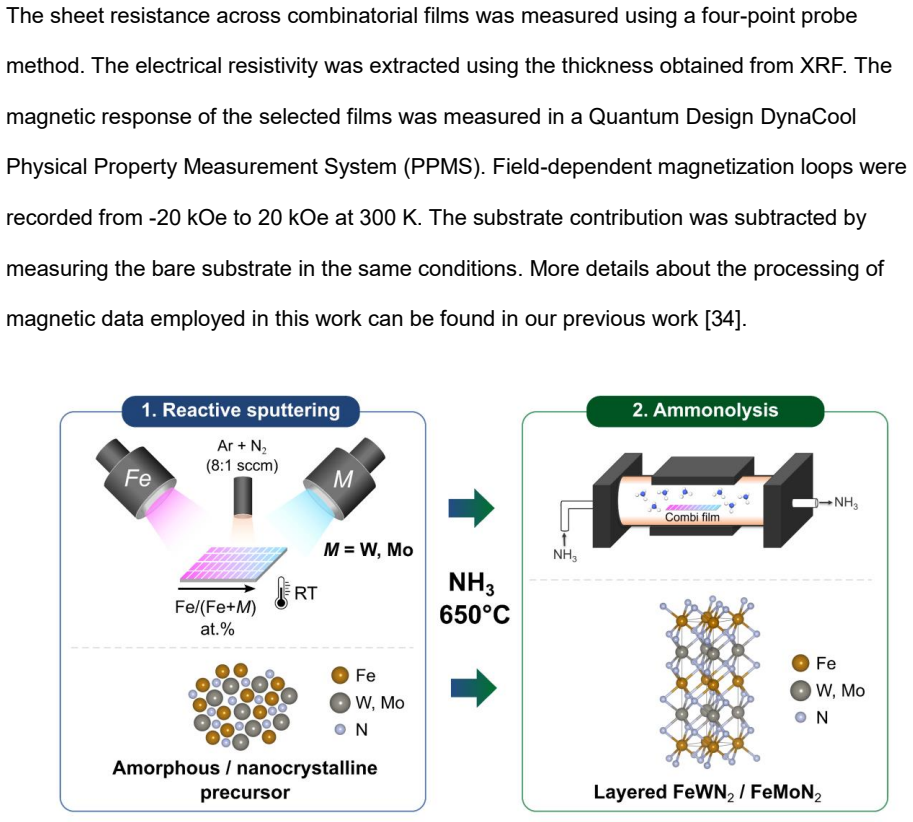
FeWN2 thin films maintain high phase purity across compositions through cation substitution, while FeMoN2 achieves it only at iron-poor ratios.
A machine-rendered reading of the paper's core claim, the machinery that carries it, and where it could break.
Core claim
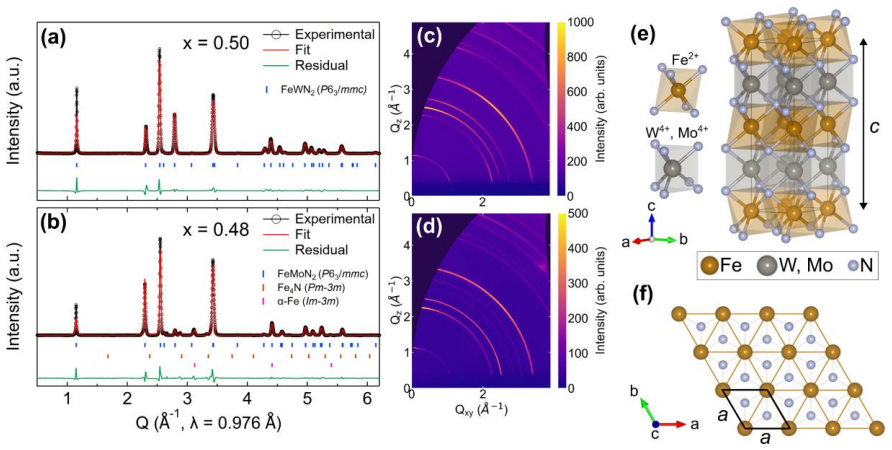
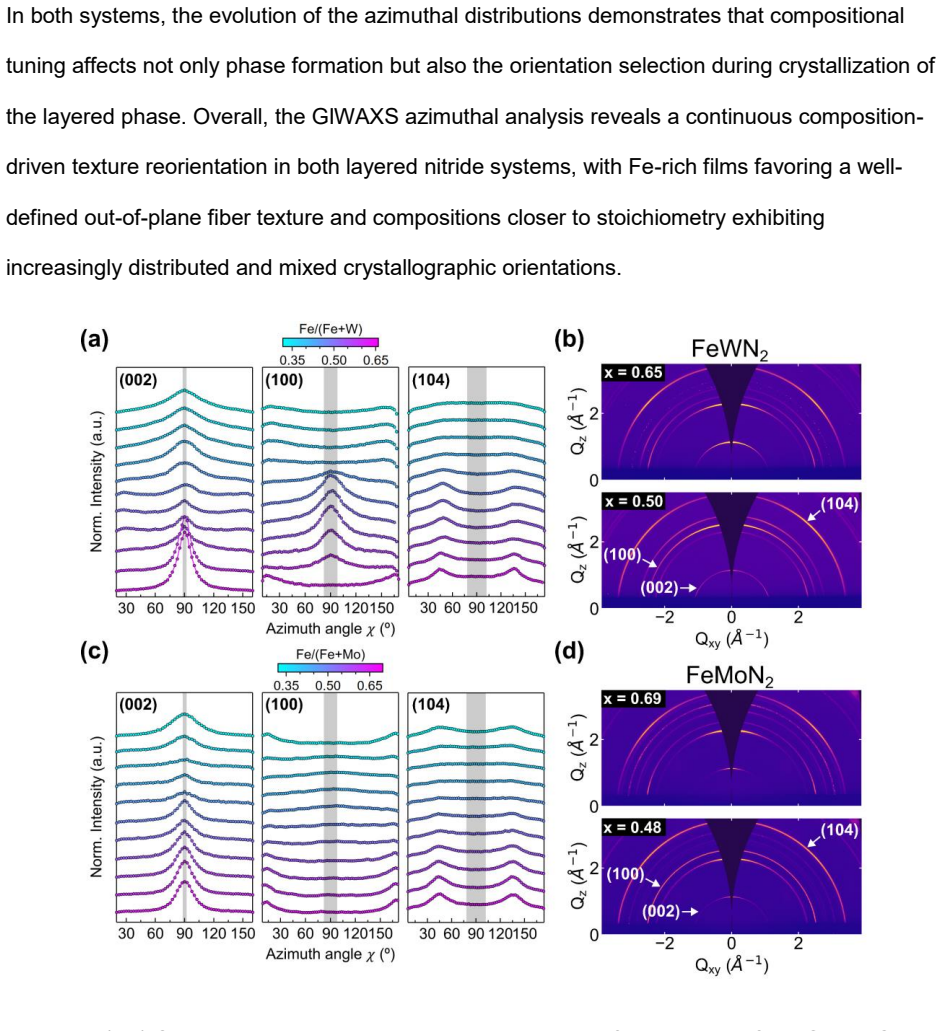
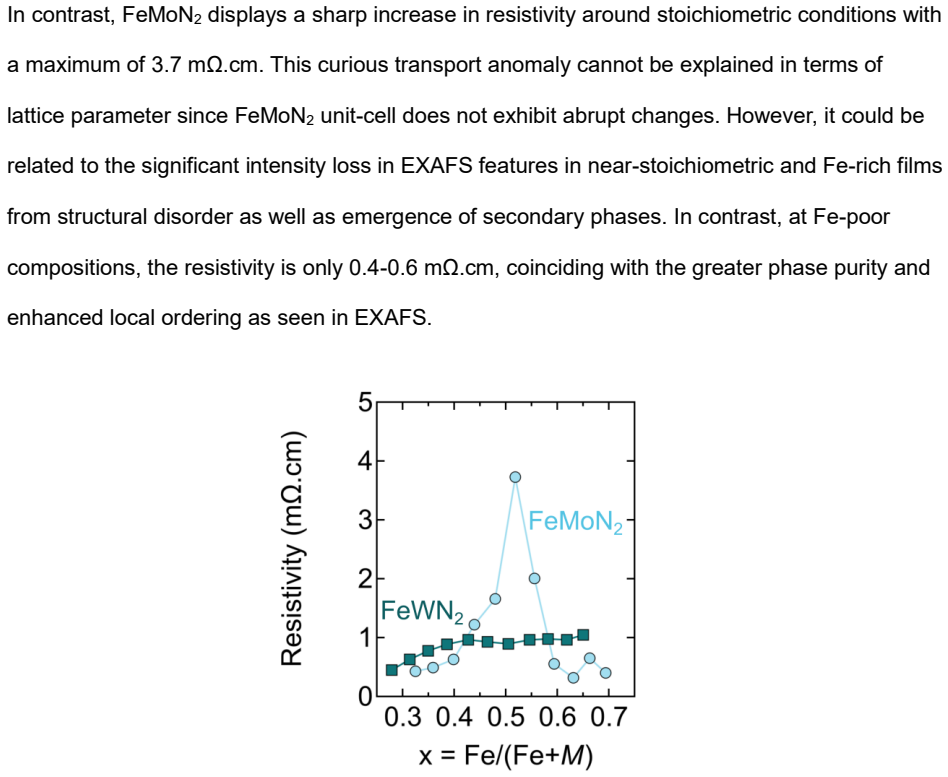
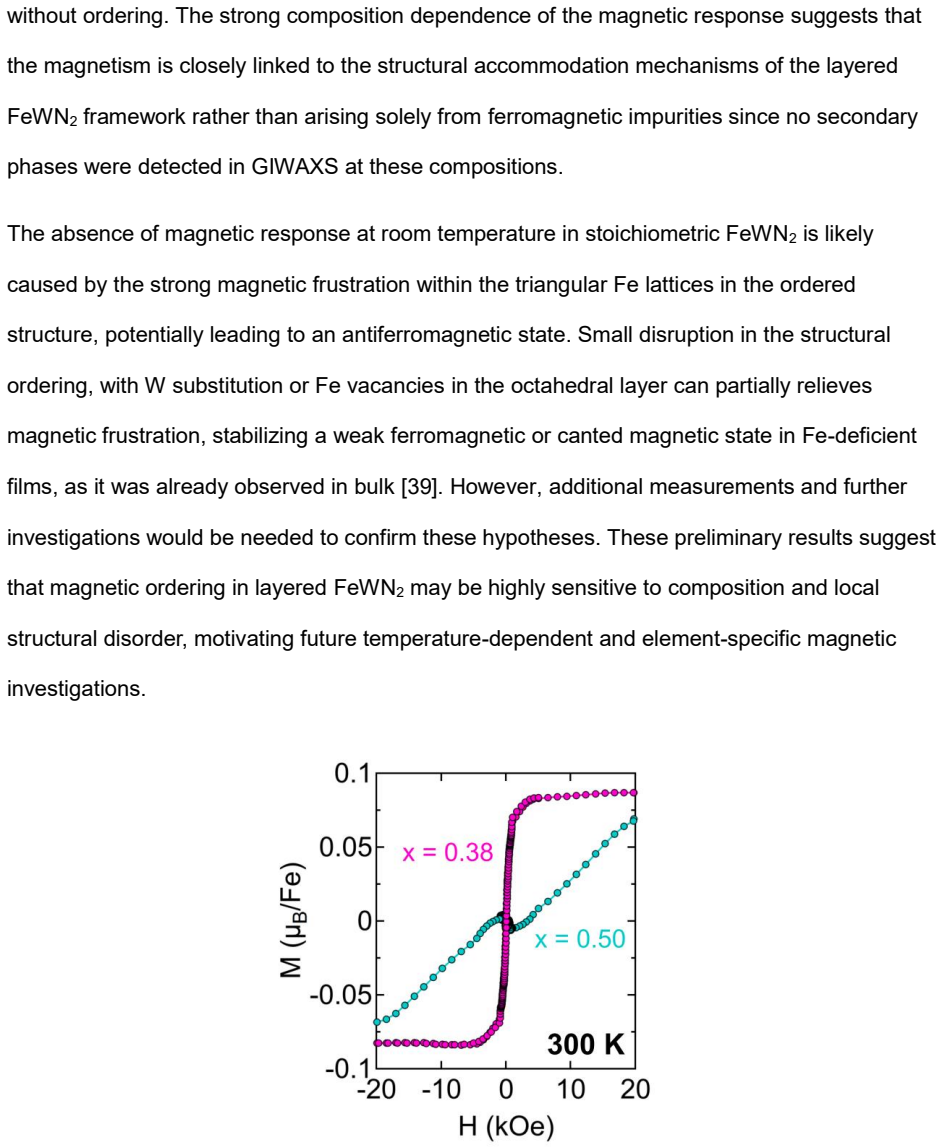
Both layered phases form over broad composition ranges. FeWN2 maintains high phase purity across compositions consistent with cation substitution, whereas FeMoN2 exhibits good phase purity only at Fe-poor compositions. Azimuthal GIWAXS shows Fe-rich films in both systems start with out-of-plane fiber texture that evolves toward in-plane orientation near stoichiometry in FeWN2 but becomes randomly oriented in FeMoN2. Resistivity remains low and composition-insensitive in FeWN2 at about 1 mΩ·cm but shows a maximum near stoichiometry in FeMoN2. Fe-poor FeWN2 displays weak ferromagnetic-like behavior at room temperature while stoichiometric films are predominantly paramagnetic.
What carries the argument
Composition-dependent accommodation of cation substitution in layered FeMN2 structures, revealed by GIWAXS texture analysis and XAS local coordination tracking after NH3 annealing of sputtered films.
If this is right
- Resistivity and magnetization in these films can be tuned by adjusting iron-to-metal ratio without losing the layered structure in the FeWN2 case.
- Texture control from out-of-plane to in-plane orientation offers a route to engineer anisotropic transport or magnetic response.
- The contrast between the two systems indicates that Mo and W differ in how they stabilize the layered nitride lattice against composition changes.
- Fe-poor FeWN2 compositions combine phase purity with measurable room-temperature magnetism, suggesting possible use in magnetic thin-film stacks.
Where Pith is reading between the lines
- Similar sputtering-plus-annealing routes may extend to other layered ternary nitrides if the same phase-purity window exists.
- The resistivity peak in FeMoN2 near stoichiometry could signal a composition-driven metal-insulator crossover worth checking with temperature-dependent measurements.
- Device-level tests on these films would show whether the observed texture and magnetism translate into useful anisotropic magnetoresistance or spin-transport effects.
Load-bearing premise
The synchrotron GIWAXS patterns and XAS spectra uniquely identify the targeted layered ternary nitride structures rather than competing rocksalt-derived or other metastable phases, and the post-deposition NH3 annealing reliably converts the as-sputtered films into those phases.
What would settle it
Detection of rocksalt-derived diffraction peaks or mismatched local Fe coordination in post-anneal GIWAXS and XAS data at any composition would show the films did not form the claimed layered phases.
Figures
read the original abstract
Ternary transition-metal nitrides with layered crystal structures host anisotropic bonding and reduced dimensionality that may enable unconventional electronic and magnetic behavior. Yet, synthesis of such nitride thin films remains challenging because reactive sputtering often favors metastable rocksalt-derived structures. We report the composition-dependent synthesis, structure, and properties of layered FeMN2 (M = W, Mo) thin films with triangular Fe sublattices, prepared by reactive sputtering and post-deposition NH3 annealing. Using synchrotron grazing-incidence wide-angle X-ray scattering (GIWAXS) and X-ray absorption spectroscopy (XAS), we investigate the evolution of phase formation, crystallographic texture, and local Fe coordination across composition. Both layered phase form over broad composition ranges. FeWN2 maintains high phase purity across compositions, consistent with cation substitution, whereas FeMoN2 only exhibits good phase purity at Fe-poor compositions. Azimuthal GIWAXS analysis shows that Fe-rich films in both systems exhibit out-of-plane fiber texture, which progressively evolves toward predominantly in-plane orientation near stoichiometry in FeWN2, while FeMoN2 develops a more randomly oriented polycrystalline microstructure. Electrical measurements reveal relatively low and composition-insensitive resistivity in FeWN2 (~1 m{\Omega}.cm), whereas FeMoN2 exhibits a pronounced resistivity maximum near nominal stoichiometry. Preliminary room-temperature magnetization measurements on FeWN2 further reveal weak ferromagnetic-like behavior in Fe-poor films, while stoichiometric compositions remain predominantly paramagnetic. These results demonstrate fundamentally different structural accommodation mechanisms in FeWN2 and FeMoN2, and highlight the strong coupling between composition, microstructure, and electronic/magnetic properties in layered nitride thin films.
Editorial analysis
A structured set of objections, weighed in public.
Referee Report
Summary. The manuscript reports the composition-dependent synthesis of layered ternary iron nitride thin films FeMN2 (M = W, Mo) with triangular Fe sublattices via reactive sputtering followed by post-deposition NH3 annealing. Synchrotron GIWAXS and XAS are used to track phase formation, texture, and local Fe coordination, claiming that both layered phases form over broad composition ranges, with FeWN2 maintaining high phase purity across compositions (consistent with cation substitution) while FeMoN2 shows good purity only at Fe-poor compositions; texture evolves from out-of-plane fiber to in-plane near stoichiometry in FeWN2 but becomes randomly oriented in FeMoN2; resistivity is low and composition-insensitive in FeWN2 (~1 mΩ·cm) but shows a maximum near stoichiometry in FeMoN2; and room-temperature magnetization on FeWN2 shows weak ferromagnetic-like behavior in Fe-poor films but is predominantly paramagnetic at stoichiometry.
Significance. If the structural assignments are robust, the work demonstrates fundamentally different structural accommodation mechanisms between the W and Mo systems and the strong coupling of composition to microstructure and electronic/magnetic properties in layered nitrides. This is potentially significant for the synthesis of anisotropic nitride thin films, as it addresses the challenge of kinetically favored rocksalt phases and provides composition-dependent guidelines for phase purity and texture control.
major comments (2)
- [GIWAXS analysis] GIWAXS results section: The assignment of observed reflections to the targeted layered FeMN2 structures (rather than rocksalt-derived or other metastable phases) lacks explicit simulated-pattern comparisons, difference plots, or Rietveld refinements against the layered versus rocksalt models. The abstract itself notes that reactive sputtering favors rocksalt structures, yet no quantification of residual rocksalt fraction (e.g., via (00l) intensity ratios) is provided; this is load-bearing for the central claims of composition-dependent phase purity, texture evolution, and property differences.
- [XAS analysis] XAS results section: The Fe K-edge XAS spectra are presented as confirming the local Fe coordination in the layered phases, but without quantitative fitting, edge-shape comparisons to reference spectra for layered versus competing phases, or discussion of potential confounding contributions, it remains unclear how uniquely the spectra fingerprint the triangular Fe sublattice structures.
minor comments (1)
- [Abstract] The resistivity unit in the abstract is written as m{\Omega}.cm; this should be corrected to the standard mΩ·cm notation for clarity.
Simulated Author's Rebuttal
We thank the referee for their careful review and constructive comments on our manuscript. We address the two major comments point by point below, agreeing that additional comparisons will strengthen the presentation of the GIWAXS and XAS data. We outline specific revisions to address the concerns regarding structural assignments and local coordination analysis.
read point-by-point responses
-
Referee: [GIWAXS analysis] GIWAXS results section: The assignment of observed reflections to the targeted layered FeMN2 structures (rather than rocksalt-derived or other metastable phases) lacks explicit simulated-pattern comparisons, difference plots, or Rietveld refinements against the layered versus rocksalt models. The abstract itself notes that reactive sputtering favors rocksalt structures, yet no quantification of residual rocksalt fraction (e.g., via (00l) intensity ratios) is provided; this is load-bearing for the central claims of composition-dependent phase purity, texture evolution, and property differences.
Authors: We agree that explicit simulated-pattern comparisons and quantification of any residual rocksalt fraction would improve the robustness of the phase assignments. Although the observed (00l) reflections and absence of certain rocksalt peaks support our interpretation of high phase purity in FeWN2 across compositions, we will revise the GIWAXS section to include simulated patterns for the layered FeMN2 and rocksalt structures, difference plots, and an analysis of (00l) intensity ratios to quantify phase purity as a function of composition. This will directly address the load-bearing nature of these claims. revision: yes
-
Referee: [XAS analysis] XAS results section: The Fe K-edge XAS spectra are presented as confirming the local Fe coordination in the layered phases, but without quantitative fitting, edge-shape comparisons to reference spectra for layered versus competing phases, or discussion of potential confounding contributions, it remains unclear how uniquely the spectra fingerprint the triangular Fe sublattice structures.
Authors: We acknowledge that the XAS interpretation relies on qualitative edge positions and shapes consistent with layered nitride references. To strengthen the fingerprinting of the triangular Fe sublattice, the revised manuscript will include quantitative fitting of the XAS data where feasible, direct edge-shape comparisons to reference spectra from layered versus rocksalt phases, and explicit discussion of potential confounding contributions from other local environments. revision: yes
Circularity Check
No circularity: purely experimental report with no derivations or self-referential modeling
full rationale
The manuscript is an experimental study of thin-film synthesis, GIWAXS/XAS characterization, and property measurements. No equations, fitted parameters, predictions, or derivation chains appear in the provided text. Claims rest on direct observation of phase formation, texture, resistivity, and magnetization across compositions. No self-citations are invoked as load-bearing uniqueness theorems or ansatzes. The analysis is self-contained against external benchmarks (synchrotron data, standard XAS interpretation) and does not reduce any result to author-defined inputs by construction.
Axiom & Free-Parameter Ledger
axioms (1)
- domain assumption GIWAXS and XAS data can be unambiguously assigned to the layered FeMN2 structures rather than competing phases.
Reference graph
Works this paper leans on
-
[1]
Kobayashi, T
A. Kobayashi, T. Maeda, T. Akiyama, T. Kawamura, and Y . Honda, Sputter Epitaxy of Transition Metal Nitrides: Advances in Superconductors, Semiconductors, and Ferroelectrics, Physica Status Solidi (a) 222, 2400896 (2025)
2025
-
[2]
H. Bell, Y . M. Shy, D. E. Anderson, and L. E. Toth, Superconducting Properties of Reactively Sputtered Thin‐Film Ternary Nitrides, Nb–Ti–N and Nb–Zr–N, Journal of Applied Physics 39, 2797 (1968)
1968
-
[3]
W. R. L. Lambrecht, M. S. Miao, and P. Lukashev, Magnetic properties of transition-metal nitrides, J. Appl. Phys. 97, 10D306 (2005)
2005
-
[4]
K. Ito, S. Honda, and T. Suemasu, Transition metal nitrides and their mixed crystals for spintronics, Nanotechnology 33, 062001 (2021)
2021
-
[5]
W. N. Porter, K. K. Turaczy, M. Yu, H. Mou, and J. G. Chen, Transition metal nitride catalysts for selective conversion of oxygen-containing molecules, Chem. Sci. 15, 6622 (2024)
2024
-
[6]
S. Hund, O. Gómez-Cápiro, K. Dembélé, S. Berendts, T. Lunkenbein, H. Ruland, E. M. Heppke, and M. Lerch, Fe3Mo3N: Crystal Structure, High-Temperature Behavior, and 23 Catalytic Activity for Ammonia Decomposition, Zeitschrift Für Anorganische Und Allgemeine Chemie 649, e202300152 (2023)
2023
-
[7]
H. Wang, J. Li, K. Li, Y . Lin, J. Chen, L. Gao, V. Nicolosi, X. Xiao, and J.-M. Lee, Transition metal nitrides for electrochemical energy applications, Chem. Soc. Rev. 50, 1354 (2021)
2021
-
[8]
S. A. Kadam, R. S. Kate, V. M. Peheliwa, S. A. Shingate, C. C. Sta. Maria, and Y .-R. Ma, A comprehensive review on transition metal nitrides electrode materials for supercapacitor: Syntheses, electronic structure engineering, present perspectives and future aspects, Journal of Energy Storage 72, 108229 (2023)
2023
-
[9]
S. Atta, U. NarendraKumar, K. V. A. N. P . S. Kumar, D. P . Yadav, and S. Dash, Recent Developments and Applications of TiN-Based Films Synthesized by Magnetron Sputtering, J. of Materi Eng and Perform 32, 9979 (2023)
2023
-
[10]
Biswas and B
B. Biswas and B. Saha, Development of semiconducting ScN, Phys. Rev. Mater. 3, 020301 (2019)
2019
-
[11]
28 (Elsevier, 2001), pp
Synthesis and Characterization of Superconducting Thin Films, in Thin Films, Vol. 28 (Elsevier, 2001), pp. 227–270
2001
-
[12]
Stavrev, D
M. Stavrev, D. Fischer, C. Wenzel, K. Drescher, and N. Mattern, Crystallographic and morphological characterization of reactively sputtered Ta, TaN and TaNO thin films, Thin Solid Films 307, 79 (1997)
1997
-
[13]
S. H. Elder, L. H. Doerrer, F. J. DiSalvo, J. B. Parise, D. Guyomard, and J. M. Tarascon, Lithium molybdenum nitride (LiMoN2): the first metallic layered nitride, Chem. Mater. 4, 928 (1992)
1992
-
[14]
A. Kuhn, M. Martín-Gil, S. Kaskel, J. Strähle, and F. García-Alvarado, The effect of cationic disordering on the electrochemical performances of the layered nitrides LiWN2 and Li0.84W1.16N2, Journal of the European Ceramic Society 27, 4199 (2007)
2007
-
[15]
Ming and X
X. Ming and X. Kuang, Phase engineering of nitride thin films, Nat. Synth 3, 1444 (2024)
2024
-
[16]
Zakutayev, M
A. Zakutayev, M. Jankousky, L. Wolf, Y . Feng, C. L. Rom, S. R. Bauers, O. Borkiewicz, D. A. LaVan, R. W. Smaha, and V. Stevanovic, Synthesis pathways to thin films of stable layered nitrides, Nat. Synth 3, 1471 (2024)
2024
-
[17]
S. Wang, Z. Wang, Z. Zuo, D. Xu, Y . Yan, Z. Feng, and Z. Zeng, Rockseline lead chalcogenides: An alternative class of high-performance thermoelectric materials, Appl. Phys. Lett. 127, 102110 (2025)
2025
-
[18]
C. L. Rom, R. W. Smaha, C. A. Knebel, K. N. Heinselman, J. R. Neilson, S. R. Bauers, and A. Zakutayev, Bulk and film synthesis pathways to ternary magnesium tungsten nitrides, Journal of Materials Chemistry C 11, 11451 (2023)
2023
-
[19]
Julien, I
B. Julien, I. A. Leahy, R. W. Smaha, J. S. Mangum, C. L. Perkins, S. R. Bauers, and A. Zakutayev, Structural stability, elemental ordering, and transport properties of layered ${\mathrm{ScTaN}}_{2}$, Phys. Rev. Mater. 9, 093403 (2025)
2025
-
[20]
Katsumata, H
K. Katsumata, H. A. Katori, S. Kimura, Y . Narumi, M. Hagiwara, and K. Kindo, Phase transition of a triangular lattice Ising antiferromagnet ${\text{FeI}}_{2}$, Phys. Rev. B 82, 104402 (2010)
2010
-
[21]
Zhong, S
R. Zhong, S. Guo, and R. J. Cava, Frustrated magnetism in the layered triangular lattice materials ${\mathrm{K}}_{2}\mathrm{Co}{({\mathrm{SeO}}_{3})}_{2}$ and ${\mathrm{Rb}}_{2}\mathrm{Co}{({\mathrm{SeO}}_{3})}_{2}$, Phys. Rev. Mater. 4, 084406 (2020)
2020
-
[22]
D. S. Bem, C. M. Lampe-Önnerud, H. P . Olsen, and H.-C. zur Loye, Synthesis and Structure of Two New Ternary Nitrides: FeWN2 and MnMoN2, Inorg. Chem. 35, 581 (1996)
1996
-
[24]
S. R. Bauers et al., Ternary nitride semiconductors in the rocksalt crystal structure, Proceedings of the National Academy of Sciences 116, 14829 (2019). 24
2019
-
[25]
Zakutayev, S
A. Zakutayev, S. R. Bauers, and S. Lany, Experimental Synthesis of Theoretically Predicted Multivalent Ternary Nitride Materials, Chem. Mater. 34, 1418 (2022)
2022
-
[26]
Miura, X.-D
A. Miura, X.-D. Wen, H. Abe, G. Yau, and F. J. DiSalvo, Non-stoichiometric FexWN2: Leaching of Fe from layer-structured FeWN2, Journal of Solid State Chemistry 183, 327 (2010)
2010
-
[27]
J. A. Steele et al., How to GIWAXS: Grazing Incidence Wide Angle X-Ray Scattering Applied to Metal Halide Perovskite Thin Films, Advanced Energy Materials 13, 2300760 (2023)
2023
-
[28]
J. C. Fischer, C. Li, S. Hamer, L. Heinke, R. Herges, B. S. Richards, and I. A. Howard, GIWAXS Characterization of Metal–Organic Framework Thin Films and Heterostructures: Quantifying Structure and Orientation, Advanced Materials Interfaces 10, 2202259 (2023)
2023
-
[29]
G. A. Waychunas, Grazing-incidence X-ray Absorption and Emission Spectroscopy, Reviews in Mineralogy and Geochemistry 49, 267 (2002)
2002
-
[30]
Dräger, R
G. Dräger, R. Frahm, G. Materlik, and O. Brümmer, On the Multipole Character of the X-Ray Transitions in the Pre-Edge Structure of Fe K Absorption Spectra. An Experimental Study, Physica Status Solidi (b) 146, 287 (1988)
1988
-
[31]
Ilavsky, Nika: software for two-dimensional data reduction, J Appl Cryst 45, 324 (2012)
J. Ilavsky, Nika: software for two-dimensional data reduction, J Appl Cryst 45, 324 (2012)
2012
-
[32]
B. H. Toby and R. B. Von Dreele, GSAS-II: the genesis of a modern open-source all purpose crystallography software package, Journal of Applied Crystallography 46, 544 (2013)
2013
-
[33]
Ravel and M
B. Ravel and M. Newville, ATHENA and ARTEMIS: interactive graphical data analysis using IFEFFIT, Phys. Scr. 2005, 1007 (2005)
2005
-
[34]
Julien, A
B. Julien, A. Rauf, L. A. V. Nagle-Cocco, R. W. Smaha, W. Sun, A. Zakutayev, and S. R. Bauers, Thin-Film Stabilization and Magnetism of 𝜼-Carbide Type Iron Nitrides, (n.d.)
-
[35]
B. Cao, G. M. Veith, J. C. Neuefeind, R. R. Adzic, and P. G. Khalifah, Mixed Close-Packed Cobalt Molybdenum Nitrides as Non-noble Metal Electrocatalysts for the Hydrogen Evolution Reaction, J. Am. Chem. Soc. 135, 19186 (2013)
2013
-
[36]
D. S. Bem, H. P . Olsen, and H.-C. zur Loye, Synthesis, Electronic and Magnetic Characterization of the Ternary Nitride (Fe0.8Mo0.2)MoN2, Chem. Mater. 7, 1824 (1995)
1995
-
[37]
Hoang and M
K. Hoang and M. Johannes, Defect Physics and Chemistry in Layered Mixed Transition Metal Oxide Cathode Materials: (Ni,Co,Mn) vs (Ni,Co,Al), Chem. Mater. 28, 1325 (2016)
2016
-
[38]
J. M. Chen, S. C. Haw, J. M. Lee, S. A. Chen, K. T. Lu, M. J. Deng, S. W. Chen, H. Ishii, N. Hiraoka, and K. D. Tsuei, Electronic structure and characteristics of Fe 3d valence states of Fe1.01Se superconductors under pressure probed by x-ray absorption spectroscopy and resonant x-ray emission spectroscopy, J. Chem. Phys. 137, 244702 (2012)
2012
-
[39]
Miura, T
A. Miura, T. Takei, N. Kumada, E. Magome, C. Moriyoshi, and Y . Kuroiwa, Crystal structures and ferromagnetism of FexWN2 (x∼0.74, 0.90) with defective iron triangular lattice, Journal of Alloys and Compounds 593, 154 (2014)
2014
discussion (0)
Sign in with ORCID, Apple, or X to comment. Anyone can read and Pith papers without signing in.