Cosmo-PINN: A Physics-Informed Neural Network for Cosmological Reconstruction
Pith reviewed 2026-06-29 05:51 UTC · model grok-4.3
The pith
A physics-informed neural network embeds Friedmann and continuity equations as hard constraints to reconstruct the dark energy equation of state from observations.
A machine-rendered reading of the paper's core claim, the machinery that carries it, and where it could break.
Core claim
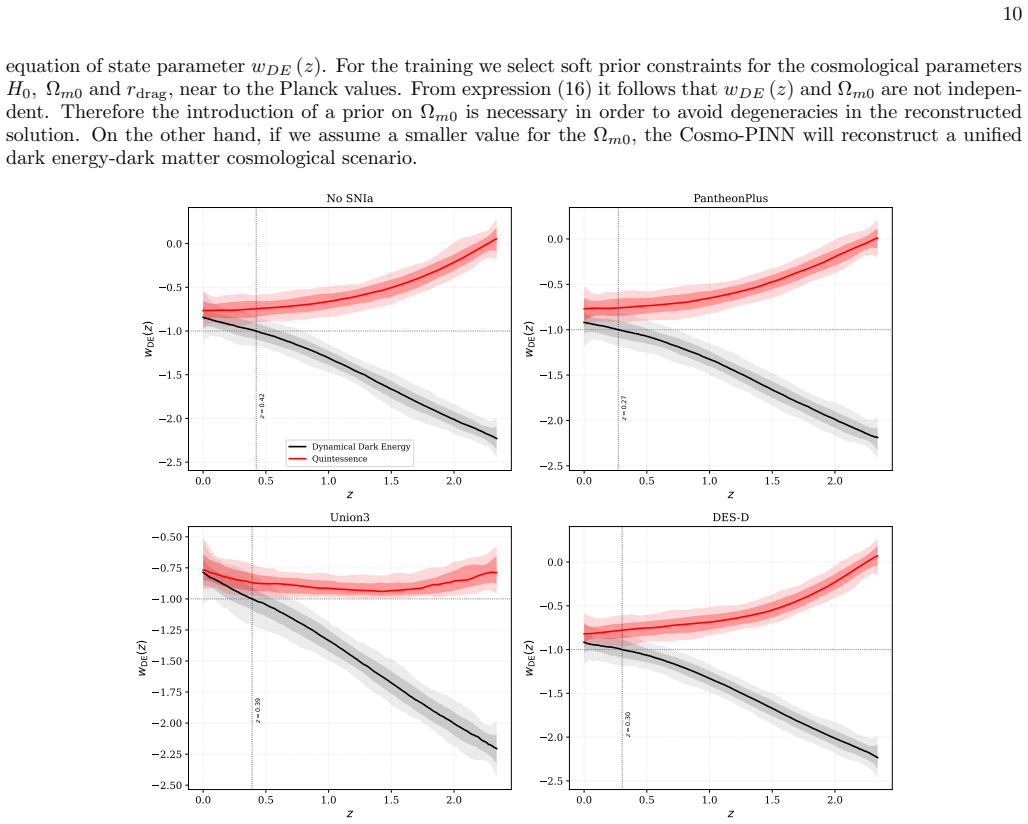
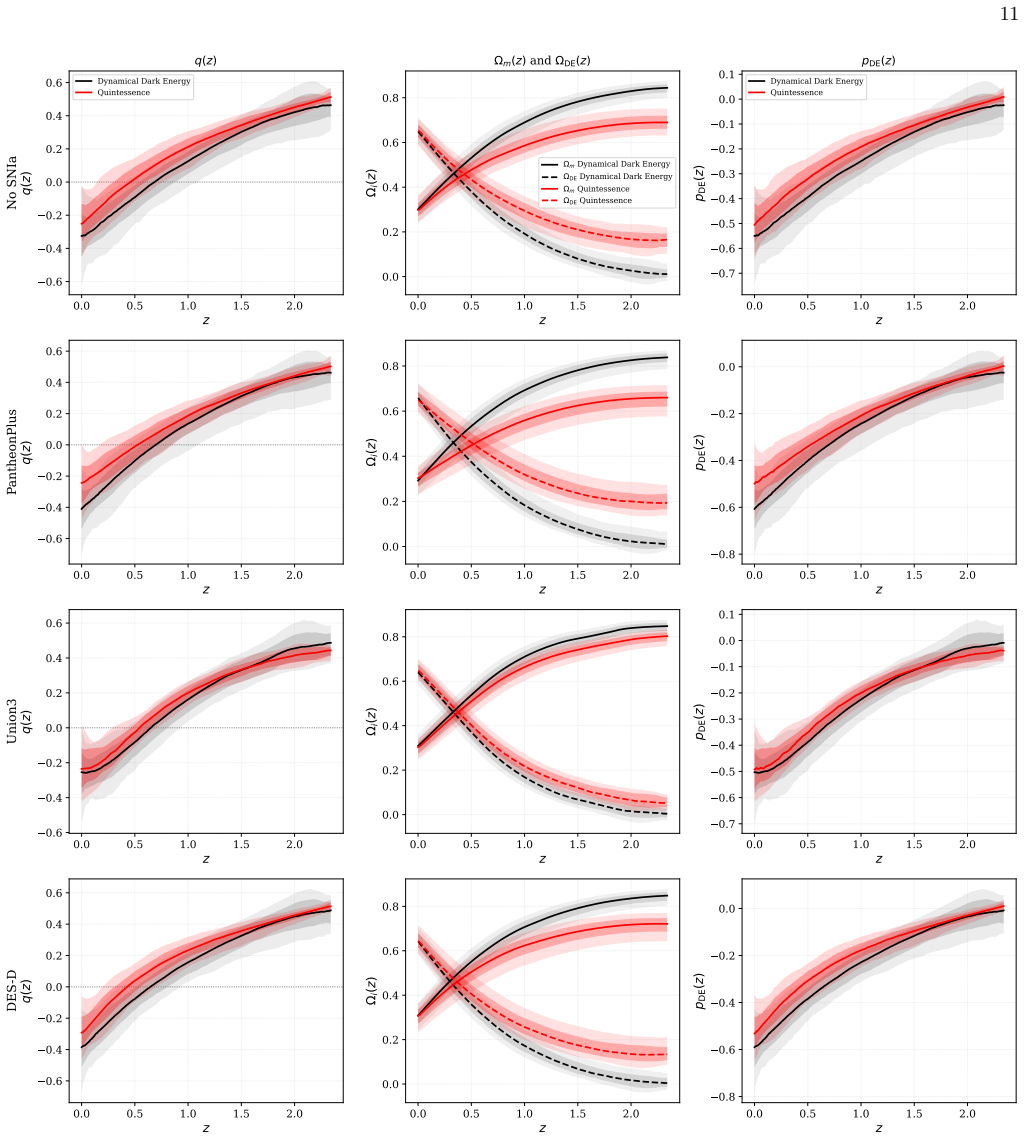
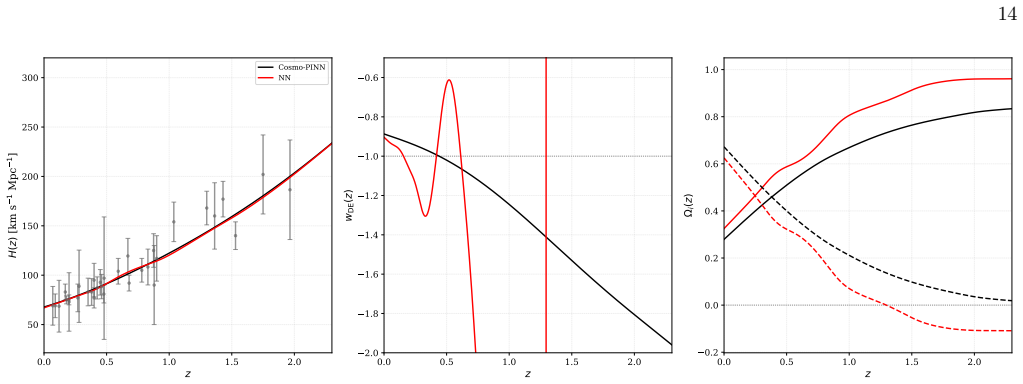
The Cosmo-PINN framework reconstructs w_DE(z) directly from late-time data by imposing the continuity and Friedmann equations as hard constraints in the loss function, yielding a function that crosses the phantom divide between z=0.27 and 0.42 in agreement with the Chevallier-Polarski-Linder parametrization, while in the quintessence case Omega_DE(z) approaches a nonzero pressureless contribution at large redshifts.
What carries the argument
Cosmo-PINN, a neural network whose loss function includes the Friedmann and continuity equations as hard constraints, allowing simultaneous training of the network weights and the parameters H0, Omega_m0, r_drag.
If this is right
- The reconstructed w_DE(z) satisfies the physical laws at every redshift during training.
- Comparison with a data-only network shows that the constraints change the recovered function.
- In the quintessence scenario the model suggests a unified dark sector at early times.
- The approach can be applied to other cosmological reconstructions beyond background data.
Where Pith is reading between the lines
- Embedding the equations this way may reduce the need for post-hoc checks on physical consistency.
- Simultaneous fitting of H0 and r_drag could help address tensions in those parameters if the data are consistent.
- Extending the network to include perturbation equations might allow reconstruction of growth functions as well.
Load-bearing premise
The cosmological equations can be imposed exactly as hard constraints in the loss without preventing the network from fitting the data or introducing systematic bias in the recovered functions.
What would settle it
If a reconstruction is produced that violates the Friedmann or continuity equation at some redshift when evaluated after training, the hard-constraint method has failed to enforce the physics.
Figures
read the original abstract
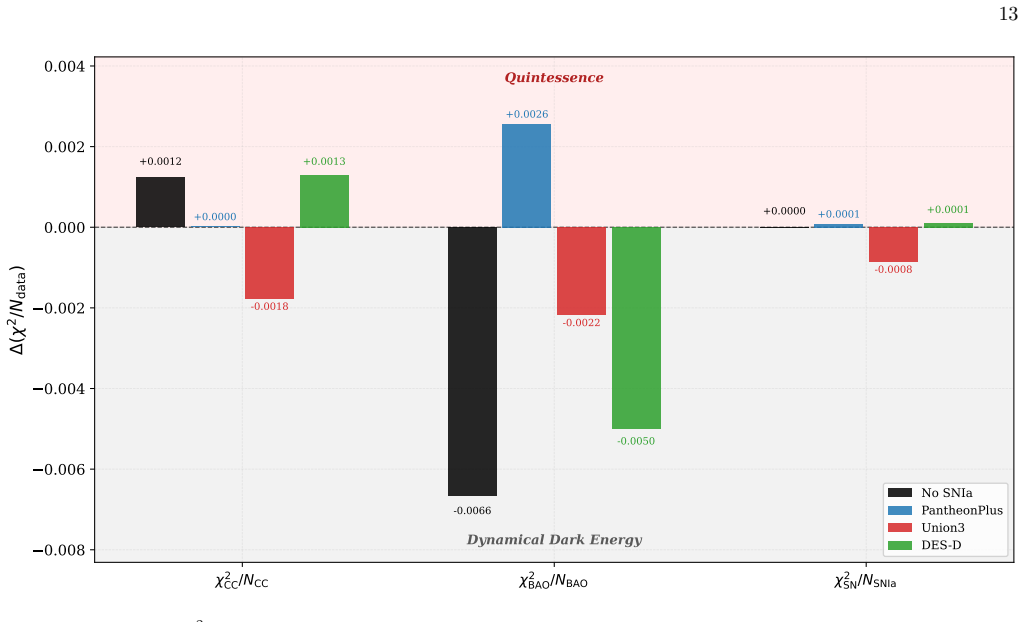
We introduce Cosmo-PINN, a Physics-Informed Neural Network for reconstruction of the cosmological theory. In this work we demonstrate the application of the Cosmo-PINN in the reconstruction of the dark energy equation of state parameter $w_{DE}\left( z\right) $ directly from late-time cosmological observations. This framework overcomes the main limitation shared by Gaussian Process and Artificial Neural Network reconstruction approaches, where the recovered solution is driven by the data and it is not necessarily true that it is physically consistent, by embedding the cosmological constraints directly into the loss function as hard constraints, ensuring that the reconstructed quantities satisfy the physical laws at every point during the training. For the training of the network, we employed background data, and specifically the Baryon Acoustic Oscillation from DESI DR2, the Cosmic Chronometers and three different Supernova compilations, while we simultaneously introduce the cosmological parameters $H_{0},~\Omega _{m0}$ and $r_{\mathrm{drag}}$ as trained parameters. The reconstruction shows that the trained $w_{DE}\left( z\right) $ crosses the phantom divide within the redshift range $z=0.27-0.42$ in agreement with the value obtained by the Chevallier-Polarski-Linder model. In the quintessence scenario, for large redshifts the dark energy $\Omega _{DE}\left( z\right) $ provides a pressureless nonzero contribution to the cosmological fluid suggesting a unified scenario. Finally, we demonstrate the significance of imposing the physical constraints within the loss function by comparing the Cosmo-PINN reconstruction against a purely data-driven neural network with the same architecture.
Editorial analysis
A structured set of objections, weighed in public.
Referee Report
Summary. The manuscript introduces Cosmo-PINN, a physics-informed neural network that embeds the Friedmann and continuity equations as hard constraints in the loss function to reconstruct w_DE(z) directly from late-time observations (DESI DR2 BAO, cosmic chronometers, and three SN compilations). It jointly optimizes the network weights together with the auxiliary parameters H0, Ω_m0, and r_drag. The central results are a phantom-divide crossing of w_DE(z) in the range z=0.27-0.42 (consistent with CPL) and, in the quintessence case, a nonzero pressureless Ω_DE contribution at high redshift suggestive of a unified scenario. A comparison to an unconstrained NN is presented to illustrate the effect of the physics terms.
Significance. If the hard-constraint implementation can be shown to drive physics residuals to near zero while preserving data fidelity and avoiding parameter absorption, the method would provide a reproducible route to physically consistent reconstructions that standard GP or NN approaches lack. The explicit comparison to a data-only network is a positive step toward falsifiability.
major comments (3)
- [§3] §3 (Methodology), loss-function definition: the manuscript states that cosmological constraints are imposed as 'hard constraints' but provides neither the explicit form of the physics residual terms, the value(s) of the weighting hyperparameter λ, nor the final L_physics norms after training. Without these quantities it is impossible to determine whether the reported phantom crossing is enforced by the DEs or remains an artifact of the network prior.
- [§4] §4 (Results), simultaneous training of r_drag: the BAO ratios depend on both the late-time expansion history and r_drag; fitting r_drag to the same late-time data used for w_DE(z) introduces a degeneracy that can trade changes in r_drag against changes in the reconstructed expansion rate. No ablation or fixed-r_drag control is reported to isolate the effect on the crossing redshift.
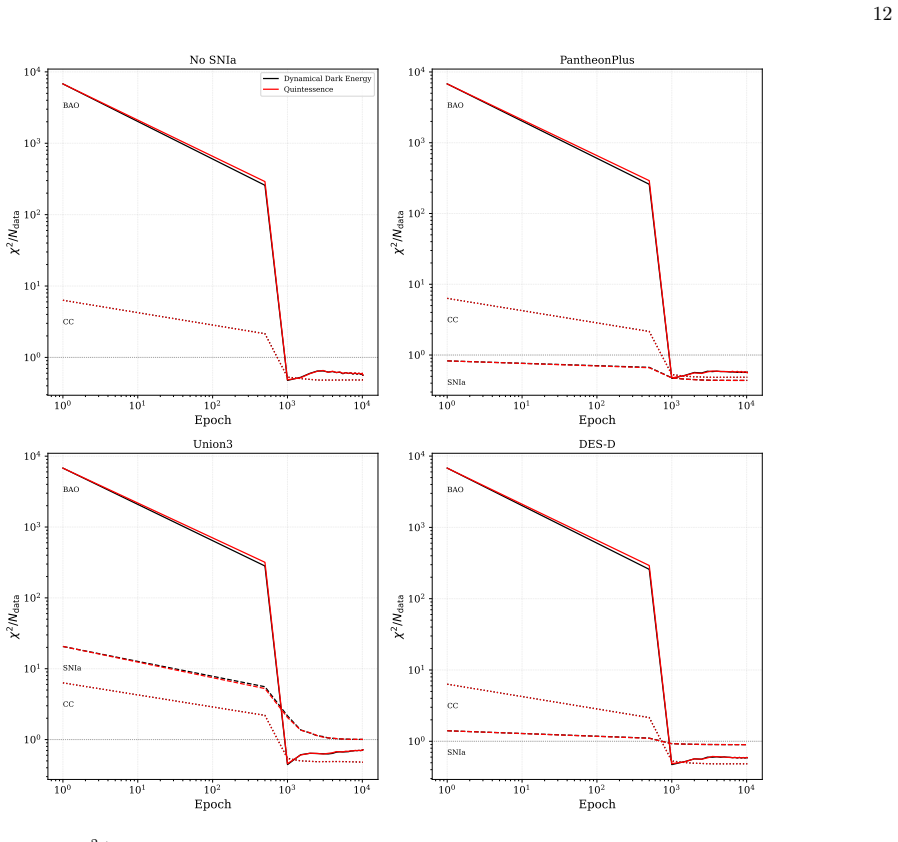
- [§4] §4, comparison to unconstrained NN: while the data-driven network is shown to differ, the manuscript supplies no quantitative error budgets, χ² values, or out-of-sample validation metrics for either model. Consequently the claim that the crossing redshift is robust to the choice of constraint enforcement cannot be assessed.
minor comments (2)
- Figure captions and axis labels should explicitly state the redshift range and the precise definition of the plotted quantities (e.g., whether w_DE is the network output or a derived quantity).
- The abstract and §1 cite three SN compilations but the text does not tabulate which compilations or the number of points from each; this information should be added for reproducibility.
Simulated Author's Rebuttal
We thank the referee for the constructive report and the opportunity to address these points. We respond to each major comment below, proposing revisions where the manuscript lacks necessary detail or controls.
read point-by-point responses
-
Referee: §3 (Methodology), loss-function definition: the manuscript states that cosmological constraints are imposed as 'hard constraints' but provides neither the explicit form of the physics residual terms, the value(s) of the weighting hyperparameter λ, nor the final L_physics norms after training. Without these quantities it is impossible to determine whether the reported phantom crossing is enforced by the DEs or remains an artifact of the network prior.
Authors: We agree that the explicit residual forms, λ value(s), and post-training L_physics norms are required for readers to verify constraint enforcement. The current manuscript describes the hard-constraint approach at a high level but omits these implementation details. We will revise §3 to include the precise mathematical expressions for the Friedmann and continuity residuals, the adopted λ, and the achieved L_physics values, allowing direct assessment of whether the phantom crossing arises from the data or the physics terms. revision: yes
-
Referee: §4 (Results), simultaneous training of r_drag: the BAO ratios depend on both the late-time expansion history and r_drag; fitting r_drag to the same late-time data used for w_DE(z) introduces a degeneracy that can trade changes in r_drag against changes in the reconstructed expansion rate. No ablation or fixed-r_drag control is reported to isolate the effect on the crossing redshift.
Authors: The potential degeneracy is a valid concern. Our joint optimization treats r_drag as a trainable parameter to remain consistent with the late-time data, but we did not report a fixed-r_drag control. We will add an ablation study in the revised §4 that fixes r_drag to the Planck value and recomputes the w_DE(z) reconstruction, explicitly comparing the phantom-crossing redshift to the joint-fit result. revision: yes
-
Referee: §4, comparison to unconstrained NN: while the data-driven network is shown to differ, the manuscript supplies no quantitative error budgets, χ² values, or out-of-sample validation metrics for either model. Consequently the claim that the crossing redshift is robust to the choice of constraint enforcement cannot be assessed.
Authors: We concur that quantitative metrics are needed to evaluate the comparison. The manuscript presents a qualitative difference between the two networks but lacks χ², error budgets, and validation statistics. We will supplement §4 with these quantities for both models, including χ² per degree of freedom and any available out-of-sample checks, to allow a rigorous assessment of robustness. revision: yes
Circularity Check
No significant circularity; reconstruction is a constrained optimization on external data.
full rationale
The paper trains a PINN whose loss combines data residuals from BAO/CC/SN observations with hard physics residuals from the Friedmann and continuity equations. Auxiliary parameters H0, Ωm0 and r_drag are optimized jointly with network weights. The reported w_DE(z) crossing at z=0.27-0.42 is an output of this joint minimization, not a quantity defined in terms of itself or statistically forced by a subset fit. No self-citation chain, uniqueness theorem, or ansatz smuggling is invoked to justify the central result. The comparison to a purely data-driven network further isolates the effect of the physics constraints. The procedure is a standard inverse-problem fit whose output is not equivalent to its inputs by construction.
Axiom & Free-Parameter Ledger
free parameters (3)
- H0
- Ω_m0
- r_drag
axioms (1)
- domain assumption Cosmological background equations (Friedmann and continuity) can be imposed as hard constraints inside the neural-network loss function.
Reference graph
Works this paper leans on
-
[1]
Physical law The full set of physical quantities is trained under the requirement of physical consistency. In order to guarantee the trained solution possesses the initial condition for the Hubble function we assume the expression H(x) =H 0 exp [x NH(x)], in which NH(x) = NX n=1 c(H) n Tn(2x−1),(17) is a Chebyshev polynomial expansion, and coefficientsc (...
-
[2]
Initial conditions As far as the baryons are concerned, we express them as Ω b(z) = ωb (1+z)3 H(z) 2 , whereω b is the value obtained by the Planck 2018 collaboration. On the other hand, regarding the free parametersH 0,Ω m0 andr drag we introduce them into the total loss via the expression LIC = λH0 2 HPINN 0 −H P lanck 0 σH0 2 + λΩm0 2 ΩPINN m0 −Ω P lan...
2018
-
[3]
Last but not least, in order to avoid unphysical oscillations related to overfitting, we introduce weak smoothness penaltiesL SP
Smoothness penalties and physical boundaries We introduce aL bounds component in the loss function, in order to impose strong boundary conditions on the trained functions such that the obtained solution satisfies Ωm ∈[0,1], or in the case of quintessence thew DE is within the rangew DE ∈[−1,1]. Last but not least, in order to avoid unphysical oscillations...
-
[4]
We consider the 31 model independent direct measurements of the Hubble parameter within the redshift range 0.09≤z≤1.965 [90]
Cosmic Chronometers Finally, we employ the cosmic chronometers, which are old galaxies, passively evolving with synchronous stellar populations and similar cosmic evolution [89]. We consider the 31 model independent direct measurements of the Hubble parameter within the redshift range 0.09≤z≤1.965 [90]. The Hubble function is trained by the PINN and theχ ...
-
[5]
Baryon Acoustic Oscillations We consider the recent BAO DESI DR2 catalogue [91, 92]. This dataset consists of 13 measurements from DESI DR2 at seven redshifts with the rangez∈[0.295,2.33],of the Hubble distance ratio the comoving angular distance ratio and the volume-averaged distance ratio, each normalized by the sound horizon at the baryon drag epochr d...
-
[6]
The catalogues provide measure- ments of the distance modulusµ obs i as a function of redshiftz i
Type Ia Supernovae We make use of three different (SNIa) compilations, the PantheonPlus (PP) catalogue without the SH0ES Cepheid calibration [93], the Union3.0 (U3) [94] and the recent DES-Dovekie (DESD) [95]. The catalogues provide measure- ments of the distance modulusµ obs i as a function of redshiftz i. The U3 and PP catalogues provide events within t...
-
[7]
For 1 NData χ2 Data << γ 2, theL DATA ≃ 1 NData χ2 Data
Data Loss function The component of the loss function related to the training given by the cosmological data is defined as LDATA =λ CC LCC +λ BAO LBAO +λ SN LSN,(28) whereλare the data weights, the loss function related to the CC is defined as LCC = 1 NCC χ2 CC,(29) 7 and for the loss functionL BAO,L SN we introduce a logarithmic cap, that is, LBAO =γ 2 l...
2000
-
[8]
First, we perform training runs with different sets of initial conditions to verify whether the PINN converges to a consistent solution
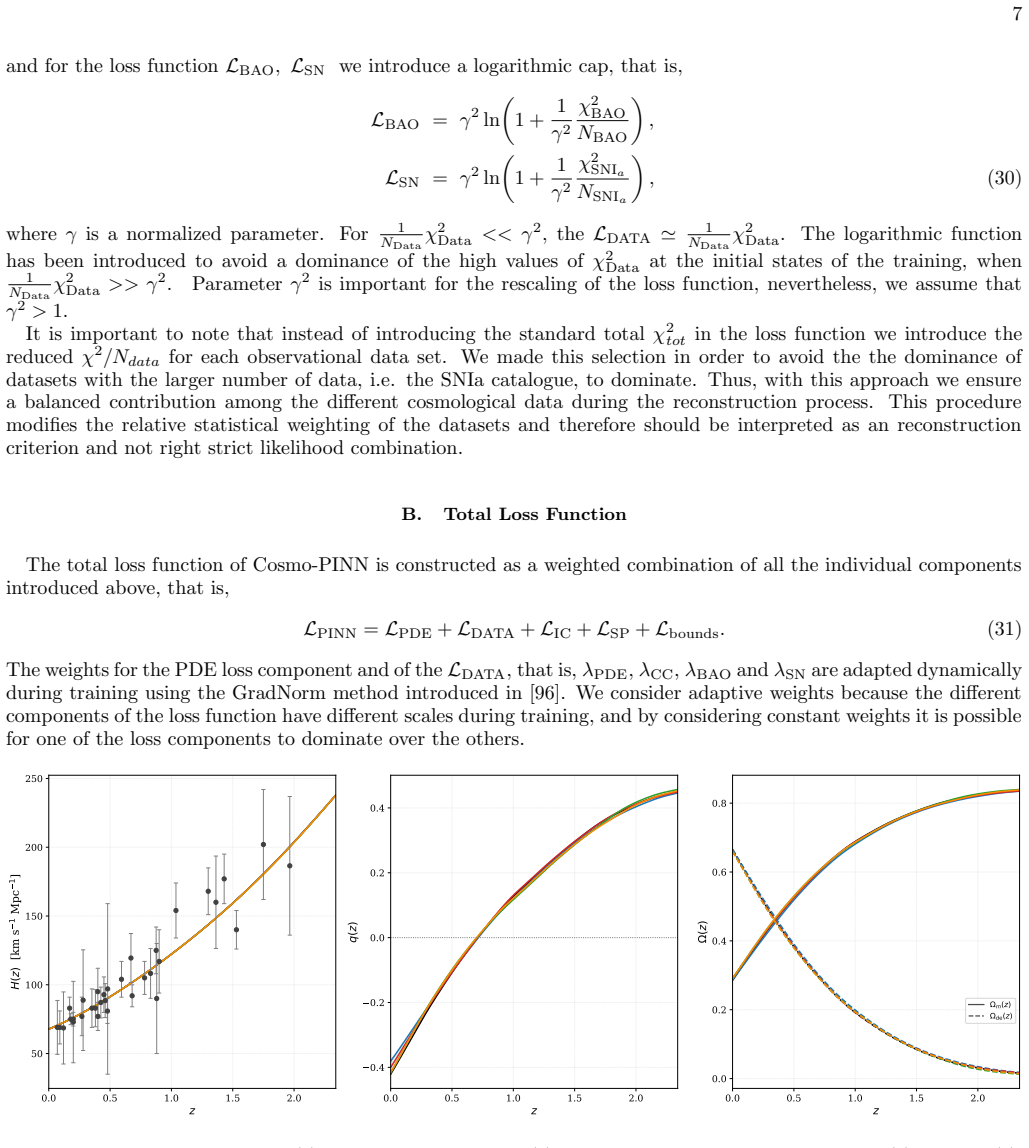
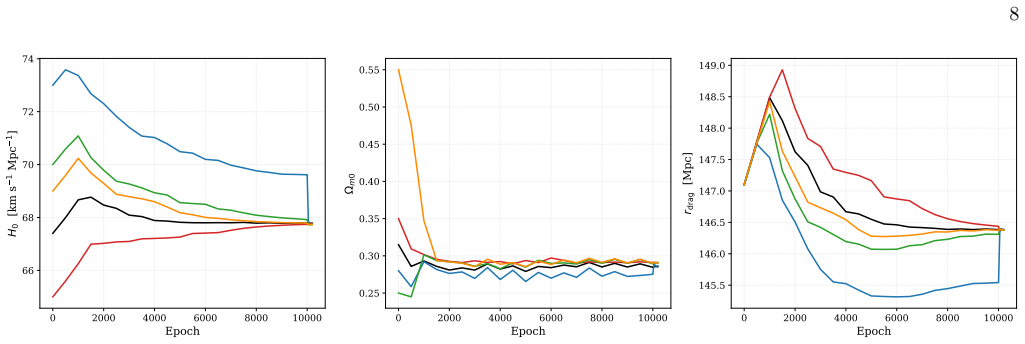
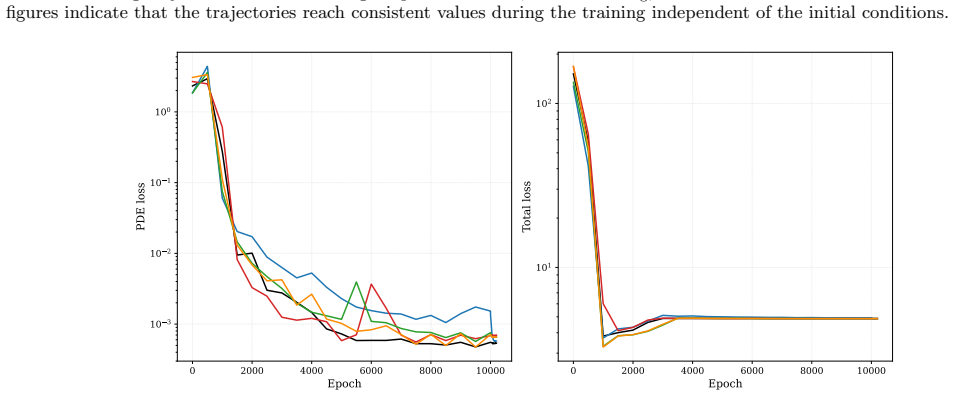
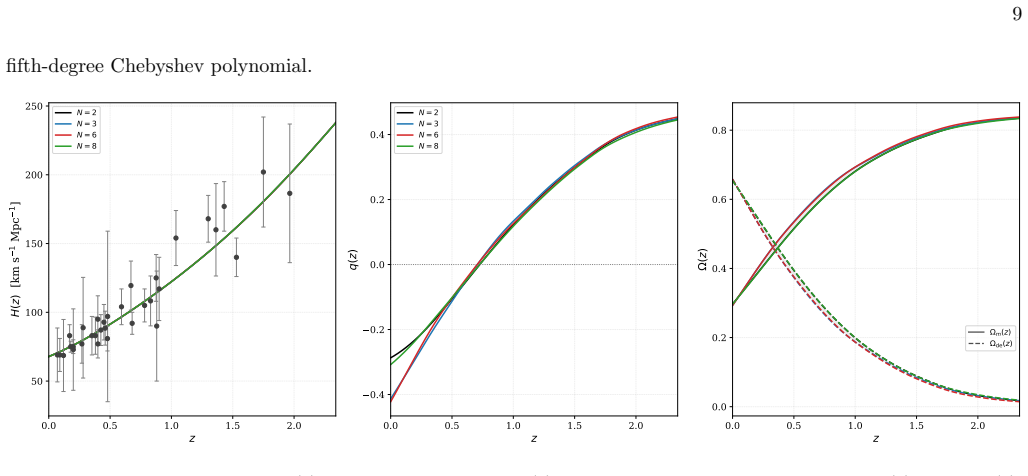
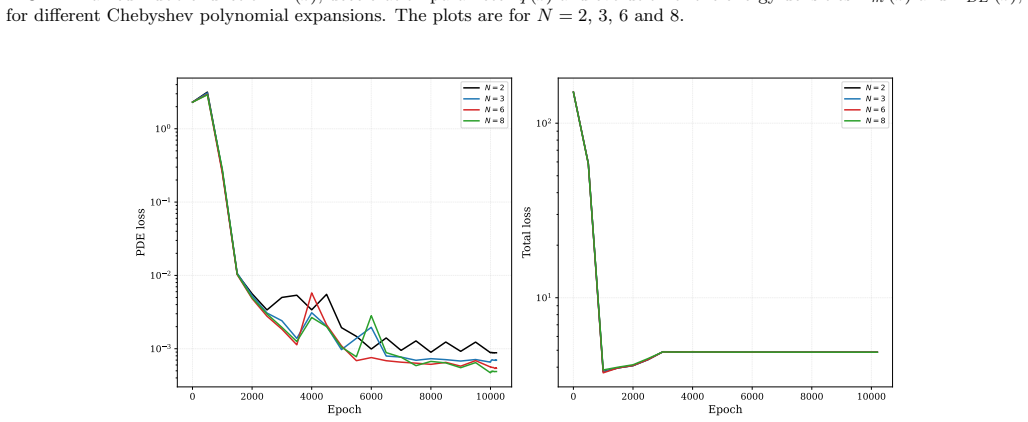
Stability and Robustness Tests Before we proceed with the reconstruction of the dark energy equation of state parameterw DE (z) we present two tests to assess the viability of the Cosmo-PINN. First, we perform training runs with different sets of initial conditions to verify whether the PINN converges to a consistent solution. Second, we train the network...
2000
-
[9]
Riess et al., Astron
A.G. Riess et al., Astron. J. 116, 1009 (1998)
1998
-
[10]
Tegmark et al., Astrophys
M. Tegmark et al., Astrophys. J. 606, 702 (2004)
2004
-
[11]
Kowalski et al., Astrophys
M. Kowalski et al., Astrophys. J. 686, 749 (2008)
2008
-
[12]
Komatsu et al., Astrophys
E. Komatsu et al., Astrophys. J. Suppl. Ser. 180, 330 (2009)
2009
-
[13]
Suzuki et al., Astrophys
N. Suzuki et al., Astrophys. J. 746, 85 (2012)
2012
-
[15]
Gutierrez, Nucl
G. Gutierrez, Nucl. Part. Phys. Proceedings, 267, 332 (2015)
2015
-
[16]
Di Valentino et al., Atropharticle Physics 131, 102605 (2021)
E. Di Valentino et al., Atropharticle Physics 131, 102605 (2021)
2021
-
[17]
Weinberg, Rev
S. Weinberg, Rev. Mod. Phys. 61, 1 (1989)
1989
-
[18]
Padmanabhan, Phys
T. Padmanabhan, Phys. Rept. 380, 235 (2003)
2003
-
[19]
Six Puzzles for LCDM Cosmology
L. Perivolaropoulos, (2008) arXiv.0811.4684
work page internal anchor Pith review Pith/arXiv arXiv 2008
-
[20]
Di Valentino et al
E. Di Valentino et al. [CosmoVerse Network], Phys. Dark Univ. 49, 101965 (2025)
2025
-
[21]
Gorini, A
V. Gorini, A. Kamenshchik and U. Moschella, Phys. Rev. D 67, 063509 (2003)
2003
-
[22]
Valiviita, E
J. Valiviita, E. Majerotto, and R. Maartens, JCAP 07, 020 (2008)
2008
-
[23]
B. Wang, E. Abdalla, F. Atrio-Barandela, and D. Pavon, Rept. Prog. Phys. 79, 096901 (2016)
2016
-
[24]
Paliathanasis, Phys
A. Paliathanasis, Phys. Dark Univ. 52, 102306 (2026)
2026
-
[25]
Ratra and P.J.E
B. Ratra and P.J.E. Peebles, Phys. Rev. D 37, 3406 (1988)
1988
-
[26]
Peebles and B
P.J.E. Peebles and B. Ratra, Rev. Mod. Phys. 75, 559 (2003)
2003
-
[27]
Ludwick, Mod
K.J. Ludwick, Mod. Phys. Lett. A 32, 28 (2017)
2017
-
[28]
V´ azquez, D
J.A. V´ azquez, D. Tamayo, G. Garcia-Arroyo, I. G´ omez-Vargas, I. Quiros, A.A. Sen, Phys. Rev. D 109, 023511 (2024)
2024
-
[29]
Shajib and J.A
A.J. Shajib and J.A. Frieman, Phys. Rev. D 112, 063508 (2025)
2025
-
[30]
van de Bruck, G
C. van de Bruck, G. Poulot and E.M. Teixeira, JCAP 07, 019 (2023)
2023
-
[31]
A. Paliathanasis, T. Mengoni, G. Leon and O. Luongo, Constraints on Chiral-Quintom dark energy after DESI DR2 and impact on unifying dark energy with inflation, (2025) [arXiv:2512.00558]
-
[32]
Deffayet, X
C. Deffayet, X. Gao, D.A. Steer and G. Zahariade, Phys. Rev. D 84, 064039 (2011)
2011
-
[33]
Faraoni, Cosmology in Scalar-Tensor Gravity, Springer Dordrecht (2004)
V. Faraoni, Cosmology in Scalar-Tensor Gravity, Springer Dordrecht (2004)
2004
-
[34]
Kase and S
R. Kase and S. Tsujikawa, Int. J. Mod. Phys. D 28, 1942005 (2019)
2019
-
[35]
Buchdahl, Mon
H.A. Buchdahl, Mon. Not. Roy. Astron. Soc. 150, 1 (1970)
1970
-
[36]
Ferraro and F
R. Ferraro and F. Fiorini, Phys. Rev. D 75, 084031 (2007)
2007
-
[37]
Heisenberg, Physics Rept
L. Heisenberg, Physics Rept. 1066, 1 (2024)
2024
-
[38]
Clifton, P.G
T. Clifton, P.G. Ferreira, A. Padilla and C. Skordis, Phys. Rept. 513, 1 (2012)
2012
-
[39]
Nojiri, S.D
S. Nojiri, S.D. Odintsov and V.K. Oikonomou, Phys.Rept. 692, 1 (2017)
2017
-
[40]
Joyce, L
A. Joyce, L. Lombriser and F. Schmidt, Annu. Rev. Nucl. Part. Sci. 66, 122 (2016)
2016
-
[41]
Yoo and Y
J. Yoo and Y. Watanabe, Int. J. Mod. Phys. D 21, 1230002 (2012)
2012
-
[42]
Nojiri, S.D
S. Nojiri, S.D. Odintsov and M. Sasaki, Phys. Rev. D 71, 123509 (2005)
2005
-
[43]
Saridakis, Phys
E.N. Saridakis, Phys. Rev. D 102, 123525 (2020)
2020
-
[44]
Basilakos, A
S. Basilakos, A. Lymperis, M. Petronikopoulou and E.N. Saridakis, Nucl. Phys. B 1015, 116904 (2025)
2025
-
[45]
Sahlu, A
S. Sahlu, A. de la Cruz-Dombriz and A. Abebe, MNRAS 539, 690 (2025)
2025
-
[46]
Paliathanasis, JHEAp 52, 100609 (2026)
A. Paliathanasis, JHEAp 52, 100609 (2026)
2026
-
[47]
Paliathanasis, Phys
A. Paliathanasis, Phys. Dark Univ. 52, 102337 (2026)
2026
-
[48]
Shafiello, V
A. Shafiello, V. Sahni and A. Starobinsky, Annalen Phys. 19, 316 (2010)
2010
-
[49]
Giare, M
W. Giare, M. Najadi, S. Pan, E. Di Valentino and J.T. Firouzjaee, JCAP 10, 035 (2024)
2024
-
[50]
Chevaller and D
M. Chevaller and D. Polarski, Int. J. Mod. Phys. D 10, 213 (2001)
2001
-
[51]
Linder, Phys
E.V. Linder, Phys. Rev. Lett. 90, 091301 (2003)
2003
-
[52]
Rezaei, M
M. Rezaei, M. Malekjani, S. Basilakos, A. Mehrabi, and D. F. Mota, Astrophys. J. 843, 65 (2017)
2017
-
[53]
L. Xing, J. Chen, Y. Gui, E. Schlegel and J. Lu, Mod. Phys. Lett. A 26, 885 (2011) 16
2011
-
[54]
Barboza Jr
E.M. Barboza Jr. and J.S. Alcaniz, Phys. Lett. B 666, 415 (2008)
2008
-
[55]
Dimakis, A
N. Dimakis, A. Karagiorgos, A. Zampeli, A. Paliathanasis, T. Christodoulakis and Petros A. Terzis, Phys. Rev. D 93, 123518 (2016)
2016
-
[56]
Linder, Astropart
E.V. Linder, Astropart. Phys. 25, 167 (2006)
2006
-
[57]
Tripathi, A
A. Tripathi, A. Sangwan and H.K. Jassal, JCAP 06, 012 (2017)
2017
-
[58]
Escamilla, S
L.A. Escamilla, S. Pan, E. Di Valentino, A. Paliathanasis and J.A. Vazquez, Phys. Rev. D 111, 2 (2025)
2025
-
[59]
Paliathanasis, Phys
A. Paliathanasis, Phys. Dark Univ. 48, 101956 (2025)
2025
-
[61]
Shafieloo, A.G
A. Shafieloo, A.G. Kim and E.V Linder, Phys. Rev. 85, 123530 (2012)
2012
-
[62]
Seikel, C
M. Seikel, C. Clarkson and M. Smith, JCAP 06, 036 (2012)
2012
-
[63]
Yang, Z.-K
T. Yang, Z.-K. Guo and R.-G. Cai, Phys. Rev. D 91, 123533 (2015)
2015
-
[64]
Zhang and J.-Q
M.-J. Zhang and J.-Q. Xia, JCAP 12, 005 (2016)
2016
-
[65]
Jesus, R
J.F. Jesus, R. Valentim, A.A. Escobal and S.H. Pereira, JCAP 04, 053 (2020)
2020
-
[66]
Yennapureddy and F
M.K. Yennapureddy and F. Melia, EPJC 78, 258 (2018)
2018
-
[67]
Bernado and J.L
R.C. Bernado and J.L. Said, JCAP 09, 014 (2021)
2021
-
[68]
Y.-F. Cai, M. Khurshudyan and E.N. Saridakis, Asrtroph. J. 888, 62 (2020)
2020
-
[69]
Ren, S.-F
X. Ren, S.-F. Yan, Y. Zhao, Y.-F. Cai and E.N. Saridakis, Astrophys. J. 932, 131 (2022)
2022
-
[70]
Y. Mu, B. Chang and L. Xu, JCAP 09, 041 (2023)
2023
-
[71]
Wang and X.-H
D. Wang and X.-H. Meng, Phys. Rev. D 95, 023508 (2017)
2017
-
[72]
Dhawan, J
S. Dhawan, J. Alsing and S. Vagnozzi, MNRAS 506, L1 (2021)
2021
-
[73]
Zhang and H
M.-J. Zhang and H. Li, EPJC 78, 460 (2018)
2018
-
[74]
Johnson and H.K
J.P. Johnson and H.K. Jassal, EPJC 85, 996 (2025)
2025
-
[75]
Reconstruction of the Quintessence Scalar Field Potential Using Gaussian Processes
R. El Ouardi, A. Bouali, A. Errahmani, R.E. Keely, A. Shafieloo and T. Ouali, (2026) [arXiv:2604.04056]
work page internal anchor Pith review Pith/arXiv arXiv 2026
-
[76]
Wang, X.-J
G.-J. Wang, X.-J. Ma, S.-Y. Li and J.-Q. Xia, ApJS 246, 13 (2020)
2020
-
[77]
Zhang, Y
J.-C. Zhang, Y. Hu, K. Jiao, H.-F. Wang, Y.-B. Xie, B. Yu, L.-L. Zhao and T.-J. Zhang, ApJS 270, 23 (2024)
2024
-
[78]
Gomez-Vargas, R
I. Gomez-Vargas, R. Medel-Esquivel, R. Gacia-Salcedo and J.A. Vazquez, EPJC 83, 304 (2023)
2023
-
[79]
Dialektopoulos, P
K.F. Dialektopoulos, P. Mukherjee, J.L. Said and J. Mifsud, EPJC 83, 956 (2023)
2023
-
[80]
Dialektopoulos, P
K.F. Dialektopoulos, P. Mukherjee, J.L. Said and J. Mifsud, Physics Dark Universe 43, 101383 (2024)
2024
-
[81]
Mukherjee, M.G
P. Mukherjee, M.G. Dainotti, K.F. Dialektopoulos, J.L. Said and J. Mifsud, JHEAp 49, 100439 (2026)
2026
-
[82]
Mukherjee, K.F
P. Mukherjee, K.F. Dialektopoulos, J.L. Said and J. Mifsud, JCAP 09, 060 (2024)
2024
discussion (0)
Sign in with ORCID, Apple, or X to comment. Anyone can read and Pith papers without signing in.