End-to-End Molecular Dynamics with a Langevin Thermostat on Quantum Circuits
Pith reviewed 2026-06-29 07:15 UTC · model grok-4.3
The pith
Quantum circuits encode Langevin relaxation to prepare canonical nuclear states and read out molecular properties.
A machine-rendered reading of the paper's core claim, the machinery that carries it, and where it could break.
Core claim
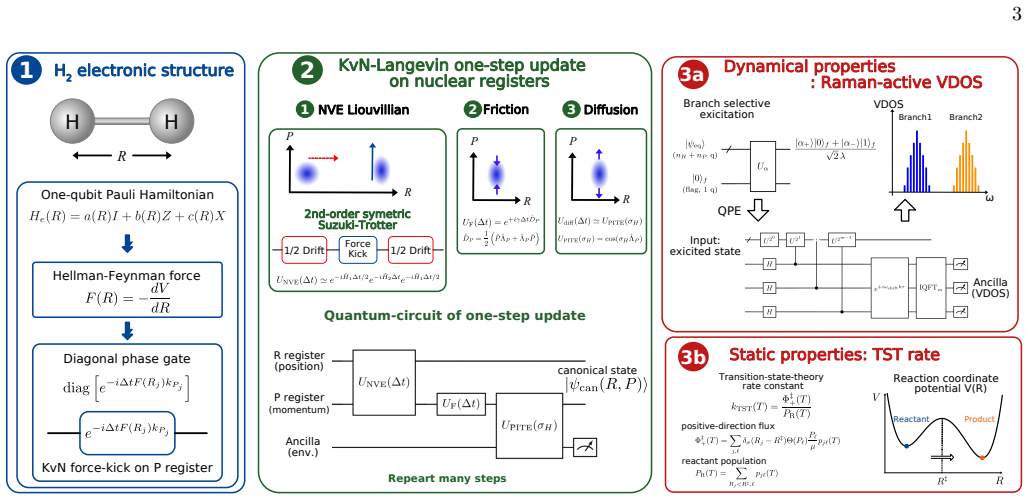
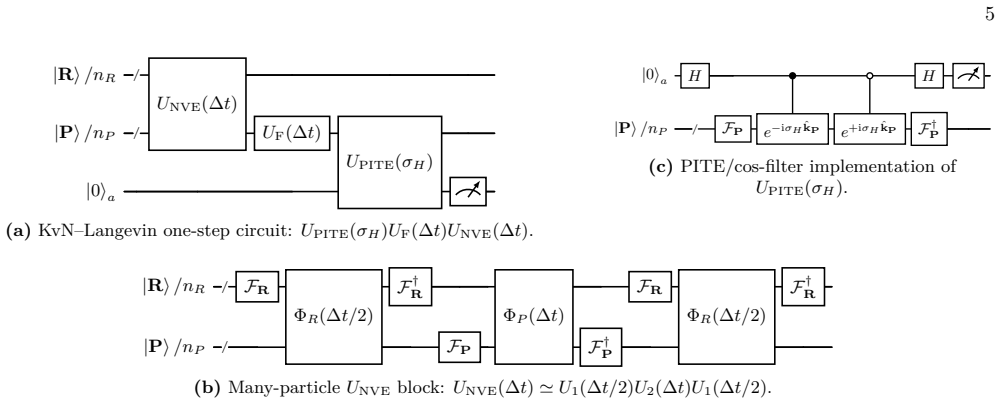
The central claim is that finite-temperature molecular dynamics in the canonical ensemble can be performed end-to-end on quantum circuits by decomposing the Langevin Fokker-Planck operator into Liouville flow, symmetrized momentum dilation for friction, and a corrected PITE cosine filter for diffusion, thereby connecting canonical state preparation directly to physical-property extraction without intermediate classical sampling.
What carries the argument
Decomposition of the Langevin Fokker-Planck operator into three independent circuit blocks, with the diffusion block implemented as a PITE-realized cosine filter whose temperature bias is removed by an internal-temperature adjustment.
If this is right
- A nonequilibrium phase-space distribution relaxes to the canonical KvN state under the circuit dynamics.
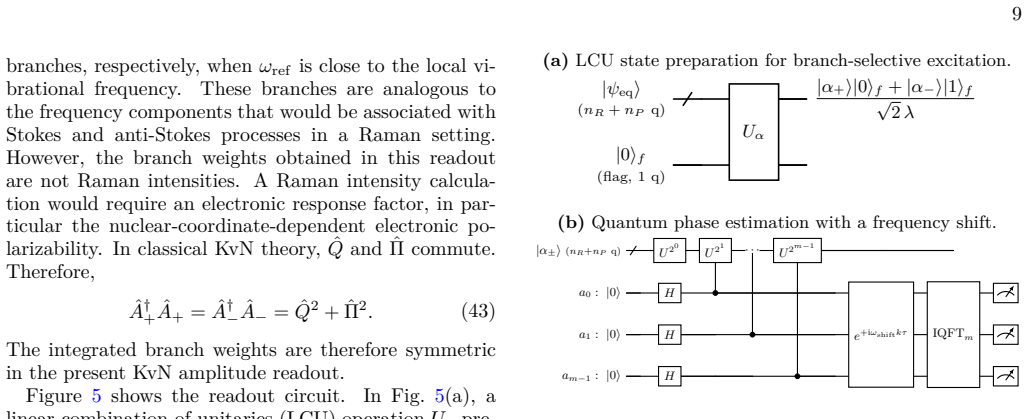
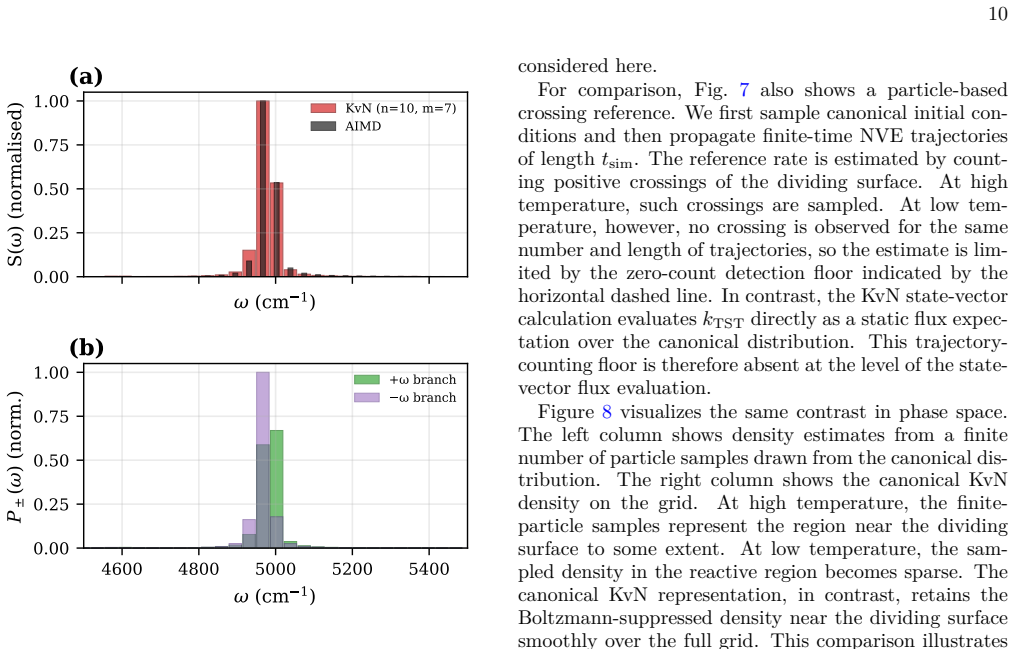
- Vibrational density of states for the H-H stretch can be obtained from dynamical quantum-phase estimation on the equilibrated state.
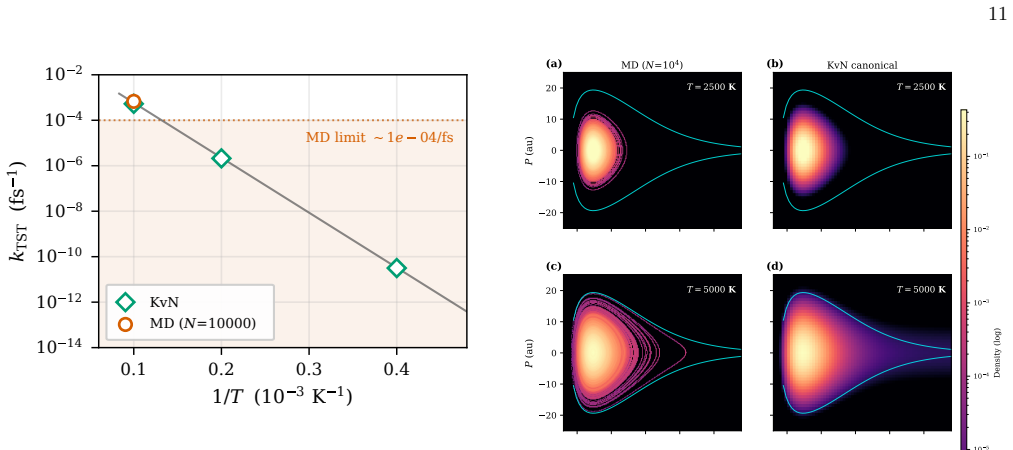
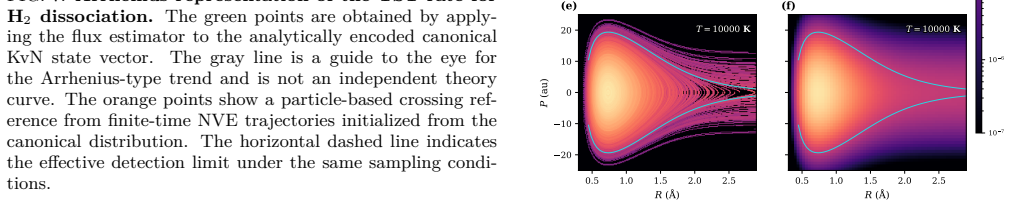
- The transition-state-theory rate constant can be evaluated directly from the canonical state without additional sampling.
- The same state-preparation and readout pipeline works for any molecular potential that can be encoded in the Hamiltonian block.
Where Pith is reading between the lines
- The protocol could be combined with existing quantum-chemistry oracles to treat larger molecules once circuit resources permit.
- The temperature-correction technique may generalize to other approximate diffusion operators used in quantum simulation of stochastic dynamics.
- If the circuit depth remains modest, the method offers a route to hybrid quantum-classical MD in regimes where classical thermostatted trajectories become costly.
Load-bearing premise
The leading temperature bias introduced by the cosine filter can be calculated exactly and removed by a one-time shift in the internal temperature parameter so that the steady-state distribution matches the physical canonical ensemble.
What would settle it
Implement the full protocol on actual quantum hardware for H2, extract the vibrational density of states or TST rate from the prepared canonical state, and compare the numerical values against independent classical Langevin or path-integral Monte Carlo results for the same potential and temperature.
Figures
read the original abstract
We construct a quantum-circuit framework for finite-temperature molecular dynamics in the canonical ensemble (NVT) with a Langevin thermostat, connecting canonical state preparation to subsequent physical-property readouts. The classical nuclear phase-space distribution is encoded as a Koopman--von Neumann (KvN) wave function, and canonical state preparation is formulated as Langevin-type Fokker--Planck relaxation. The Hamiltonian Liouville flow, momentum friction, and momentum diffusion are decomposed into separate circuit blocks. The friction block is represented by a symmetrized momentum-space dilation, whereas the diffusion block is implemented as a cosine filter realized by probabilistic imaginary-time evolution (PITE). We analytically quantify the leading-order temperature bias caused by replacing the Gaussian diffusion kernel with this PITE-realized cosine filter. This analysis yields an internal-temperature correction that targets the desired physical equilibrium distribution. As a proof-of-concept demonstration connecting quantum chemistry to KvN nuclear dynamics, we study the H$_2$ molecule. Numerical simulations show relaxation from a nonequilibrium phase-space distribution to a canonical KvN state. From this canonical state, we demonstrate two complementary readouts: a dynamical quantum-phase-estimation readout of the vibrational density of states associated with the H--H stretch coordinate and a static canonical evaluation of the transition-state-theory (TST) rate constant. This work demonstrates, in a minimal molecular system, a circuit-level protocol that connects Langevin canonical state preparation to physical-property calculations, providing a concrete step toward quantum--classical hybrid molecular dynamics on quantum computers.
Editorial analysis
A structured set of objections, weighed in public.
Referee Report
Summary. The paper constructs a quantum-circuit framework for finite-temperature molecular dynamics in the canonical (NVT) ensemble using a Langevin thermostat. Classical nuclear phase space is encoded as a Koopman-von Neumann wave function; the dynamics are decomposed into circuit blocks for Liouville flow, friction (symmetrized momentum dilation), and diffusion (PITE cosine filter). A leading-order analytic correction for the temperature bias induced by the cosine filter is derived and applied via an internal-temperature adjustment. A proof-of-concept on H2 demonstrates relaxation from a nonequilibrium distribution to a canonical KvN state, followed by readouts of the vibrational density of states (via dynamical quantum phase estimation) and the TST rate constant.
Significance. If the analytic bias correction is shown to restore the target canonical distribution to within controllable error, the work would provide a concrete end-to-end protocol linking quantum-chemistry state preparation to finite-temperature nuclear dynamics and observable extraction on quantum hardware. The decomposition into reusable circuit blocks and the explicit analytic treatment of the leading bias term are positive features that could support reproducibility.
major comments (2)
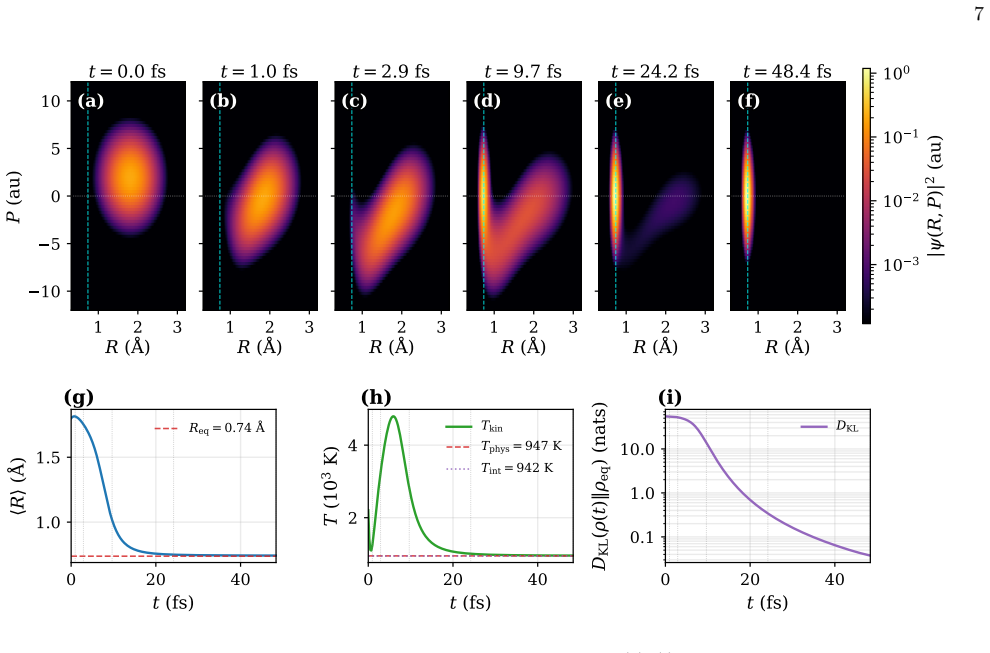
- [Abstract / proof-of-concept demonstration] The central claim that the internal-temperature adjustment restores the exact target canonical KvN equilibrium distribution rests on the analytic leading-order bias derivation. However, the H2 proof-of-concept reports relaxation but supplies neither a quantitative metric (e.g., Kullback-Leibler divergence or moment errors) comparing the final distribution to the corrected canonical target nor a comparison against an exact classical Langevin reference. This verification step is load-bearing for the NVT ensemble assertion.
- [Analytic bias derivation and H2 numerics] The diffusion block replaces the exact Gaussian kernel with a PITE cosine filter; the manuscript states that higher-order bias terms are negligible after the leading-order correction. No explicit bound or numerical test is provided showing that residual discretization or higher-order effects in the KvN encoding remain small enough not to distort the equilibrium distribution at the simulated times.
minor comments (2)
- Full circuit diagrams for the friction and diffusion blocks, together with gate counts and depth, are not shown; these would clarify the resource requirements of the decomposed blocks.
- [proof-of-concept demonstration] Numerical results for the H2 demonstration lack reported error bars or convergence checks with respect to Trotter steps or PITE shots.
Simulated Author's Rebuttal
We thank the referee for their careful reading and constructive comments on our manuscript. We address the major comments point by point below and will revise the manuscript to incorporate additional verification as requested.
read point-by-point responses
-
Referee: [Abstract / proof-of-concept demonstration] The central claim that the internal-temperature adjustment restores the exact target canonical KvN equilibrium distribution rests on the analytic leading-order bias derivation. However, the H2 proof-of-concept reports relaxation but supplies neither a quantitative metric (e.g., Kullback-Leibler divergence or moment errors) comparing the final distribution to the corrected canonical target nor a comparison against an exact classical Langevin reference. This verification step is load-bearing for the NVT ensemble assertion.
Authors: We agree that quantitative verification is essential to support the central claim. In the revised manuscript we will add explicit metrics, including Kullback-Leibler divergence and errors in the first few moments, between the final simulated KvN distribution and the analytically corrected canonical target. We will also include a side-by-side comparison of the H2 relaxation trajectory against an independent classical Langevin integrator run at the same parameters. These additions will be placed in the results section and referenced from the abstract. revision: yes
-
Referee: [Analytic bias derivation and H2 numerics] The diffusion block replaces the exact Gaussian kernel with a PITE cosine filter; the manuscript states that higher-order bias terms are negligible after the leading-order correction. No explicit bound or numerical test is provided showing that residual discretization or higher-order effects in the KvN encoding remain small enough not to distort the equilibrium distribution at the simulated times.
Authors: We acknowledge the need for a quantitative bound on residual terms. The revised manuscript will contain an explicit analytic estimate of the leading higher-order bias contributions from both the cosine-filter approximation and the finite-resolution KvN encoding. In addition, we will report numerical convergence tests performed at the H2 simulation times, confirming that the combined residual error remains below a stated threshold (e.g., 1 % relative deviation in the equilibrium temperature and distribution moments). revision: yes
Circularity Check
Analytical bias correction derived independently; no load-bearing reduction to self-fit or self-citation.
full rationale
The abstract describes an explicit analytical derivation of the leading-order temperature bias induced by the PITE cosine filter, followed by an internal-temperature adjustment to restore the target equilibrium distribution. This step is presented as a first-principles calculation rather than a parameter fit or renaming. No evidence appears of self-definitional loops, fitted inputs relabeled as predictions, or load-bearing self-citations that would force the canonical ensemble property. The KvN encoding, circuit decomposition, and readout protocols are constructed from standard blocks without circular reduction. A score of 2 reflects only the normal presence of self-citations in any research paper, none of which are shown to be the sole justification for the central claims.
Axiom & Free-Parameter Ledger
axioms (2)
- domain assumption Koopman-von Neumann formalism maps classical nuclear phase-space distributions to quantum wave functions
- domain assumption Langevin dynamics decomposes into independent Hamiltonian Liouville flow, momentum friction, and momentum diffusion operators
Reference graph
Works this paper leans on
-
[1]
Google Quantum AI and Collaborators, Nature 638, 920 (2025)
2025
-
[2]
Bluvstein et al
D. Bluvstein et al. , Nature 626, 58 (2024)
2024
-
[3]
Sales Rodriguez et al
P. Sales Rodriguez et al. , Nature 645, 620 (2025)
2025
-
[4]
Helios: A 98-qubit trapped-ion quantum computer
A. Ransford et al. , arXiv preprint arXiv:2511.05465 (2025), arXiv:2511.05465 [quant-ph]
work page internal anchor Pith review Pith/arXiv arXiv 2025
-
[5]
Montanaro, npj Quantum Inf
A. Montanaro, npj Quantum Inf. 2, 15023 (2016)
2016
-
[6]
McArdle, S
S. McArdle, S. Endo, A. Aspuru-Guzik, S. C. Benjamin, and X. Yuan, Rev. Mod. Phys. 92, 015003 (2020)
2020
-
[7]
Aspuru-Guzik, A
A. Aspuru-Guzik, A. D. Dutoi, P. J. Love, and M. Head- Gordon, Science 309, 1704 (2005)
2005
-
[8]
Car and M
R. Car and M. Parrinello, Phys. Rev. Lett. 55, 2471 (1985)
1985
-
[9]
Marx and J
D. Marx and J. Hutter, Ab Initio Molecular Dynamics: Basic Theory and Advanced Methods (Cambridge Uni- versity Press, Cambridge, 2009)
2009
-
[10]
M. E. Tuckerman, Statistical Mechanics: Theory and Molecular Simulation (Oxford University Press, 2023)
2023
-
[11]
D. A. Fedorov, M. J. Otten, S. K. Gray, and Y. Alexeev, J. Chem. Phys. 154, 164103 (2021)
2021
-
[12]
Dononelli, arXiv preprint arXiv:2602.02695 (2026), arXiv:2602.02695 [quant-ph]
W. Dononelli, arXiv preprint arXiv:2602.02695 (2026), arXiv:2602.02695 [quant-ph]
-
[13]
Kassal, S
I. Kassal, S. P. Jordan, P. J. Love, M. Mohseni, and A. Aspuru-Guzik, Proc. Natl. Acad. Sci. USA 105, 18681 (2008)
2008
- [14]
-
[15]
M. Pocrnic, I. Loaiza, J. M. Arrazola, N. Wiebe, and D. Motlagh, arXiv preprint arXiv:2602.11272 (2026), arXiv:2602.11272 [quant-ph]
- [16]
-
[17]
B. O. Koopman, Proc. Natl. Acad. Sci. U.S.A. 17, 315 (1931)
1931
-
[18]
J. v. Neumann, Annals of Mathematics 33, 587 (1932)
1932
-
[19]
Joseph, Phys
I. Joseph, Phys. Rev. Research 2, 043102 (2020)
2020
-
[20]
Watanabe, H
M. Watanabe, H. Nishi, T. Kosugi, S. Hidaka, R. Saku- rai, and Y.-i. Matsushita, arXiv preprint (2026), submit- ted May 28, 2026; arXiv identifier to be added
2026
-
[21]
Risken, The Fokker–Planck Equation: Methods of So- lution and Applications , 2nd ed
H. Risken, The Fokker–Planck Equation: Methods of So- lution and Applications , 2nd ed. (Springer, Berlin, Hei- delberg, 1989)
1989
-
[22]
Leimkuhler and C
B. Leimkuhler and C. Matthews, Molecular Dynam- ics: With Deterministic and Stochastic Numerical Meth- ods, Interdisciplinary Applied Mathematics, Vol. 39 (Springer, Cham, 2015) see Chapter 7 for Langevin inte- grator analysis
2015
-
[23]
H. F. Trotter, Proceedings of the American Mathematical Society 10, 545 (1959)
1959
-
[24]
Suzuki, Communications in Mathematical Physics 51, 183 (1976)
M. Suzuki, Communications in Mathematical Physics 51, 183 (1976)
1976
-
[25]
Suzuki, Physics Letters A 146, 319 (1990)
M. Suzuki, Physics Letters A 146, 319 (1990)
1990
-
[26]
Tapering off qubits to simulate fermionic Hamiltonians
S. Bravyi, J. M. Gambetta, A. Mezzacapo, and K. Temme, arXiv preprint arXiv:1701.08213 (2017), arXiv:1701.08213 [quant-ph]
work page internal anchor Pith review Pith/arXiv arXiv 2017
-
[27]
Fullqubit alchemist: Quantum algorithm for alchemical free energy calculations
P.-W. Huang, G. Boyd, G.-L. R. Anselmetti, M. Deg- roote, N. Moll, R. Santagati, M. Streif, B. Ries, D. Marti- Dafcik, H. Jnane, S. Simon, N. Wiebe, T. R. Brom- ley, and B. Koczor, arXiv preprint arXiv:2508.16719 (2025), arXiv:2508.16719 [quant-ph]
work page internal anchor Pith review Pith/arXiv arXiv 2025
discussion (0)
Sign in with ORCID, Apple, or X to comment. Anyone can read and Pith papers without signing in.