Supermassive black hole seeds from direct collapse of CDM-curvature peaks
Pith reviewed 2026-06-29 06:28 UTC · model grok-4.3
The pith
Broad compensated CDM curvature peaks collapse directly into supermassive black hole seeds at redshifts above 5.
A machine-rendered reading of the paper's core claim, the machinery that carries it, and where it could break.
Core claim
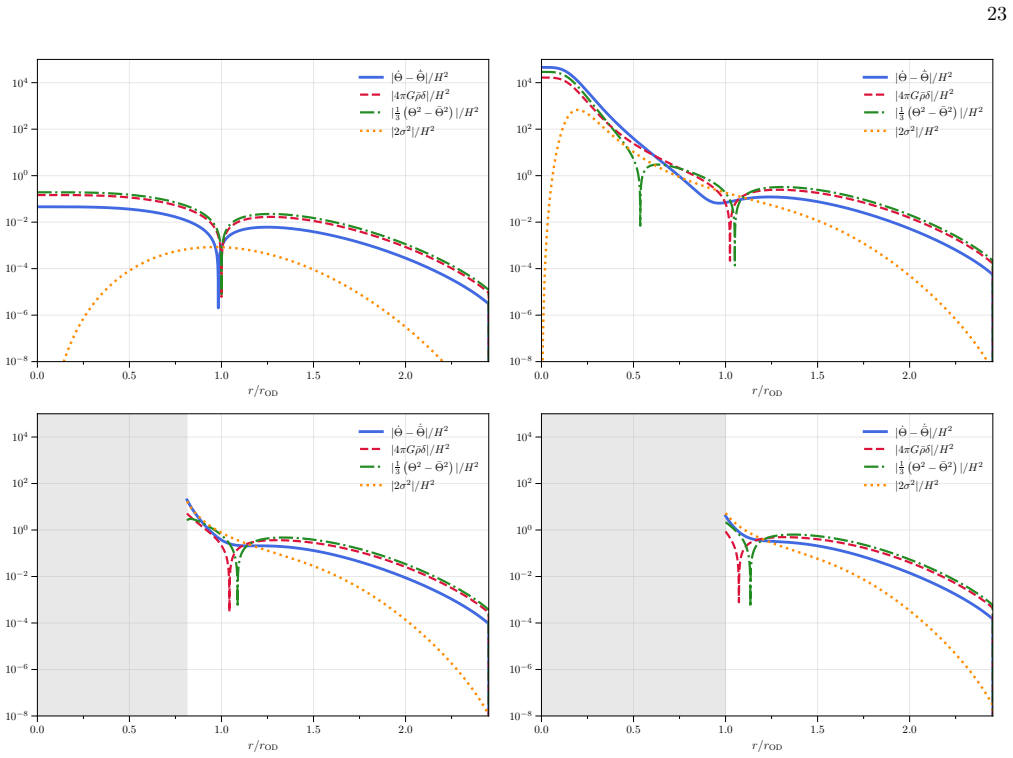
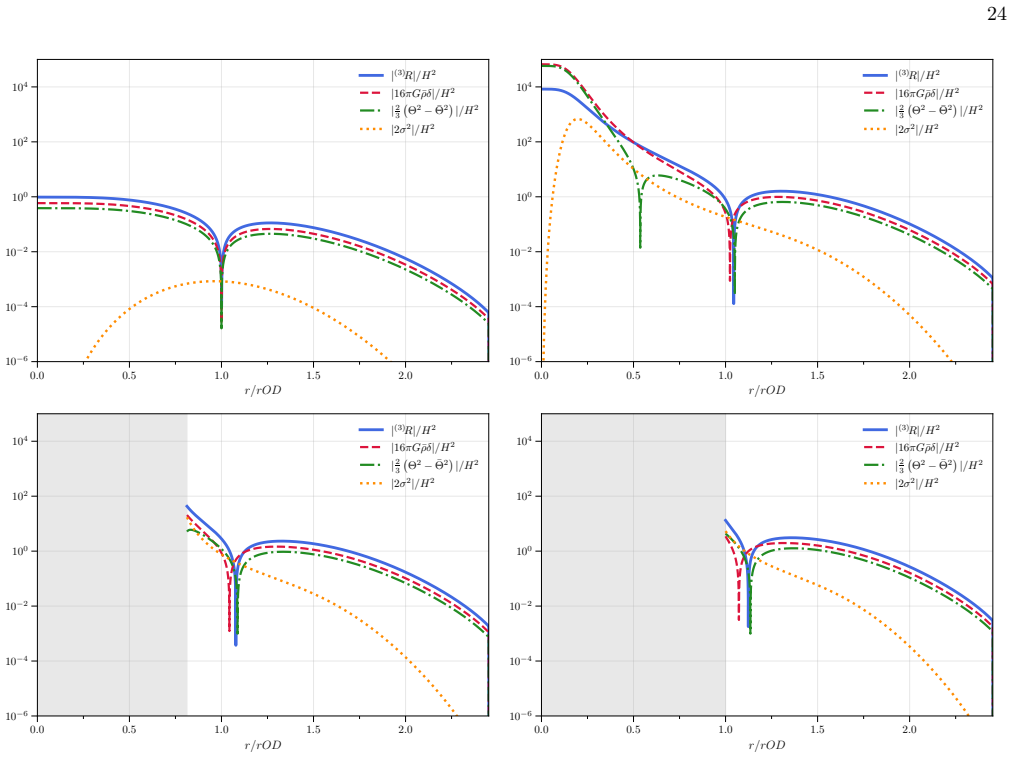
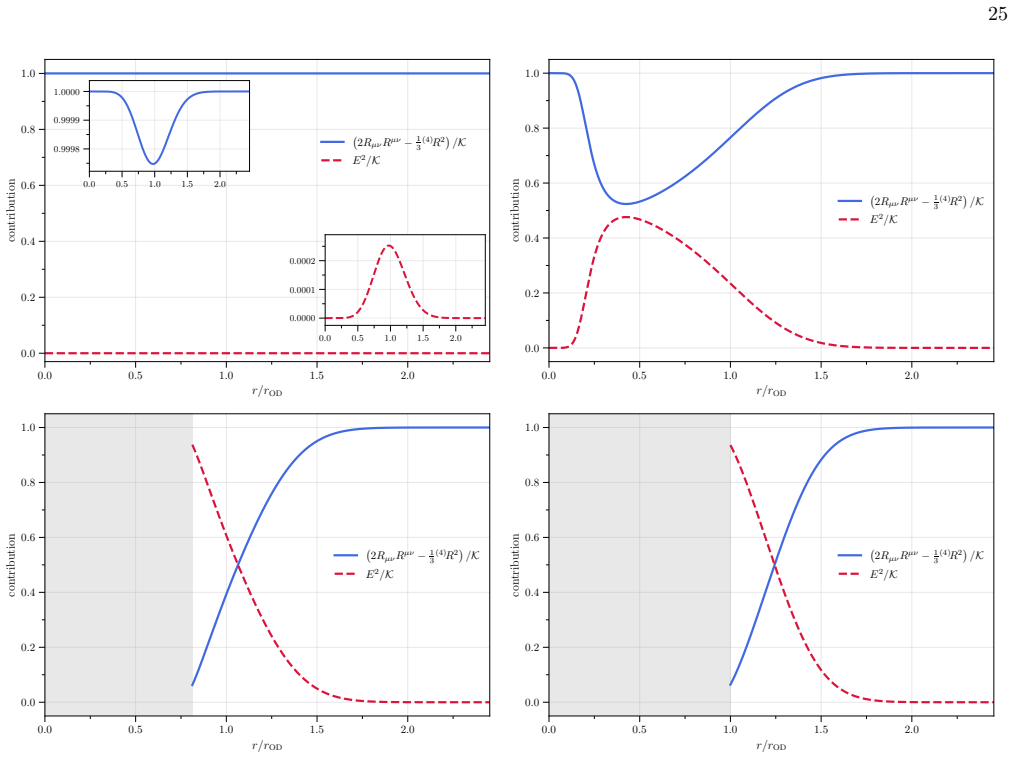
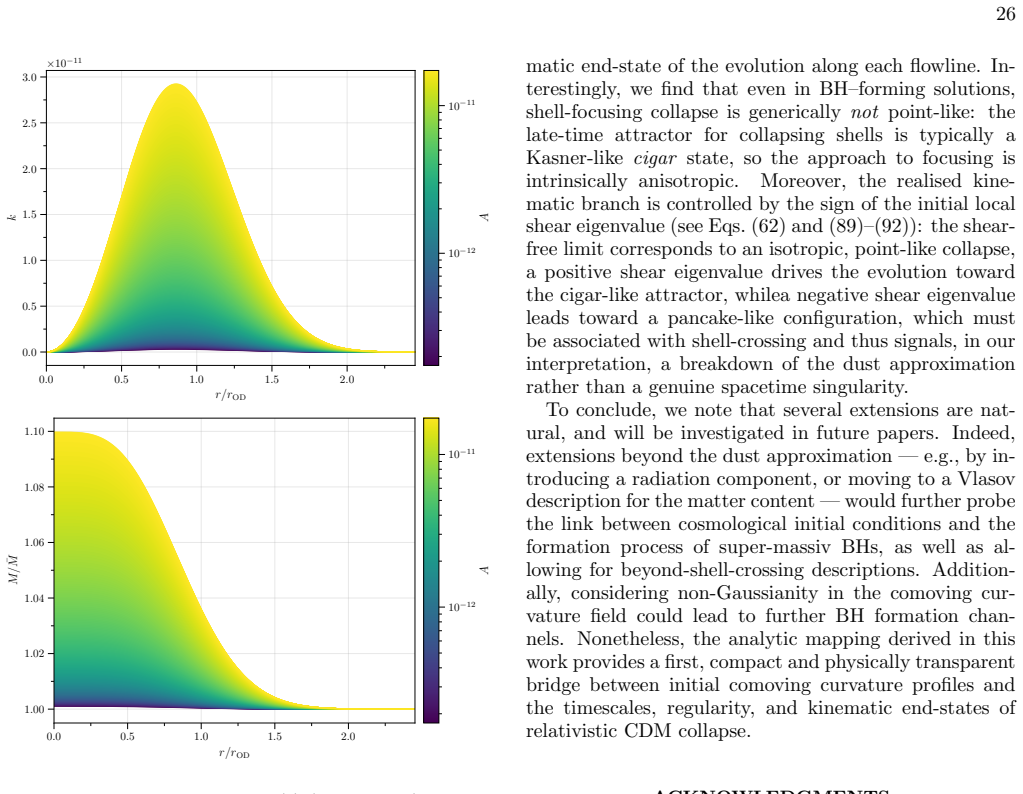
Using the conserved curvature perturbation R_c to initialize LTB and Szekeres models of dust collapse, the authors derive that broad compensated peaks lead to viable black hole formation with the specified redshifts, and that the initial shear from the curvature data determines whether the singularity is point-like, cigar-like or pancake-like.
What carries the argument
The initial comoving curvature perturbation R_c and its spatial derivatives, which set the active gravitational mass and curvature functions in the LTB and Szekeres models and enforce the regularity conditions for black hole formation.
If this is right
- Black hole seeds of 10^3-10^6 solar masses form fully at redshifts z>5.
- Core collapse begins at redshifts 10 to 16.
- The collapse end-state is selected by the initial shear from the curvature data.
- Only broad compensated peaks provide viable black hole channels, unlike sinusoidal or Gaussian profiles.
Where Pith is reading between the lines
- This channel could explain the early appearance of supermassive black holes without prior stellar-mass seeds.
- The predicted formation redshifts could be compared against the observed population of high-redshift quasars.
- The link between initial shear and singularity type might extend to understanding generic collapse outcomes in inhomogeneous cosmologies.
Load-bearing premise
The initial curvature data from peak theory evolves under pure gravitational collapse in pressureless dust to produce regular black holes without baryonic or other effects disrupting the regularity conditions.
What would settle it
An observation that black holes in the 10^3-10^6 solar mass range are absent or form at redshifts well below 5, or a calculation showing that compensated peaks violate the regularity conditions in the LTB and Szekeres models.
Figures
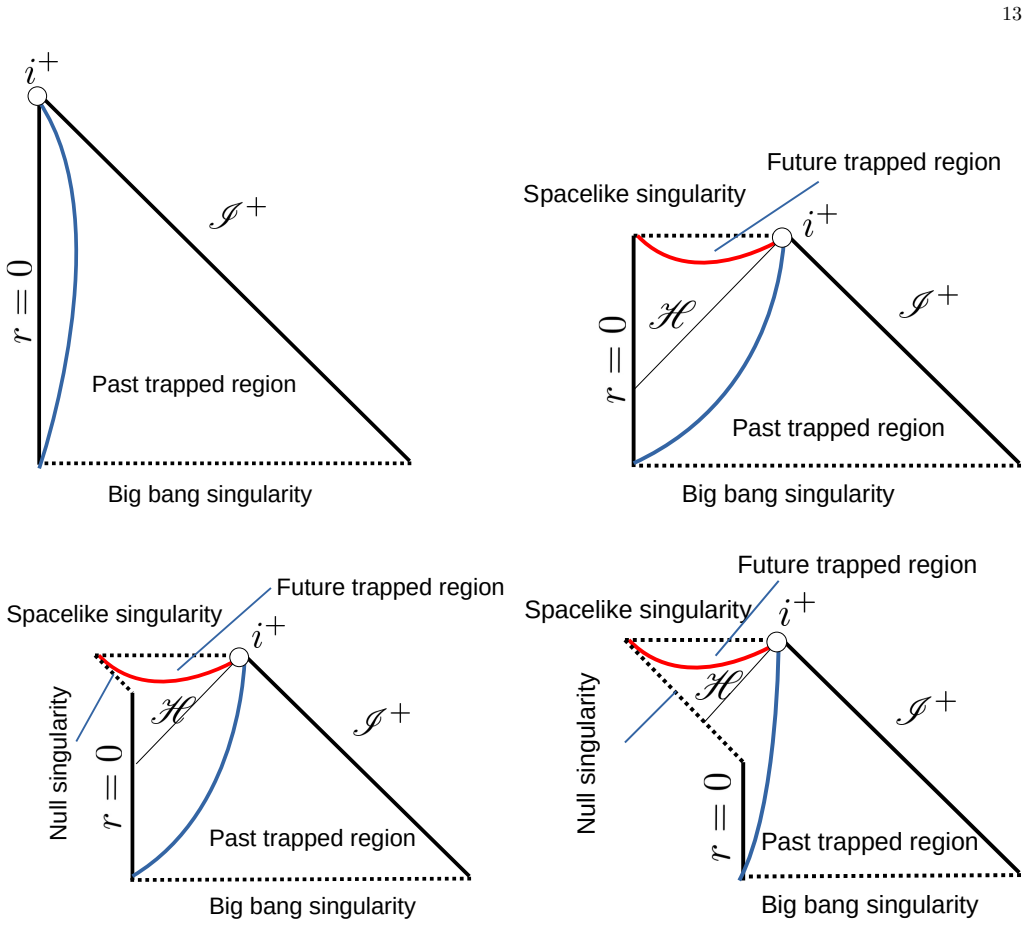
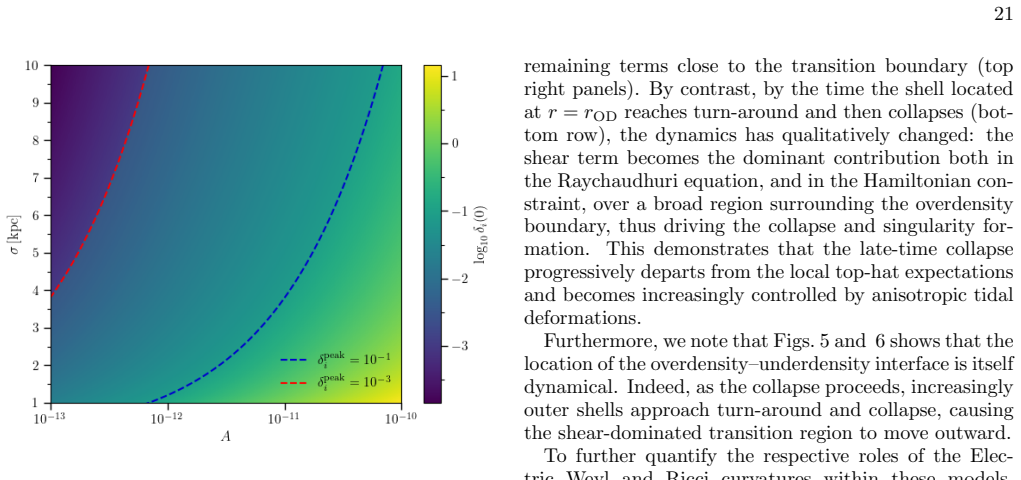
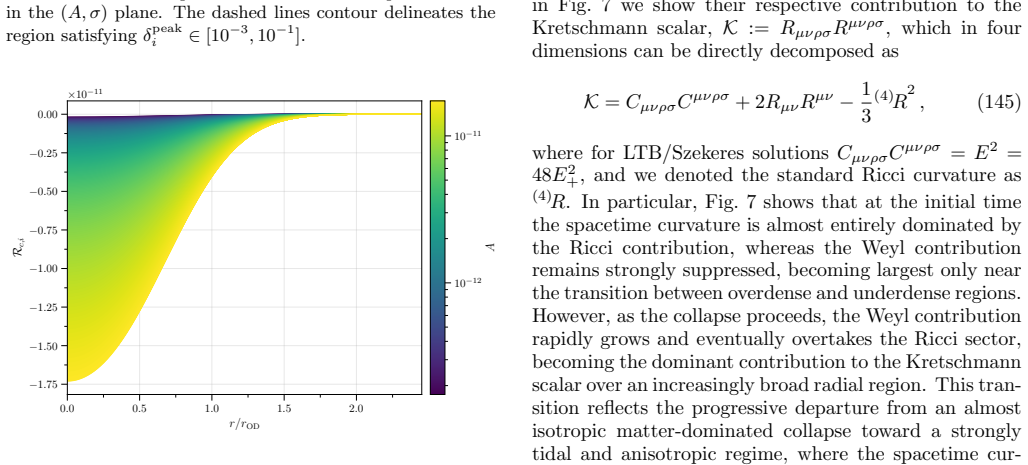
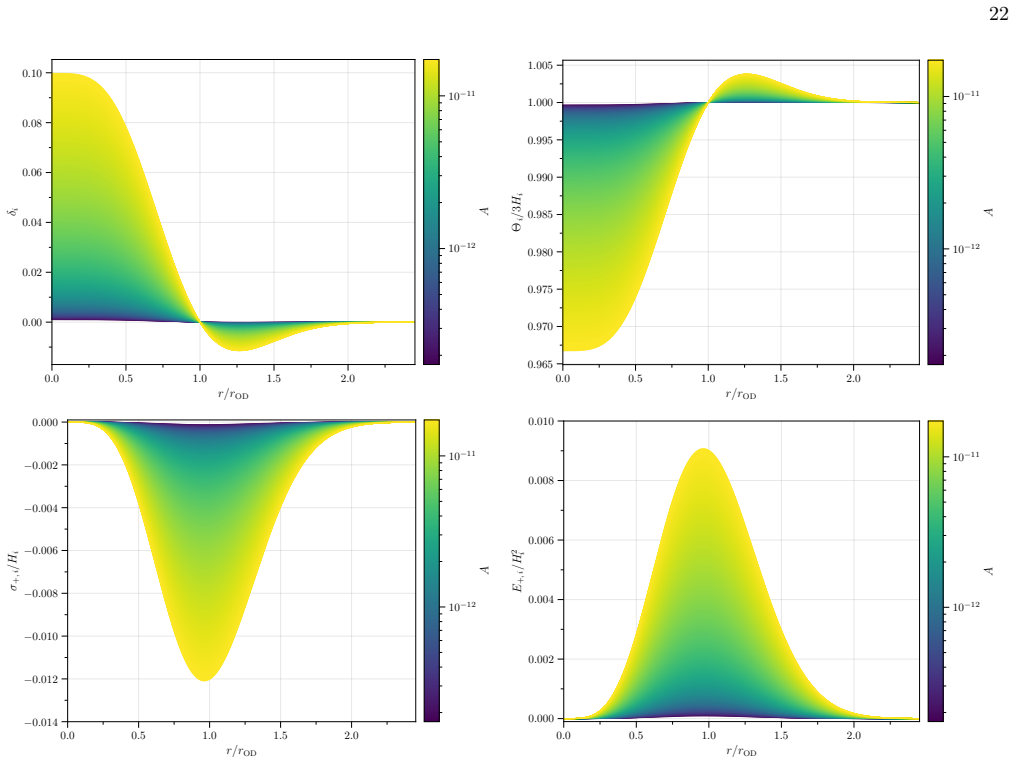
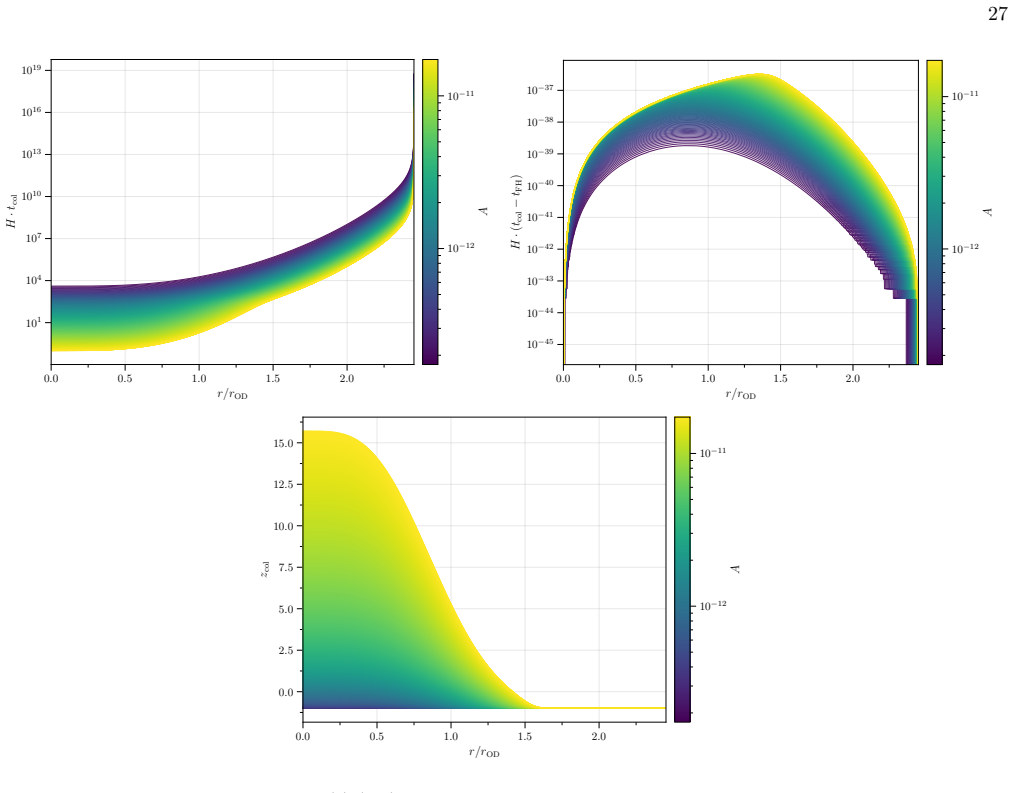
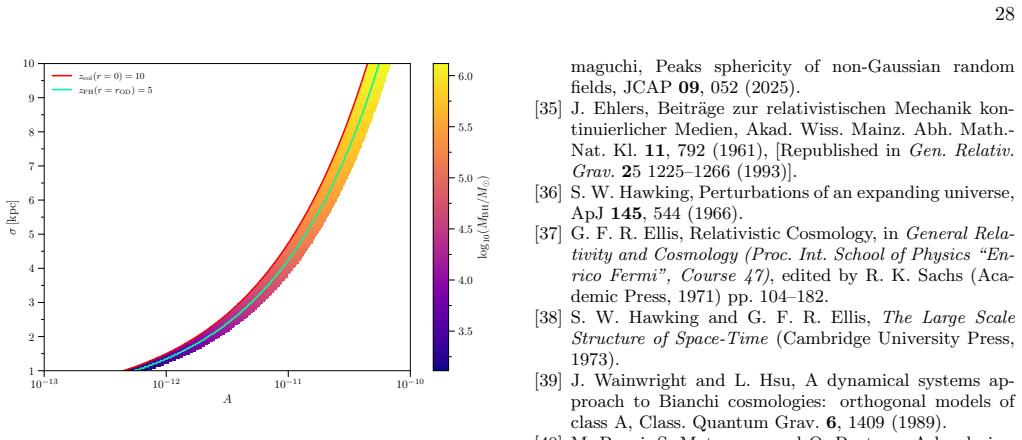
read the original abstract
We study black hole (BH) formation from the nonlinear growth and collapse of primordial perturbations during the matter-dominated era. Modelling cold dark matter (CDM) as pressureless dust, we describe the collapse in a fully nonlinear relativistic framework using the Lema\^{i}tre-Tolman-Bondi (LTB) and quasi-spherical Szekeres solutions as exact perturbations of a spatially-flat Friedmann-Lema\^{i}tre-Robertson-Walker (FLRW) $\Lambda$CDM background. At first order in relativistic scalar perturbation theory, the growing mode of any relevant quantity can be expressed in terms of the conserved gauge-invariant curvature perturbation $\mathcal{R}_c$, which acts as a potential for the 3-curvature of hypersurfaces orthogonal to the matter 4-velocity. We use this result to express the active gravitational mass and curvature functions of the LTB and Szekeres models in terms of the initial values of $\mathcal{R}_c$ and its spatial derivatives. From these initial curvature data we derive: (i) the turn-around, collapse, and apparent-horizon formation times, and (ii) the regularity conditions required for BH formation. We show that sinusoidal and Gaussian profiles do not provide viable BH-forming channels, whereas broad compensated curvature peaks, naturally predicted by peak theory, do. We then estimate the formation times of $10^{3}-10^{6}~\mathrm{M}_\odot$ massive BH seeds produced by the direct collapse of primordial CDM curvature peaks, finding full BH formation at redshifts $z>5$, with core collapse beginning at $10 \lesssim z \lesssim 16$. Finally, we characterize the local dynamics and singularity type of the collapse (point-like, cigar-like, or pancake-like) directly from the initial comoving curvature data, clarifying the role of the initial shear in selecting the collapse end-state.
Editorial analysis
A structured set of objections, weighed in public.
Referee Report
Summary. The paper models the nonlinear collapse of primordial CDM perturbations in the matter era using exact LTB and Szekeres solutions whose initial data are set from the first-order growing mode of the conserved curvature perturbation R_c. It derives turnaround, collapse, and apparent-horizon times together with regularity conditions for black-hole formation, concluding that broad compensated curvature peaks (as predicted by peak theory) produce regular 10^3–10^6 M_⊙ seeds with full BH formation at z>5 and core collapse beginning at 10≲z≲16, while sinusoidal and Gaussian profiles do not; the local collapse dynamics (point-, cigar-, or pancake-like) are also read off directly from the initial comoving curvature data.
Significance. If the first-order initial-data construction remains valid, the work supplies a purely gravitational channel for early supermassive black-hole seeds whose formation redshifts and end-state morphology are fixed by the shape of R_c, together with explicit regularity criteria that can be checked against peak-theory statistics. The use of exact inhomogeneous solutions and the direct translation from initial R_c to collapse times and singularity type constitute a clear technical advance over purely perturbative or Newtonian treatments.
major comments (2)
- [Initial-data construction from R_c (abstract and § on LTB/Szekeres initial conditions)] The central construction maps the first-order growing mode of R_c directly onto the LTB active-mass and curvature functions (and their Szekeres generalizations). For the broad compensated peaks that the paper claims produce regular BHs, the required density contrast reaches O(1) at turnaround; at those amplitudes the linear relation between R_c and the metric functions receives O(R_c²) corrections that are not included. If those corrections modify the sign or magnitude of the curvature function or the mass profile, the derived regularity conditions (absence of shell-crossing, apparent-horizon formation before singularity) and the quoted collapse redshifts (z>5) no longer follow. The paper does not quantify the size of R_c for its 10³–10⁶ M_⊙ examples or demonstrate that second-order terms remain negligible.
- [Profile viability and regularity conditions] The distinction between viable (broad compensated) and non-viable (sinusoidal, Gaussian) profiles rests entirely on the regularity conditions obtained from the first-order R_c data. Because the amplitude regime in which those conditions are applied is precisely where the linear mapping is most suspect, the profile-selection claim is load-bearing and requires an explicit check that second-order corrections do not alter the sign of the curvature function or the ordering of apparent-horizon and singularity formation times.
minor comments (2)
- [Abstract] The abstract states that core collapse begins at 10≲z≲16; a brief clarification of how this interval is obtained from the turnaround and apparent-horizon times would help readers trace the numerical estimates.
- [Throughout] Notation for the conserved curvature perturbation is given as both R_c and Ρ_c in different places; consistent use of a single symbol (with the script R_c preferred) would remove ambiguity.
Simulated Author's Rebuttal
We thank the referee for the careful reading and the constructive major comments on the validity of the first-order initial-data construction. We address both points below and will incorporate explicit estimates of the curvature amplitude to demonstrate the robustness of the linear mapping.
read point-by-point responses
-
Referee: The central construction maps the first-order growing mode of R_c directly onto the LTB active-mass and curvature functions. For the broad compensated peaks, the required density contrast reaches O(1) at turnaround; at those amplitudes the linear relation between R_c and the metric functions receives O(R_c²) corrections that are not included. The paper does not quantify the size of R_c for its 10³–10⁶ M_⊙ examples or demonstrate that second-order terms remain negligible.
Authors: We agree that an explicit quantification strengthens the presentation. In the matter-dominated era the density contrast relates to the conserved curvature perturbation by δ ≈ −(2/3)(k/(aH))² R_c (comoving gauge, leading order). For the comoving wavenumbers corresponding to 10³–10⁶ M_⊙ objects collapsing at z ≳ 5, k/(aH) ≳ 10³, so |R_c| ≲ 10^{-6} when δ reaches O(1). Second-order corrections are therefore O(10^{-12}) and cannot change the sign of the curvature function, the mass profile, or the ordering of apparent-horizon and singularity times. We will add a short subsection (or paragraph in the initial-conditions section) that computes the representative R_c values for the quoted mass range and confirms the linear approximation remains valid throughout the evolution. revision: yes
-
Referee: The distinction between viable (broad compensated) and non-viable (sinusoidal, Gaussian) profiles rests entirely on the regularity conditions obtained from the first-order R_c data. Because the amplitude regime is where the linear mapping is most suspect, the profile-selection claim requires an explicit check that second-order corrections do not alter the sign of the curvature function or the ordering of apparent-horizon and singularity formation times.
Authors: The same amplitude estimate applies uniformly to all profiles examined. Because |R_c| remains ≪ 1 for every case, the O(R_c²) corrections are negligible and preserve both the sign of the curvature function and the relative ordering of the characteristic times. The distinction between profiles originates from the spatial structure and compensation of R_c, which are leading-order quantities. We will insert a brief statement in the revised manuscript noting that the profile viability conclusions are insensitive to second-order corrections at the amplitudes relevant to the 10³–10⁶ M_⊙ seeds. revision: yes
Circularity Check
No circularity: derivation starts from external standard perturbation result
full rationale
The paper begins from the standard first-order result that the growing mode is expressed in terms of the conserved curvature perturbation ℛ_c (an input from relativistic perturbation theory, not derived or fitted here). It then maps this directly to the LTB/Szekeres mass and curvature functions via the quoted first-order expressions, and derives turnaround/collapse times and regularity conditions as consequences. No steps match the enumerated circularity patterns: there are no self-definitional loops, no fitted inputs renamed as predictions, no load-bearing self-citations, and no ansatz smuggled via prior work. The central claims about which profiles produce BHs and the quoted redshifts follow from the external ℛ_c data without reducing to the inputs by construction.
Axiom & Free-Parameter Ledger
free parameters (1)
- Mass range for seeds
axioms (2)
- domain assumption CDM modeled as pressureless dust
- standard math Growing mode expressed via conserved ℛ_c
Reference graph
Works this paper leans on
-
[1]
IC for LTB models To linearise the LTB metric in Eq. (65) it can be meaningful, a priori, to employ the parametrisation (see e.g., [8]) R(t, r) =ra(t)e ζ(t,r) ,(102) wherea(t) is the FLRW background scale-factor, and ζ(t, r) would thus measure deviations of the LTB space- time from the background. However, it is more conve- nient at this stage to exploit ...
-
[2]
R ′−3/2 c,i + 3 r2 + 2 5a2 i H2 i R ′−1/2 c,i r +O ϵ1/2 # ,(122) tcol(r) = π 23/2 H2 i a3 i r3/2
IC for axisymmetric Szekeres models To initialise Szekeres collpase via linear perturbation we employ the same approach as for the LTB models. In addition, we linearise the dipole functions according to L (1) = 1 +L (1) ;P (1) =P (1) ;Q (1) =Q (1) .(114) Hence, we have D (1) = 1 2 h 1 +p 2 +q 2 +L (1) 1−p 2 −q 2 + 2pP(1) + 2qQ(1) i .(115) However, as also...
-
[3]
sep- arate universe
Top-Hat Collapse Before moving to more realistic collpases from initial comoving curvature perturbation profiles, we show that we can directly recover the TH model [16] as a sub- case of the LTB solutions. The TH model describes the evolution of a homogeneous spherical overdensity in the matter-dominated era. This overdense sphere is mod- eled by a closed...
-
[4]
Single-mode collapse It is meaningful to consider asingle-modecollapse, namely a configuration in which the initial curvature profile is characterised by a single scale set by a sin- gle wavenumberλ. Besides providing a minimal test bed for general multi-mode collapse — a clear base- line against which the impact of additional structure can be assessed — ...
-
[5]
single-peak
Gaussian collapse It is likewise meaningful to consider aGaussiancol- lapse, as it provides a complementary “single-peak” test bed to the single-mode collapse. We therefore take the monopole of the initial curvature to be 11 R[m] c,i (r) =−Aexp − r2 2σ2 ,(136) whereA >0 is the amplitude,σis the characteristic scale. In addition,R [d] c,i is either zero (L...
-
[6]
kurtosis
Peak collapse Within the context of cosmological perturbation the- ory, where the initial comoving curvature may be mod- elled as a (smoothed) Gaussian random field, a promi- nent role in the study of collapsing structures is played by peak theory, which provides a controlled description of the rare, high-amplitude extrema that seed nonlinear collapse and...
-
[7]
CDM compensated peaks as massive BH seeds Having constructed a family of compensated curva- ture peaks that (i) satisfies the no–shell-crossing condi- tions and hence remains single-stream up to focusing (cf. Eqs. (81)–(82)), and (ii) forms a future-trapped region prior to the central shell-focusing singularity (so that the latter is covered), we now turn...
-
[8]
Y. B. Zel’dovich and I. D. Novikov, The Hypothesis of Cores Retarded during Expansion and the Hot Cos- mological Model, Sov. Astron.10, 602 (1967), english translation of Astron. Zh.43, 758 (1966)
1967
-
[9]
S. W. Hawking, Gravitationally Collapsed Objects of Very Low Mass, MNRAS152, 75 (1971)
1971
-
[10]
B. J. Carr and S. W. Hawking, Black Holes in the Early Universe, MNRAS168, 399 (1974)
1974
-
[11]
B. J. Carr, The Primordial Black Hole Mass Spectrum, ApJ201, 1 (1975)
1975
-
[12]
Harada, C.-M
T. Harada, C.-M. Yoo, K. Kohri, K.-i. Nakao, and S. Jhingan, Primordial black hole formation in the matter-dominated phase of the Universe, ApJ833, 61 (2016)
2016
-
[13]
C.-M. Yoo, T. Harada, J. Garriga, and K. Kohri, Pri- mordial black hole abundance from random Gaussian curvature perturbations and a local density threshold, PTEP2018, 123E01 (2018), [Erratum: PTEP 2024, 049202 (2024)]
2018
-
[14]
Harada, K
T. Harada, K. Kohri, M. Sasaki, T. Terada, and C.- M. Yoo, Threshold of primordial black hole formation against velocity dispersion in matter-dominated era, 27 0.0 0.5 1.0 1.5 2.0 r/rOD 101 104 107 1010 1013 1016 1019 H ·tcol 10−12 10−11 A 0.0 0.5 1.0 1.5 2.0 r/rOD 10−45 10−44 10−43 10−42 10−41 10−40 10−39 10−38 10−37 H ·(tcol − tFH) 10−12 10−11 A 0.0 0.5...
2018
-
[15]
Uehara, A
K. Uehara, A. Escriv` a, T. Harada, D. Saito, and C.- M. Yoo, Primordial black hole formation from a type II perturbation in the absence and presence of pressure, JCAP08, 042 (2025)
2025
-
[16]
W. Ye, Y. Gong, T. Harada, Z. Kang, K. Kohri, D. Saito, and C.-M. Yoo, Primordial black hole forma- tion and spin in matter domination revisited, Phys. Rev. D112, 103524 (2025)
2025
-
[17]
Byrnes, G
C. Byrnes, G. Franciolini, T. Harada, P. Pani, and M. Sasaki, eds.,Primordial Black Holes(Springer, 2025)
2025
-
[18]
Pacucci, B
F. Pacucci, B. Nguyen, S. Carniani, R. Maiolino, and X. Fan, JWST CEERS and JADES Active Galaxies at z= 4–7 Violate the LocalM •–M⋆ Relation at>3σ: Im- plications for Low-mass Black Holes and Seeding Mod- els, ApJL957, L3 (2023)
2023
-
[19]
R. L. Larson, S. L. Finkelstein, D. D. Kocevski,et al., A CEERS Discovery of an Accreting Supermassive Black Hole 570 Myr after the Big Bang: Identifying a Progen- itor of Massivez >6 Quasars, ApJL953, L29 (2023)
2023
-
[20]
Maiolino, J
R. Maiolino, J. Scholtz, J. Witstok,et al., A Small and Vigorous Black Hole in the Early Universe, Nature627, 59 (2024)
2024
-
[21]
M. Y. Khlopov and A. G. Polnarev, Primordial black holes as a cosmological test of grand unification, Phys. Lett. B97, 383 (1980)
1980
-
[22]
Harada and S
T. Harada and S. Jhingan, Spherical and nonspherical models of primordial black hole formation: exact solu- tions, PTEP2016, 093E04 (2016)
2016
-
[23]
J. E. Gunn and J. R. I. Gott, On the Infall of Matter Into Clusters of Galaxies and Some Effects on Their Evolution, ApJ176, 1 (1972)
1972
-
[24]
Lemaˆ ıtre, L’Univers en expansion, Ann
G. Lemaˆ ıtre, L’Univers en expansion, Ann. Soc ˙Sci. Brux.53A, 51 (1933)
1933
-
[25]
R. C. Tolman, Effect of Inhomogeneity on Cosmological Models, Proc. Natl. Acad. Sci. U.S.A.20, 169 (1934)
1934
-
[26]
Bondi, Spherically Symmetrical Models in General Relativity, MNRAS107, 410 (1947), [Republished in Gen
H. Bondi, Spherically Symmetrical Models in General Relativity, MNRAS107, 410 (1947), [Republished in Gen. Relativ. Grav.31 1783 (1999)]
1947
-
[27]
Szekeres, A class of inhomogeneous cosmological models, Comm
P. Szekeres, A class of inhomogeneous cosmological models, Comm. Math. Phys.41, 55–64 (1975). 28 10−13 10−12 10−11 10−10 A 1 2 3 4 5 6 7 8 9 10σ [kpc] zcol(r = 0) = 10 zFH(r = rOD) = 5 3.5 4.0 4.5 5.0 5.5 6.0 log10(MBH/M⊙) FIG. 10. Phase space of collapse outcomes in the (A, σ) plane. The red and green curves mark the boundariesz col(r= 0) = 10, andz FH(r...
1975
-
[28]
Szekeres, Quasispherical gravitational collapse, Phys
P. Szekeres, Quasispherical gravitational collapse, Phys. Rev. D12, 2941 (1975)
1975
-
[29]
Bruni, S
M. Bruni, S. Matarrese, and O. Pantano, Dynamics of silent universes, ApJ445, 958 (1995)
1995
-
[30]
Wainwright and G
J. Wainwright and G. F. R. Ellis,Dynamical Systems in Cosmology(Cambridge University Press, 1997)
1997
-
[31]
G. F. R. Ellis, R. Maartens, and M. A. H. MacCallum, Relativistic Cosmology(Cambridge University Press, 2012)
2012
-
[32]
K. A. Malik and D. Wands, Cosmological perturbations, Phys. Rep.475, 1 (2009)
2009
-
[33]
Bruni, J
M. Bruni, J. C. Hidalgo, N. Meures, and D. Wands, Non-Gaussian initial conditions in ΛCDM: Newtonian, relativistic, and primordial contributions, The Astro- physical Journal785, 2 (2014)
2014
-
[34]
R. L. Munoz and M. Bruni, Structure formation and quasispherical collapse from initial curvature perturba- tions with numerical relativity simulations, Phys. Rev. D107, 123536 (2023)
2023
-
[35]
Hellaby and A
C. Hellaby and A. Krasi´ nski, You cannot get through Szekeres wormholes: Regularity, topology, and causal- ity in quasispherical Szekeres models, Phys. Rev. D66, 084011 (2002)
2002
-
[36]
Hellaby and A
C. Hellaby and A. Krasi´ nski, Physical and geometrical interpretation of theϵ≤0 Szekeres models, Phys. Rev. D77, 023529 (2008)
2008
-
[37]
A. G. Doroshkevich, The Spatial Structure of Pertur- bations and the Origin of Rotation of Galaxies in the Theory of Fluctuations, Astrophys.6, 320 (1970)
1970
-
[38]
J. M. Bardeen, J. R. Bond, N. Kaiser, and A. S. Szalay, The Statistics of Peaks of Gaussian Random Fields, ApJ 304, 15 (1986)
1986
-
[39]
R. J. Adler,The Geometry of Random Fields(Wiley, New York, 1981)
1981
-
[40]
Germani and T
C. Germani and T. Prokopec, On Primordial Black Holes from an Inflection Point, Phys. Dark Universe18, 6 (2017)
2017
-
[41]
Germani, M
C. Germani, M. A. Gorji, M. Uwabo-Niibo, and M. Ya- maguchi, Peaks sphericity of non-Gaussian random fields, JCAP09, 052 (2025)
2025
-
[42]
Ehlers, Beitr¨ age zur relativistischen Mechanik kon- tinuierlicher Medien, Akad
J. Ehlers, Beitr¨ age zur relativistischen Mechanik kon- tinuierlicher Medien, Akad. Wiss. Mainz. Abh. Math.- Nat. Kl.11, 792 (1961), [Republished inGen. Relativ. Grav.25 1225–1266 (1993)]
1961
-
[43]
S. W. Hawking, Perturbations of an expanding universe, ApJ145, 544 (1966)
1966
-
[44]
En- rico Fermi
G. F. R. Ellis, Relativistic Cosmology, inGeneral Rela- tivity and Cosmology (Proc. Int. School of Physics “En- rico Fermi”, Course 47), edited by R. K. Sachs (Aca- demic Press, 1971) pp. 104–182
1971
-
[45]
S. W. Hawking and G. F. R. Ellis,The Large Scale Structure of Space-Time(Cambridge University Press, 1973)
1973
-
[46]
Wainwright and L
J. Wainwright and L. Hsu, A dynamical systems ap- proach to Bianchi cosmologies: orthogonal models of class A, Class. Quantum Grav.6, 1409 (1989)
1989
-
[47]
Bruni, S
M. Bruni, S. Matarrese, and O. Pantano, A local view of the observable universe, Phys. Rev. Lett.74, 1916 (1995)
1916
-
[48]
S. W. Goode and J. Wainwright, Singularities and evo- lution of the Szekeres cosmological models, Phys. Rev. D26, 3315 (1982)
1982
-
[49]
G. F. R. Ellis and M. Bruni, Covariant and gauge- invariant approach to cosmological density fluctuations, Phys. Rev. D40, 1804 (1989)
1989
-
[50]
Bruni, P
M. Bruni, P. K. S. Dunsby, and G. F. R. Ellis, Cosmo- logical perturbations and the physical meaning of gauge invariant variables, ApJ395, 34 (1992)
1992
-
[51]
P. K. S. Dunsby, M. Bruni, and G. F. R. Ellis, Covariant perturbations in a multifluid cosmological medium, ApJ 395, 54 (1992)
1992
-
[52]
Kofman and D
L. Kofman and D. Pogosian, Equations of gravitational instability are nonlocal, ApJ442, 30 (1995)
1995
-
[53]
Barnes and R
A. Barnes and R. R. Rowlingson, Irrotational perfect fluids with a purely electric Weyl tensor, Class. Quan- tum Grav.6, 949 (1989)
1989
-
[54]
Matarrese, O
S. Matarrese, O. Pantano, and D. Saez, General- relativistic approach to the nonlinear evolution of colli- sionless matter, Phys. Rev. D47, 1311 (1993)
1993
-
[55]
Y. B. Zel’dovich, Gravitational instability: An approx- imate theory for large density perturbations., A&A5, 84 (1970)
1970
- [56]
-
[57]
M. A. H. MacCallum, Cosmological models from a ge- ometric point of view, inCarg` ese Lectures in Physics, Vol. 6, edited by E. Schatzman (Gordon and Breach, New York, 1973) pp. 61–174, lectures at the Inter- national Summer School of Physics, Carg` ese, Corsica (1971)
1973
-
[58]
S. L. Shapiro and S. A. Teukolsky, Formation of Naked Singularities: The Violation of Cosmic Censorship, Phys. Rev. Lett.66, 994 (1991)
1991
-
[59]
L. D. Landau and E. M. Lifshitz,The Classical Theory of Fields, Course of Theoretical Physics, Vol. 2 (Perga- mon Press, Oxford, 1975)
1975
-
[60]
S. Matarrese, O. Pantano, and D. Saez, General rela- tivistic dynamics of irrotational dust: Cosmological im- plications, Phys. Rev. Lett.72, 320 (1994), arXiv:astro- ph/9310036. 29
-
[61]
Covariant Fluid Dynamics: a Long Wave-Length Approximation
M. Bruni and C. F. Sopuerta, Covariant fluid dynamics: A Long wavelength approximation, Class. Quant. Grav. 20, 5275 (2003), arXiv:gr-qc/0307059
work page internal anchor Pith review Pith/arXiv arXiv 2003
-
[62]
R. L. Arnowitt, S. Deser, and C. W. Misner, Dynamical Structure and Definition of Energy in General Relativ- ity, Phys. Rev.116, 1322 (1959)
1959
-
[63]
Arnowitt and S
R. Arnowitt and S. Deser, Quantum Theory of Gravita- tion: General Formulation and Linearized Theory, Phys. Rev.113, 745 (1959)
1959
-
[64]
Arnowitt, S
R. Arnowitt, S. Deser, and C. W. Misner, Canonical Variables for General Relativity, Phys. Rev.117, 1595 (1960)
1960
-
[65]
Arnowitt, S
R. Arnowitt, S. Deser, and C. W. Misner, Coordinate Invariance and Energy Expressions in General Relativ- ity, Phys. Rev.122, 997 (1961)
1961
-
[66]
Arnowitt, S
R. Arnowitt, S. Deser, and C. W. Misner,The Dynamics of General Relativity(John Wiley & Sons, 1962)
1962
-
[67]
Four` es-Bruhat, Th´ eor` eme d’existence pour cer- tains syst` emes d’´ equations aux d´ eriv´ ees partielles non lin´ eaires, Acta Math.88, 141 (1952)
Y. Four` es-Bruhat, Th´ eor` eme d’existence pour cer- tains syst` emes d’´ equations aux d´ eriv´ ees partielles non lin´ eaires, Acta Math.88, 141 (1952)
1952
-
[68]
Choquet-Bruhat and R
Y. Choquet-Bruhat and R. Geroch, Global Aspects of the Cauchy Problem in General Relativity, Commun. Math. Phys.14, 329 (1969)
1969
-
[69]
York, James W., Conformally Invariant Orthogonal Decomposition of Symmetric Tensors on Riemannian Manifolds and the Initial-Value Problem of General Rel- ativity, J
J. York, James W., Conformally Invariant Orthogonal Decomposition of Symmetric Tensors on Riemannian Manifolds and the Initial-Value Problem of General Rel- ativity, J. Math. Phys.14, 456 (1973)
1973
-
[70]
P. A. M. Dirac, The Theory of Gravitation in Hamilto- nian Form, Proc. R. Soc. Lond. A246, 333 (1958)
1958
-
[71]
P. A. M. Dirac, Fixation of Coordinates in the Hamilto- nian Theory of Gravitation, Phys. Rev.114, 924 (1959)
1959
-
[72]
S. A. Hojman, K. Kuchaˇ r, and C. Teitelboim, Ge- ometrodynamics Regained, Annals of Physics96, 88 (1976)
1976
-
[73]
Alcubierre,Introduction to 3+1 Numerical Relativity (Oxford Science Publications, 2008)
M. Alcubierre,Introduction to 3+1 Numerical Relativity (Oxford Science Publications, 2008)
2008
-
[74]
T. W. Baumgarte and S. L. Shapiro,Numerical Rel- ativity: Solving Einstein’s Equations on the Computer (Cambridge University Press, 2010)
2010
-
[75]
Shibata,Numerical Relativity(World Scientific Pub- lishing Company, 2015)
M. Shibata,Numerical Relativity(World Scientific Pub- lishing Company, 2015)
2015
-
[76]
Bruni, J
M. Bruni, J. C. Hidalgo, and D. Wands, Einstein’s sig- nature in cosmological large-scale structure, ApJL794, L11 (2014)
2014
-
[77]
Langlois and F
D. Langlois and F. Vernizzi, A geometrical approach to nonlinear perturbations in relativistic cosmology, Class. Quantum Grav.27, 124007 (2010)
2010
-
[78]
D. H. Lyth, Large-scale energy-density perturbations and inflation, Phys. Rev. D31, 1792 (1985)
1985
-
[79]
J. M. Stewart and M. Walker, Perturbations of Space- Times in General Relativity, Proc. R. Soc. London. A. Math. Phys. Sc.341, 49 (1974)
1974
-
[80]
P. J. E. Peebles,The large-scale structure of the universe (Princeton University Press, 1980)
1980
discussion (0)
Sign in with ORCID, Apple, or X to comment. Anyone can read and Pith papers without signing in.