The polarization of thermal dileptons emitted in high-energy heavy-ion collisions
Pith reviewed 2026-06-29 00:24 UTC · model grok-4.3
The pith
Polarization of thermal dileptons is sensitive to in-medium properties of the quark-gluon plasma.
A machine-rendered reading of the paper's core claim, the machinery that carries it, and where it could break.
Core claim
We present calculations of thermal dilepton emission and polarization observables using a framework that comprises virtual photon spectral functions complete at next-to-leading-order in the strong coupling together with iEBE-MUSIC hydrodynamic simulations. The polarization of thermal lepton pairs is shown to be sensitive to in-medium properties of the quark-gluon plasma. For Pb+Pb collisions at LHC conditions we examine the magnitude and behaviour of the polarization as measured in different frames, the effects of the pre-equilibrium gluon abundance, and we derive a one-to-one mapping between dielectron and dimuon polarization.
What carries the argument
One-to-one mapping between dielectron and dimuon polarization, derived from NLO virtual photon spectral functions and hydrodynamic space-time evolution.
If this is right
- Polarization measurements can be used to constrain in-medium properties of the quark-gluon plasma.
- The one-to-one mapping permits interchangeable use of dielectron and dimuon channels for polarization studies.
- Pre-equilibrium gluon abundance modifies the magnitude and frame dependence of the observed polarization.
- Polarization behavior differs across reference frames, requiring careful choice of frame for comparisons to data.
Where Pith is reading between the lines
- Future LHC experiments could prioritize dilepton polarization measurements to extract additional QGP medium information.
- The mapping may allow cross-checks between different detector channels to reduce systematic uncertainties.
- The framework could be applied to other collision systems or beam energies to test consistency of extracted medium properties.
Load-bearing premise
That the iEBE-MUSIC hydrodynamic simulations combined with NLO spectral functions provide a sufficiently accurate description of the space-time evolution and emission rates.
What would settle it
An experimental measurement of dilepton polarization in LHC Pb+Pb collisions that differs substantially from the values predicted by the NLO spectral functions in the iEBE-MUSIC evolution.
Figures
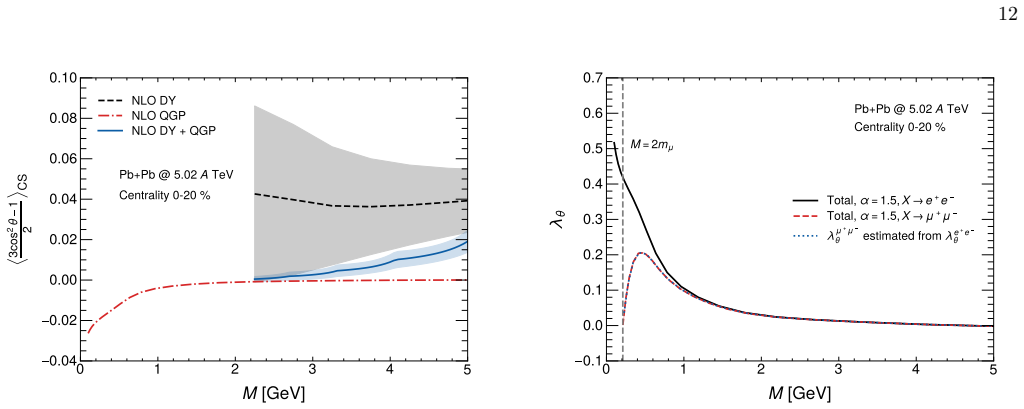
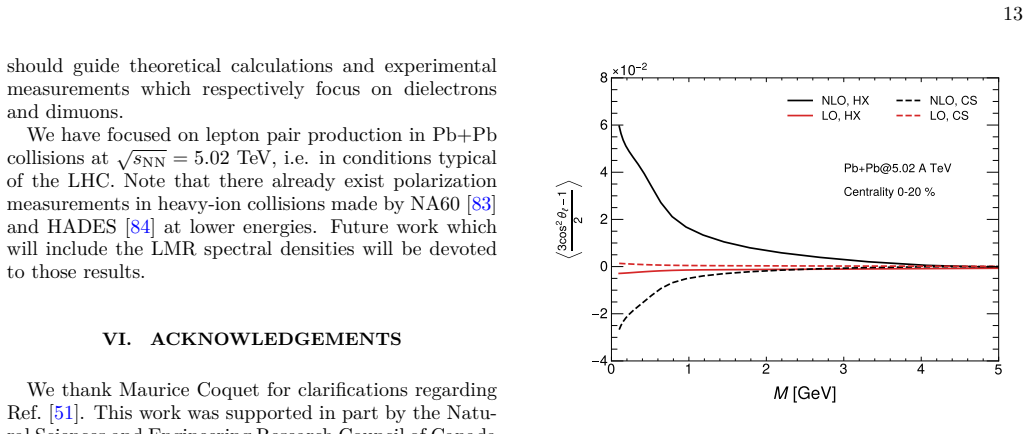
read the original abstract
This work presents calculations of thermal dilepton emission and polarization observables. It features a comprehensive framework which comprises virtual photon spectral functions complete at next-to-leading-order in the strong coupling and iEBE-MUSIC hydrodynamic simulations. The polarization of thermal lepton pairs is shown to be sensitive to in-medium properties of the quark-gluon plasma. We consider Pb+Pb collisions performed in conditions specific to the LHC and examine the magnitude and behaviour of the polarization as measured in different frames, the effects of the pre-equilibrium gluon abundance, and we derive a one-to-one mapping between dielectron and dimuon polarization.
Editorial analysis
A structured set of objections, weighed in public.
Referee Report
Summary. The paper presents calculations of thermal dilepton emission and polarization observables in Pb+Pb collisions at LHC energies. It employs a framework combining virtual-photon spectral functions complete at next-to-leading order in the strong coupling with iEBE-MUSIC hydrodynamic simulations. The polarization of thermal lepton pairs is shown to be sensitive to in-medium properties of the quark-gluon plasma; the work examines the magnitude and frame dependence of the polarization, the effects of pre-equilibrium gluon abundance, and derives a one-to-one mapping between dielectron and dimuon polarization.
Significance. If the numerical results hold, the work supplies a new polarization observable potentially sensitive to QGP in-medium properties and a channel-independent mapping that could simplify experimental comparisons. The combination of NLO rates with event-by-event hydrodynamics is a technical strength that allows direct connection to realistic space-time evolution.
major comments (1)
- [Abstract / framework description] The central claim that polarization is sensitive to in-medium properties rests on results obtained with the specific iEBE-MUSIC + NLO framework. No cross-checks with alternate hydrodynamic codes, varied initial conditions, or different spectral-function approximations are reported; therefore the magnitude of the reported sensitivity could be an artifact of this particular evolution model rather than a robust feature of thermal emission (abstract framework description and numerical results section).
Simulated Author's Rebuttal
We thank the referee for the careful reading of our manuscript and the constructive feedback. We address the single major comment below.
read point-by-point responses
-
Referee: [Abstract / framework description] The central claim that polarization is sensitive to in-medium properties rests on results obtained with the specific iEBE-MUSIC + NLO framework. No cross-checks with alternate hydrodynamic codes, varied initial conditions, or different spectral-function approximations are reported; therefore the magnitude of the reported sensitivity could be an artifact of this particular evolution model rather than a robust feature of thermal emission (abstract framework description and numerical results section).
Authors: We agree that the numerical results are obtained within the iEBE-MUSIC + NLO framework and that no explicit cross-checks with alternate hydrodynamic codes or initial conditions are presented. The in-medium sensitivity is encoded in the NLO virtual-photon spectral functions, which are computed independently of the hydrodynamic evolution; the hydrodynamic model supplies only the space-time temperature and flow profiles. The one-to-one mapping between dielectron and dimuon polarization is derived from the general structure of the lepton tensor and the spectral functions and is therefore independent of the hydrodynamic implementation. While additional variations would strengthen the robustness claim, the chosen framework is a standard, well-validated combination that enables direct comparison with experimental conditions at the LHC. We do not plan to add new calculations at this stage. revision: no
Circularity Check
No significant circularity; forward calculation from external inputs
full rationale
The paper computes thermal dilepton polarization using iEBE-MUSIC hydrodynamics plus NLO virtual-photon spectral functions as stated inputs, then extracts numerical sensitivity and derives a one-to-one dielectron–dimuon mapping. No quoted equation or step reduces a claimed prediction to a fitted parameter by construction, nor does any load-bearing premise rest on a self-citation chain that itself lacks independent verification. The derivation chain is self-contained against the supplied external models and does not exhibit self-definitional, fitted-input-renamed-as-prediction, or ansatz-smuggled patterns.
Axiom & Free-Parameter Ledger
axioms (2)
- domain assumption iEBE-MUSIC hydrodynamic simulations accurately capture the space-time evolution and temperature profile of the QGP
- domain assumption Next-to-leading-order virtual photon spectral functions correctly describe in-medium dilepton production rates
Forward citations
Cited by 1 Pith paper
-
Probing Pair Correlations in QCD Matter with Photon Spectra
Relative-angle modes of pair correlations produce sign-changing modifications to the in-medium photon spectrum with magnitudes comparable to the factorized contribution.
Reference graph
Works this paper leans on
-
[1]
This may enhance the relative longitudinal component depending on the angle and energy of the emitted gluon
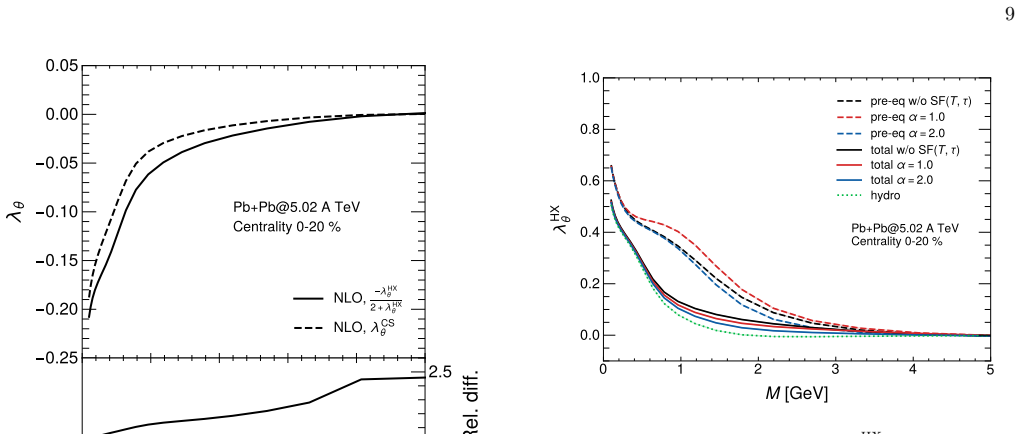
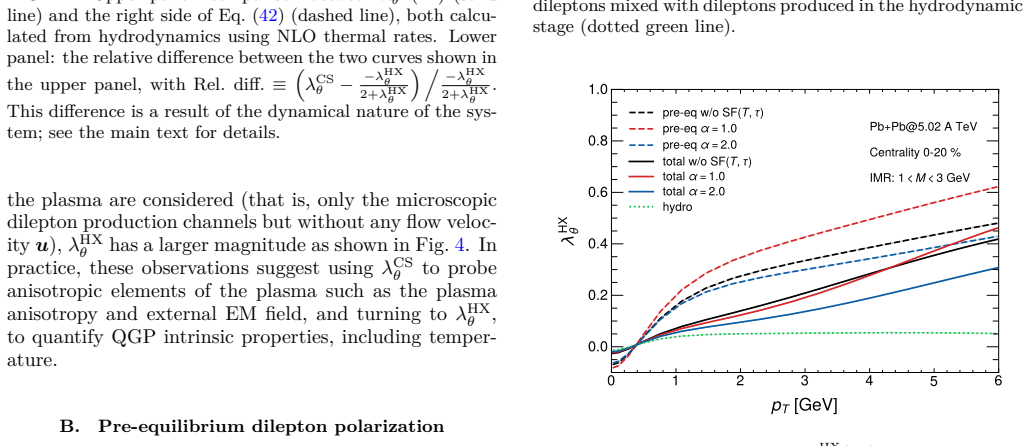
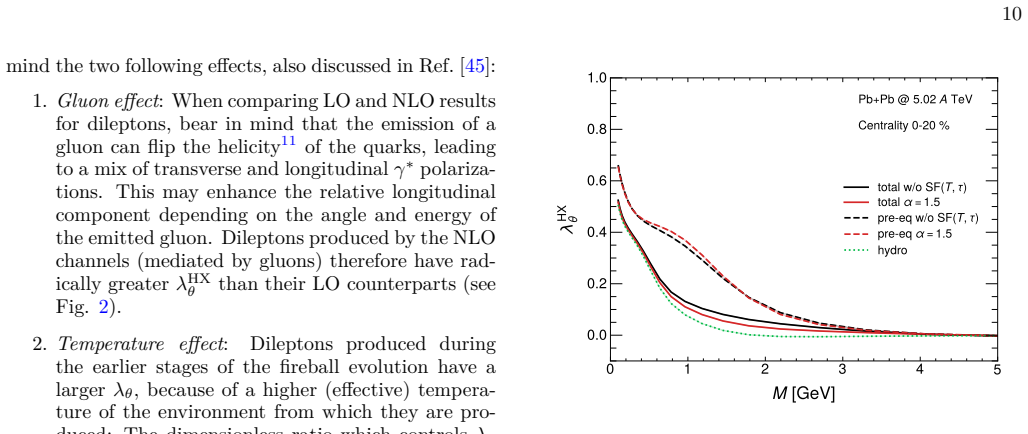
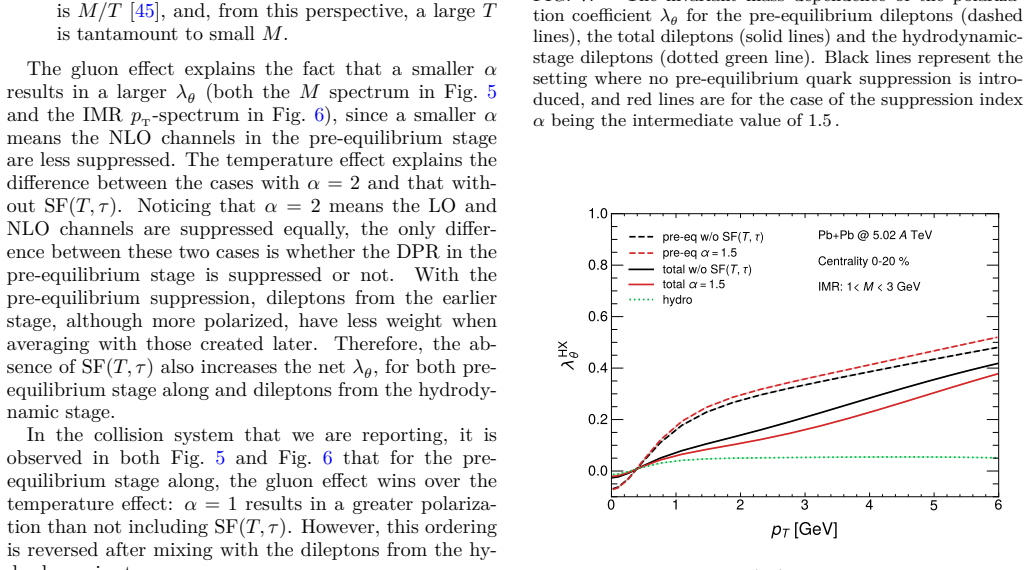
Gluon effect: When comparing LO and NLO results for dileptons, bear in mind that the emission of a gluon can flip the helicity 11 of the quarks, leading to a mix of transverse and longitudinal γ∗ polariza- tions. This may enhance the relative longitudinal component depending on the angle and energy of the emitted gluon. Dileptons produced by the NLO chann...
-
[2]
The gluon effect explains the fact that a smaller α results in a larger λθ (both the M spectrum in Fig
Temperature effect : Dileptons produced during the earlier stages of the fireball evolution have a larger λθ, because of a higher (effective) tempera- ture of the environment from which they are pro- duced: The dimensionless ratio which controls λθ is M/T [45], and, from this perspective, a large T is tantamount to small M . The gluon effect explains the ...
2026
-
[3]
Hydrodynamic Modeling of Heavy-Ion Collisions,
Gale, Charles and Jeon, Sangyong and Schenke, Björn, “Hydrodynamic Modeling of Heavy-Ion Collisions,” Int. J. Mod. Phys. A28, 1340011 (2013) , arXiv:1301.5893 [nucl-th]
Pith/arXiv arXiv 2013
-
[4]
Quark-Gluon Plasma and Hadronic Production of Leptons, Photons and Psions,
Edward V. Shuryak, “Quark-Gluon Plasma and Hadronic Production of Leptons, Photons and Psions,” Phys. Lett. B 78, 150 (1978)
1978
-
[5]
Multimessenger heavy-ion colli- sion physics,
Charles Gale, Jean-François Paquet, Björn Schenke, and Chun Shen, “Multimessenger heavy-ion colli- sion physics,” Phys. Rev. C 105, 014909 (2022) , arXiv:2106.11216 [nucl-th]
arXiv 2022
-
[6]
Production of photons in relativis- tic heavy-ion collisions,
Jean-François Paquet, Chun Shen, Gabriel S. Deni- col, Matthew Luzum, Björn Schenke, Sangyong Jeon, and Charles Gale, “Production of photons in relativis- tic heavy-ion collisions,” Phys. Rev. C93, 044906 (2016) , arXiv:1509.06738 [hep-ph]
Pith/arXiv arXiv 2016
-
[7]
Ther- mal Photons and Collective Flow at the Relativistic Heavy-Ion Collider,
Hendrik van Hees, Charles Gale, and Ralf Rapp, “Ther- mal Photons and Collective Flow at the Relativistic Heavy-Ion Collider,” Phys. Rev. C 84, 054906 (2011) , arXiv:1108.2131 [hep-ph]
Pith/arXiv arXiv 2011
-
[8]
Electromagnetic ra- diation from relativistic nuclear collisions,
Charles Gale and Kevin L. Haglin, “Electromagnetic ra- diation from relativistic nuclear collisions,” , 364–429 (2003), arXiv:hep-ph/0306098
Pith/arXiv arXiv 2003
-
[9]
Dilepton radiation from high temperature nuclear matter,
Charles Gale and Joseph I. Kapusta, “Dilepton radiation from high temperature nuclear matter,” Phys. Rev. C 35, 2107–2116 (1987)
1987
-
[10]
Dilepton Radiation at the CERN Super Proton Synchrotron,
Hendrik van Hees and Ralf Rapp, “Dilepton Radiation at the CERN Super Proton Synchrotron,” Nucl. Phys. A 806, 339–387 (2008) , arXiv:0711.3444 [hep-ph]
Pith/arXiv arXiv 2008
-
[11]
Dileptons, spectral weights, and conductivity in the quark-gluon plasma,
Guy D. Moore and Jean-Marie Robert, “Dileptons, spectral weights, and conductivity in the quark-gluon plasma,” (2006), arXiv:hep-ph/0607172
Pith/arXiv arXiv 2006
-
[12]
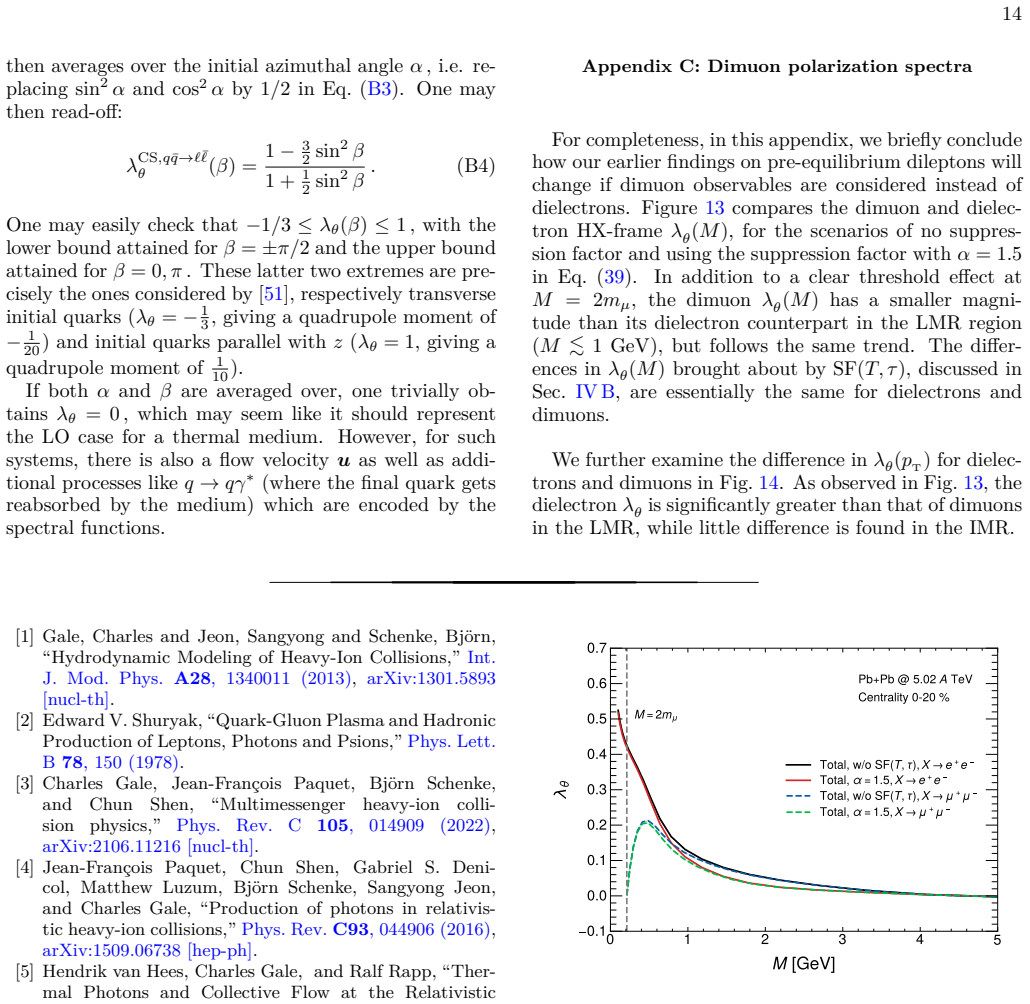
Stefan Floerchinger, Charlotte Gebhardt, and Klaus Reygers, “Electrical conductivity of the quark-gluon plasma from the low energy limit of photon and dilepton spectra,” Phys. Lett. B 837, 137647 (2023) , 0 1 2 3 4 5 M [GeV] 0.1 0.0 0.1 0.2 0.3 0.4 0.5 0.6 0.7 M = 2m Pb+Pb @ 5.02 A TeV Centrality 0-20 % Total, w/o SF(T, ), X e + e Total, = 1.5, X e + e To...
arXiv 2023
-
[13]
Electric Conductivity of QCD Matter and Dilepton Spectra in Heavy-Ion Collisions,
Ralf Rapp, “Electric Conductivity of QCD Matter and Dilepton Spectra in Heavy-Ion Collisions,” (2024), arXiv:2406.14656 [hep-ph]
arXiv 2024
-
[14]
Elec- tric conductivity of hot and dense nuclear matter,
Joseph Atchison, Yiding Han, and Frank Geurts, “Elec- tric conductivity of hot and dense nuclear matter,” Phys. Lett. B 858, 139024 (2024) , arXiv:2408.10176 [nucl-th]
arXiv 2024
-
[15]
Probing the equilibration of the QCD matter cre- ated in heavy-ion collisions with dileptons,
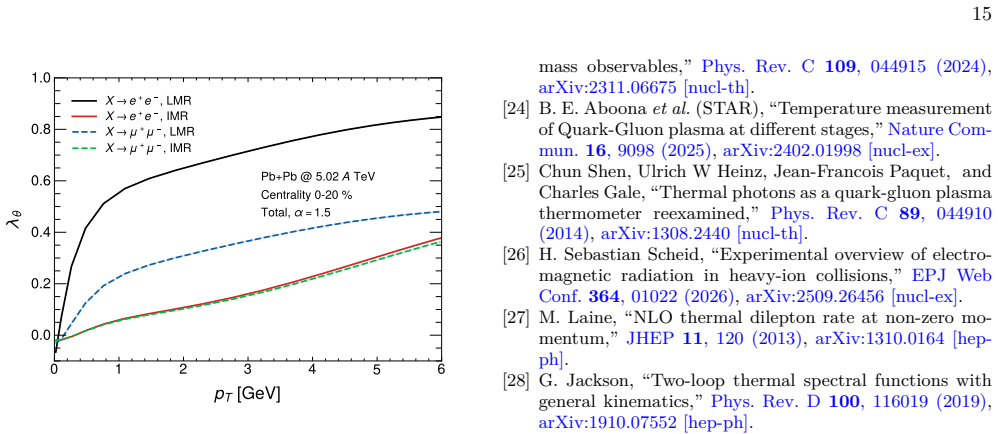
Xiang-Yu Wu, Lipei Du, Charles Gale, and Sangyong Jeon, “Probing the equilibration of the QCD matter cre- ated in heavy-ion collisions with dileptons,” Phys. Rev. 15 0 1 2 3 4 5 6 pT [GeV] 0.0 0.2 0.4 0.6 0.8 1.0 Pb+Pb @ 5.02 A TeV Centrality 0-20 % Total, = 1.5 X e + e , LMR X e + e , IMR X + , LMR X + , IMR FIG. 14. The pT -dependence of the helicity-fr...
arXiv 2024
-
[16]
Scaling of pre-equilibrium dilepton produc- tion in QCD Kinetic Theory,
Oscar Garcia-Montero, Philip Plaschke, and Sören Schlichting, “Scaling of pre-equilibrium dilepton produc- tion in QCD Kinetic Theory,” (2024), arXiv:2403.04846 [hep-ph]
arXiv 2024
-
[17]
Intermedi- ate mass dileptons as pre-equilibrium probes in heavy ion collisions,
Maurice Coquet, Xiaojian Du, Jean-Yves Ollitrault, Soeren Schlichting, and Michael Winn, “Intermedi- ate mass dileptons as pre-equilibrium probes in heavy ion collisions,” Phys. Lett. B 821, 136626 (2021) , arXiv:2104.07622 [nucl-th]
arXiv 2021
-
[18]
Ellipticity of photon emission from strongly magnetized hot QCD plasma,
Xinyang Wang, Igor A. Shovkovy, Lang Yu, and Mei Huang, “Ellipticity of photon emission from strongly magnetized hot QCD plasma,” Phys. Rev. D 102, 076010 (2020), arXiv:2006.16254 [hep-ph]
arXiv 2020
-
[19]
Photon polarization tensor in a magnetized plasma: Absorptive part,
Xinyang Wang and Igor Shovkovy, “Photon polarization tensor in a magnetized plasma: Absorptive part,” Phys. Rev. D 104, 056017 (2021) , arXiv:2103.01967 [nucl-th]
arXiv 2021
-
[20]
Rate and el- lipticity of dilepton production in a magnetized quark- gluon plasma,
Xinyang Wang and Igor A. Shovkovy, “Rate and el- lipticity of dilepton production in a magnetized quark- gluon plasma,” Phys. Rev. D 106, 036014 (2022) , arXiv:2205.00276 [nucl-th]
arXiv 2022
-
[21]
Kento Kimura, Nicholas J. Benoit, Ken-Ichi Ishikawa, Chiho Nonaka, and Kenta Shigaki, “Estimate of vir- tual photon polarization due to the intense magnetic field in Pb-Pb collisions at the LHC energies,” (2024), arXiv:2411.01406 [hep-ph]
arXiv 2024
-
[22]
Temperature Measure- ment of Quark-Gluon Plasma Formed in High-Energy Nucleus-Nucleus Collisions,
K. Kajantie and H. I. Miettinen, “Temperature Measure- ment of Quark-Gluon Plasma Formed in High-Energy Nucleus-Nucleus Collisions,” Z. Phys. C 9, 341 (1981)
1981
-
[23]
NA60 results on ther- mal dimuons,
R. Arnaldi et al. (NA60), “NA60 results on ther- mal dimuons,” Eur. Phys. J. C 61, 711–720 (2009) , arXiv:0812.3053 [nucl-ex]
Pith/arXiv arXiv 2009
-
[24]
Virtual Photons Shed Light on the Early Temperature of Dense QCD Matter,
Jessica Churchill, Lipei Du, Charles Gale, Greg Jackson, and Sangyong Jeon, “Virtual Photons Shed Light on the Early Temperature of Dense QCD Matter,” Phys. Rev. Lett. 132, 172301 (2024) , arXiv:2311.06951 [nucl-th]
arXiv 2024
-
[25]
Dilepton production at next-to-leading order and intermediate invariant- mass observables,
Jessica Churchill, Lipei Du, Charles Gale, Greg Jackson, and Sangyong Jeon, “Dilepton production at next-to-leading order and intermediate invariant- mass observables,” Phys. Rev. C 109, 044915 (2024) , arXiv:2311.06675 [nucl-th]
arXiv 2024
-
[26]
Temperature measurement of Quark-Gluon plasma at different stages,
B. E. Aboona et al. (STAR), “Temperature measurement of Quark-Gluon plasma at different stages,” Nature Com- mun. 16, 9098 (2025) , arXiv:2402.01998 [nucl-ex]
arXiv 2025
-
[27]
Thermal photons as a quark-gluon plasma thermometer reexamined,
Chun Shen, Ulrich W Heinz, Jean-Francois Paquet, and Charles Gale, “Thermal photons as a quark-gluon plasma thermometer reexamined,” Phys. Rev. C 89, 044910 (2014), arXiv:1308.2440 [nucl-th]
Pith/arXiv arXiv 2014
-
[28]
Experimental overview of electro- magnetic radiation in heavy-ion collisions,
H. Sebastian Scheid, “Experimental overview of electro- magnetic radiation in heavy-ion collisions,” EPJ Web Conf. 364, 01022 (2026) , arXiv:2509.26456 [nucl-ex]
arXiv 2026
-
[29]
NLO thermal dilepton rate at non-zero mo- mentum,
M. Laine, “NLO thermal dilepton rate at non-zero mo- mentum,” JHEP 11, 120 (2013) , arXiv:1310.0164 [hep- ph]
Pith/arXiv arXiv 2013
-
[30]
Two-loop thermal spectral functions with general kinematics,
G. Jackson, “Two-loop thermal spectral functions with general kinematics,” Phys. Rev. D 100, 116019 (2019) , arXiv:1910.07552 [hep-ph]
arXiv 2019
-
[31]
Photon emission from ultrarelativistic plasmas,
Peter Brockway Arnold, Guy D. Moore, and Laurence G. Yaffe, “Photon emission from ultrarelativistic plasmas,” JHEP 11, 057 (2001) , arXiv:hep-ph/0109064
Pith/arXiv arXiv 2001
-
[32]
Photon emission from quark gluon plasma: Complete leading order results,
Peter Brockway Arnold, Guy D. Moore, and Lau- rence G. Yaffe, “Photon emission from quark gluon plasma: Complete leading order results,” JHEP 12, 009 (2001), arXiv:hep-ph/0111107 [hep-ph]
Pith/arXiv arXiv 2001
-
[33]
Enhanced ther- mal production of hard dileptons by 3 → 2 processes,
P. Aurenche, F. Gelis, and H. Zaraket, “Enhanced ther- mal production of hard dileptons by 3 → 2 processes,” JHEP 07, 063 (2002) , arXiv:hep-ph/0204145
Pith/arXiv arXiv 2002
-
[34]
Landau-Pomeranchuk-Migdal resummation for dilep- ton production,
P. Aurenche, F. Gelis, G. D. Moore, and H. Zaraket, “Landau-Pomeranchuk-Migdal resummation for dilep- ton production,” JHEP 12, 006 (2002) , arXiv:hep- ph/0211036 [hep-ph]
arXiv 2002
-
[35]
Next-to- leading order thermal photon production in a weakly coupled quark-gluon plasma,
Jacopo Ghiglieri, Juhee Hong, Aleksi Kurkela, Egang Lu, Guy D. Moore, and Derek Teaney, “Next-to- leading order thermal photon production in a weakly coupled quark-gluon plasma,” JHEP 05, 010 (2013) , arXiv:1302.5970 [hep-ph]
Pith/arXiv arXiv 2013
-
[36]
Low Mass Ther- mal Dilepton Production at NLO in a Weakly Cou- pled Quark-Gluon Plasma,
Jacopo Ghiglieri and Guy D. Moore, “Low Mass Ther- mal Dilepton Production at NLO in a Weakly Cou- pled Quark-Gluon Plasma,” JHEP 12, 029 (2014) , arXiv:1410.4203 [hep-ph]
Pith/arXiv arXiv 2014
-
[37]
Ther- mal dilepton production in heavy-ion collisions at beam- energy-scan (BES) energies,
Jessica Churchill, Lipei Du, Bailey Forster, Han Gao, Greg Jackson, Sangyong Jeon, and Charles Gale, “Ther- mal dilepton production in heavy-ion collisions at beam- energy-scan (BES) energies,” EPJ Web Conf. 296, 07006 (2024), arXiv:2312.10166 [nucl-th]
arXiv 2024
-
[38]
Chiral symmetry restoration and dileptons in relativistic heavy ion collisions,
R. Rapp and J. Wambach, “Chiral symmetry restoration and dileptons in relativistic heavy ion collisions,” Adv. Nucl. Phys. 25, 1 (2000) , arXiv:hep-ph/9909229
Pith/arXiv arXiv 2000
-
[39]
Interpolation of hard and soft dilepton rates,
I. Ghisoiu and M. Laine, “Interpolation of hard and soft dilepton rates,” JHEP 10, 083 (2014) , arXiv:1407.7955 [hep-ph]
Pith/arXiv arXiv 2014
-
[40]
Testing thermal photon and dilepton rates,
G. Jackson and M. Laine, “Testing thermal photon and dilepton rates,” JHEP 11, 144 (2019) , arXiv:1910.09567 [hep-ph]
arXiv 2019
-
[41]
Smooth interpolation between thermal Born and LPM rates,
J. Ghiglieri and M. Laine, “Smooth interpolation between thermal Born and LPM rates,” JHEP 01, 173 (2022) , arXiv:2110.07149 [hep-ph]
arXiv 2022
-
[42]
Particle Polarization as a Signal of Plasma Formation,
Paul Hoyer, “Particle Polarization as a Signal of Plasma Formation,” Phys. Lett. B 187, 162–164 (1987)
1987
-
[43]
Virtual photon polarization in ultrarelativistic heavy-ion collisions,
Gordon Baym, Tetsuo Hatsuda, and Michael Strick- land, “Virtual photon polarization in ultrarelativistic heavy-ion collisions,” Phys. Rev. C 95, 044907 (2017) , arXiv:1702.05906 [nucl-th] . 16
Pith/arXiv arXiv 2017
-
[44]
Virtual photon polarization and dilepton anisotropy in relativistic nucleus–nucleus collisions,
Enrico Speranza, Amaresh Jaiswal, and Bengt Friman, “Virtual photon polarization and dilepton anisotropy in relativistic nucleus–nucleus collisions,” Phys. Lett. B 782, 395–400 (2018) , arXiv:1802.02479 [hep-ph]
Pith/arXiv arXiv 2018
-
[45]
Weak magnetic field effect on dilepton polarization in heavy-ion collisions,
Minghua Wei and Li Yan, “Weak magnetic field effect on dilepton polarization in heavy-ion collisions,” Phys. Rev. D 110, 054024 (2024) , arXiv:2406.10041 [nucl-th]
arXiv 2024
-
[46]
Polarization of thermal dilepton radiation,
Florian Seck, Bengt Friman, Tetyana Galatyuk, Hen- drik van Hees, Ralf Rapp, Enrico Speranza, and Jochen Wambach, “Polarization of thermal dilepton radiation,” Phys. Lett. B 861, 139267 (2025) , arXiv:2309.03189 [nucl-th]
arXiv 2025
-
[47]
Thermal Dilep- ton Polarization and Dynamics of the QCD Plasma in Relativistic Heavy-Ion Collisions,
Xiang-Yu Wu, Han Gao, Bailey Forster, Charles Gale, Greg Jackson, and Sangyong Jeon, “Thermal Dilep- ton Polarization and Dynamics of the QCD Plasma in Relativistic Heavy-Ion Collisions,” Phys. Rev. Lett. 134, 242301 (2025) , arXiv:2412.15052 [nucl-th]
arXiv 2025
-
[48]
Shedding light on thermal photon and dilepton production,
Greg Jackson, “Shedding light on thermal photon and dilepton production,” EPJ Web Conf. 274, 05014 (2022) , arXiv:2211.09575 [hep-ph]
arXiv 2022
-
[49]
Lattice constraints on the thermal photon rate,
J. Ghiglieri, O. Kaczmarek, M. Laine, and F. Meyer, “Lattice constraints on the thermal photon rate,” Phys. Rev. D 94, 016005 (2016) , arXiv:1604.07544 [hep-lat]
Pith/arXiv arXiv 2016
-
[50]
Rate of photon production in the quark-gluon plasma from lattice QCD,
Marco Cè, Tim Harris, Harvey B. Meyer, Aman Stein- berg, and Arianna Toniato, “Rate of photon production in the quark-gluon plasma from lattice QCD,” Phys. Rev. D 102, 091501 (2020) , arXiv:2001.03368 [hep-lat]
arXiv 2020
-
[51]
Photon emissivity of the quark-gluon plasma: A lattice QCD analysis of the transverse chan- nel,
Marco Cè, Tim Harris, Ardit Krasniqi, Harvey B. Meyer, and Csaba Török, “Photon emissivity of the quark-gluon plasma: A lattice QCD analysis of the transverse chan- nel,” Phys. Rev. D 106, 054501 (2022) , arXiv:2205.02821 [hep-lat]
arXiv 2022
-
[52]
Lattice QCD estimates of thermal photon production from the QGP,
Sajid Ali, Dibyendu Bala, Anthony Francis, Greg Jack- son, Olaf Kaczmarek, Jonas Turnwald, Tristan Ueding, and Nicolas Wink (HotQCD), “Lattice QCD estimates of thermal photon production from the QGP,” Phys. Rev. D 110, 054518 (2024) , arXiv:2403.11647 [hep-lat]
arXiv 2024
-
[53]
Dilepton Polariza- tion as a Signature of Plasma Anisotropy,
Maurice Coquet, Michael Winn, Xiaojian Du, Jean-Yves Ollitrault, and Soeren Schlichting, “Dilepton Polariza- tion as a Signature of Plasma Anisotropy,” Phys. Rev. Lett. 132, 232301 (2024) , arXiv:2309.00555 [nucl-th]
arXiv 2024
-
[54]
Polarized photons from the early stages of relativistic heavy- ion collisions,
Sigtryggur Hauksson and Charles Gale, “Polarized photons from the early stages of relativistic heavy- ion collisions,” Phys. Rev. C 109, 034902 (2024) , arXiv:2306.10307 [nucl-th]
arXiv 2024
-
[55]
Kapusta and Charles Gale, Finite-Temperature Field Theory , Cambridge Monographs on Mathematical Physics (Cambridge University Press, 2023)
Joseph I. Kapusta and Charles Gale, Finite-Temperature Field Theory , Cambridge Monographs on Mathematical Physics (Cambridge University Press, 2023)
2023
-
[56]
Covariant Calculations at Finite Temperature: The Relativistic Plasma,
H. Arthur Weldon, “Covariant Calculations at Finite Temperature: The Relativistic Plasma,” Phys. Rev. D 26, 1394 (1982)
1982
-
[57]
Photon and Dilep- ton Emission from the Quark - Gluon Plasma: Some General Considerations,
Larry D. McLerran and T. Toimela, “Photon and Dilep- ton Emission from the Quark - Gluon Plasma: Some General Considerations,” Phys. Rev. D 31, 545 (1985)
1985
-
[58]
Reformulation of finite temperature dilepton production,
H. A. Weldon, “Reformulation of finite temperature dilepton production,” Phys. Rev. D 42, 2384–2387 (1990)
1990
-
[59]
Vector dominance model at finite temperature,
Charles Gale and Joseph I. Kapusta, “Vector dominance model at finite temperature,” Nucl. Phys. B 357, 65–89 (1991)
1991
-
[60]
An estimate for the thermal photon rate from lattice QCD,
Bastian B. Brandt, Anthony Francis, Tim Harris, Har- vey B. Meyer, and Aman Steinberg, “An estimate for the thermal photon rate from lattice QCD,” EPJ Web Conf. 175, 07044 (2018) , arXiv:1710.07050 [hep-lat]
Pith/arXiv arXiv 2018
-
[61]
Asymptotics of thermal spectral func- tions,
S. Caron-Huot, “Asymptotics of thermal spectral func- tions,” Phys. Rev. D 79, 125009 (2009) , arXiv:0903.3958 [hep-ph]
Pith/arXiv arXiv 2009
-
[62]
Ul- traviolet asymptotics of scalar and pseudoscalar corre- lators in hot Yang-Mills theory,
Laine, M. and Vepsäläinen, M. and Vuorinen, A., “Ul- traviolet asymptotics of scalar and pseudoscalar corre- lators in hot Yang-Mills theory,” JHEP 10, 010 (2010) , arXiv:1008.3263 [hep-ph]
Pith/arXiv arXiv 2010
-
[63]
Finite temperature sum rules in the vector channel at finite momentum,
Philipp Gubler and Daisuke Satow, “Finite temperature sum rules in the vector channel at finite momentum,” Phys. Rev. D 96, 114028 (2017) , arXiv:1710.02256 [hep- ph]
Pith/arXiv arXiv 2017
-
[64]
Photon and dilepton produc- tion rate in the quark-gluon plasma from lattice QCD,
Harvey B. Meyer, Marco Cè, Tim Harris, Ardit Kras- niqia, and Csaba Török, “Photon and dilepton produc- tion rate in the quark-gluon plasma from lattice QCD,” PoS LA TTICE2022, 186 (2023)
2023
-
[65]
Towards the experimental clarification of quarkonium polarization,
Pietro Faccioli, Carlos Lourenco, Joao Seixas, and Her- mine K. Wohri, “Towards the experimental clarification of quarkonium polarization,” Eur. Phys. J. C 69, 657–673 (2010), arXiv:1006.2738 [hep-ph]
Pith/arXiv arXiv 2010
-
[66]
Angular Distri- bution of Dileptons in High-Energy Hadron Collisions,
John C. Collins and Davison E. Soper, “Angular Distri- bution of Dileptons in High-Energy Hadron Collisions,” Phys. Rev. D 16, 2219 (1977)
1977
-
[67]
A New approach to quarkonium polarization studies,
Pietro Faccioli, Carlos Lourenco, and Joao Seixas, “A New approach to quarkonium polarization studies,” Phys. Rev. D 81, 111502 (2010) , arXiv:1005.2855 [hep- ph]
Pith/arXiv arXiv 2010
-
[68]
(3+1)D hydrodynamic simulation of relativistic heavy- ion collisions,
Schenke, Björn and Jeon, Sangyong and Gale, Charles, “(3+1)D hydrodynamic simulation of relativistic heavy- ion collisions,” Phys. Rev. C82, 014903 (2010) , arXiv:1004.1408 [hep-ph]
Pith/arXiv arXiv 2010
-
[69]
Ellip- tic and triangular flow in event-by-event (3+1)D viscous hydrodynamics,
Björn Schenke, Sangyong Jeon, and Charles Gale, “Ellip- tic and triangular flow in event-by-event (3+1)D viscous hydrodynamics,” Phys. Rev. Lett. 106, 042301 (2011) , arXiv:1009.3244 [hep-ph]
Pith/arXiv arXiv 2011
-
[70]
The Color glass condensate: An Introduction,
Edmond Iancu, Andrei Leonidov, and Larry McLer- ran, “The Color glass condensate: An Introduction,” in Cargese Summer School on QCD Perspectives on Hot and Dense Matter (2002) pp. 73–145, arXiv:hep-ph/0202270
Pith/arXiv arXiv 2002
-
[71]
Fluctuating Glasma initial conditions and flow in heavy ion collisions,
Schenke, Björn and Tribedy, Prithwish and Venugopalan, Raju, “Fluctuating Glasma initial conditions and flow in heavy ion collisions,” Phys. Rev. Lett. 108, 252301 (2012), arXiv:1202.6646 [nucl-th]
Pith/arXiv arXiv 2012
-
[72]
Schenke, Björn and Tribedy, Prithwish and Venu- gopalan, Raju, “Event-by-event gluon multiplicity, en- ergy density, and eccentricities in ultrarelativistic heavy- ion collisions,” Phys. Rev. C 86, 034908 (2012) , arXiv:1206.6805 [hep-ph]
Pith/arXiv arXiv 2012
-
[73]
An Impact param- eter dipole saturation model,
Henri Kowalski and Derek Teaney, “An Impact param- eter dipole saturation model,” Phys. Rev. D 68, 114005 (2003), arXiv:hep-ph/0304189
Pith/arXiv arXiv 2003
-
[74]
Aleksi Kurkela, Aleksas Mazeliauskas, Jean-François Pa- quet, Sören Schlichting, and Derek Teaney, “Matching the Nonequilibrium Initial Stage of Heavy Ion Collisions to Hydrodynamics with QCD Kinetic Theory,” Phys. Rev. Lett. 122, 122302 (2019) , arXiv:1805.01604 [hep- ph]
Pith/arXiv arXiv 2019
-
[75]
Aleksi Kurkela, Aleksas Mazeliauskas, Jean-François Pa- quet, Sören Schlichting, and Derek Teaney, “Effective kinetic description of event-by-event pre-equilibrium dy- namics in high-energy heavy-ion collisions,” Phys. Rev. C99, 034910 (2019) , arXiv:1805.00961 [hep-ph]
Pith/arXiv arXiv 2019
-
[76]
Equation of state in ( 2+1 )-flavor QCD,
A. Bazavov et al. (HotQCD), “Equation of state in ( 2+1 )-flavor QCD,” Phys. Rev. D 90, 094503 (2014) , arXiv:1407.6387 [hep-lat] . 17
Pith/arXiv arXiv 2014
-
[77]
Derivation of transient relativistic fluid dy- namics from the Boltzmann equation,
G. S. Denicol, H. Niemi, E. Molnar, and D. H. Rischke, “Derivation of transient relativistic fluid dy- namics from the Boltzmann equation,” Phys. Rev. D 85, 114047 (2012) , [Erratum: Phys.Rev.D 91, 039902 (2015)], arXiv:1202.4551 [nucl-th]
Pith/arXiv arXiv 2012
-
[78]
Importance of the Bulk Viscosity of QCD in Ultrarelativistic Heavy-Ion Collisions,
S. Ryu, J. F. Paquet, C. Shen, G. S. Denicol, B. Schenke, S. Jeon, and C. Gale, “Importance of the Bulk Viscosity of QCD in Ultrarelativistic Heavy-Ion Collisions,” Phys. Rev. Lett. 115, 132301 (2015) , arXiv:1502.01675 [nucl- th]
Pith/arXiv arXiv 2015
-
[79]
Running the gamut of high energy nuclear collisions,
Schenke, Björn and Shen, Chun and Tribedy, Prithwish, “Running the gamut of high energy nuclear collisions,” Phys. Rev. C 102, 044905 (2020) , arXiv:2005.14682 [nucl-th]
arXiv 2020
-
[80]
The iEBE-VISHNU code package for relativistic heavy-ion collisions,
Chun Shen, Zhi Qiu, Huichao Song, Jonah Bernhard, Steffen Bass, and Ulrich Heinz, “The iEBE-VISHNU code package for relativistic heavy-ion collisions,” Com- put. Phys. Commun. 199, 61–85 (2016) , arXiv:1409.8164 [nucl-th]
Pith/arXiv arXiv 2016
discussion (0)
Sign in with ORCID, Apple, or X to comment. Anyone can read and Pith papers without signing in.