REVIEW 2 major objections 1 minor 31 references
The relative interfacial thermal contraction as a possible origin of the low-energy excess in cryogenic calorimeters
T0 review · 2 major / 1 minor · reviewed 2026-06-28 · grok-4.3
Pith's one-line read The low-energy excess in cryogenic calorimeters originates from surface dislocations triggered by thermal contraction mismatch at the absorber-TES interface.
desk verdict The paper floats a plausible solid-state origin for the LEE via contraction mismatch but the elastic model stays qualitative and does not derive the observed spectrum or rate. read the letter →
The pith
A machine-rendered reading of the paper's core claim, the machinery that carries it, and where it could break.
The reading
What carries the argument
Relative interfacial thermal contraction mismatch between absorber and SiO2 layer, which drives surface dislocation nucleation during cooldown or fabrication.
What would settle it
Fabricate otherwise identical detectors using an interface layer whose thermal contraction coefficient matches the absorber and measure whether the LEE disappears or changes its spectrum.
Extended reading notes
Core claim
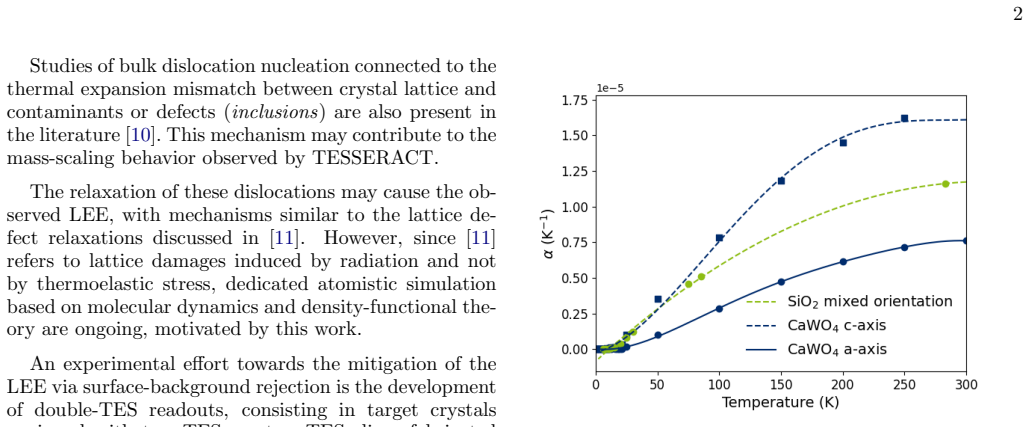
The authors describe the LEE as absorber events induced by the relative thermal-contraction coefficient mismatch between the absorber and the SiO2 amorphous layer underneath the transition-edge sensors. The mismatch during temperature changes can induce surface dislocation nucleation, and a simple elastic model connects this process to the LEE observations. The presence of the LEE in the coincident-event band of double-TES modules is consistent with the account when thermal boundary resistance is taken into account.
Load-bearing premise
The mismatch in contraction produces dislocations whose energies and rates exactly match the measured LEE spectrum.
Editorial extensions
If this is right
- Double-TES modules with surface rejection would still register the LEE in the coincident band because the events originate inside the absorber.
- Thermal boundary resistance between absorber and sensor can keep the dislocation energy from being shared promptly, allowing coincident registration.
- Any detector interface with mismatched thermal expansion coefficients can generate similar dislocation events during temperature cycles.
- Mitigation requires redesign of the sensor-absorber interface rather than changes to shielding or veto systems.
Reading between the lines
- Replacing the SiO2 layer with a material whose expansion coefficient matches the absorber would provide a direct test and possible fix.
- The same mechanism could limit sensitivity in other cryogenic detector technologies that use thin films on crystals.
- Quantitative modeling of dislocation energy release at the specific interface temperatures could predict the LEE spectrum without free parameters.
Signed reviews
Editorial analysis
A structured set of objections, weighed in public.
Referee Report
Summary. The manuscript proposes that the low-energy excess (LEE) observed in low-threshold cryogenic calorimeters arises from absorber events triggered by surface dislocation nucleation due to the mismatch in thermal contraction coefficients between the absorber and the underlying SiO₂ amorphous layer (as in CRESST-style TES detectors). A simple elastic model is formulated to connect this interfacial effect to the LEE, and the appearance of LEE in the coincident-event band of double-TES modules is attributed to thermal boundary resistance; detector designs are suggested to test and mitigate the proposed mechanism.
Significance. A quantitatively validated model linking measured thermal-contraction coefficients and layer properties to the LEE spectrum and rate would constitute a substantive advance for background understanding in rare-event searches. The explicit proposal of testable detector geometries is a constructive element that could enable falsification.
major comments (2)
- [Elastic model formulation] The elastic model is described as bridging the contraction mismatch to LEE observations, yet no derivation is supplied showing that the resulting dislocation nucleation energies and rates reproduce the observed LEE spectrum (rising toward threshold) or absolute normalization from the input material parameters alone; the central claim therefore rests on an unverified assumption rather than a demonstrated prediction.
- [Double-TES modules discussion] The thermal-boundary-resistance argument invoked to explain LEE events in the coincident band of double-TES modules introduces an additional free parameter whose magnitude is not constrained by independent measurement or calculation, leaving the explanation for the coincident-band population unquantified.
minor comments (1)
- Explicit equations for the elastic model, together with numerical predictions and direct comparison to published LEE spectra, should be added so that the quantitative link can be verified.
Simulated Author's Rebuttal
We thank the referee for the constructive report and the recommendation for major revision. We address each major comment below, clarifying the scope and intent of the manuscript while acknowledging its limitations as an initial proposal.
read point-by-point responses
-
Referee: [Elastic model formulation] The elastic model is described as bridging the contraction mismatch to LEE observations, yet no derivation is supplied showing that the resulting dislocation nucleation energies and rates reproduce the observed LEE spectrum (rising toward threshold) or absolute normalization from the input material parameters alone; the central claim therefore rests on an unverified assumption rather than a demonstrated prediction.
Authors: The manuscript presents a simple elastic model as a conceptual bridge between the known thermal-contraction mismatch and the possibility of surface dislocation nucleation, rather than a complete first-principles derivation of the LEE spectrum or rate. We agree that the model does not quantitatively reproduce the observed spectral shape or absolute normalization from material parameters alone; such a derivation would require atomistic simulations of nucleation barriers and statistics that lie beyond the scope of this work. The central claim is therefore that the mechanism is plausible and testable, not that it has been fully validated. We will revise the text to state these limitations more explicitly and to frame the model as an order-of-magnitude illustration. revision: partial
-
Referee: [Double-TES modules discussion] The thermal-boundary-resistance argument invoked to explain LEE events in the coincident band of double-TES modules introduces an additional free parameter whose magnitude is not constrained by independent measurement or calculation, leaving the explanation for the coincident-band population unquantified.
Authors: The thermal-boundary-resistance discussion is offered only as an exemplary illustration of how LEE events could appear in the coincident band without contradicting the proposed mechanism. We acknowledge that the argument introduces an unconstrained parameter and does not provide a quantitative prediction for the coincident population. No independent constraint is attempted in the manuscript. We will revise the relevant paragraph to label this explanation as qualitative and to note that dedicated measurements of the boundary resistance in the relevant geometry would be required for quantification. revision: partial
Circularity Check
No circularity: model remains an unquantified assumption without reduction to inputs
full rationale
The provided manuscript text (abstract and description) states that a simple elastic model is formulated to link interfacial thermal contraction mismatch to LEE via dislocation nucleation, but supplies no equations, fitted parameters, or self-citations. No derivation chain exists that reduces a claimed prediction to its own inputs by construction. The central claim is presented as a hypothesis requiring future tests, with no load-bearing step that is self-definitional, a fitted input renamed as prediction, or dependent on author-overlapping citations. This is the normal case of a paper whose quantitative bridge is not yet derived, yielding no detectable circularity.
Assumptions & free parameters
Cite this review
Pith. "Pith review of The relative interfacial thermal contraction as a possible origin of the low-energy excess in cryogenic calorimeters." pith.science (2026). https://pith.science/paper/A25IP6JH
@misc{pith2026260530194,
  author       = {Pith},
  title        = {Pith review of: The relative interfacial thermal contraction as a possible origin of the low-energy excess in cryogenic calorimeters},
  year         = {2026},
  howpublished = {\url{https://pith.science/paper/A25IP6JH}},
  note         = {Machine review of arXiv:2605.30194}
}
abstract
Low threshold cryogenic calorimeters are a key technology for the advancement of rare-event searches. However, since a few years their sensitivity reach is challenged by the presence of a rising spectrum at low energies named low-energy excess (LEE), ascribed to an unknown background. In this work, we describe the LEE as absorber events induced by the relative thermal-contraction coefficient mismatch between the absorber and the SiO$_2$ amorphous layer underneath the transition-edge sensors (TESs), present for example in the case of CRESST detectors. The relative contraction in processes with temperature changes, such as during sensor fabrication and cooldown from room temperature to the temperature of operation, can induce surface dislocation nucleation. Other interfaced materials with thermal-expansion mismatch can also generate dislocations during temperature-variation processes. We formulate a simple elastic model to bridge this solid-state effect and the LEE observations. Double-TES modules have been designed to provide surface background rejection. We highlight that the presence of the LEE in the coincident event band of double-TES modules does not exclude the explanation given in this work. Exemplary, we discuss the role of the thermal boundary resistance between absorber and sensor as explanation for the presence of the LEE in the coincident-event band. We propose detector designs to test these hypotheses and mitigate the LEE.
Figures


Figures from the paper (1 more)

Reference graph
Works this paper leans on
-
[1]
Fusset al., EXCESS workshop: Descriptions of rising low-energy spectra, SciPost Phys
A. Fusset al., EXCESS workshop: Descriptions of rising low-energy spectra, SciPost Phys. Proc.9, 001 (2022)
2022
-
[2]
Baxteret al., Low-Energy Backgrounds in Solid-State Phonon and Charge Detectors, Ann
D. Baxteret al., Low-Energy Backgrounds in Solid-State Phonon and Charge Detectors, Ann. Rev. Nucl. Part. Sci. 75, 301 (2025)
2025
-
[3]
Angloheret al.(CRESST), Latest observations on the low energy excess in CRESST-III, SciPost Phys
G. Angloheret al.(CRESST), Latest observations on the low energy excess in CRESST-III, SciPost Phys. Proc. , 013 (2023)
2023
-
[4]
Gascon, EDELWEISS (+Ricochet Ge) Low-energy spectrum studies, inEXCESS Workshop(2021)
J. Gascon, EDELWEISS (+Ricochet Ge) Low-energy spectrum studies, inEXCESS Workshop(2021)
2021
-
[5]
H. Abeleet al.(NUCLEUS), Characterization of the Low Energy Excess using a NUCLEUS Al 2O3 detector, (2026), arXiv:2603.07687
-
[6]
C. L. Changet al.(TESSERACT), Spontaneous gen- eration of athermal phonon bursts within bulk silicon causing excess noise, low energy background events, and quasiparticle poisoning in superconducting sensors, Appl. Phys. Lett.127, 263502 (2025)
2025
-
[7]
A. Armatolet al., Low Energy Phonon Bursts Created By Fast Neutron Damage, (2026), arXiv:2603.17964
-
[8]
Zemaet al., The low energy excess in CRESST-III, in EXCESS23@TAUP Workshop(2023)
V. Zemaet al., The low energy excess in CRESST-III, in EXCESS23@TAUP Workshop(2023)
2023
Show all 31 references
-
[9]
Zhuet al., Temperature and strain-rate dependence of surface dislocation nucleation, Phys
T. Zhuet al., Temperature and strain-rate dependence of surface dislocation nucleation, Phys. Rev. Lett.100, 025502 (2008)
2008
-
[10]
Arsenault and N
R. Arsenault and N. Shi, Dislocation generation due to differences between the coefficients of thermal expansion, Materials Science and Engineering81, 175 (1986), Pro- ceedings of the International Conference on Low Energy Dislocation Structures
1986
-
[11]
Nordlundet al., Spontaneous damage annealing reac- tions as a possible source of low energy excess in semi- conductor detectors, Phys
K. Nordlundet al., Spontaneous damage annealing reac- tions as a possible source of low energy excess in semi- conductor detectors, Phys. Rev. Mater.9, 113603 (2025)
2025
-
[12]
Angloheret al.(CRESST), DoubleTES detectors to investigate the CRESST low energy background: results from above-ground prototypes, Eur
G. Angloheret al.(CRESST), DoubleTES detectors to investigate the CRESST low energy background: results from above-ground prototypes, Eur. Phys. J. C84, 1001 (2024), [Erratum: Eur.Phys.J.C 84, 1227 (2024)]
2024
-
[13]
N. W. Ashcroft and N. D. Mermin,Solid State Physics, Chapter 25(Harcourt College Publishers, 1976)
1976
-
[14]
Senyshyn, H
A. Senyshyn, H. Kraus, V. B. Mikhailik, and V. Yakovyna, Lattice dynamics and thermal properties of CaWO4, Phys. Rev. B70, 214306 (2004)
2004
-
[15]
White, Thermal expansion of silica at low tempera- tures, Cryogenics4, 2 (1964)
G. White, Thermal expansion of silica at low tempera- tures, Cryogenics4, 2 (1964)
1964
-
[16]
R. J. Corruccini and J. J. Gniewek,Thermal Expansion of Technical Solids at Low Temperatures: A Compilation from the Literature(National Institute of Standards and Technology, Gaithersburg, MD, 1961)
1961
-
[17]
Barron, J
T. Barron, J. Collins, and G. White, Thermal expansion of solids at low temperatures, Advances in Physics29, 609 (1980)
1980
-
[18]
A. C. Kinast,Enhancing the Dark Matter Sensitivity of CRESST: Purification, Stress Reduction and 17O En- richment of CaWO4 Target Crystals, Ph.D. thesis, Tech- nische Universit¨ at M¨ unchen (2023)
2023
-
[19]
S. N. Kuckuk,An Extensive Description of the Low- Energy Excess in CRESST-III, Dr. rer. nat. dissertation, Eberhard Karls University of T¨ ubingen, T¨ ubingen, Ger- many (2025)
2025
-
[20]
Zalkin and D
A. Zalkin and D. H. Templeton, X-Ray Diffraction Re- finement of the Calcium Tungstate Structure, The Jour- nal of Chemical Physics40, 501 (1964)
1964
-
[21]
Farley and G
J. Farley and G. Saunders, The elastic constants of CaWO4, Solid State Communications9, 965 (1971). 7
1971
-
[22]
Gluyas, F
M. Gluyas, F. D. Hughes, and B. W. James, The elas- tic constants of calcium tungstate, 4·2-300 K, Journal of Physics D: Applied Physics6, 2025 (1973)
2025
-
[23]
Ohring, Chapter 8 - Epitaxy, inMaterials Science of Thin Films (Second Edition), edited by M
M. Ohring, Chapter 8 - Epitaxy, inMaterials Science of Thin Films (Second Edition), edited by M. Ohring (Academic Press, San Diego, 2002) second edition ed., pp. 417–494
2002
-
[24]
Roos and F
B. Roos and F. Ernst, Thermal-stress-induced dislo- cations in GeSi/Si heterostructures, Journal of crystal growth137, 457 (1994)
1994
-
[25]
Armour and A
D. Armour and A. Al-Bayati, Surface radiation damage, Nuclear Instruments and Methods in Physics Research Section B: Beam Interactions with Materials and Atoms 67, 279 (1992)
1992
-
[26]
Bany Salman, M
M. Bany Salman, M. Park, and M. J. Banisalman, Atom- istic Study for the Tantalum and Tantalum–Tungsten Al- loy Threshold Displacement Energy under Local Strain, International Journal of Molecular Sciences24(2023)
2023
-
[27]
Raya-Morenoet al., Phonon dynamics for light dark matter detection, Phys
M. Raya-Morenoet al., Phonon dynamics for light dark matter detection, Phys. Rev. D110, 112007 (2024)
2024
-
[28]
Smirnov, Copper, gold, and platinum under femtosec- ond irradiation: Results of first-principles calculations, Physical Review B101, 094103 (2020)
N. Smirnov, Copper, gold, and platinum under femtosec- ond irradiation: Results of first-principles calculations, Physical Review B101, 094103 (2020)
2020
-
[29]
Jainet al., Commentary: The Materials Project: A materials genome approach to accelerating materials in- novation, APL materials1(2013)
A. Jainet al., Commentary: The Materials Project: A materials genome approach to accelerating materials in- novation, APL materials1(2013)
2013
-
[30]
A. R. Jani and V. B. Gohel, On the phonon dispersion in tungsten, Journal of Physics F: Metal Physics6, L25 (1976)
1976
-
[31]
Giannozzi, S
P. Giannozzi, S. de Gironcoli, P. Pavone, and S. Baroni, Ab initio calculation of phonon dispersions in semicon- ductors, Phys. Rev. B43, 7231 (1991)
1991
Reviewed June 28, 2026 · model on record in the stance chip above.
Discussion (0). Continue with ORCID to comment.