Energetic characterisation of transient clustering dynamics in aggregation-diffusion systems
Pith reviewed 2026-06-29 00:13 UTC · model grok-4.3
The pith
Numerical experiments identify alternating aggregation- and diffusion-dominated regimes during transient clustering in aggregation-diffusion systems.
A machine-rendered reading of the paper's core claim, the machinery that carries it, and where it could break.
Core claim
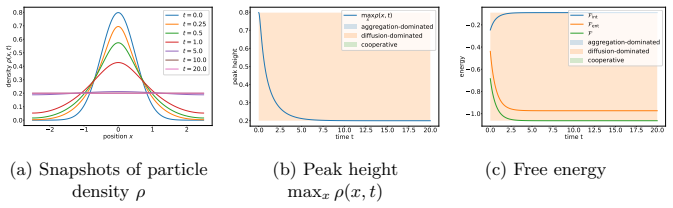
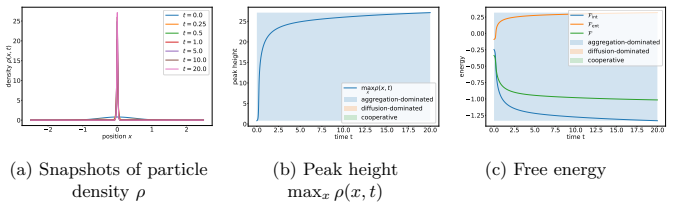
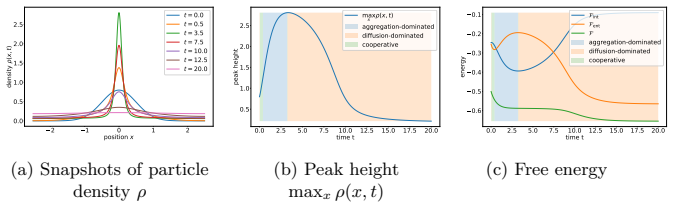
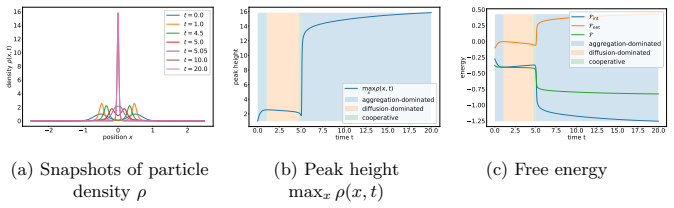
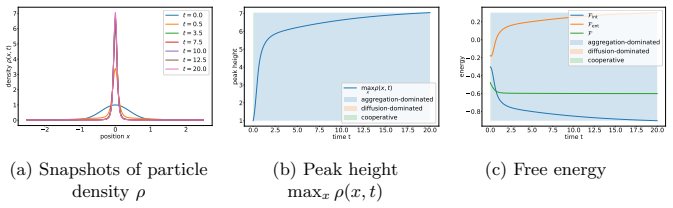
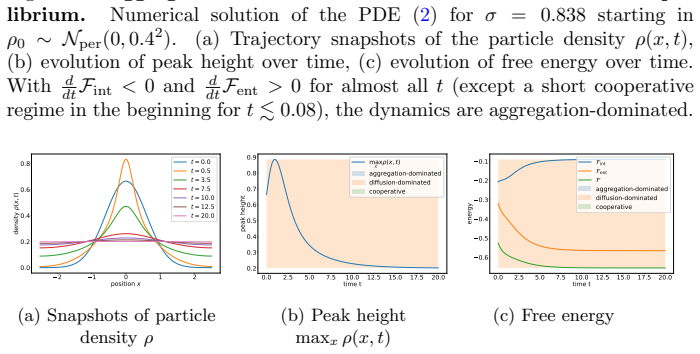
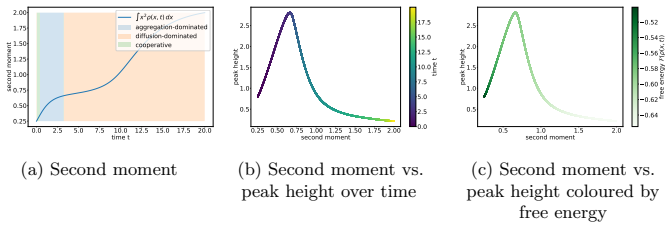
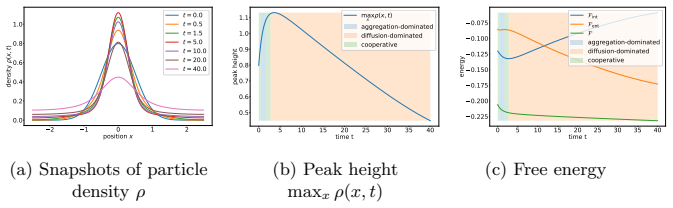
Starting from a stochastic interacting particle system, the macroscopic McKean-Vlasov equation on the torus is analysed via its Wasserstein gradient-flow structure to study the competition between interaction energy and entropy. Numerical experiments with locally attractive kernels identify alternating aggregation- and diffusion-dominated transient regimes along paths to fixed equilibria; these are interpreted as non-monotone clustering. Clustering observables such as density peak height prove only partially coupled to the energetic mechanisms and therefore fail to uniquely characterise the relevant transport dynamics.
What carries the argument
The Wasserstein gradient-flow structure of the McKean-Vlasov equation, which variationally encodes the competition between interaction energy and entropy and thereby organises the transient dynamics.
Load-bearing premise
Numerical experiments on the McKean-Vlasov equation with locally attractive kernels are sufficient to identify alternating regimes and to establish that clustering observables are only partially coupled to energetic mechanisms.
What would settle it
A numerical trajectory in the same setting where the density peak height changes monotonically in lockstep with the rate of energy dissipation would falsify the claim of partial coupling.
Figures
read the original abstract
We investigate transient clustering dynamics in nonlocal aggregation-diffusion systems from an energetic perspective. Starting from a stochastic interacting particle system, we study the associated macroscopic McKean-Vlasov equation on the torus and exploit its Wasserstein gradient-flow structure to analyse the thermodynamic competition between interaction-driven aggregation and entropy-driven diffusion. Through numerical experiments for locally attractive interaction kernels, we identify alternating aggregation- and diffusion-dominated transient regimes along trajectories converging to fixed equilibria. These dynamics can be interpreted as a form of non-monotone clustering behaviour. Moreover, we demonstrate that clustering observables, such as the density peak height, are only partially coupled to the underlying energetic mechanisms and therefore do not uniquely characterise the relevant macroscopic transport dynamics. Our results highlight the role of the variational structure not only for equilibrium analysis, but also as a framework for understanding transient clustering phenomena in interacting particle systems.
Editorial analysis
A structured set of objections, weighed in public.
Referee Report
Summary. The manuscript investigates transient clustering dynamics in nonlocal aggregation-diffusion systems modeled by the McKean-Vlasov equation on the torus. It exploits the Wasserstein gradient-flow structure to analyze the competition between interaction-driven aggregation and entropy-driven diffusion. Numerical experiments with locally attractive interaction kernels identify alternating aggregation- and diffusion-dominated transient regimes along trajectories to equilibria (interpreted as non-monotone clustering), and demonstrate that observables such as density peak height are only partially coupled to the underlying energetic mechanisms.
Significance. If the numerical observations are robust, the work extends the application of variational structures from equilibrium analysis to transient dynamics, offering a framework for understanding non-monotone clustering in interacting particle systems. The energetic perspective on the partial decoupling of clustering observables from energy dissipation is a potentially useful contribution to the study of aggregation-diffusion models.
major comments (1)
- [Abstract] Abstract (numerical experiments paragraph): the central observational claims rest on numerical identification of alternating regimes and partial coupling of observables, yet no details are provided on discretization scheme, time-stepping, error controls, kernel definitions, or quantitative thresholds for regime identification. This renders the claims unverifiable from the given information and is load-bearing for the main results.
Simulated Author's Rebuttal
We thank the referee for their detailed review and valuable feedback on our manuscript. We appreciate the recognition of the potential significance of our work on transient clustering dynamics. Below, we provide a point-by-point response to the major comment.
read point-by-point responses
-
Referee: [Abstract] Abstract (numerical experiments paragraph): the central observational claims rest on numerical identification of alternating regimes and partial coupling of observables, yet no details are provided on discretization scheme, time-stepping, error controls, kernel definitions, or quantitative thresholds for regime identification. This renders the claims unverifiable from the given information and is load-bearing for the main results.
Authors: We agree with the referee that the abstract's description of the numerical experiments lacks the necessary details on the discretization, time-stepping, and regime identification criteria, which are essential for verifying the central claims. While these details are elaborated in the main text (specifically in the numerical methods section), we acknowledge that the abstract should be self-contained to a greater extent for such observational results. We will revise the abstract to incorporate a brief mention of the numerical scheme (e.g., finite volume discretization with IMEX time stepping), the kernel specifications, and the quantitative criteria used for identifying aggregation- vs. diffusion-dominated regimes (based on the relative contributions to the energy dissipation). This revision will be made in the next version of the manuscript. revision: yes
Circularity Check
No significant circularity
full rationale
The paper's central claims rest on numerical experiments performed on the standard McKean-Vlasov equation and its established Wasserstein gradient-flow structure, which is drawn from prior literature rather than derived or fitted within this work. The identification of alternating aggregation/diffusion regimes and the partial coupling of clustering observables to energetic mechanisms are presented as direct observational results from those simulations, without any reduction of the reported dynamics to quantities defined by self-citations, fitted parameters renamed as predictions, or ansatzes smuggled via the authors' own prior work. The energetic interpretation simply invokes the known competition between interaction and entropy terms. No load-bearing step in the derivation chain reduces to its own inputs by construction.
Axiom & Free-Parameter Ledger
axioms (1)
- domain assumption The macroscopic dynamics are governed by the McKean-Vlasov equation possessing a Wasserstein gradient-flow structure that encodes the competition between interaction energy and entropy.
Reference graph
Works this paper leans on
-
[1]
Z. P. Adams, M. Engel, and R. S. Gvalani. Separation of time scales in weakly interacting diffusions. Arch. Rational Mech. Anal., 250 0 (3): 0 33, 2026. doi:10.1007/s00205-026-02180-w
-
[2]
Ambrosio, N
L. Ambrosio, N. Gigli, and G. Savaré. Gradient Flows. In Metric Spaces and in the Space of Probability Measures. Lectures in Mathematics. ETH Zürich. Birkhäuser Basel, 2nd edition, 2008
2008
-
[3]
Arnold and J
A. Arnold and J. Erb. Sharp entropy decay for hypocoercive and non-symmetric F okker- P lanck equations with linear drift. ASC Report (TU Wien), 29: 0 1--45, 2014. URL http://hdl.handle.net/20.500.12708/28336
2014
-
[4]
R. Bailo, J. A. Carrillo, and J. Hu. Fully discrete positivity-preserving and energy-dissipating schemes for aggregation-diffusion equations with a gradient-flow structure. Commun. Math. Sci., 18 0 (5): 0 1259--1303, 2020. doi:10.4310/CMS.2020.v18.n5.a5
-
[5]
Bellomo, D
N. Bellomo, D. Clarke, L. Gibelli, P. Townsend, and B. Vreugdenhil. Human behaviours in evacuation crowd dynamics: F rom modelling to ``big data''' toward crisis management. Phys. Life Rev., 18: 0 1--21, 2016
2016
-
[6]
J. A. Carrillo, M. Fornasier, G. Toscani, and F. Vecil. Particle, kinetic, and hydrodynamic models of swarming, pages 297--336. Birkh \"a user Boston, Boston, 2010. doi:10.1007/978-0-8176-4946-3_12
-
[7]
J. A. Carrillo, A. Chertock, and Y. Huang. A finite-volume method for nonlinear nonlocal equations with a gradient flow structure. Commun. Comput. Phys., 17 0 (1): 0 233--258, 2015. doi:10.4208/cicp.160214.010814a
-
[8]
J. A. Carrillo, K. Craig, and Y. Yao. Aggregation--Diffusion Equations: D ynamics, Asymptotics, and Singular Limits , pages 65--108. Springer International Publishing, Cham, 2019. doi:10.1007/978-3-030-20297-2_3
-
[9]
J. A. Carrillo, R. Gvalani, G. Pavliotis, and A. Schlichting. Long-time behaviour and phase transitions for the McKean -- Vlasov equation on the torus. Arch. Ration. Mech. Anal., 235 0 (1): 0 635--690, 2020. doi:10.1007/s00205-019-01430-4
-
[10]
Chayes and V
L. Chayes and V. Panferov. The McKean--Vlasov equation in finite volume. J. Stat. Phys., 138 0 (1): 0 351--380, 2010
2010
-
[11]
D. A. Dawson. Critical dynamics and fluctuations for a mean-field model of cooperative behavior. J. Stat. Phys., 31 0 (1): 0 29--85, 1983
1983
-
[12]
M. D'Orsogna, Y.-L. Chuang, A. Bertozzi, and L. Chayes. Self-propelled particles with soft-core interactions: P atterns, stability, and collapse. Phys. Rev. Lett., 96: 0 104302, 2006. doi:10.1103/PhysRevLett.96.104302
-
[13]
J. Garnier, G. Papanicolaou, and T.-W. Yang. Consensus convergence with stochastic effects. Vietnam J. Math., 45: 0 51--75, 2017. doi:10.1007/s10013-016-0190-2
-
[14]
J. G \"a rtner. On the McKean‐Vlasov limit for interacting diffusions. Math. Nachr., 137 0 (1): 0 197--248, 1988. doi:10.1002/mana.19881370116
-
[15]
Formation of clusters and coarsening in weakly interacting diffusions
N. Gerber, R. Gvalani, M. Hairer, G. Pavliotis, and A. Schlichting. Formation of clusters and coarsening in weakly interacting diffusions. Working paper or preprint, 2025. URL https://arxiv.org/abs/2510.17629
work page internal anchor Pith review Pith/arXiv arXiv 2025
-
[16]
Guillin, P
A. Guillin, P. L. Bris, and P. Monmarché. Uniform in time propagation of chaos for the 2D vortex model and other singular stochastic systems. J. Eur. Math. Soc., 27 0 (6): 0 2359--2386, 2025
2025
-
[17]
Hegselmann and U
R. Hegselmann and U. Krause. Opinion dynamics and bounded confidence: Models , analysis and simulation. J. Artif. Soc. Soc. Simul., 5 0 (3), 2002
2002
-
[18]
L. Helfmann, N. Djurdjevac Conrad, A. Djurdjevac, S. Winkelmann, and C. Sch \"u tte. From interacting agents to density-based modeling with stochastic PDEs . Commun. Appl. Math. Comput. Sci., 16 0 (1): 0 1--32, 2021. doi:10.2140/camcos.2021.16.1
-
[19]
P.-E. Jabin and Z. Wang. Quantitative estimates of propagation of chaos for stochastic systems with W ^ -1, kernels. Invent. Math., 214 0 (1): 0 523--591, 2018. doi:10.1007/s00222-018-0808-y
-
[20]
R. Jordan, D. Kinderlehrer, and F. Otto. The variational formulation of the Fokker--Planck equation. SIAM J. Math. Anal., 29 0 (1): 0 1--17, 1998. doi:10.1137/S0036141096303359
-
[21]
B. Leimkuhler, R. Lohmann, G. A. Pavliotis, and P. A. Whalley. Cluster formation in diffusive systems. Working paper or preprint, 2025. URL https://arxiv.org/abs/2510.25034
work page internal anchor Pith review arXiv 2025
-
[22]
A. J. Leverentz, C. M. Topaz, and A. J. Bernoff. Asymptotic dynamics of attractive--repulsive swarms. SIAM J. Appl. Dyn. Syst., 8 0 (3): 0 880--908, 2009. doi:10.1137/090749037
-
[23]
P. Li, Z. Li, H. Zhang, and J. Bian. On the generalization properties of diffusion models. Adv. Neural Inf. Process. Syst., 36: 0 2097--2127, 2023
2097
-
[24]
Neureither and C
L. Neureither and C. Hartmann. Time scales and exponential trend to equilibrium: G aussian model problems. In International workshop on Stochastic Dynamics out of Equilibrium, pages 391--410. Springer, 2017
2017
-
[25]
Rouwhorst, C
J. Rouwhorst, C. Ness, S. Stoyanov, A. Zaccone, and P. Schall. Nonequilibrium continuous phase transition in colloidal gelation with short-range attraction. Nat. Commun., 11 0 (1): 0 3558, 2020
2020
-
[26]
Santambrogio
F. Santambrogio. Optimal Transport for Applied Mathematicians. Calculus of Variations, PDEs and Modeling. Progress in Nonlinear Differential Equations and Their Applications. Birkhäuser Cham, 1st edition, 2015
2015
-
[27]
Sznitman
A.-S. Sznitman. Topics in propagation of chaos. In Ecole d'Et \'e de Probabilit \'e s de Saint-Flour XIX --- 1989 , pages 165--251. Springer Berlin Heidelberg, 1991
1989
-
[28]
Taboada-Serrano, C.-J
P. Taboada-Serrano, C.-J. Chin, S. Yiacoumi, and C. Tsouris. Modeling aggregation of colloidal particles. Curr. Opin. Colloid Interface Sci., 10 0 (3-4): 0 123--132, 2005
2005
-
[29]
C. M. Topaz, A. J. Bernoff, S. Logan, and W. Toolson. A model for rolling swarms of locusts. Eur. Phys. J. Spec. Top., 157: 0 93--109, 2008. doi:10.1140/epjst/e2008-00633-y
-
[30]
N. Wehlitz, M. Sadeghi, A. Montefusco, C. Sch\" u tte, G. A. Pavliotis, and S. Winkelmann. Approximating particle-based clustering dynamics by stochastic PDE s. SIAM J. Appl. Dyn. Syst., 24 0 (2): 0 1231--1250, 2025. doi:10.1137/24M1676661
-
[31]
Data-driven Reduction of Transfer Operators for Particle Clustering Dynamics
N. Wehlitz, G. A. Pavliotis, C. Schütte, and S. Winkelmann. Data-driven reduction of transfer operators for particle clustering dynamics. Working paper or preprint, 2026. URL https://arxiv.org/abs/2601.02932
work page internal anchor Pith review Pith/arXiv arXiv 2026
- [32]
- [33]
-
[34]
Clustering in co-evolving opinion dynamics: reduced SPDE models
S. Zimper, N. Djurdjevac Conrad , F. Cornalba, and A. Djurdjevac. Clustering in co-evolving opinion dynamics: reduced SPDE models. Working paper or preprint, 2026. URL https://arxiv.org/abs/2604.27961
work page internal anchor Pith review Pith/arXiv arXiv 2026
discussion (0)
Sign in with ORCID, Apple, or X to comment. Anyone can read and Pith papers without signing in.