REVIEW 1 major objections 1 minor 4 references
Ambient-robust Inverse Rendering using Active RGB-NIR Imaging
T0 review · 1 major / 1 minor · reviewed 2026-06-29 · grok-4.3
Pith's one-line read Active NIR flash illumination enables accurate geometry and reflectance reconstruction from multi-view RGB and NIR images despite varying ambient light.
desk verdict The paper gives a concrete RGB-NIR active capture system and first multi-view dataset for ambient-robust inverse rendering, but the flash separation step rests on assumptions that are not shown to hold under varied real lighting. read the letter →
The pith
A machine-rendered reading of the paper's core claim, the machinery that carries it, and where it could break.
The reading
What carries the argument
Three-stage inverse rendering pipeline that separates and combines ambient RGB information with active NIR flash shading.
What would settle it
If geometry or reflectance estimates change substantially when ambient lighting is altered while the object, camera positions, and NIR flash remain fixed.
Extended reading notes
Core claim
By using multi-view RGB images illuminated by ambient light and NIR images acquired with active NIR flash illumination, accurate geometry and reflectance are reconstructed via a three-stage inverse rendering method that exploits the complementary benefits of the two image types.
Load-bearing premise
The NIR flash illumination produces point-light shading that is largely invariant to ambient illumination and can be reliably separated from ambient contributions in the captured NIR images.
Editorial extensions
If this is right
- Accurate geometry and reflectance estimates are obtained across multiple ambient lighting scenarios.
- The method outperforms prior inverse rendering approaches on the collected data.
- A mobile active imaging system supports dense multi-view RGB-NIR acquisition.
- The first multi-view RGB-NIR inverse rendering dataset under varying ambient conditions is introduced.
Reading between the lines
- The technique could support inverse rendering in outdoor or uncontrolled environments where ambient light fluctuates.
- The dataset may serve as a testbed for evaluating robustness in other reconstruction methods.
- Active flash separation in NIR could inspire similar strategies for other spectral bands or modalities.
Editorial analysis
A structured set of objections, weighed in public.
Referee Report
Summary. The manuscript claims to present an ambient-robust inverse rendering approach that combines multi-view RGB images captured under uncontrolled ambient illumination with NIR images acquired under active NIR flash illumination. A three-stage inverse rendering pipeline exploits the complementary properties of the two modalities to recover geometry and reflectance; the NIR flash is asserted to supply point-light shading that is largely invariant to ambient light. The authors describe a custom mobile RGB-NIR acquisition system and release the first multi-view RGB-NIR inverse-rendering dataset captured under multiple ambient conditions. Experiments are reported to show improved accuracy over prior methods across varying lighting scenarios.
Significance. If the NIR-flash separation step proves reliable, the work would offer a practical route to inverse rendering that remains stable under real-world ambient variation, a long-standing obstacle in the field. The new dataset and mobile capture platform constitute concrete, reusable contributions that could support follow-on research even if the algorithmic details require refinement.
major comments (1)
- [Abstract / §3] Abstract / §3 (three-stage pipeline): the central claim that active NIR flash shading is 'largely invariant to ambient illumination' and 'reliably separated' is load-bearing for all downstream geometry and reflectance estimates, yet no equation, calibration procedure, or explicit separation formula is supplied. Without these, it is impossible to verify whether the method assumes linear NIR sensor response, negligible crosstalk, or low-frequency ambient NIR, any of which would invalidate the invariance premise under sunlight or broadband LED sources.
minor comments (1)
- [Abstract] The abstract states that the method 'exploits the complementary benefits' of RGB and NIR but does not name the three stages; a one-sentence outline of the stages would improve readability without lengthening the abstract.
Simulated Author's Rebuttal
We thank the referee for the constructive comment on the NIR separation step. We address it point-by-point below and will revise the manuscript to supply the missing details.
read point-by-point responses
-
Referee: [Abstract / §3] Abstract / §3 (three-stage pipeline): the central claim that active NIR flash shading is 'largely invariant to ambient illumination' and 'reliably separated' is load-bearing for all downstream geometry and reflectance estimates, yet no equation, calibration procedure, or explicit separation formula is supplied. Without these, it is impossible to verify whether the method assumes linear NIR sensor response, negligible crosstalk, or low-frequency ambient NIR, any of which would invalidate the invariance premise under sunlight or broadband LED sources.
Authors: We agree that the manuscript does not supply an explicit separation equation or calibration details in §3. In the revised version we will add a dedicated paragraph (and accompanying equation) that formalizes the separation as I_NIR^flash = I_NIR^with - I_NIR^ambient, describe the capture protocol used to obtain the ambient-only NIR image, and report the sensor calibration steps that confirm linear response and negligible RGB-NIR crosstalk on the hardware employed. We will also state the operating assumption that ambient NIR is spatially low-frequency relative to the flash and therefore removable by direct subtraction. These additions will allow readers to evaluate the invariance claim under the tested conditions, including sunlight. revision: yes
Circularity Check
No circularity detected; method description contains no self-referential derivations
full rationale
The provided abstract and text describe a three-stage inverse rendering pipeline that exploits RGB ambient images and active NIR flash images for geometry and reflectance recovery. No equations, fitting procedures, or derivation steps are shown that reduce a claimed prediction or result to its own inputs by construction. The NIR flash separation is presented as an enabling physical property rather than a fitted or self-defined quantity. The central claim therefore remains independent of any circular reduction within the visible content, warranting a score of 0.
Assumptions & free parameters
Cite this review
Pith. "Pith review of Ambient-robust Inverse Rendering using Active RGB-NIR Imaging." pith.science (2026). https://pith.science/paper/PZACUCKZ
@misc{pith2026260530250,
  author       = {Pith},
  title        = {Pith review of: Ambient-robust Inverse Rendering using Active RGB-NIR Imaging},
  year         = {2026},
  howpublished = {\url{https://pith.science/paper/PZACUCKZ}},
  note         = {Machine review of arXiv:2605.30250}
}
read the original abstract
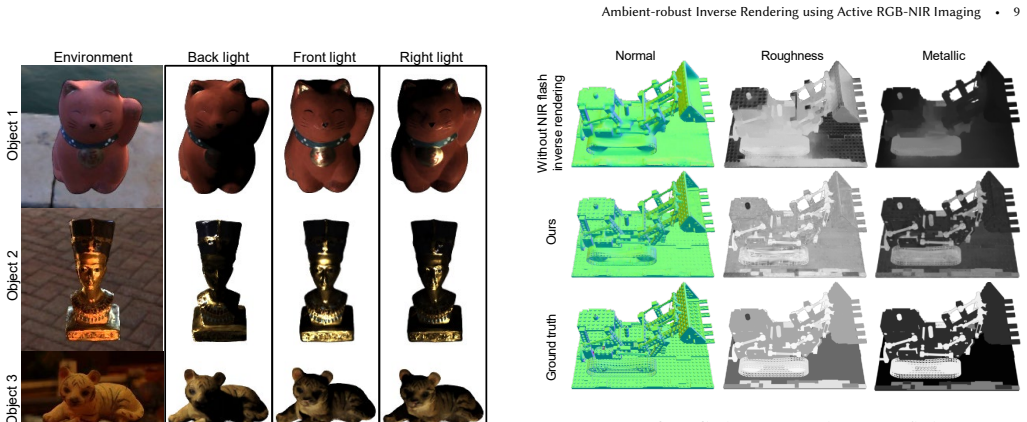
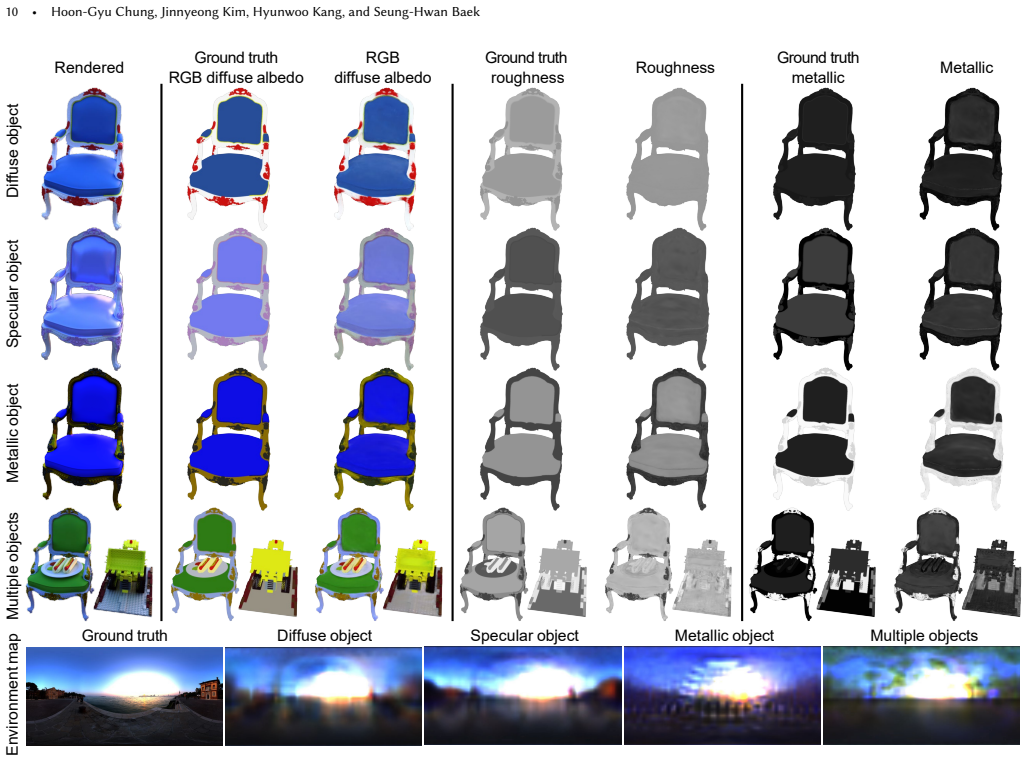
Inverse rendering aims to reconstruct geometry and reflectance of objects from images. Despite recent progress, existing methods often produces inaccurate reconstructions that are sensitive to ambient illumination conditions. Here we introduce an ambient-robust inverse rendering method enabled by active RGB-NIR imaging. Our key insight is to leverage near-infrared (NIR) flash illumination-imperceptible to human observers-to obtain stable point-light shading that is largely invariant to ambient illumination. By using multi-view RGB images illuminated by ambient light and NIR images acquired with active NIR flash illumination, we reconstruct accurate geometry and reflectance by exploiting the complementary benefits of RGB and NIR images via a three-stage inverse rendering method. To enable dense multi-view acquisition, we develop an active imaging system equipped with a RGB-NIR camera and a NIR flash mounted on a mobile base. Using this system, we collect the first multi-view RGB-NIR inverse rendering dataset captured under multiple ambient illumination conditions. Experiments demonstrate that our method outperforms prior approaches, achieving accurate geometry and reflectance estimation across multiple ambient lighting scenarios.
Figures


Figures from the paper (10 more)


Reference graph
Works this paper leans on
-
[1]
InSIGGRAPH Asia 2024 Conference Papers
GS 3: Efficient Relighting with Triple Gaussian Splatting. InSIGGRAPH Asia 2024 Conference Papers. Samuel Brucker, Stefanie Walz, Mario Bijelic, and Felix Heide. 2024. Cross-spectral Gated-RGB Stereo Depth Estimation. InProceedings of the IEEE/CVF Conference on Computer Vision and Pattern Recognition. 21654–21665. Monica Carfagni, Rocco Furferi, Lapo Gove...
2024
-
[2]
SAM 3: Segment Anything with Concepts. (2025). arXiv:cs.CV/2511.16719 https://arxiv.org/abs/2511.16719 Charles-Félix Chabert, Per Einarsson, Andrew Jones, Bruce Lamond, Wan-Chun Ma, Sebastian Sylwan, Tim Hawkins, and Paul Debevec. 2006. Relighting human loco- motion with flowed reflectance fields. InACM SIGGRAPH 2006 Sketches. 76–es. Ziang Cheng, Junxuan ...
work page Pith review arXiv 2025
-
[3]
InProceedings of the IEEE/CVF Conference on Computer Vision and Pattern Recognition
Differentiable display photometric stereo. InProceedings of the IEEE/CVF Conference on Computer Vision and Pattern Recognition. 11831–11840. Hoon-Gyu Chung, Seokjun Choi, and Seung-Hwan Baek. 2024. Differentiable Point- based Inverse Rendering. InProceedings of the IEEE/CVF Conference on Computer Vision and Pattern Recognition. 4399–4409. Hoon-Gyu Chung, ...
-
[4]
Nefii: Inverse rendering for reflectance decomposition with near-field indirect illumination. InProceedings of the IEEE/CVF Conference on Computer Vision and Pattern Recognition. 4295–4304. Hongzhi Wu and Kun Zhou. 2015. Appfusion: Interactive appearance acquisition using a kinect sensor. InComputer Graphics Forum, Vol. 34. Wiley Online Library, 289–298. ...
Reviewed June 29, 2026 · model on record in the stance chip above.
Discussion (0). Sign in to comment.