Characterization of Spurious Charge in SENSEI Skipper-CCDs
Pith reviewed 2026-06-28 23:47 UTC · model grok-4.3
The pith
Spurious single-electron charge in Skipper-CCDs is dominated by the serial register during readout and drops by a factor of seven with tri-level clocking.
A machine-rendered reading of the paper's core claim, the machinery that carries it, and where it could break.
Core claim
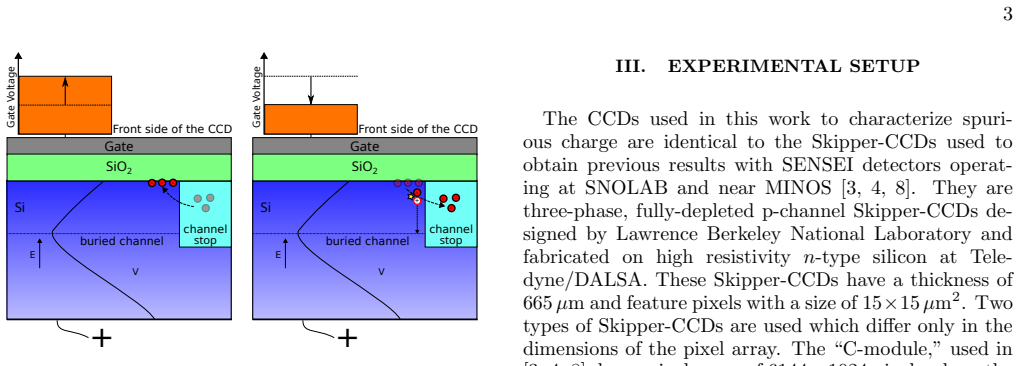
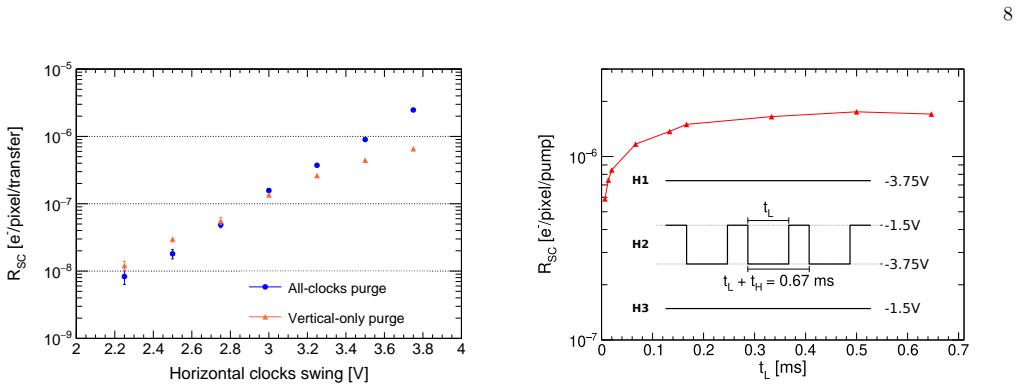
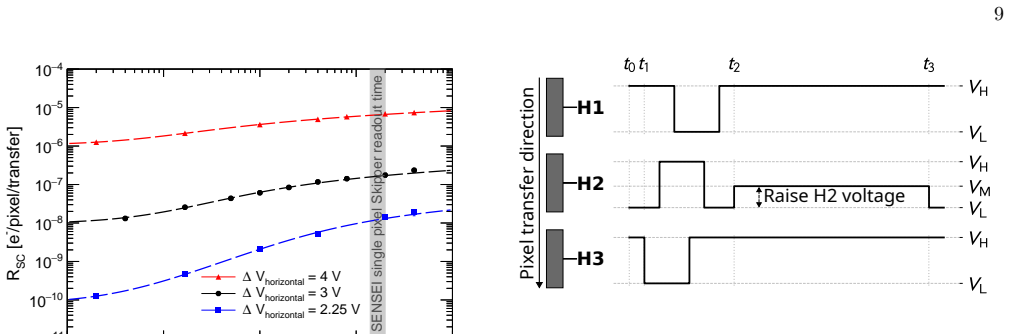
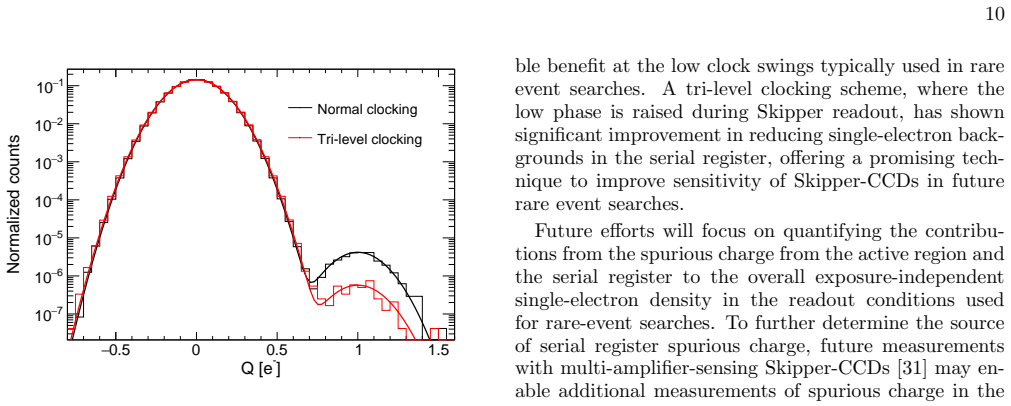
In a well-shielded low-background environment, the dominant contribution to spurious charge originates in the serial register during Skipper readout when horizontal clocks are held at constant voltage between pixel transfers. A tri-level clocking scheme raises the held-low phase to an intermediate voltage and reduces the serial-register single-electron density from (2.9 ± 0.1) × 10^{-5} to (4.0 ± 0.4) × 10^{-6} electrons/pixel/image, a factor of ∼7 improvement.
What carries the argument
Tri-level clocking scheme that raises the held-low phase of the horizontal clocks to an intermediate voltage during readout to suppress trap-mediated charge generation in the serial register.
If this is right
- The serial-register single-electron density drops to (4.0 ± 0.4) × 10^{-6} electrons/pixel/image under tri-level clocking.
- This technique supplies a practical route to lower backgrounds in present and future Skipper-CCD dark-matter and neutrino experiments.
- Dominance of the serial register holds only when other backgrounds are controlled by shielding and low-radioactivity materials.
Where Pith is reading between the lines
- Tri-level clocking could be ported to other Skipper-CCD or CCD-based rare-event detectors to test whether comparable background reductions appear.
- Lower single-electron rates would directly tighten limits on sub-GeV dark matter interactions by reducing the irreducible background floor.
- Combining the clocking change with existing shielding or material improvements might produce larger total background reductions than either method alone.
Load-bearing premise
That in the well-shielded low-background environment at the MINOS cavern, other potential sources of single-electron events are negligible compared to the serial register contribution, allowing clean attribution of the measured rates.
What would settle it
Repeating the rate measurements in the same shielded setup but with a different clocking voltage sequence that keeps the low phase unchanged and observing no reduction in single-electron density would falsify the efficacy of tri-level clocking.
Figures
read the original abstract
Skipper Charge-Coupled Devices (Skipper-CCDs) are a leading technology in the search for sub-GeV dark matter and coherent elastic neutrino-nucleus scattering. A key background for rare-event searches with these detectors arises from "spurious charge" -- single-electron events generated when charges are transferred through the active region to the serial register, and across the serial register to the readout stage. We present a characterization of spurious charge in both the active region and the serial register of SENSEI Skipper-CCDs, and show that, in a well-shielded low-background environment, the dominant contribution originates in the serial register during Skipper readout, when horizontal clocks are held at constant voltage between pixel transfers. Motivated by this finding, we develop a "tri-level" clocking scheme in which the held-low phase is raised to an intermediate voltage during readout to suppress trap-mediated charge generation. Using the SENSEI detector near the MINOS cavern, we measure a serial-register single-electron density of $(2.9 \pm 0.1) \times 10^{-5}$ electrons/pixel/image under standard SENSEI readout conditions, reduced to $(4.0 \pm 0.4) \times 10^{-6}$ electrons/pixel/image with tri-level clocking -- a factor of $\sim$7 improvement. This technique offers a promising path to lower backgrounds in current and future Skipper-CCD experiments.
Editorial analysis
A structured set of objections, weighed in public.
Referee Report
Summary. The paper characterizes spurious charge in SENSEI Skipper-CCDs, reporting that in a well-shielded low-background environment the dominant source is the serial register during readout when horizontal clocks are held at constant voltage. It introduces a tri-level clocking scheme that reduces the measured serial-register single-electron density from (2.9 ± 0.1) × 10^{-5} to (4.0 ± 0.4) × 10^{-6} electrons/pixel/image, a factor of ~7 improvement, while also quantifying the smaller active-region contribution.
Significance. If the attribution holds, the result supplies a practical, experimentally demonstrated technique for background reduction in Skipper-CCD searches for sub-GeV dark matter and CEvNS. The manuscript supplies direct rate measurements carrying explicit statistical uncertainties, with explicit separation of active-region versus serial-register contributions obtained in a controlled shielded environment; these quantitative, model-independent data constitute a clear strength.
Simulated Author's Rebuttal
We thank the referee for their positive evaluation of the manuscript and for recommending acceptance. No major comments were raised in the report.
Circularity Check
No significant circularity; results from direct experimental measurements
full rationale
The paper reports direct rate measurements of spurious charge in Skipper-CCDs, isolating serial-register contributions via shielded-environment data and demonstrating a factor-of-7 reduction under tri-level clocking. All central claims carry explicit statistical uncertainties and rest on observed counts rather than any derivation, fit, prediction, or self-citation chain. No equations or steps reduce by construction to inputs; the attribution of dominance to the serial register follows from comparative measurements, not from any self-definitional or fitted-input logic. This is the expected non-finding for a pure characterization study.
Axiom & Free-Parameter Ledger
Reference graph
Works this paper leans on
-
[1]
This detector is lo- cated∼100 m underground in the MINOS cavern at Fermilab and surrounded by lead shielding to re- duce cosmic rays and other high-energy events
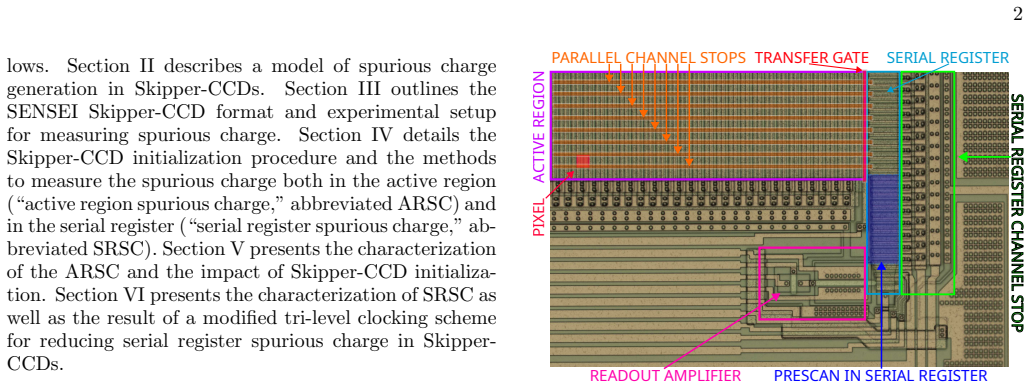
Underground setup with C-module: This setup is identical to the SENSEI@MINOS detector used in previous single-electron rate measurements [8], although of the two installed C-module Skipper- CCDs, only one is functional. This detector is lo- cated∼100 m underground in the MINOS cavern at Fermilab and surrounded by lead shielding to re- duce cosmic rays and...
-
[2]
All other details remain unchanged
Underground setup with skinny modules: The SENSEI@MINOS apparatus has recently been modified to house four skinny-module Skipper- CCDs. All other details remain unchanged
-
[3]
This setup lacks lead shielding, but the readout electronics allow the time constants of the RC filters to be modified easily
Surface setup with C-module: A single C-module Skipper-CCD is housed in a stainless steel dewar at a Fermilab surface facility. This setup lacks lead shielding, but the readout electronics allow the time constants of the RC filters to be modified easily. 4 While background radiation does not affect the mecha- nism of spurious charge generation in Skipper-...
-
[4]
erase” and “e-purge
Temperature cycle: This is performed after each power cycle of the readout electronics. In this pro- cedure, the “erase” and “e-purge” procedures (de- scribed next) are run repeatedly during a ramp down from an elevated temperature of 220 K to the nominal temperature of 135 K. This procedure minimizes dark current
-
[5]
all-clocks purge:
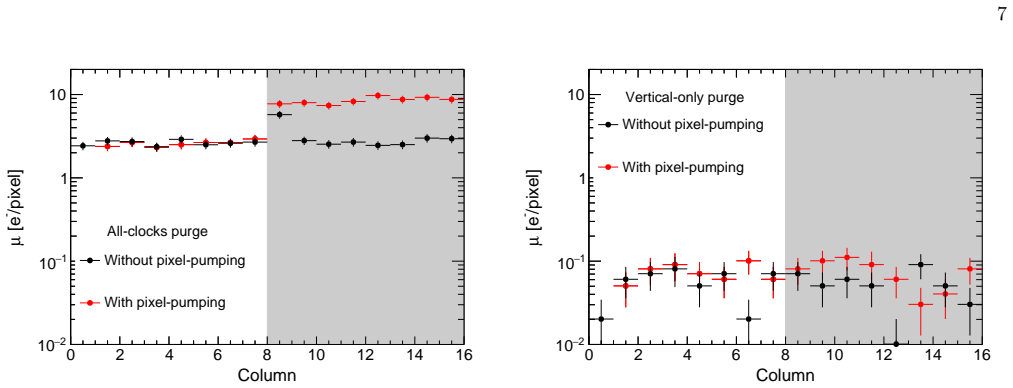
Erase and e-purge: This is performed during the temperature cycle and additionally as needed to re-initialize the dark current to a baseline state. In the erase procedure, the substrate voltage is ramped down from 70 V to 0 V and a set of clock voltages are increased to 9 V, which floods the sur- face of the Skipper-CCD with electrons. This state is maint...
-
[6]
superpixel
Cleaning: Before taking each image, the charges in the active region and serial register are shifted to readout amplifiers and drained repeatedly to re- move accumulated charges from background radi- ation, as well as to remove single electrons from charge traps with long emission time constants. This ensures a clean image before the spurious charge measu...
-
[7]
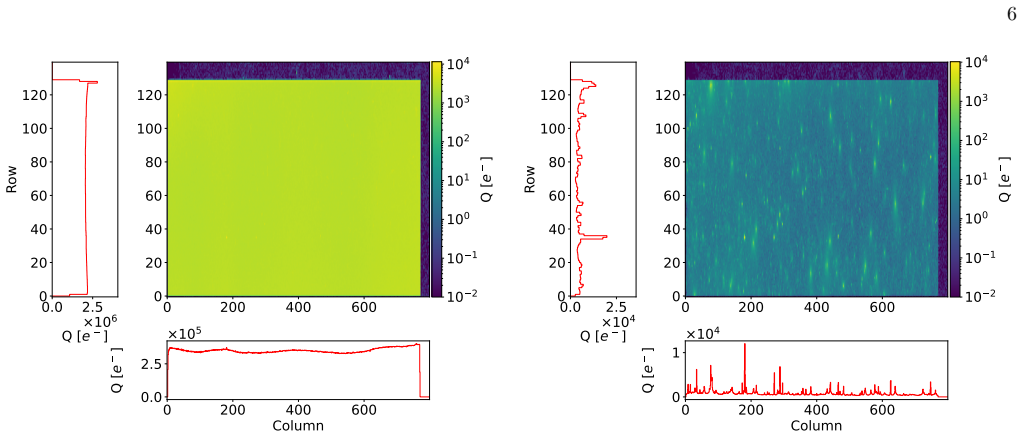
Active region spurious charge For the ARSC measurement, the active region along with additional overscan regions are read out through all four amplifiers following pumping in the active region. The standard SENSEI calibration procedure is followed, determining baseline and gain constants by fitting Gaus- sian distributions on 0 e − and 1 e − peaks, and ap...
-
[8]
clocking luminescence
Serial register spurious charge After pumping in the serial register, the serial register is read out along with additional pixels in the overscan region. This process is repeated multiple times to form a serial register image, where each row consists of one array of serial register pixels. Skipper readout with 800 measurement samples per pixel is perform...
2023
-
[9]
Tiffenberg, M
J. Tiffenberg, M. Sofo-Haro, A. Drlica-Wagner, R. Essig, Y. Guardincerri, S. Holland, T. Volansky, and T.-T. Yu, Phys. Rev. Lett.119, 131802 (2017)
2017
-
[10]
Barak, I
L. Barak, I. M. Bloch, M. Cababie, G. Cancelo, L. Chap- linsky, F. Chierchie, M. Crisler, A. Drlica-Wagner, R. Es- sig, J. Estrada, E. Etzion, G. F. Moroni, D. Gift, S. Mu- nagavalasa, A. Orly, D. Rodrigues, A. Singal, M. S. Haro, L. Stefanazzi, J. Tiffenberg, S. Uemura, T. Volansky, and T.-T. Yu (SENSEI Collaboration), Phys. Rev. Lett.125, 171802 (2020). 11
2020
-
[11]
Adari, I
P. Adari, I. M. Bloch, A. M. Botti, M. Cababie, G. Can- celo, B. A. Cervantes-Vergara, M. Crisler, M. Daal, A. Desai, A. Drlica-Wagner, R. Essig, J. Estrada, E. Et- zion, G. F. Moroni, S. E. Holland, J. Kehat, Y. Korn, I. Lawson, S. Luoma, A. Orly, S. E. Perez, D. Rodrigues, N. A. Saffold, S. Scorza, A. Singal, M. Sofo-Haro, L. Ste- fanazzi, K. Stifter, J...
2025
-
[12]
I. M. Bloch, A. M. Botti, M. Cababie, G. Cancelo, B. A. Cervantes-Vergara, M. Daal, A. Desai, A. Drlica-Wagner, R. Essig, J. Estrada, E. Etzion, G. F. Moroni, S. E. Hol- land, J. Kehat, I. Lawson, S. Luoma, A. Orly, S. E. Perez, D. Rodrigues, N. A. Saffold, S. Scorza, M. Sofo-Haro, K. Stifter, J. Tiffenberg, S. Uemura, E. M. Villalpando, T. Volansky, F. W...
2026
-
[13]
Arnquist, N
I. Arnquist, N. Avalos, D. Baxter, X. Bertou, N. Castell´ o-Mor, A. E. Chavarria, J. Cuevas-Zepeda, A. Dastgheibi-Fard, C. De Dominicis, O. Deligny, J. Duarte-Campderros, E. Estrada, N. Gadola, R. Ga¨ ıor, T. Hossbach, L. Iddir, B. J. Kavanagh, B. Kilminster, A. Lantero-Barreda, I. Lawson, S. Lee, A. Letessier- Selvon, P. Loaiza, A. Lopez-Virto, K. J. McG...
2024
-
[14]
Arnquist, N
I. Arnquist, N. Avalos, D. Baxter, X. Bertou, N. Castell´ o- Mor, A. E. Chavarria, J. Cuevas-Zepeda, J. C. Guti´ errez, J. Duarte-Campderros, A. Dastgheibi-Fard, O. Deligny, C. De Dominicis, E. Estrada, N. Gadola, R. Ga¨ ıor, T. Hossbach, L. Iddir, L. Khalil, B. Kilminster, A. Lantero-Barreda, I. Lawson, S. Lee, A. Letessier- Selvon, P. Loaiza, A. Lopez-V...
2023
-
[15]
A. A. Aguilar-Arevaloet al.(CONNIE), arXiv:2403.15976 [hep-ex] (2024)
work page internal anchor Pith review Pith/arXiv arXiv 2024
-
[16]
I. M. Bloch, A. M. Botti, M. Cababie, G. Cancelo, B. A. Cervantes-Vergara, M. Daal, A. Desai, A. Drlica-Wagner, R. Essig, J. Estrada, E. Etzion, G. F. Moroni, S. E. Hol- land, J. Kehat, I. Lawson, S. Luoma, A. Orly, S. E. Perez, D. Rodrigues, N. A. Saffold, S. Scorza, M. Sofo-Haro, K. Stifter, J. Tiffenberg, S. Uemura, E. M. Villalpando, T. Volansky, F. W...
2025
-
[17]
Aggarwal, I
K. Aggarwal, I. Arnquist, N. Avalos, X. Bertou, N. Castell´ o-Mor, A. E. Chavarria, J. Cuevas-Zepeda, A. Dastgheibi-Fard, C. De Dominicis, O. Deligny, J. Duarte-Campderros, E. Estrada, R. Ga¨ ıor, E.- L. Gkougkousis, T. Hossbach, L. Iddir, B. J. Ka- vanagh, B. Kilminster, A. Lantero-Barreda, I. Lawson, A. Letessier-Selvon, H. Lin, P. Loaiza, A. Lopez-Virt...
2025
-
[18]
K. Aggarwal, I. Arnquist, N. Avalos, X. Bertou, N. Castello-Mor, C. Centeno-Lorca, A. E. Chavarria, J. Cuevas-Zepeda, A. Dastgheibi-Fard, C. D. Dominicis, O. Deligny, J. Duarte-Campderros, E. Estrada, R. Gaior, E. L. Gkougkousis, T. Hossbach, L. Iddir, B. J. Ka- vanagh, B. Kilminster, I. Lawson, A. Letessier-Selvon, H. Lin, P. Loaiza, A. Lopez-Virto, R. L...
- [19]
-
[20]
P. Du, D. Ega˜ na-Ugrinovic, R. Essig, and M. Shola- purkar, Journal of High Energy Physics2024, 164 (2024)
2024
-
[21]
Barak, I
L. Barak, I. M. Bloch, A. Botti, M. Cababie, G. Can- celo, L. Chaplinsky, F. Chierchie, M. Crisler, A. Drlica- Wagner, R. Essig, J. Estrada, E. Etzion, G. Fernan- dez Moroni, D. Gift, S. E. Holland, S. Munagavalasa, A. Orly, D. Rodrigues, A. Singal, M. S. Haro, L. Ste- fanazzi, J. Tiffenberg, S. Uemura, T. Volansky, and T.- T. Yu (SENSEI Collaboration), P...
2022
-
[22]
S. E. Holland, W. F. Kolbe, and C. J. Bebek, IEEE Transactions on Electron Devices56, 2612 (2009)
2009
-
[23]
Janesick, T
J. Janesick, T. Elliott, G. Frasehetti, S. Collins, M. Blouke, and B. Corrie, inOptical Sensors and Elec- tronic Photography, Vol. 1071, edited by M. M. Blouke and D. Pophal, International Society for Optics and Pho- tonics (SPIE, 1989) pp. 153 – 169
1989
-
[24]
S. E. Holland, C. J. Bebek, K. S. Dawson, J. H. Emes, M. H. Fabricius, J. A. Fairfield, D. E. Groom, A. Karcher, W. F. Kolbe, N. P. Palaio, N. A. Roe, and G. Wang, inHigh Energy, Optical, and Infrared Detectors for As- tronomy II, Vol. 6276, edited by D. A. Dorn and A. D. Holland, International Society for Optics and Photonics (SPIE, 2006) p. 62760B
2006
-
[25]
J. R. Janesick,Scientific Charge-Coupled Devices, Vol. 83 (SPIE Press, 2001)
2001
-
[26]
N. Bush, J. Heymes, D. Hall, A. Holland, and D. Jor- dan, Journal of Astronomical Telescopes, Instruments, and Systems7, 016002 (2021)
2021
-
[27]
Shockley and W
W. Shockley and W. T. Read, Phys. Rev.87, 835 (1952)
1952
-
[28]
G. Cancelo, C. Chavez, F. Chierchie, J. Estrada, G. F. Moroni, E. E. Paolini, M. S. Haro, A. Soto, L. Stefanazzi, J. Tiffenberg, K. Treptow, N. Wilcer, and T. Zmuda, Low threshold acquisition controller for skipper ccds (2020), arXiv:2004.07599 [astro-ph.IM]
-
[29]
Holland, D
S. Holland, D. Groom, N. Palaio, R. Stover, and M. Wei, IEEE Transactions on Electron Devices50, 225 (2003)
2003
-
[30]
Burke and S
B. Burke and S. Gajar, IEEE Transactions on Electron Devices38, 285 (1991)
1991
-
[31]
Bebek and N
C. Bebek and N. Roe,4k x 2k and 4k x 4k CCD Users Manual, Lawrence Berkeley National Laboratory (2011), rev. 3b
2011
-
[32]
Juramy, P
C. Juramy, P. Antilogus, L. Le Guillou, and E. Sepul- veda, Journal of Astronomical Telescopes, Instruments, and Systems5, 1 (2019)
2019
-
[33]
G. F. Moroni, F. Chierchie, J. Tiffenberg, A. Botti, M. Cababie, G. Cancelo, E. L. Depaoli, J. Estrada, S. E. 12 Holland, D. Rodrigues, I. Sidelnik, M. S. Haro, L. Ste- fanazzi, and S. Uemura, Phys. Rev. Appl.17, 044050 (2022)
2022
-
[34]
A. W. Neely and J. R. Janesick, Publications of the As- tronomical Society of the Pacific105, 1330 (1993)
1993
-
[35]
Vincent, A
G. Vincent, A. Chantre, and D. Bois, Journal of Applied Physics50, 5484 (1979)
1979
-
[36]
P. A. Martin, B. G. Streetman, and K. Hess, Journal of Applied Physics52, 7409 (1981)
1981
-
[37]
D. J. Hall, N. J. Murray, A. D. Holland, J. Gow, A. Clarke, and D. Burt, IEEE Transactions on Nuclear Science61, 1826 (2014)
2014
-
[38]
E. M. Villalpando, A. Drlica-Wagner, A. A. Plazas Malag´ on, A. Bakshi, M. Bonati, J. Campa, B. Cancino, C. R. Chavez, J. Estrada, G. Fernan- dez Moroni, L. Fraga, M. E. Gaido, S. Holland, R. Hur, M. Jonas, P. Moore, and J. Tiffenberg, Publications of the Astronomical Society of the Pacific136, 045001 (2024)
2024
-
[39]
A. M. Botti, B. A. Cervantes-Vergara, C. R. Chavez, F. Chierchie, A. Drlica-Wagner, J. Estrada, G. F. Mo- roni, S. E. Holland, B. J. Irigoyen Gimenez, A. J. Lapi, E. M. Villalpando, M. S. Haro, J. Tiffenberg, and S. Ue- mura, IEEE Transactions on Electron Devices71, 3732 (2024)
2024
-
[40]
Sofo-Haro, K
M. Sofo-Haro, K. Donlon, J. Estrada, S. Holland, F. Fahim, and C. Leitz, Phys. Rev. Lett.133, 121003 (2024)
2024
-
[41]
Direct Detection of Sub-GeV Dark Matter
R. Essig, J. Mardon, and T. Volansky, Phys. Rev. D85, 076007 (2012), arXiv:1108.5383 [hep-ph]
work page internal anchor Pith review Pith/arXiv arXiv 2012
-
[42]
Essig, M
R. Essig, M. Fern´ andez-Serra, J. Mardon, A. Soto, T. Volansky, and T.-T. Yu, Journal of High Energy Physics2016, 46 (2016)
2016
discussion (0)
Sign in with ORCID, Apple, or X to comment. Anyone can read and Pith papers without signing in.