Graph automorphisms to obtain Clifford symmetries in open and closed qudit models
Pith reviewed 2026-06-29 06:36 UTC · model grok-4.3
The pith
Clifford symmetries of qudit Hamiltonians are recovered exactly by graph automorphisms on a graph whose vertices encode the Hamiltonian terms and their invariants.
A machine-rendered reading of the paper's core claim, the machinery that carries it, and where it could break.
Core claim
Encoding the Clifford invariants of a Hamiltonian as properties of a graph with one vertex per Hamiltonian term converts the search for Clifford symmetries into the standard graph-automorphism problem; every automorphism yields a symmetry of the Hamiltonian up to phase factors, and the same graph representation works for both closed and open qudit systems.
What carries the argument
The graph whose vertices are the Hamiltonian terms and whose labels and edges store the Clifford invariants (commutation relations, support overlaps, and other quantities preserved by Clifford conjugation).
If this is right
- Existing graph-automorphism libraries can be used directly to enumerate Clifford symmetries.
- The same procedure works for Lindblad generators in open systems without additional encoding steps.
- Runtime is governed by the number of distinct Pauli strings rather than the Hilbert-space dimension.
Where Pith is reading between the lines
- The reduction may allow symmetry discovery in models too large for exhaustive search by hand.
- It supplies a uniform computational interface between symmetry problems in closed and open quantum dynamics.
Load-bearing premise
Every graph automorphism on the constructed graph corresponds exactly to a Clifford symmetry of the original Hamiltonian, with no extra or missing symmetries introduced by the encoding.
What would settle it
An explicit Hamiltonian together with a symmetry that is not recovered as any automorphism of the associated graph, or an automorphism that produces an operator that fails to be a symmetry.
Figures
read the original abstract
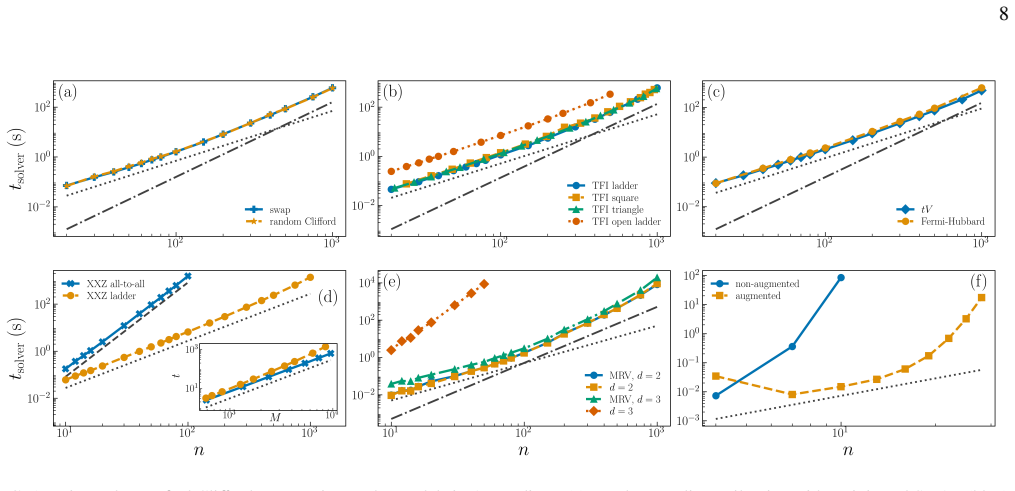
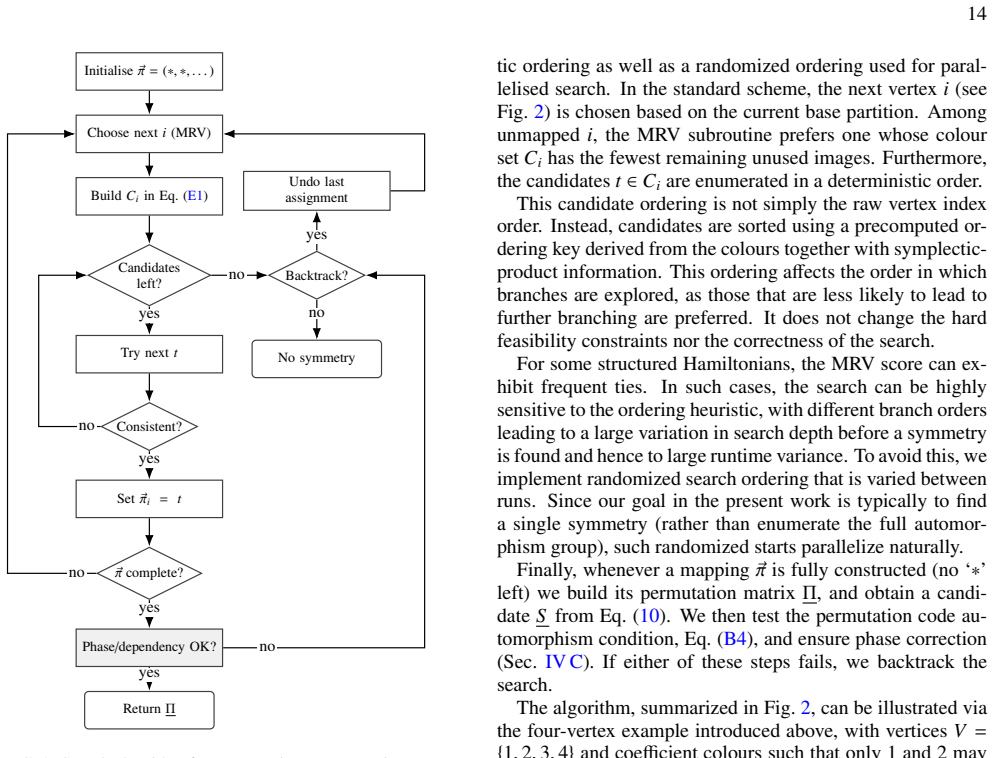
In the recent article [arXiv:2605.18966], we demonstrated that finding Clifford symmetries can be mapped to a Graph Automorphism (GA) problem. Here, we provide an algorithm to obtain such symmetries on general qudit systems, that works on the principle of encoding Clifford invariants of a Hamiltonian onto properties of a graph. Labelling Hamiltonian terms as vertices, a permutation of such vertices that respects the Clifford invariants (a GA) is both a valid Clifford, and a symmetry up to phase correction checks. We test this on multiple physical models and discuss the scaling with respect to the number of qudits and Pauli strings, as well as various strategies for optimisation in different regimes. We further show that the graph automorphism representation of Clifford symmetries can be expanded to open quantum systems.
Editorial analysis
A structured set of objections, weighed in public.
Referee Report
Summary. The manuscript extends the authors' prior mapping of Clifford symmetry search to graph automorphism (GA) problems (arXiv:2605.18966) to general qudit systems and open quantum systems. Hamiltonian terms are encoded as graph vertices whose labels capture Clifford invariants (commutation relations, support overlaps, and phase factors); a graph automorphism then yields a valid Clifford symmetry after phase-correction checks. The algorithm is tested on several physical models, scaling with qudit number and Pauli-string count is analyzed, and optimization strategies are discussed; the same representation is shown to apply to open-system Lindblad operators.
Significance. If the encoding is faithful and complete, the reduction supplies a practical computational route to Clifford symmetries via existing GA solvers, which scales better than brute-force search for moderate system sizes and extends naturally to open systems. The work supplies concrete tests and scaling data that would be useful for qudit-based quantum error correction and simulation codes.
major comments (2)
- [Abstract / algorithm description] Abstract and § on the algorithm: the central claim that 'a permutation of such vertices that respects the Clifford invariants (a GA) is both a valid Clifford' requires the chosen vertex/edge labeling to be bijective for general qudits. No explicit construction rules, completeness proof, or counter-example check that extra automorphisms are excluded appear in the provided text; this is the load-bearing assumption identified in the stress-test note.
- [Tests / examples] Tests section: while multiple models are mentioned, the manuscript must show at least one explicit qudit example (e.g., a small qutrit Hamiltonian) where the GA output is independently verified to match the full Clifford symmetry group, including phase factors, to substantiate the extension beyond the qubit case of the prior work.
minor comments (2)
- [Open systems paragraph] Clarify notation for the open-system extension: how Lindblad operators are encoded as additional vertices or edges should be stated explicitly rather than by reference to the closed-system case.
- [Scaling analysis] The scaling discussion would benefit from a table comparing GA runtime versus brute-force enumeration for the tested models.
Simulated Author's Rebuttal
We thank the referee for the careful reading and constructive feedback on our extension of the graph-automorphism approach to general qudits and open systems. We address each major comment below and have revised the manuscript accordingly to strengthen the exposition and validation.
read point-by-point responses
-
Referee: [Abstract / algorithm description] Abstract and § on the algorithm: the central claim that 'a permutation of such vertices that respects the Clifford invariants (a GA) is both a valid Clifford' requires the chosen vertex/edge labeling to be bijective for general qudits. No explicit construction rules, completeness proof, or counter-example check that extra automorphisms are excluded appear in the provided text; this is the load-bearing assumption identified in the stress-test note.
Authors: We agree that the bijectivity of the encoding is central and must be made fully explicit. The vertex and edge labels are constructed from the complete set of Clifford invariants (generalized commutation relations, support overlaps, and phase factors under the Weyl-Heisenberg group for prime-power dimension). In the revised manuscript we add a dedicated subsection that states the precise label-construction rules for arbitrary qudit dimension, provides a short completeness argument showing that every Clifford symmetry induces a unique automorphism and conversely, and includes a small-scale counter-example check confirming that no extraneous automorphisms survive the phase-correction step. These additions directly address the load-bearing assumption. revision: yes
-
Referee: [Tests / examples] Tests section: while multiple models are mentioned, the manuscript must show at least one explicit qudit example (e.g., a small qutrit Hamiltonian) where the GA output is independently verified to match the full Clifford symmetry group, including phase factors, to substantiate the extension beyond the qubit case of the prior work.
Authors: We accept the need for an explicit, independently verified qudit demonstration. The revised manuscript now contains a worked example of a three-qutrit Hamiltonian whose graph is constructed, whose automorphism group is computed, and whose candidate symmetries (after phase correction) are cross-checked by direct matrix conjugation against the full Clifford symmetry group obtained by exhaustive search. The example confirms exact agreement, including all phase factors, thereby substantiating the extension beyond the qubit case. revision: yes
Circularity Check
Central construction relies on authors' prior self-citation for graph encoding completeness
specific steps
-
self citation load bearing
[Abstract]
"In the recent article [arXiv:2605.18966], we demonstrated that finding Clifford symmetries can be mapped to a Graph Automorphism (GA) problem. Here, we provide an algorithm to obtain such symmetries on general qudit systems, that works on the principle of encoding Clifford invariants of a Hamiltonian onto properties of a graph. Labelling Hamiltonian terms as vertices, a permutation of such vertices that respects the Clifford invariants (a GA) is both a valid Clifford, and a symmetry up to phase correction checks."
The algorithm's validity for qudits rests on the encoding being bijective between graph automorphisms and Clifford symmetries. This completeness/faithfulness is asserted via the self-citation to prior work by the same authors and is not independently proven or constructed in the present manuscript; any gap in the prior encoding propagates directly to the claimed symmetries.
full rationale
The paper extends the GA mapping to qudits and open systems with new algorithmic details and tests, giving the central claim independent content beyond the citation. However, the load-bearing premise that the vertex/edge labeling of Clifford invariants is complete and faithful (so GA outputs are exactly the symmetries) is justified only by the overlapping-author citation to arXiv:2605.18966 without re-derivation or external verification here. This matches the self-citation-load-bearing pattern at a moderate level; the derivation chain does not collapse to a pure fit or definition.
Axiom & Free-Parameter Ledger
Reference graph
Works this paper leans on
-
[1]
Gibbs, Z
J. Gibbs, Z. Holmes, and P. Stevenson, Quantum Machine In- telligence7, 14 (2025)
2025
-
[2]
G. Yoo, J. Bae, and D. S. Kim, Phys. Rev. A111, 032615 (2025)
2025
-
[3]
M. C. Tran, Y . Su, D. Carney, and J. M. Taylor, PRX Quantum 2, 010323 (2021)
2021
-
[4]
Vidmar and M
L. Vidmar and M. Rigol, Journal of Statistical Mechanics: The- ory and Experiment2016, 064007 (2016)
2016
-
[5]
D’Alessio, Y
L. D’Alessio, Y . Kafri, A. Polkovnikov, and M. Rigol, Ad- vances in Physics65, 239 (2016)
2016
-
[6]
Sachdev,Quantum Phases of Matter(Cambridge University Press, Cambridge, UK, 2023)
S. Sachdev,Quantum Phases of Matter(Cambridge University Press, Cambridge, UK, 2023)
2023
-
[7]
Chandran, I
A. Chandran, I. H. Kim, G. Vidal, and D. A. Abanin, Phys. Rev. B91, 085425 (2015)
2015
-
[8]
Shtanko, D
O. Shtanko, D. S. Wang, H. Zhang, N. Harle, A. Seif, R. Movas- sagh, and Z. Minev, Nature Communications16, 2552 (2025)
2025
-
[9]
L. G. Gunderman, A. Jena, and L. Dellantonio, Phys. Rev. A 109, 022618 (2024)
2024
-
[10]
P. Sala, T. Rakovszky, R. Verresen, M. Knap, and F. Pollmann, Physical Review X10, 011047 (2020)
2020
-
[11]
Moudgalya and O
S. Moudgalya and O. I. Motrunich, Physical Review X12, 011050 (2022)
2022
-
[12]
A. T. Schmitz and S. Johri, npj Quantum Information6, 2 (2020)
2020
-
[13]
Alvarez, Computer Physics Communications183, 2226 (2012)
G. Alvarez, Computer Physics Communications183, 2226 (2012)
2012
-
[14]
Moudgalya and O
S. Moudgalya and O. I. Motrunich, Physical Review B107, 224312 (2023)
2023
-
[15]
Paulson, L
D. Paulson, L. Dellantonio, J. F. Haase, A. Celi, A. Kan, A. Jena, C. Kokail, R. van Bijnen, K. Jansen, P. Zoller, and C. A. Muschik, PRX Quantum2, 030334 (2021)
2021
-
[16]
Dutta and N
S. Dutta and N. R. Cooper, Phys. Rev. Lett.125, 240404 (2020)
2020
-
[17]
Kennedy and H
T. Kennedy and H. Tasaki, Phys. Rev. B45, 304 (1992)
1992
-
[18]
C. N. Yang, Phys. Rev. Lett.63, 2144 (1989)
1989
-
[19]
Szriftgiser and E
P. Szriftgiser and E. S. Cheb-Terrab, Computer Physics Com- munications268, 108076 (2021)
2021
-
[20]
Lootens, C
L. Lootens, C. Delcamp, G. Ortiz, and F. Verstraete, PRX Quantum4, 020357 (2023)
2023
-
[21]
Pauli, Zeitschrift f ¨ur Physik36, 336 (1926)
W. Pauli, Zeitschrift f ¨ur Physik36, 336 (1926)
1926
-
[22]
Cariglia, Rev
M. Cariglia, Rev. Mod. Phys.86, 1283 (2014)
2014
-
[23]
Tapering off qubits to simulate fermionic Hamiltonians
S. Bravyi, J. M. Gambetta, A. Mezzacapo, and K. Temme, “Ta- pering offqubits to simulate fermionic hamiltonians,” (2017), arXiv:1701.08213
work page internal anchor Pith review Pith/arXiv arXiv 2017
-
[24]
M. L. LaBorde and M. M. Wilde, Phys. Rev. Lett.129, 160503 (2022)
2022
-
[25]
Moudgalya and O
S. Moudgalya and O. I. Motrunich, Annals of Physics455, 169384 (2023)
2023
-
[26]
Gottesman, Physical Review A54, 1862 (1996)
D. Gottesman, Physical Review A54, 1862 (1996)
1996
-
[27]
Surviving as a quantum computer in a classical world,
D. Gottesman, “Surviving as a quantum computer in a classical world,” (2024)
2024
-
[28]
Aaronson and D
S. Aaronson and D. Gottesman, Phys. Rev. A70, 052328 (2004)
2004
-
[29]
Chapman and S
A. Chapman and S. T. Flammia, Quantum4, 278 (2020)
2020
-
[30]
N. G. Jones and N. Linden, Journal of Mathematical Physics 63, 101901 (2022)
2022
-
[31]
Clifford symmetries in quantum many-body systems
C. Nation, R. P. A. Simon, S. Banerjee, F. Martini, A. Ricot- tone, F. Cerisola, and L. Dellantonio, “Clifford symmetries in quantum many-body systems,” (2026), arXiv:2605.18966
work page internal anchor Pith review Pith/arXiv arXiv 2026
-
[32]
R. P. A. Simon, M. Meth, F. Martini, P. Tirler, A. Jena, M. Ringbauer, and L. Dellantonio, “An error-aware and adap- tive method for the estimation of quantum observables on qudit- based quantum computers,” (2026), arXiv:2605.00682
work page internal anchor Pith review Pith/arXiv arXiv 2026
-
[33]
Sympleq,
C. Nation, R. P. A. Simon, F. Martini, A. Ricottone, S. Banerjee, F. Cerisola, and L. Dellantonio, “Sympleq,” (2026)
2026
-
[34]
For compos- itedthe labels instead live over the ringZ d, where nonzero elements need not be invertible
The restriction to primedensures that the Pauli labels form a vector space over the fieldF d, allowing the use of Gaus- sian elimination and symplectic linear algebra. For compos- itedthe labels instead live over the ringZ d, where nonzero elements need not be invertible. In many cases composite- dimensional systems may also be decomposed into smaller pri...
-
[35]
Hostens, J
E. Hostens, J. Dehaene, and B. De Moor, Phys. Rev. A71, 042315 (2005)
2005
-
[36]
Dehaene and B
J. Dehaene and B. De Moor, Physical Review A68, 042318 (2003)
2003
-
[37]
A. Wills, “A review of galois qudits,” (2026), arXiv:2605.18981
work page internal anchor Pith review Pith/arXiv arXiv 2026
-
[38]
Gottesman, inQuantum Computing and Quantum Commu- nications, edited by C
D. Gottesman, inQuantum Computing and Quantum Commu- nications, edited by C. P. Williams (Springer Berlin Heidelberg,
-
[39]
Rengaswamy, R
N. Rengaswamy, R. Calderbank, S. Kadhe, and H. D. Pfister, IEEE Transactions on Quantum Engineering1, 1 (2020)
2020
-
[40]
A. M. Polloreno, A. Carignan-Dugas, J. Hines, R. Blume- Kohout, K. Young, and T. Proctor, Quantum9, 1848 (2025)
2025
-
[41]
Mitarai, Y
K. Mitarai, Y . Suzuki, W. Mizukami, Y . O. Nakagawa, and K. Fujii, Phys. Rev. Res.4, 033012 (2022)
2022
-
[42]
Turkeshi, E
X. Turkeshi, E. Tirrito, and P. Sierant, Nature Communications 16, 2575 (2025)
2025
-
[43]
Liu and A
Z.-W. Liu and A. Winter, PRX Quantum3, 020333 (2022). 11
2022
-
[44]
Bejan, C
M. Bejan, C. McLauchlan, and B. B ´eri, PRX Quantum5, 030332 (2024)
2024
-
[45]
Qassim, J
H. Qassim, J. J. Wallman, and J. Emerson, Quantum3, 170 (2019)
2019
-
[46]
W. J. Huggins and J. R. McClean, Quantum8, 1264 (2024)
2024
-
[47]
M. H. Cheng, K. E. Khosla, C. N. Self, M. Lin, B. X. Li, A. C. Medina, and M. S. Kim, Phys. Rev. A111, 062413 (2025)
2025
-
[48]
(4) is equivalent to the one given in Ref
Notice that the definition ofΩ in Eq. (4) is equivalent to the one given in Ref. [31] ford=2
-
[49]
We note this convention infers simply the interpretation of Paulis as rows rather than columns of the matrixp
-
[50]
Mixed-register stabilizer codes: A coding-theoretic perspective,
H. Dongre and L. G. Gunderman, “Mixed-register stabilizer codes: A coding-theoretic perspective,” (2026)
2026
-
[51]
Sarkar and T
R. Sarkar and T. J. Yoder, Quantum8, 1307 (2024)
2024
-
[52]
Gorini, A
V . Gorini, A. Kossakowski, and E. C. G. Sudarshan, Journal of Mathematical Physics17, 821 (1976)
1976
-
[53]
Lindblad, Communications in Mathematical Physics48, 119 (1976)
G. Lindblad, Communications in Mathematical Physics48, 119 (1976)
1976
-
[54]
Vectorization of quantum operations and its use
A. Gilchrist, D. R. Terno, and C. J. Wood, “Vectorization of quantum operations and its use,” (2011), arXiv:0911.2539
work page internal anchor Pith review Pith/arXiv arXiv 2011
-
[55]
Weimer, A
H. Weimer, A. Kshetrimayum, and R. Or ´us, Rev. Mod. Phys. 93, 015008 (2021)
2021
-
[56]
Then no coupling encodes that data (e.g
In practice it is often useful to create a sparse graph, in which case we can choose the most common edge data type, and re- move it. Then no coupling encodes that data (e.g. commuta- tion). We choose to present the fully connected case simply as a convention
-
[57]
In the graph representation these labels should therefore be compared up to this common rescaling
The coefficients of a dependency relation are defined only up to multiplication by a common nonzero element ofZ d. In the graph representation these labels should therefore be compared up to this common rescaling
-
[58]
Roman,Advanced Linear Algebra, 3rd ed., Graduate Texts in Mathematics, V ol
S. Roman,Advanced Linear Algebra, 3rd ed., Graduate Texts in Mathematics, V ol. 135 (Springer, New York, NY , 2008) eBook ISBN: 978-0-387-72831-5
2008
-
[59]
Csardi and T
G. Csardi and T. Nepusz, InterJournal, Complex Systems1695, 1 (2006)
2006
-
[60]
Junttila and P
T. Junttila and P. Kaski, in2007 Proceedings of the Workshop on Algorithm Engineering and Experiments (ALENEX)(2007) pp. 135–149
2007
-
[61]
Bacchus and P
F. Bacchus and P. van Run, inPrinciples and Practice of Con- straint Programming — CP ’95, Lecture Notes in Computer Science, V ol. 910 (Springer, 1995) pp. 258–275
1995
-
[62]
N. T. Huang and S. Villar, inICASSP 2021 - 2021 IEEE Interna- tional Conference on Acoustics, Speech and Signal Processing (ICASSP)(2021) pp. 8533–8537
2021
-
[63]
We then have that the total orbit, acted upon by any power ofFis invariant
Choosing a random Pauli ⃗p, the orbit is the set{pF i}i∈[0,nF ] such thatpF nF =p. We then have that the total orbit, acted upon by any power ofFis invariant
-
[64]
Based on numerical investigation, the number of gates chosen for the RCC symmetry does not have a significant impact on the performance of our algorithm
-
[65]
F. H. L. Essler, H. Frahm, F. G ¨ohmann, A. Kl¨umper, and V . E. Korepin,The One-Dimensional Hubbard Model(Cambridge University Press, 2005)
2005
-
[66]
J. R. McClean, N. C. Rubin, K. J. Sung, I. D. Kivlichan, X. Bonet-Monroig, Y . Cao, C. Dai, E. S. Fried, C. Gidney, B. Gimby, P. Gokhale, T. H ¨aner, T. Hardikar, V . Havl ´ıˇcek, O. Higgott, C. Huang, J. Izaac, Z. Jiang, X. Liu, S. McArdle, M. Neeley, T. O’Brien, B. O’Gorman, I. Ozfidan, M. D. Radin, J. Romero, N. P. D. Sawaya, B. Senjean, K. Setia, S. S...
2020
-
[67]
Vardhan, G
S. Vardhan, G. De Tomasi, M. Heyl, E. J. Heller, and F. Poll- mann, Phys. Rev. Lett.119, 016802 (2017)
2017
-
[68]
Kiefer-Emmanouilidis, R
M. Kiefer-Emmanouilidis, R. Unanyan, M. Fleischhauer, and J. Sirker, Annals of Physics435, 168481 (2021)
2021
-
[69]
F. B. Ramos, M. Lencs´es, J. C. Xavier, and R. G. Pereira, Phys. Rev. B102, 014426 (2020)
2020
-
[70]
van V oorden, J
B. van V oorden, J. c. v. Min´aˇr, and K. Schoutens, Phys. Rev. B 101, 220305 (2020)
2020
-
[71]
S. S. Bullock and G. K. Brennen, Journal of Physics A: Mathe- matical and Theoretical40, 3481 (2007)
2007
-
[72]
M. F. Araujo de Resende, Reviews in Mathematical Physics32, 2030002 (2020)
2020
-
[73]
A. Chan, Z. Shi, L. Dellantonio, W. D ¨ur, and C. A. Muschik, Phys. Rev. Lett.132, 240601 (2024)
2024
-
[74]
R. R. Ferguson, L. Dellantonio, A. A. Balushi, K. Jansen, W. D ¨ur, and C. A. Muschik, Phys. Rev. Lett.126, 220501 (2021)
2021
-
[75]
Automorphisms of graphs,
P. J. Cameron, “Automorphisms of graphs,” (2003)
2003
-
[76]
Babai, inProceedings of the 48th Annual ACM SIGACT Sym- posium on Theory of Computing (STOC ’16)(Association for Computing Machinery, 2016) pp
L. Babai, inProceedings of the 48th Annual ACM SIGACT Sym- posium on Theory of Computing (STOC ’16)(Association for Computing Machinery, 2016) pp. 684–697
2016
-
[77]
B. D. McKay and A. Piperno, Journal of Symbolic Computation 60, 94 (2014)
2014
-
[78]
W. C. Huffman and V . Pless,Fundamentals of Error-Correcting Codes(Cambridge University Press, 2010)
2010
-
[79]
R. M. Haralick and G. L. Elliott, Artificial Intelligence14, 263 (1980)
1980
-
[80]
Ford=2 one has⟨ ⃗pi, ⃗p j⟩=⟨ ⃗p j, ⃗pi⟩, so the second equality is redundant
discussion (0)
Sign in with ORCID, Apple, or X to comment. Anyone can read and Pith papers without signing in.