Impact of Primordial Black Holes Induced Neutrinos on the Cosmic 21-cm Brightness Temperature
Pith reviewed 2026-06-29 06:07 UTC · model grok-4.3
The pith
Neutrinos from evaporating primordial black holes scatter with the cosmic neutrino background to produce secondary photons that heat neutral hydrogen and raise the 21-cm brightness temperature.
A machine-rendered reading of the paper's core claim, the machinery that carries it, and where it could break.
Core claim
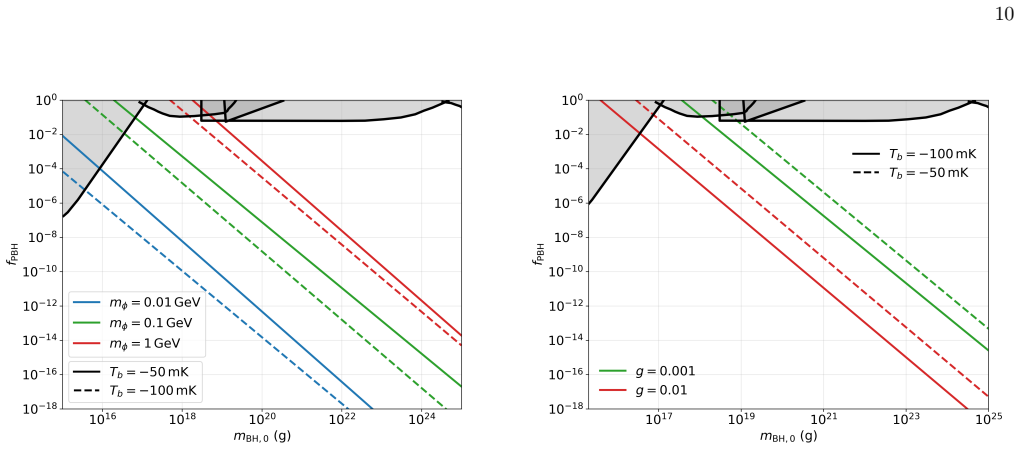
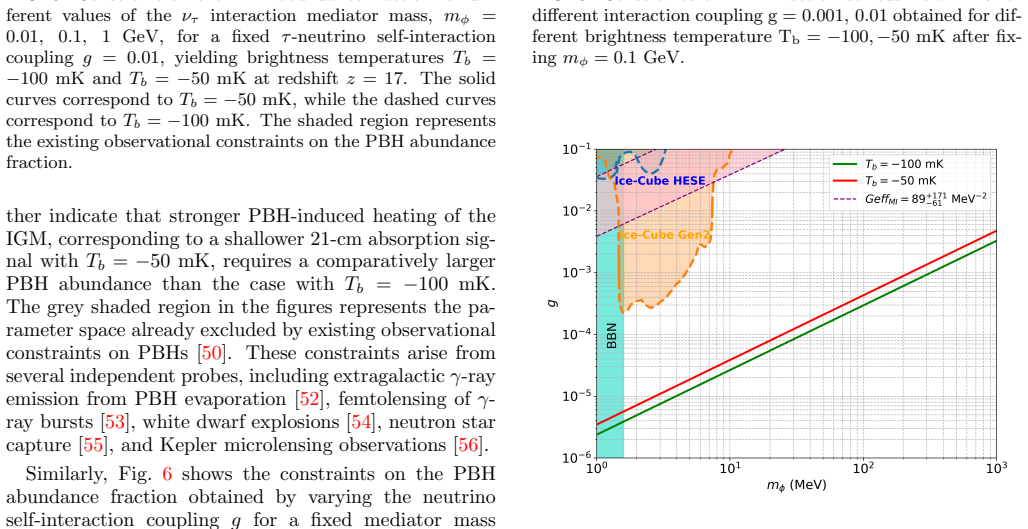
Evaporating primordial black holes emit neutrinos over a wide energy range. Radiative scattering of these neutrinos with the cosmic neutrino background produces secondary photons. The photons heat the neutral hydrogen in the intergalactic medium, which increases the global 21-cm brightness temperature relative to the standard cosmological model. The observed absorption feature at redshift approximately 17 is then used to set new limits on the primordial black hole fraction for initial masses from 10^15 g to 10^25 g. Existing PBH bounds are further translated into limits on neutrino self-interaction couplings across a range of mediator masses.
What carries the argument
Radiative scattering between PBH-emitted neutrinos and the cosmic neutrino background that generates secondary photons heating the neutral hydrogen gas.
If this is right
- New upper limits on the fraction of dark matter in primordial black holes for masses 10^15 g to 10^25 g.
- Constraints on neutrino self-interaction coupling strengths for a broad range of mediator masses.
- A neutrino-mediated heating channel that complements direct photon injection from PBH evaporation.
- A multimessenger route to probe both PBH abundance and beyond-standard-model neutrino physics.
Where Pith is reading between the lines
- More precise future 21-cm observations could strengthen the derived PBH and neutrino-coupling bounds by reducing uncertainty in the absorption depth.
- If the heating effect is present it may leave correlated signatures in other early-universe observables such as the CMB spectral distortions.
- Laboratory or astrophysical searches for neutrino self-interactions could be cross-checked against the cosmological limits obtained here.
Load-bearing premise
The secondary photons produced by neutrino scattering deposit enough energy to measurably raise the temperature of neutral hydrogen and thereby change the 21-cm brightness temperature.
What would settle it
A measurement of the 21-cm absorption depth at redshift 17 that exactly matches the standard no-extra-heating prediction would show that PBH-induced neutrino heating is negligible.
Figures
read the original abstract
We study the impact of neutrinos emitted from evaporating Primordial Black Holes (PBHs) on the global 21-cm absorption signal during the dark ages and pre-reionization epochs. PBHs emit neutrinos over a wide energy range through Hawking evaporation. We investigate the possibility that radiative scattering between these neutrinos and the Cosmic Neutrino Background (C$\nu$B) generates secondary photons, leading to additional heating of the neutral hydrogen gas. This modifies the thermal history of the intergalactic medium and increases the global 21-cm brightness temperature relative to the standard cosmological prediction. Using the absorption feature at redshift $z\simeq17$, we derive new constraints on the PBH fraction for PBH masses in the range $10^{15}\mathrm{g}\lesssim m_{\rm BH,0}\lesssim10^{25}\mathrm{g}$. We further use existing PBH limits to constrain neutrino self-interaction couplings over a broad range of mediator masses. Our analysis complements previous studies that focused on direct photon injection from PBH evaporation and highlights the importance of neutrino-induced effects within a multimessenger framework for probing PBHs and beyond-standard-model neutrino interactions.
Editorial analysis
A structured set of objections, weighed in public.
Referee Report
Summary. The manuscript studies neutrinos emitted via Hawking evaporation from primordial black holes (PBHs) and their potential radiative scattering with the cosmic neutrino background (CνB) to produce secondary photons. These photons are argued to heat the neutral hydrogen in the intergalactic medium, modifying the thermal history and increasing the global 21-cm brightness temperature relative to ΛCDM at z ≃ 17. The absorption feature is then used to derive new upper limits on the PBH dark-matter fraction f_PBH for initial masses 10^15 g ≲ m_BH,0 ≲ 10^25 g; conversely, existing PBH limits are inverted to constrain neutrino self-interaction couplings over a range of mediator masses. The analysis is presented as complementary to direct-photon-injection studies within a multimessenger framework.
Significance. If the secondary-photon heating rate is shown to be both quantitatively sufficient and distinguishable from other IGM heating channels at z ~ 17, the work would supply an independent probe of the PBH mass window that is currently only weakly constrained and would simultaneously bound BSM neutrino interactions in a previously unexplored regime. The approach also illustrates how 21-cm data can be repurposed for multimessenger constraints on evaporating relics.
major comments (3)
- [Sections on neutrino-CνB scattering and IGM heating] The central claim rests on the assertion that PBH-emitted neutrinos undergo BSM radiative scattering (ν + ν → ν + γ or equivalent) with the CνB at a rate that deposits enough energy to measurably raise T_gas or T_s at z ≃ 17. No explicit derivation of the effective heating rate—incorporating the mediator mass, coupling strength, photon yield, Compton scattering, pair-production opacity, and mean-free-path at z ~ 17—is provided in the sections describing the interaction; without this, it is impossible to verify that the effect exceeds other heating sources or produces a detectable shift in the absorption depth.
- [Section deriving PBH fraction constraints] The new f_PBH limits for 10^15–10^25 g are derived from the modified 21-cm signal. Because the magnitude of the temperature shift scales directly with the (unspecified) self-interaction coupling, the resulting bounds are conditional on a particular coupling value; a sensitivity plot or explicit statement of the assumed coupling range is required before the limits can be regarded as robust.
- [Section on neutrino coupling constraints] When existing PBH limits are used to bound the neutrino self-interaction couplings, the mapping assumes that the 21-cm-derived heating effect is the dominant observable; any degeneracy with direct photon injection or other BSM processes must be quantified, otherwise the inverted bounds on the mediator mass and coupling may be overstated.
minor comments (2)
- [Abstract and §2] Notation for the initial PBH mass m_BH,0 and the present-day mass should be defined once at first use and used consistently; the abstract and main text currently mix the two.
- [21-cm modeling section] The 21-cm brightness-temperature formula (presumably Eq. (X) in the modeling section) should explicitly list all additional heating/cooling terms retained from the standard calculation so that the incremental PBH-neutrino contribution can be isolated.
Simulated Author's Rebuttal
We thank the referee for the careful reading and constructive comments on our manuscript. We address each of the three major comments below, indicating the revisions that will be incorporated.
read point-by-point responses
-
Referee: [Sections on neutrino-CνB scattering and IGM heating] The central claim rests on the assertion that PBH-emitted neutrinos undergo BSM radiative scattering (ν + ν → ν + γ or equivalent) with the CνB at a rate that deposits enough energy to measurably raise T_gas or T_s at z ≃ 17. No explicit derivation of the effective heating rate—incorporating the mediator mass, coupling strength, photon yield, Compton scattering, pair-production opacity, and mean-free-path at z ~ 17—is provided in the sections describing the interaction; without this, it is impossible to verify that the effect exceeds other heating sources or produces a detectable shift in the absorption depth.
Authors: We acknowledge that the derivation of the effective heating rate was not presented with full explicit detail. In the revised manuscript we will add a dedicated subsection that derives the heating rate step by step, explicitly including the dependence on mediator mass and coupling strength, the photon yield per scattering, and the relevant propagation effects (Compton scattering, pair-production opacity, and mean free path) evaluated at z ≈ 17. This will make the magnitude of the effect and its comparison to other heating channels fully transparent. revision: yes
-
Referee: [Section deriving PBH fraction constraints] The new f_PBH limits for 10^15–10^25 g are derived from the modified 21-cm signal. Because the magnitude of the temperature shift scales directly with the (unspecified) self-interaction coupling, the resulting bounds are conditional on a particular coupling value; a sensitivity plot or explicit statement of the assumed coupling range is required before the limits can be regarded as robust.
Authors: The referee is correct that the reported f_PBH limits are conditional on the assumed coupling. The original analysis adopted a benchmark value; we will revise the manuscript to include an explicit sensitivity plot showing how the upper limits on f_PBH vary with coupling strength and mediator mass, together with a clear statement of the coupling range used for the quoted constraints. revision: yes
-
Referee: [Section on neutrino coupling constraints] When existing PBH limits are used to bound the neutrino self-interaction couplings, the mapping assumes that the 21-cm-derived heating effect is the dominant observable; any degeneracy with direct photon injection or other BSM processes must be quantified, otherwise the inverted bounds on the mediator mass and coupling may be overstated.
Authors: We agree that possible degeneracies with direct photon injection must be addressed. In the revision we will add a quantitative discussion of the relative importance of the neutrino-induced channel versus direct photon injection, including estimates of any overlap and a statement that the derived coupling bounds are conservative with respect to such degeneracies. revision: yes
Circularity Check
No significant circularity; derivation is forward modeling from external 21-cm data.
full rationale
The paper models Hawking neutrinos from PBHs, their radiative scattering with CνB to produce secondary photons, and the resulting IGM heating that modifies the 21-cm brightness temperature. It then compares this modified signal to the observed absorption feature at z≃17 to derive upper limits on the PBH fraction f_PBH for the stated mass range. This is a standard parameter-constraint procedure using an external observable; the model inputs (Hawking spectrum, scattering cross section via unspecified BSM couplings, energy deposition efficiency) are not fitted to the target 21-cm datum and then re-labeled as a prediction. The secondary step of applying pre-existing PBH limits to bound neutrino self-interaction couplings is likewise an external-input exercise. No equations or sections exhibit self-definition, fitted-input-as-prediction, or load-bearing self-citation chains that collapse the central claim to its own inputs by construction. The analysis is therefore self-contained against the cited 21-cm data and prior PBH bounds.
Axiom & Free-Parameter Ledger
axioms (2)
- domain assumption Hawking evaporation of PBHs produces neutrinos over a wide energy range
- domain assumption Radiative scattering of these neutrinos with the CνB produces secondary photons that heat neutral hydrogen
Reference graph
Works this paper leans on
-
[1]
Evolution of the ionizing back- ground and the epoch of reionization from the spectra of z 6 quasars.The Astronomical Journal, 123(3):1247– 1257, 2002
Xiaohui Fan, Vijay K Narayanan, Michael A Strauss, Richard L White, Robert H Becker, Laura Pentericci, and Hans-Walter Rix. Evolution of the ionizing back- ground and the epoch of reionization from the spectra of z 6 quasars.The Astronomical Journal, 123(3):1247– 1257, 2002
2002
-
[2]
Probing beyond the epoch of hydrogen reionization with 21 centimeter radi- ation.Astrophys
Benedetta Ciardi and Piero Madau. Probing beyond the epoch of hydrogen reionization with 21 centimeter radi- ation.Astrophys. J., 596:1–8, 2003
2003
-
[3]
Vishrut Pandya, Leon Noble, Suman Majumdar, Deban- jan Sarkar, Mohd Kamran, and Abhirup Datta. Probing reionization up to the mark: The marked power spec- 12 trum to unveil the hi 21-cm signal from the eor.arXiv preprint arXiv:2605.18301, 2026
work page internal anchor Pith review Pith/arXiv arXiv 2026
-
[4]
HI Epoch of Reionization Arrays
LJ Greenhill and G Bernardi. Hi epoch of reionization arrays.arXiv preprint arXiv:1201.1700, 2012
work page internal anchor Pith review Pith/arXiv arXiv 2012
-
[5]
Reach project homepage
-
[6]
The murchison widefield array: the square kilometre array precursor at low radio frequencies.Publi- cations of the Astronomical Society of Australia, 30:e007, 2013
Steven John Tingay, Robert Goeke, Judd D Bowman, David Emrich, Stephen M Ord, Daniel A Mitchell, Miguel F Morales, Tom Booler, Brian Crosse, Randall B Wayth, et al. The murchison widefield array: the square kilometre array precursor at low radio frequencies.Publi- cations of the Astronomical Society of Australia, 30:e007, 2013
2013
-
[7]
Reionization and the Cosmic Dawn with the Square Kilometre Array.Exper
Garrelt Mellema et al. Reionization and the Cosmic Dawn with the Square Kilometre Array.Exper. Astron., 36:235–318, 2013
2013
-
[8]
L. V. E. Koopmans et al. The Cosmic Dawn and Epoch of Reionization with the Square Kilometre Array.PoS, AASKA14:001, 2015
2015
-
[9]
The gmrt eor experiment: limits on polarized sky brightness at 150 mhz.Monthly Notices of the Royal Astronomical Society, 399(1):181– 194, 2009
Ue-Li Pen, Tzu-Ching Chang, Christopher M Hirata, Jef- frey B Peterson, Jayanta Roy, Yashwant Gupta, Julia Odegova, and Kris Sigurdson. The gmrt eor experiment: limits on polarized sky brightness at 150 mhz.Monthly Notices of the Royal Astronomical Society, 399(1):181– 194, 2009
2009
-
[10]
DeBoer et al
David R. DeBoer et al. Hydrogen Epoch of Reion- ization Array (HERA).Publ. Astron. Soc. Pac., 129(974):045001, 2017
2017
-
[11]
Improved Constraints on the 21 cm EoR Power Spectrum and the X-Ray Heating of the IGM with HERA Phase I Observations.Astrophys
Zara Abdurashidova et al. Improved Constraints on the 21 cm EoR Power Spectrum and the X-Ray Heating of the IGM with HERA Phase I Observations.Astrophys. J., 945(2):124, 2023
2023
-
[12]
The low- frequency array (lofar): opening a new window on the universe.Planetary and Space Science, 52(15):1343– 1349, 2004
NE Kassim, TJW Lazio, PS Ray, PC Crane, BC Hicks, KP Stewart, AS Cohen, and WM Lane. The low- frequency array (lofar): opening a new window on the universe.Planetary and Space Science, 52(15):1343– 1349, 2004
2004
-
[13]
A lower limit ofδz¿ 0.06 for the duration of the reionization epoch
Judd D Bowman and Alan EE Rogers. A lower limit ofδz¿ 0.06 for the duration of the reionization epoch. Nature, 468(7325):796–798, 2010
2010
-
[14]
Udaya Shankar, B
Saurabh Singh, Jishnu Nambissan T., Ravi Subrah- manyan, N. Udaya Shankar, B. S. Girish, A. Raghu- nathan, R. Somashekar, K. S. Srivani, and Mayuri Sathyanarayana Rao. On the detection of a cosmic dawn signal in the radio background.Nature Astron., 6(5):607– 617, 2022
2022
-
[15]
Weltman et al
A. Weltman et al. Fundamental physics with the Square Kilometre Array.Publ. Astron. Soc. Austral., 37:e002, 2020
2020
-
[16]
Possible interaction between baryons and dark-matter particles revealed by the first stars.Na- ture, 555(7694):71–74, 2018
Rennan Barkana. Possible interaction between baryons and dark-matter particles revealed by the first stars.Na- ture, 555(7694):71–74, 2018
2018
-
[17]
GRB221009A gamma-ray events from nonstandard neutrino self-interactions.Phys
Mansi Dhuria. GRB221009A gamma-ray events from nonstandard neutrino self-interactions.Phys. Rev. D, 109(6):063007, 2024
2024
-
[18]
Strong constraints on light dark matter interpretation of the EDGES signal
Rennan Barkana, Nadav Joseph Outmezguine, Diego Redigolo, and Tomer Volansky. Strong constraints on light dark matter interpretation of the EDGES signal. Phys. Rev. D, 98(10):103005, 2018
2018
-
[19]
Pritchard and Steven R
Jonathan R. Pritchard and Steven R. Furlanetto. 21 cm fluctuations from inhomogeneous X-ray heating before reionization.Mon. Not. Roy. Astron. Soc., 376:1680– 1694, 2007
2007
-
[20]
Enhanced global signal of neutral hydrogen due to excess radiation at cosmic dawn.Astrophys
Chang Feng and Gilbert Holder. Enhanced global signal of neutral hydrogen due to excess radiation at cosmic dawn.Astrophys. J. Lett., 858(2):L17, 2018
2018
-
[21]
KM3-230213A and IceCube neutrino events from metastable dark matter of primordial black hole origin
Prabhav Singh, Mansi Dhuria, and Nathanael Varghese Job. KM3-230213A and IceCube neutrino events from metastable dark matter of primordial black hole origin. Phys. Rev. D, 113(10):103014, 2026
2026
-
[22]
High-energy and ultra-high-energy neutrinos from primordial black holes.Journal of Cosmology and Astroparticle Physics, 2025(02):059, 2025
Quan-feng Wu and Xun-Jie Xu. High-energy and ultra-high-energy neutrinos from primordial black holes.Journal of Cosmology and Astroparticle Physics, 2025(02):059, 2025
2025
-
[23]
Hooper, and Laura Lopez-Honorez
Iason Baldes, Quentin Decant, Deanna C. Hooper, and Laura Lopez-Honorez. Non-cold dark matter from pri- mordial black hole evaporation.Journal of Cosmology and Astroparticle Physics, 2020(08):045, aug 2020
2020
-
[24]
Seven hints for primordial black hole dark matter.Physics of the Dark Universe, 22:137–146, 2018
S´ ebastien Clesse and Juan Garc´ ıa-Bellido. Seven hints for primordial black hole dark matter.Physics of the Dark Universe, 22:137–146, 2018
2018
-
[25]
Chapter 4 - primordial black holes
Albert Escriv` a, Florian K¨ uhnel, and Yuichiro Tada. Chapter 4 - primordial black holes. In Manuel Arca Sedda, Elisa Bortolas, and Mario Spera, editors,Black Holes in the Era of Gravitational-Wave Astronomy, pages 261–377. Elsevier, 2024
2024
-
[26]
Black holes in the early universe.Monthly Notices of the Royal Astro- nomical Society, 168(2):399–415, 1974
Bernard J Carr and Stephen W Hawking. Black holes in the early universe.Monthly Notices of the Royal Astro- nomical Society, 168(2):399–415, 1974
1974
-
[27]
Black hole explosions?Nature, 248(5443):30–31, 1974
Stephen W Hawking. Black hole explosions?Nature, 248(5443):30–31, 1974
1974
-
[28]
Foster, and Julian B
Yitian Sun, Joshua W. Foster, and Julian B. Mu˜ noz. Constraining inhomogeneous energy injection from an- nihilating dark matter and primordial black holes with 21-cm cosmology. 9 2025
2025
-
[29]
Impact of Primordial Black Hole population on 21 cm observ- ables at high redshift
Atrideb Chatterjee, Barun Maity, and Koushiki. Impact of Primordial Black Hole population on 21 cm observ- ables at high redshift. 4 2026
2026
-
[30]
Primordial black holes in the Dark Ages: Observational prospects for future 21cm surveys
KJ Mack and DH Wesley. Primordial black holes in the dark ages: Observational prospects for future 21cm surveys, arxiv e-prints (2008).arXiv preprint arXiv:0805.1531, 805
work page internal anchor Pith review Pith/arXiv arXiv 2008
-
[31]
Probing memory-burdened Primordial Black Holes with global 21 cm signal
Priyanka Sarmah and Kingman Cheung. Probing memory-burdened Primordial Black Holes with global 21 cm signal. 12 2025
2025
-
[32]
Constraining spinning primordial black holes with global 21-cm signal.Monthly Notices of the Royal Astronomical Society, 510(3):4236–4241, 2022
Pravin Kumar Natwariya, Alekha C Nayak, and Tripu- rari Srivastava. Constraining spinning primordial black holes with global 21-cm signal.Monthly Notices of the Royal Astronomical Society, 510(3):4236–4241, 2022
2022
-
[33]
Sensitivities on nonspinning and spinning primordial black hole dark matter with global 21-cm troughs.Physical Review D, 105(10):103026, 2022
Akash Kumar Saha and Ranjan Laha. Sensitivities on nonspinning and spinning primordial black hole dark matter with global 21-cm troughs.Physical Review D, 105(10):103026, 2022
2022
-
[34]
21 cm limits on decaying dark matter and primordial black holes.Physical Review D, 98(4):043006, 2018
Steven J Clark, Bhaskar Dutta, Yu Gao, Yin-Zhe Ma, and Louis E Strigari. 21 cm limits on decaying dark matter and primordial black holes.Physical Review D, 98(4):043006, 2018
2018
-
[35]
21-cm con- straints on spinning primordial black holes.Journal of Cosmology and Astroparticle Physics, 2022(03):012, 2022
Junsong Cang, Yu Gao, and Yin-Zhe Ma. 21-cm con- straints on spinning primordial black holes.Journal of Cosmology and Astroparticle Physics, 2022(03):012, 2022
2022
-
[36]
21 cm cosmol- ogy in the 21st century.Reports on Progress in Physics, 75(8):086901, 2012
Jonathan R Pritchard and Abraham Loeb. 21 cm cosmol- ogy in the 21st century.Reports on Progress in Physics, 75(8):086901, 2012
2012
-
[37]
Probing self- interacting ultrahigh-energy neutrinos with the cosmic 21-cm signal.Phys
Mansi Dhuria and Bishnu Gupta Teli. Probing self- interacting ultrahigh-energy neutrinos with the cosmic 21-cm signal.Phys. Rev. D, 110(12):123033, 2024
2024
-
[38]
Cosmology at low frequencies: The 21 cm transition and 13 the high-redshift universe.Physics reports, 433(4-6):181– 301, 2006
Steven R Furlanetto, S Peng Oh, and Frank H Briggs. Cosmology at low frequencies: The 21 cm transition and 13 the high-redshift universe.Physics reports, 433(4-6):181– 301, 2006
2006
-
[39]
A strong broadband 21 cm cosmologi- cal signal from dark matter spin-flip interactions.JCAP, 08:041, 2021
Mansi Dhuria, Viraj Karambelkar, Vikram Rentala, and Priyanka Sarmah. A strong broadband 21 cm cosmologi- cal signal from dark matter spin-flip interactions.JCAP, 08:041, 2021
2021
-
[40]
Spin exchange rates in proton–hydrogen collisions.Monthly Notices of the Royal Astronomical Society, 379(1):130– 134, 2007
Steven R Furlanetto and Michael R Furlanetto. Spin exchange rates in proton–hydrogen collisions.Monthly Notices of the Royal Astronomical Society, 379(1):130– 134, 2007
2007
-
[41]
Kovetz, Vivian Poulin, Vera Gluscevic, Kimberly K
Ely D. Kovetz, Vivian Poulin, Vera Gluscevic, Kimberly K. Boddy, Rennan Barkana, and Marc Kamionkowski. Tighter limits on dark matter explana- tions of the anomalous edges 21 cm signal.Phys. Rev. D, 98:103529, Nov 2018
2018
-
[42]
Jordan Mirocha, Geraint J. A. Harker, and Jack O. Burns. Interpreting the global 21-cm signal from high redshifts. ii. parameter estimation for models of galaxy formation.The Astrophysical Journal, 813(1):11, oct 2015
2015
-
[43]
Geraint J. A. Harker, Jordan Mirocha, Jack O. Burns, and Jonathan R. Pritchard. Parametrizations of the 21- cm global signal and parameter estimation from single- dipole experiments.Monthly Notices of the Royal Astro- nomical Society, 455(4):3829–3840, 02 2016
2016
-
[44]
Heating of the intergalactic medium by the cosmic microwave background during cos- mic dawn.Phys
Tejaswi Venumadhav, Liang Dai, Alexander Kaurov, and Matias Zaldarriaga. Heating of the intergalactic medium by the cosmic microwave background during cos- mic dawn.Phys. Rev. D, 98:103513, Nov 2018
2018
-
[45]
Wenzer Qin. Illuminating the cosmos: Dark matter, pri- mordial black holes, and cosmic dawn.arXiv preprint arXiv:2406.09483, 2024
-
[46]
The effects of dark matter annihilation and dark matter-baryon velocity off- sets at cosmic dawn.Journal of Cosmology and Astropar- ticle Physics, 2025(04):081, 2025
Liqiang Hou and Katherine J Mack. The effects of dark matter annihilation and dark matter-baryon velocity off- sets at cosmic dawn.Journal of Cosmology and Astropar- ticle Physics, 2025(04):081, 2025
2025
-
[47]
Nishizawa
Pravin Kumar Natwariya, Kenji Kadota, and Atsushi J. Nishizawa. Sensitivity toward dark matter annihila- tion imprints on the 21-cm signal with SKA-Low: A convolutional neural network approach.Phys. Rev. D, 113(2):023038, 2026
2026
-
[48]
Particle decays during the cosmic dark ages.Phys
Xuelei Chen and Marc Kamionkowski. Particle decays during the cosmic dark ages.Phys. Rev. D, 70:043502, Aug 2004
2004
-
[49]
Constraints on primordial black holes.Reports on Progress in Physics, 84(11):116902, 2021
Bernard Carr, Kazunori Kohri, Yuuiti Sendouda, and Jun’ichi Yokoyama. Constraints on primordial black holes.Reports on Progress in Physics, 84(11):116902, 2021
2021
-
[50]
Pri- mordial Black Holes as Dark Matter.Phys
Bernard Carr, Florian Kuhnel, and Marit Sandstad. Pri- mordial Black Holes as Dark Matter.Phys. Rev. D, 94(8):083504, 2016
2016
-
[51]
Ser- pico
Vivian Poulin, Julien Lesgourgues, and Pasquale D. Ser- pico. Cosmological constraints on exotic injection of elec- tromagnetic energy.JCAP, 03:043, 2017
2017
-
[52]
New cosmological constraints on primordial black holes.Physical Review D—Particles, Fields, Grav- itation, and Cosmology, 81(10):104019, 2010
BJ Carr, Kazunori Kohri, Yuuiti Sendouda, and Jun’ichi Yokoyama. New cosmological constraints on primordial black holes.Physical Review D—Particles, Fields, Grav- itation, and Cosmology, 81(10):104019, 2010
2010
-
[53]
New constraints on primordial black holes abundance from femtolensing of gamma-ray bursts.Physical Re- view D—Particles, Fields, Gravitation, and Cosmology, 86(4):043001, 2012
Anna Barnacka, J-F Glicenstein, and R Moderski. New constraints on primordial black holes abundance from femtolensing of gamma-ray bursts.Physical Re- view D—Particles, Fields, Gravitation, and Cosmology, 86(4):043001, 2012
2012
-
[54]
Dark matter triggers of supernovae.Physical Review D, 92(6):063007, 2015
Peter W Graham, Surjeet Rajendran, and Jaime Varela. Dark matter triggers of supernovae.Physical Review D, 92(6):063007, 2015
2015
-
[55]
Constraints on primordial black holes as dark matter candidates from capture by neutron stars.Physical Re- view D—Particles, Fields, Gravitation, and Cosmology, 87(12):123524, 2013
Fabio Capela, Maxim Pshirkov, and Peter Tinyakov. Constraints on primordial black holes as dark matter candidates from capture by neutron stars.Physical Re- view D—Particles, Fields, Gravitation, and Cosmology, 87(12):123524, 2013
2013
-
[56]
Experimental limits on primordial black hole dark matter from the first 2 yr of kepler data.The As- trophysical Journal, 786(2):158, 2014
Kim Griest, Agnieszka M Cieplak, and Matthew J Lehner. Experimental limits on primordial black hole dark matter from the first 2 yr of kepler data.The As- trophysical Journal, 786(2):158, 2014
2014
-
[57]
Constraining the self-interacting neutrino interpretation of the hubble tension.Physical Review Letters, 123(19):191102, 2019
Nikita Blinov, Kevin J Kelly, Gordan Krnjaic, and Samuel D McDermott. Constraining the self-interacting neutrino interpretation of the hubble tension.Physical Review Letters, 123(19):191102, 2019
2019
-
[58]
Probing secret interactions of astrophysical neutrinos in the high-statistics era.Physical Review D, 104(12):123014, 2021
Ivan Esteban, Sujata Pandey, Vedran Brdar, and John F Beacom. Probing secret interactions of astrophysical neutrinos in the high-statistics era.Physical Review D, 104(12):123014, 2021
2021
-
[59]
Icecube high-energy start- ing event sample: Description and flux characterization with 7.5 years of data.Physical Review D, 104(2):022002, 2021
R Abbasi, M Ackermann, J Adams, JA Aguilar, M Ahlers, M Ahrens, C Alispach, AA Alves Jr, NM Amin, K Andeen, et al. Icecube high-energy start- ing event sample: Description and flux characterization with 7.5 years of data.Physical Review D, 104(2):022002, 2021
2021
discussion (0)
Sign in with ORCID, Apple, or X to comment. Anyone can read and Pith papers without signing in.