A Denser Planar Surface Code
Reviewed by Pith T0 review T1 audit T2 compute T3 formal T4 kernel 2026-06-29 06:28 UTCgrok-4.3pith:ZZUREG4Nrecord.jsonopen to challenge →
The pith
A hex-grid surface code packs twist defects to reach 4.5 times the logical-qubit density of rotated surface codes under 10^{-3} circuit noise.
A machine-rendered reading of the paper's core claim, the machinery that carries it, and where it could break.
Core claim
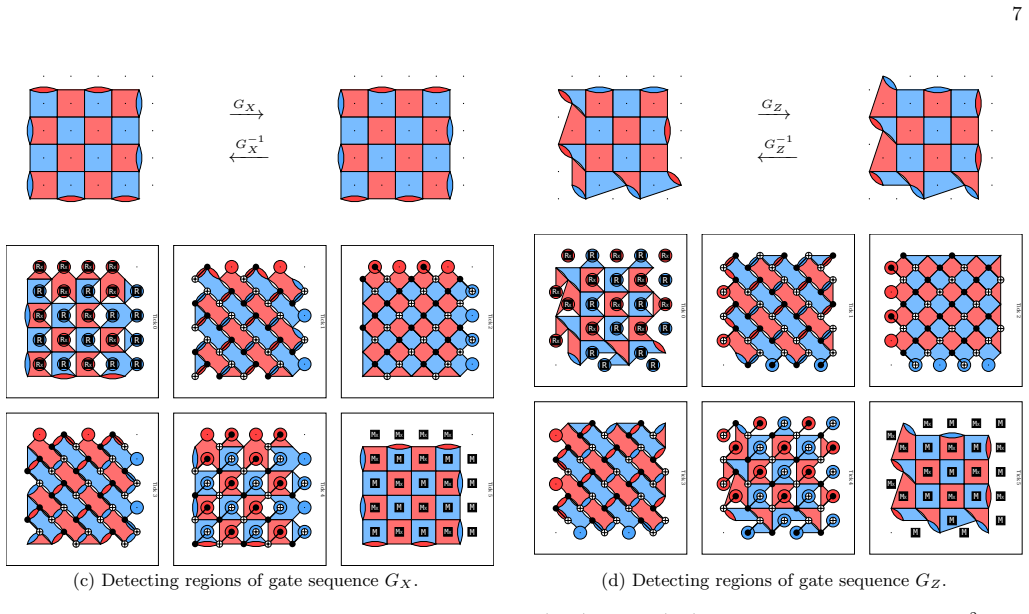
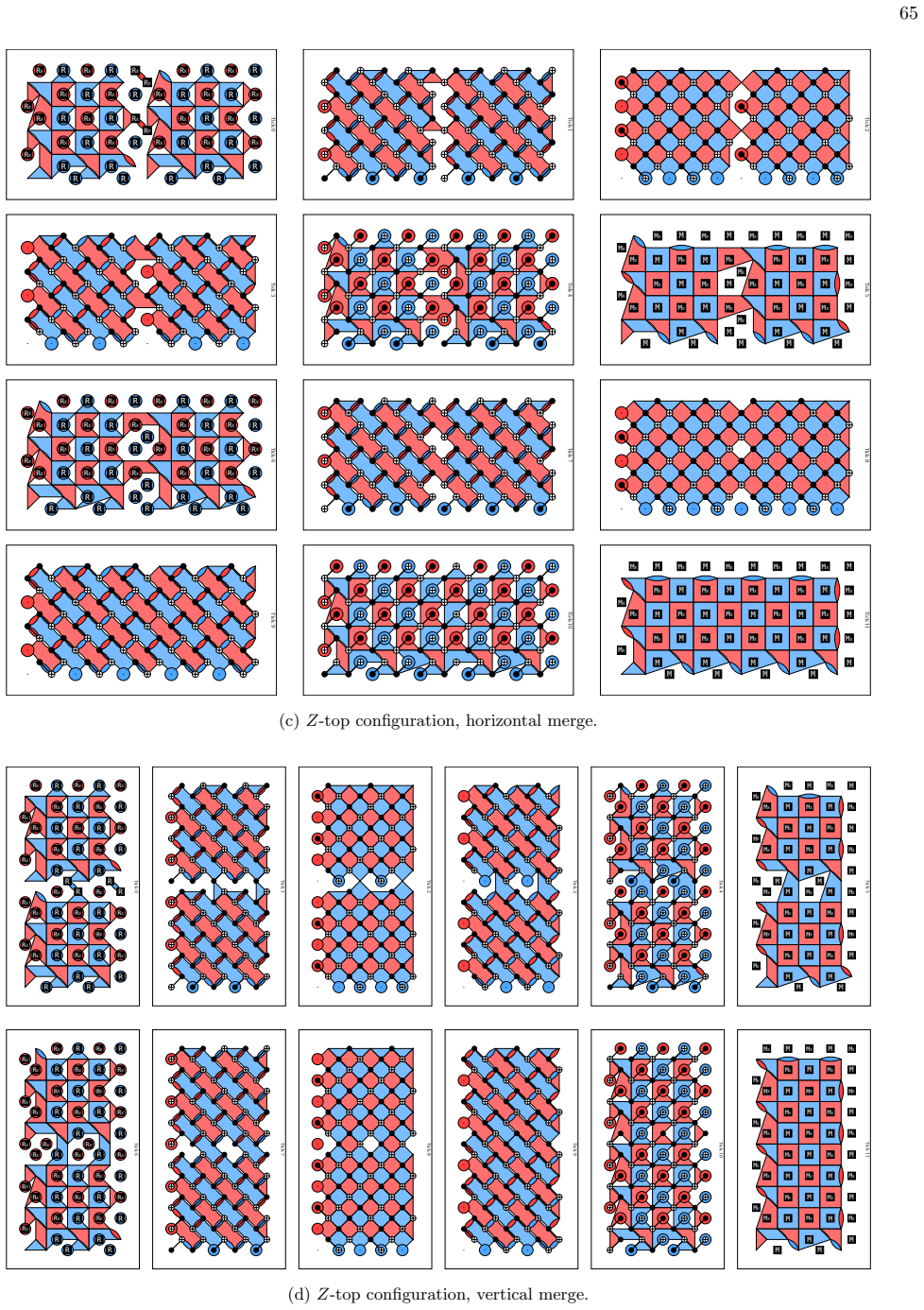
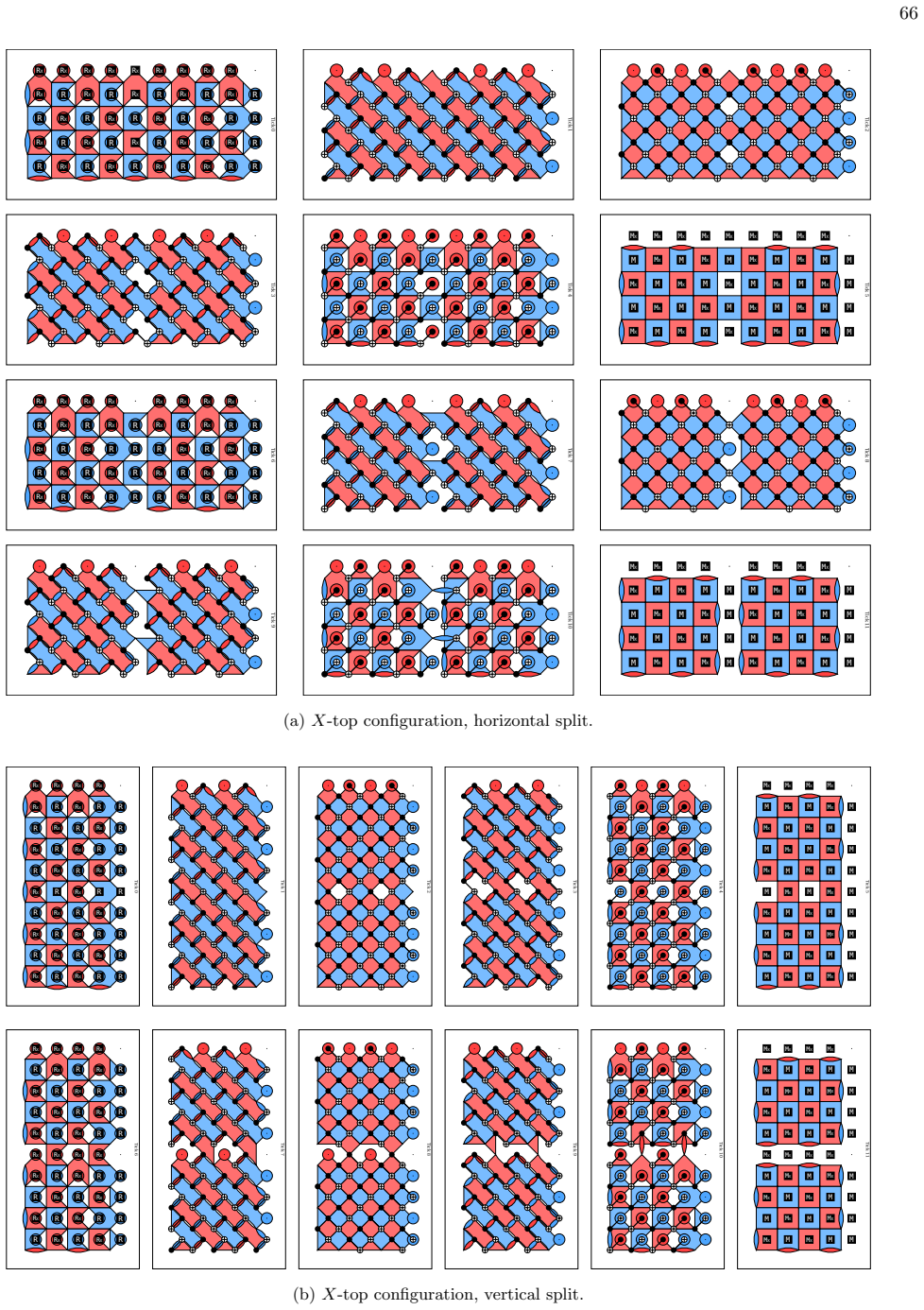
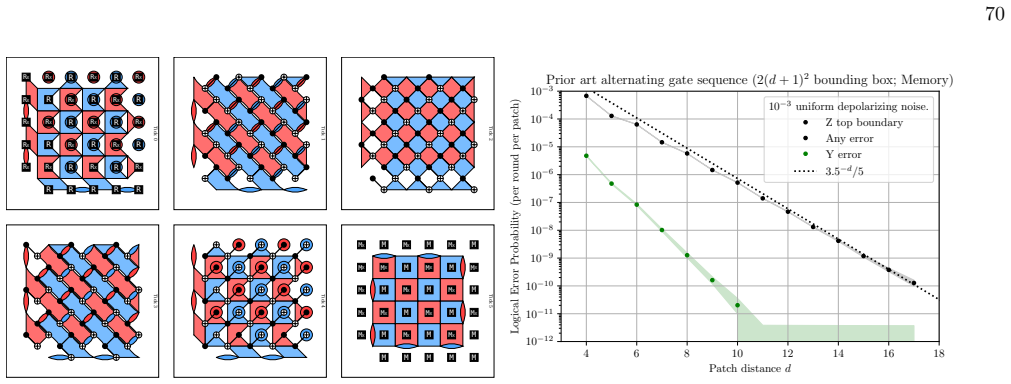
We present a quantum code implementable on a regular 2D hex grid with an estimated encoding rate up to 4.5× of that of a rotated surface code patch using circuit-level noise in a one- and two-qubit 10^{-3} error uniform depolarizing model. Our approach is based on yoking a dense packing of surface code twist defects, enabled by new stabilizer measurement cycles with an optimal four layers of nearest-neighbor two-qubit gates, almost no distance-reducing hook errors, and efficient decoding. We demonstrate a space-efficient architecture for computing on densely packed logical qubits, including new padding-free lattice surgery protocols in an optimal bounding box of 2d² data and measurement qubi
What carries the argument
Dense yoking of surface-code twist defects on a hex grid, realized through four-layer nearest-neighbor stabilizer cycles that avoid hook errors.
If this is right
- Chemically accurate ground-state phase estimation of the 108-spin-orbital FeMoco molecule becomes feasible in under a month using 89k noisy superconducting qubits.
- Space overhead drops by a factor of 36 and spacetime overhead by a factor of 6.6 relative to prior minimum-Toffoli estimates.
- A Pareto frontier of space-time trade-offs exists with a minimum physical quantum volume of 1.3 mega-qubit-hours.
- Padding-free lattice surgery fits inside a 2d² bounding box for each logical patch.
Where Pith is reading between the lines
- The same twist-defect packing technique may reduce overhead for non-chemistry algorithms whose bottleneck is the number of logical qubits rather than gate depth.
- If the four-layer cycles remain efficient when the code is concatenated or used inside larger fault-tolerant protocols, the approach could compound with other overhead-reduction methods.
- Hardware that already supports hexagonal connectivity may see an immediate density gain without requiring new fabrication steps.
Load-bearing premise
The new four-layer stabilizer cycles can be executed on hardware without introducing error rates or correlations beyond those captured by the uniform 10^{-3} depolarizing model.
What would settle it
A circuit-level simulation or device experiment that measures the logical error rate per cycle for the new code and finds it no better than the rate achieved by a rotated surface-code patch of equal distance at the same physical error rate.
Figures













read the original abstract
We present a quantum code implementable on a regular $2$D hex grid with an estimated encoding rate up to $4.5\times$ of that of a rotated surface code patch using circuit-level noise in a one- and two-qubit $10^{-3}$ error uniform depolarizing model. Our approach is based on yoking a dense packing of surface code twist defects, enabled by new stabilizer measurement cycles with an optimal four layers of nearest-neighbor two-qubit gates, almost no distance-reducing hook errors, and efficient decoding. We demonstrate a space-efficient architecture for computing on densely packed logical qubits, including new padding-free lattice surgery protocols in an optimal bounding box of $2d^2$ data and measurement qubits per patch. Assuming a $1\mu$s surface code cycle time and a $10\mu$s reaction time, these developments enable chemically accurate ground state phase estimation of a broad class of `utility-scale' electronic structure simulation problems such as the $108$ spin-orbital FeMoco-based nitrogen fixation catalyst in under a month with $89$k noisy superconducting qubits. We elucidate a Pareto frontier of space-time trade-offs and find a minimum physical quantum volume of $1.3$ mega-qubit-hours. These correspond to a $36\times$ space and $6.6\times$ spacetime improvement, respectively, over our previous state-of-the-art minimum-Toffoli resource estimates (Phys. Rev. X 15, 041016).
Editorial analysis
A structured set of objections, weighed in public.
Referee Report
Summary. The manuscript proposes a denser planar surface code on a regular 2D hexagonal grid achieved via dense packing of surface-code twist defects. It introduces new stabilizer measurement cycles using an optimal four layers of nearest-neighbor two-qubit gates that are asserted to incur almost no distance-reducing hook errors while supporting efficient decoding. Under a circuit-level uniform depolarizing noise model with 10^{-3} one- and two-qubit error rates, the construction is claimed to deliver up to 4.5× higher encoding rate than rotated surface-code patches, together with padding-free lattice surgery in a 2d² bounding box. These improvements are used to derive resource estimates for chemically accurate ground-state phase estimation of the 108-orbital FeMoco system (89k physical qubits, under one month) and a minimum physical quantum volume of 1.3 mega-qubit-hours, corresponding to 36× space and 6.6× spacetime gains over prior estimates.
Significance. If the hook-error suppression and distance preservation claims are substantiated, the work would provide a concrete reduction in physical-qubit overhead for planar surface-code architectures, directly impacting the feasibility of utility-scale quantum simulations on near-term superconducting hardware. The explicit Pareto frontier of space-time trade-offs and the end-to-end FeMoco resource calculation supply falsifiable benchmarks that strengthen the paper’s utility for the broader quantum resource estimation literature.
major comments (1)
- [Abstract] Abstract: the central claim that the four-layer stabilizer cycles incur 'almost no distance-reducing hook errors' and support 'efficient decoding' for the dense twist-defect packing is load-bearing for the reported 4.5× encoding rate, 36× space improvement, and 89k-qubit FeMoco estimate, yet the abstract supplies no explicit distance calculations, per-configuration hook-error analysis, or threshold simulations under the stated 10^{-3} depolarizing model to confirm that effective distance is preserved across all relevant defect arrangements.
minor comments (1)
- [Abstract] Abstract: the precise definition of the 'one- and two-qubit 10^{-3} error uniform depolarizing model' (including whether measurement errors are included and how the circuit-level noise is applied to the four-layer schedule) should be stated explicitly or referenced to a methods section for reproducibility.
Simulated Author's Rebuttal
We thank the referee for their thoughtful review and positive assessment of the work's significance. We address the single major comment below, providing clarification on where the supporting analyses appear in the manuscript while agreeing that the abstract itself is concise by design.
read point-by-point responses
-
Referee: [Abstract] Abstract: the central claim that the four-layer stabilizer cycles incur 'almost no distance-reducing hook errors' and support 'efficient decoding' for the dense twist-defect packing is load-bearing for the reported 4.5× encoding rate, 36× space improvement, and 89k-qubit FeMoco estimate, yet the abstract supplies no explicit distance calculations, per-configuration hook-error analysis, or threshold simulations under the stated 10^{-3} depolarizing model to confirm that effective distance is preserved across all relevant defect arrangements.
Authors: The abstract is a high-level summary and does not include detailed calculations, which is standard. The explicit distance calculations, per-configuration hook-error analysis demonstrating preservation of distance for all relevant twist-defect arrangements, and threshold simulations under the uniform depolarizing circuit-level noise model at 10^{-3} are provided in the main text (Sections III–V). These confirm that the four-layer cycles incur almost no distance-reducing hook errors and support efficient decoding. We will revise the abstract to add a short clause referencing these results for improved clarity. revision: partial
Circularity Check
Minor self-citation for baseline comparison; central code construction and rate estimates remain independent.
specific steps
-
self citation load bearing
[Abstract (final sentence)]
"These correspond to a 36× space and 6.6× spacetime improvement, respectively, over our previous state-of-the-art minimum-Toffoli resource estimates (Phys. Rev. X 15, 041016)."
The quoted improvement factors are computed relative to the authors' own earlier resource estimates. While this is only a comparative baseline and does not define or justify the new stabilizer cycles or encoding rate, it constitutes the single minor self-citation present.
full rationale
The paper introduces new stabilizer measurement cycles (four nearest-neighbor layers) and padding-free lattice surgery on a hex grid, then estimates encoding rate (4.5×) and resource counts under an explicit circuit-level depolarizing noise model. These constructions are presented directly rather than defined in terms of the output metrics. The 36×/6.6× improvements and FeMoco numbers are comparisons to a prior self-cited work (Phys. Rev. X 15, 041016); this citation supplies only the baseline and is not invoked to justify uniqueness or forbid alternatives for the new code. No fitted parameters are renamed as predictions, no self-definitional loops appear in the abstract or cited claims, and the derivation does not reduce to its inputs by construction. This is the normal minor self-citation case (score 2).
Axiom & Free-Parameter Ledger
free parameters (3)
- depolarizing error probability =
10^{-3}
- surface-code cycle time =
1 μs
- reaction time =
10 μs
axioms (2)
- domain assumption New stabilizer measurement cycles on the hex grid incur almost no distance-reducing hook errors and admit efficient decoding.
- domain assumption The 1 μs cycle time and 10 μs reaction time are representative of future hardware.
Forward citations
Cited by 5 Pith papers
-
Vine Codes: Low-Overhead Quantum LDPC Codes on a Planar Square Grid
Vine codes generalize directional codes to open planar boundaries, delivering up to 28% fewer data/measure qubits at circuit distance 7 and better simulated performance than the surface code at 10^{-3} noise while usi...
-
Exploring the landscape of compact magic-state distillation factories
Classical codes plus SAT search yield no-go theorems limiting error detection in sub-8-qubit distillation and new minimal-qubit protocols for T-to-T (distances 4-5 on 10-11 qubits) and T-to-CCZ (distances 3-4 on 9-10 qubits).
-
Nearest-neighbour gates are all you need: High-rate quantum low-density parity-check codes on a planar grid
Presents planar open-boundary quantum LDPC codes with nearest-neighbor iSWAP-based syndrome extraction that outperform rotated surface codes in code-efficiency and logical error rate on finite instances like [[323,14,15]].
-
Practical gates by Majorana fermion motion
Majorana fermion motion serves as a primitive for braiding-based logical gates in stabilizer codes, enabling denser packing and numerical outperformance of lattice surgery for 2-qubit Clifford gates under near-term noise.
-
Nanostructure modelling with early fault tolerant quantum computers
Quantum simulation framework for ground-state energies of 4- and 8-electron double quantum dots on surface-code fault-tolerant hardware, with resource estimates of 226k-314k physical qubits and 24 hours to 3.4 days ru...
Reference graph
Works this paper leans on
-
[1]
From|x o⟩, compute in a single ancillary qubit the comparison|x o <2 nR C⟩
-
[2]
These correspond to theG SF components
Controlled on|x o <2 nR C⟩=|1⟩, perform unary iteration over the firstRaddresses of then R qubits. These correspond to theG SF components
-
[3]
The high bit can be used as a control to perform unary iteration over the firstNaddresses of then R +n C qubits
Subtract 2 nR Cfrom|x o⟩to obtain|x o −2 nR C⟩. The high bit can be used as a control to perform unary iteration over the firstNaddresses of then R +n C qubits. These correspond to theG D1 andG Q1 compo- nents. •Removing the single-qubit|b=B⟩registerQROAM inRPrepoutputs a single qubit state flagging the condition|b=B⟩. This is then used to controlMaj: If|...
-
[4]
This large overhead was chosen to minimize the Toffoli cost ofRPrep
Reducing RPrep bits and using dirty qubits The qubit overhead is dominated by the (N−1)b rot qubits output by theQROMinRPrep. This large overhead was chosen to minimize the Toffoli cost ofRPrep. In this section, we show that for any integerλ∈[1,(N−1)], we can reduce this qubit overhead to justλb rot. We also use QROAM with either clean or dirty qubits for...
-
[5]
In contrast, alias sampling of the same state tob coeff bits of precision uses a large number of 2(n X +b coeff) persistent bits
Pure state preparation instead of alias sampling Storing a pure state PX−1 j=0 cj |j⟩requires onlyn X qubits. In contrast, alias sampling of the same state tob coeff bits of precision uses a large number of 2(n X +b coeff) persistent bits. In the limit of very few ancillae, it is beneficial to replace alias sampling in both Inner and OuterPrepwith alterna...
-
[6]
However, there exist alternate implementations that cost a constant factor more in Toffoli gates but only use dirty qubits
Clean-ancilla-free arithmetic The arithmetic operations (multiple-controlledX, quantum-classical comparators, adders, unary iteration) used in our block-encoding previously required temporary clean ancilla qubits. However, there exist alternate implementations that cost a constant factor more in Toffoli gates but only use dirty qubits. By using only dirty...
-
[7]
This method always uses at least 2b rot qubits: Half for storing ab rot-qubit Fourier resource state, and half for theb rot-qubit bit-string specifying the rotation angle
Rotation synthesis with fewer qubits Up to this point, we have been synthesizingb-bitZrotations using the phase gradient technique. This method always uses at least 2b rot qubits: Half for storing ab rot-qubit Fourier resource state, and half for theb rot-qubit bit-string specifying the rotation angle. However, there are other methods of rotation synthesi...
-
[8]
Qubits after
Uncompute QROAM. For any integerγ∈[1, b rot], one may instead define a loop overl= 0,1, l max −1, wherel max =⌈b rot/γ⌉. Then at iterationl: 1) Perform QROAM on some number ofdaddresses to outputγ rotation bits| ⃗θl⟩where ⃗θl .= (θ0+lγ, θ1+lγ,· · ·, θ γ−1+lγ ). Similar to the programmable gate array, the (l+ 1) th iteration can XOR in ⃗θl ⊕ ⃗θl+1 to reali...
-
[9]
This uses as most one dirty ancilla for the comparison by Lemma 9, which also dominates the Toffoli count
Compute the flags|f SF⟩=|x o < RC⟩and|f B′⟩=|b ′ =B⟩. This uses as most one dirty ancilla for the comparison by Lemma 9, which also dominates the Toffoli count
-
[10]
This guarantees that|b⟩stores an integer< B
Controlled by|f B′⟩=|1⟩, perform a quantum-classical subtraction|b⟩ → |b−B⟩using one dirty ancilla. This guarantees that|b⟩stores an integer< B
-
[11]
The multiply-add uses one clean qubit and one dirty qubit
Controlled by|f SF⟩, apply a multiply-add to compute|x o⟩ |b⟩ → |x oB+b⟩, wherex oB+b=cRB+rB+b. The multiply-add uses one clean qubit and one dirty qubit
-
[12]
Controlled by|f SF⟩, apply a multiply-add in reverse to compute|x oB+b⟩ → |rB+b⟩ |c⟩
-
[13]
Controlled by|f SF⟩=|1⟩, add the constantNwith a quantum-classical adder to obtain|rB+b⟩ → |rB+b+N⟩, and controlled by|f SF⟩=|0⟩, subtract the constantRCfrom|x o⟩to index theG D1 , GQ1 terms
-
[14]
Uncompute the flag|f SF⟩using a comparison
-
[15]
At this point, the lowestn N+RB qubits hold the contiguous address, and the remaining addresses may be used as dirty qubits for QROAM. One may also flatten theRBCaddresses forInner, but this does not appear worth doing as it only frees one or two qubits sinceRBC≫N+RB, andInneris a much smaller lookup thanRPrepanyway. Address flattening also changes some o...
2002
discussion (0)
Sign in with ORCID, Apple, or X to comment. Anyone can read and Pith papers without signing in.