Harnessing diamond surface features for dense and aligned NV ensembles
Pith reviewed 2026-06-29 06:15 UTC · model grok-4.3
The pith
Hillocks on (001) diamond surfaces produce up to 1000 times more nitrogen at sidewalls for dense aligned NV centers.
A machine-rendered reading of the paper's core claim, the machinery that carries it, and where it could break.
Core claim
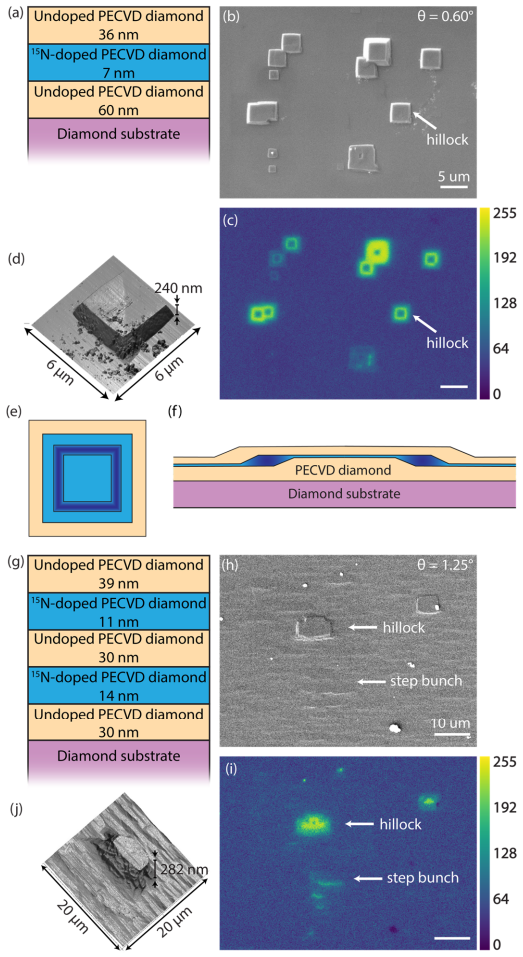
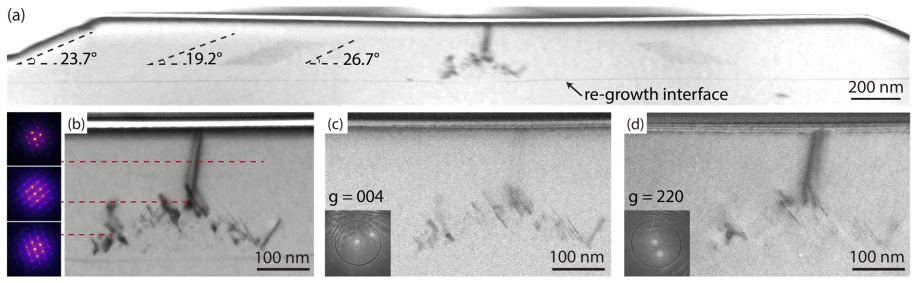
By correlating enhanced cathodoluminescence with nanoSIMS measurements, the authors demonstrate that hillock sidewalls incorporate up to 1000x more nitrogen. The hillocks, linked to stacking faults and edge dislocations from surface preparation, allow each of four sidewalls to host a distinct NV orientation. Decoherence analysis reveals a grown-in NV/P1 ratio of 1.7-2%, four times higher than typical (001) growth. This shows hillocks act as natural laboratories for dense aligned NV formation.
What carries the argument
The hillock sidewalls, which exhibit facet-dependent nitrogen incorporation and preferential NV alignment.
If this is right
- NV centers can be created densely on standard (001) diamond without needing other orientations
- The four sidewalls each align to a different NV direction
- The NV to P1 ratio reaches 1.7-2%, four times the usual for (001) growth
- Hillocks originate from surface preparation rather than substrate defects
Where Pith is reading between the lines
- This approach might extend to incorporating other impurities or defects selectively on facets
- Device fabrication could pattern or control hillock formation for localized high-density NV regions
Load-bearing premise
The enhanced nitrogen incorporation and NV alignment are directly caused by the presence of hillock facets and sidewalls rather than unrelated factors in the growth or measurement process.
What would settle it
Growing diamond without hillocks under the same conditions and observing no difference in nitrogen incorporation or NV density would show that hillocks are not the cause.
Figures
read the original abstract
Controlling nitrogen doping in diamond is key to advancing nitrogen-vacancy (NV) center devices. We harness the hillock, a typically undesirable surface feature, to incorporate high densities of grown-in, aligned NV-centers on a (001)-oriented substrate. Enhanced cathodoluminescence at hillock sidewalls is correlated via nanoSIMS to up to 1000x greater nitrogen incorporation compared to the planar film. We find that these hillocks are associated with stacking faults and edge-type dislocations, consistent with an origin in surface preparation rather than substrate screw dislocations. Yet, the growth is orderly enough that each of the four hillock sidewalls hosts a distinct NV orientation. A 1.7-2% grown-in NV/substitutional nitrogen (P1) ratio, 4x higher than typical (001)-oriented growth, is measured via NV decoherence analysis. By revealing that spontaneously formed hillocks act as natural laboratories for dense, aligned NV formation, this work motivates systematic investigation of facet-dependent nitrogen incorporation and preferential NV alignment in (001) diamond.
Editorial analysis
A structured set of objections, weighed in public.
Referee Report
Summary. The manuscript reports that spontaneously formed hillocks on (001) diamond, associated with stacking faults and edge dislocations from surface preparation, enable dense aligned NV ensembles. Enhanced cathodoluminescence at hillock sidewalls correlates with nanoSIMS maps showing up to 1000x greater nitrogen incorporation relative to planar regions; each of the four sidewalls hosts a distinct NV orientation; and decoherence analysis yields a 1.7-2% grown-in NV/P1 ratio that is 4x higher than typical (001) growth.
Significance. If the facet-dependent nitrogen incorporation and alignment mechanism can be isolated and reproduced, the result would offer a practical route to high-density aligned NV centers on standard (001) substrates without post-growth processing, which is relevant for quantum sensing and hybrid quantum devices. The experimental correlations (CL-nanoSIMS, orientation selectivity, and quantitative NV/P1 ratio) provide concrete benchmarks that could guide targeted facet-engineering studies.
major comments (2)
- [Abstract] Abstract: The central interpretation that hillock sidewalls drive the 1000x N enhancement and 4x higher NV/P1 ratio is based on spatial correlation between CL, nanoSIMS, and decoherence data, but the manuscript does not report control growths that suppress hillock formation while holding other parameters fixed, nor does it compare to lithographically engineered facets of identical orientation. This leaves the facet-specific mechanism as an interpretation rather than an isolated result, which is load-bearing for the claim that hillocks act as 'natural laboratories'.
- [Abstract] Abstract: The stated 1.7-2% NV/P1 ratio (and the factor-of-4 improvement) is obtained from NV decoherence analysis, yet the text provides no details on the fitting procedure, error bars, independent verification of P1 density, or exclusion criteria for the decoherence model. Without these, the quantitative comparison to 'typical (001) growth' cannot be fully assessed.
minor comments (1)
- The manuscript would benefit from a dedicated methods subsection or supplementary note that tabulates the growth conditions, nanoSIMS calibration standards, and CL excitation parameters to allow direct replication.
Simulated Author's Rebuttal
We thank the referee for their detailed and constructive comments. We respond to each major comment below, indicating where revisions will be made to the manuscript.
read point-by-point responses
-
Referee: [Abstract] Abstract: The central interpretation that hillock sidewalls drive the 1000x N enhancement and 4x higher NV/P1 ratio is based on spatial correlation between CL, nanoSIMS, and decoherence data, but the manuscript does not report control growths that suppress hillock formation while holding other parameters fixed, nor does it compare to lithographically engineered facets of identical orientation. This leaves the facet-specific mechanism as an interpretation rather than an isolated result, which is load-bearing for the claim that hillocks act as 'natural laboratories'.
Authors: We agree that dedicated control growths or comparisons to lithographically engineered facets would more definitively isolate the mechanism. The present evidence consists of spatially resolved correlations across CL, nanoSIMS (1000x N contrast), and orientation-selective NV formation. We will revise the abstract and discussion to frame the result explicitly as correlative, temper the 'natural laboratories' phrasing, and call for future facet-engineering studies. revision: partial
-
Referee: [Abstract] Abstract: The stated 1.7-2% NV/P1 ratio (and the factor-of-4 improvement) is obtained from NV decoherence analysis, yet the text provides no details on the fitting procedure, error bars, independent verification of P1 density, or exclusion criteria for the decoherence model. Without these, the quantitative comparison to 'typical (001) growth' cannot be fully assessed.
Authors: We will expand the methods and supplementary sections in the revised manuscript to include the decoherence fitting procedure, error bars, how P1 density was obtained, model validation criteria, and explicit literature references for the typical (001) comparison values. revision: yes
Circularity Check
No circularity: all claims are direct experimental measurements
full rationale
The paper reports empirical observations of hillock formation, nitrogen incorporation via nanoSIMS, cathodoluminescence correlations, NV orientation via four distinct alignments, and NV/P1 ratios via decoherence analysis. No equations, models, or derivations are presented that reduce reported quantities (enhancement factors, ratios) to parameters fitted from the same dataset. No self-citations are invoked as load-bearing uniqueness theorems or ansatzes. The work is self-contained against external benchmarks through direct measurement techniques.
Axiom & Free-Parameter Ledger
axioms (1)
- domain assumption Standard assumptions about NV center optical and spin properties used in cathodoluminescence and decoherence measurements
Reference graph
Works this paper leans on
-
[1]
Nuñez, J., Renslow, R., Cliff, J. B. & Anderton, C. R. NanoSIMS for biological applications: Current practices and analyses. Biointerphases 13 , (2018)
2018
-
[2]
Piecewise linear model
Okazaki, S. Piecewise linear model. (2025)
2025
-
[3]
& Jayich, A
Bluvstein, D., Zhang, Z. & Jayich, A. C. B. Identifying and Mitigating Charge Instabilities in Shallow Diamond Nitrogen-Vacancy Centers. Phys. Rev. Lett. 122 , (2019)
2019
-
[4]
Davis, E. J. et al. Probing many-body dynamics in a two-dimensional dipolar spin ensemble. Nat. Phys. 19 , 836–844 (2023)
2023
-
[5]
Hughes, L. B. et al. Two-dimensional spin systems in PECVD-grown diamond with tunable density and long coherence for enhanced quantum sensing and simulation. APL Mater. 11 , (2023)
2023
-
[6]
Yan, H. et al. Multi-microscopy characterization of threading dislocations in CVD-grown diamond films. Appl. Phys. Lett. 124 , (2024)
2024
discussion (0)
Sign in with ORCID, Apple, or X to comment. Anyone can read and Pith papers without signing in.