Rydberg state engineering of trapped ions
Pith reviewed 2026-06-29 06:25 UTC · model grok-4.3
The pith
Microwave pulses achieve first coherent population transfer between Rydberg states in trapped ions
A machine-rendered reading of the paper's core claim, the machinery that carries it, and where it could break.
Core claim
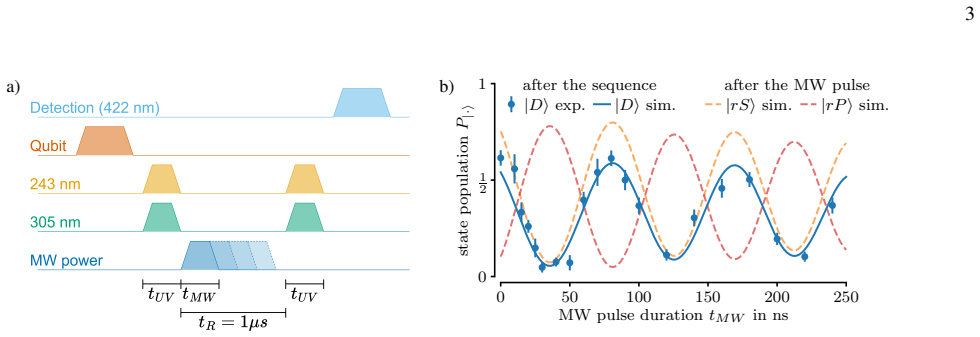
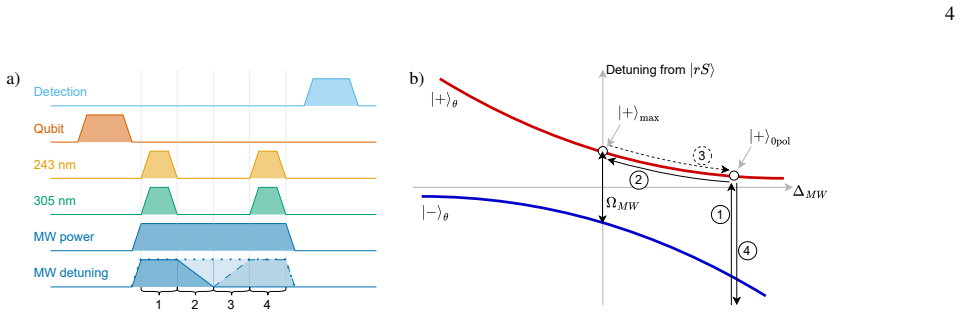
Here, we report on the first demonstration of coherent population transfer between different Rydberg states of a trapped ion. We investigate both microwave-mediated Rabi oscillations between Rydberg S and P states and adiabatic transfer between microwave-dressed Rydberg states. Between Rydberg S and P states we achieve a population transfer efficiency of 91.5(5)% in a single microwave π-pulse. Microwave dressing hybridizes the S and P Rydberg states into new eigenstates with tunable polarizability, enabling both noise-resilient zero-polarizability states and maximally interacting states. We demonstrate adiabatic transfer between these zero-polarizability and maximally dressed states, enablin
What carries the argument
Microwave dressing that hybridizes Rydberg S and P states into tunable eigenstates, navigated via Rabi oscillations and adiabatic transfer
Load-bearing premise
The detected population changes arise solely from the intended coherent microwave-driven dynamics between the specified Rydberg levels, without dominant contributions from off-resonant couplings, spontaneous decay during the pulse, or state-detection errors
What would settle it
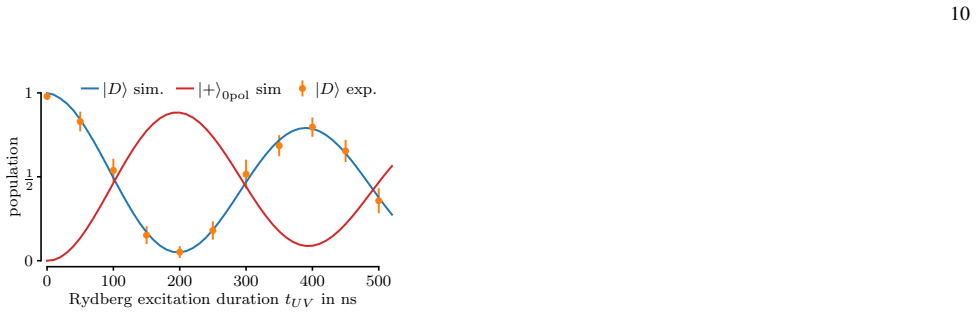
Time-resolved measurements of state populations after microwave pulses of varying durations that show clear Rabi oscillations reaching 91.5% transfer efficiency at the expected pi-pulse length, with no significant additional loss
Figures
read the original abstract
Microwave dressing of Rydberg ions creates tunable eigenstates with controllable polarizability and interaction strength, but coherent navigation between these states has remained elusive. Here, we report on the first demonstration of coherent population transfer between different Rydberg states of a trapped ion. We investigate both microwave-mediated Rabi oscillations between Rydberg S and P states and adiabatic transfer between microwave-dressed Rydberg states. Between Rydberg S and P states we achieve a population transfer efficiency of 91.5(5)% in a single microwave ${\pi}$-pulse. Microwave dressing hybridizes the S and P Rydberg states into new eigenstates with tunable polarizability, enabling both noise-resilient zero-polarizability states and maximally interacting states. We demonstrate adiabatic transfer between these zero-polarizability and maximally dressed states, enabling experiments that combine noise-resilient excitation with strong dipole-dipole interactions and F\"orster resonance control within a single measurement sequence.
Editorial analysis
A structured set of objections, weighed in public.
Referee Report
Summary. The manuscript reports the first experimental demonstration of coherent population transfer between distinct Rydberg states of a trapped ion. It presents microwave-mediated Rabi oscillations between S and P Rydberg states with a claimed single-pulse transfer efficiency of 91.5(5)%, together with adiabatic transfer between microwave-dressed eigenstates that exhibit tunable polarizability, enabling both zero-polarizability and maximally interacting configurations.
Significance. If the efficiency and coherence claims are substantiated, the work would constitute a notable advance for Rydberg-ion platforms by providing a route to coherent state navigation that combines noise-resilient excitation with controllable dipole-dipole interactions and Förster resonances within a single sequence.
major comments (1)
- [Abstract] Abstract: the central claim of 91.5(5)% population transfer efficiency in a single microwave π-pulse between Rydberg S and P states is load-bearing for the 'first demonstration' assertion, yet the manuscript supplies neither raw Rabi data, pulse parameters, detuning dependence, nor an error budget that excludes dominant contributions from off-resonant couplings, finite Rydberg lifetimes, or state-detection infidelity.
minor comments (1)
- Figure captions and methods should explicitly state the detection fidelity, microwave pulse duration, and any calibration procedures used to extract the quoted efficiency.
Simulated Author's Rebuttal
We thank the referee for their careful review and for recognizing the potential significance of our work. We address the major comment below and will strengthen the manuscript accordingly.
read point-by-point responses
-
Referee: [Abstract] Abstract: the central claim of 91.5(5)% population transfer efficiency in a single microwave π-pulse between Rydberg S and P states is load-bearing for the 'first demonstration' assertion, yet the manuscript supplies neither raw Rabi data, pulse parameters, detuning dependence, nor an error budget that excludes dominant contributions from off-resonant couplings, finite Rydberg lifetimes, or state-detection infidelity.
Authors: We agree that additional detail is needed to fully substantiate the efficiency claim. While the main text presents Rabi oscillation results leading to the quoted efficiency, we will revise the manuscript to include raw Rabi data (as an additional figure or supplementary material), explicit microwave pulse parameters (duration, Rabi frequency, and detuning), a detuning dependence scan, and a quantitative error budget addressing off-resonant couplings, finite Rydberg lifetimes, and state-detection infidelity. These additions will appear in a new subsection of the results and an expanded methods section. revision: yes
Circularity Check
No circularity: experimental measurements of transfer efficiency reported directly from data
full rationale
The paper is an experimental demonstration of coherent population transfer in Rydberg ions, reporting measured efficiencies such as 91.5(5)% from microwave π-pulses and observations of Rabi oscillations and adiabatic transfers. No derivation chain exists that reduces predictions or results to fitted inputs by construction, self-citations, or ansatzes; the central claims are direct experimental outcomes with no equations deriving one quantity from another in a self-referential manner. The reported efficiencies are obtained from population measurements, not from any model that presupposes the result. This is the standard case of a self-contained experimental report with no load-bearing circular steps.
Axiom & Free-Parameter Ledger
axioms (1)
- domain assumption The ion can be prepared and detected in well-defined electronic states whose populations are read out via fluorescence without significant systematic bias.
Reference graph
Works this paper leans on
-
[1]
Bloch, J
I. Bloch, J. Dalibard, and S. Nascimb `ene, Quantum simulations with ultracold quantum gases, Nature Physics8, 267 (2012)
2012
-
[2]
Labuhn, D
H. Labuhn, D. Barredo, S. Ravets, S. de L ´es´eleuc, T. Macr `ı, T. Lahaye, and A. Browaeys, Tunable two-dimensional arrays of single Rydberg atoms for realizing quantum Ising models, Nature534, 667 (2016)
2016
-
[3]
Gross and I
C. Gross and I. Bloch, Quantum simulations with ultracold atoms in optical lattices, Science357, 995 (2017)
2017
-
[4]
Scholl, M
P. Scholl, M. Schuler, H. J. Williams, A. A. Eberharter, D. Barredo, K.-N. Schymik, V . Lienhard, L.-P. Henry, T. C. Lang, T. Lahaye, A. M. L ¨auchli, and A. Browaeys, Quantum simulation of 2d antiferromagnets with hundreds of Rydberg atoms, Nature595, 233 (2021)
2021
-
[5]
Euchner and I
S. Euchner and I. Lesanovsky, Rydberg atom arrays as quantum simulators for molecular dynamics, Phys. Rev. Res.7, L042009 (2025). 6
2025
-
[6]
Jaksch, J
D. Jaksch, J. I. Cirac, P. Zoller, S. L. Rolston, R. C ˆot´e, and M. D. Lukin, Fast quantum gates for neutral atoms, Phys. Rev. Lett.85, 2208 (2000)
2000
-
[7]
Saffman, T
M. Saffman, T. G. Walker, and K. Mølmer, Quantum informa- tion with Rydberg atoms, Rev. Mod. Phys.82, 2313 (2010)
2010
-
[8]
Levine, A
H. Levine, A. Keesling, A. Omran, H. Bernien, S. Schwartz, A. S. Zibrov, M. Endres, M. Greiner, V . Vuleti ´c, and M. D. Lukin, High-fidelity control and entanglement of Rydberg-atom qubits, Phys. Rev. Lett.121, 123603 (2018)
2018
-
[9]
S. J. Evered, D. Bluvstein, M. Kalinowski, S. Ebadi, T. Manovitz, H. Zhou, S. H. Li, A. A. Geim, T. T. Wang, N. Maskara, H. Levine, G. Semeghini, M. Greiner, V . Vuleti´c, and M. D. Lukin, High-fidelity parallel entangling gates on a neutral-atom quantum computer, Nature622, 268 (2023)
2023
-
[10]
J. A. Sedlacek, A. Schwettmann, H. K ¨ubler, R. L ¨ow, T. Pfau, and J. P. Shaffer, Microwave electrometry with Rydberg atoms in a vapour cell using bright atomic resonances, Nature Physics 8, 819 (2012)
2012
-
[11]
J. A. Sedlacek, A. Schwettmann, H. K ¨ubler, and J. P. Shaf- fer, Atom-based vector microwave electrometry using Rubid- ium Rydberg atoms in a vapor cell, Phys. Rev. Lett.111, 063001 (2013)
2013
-
[12]
M. T. Simons, A. B. Artusio-Glimpse, A. K. Robinson, N. Pra- japati, and C. L. Holloway, Rydberg atom-based sensors for radio-frequency electric field metrology, sensing, and commu- nications, Measurement: Sensors18, 100273 (2021)
2021
-
[13]
D. Somaweera, A. Abdulghani, A. A. Odebowale, A. M. Berhe, M. I. U. Weerasinghe, K. As’ham, I. A. M. Al Ani, M. C. Dum- lao, A. E. Miroshnichenko, and H. T. Hattori, Rydberg atom- based sensors: Principles, recent advances, and applications, Photonics12, 10.3390/photonics12121228 (2025)
-
[14]
Z. Feng, X. Liu, Z. Song, and J. Qu, Multi-parameter mi- crowave quantum sensing with a single atomic probe, Scientific Reports15, 5379 (2025)
2025
-
[15]
M ¨uller, L
M. M ¨uller, L. Liang, I. Lesanovsky, and P. Zoller, Trapped Ryd- berg ions: from spin chains to fast quantum gates, New Journal of Physics10, 093009 (2008)
2008
-
[16]
Feldker, P
T. Feldker, P. Bachor, M. Stappel, D. Kolbe, R. Gerritsma, J. Walz, and F. Schmidt-Kaler, Rydberg excitation of a single trapped ion, Phys. Rev. Lett.115, 173001 (2015)
2015
-
[17]
Higgins, W
G. Higgins, W. Li, F. Pokorny, C. Zhang, F. Kress, C. Maier, J. Haag, Q. Bodart, I. Lesanovsky, and M. Hennrich, Single strontium Rydberg ion confined in a Paul trap, Phys. Rev. X7, 021038 (2017)
2017
-
[18]
Y . O. Dudin, L. Li, F. Bariani, and A. Kuzmich, Observation of coherent many-body Rabi oscillations, Nature Physics8, 790 (2012)
2012
-
[19]
T. M. Graham, M. Kwon, B. Grinkemeyer, Z. Marra, X. Jiang, M. T. Lichtman, Y . Sun, M. Ebert, and M. Saffman, Rydberg- mediated entanglement in a two-dimensional neutral atom qubit array, Phys. Rev. Lett.123, 230501 (2019)
2019
-
[20]
Ahlheit, C
L. Ahlheit, C. Nill, D. Svirskiy, J. de Haan, S. Schroers, W. Alt, N. Stiesdal, I. Lesanovsky, and S. Hofferberth, Magic running- and standing-wave optical traps for Rydberg atoms, Phys. Rev. A111, 013115 (2025)
2025
-
[21]
Jansohn, A
C. Jansohn, A. Londo ˜no, Y . Li, H. Nguyen, P. R. Berman, and A. Kuzmich, Magic-wavelength trapping of alkali-metal Ry- dberg atoms: The role of landscape polarization modulation, Phys. Rev. A112, L041101 (2025)
2025
-
[22]
Mokhberi, M
A. Mokhberi, M. Hennrich, and F. Schmidt-Kaler, Chapter four - trapped Rydberg ions: A new platform for quantum informa- tion processing, inAdvances In Atomic, Molecular , and Optical Physics, V ol. 69 (Academic Press, 2020) pp. 233–306
2020
-
[23]
Zhang, F
C. Zhang, F. Pokorny, W. Li, G. Higgins, A. P ¨oschl, I. Lesanovsky, and M. Hennrich, Submicrosecond entangling gate between trapped ions via Rydberg interaction, Nature580, 345 (2020)
2020
-
[24]
M. Mallweger, N. Kuk, V . Shankar, R. Thomm, H. Parke, I. Straka, W. Li, I. Lesanovsky, and M. Hennrich, Probing elec- tronic state-dependent conformational changes in a trapped Ry- dberg ion Wigner crystal (2025), arXiv:2507.23631 [quant-ph]
-
[25]
Higgins, F
G. Higgins, F. Pokorny, C. Zhang, and M. Hennrich, Highly polarizable Rydberg ion in a Paul trap, Phys. Rev. Lett.123, 153602 (2019)
2019
-
[26]
F. Pokorny, C. Zhang, G. Higgins, and M. Hennrich, Magic trapping of a Rydberg ion with a diminished static polarizability (2020), arXiv:2005.12422 [physics.atom-ph]
-
[27]
Pokorny,A microwave dressed Rydberg ion, Ph.D
F. Pokorny,A microwave dressed Rydberg ion, Ph.D. thesis, Stockholm university (2020)
2020
-
[28]
Higgins, F
G. Higgins, F. Pokorny, C. Zhang, Q. Bodart, and M. Hennrich, Coherent control of a single trapped Rydberg ion, Phys. Rev. Lett.119, 220501 (2017)
2017
-
[29]
Leibfried, R
D. Leibfried, R. Blatt, C. Monroe, and D. Wineland, Quan- tum dynamics of single trapped ions, Rev. Mod. Phys.75, 281 (2003)
2003
-
[30]
Higgins, C
G. Higgins, C. Zhang, F. Pokorny, H. Parke, E. Jansson, S. Salim, and M. Hennrich, Observation of second- and higher- order electric quadrupole interactions with an atomic ion, Phys. Rev. Res.3, L032032 (2021)
2021
- [31]
-
[32]
Gorniaczyk, C
H. Gorniaczyk, C. Tresp, P. Bienias, A. Paris-Mandoki, W. Li, I. Mirgorodskiy, H. P. B ¨uchler, I. Lesanovsky, and S. Hoffer- berth, Enhancement of Rydberg-mediated single-photon non- linearities by electrically tuned F ¨orster resonances, Nature Communications7, 12480 (2016)
2016
-
[33]
Nipper, J
J. Nipper, J. B. Balewski, A. T. Krupp, B. Butscher, R. L ¨ow, and T. Pfau, Highly resolved measurements of Stark-tuned F¨orster resonances between Rydberg atoms, Phys. Rev. Lett. 108, 113001 (2012)
2012
-
[34]
Ravets, H
S. Ravets, H. Labuhn, D. Barredo, L. B ´eguin, T. Lahaye, and A. Browaeys, Coherent dipole–dipole coupling between two single Rydberg atoms at an electrically-tuned F ¨orster reso- nance, Nature Physics10, 914 (2014)
2014
-
[35]
Kaiser, C
M. Kaiser, C. Glaser, L. Y . Ley, J. Grimmel, H. Hattermann, D. Bothner, D. Koelle, R. Kleiner, D. Petrosyan, A. G ¨unther, and J. Fort ´agh, Cavity-driven Rabi oscillations between Ryd- berg states of atoms trapped on a superconducting atom chip, Phys. Rev. Res.4, 013207 (2022)
2022
-
[36]
Petrosyan and M
D. Petrosyan and M. Fleischhauer, Quantum information pro- cessing with single photons and atomic ensembles in mi- crowave coplanar waveguide resonators, Phys. Rev. Lett.100, 170501 (2008)
2008
-
[37]
Petrosyan, G
D. Petrosyan, G. Bensky, G. Kurizki, I. Mazets, J. Majer, and J. Schmiedmayer, Reversible state transfer between supercon- ducting qubits and atomic ensembles, Phys. Rev. A79, 040304 (2009)
2009
-
[38]
S. D. Hogan, J. A. Agner, F. Merkt, T. Thiele, S. Filipp, and A. Wallraff, Driving RydbergRydberg transitions from a copla- nar microwave waveguide, Phys. Rev. Lett.108, 063004 (2012)
2012
-
[39]
Johansson, P
J. Johansson, P. Nation, and F. Nori, Qutip 2: A Python frame- work for the dynamics of open quantum systems, Computer Physics Communications184, 1234 (2013)
2013
- [40]
-
[41]
Kiruga, C
A. Kiruga, C. Cheung, D. Filin, P. Barakhshan, A. Bhosale, V . Badhan, B. Arora, R. Eigenmann, and M. S. Safronova, Por- tal for high-precision atomic data and computation, Computer Physics Communications319, 109951 (2026)
2026
-
[42]
Li, private communication
W. Li, private communication
-
[43]
Dembinski and P
H. Dembinski and P. O. et al., scikit-hep/iminuit (2020)
2020
-
[44]
James and M
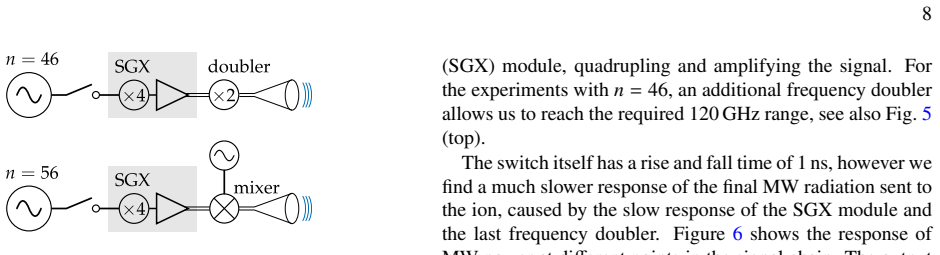
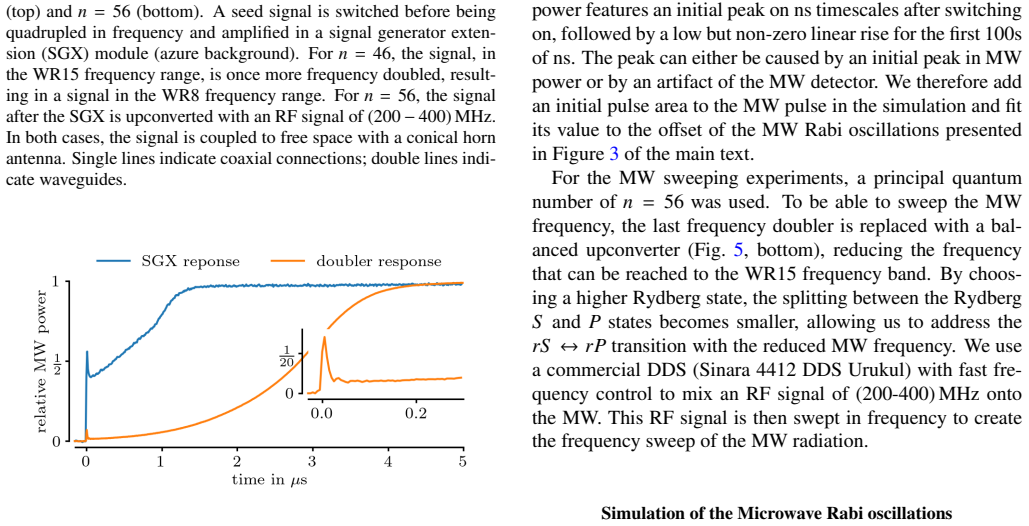
F. James and M. Roos, Minuit: A System for Function Mini- mization and Analysis of the Parameter Errors and Correlations, Comput. Phys. Commun.10, 343 (1975). 8 FIG. 5. MW generation for both principal quantum numbersn=46 (top) andn=56 (bottom). A seed signal is switched before being quadrupled in frequency and amplified in a signal generator exten- sion ...
1975
discussion (0)
Sign in with ORCID, Apple, or X to comment. Anyone can read and Pith papers without signing in.