Kinetic phase transition modeling for metals
Pith reviewed 2026-06-29 06:12 UTC · model grok-4.3
The pith
The Fermi KPT model describes metal phase transformation kinetics with four parameters and outperforms prior simple models on iron and tin data.
A machine-rendered reading of the paper's core claim, the machinery that carries it, and where it could break.
Core claim
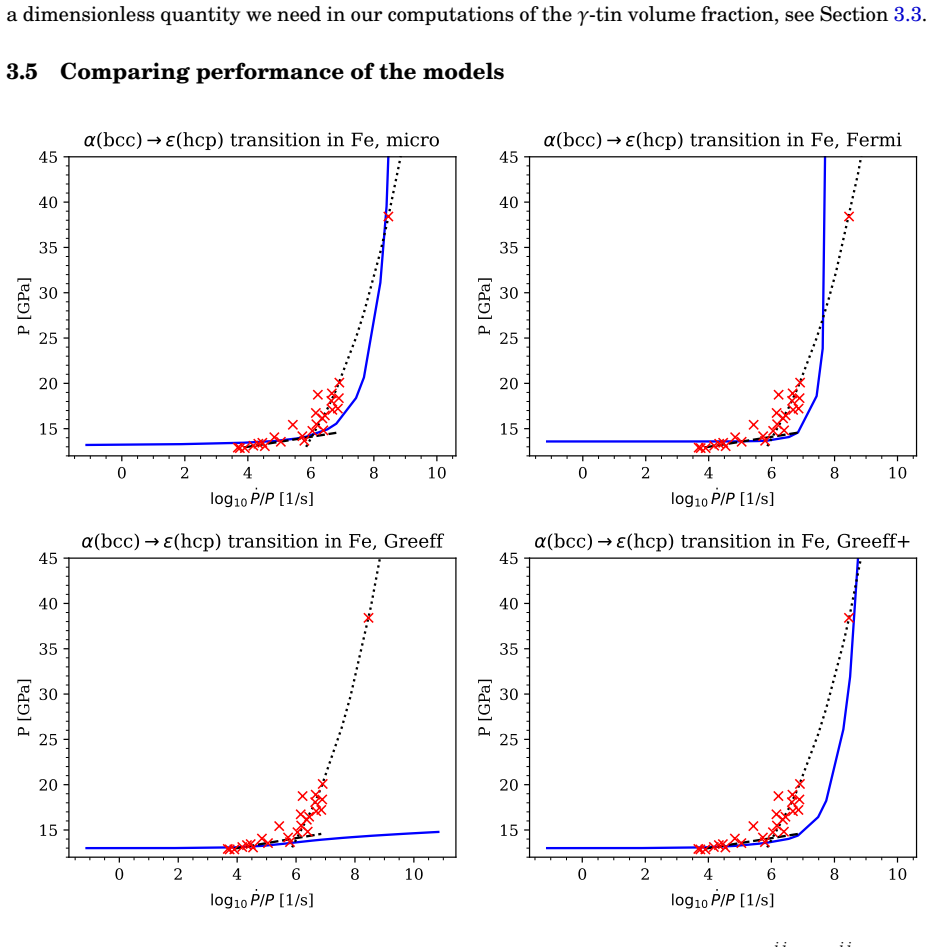
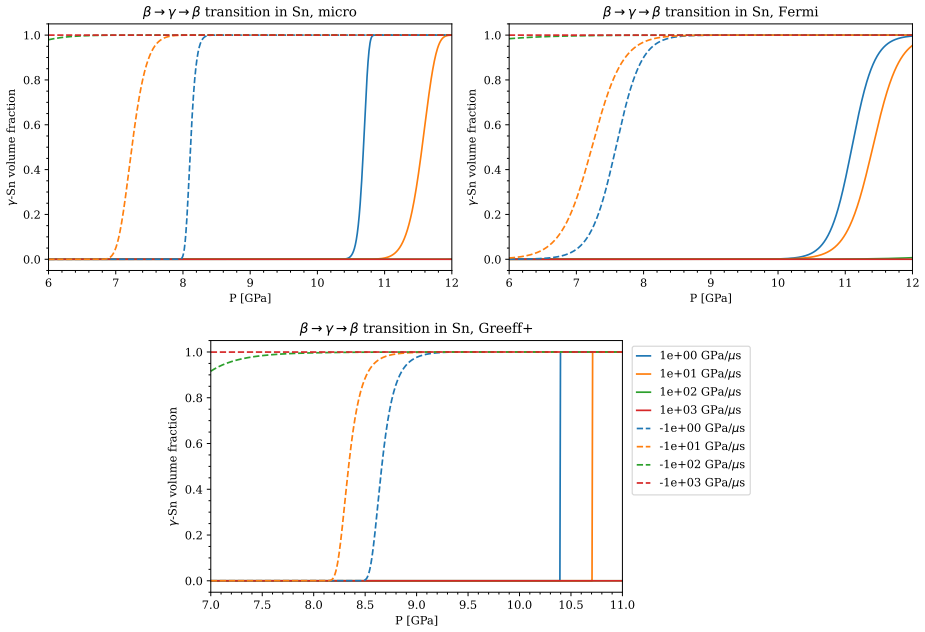
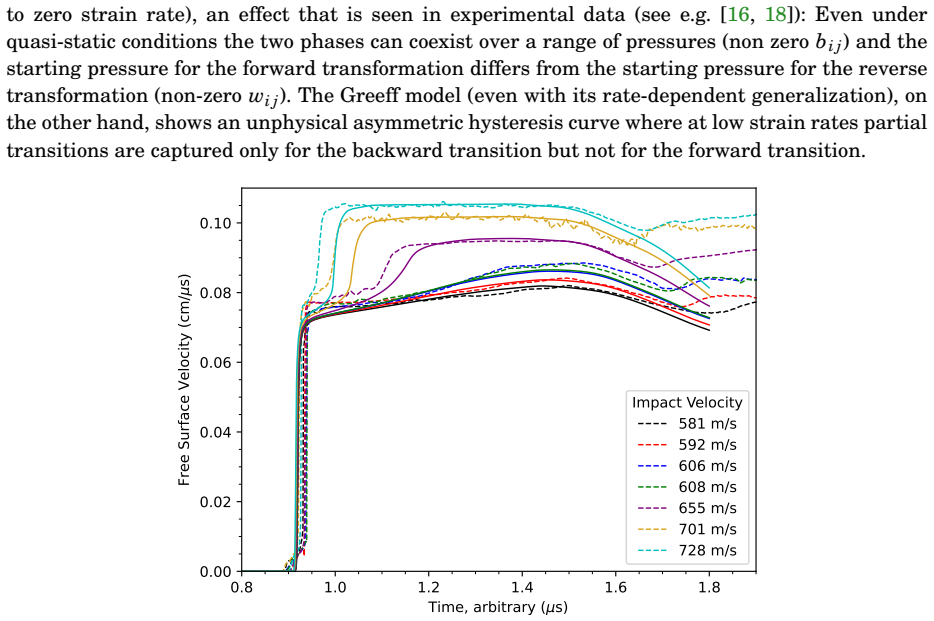
We present a new phenomenological model for phase transformation (PT) kinetics in metals, the Fermi Kinetic Phase Transition (KPT) Model. It is designed such that it captures the main macroscopic features of our previously developed micro-structure dependent model, but at a fraction of the computational cost of the latter. Using four model parameters, the Fermi KPT model performs better than other phenomenological PT kinetics models in the literature, as shown by our present comparisons to experimental data for iron and tin.
What carries the argument
The Fermi Kinetic Phase Transition (KPT) Model, a phenomenological rate model that employs a Fermi-like functional form to govern the time evolution of phase fractions and thereby reproduces key macroscopic transformation features from microstructure models at reduced cost.
If this is right
- Simulations of large-scale metal components under shock or thermal loading can incorporate phase kinetics at lower cost while retaining essential macroscopic behavior.
- The model supplies a compact alternative for cases where full microstructure tracking is impractical.
- Four-parameter calibration reduces the data volume needed to adapt the description to new alloys.
- Direct comparisons establish that the Fermi form improves quantitative agreement with measured transformation rates in iron and tin over other simple kinetics expressions.
Where Pith is reading between the lines
- The four-parameter structure could be tested for transferability to steels or titanium by fitting to existing shock-wave data sets.
- Integration into continuum codes would allow systematic checks of how the reduced cost affects predicted residual stresses after phase changes.
- If the Fermi functional shape proves robust, it might serve as a starting point for adding explicit temperature or strain-rate dependence without increasing parameter count.
- Extension to multi-phase systems would require checking whether the same functional form still captures sequential transformations observed in experiments.
Load-bearing premise
That four parameters chosen to match iron and tin experiments will deliver superior accuracy for other metals and loading conditions without requiring material-specific retuning.
What would settle it
New experimental phase-fraction versus time or pressure data for a different metal such as aluminum under dynamic compression, tested to check whether the same four-parameter Fermi KPT form still matches better than alternative phenomenological models.
Figures
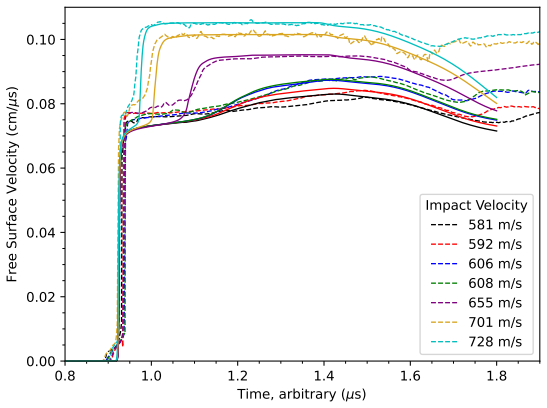
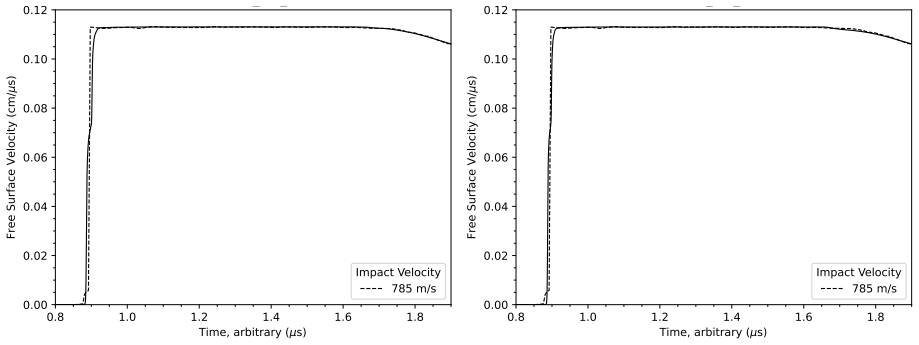
read the original abstract
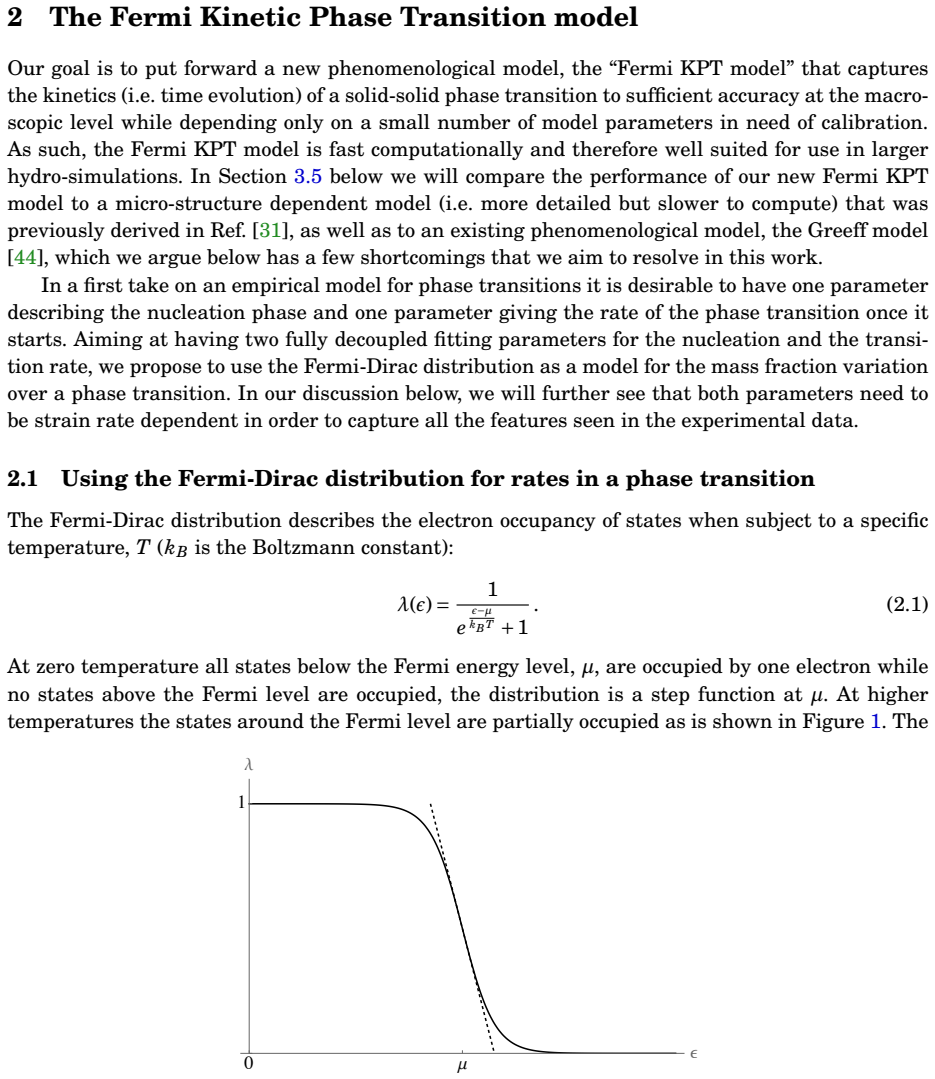
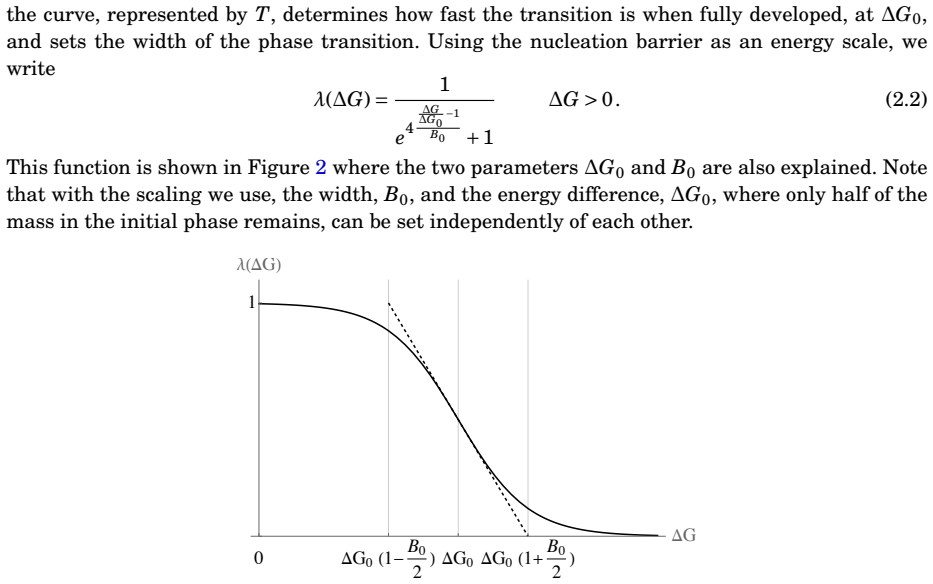
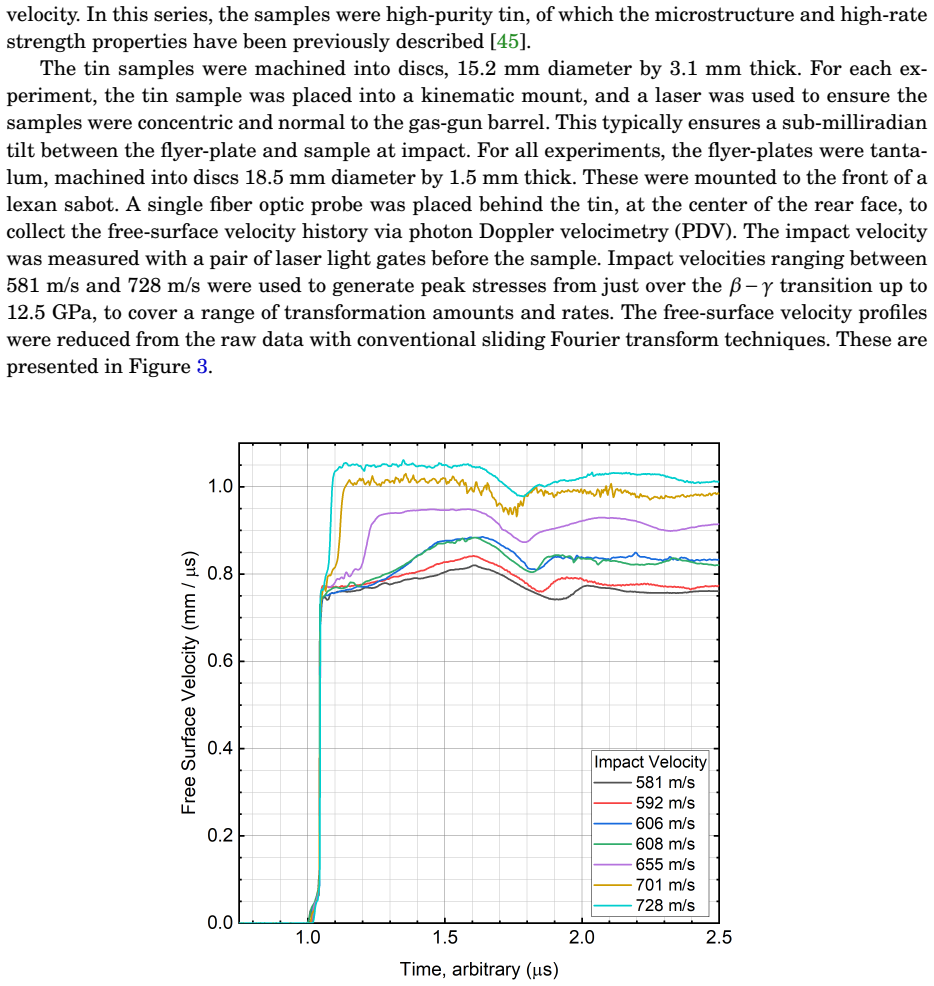
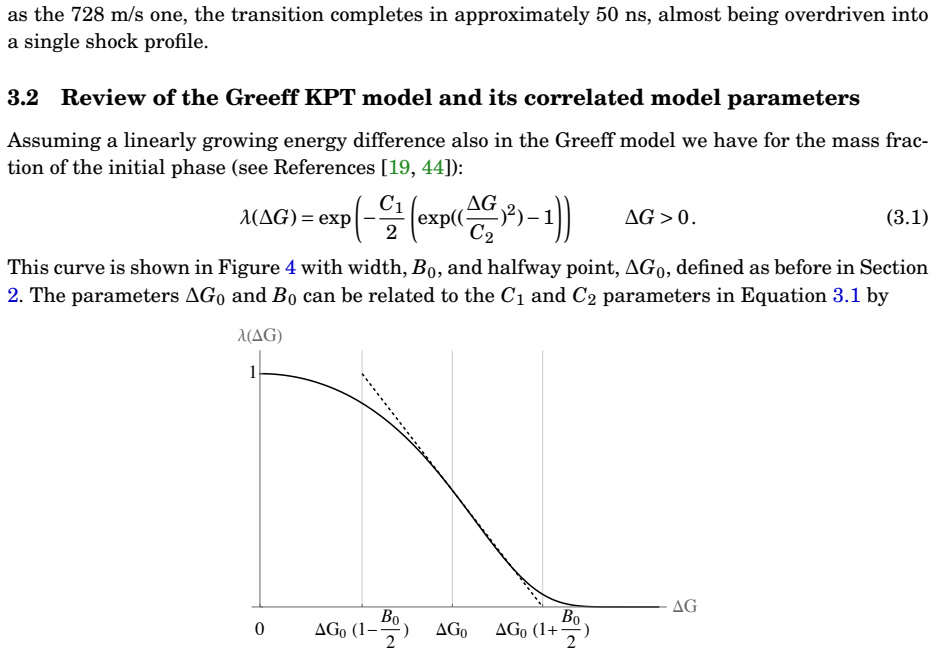
We present a new phenomenological model for phase transformation (PT) kinetics in metals, the "Fermi Kinetic Phase Transition (KPT) Model". It is designed such that it captures the main macroscopic features of our previously developed micro-structure dependent model, but at a fraction of the computational cost of the latter. Using four model parameters, the Fermi KPT model performs better than other phenomenological PT kinetics models in the literature, as shown by our present comparisons to experimental data for iron and tin.
Editorial analysis
A structured set of objections, weighed in public.
Referee Report
Summary. The manuscript introduces the Fermi Kinetic Phase Transition (KPT) Model, a phenomenological model for phase transformation kinetics in metals. It claims to reproduce the main macroscopic features of a prior microstructure-dependent model at substantially lower computational cost while using only four adjustable parameters. The central assertion is that this model outperforms other phenomenological PT kinetics models in the literature, as demonstrated by direct comparisons against experimental data for iron and tin.
Significance. If the performance advantage can be shown to arise from structural features of the model rather than dataset-specific fitting, the approach would supply a computationally lightweight yet macroscopically faithful alternative to both detailed microstructure models and existing phenomenological kinetics descriptions, with potential utility in large-scale simulations of metal processing.
major comments (2)
- [Abstract] Abstract: the claim that the Fermi KPT model 'performs better' than other phenomenological models is unsupported by any quantitative metrics, error analysis, baseline model results, or statistical comparison; the abstract supplies only the qualitative statement.
- [Results / comparisons section] Comparisons to experimental data: the reported superiority on iron and tin rests on four fitted parameters whose selection procedure is not shown to be independent of the target datasets; without out-of-sample tests or re-optimization of the comparison models on the same data, the performance gain is consistent with extra degrees of freedom rather than an intrinsic improvement.
Simulated Author's Rebuttal
We thank the referee for their thoughtful review and for highlighting areas where the manuscript can be strengthened. We address each major comment below and commit to revisions that directly respond to the concerns while preserving the core contribution of the Fermi KPT model.
read point-by-point responses
-
Referee: [Abstract] Abstract: the claim that the Fermi KPT model 'performs better' than other phenomenological models is unsupported by any quantitative metrics, error analysis, baseline model results, or statistical comparison; the abstract supplies only the qualitative statement.
Authors: We agree that the abstract currently states the performance advantage only qualitatively. The manuscript body contains direct visual comparisons to experimental data for iron and tin that illustrate closer agreement than the other phenomenological models considered. To address the referee's point, we will revise the abstract to include explicit quantitative metrics (e.g., mean absolute percentage error or R² values) extracted from those comparisons, together with a brief statement of the baseline models used. revision: yes
-
Referee: [Results / comparisons section] Comparisons to experimental data: the reported superiority on iron and tin rests on four fitted parameters whose selection procedure is not shown to be independent of the target datasets; without out-of-sample tests or re-optimization of the comparison models on the same data, the performance gain is consistent with extra degrees of freedom rather than an intrinsic improvement.
Authors: This concern is well-founded. The four parameters are chosen to reproduce the macroscopic kinetics produced by our earlier microstructure-dependent model rather than being optimized directly against the iron and tin experimental datasets; this procedure is described in the methods but not emphasized in the results. We will expand the manuscript to (i) document the parameter-selection workflow with explicit reference to the microstructure model outputs, (ii) re-optimize the literature baseline models on the identical datasets for a controlled comparison, and (iii) add a short discussion of the risk of extra degrees of freedom. If additional independent datasets become available we will include out-of-sample checks; otherwise we will note the limitation. revision: yes
Circularity Check
No significant circularity; model is phenomenological fit to data
full rationale
The provided abstract and context describe a new phenomenological model with four parameters whose performance is evaluated via direct comparisons to experimental datasets for iron and tin. No mathematical derivation chain, equations, or first-principles predictions are shown that reduce by construction to the fitted inputs or to self-citations. The design goal of capturing macroscopic features from a prior microstructure model is stated explicitly as an engineering choice rather than a derived result. Self-citation to the authors' earlier work is present but does not bear the load of the performance claim, which rests on external experimental benchmarks. No steps meet the criteria for quoting a specific reduction (e.g., fitted parameter renamed as prediction or ansatz smuggled via citation). The paper is therefore self-contained against its stated empirical comparisons.
Axiom & Free-Parameter Ledger
free parameters (1)
- four model parameters
Reference graph
Works this paper leans on
-
[1]
Omega phase in materials
S. K. Sikka, Y. K. Vohra, and R. Chidambaram, “Omega phase in materials”,Progress in Materials Science27(1982) 245–310
1982
-
[2]
Microscopic description of the kinetics of a martensitic transition in real crystals: bcc-hcp transition in Zr
Yu. N. Gornostyrev, M. I. Katsnel’son, A. R. Kuznetsov, and A. V. Trefilov, “Microscopic description of the kinetics of a martensitic transition in real crystals: bcc-hcp transition in Zr”,JETP Letters70(1999) 380–384
1999
-
[3]
Measurement of the dynamicβ-γphase boundary in tin
J.-P. Davis and D. B. Hayes, “Measurement of the dynamicβ-γphase boundary in tin”,AIP Conference Proceedings955(2007) 159–162
2007
-
[4]
Influence of impurities on theα toωphase transition in zirconium under dynamic loading conditions
P. A. Rigg, C. W. Greeff, M. D. Knudson, G. T. Gray, and R. S. Hixson, “Influence of impurities on theα toωphase transition in zirconium under dynamic loading conditions”,Journal of Applied Physics106 (2009) 123532
2009
-
[5]
Time-dependence of the alpha to epsilon phase transfor- mation in iron
R. F. Smith, J. H. Eggert, D. C. Swift,et al., “Time-dependence of the alpha to epsilon phase transfor- mation in iron”,Journal of Applied Physics114(2013) 223507. 16 0.8 1.0 1.2 1.4 1.6 1.8 Time, arbitrary ( s) 0.00 0.02 0.04 0.06 0.08 0.10 0.12Free Surface Velocity (cm/ s) new79os_Kin_ZS1 Impact Velocity 785 m/s 0.8 1.0 1.2 1.4 1.6 1.8 Time, arbitrary (...
2013
-
[6]
Anisotropic shock response of titanium: Reorien- tation and transformation mechanisms
H. Zong, T. Lookman, X. Ding, S.-N. Luo, and J. Sun, “Anisotropic shock response of titanium: Reorien- tation and transformation mechanisms”,Acta Materialia65(2014) 10–18
2014
-
[7]
X-ray diffraction of solid tin to 1.2 TPa
A. Lazicki, J. R. Rygg, F. Coppari,et al., “X-ray diffraction of solid tin to 1.2 TPa”,Physical Review Letters115(2015) 075502
2015
-
[8]
A review on computational modelling of phase-transition prob- lems
H. Gomez, M. Bures, and A. Moure, “A review on computational modelling of phase-transition prob- lems”,Philosophical Transactions of the Royal Society A377(2019) 20180203
2019
-
[9]
A multi-phase modeling framework suitable for dynamic applications
N. R. Barton, D. J. Luscher, C. Battaile,et al., “A multi-phase modeling framework suitable for dynamic applications”,Metals12(2022) 1844
2022
-
[10]
Revisiting the high-pressure behaviors of zirconium: Nonhydrostatic- ity promoting the phase transitions and absence of the isostructural phase transition inβ-zirconium
L. Liu, Q. Jing, H. Y. Geng,et al., “Revisiting the high-pressure behaviors of zirconium: Nonhydrostatic- ity promoting the phase transitions and absence of the isostructural phase transition inβ-zirconium”, Materials16(2023) 5157
2023
-
[11]
A coupled phase-field and crystal plasticity model for understanding shock-induced phase transition of iron
S. Yao, J. Yu, X. Pei, Y. Cui, H. Zhang, H. Peng, Y. Li, and Q. Wu, “A coupled phase-field and crystal plasticity model for understanding shock-induced phase transition of iron”,International Journal of Plasticity173(2024) 103860
2024
-
[12]
Crystal structure, phase transitions, and thermodynamic properties of magnesium metavanadate (MgV2O6)
G. Pei, C. Pan, D. Zhong, J. Xiang, and X. Lv, “Crystal structure, phase transitions, and thermodynamic properties of magnesium metavanadate (MgV2O6)”,Journal of Magnesium and Alloys12(2024) 1449– 1460
2024
-
[13]
Kinetics of the bct-bcc phase transformation in tin revealed by ultrafast x-ray diffraction
J. Li, L. Xu, S. Takagi,et al., “Kinetics of the bct-bcc phase transformation in tin revealed by ultrafast x-ray diffraction”,Applied Physics Letters126(2025) 264102
2025
-
[14]
Effects of theα−ϵphase transition on wave propagation and spal- lation in laser shock-loaded iron
T. de Rességuier and M. Hallouin, “Effects of theα−ϵphase transition on wave propagation and spal- lation in laser shock-loaded iron”,Physical Review B77(2008) 174107
2008
-
[15]
A spall and diffraction study of nanosecond pressure release across the ironϵ-αphase boundary
G. Righi, R. Briggs, O. R. Deluigi,et al., “A spall and diffraction study of nanosecond pressure release across the ironϵ-αphase boundary”,Acta Materialia257(2023) 119148
2023
-
[16]
High-pressureα↔ϵmartensitic transformation in iron
P. M. Giles, M. H. Longenbach, and A. R. Marder, “High-pressureα↔ϵmartensitic transformation in iron”,Journal of Applied Physics42(1971) 4290–4295
1971
-
[17]
Hysteresis in the high pressure transformation of bcc- to hcp-iron
R. D. Taylor, M. P. Pasternak, and R. Jeanloz, “Hysteresis in the high pressure transformation of bcc- to hcp-iron”,Journal of Applied Physics69(1991) 6126–6128. 17
1991
-
[18]
Microstructural effects and mechanism of bcc-hcp-bcc trans- formations in polycrystalline iron
S. Merkel, A. Lincot, and S. Petitgirard, “Microstructural effects and mechanism of bcc-hcp-bcc trans- formations in polycrystalline iron”,Physical Review B102(2020) 104103
2020
-
[19]
A model for phase transitions under dynamic compression
C. W. Greeff, “A model for phase transitions under dynamic compression”,Journal of Dynamic Behavior of Materials2(2016) 452–459
2016
-
[20]
Phase-field crystal modeling and clas- sical density functional theory of freezing
K. R. Elder, N. Provatas, J. Berry, P. Stefanovic, and M. Grant, “Phase-field crystal modeling and clas- sical density functional theory of freezing”,Physical Review B75(Feb, 2007) 064107
2007
-
[21]
Phase field modeling for the morphological and microstructural evolution of metallic materials under environmental attack
T. Q. Ansari, H. Huang, and S.-Q. Shi, “Phase field modeling for the morphological and microstructural evolution of metallic materials under environmental attack”,npj Computational Materials7(2021) 143
2021
-
[22]
Phase-field modeling of phase transformations in multicomponent alloys: A review
A. Lahiri, “Phase-field modeling of phase transformations in multicomponent alloys: A review”,Journal of the Indian Institute of Science102(2022) 39–57
2022
-
[23]
Phase-field modeling of microstructure evolution: Recent applica- tions, perspectives and challenges
D. Tourret, H. Liu, and J. LLorca, “Phase-field modeling of microstructure evolution: Recent applica- tions, perspectives and challenges”,Progress in Materials Science123(2022) 100810, A Festschrift in Honor of Brian Cantor
2022
-
[24]
Progress in phase field modeling of functional properties and fracture behavior of shape memory alloys
B. Xu, C. Yu, J. Xiong, J. Hu, Q. Kan, C. Wang, Q. Wang, and G. Kang, “Progress in phase field modeling of functional properties and fracture behavior of shape memory alloys”,Progress in Materials Science 148(2025) 101364
2025
-
[25]
Mechanism for theα→ϵphase transition in iron
B. Dupé, B. Amadon, Y.-P. Pellegrini, and C. Denoual, “Mechanism for theα→ϵphase transition in iron”,Physical Review B87(2013) 024103
2013
-
[26]
Morphology and growth speed of hcp domains during shock-induced phase transition in iron
W.-W. Pang, P. Zhang, G.-C. Zhang, A.-G. Xu, and X.-G. Zhao, “Morphology and growth speed of hcp domains during shock-induced phase transition in iron”,Scientific Reports4(2014) 3628
2014
-
[27]
Morphological changes in polycrystalline Fe after compression and release
N. Gunkelmann, D. R. Tramontina, E. M. Bringa, and H. M. Urbassek, “Morphological changes in polycrystalline Fe after compression and release”,Journal of Applied Physics117(2015) 085901
2015
-
[28]
Reversibility of the structural transition in single crystal iron driven by uniaxial and triaxial strains: Atomistic study
X.-X. Guo, J.-L. Shao, and G. Lu, “Reversibility of the structural transition in single crystal iron driven by uniaxial and triaxial strains: Atomistic study”,International Journal of Mechanical Sciences191 (2021) 106064
2021
-
[29]
Role ofα→ϵ→αphase transformation on the spall behavior of iron at atomic scales
K. Ma and A. M. Dongare, “Role ofα→ϵ→αphase transformation on the spall behavior of iron at atomic scales”,Journal of Materials Science57(2022) 12556–12571
2022
-
[30]
Kinetics of HCP-BCC phase transition boundary in magnesium at high pres- sure
N. P. Daphalapurkar, “Kinetics of HCP-BCC phase transition boundary in magnesium at high pres- sure”,Metals14(2024) 609
2024
-
[31]
Phase Transformation Kinetics Model for Metals
D. N. Blaschke, A. Hunter, and D. L. Preston, “Phase Transformation Kinetics Model for Metals”, International Journal of Plasticity196(2025) 104579,arXiv:2504.00250 [cond-mat.mtrl-sci]
-
[32]
High-pressure polymorph of iron
T. Takahashi and W. A. Bassett, “High-pressure polymorph of iron”,Science145(1964) 483–486
1964
-
[33]
Shock wave study of theα↔εphase transition in iron
L. M. Barker and R. E. Hollenbach, “Shock wave study of theα↔εphase transition in iron”,Journal of Applied Physics45(1974) 4872–4887
1974
-
[34]
Metastability and dynamics of the shock-induced phase transition in iron
J. C. Boettger and D. C. Wallace, “Metastability and dynamics of the shock-induced phase transition in iron”,Physical Review B55(1997) 2840–2849
1997
-
[35]
Direct observation of theα–εtransition in shock- compressed iron via nanosecond x-ray diffraction
D. H. Kalantar, J. F. Belak, G. W. Collins,et al., “Direct observation of theα–εtransition in shock- compressed iron via nanosecond x-ray diffraction”,Physical Review Letters95(2005) 075502
2005
-
[36]
Atomistic simulations of shock-induced transformations and their orientation dependence in bcc Fe single crystals
K. Kadau, T. C. Germann, P. S. Lomdahl, and B. L. Holian, “Atomistic simulations of shock-induced transformations and their orientation dependence in bcc Fe single crystals”,Physical Review B72 (2005) 064120
2005
-
[37]
Direct measurements of theα→ϵtransition stress and kinetics for shocked iron
B. J. Jensen, G. T. Gray, III, and R. S. Hixson, “Direct measurements of theα→ϵtransition stress and kinetics for shocked iron”,Journal of Applied Physics105(2009) 103502
2009
-
[38]
High pressure phase transformation in iron under fast compres- sion
M. Bastea, S. Bastea, and R. Becker, “High pressure phase transformation in iron under fast compres- sion”,Applied Physics Letters95(2009) 241911
2009
-
[39]
In situ x-ray diffraction measurements of the 18 c/aratio in the high-pressureϵphase of shock-compressed polycrystalline iron
J. A. Hawreliak, B. El-Dasher, H. Lorenzana,et al., “In situ x-ray diffraction measurements of the 18 c/aratio in the high-pressureϵphase of shock-compressed polycrystalline iron”,Physical Review B83 (2011) 144114
2011
-
[40]
Kinetics of the ironα−εphase transition at high- strain rates: Experiment and model
N. Amadou, T. de Resseguier, E. Brambrink,et al., “Kinetics of the ironα−εphase transition at high- strain rates: Experiment and model”,Physical Review B93(2016) 214108
2016
-
[41]
Multiphase tin equation of state using density functional theory
D. A. Rehn, C. W. Greeff, L. Burakovsky, D. G. Sheppard, and S. D. Crockett, “Multiphase tin equation of state using density functional theory”,Physical Review B103(2021) 184102
2021
-
[42]
Parameterization of theβandγphases of tin using the Vinet and Mie-Grüneisen equations of state
A. E. Mattsson Wills, “Parameterization of theβandγphases of tin using the Vinet and Mie-Grüneisen equations of state”, Tech. Rep. LA-UR-23-26917, Los Alamos National Laboratory, 2023
2023
-
[43]
SESAME 2163: an updated tin equation of state
D. A. Rehn, “SESAME 2163: an updated tin equation of state”, Tech. Rep. LA-UR-23-23409, Los Alamos National Laboratory, 2023
2023
-
[44]
Parameter study of a kinetic phase transition model
A. E. Mattsson Wills, “Parameter study of a kinetic phase transition model.” tech. rep., Los Alamos National Laboratory, Los Alamos, New Mexico 87545, 2022. LA-UR-22-32182
2022
-
[45]
Calibration and validation of the foundation for a mul- tiphase strength model for tin
T. Nguyen, L. Burakovsky, S. J. Fensin,et al., “Calibration and validation of the foundation for a mul- tiphase strength model for tin”,Journal of Applied Physics135(2024) 225105
2024
-
[46]
On the statistical theory of crystallization of metals
A. N. Kolmogorov, “On the statistical theory of crystallization of metals”,Bulletin of the Academy of Sciences of the USSR. Mathematics Series3(1937) 355–359
1937
-
[47]
Reaction kinetics in processes of nucleation and growth
W. A. Johnson and P. A. Mehl, “Reaction kinetics in processes of nucleation and growth”,Transactions of the Metallurgical Society of AIME135(1939) 416
1939
-
[48]
Kinetics of phase change. I General theory
M. Avrami, “Kinetics of phase change. I General theory”,Journal of Chemical Physics7(1939) 1103
1939
-
[49]
Kinetics of phase change. II Transformation-time relations for random distributions of nuclei
M. Avrami, “Kinetics of phase change. II Transformation-time relations for random distributions of nuclei”,Journal of Chemical Physics8(1940) 212
1940
-
[50]
Granulation, phase change, and microstructure kinetics of phase change. III
M. Avrami, “Granulation, phase change, and microstructure kinetics of phase change. III”,Journal of Chemical Physics9(1941) 177–184
1941
-
[51]
Nucleation on dislocations
J. W. Cahn, “Nucleation on dislocations”,Acta Metallurgica5(1957) 169–172
1957
-
[52]
The influence of grain boundaries on the nucleation of secondary phases
P. J. Clemm and J. C. Fisher, “The influence of grain boundaries on the nucleation of secondary phases”, Acta Metallurgica3(1955) 70–73, Erratum-ibid. p. 315
1955
-
[53]
D. N. Blaschke,PyPTkinetics, 2025, #O4940,URL:https://github.com/lanl/PyPTkinetics
2025
-
[54]
Analytic model of dislocation density evolution in fcc polycrystals account- ing for dislocation generation, storage, and dynamic recovery mechanisms
A. Hunter and D. L. Preston, “Analytic model of dislocation density evolution in fcc polycrystals account- ing for dislocation generation, storage, and dynamic recovery mechanisms”,International Journal of Plasticity151(2022) 103178
2022
-
[55]
Probing off-Hugoniot states in Ta, Cu, and Al to 1000 GPa compression with magnetically driven liner implosions
R. W. Lemke, D. H. Dolan, D. G. Dalton,et al., “Probing off-Hugoniot states in Ta, Cu, and Al to 1000 GPa compression with magnetically driven liner implosions”,Journal of Applied Physics119(2016) 015904
2016
-
[56]
Temperature effects on the universal equation of state of solids
P. Vinet, J. R. Smith, J. Ferrante, and J. H. Rose, “Temperature effects on the universal equation of state of solids”,Physical Review B35(1987) 1945–1953
1987
-
[57]
Short introduction to relations between thermodynamic quantities
A. E. Mattsson, “Short introduction to relations between thermodynamic quantities”, Tech. Rep. SAND2016-2112, Sandia National Laboratory, 2016
2016
-
[58]
Vanishing dynamic strength measured in a transient high-pressure phase of tin
M. B. Prime, S. J. Fensin, D. R. Jones, J. L. Brown, and J. W. Dyer, “Vanishing dynamic strength measured in a transient high-pressure phase of tin”, in preparation
-
[59]
Introduction to FLAG
V. H. Whitley and C. A. DeBurgomaster, “Introduction to FLAG”, tech. rep., Los Alamos National Lab- oratory (LANL), Los Alamos, NM (United States), 09, 2020.URL:https://www.osti.gov/biblio/ 1663163
2020
-
[60]
Hydro-code implementation and testing of a kinetic phase transition framework
A. E. Mattsson Wills, “Hydro-code implementation and testing of a kinetic phase transition framework”, tech. rep., Los Alamos National Laboratory (LANL), Los Alamos, NM (United States), 10, 2023.URL: https://www.osti.gov/biblio/2202604
-
[61]
Model of plastic deformation for extreme loading condi- tions
D. L. Preston, D. L. Tonks, and D. C. Wallace, “Model of plastic deformation for extreme loading condi- tions”,Journal of Applied Physics93(2003) 211–220. 19
2003
discussion (0)
Sign in with ORCID, Apple, or X to comment. Anyone can read and Pith papers without signing in.