Time-ordered Diagrammatic Monte Carlo for atomic nuclei
Pith reviewed 2026-06-29 00:10 UTC · model grok-4.3
The pith
A time-ordered diagrammatic Monte Carlo algorithm computes the single-particle Green's function for 16O to fifth order by sampling Goldstone diagrams on the fly.
A machine-rendered reading of the paper's core claim, the machinery that carries it, and where it could break.
Core claim
The time-ordered diagrammatic Monte Carlo algorithm for the single-particle Green's function is based on the on-the-fly evaluation of time-ordered Goldstone diagrams, avoiding explicit diagram enumeration and expensive frequency integration. It is tailored to finite nuclei in discrete model spaces and demonstrated by computing 16O up to fifth order in a reduced model space with optimized reference state orbitals and effective three-body forces.
What carries the argument
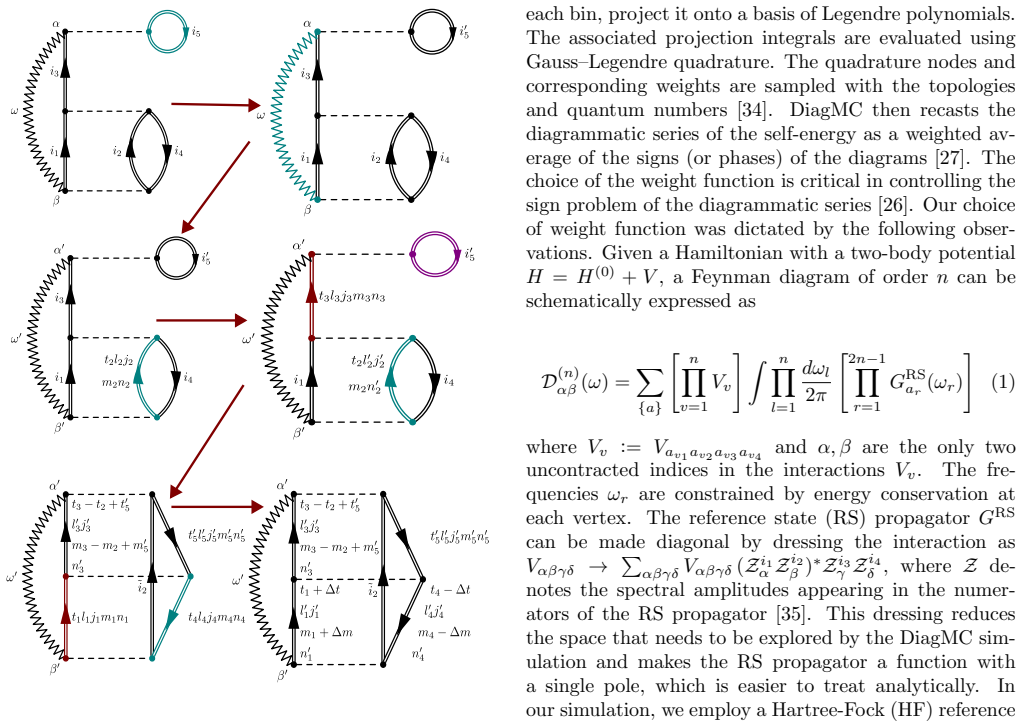
On-the-fly evaluation of time-ordered Goldstone diagrams within the Diagrammatic Monte Carlo sampling, which replaces explicit summation and frequency integration for the single-particle Green's function.
If this is right
- The method reaches fifth order for 16O while incorporating effective three-body forces.
- It applies to arbitrary two-body interactions in discrete model spaces for other finite nuclei.
- Benchmarking against established truncation schemes indicates it can surpass current order limitations in ab initio nuclear calculations.
- The approach is systematically improvable by increasing the sampled diagram orders.
Where Pith is reading between the lines
- The same sampling strategy could be tested on other nuclei or observables to check consistency with existing ab initio results.
- Adapting the discrete-space formulation to larger model spaces might reveal how the computational scaling behaves beyond the reduced case shown.
- Combining the algorithm with different reference states could test sensitivity to orbital optimization choices.
Load-bearing premise
The on-the-fly evaluation of time-ordered Goldstone diagrams produces unbiased results equivalent to explicit summation when applied to the chosen discrete model space and reference state.
What would settle it
Running the Monte Carlo algorithm and an explicit enumeration of all diagrams up to fifth order on the identical reduced model space for 16O and checking whether the Green's function values agree within statistical error bars.
Figures

read the original abstract
Diagrammatic Monte Carlo provides a systematically improvable framework for stochastically resumming many-body expansions to high orders through direct sampling of diagram topologies. We advance our earlier work by introducing a novel time-ordered Diagrammatic Monte Carlo algorithm for the single-particle Green's function. The algorithm is tailored to finite nuclei, formulated in discrete model spaces and applicable to arbitrary two-body interactions. The new time-ordered diagrammatic Monte Carlo algorithm is based on the on-the-fly evaluation of time-ordered Goldstone diagrams, avoiding explicit diagram enumeration and expensive frequency integration. We show the algorithm by computing ${}^{16}$O up to fifth order in a reduced model space using optimized reference state orbitals and including effective three-body forces. Benchmarking against established truncation schemes in ab initio nuclear theory demonstrates its potential to overcome the limitations of current many-body approaches.
Editorial analysis
A structured set of objections, weighed in public.
Referee Report
Summary. The paper introduces a time-ordered Diagrammatic Monte Carlo algorithm for the single-particle Green's function in finite nuclei, based on on-the-fly evaluation of time-ordered Goldstone diagrams to avoid explicit enumeration and frequency integration. It demonstrates the method by computing 16O up to fifth order in a reduced model space using optimized reference-state orbitals and effective three-body forces, with benchmarking against established truncation schemes in ab initio nuclear theory.
Significance. If the on-the-fly sampling is shown to be unbiased and equivalent to explicit summation, the approach would provide a systematically improvable stochastic framework for high-order many-body expansions in nuclei with arbitrary two-body interactions, addressing limitations of current perturbative and truncation-based methods.
major comments (2)
- [Algorithm description and 16O results] The central claim rests on the equivalence between on-the-fly time-ordered Goldstone diagram sampling and explicit summation over all time orderings for the single-particle Green's function in a finite discrete model space. No direct numerical verification of this equivalence (e.g., comparison of sampled vs. explicitly summed results at second or third order) is reported in the 16O calculations or algorithm validation sections, leaving the unbiased nature of the stochastic procedure unconfirmed beyond statistical errors.
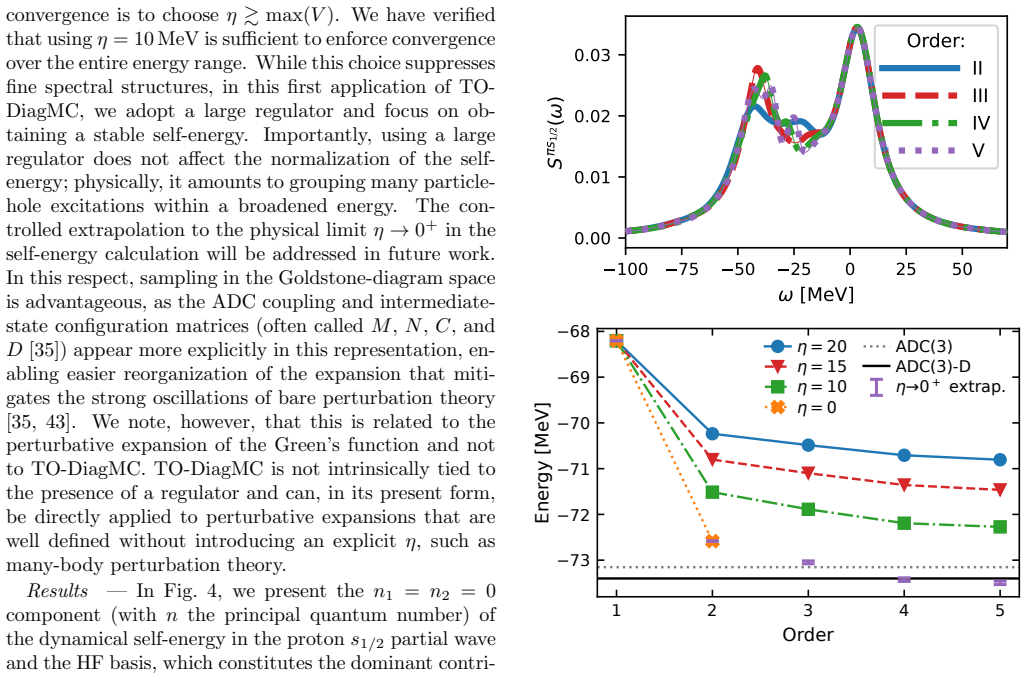
- [Abstract and results section] Abstract and results: Benchmarking against established truncation schemes is stated but no quantitative values (energies, errors, or direct comparisons at specific orders) are supplied, making it impossible to assess whether the fifth-order results support the claim of overcoming current many-body limitations.
minor comments (1)
- [Method section] Notation for the time-ordering constraints and diagram weights could be clarified with an explicit example at low order to aid reproducibility.
Simulated Author's Rebuttal
We thank the referee for their careful reading of the manuscript and for highlighting these important points regarding validation and quantitative presentation of results. We address each major comment below.
read point-by-point responses
-
Referee: [Algorithm description and 16O results] The central claim rests on the equivalence between on-the-fly time-ordered Goldstone diagram sampling and explicit summation over all time orderings for the single-particle Green's function in a finite discrete model space. No direct numerical verification of this equivalence (e.g., comparison of sampled vs. explicitly summed results at second or third order) is reported in the 16O calculations or algorithm validation sections, leaving the unbiased nature of the stochastic procedure unconfirmed beyond statistical errors.
Authors: We agree that an explicit numerical check of the equivalence between the on-the-fly sampling and direct summation is necessary to fully substantiate the unbiased character of the algorithm. In the revised manuscript we will add a dedicated validation subsection (prior to the 16O results) that performs this comparison at second and third order in a small discrete model space, reporting both the explicitly summed values and the Monte Carlo estimates with their statistical uncertainties. revision: yes
-
Referee: [Abstract and results section] Abstract and results: Benchmarking against established truncation schemes is stated but no quantitative values (energies, errors, or direct comparisons at specific orders) are supplied, making it impossible to assess whether the fifth-order results support the claim of overcoming current many-body limitations.
Authors: We acknowledge that the current version does not provide the numerical values needed for a quantitative assessment. In the revision we will expand the results section to include explicit energies (and associated statistical errors) at successive orders up to fifth order, together with direct side-by-side comparisons against the truncation schemes mentioned in the text. These numbers will also be reflected in an updated abstract. revision: yes
Circularity Check
Minor self-citation to prior work; central algorithm remains independently formulated
full rationale
The paper introduces a time-ordered Diagrammatic Monte Carlo method based on on-the-fly evaluation of Goldstone diagrams for the single-particle Green's function in discrete model spaces. It references advancing 'our earlier work' but this citation supports the general diagrammatic Monte Carlo framework rather than defining the new time-ordering or nuclear-specific adaptations. No load-bearing step equates a claimed prediction or result to a fitted parameter or self-referential definition by construction. Benchmarking against established ab initio truncation schemes supplies external comparison. The absence of any quoted reduction (e.g., sampling weights forced to match explicit sums by ansatz) keeps the circularity score low.
Axiom & Free-Parameter Ledger
Reference graph
Works this paper leans on
-
[1]
F. Bonaiti, G. Hagen, and T. Papenbrock, Structure of the doubly magic nuclei 208Pb and 266Pb from ab initio computations (2025), arXiv:2508.14217 [nucl-th]
-
[2]
B. Hu, W. Jiang, T. Miyagi, Z. Sun, A. Ekstr¨ om, C. Forss´ en, G. Hagen, J. D. Holt, T. Papenbrock, S. R. Stroberg, and I. Vernon, Nat. Phys.18, 1196 (2022)
2022
-
[3]
Z. H. Sun, A. Ekstr¨ om, C. Forss´ en, G. Hagen, G. R. Jansen, and T. Papenbrock, Phys. Rev. X15, 011028 (2025)
2025
-
[4]
B. S. Hu, Z. H. Sun, G. Hagen, and T. Papenbrock, Phys. Rev. C110, L011302 (2024)
2024
- [5]
-
[6]
P. Arthuis, K. Hebeler, and A. Schwenk, Neutron-rich nuclei and neutron skins from chiral low-resolution inter- actions (2024), arXiv:2401.06675 [nucl-th]
-
[7]
W. G. Jiang, A. Ekstr¨ om, C. Forss´ en, G. Hagen, G. R. Jansen, and T. Papenbrock, Phys. Rev. C102, 054301 (2020)
2020
-
[8]
Ekstr¨ om, G
A. Ekstr¨ om, G. R. Jansen, K. A. Wendt, G. Hagen, T. Papenbrock, B. D. Carlsson, C. Forss´ en, M. Hjorth- Jensen, P. Navr´ atil, and W. Nazarewicz, Phys. Rev. C 91, 051301 (2015)
2015
- [9]
-
[10]
S. Shen, S. Elhatisari, T. A. L¨ ahde, D. Lee, B.-N. Lu, and U.-G. Meißner, Nature Communications14, 2777 (2023)
2023
-
[11]
Epelbaum, H
E. Epelbaum, H. Krebs, T. A. L¨ ahde, D. Lee, and U.-G. Meißner, Phys. Rev. Lett.109, 252501 (2012)
2012
-
[12]
Idini, C
A. Idini, C. Barbieri, and P. Navr´ atil, Phys. Rev. Lett. 123, 092501 (2019)
2019
-
[13]
Rotureau, P
J. Rotureau, P. Danielewicz, G. Hagen, G. R. Jansen, and F. M. Nunes, Phys. Rev. C98, 044625 (2018)
2018
-
[14]
Gade and B
A. Gade and B. M. Sherrill, Phys. Scr.91, 053003 (2016)
2016
-
[15]
Andrighetto, M
A. Andrighetto, M. Manzolaro, S. Corradetti, D. Scarpa, A. Monetti, M. Rossignoli, M. Ballan, F. Borgna, F. D’Agostini, F. Gramegna, G. Prete, G. Meneghetti, M. Ferrari, and A. Zenoni, J. Phys. Conf. Ser.966, 012028 (2018)
2018
-
[16]
Aumann, Prog
T. Aumann, Prog. Part. Nucl. Phys.59, 3 (2007)
2007
-
[17]
Borge, Nucl
M. Borge, Nucl. Instrum. Methods Phys. Res., Sect. B 376, 408 (2016)
2016
-
[18]
J. C. Hardy and I. S. Towner, Phys. Rev. C102, 045501 (2020)
2020
-
[19]
Engel, M
J. Engel, M. J. Ramsey-Musolf, and U. van Kolck, Progress in Particle and Nuclear Physics71, 21 (2013), fundamental Symmetries in the Era of the LHC
2013
-
[20]
Belley, J
A. Belley, J. M. Yao, B. Bally, J. Pitcher, J. Engel, H. Hergert, J. D. Holt, T. Miyagi, T. R. Rodr´ ıguez, A. M. Romero, S. R. Stroberg, and X. Zhang, Phys. Rev. Lett. 132, 182502 (2024)
2024
-
[21]
Belley, C
A. Belley, C. G. Payne, S. R. Stroberg, T. Miyagi, and J. D. Holt, Phys. Rev. Lett.126, 042502 (2021)
2021
-
[22]
Arthuis, A
P. Arthuis, A. Tichai, J. Ripoche, and T. Duguet, Com- puter Physics Communications261, 107677 (2021). 5
2021
-
[23]
Arthuis, T
P. Arthuis, T. Duguet, A. Tichai, R.-D. Lasseri, and J.-P. Ebran, Comput. Phys. Commun.240, 202 (2019)
2019
-
[24]
C. Drischler, K. S. McElvain, and P. Arthuis, Many-body perturbation theory for the nuclear equation of state up to fifth order (2026), arXiv:2603.24532 [nucl-th]
-
[25]
Drischler, K
C. Drischler, K. Hebeler, and A. Schwenk, Phys. Rev. Lett.122, 042501 (2019)
2019
-
[26]
Y. Luo, J. Park, and M. Bernardi, Nature Physics21, 1275 (2025)
2025
-
[28]
Van Houcke, F
K. Van Houcke, F. Werner, E. Kozik, N. Prokof’ev, B. Svistunov, M. J. H. Ku, A. T. Sommer, L. W. Cheuk, A. Schirotzek, and M. W. Zwierlein, Nat. Phys.8, 366 (2012)
2012
-
[29]
N. V. Prokof’ev and B. V. Svistunov, Phys. Rev. Lett. 81, 2514 (1998)
1998
-
[30]
Brolli, C
S. Brolli, C. Barbieri, and E. Vigezzi, Phys. Rev. Lett. 134, 182502 (2025)
2025
-
[31]
Capuzzi and C
F. Capuzzi and C. Mahaux, Ann. Phys. (N.Y.)245, 147 (1996)
1996
-
[32]
Mahaux, Microscopic theories of atomic and nuclear optical potentials, inRecent Progress in Many-Body The- ories: Volume 4(Springer US, Boston, MA, 1995) pp
C. Mahaux, Microscopic theories of atomic and nuclear optical potentials, inRecent Progress in Many-Body The- ories: Volume 4(Springer US, Boston, MA, 1995) pp. 171–175
1995
-
[33]
The diagram shown is topologically equivalent to a double-ring diagram, as the latter can be obtained by considering the exchange contributions at all the interac- tion vertices
-
[34]
See Supplemental Material atURL_will_be_inserted_ by_publisherfor details
-
[35]
Barbieri and A
C. Barbieri and A. Carbone,Self-Consistent Green’s Function Approaches, Vol. 936 of Lecture Notes in Physics (Springer, New York, 2017) Chap. 11, pp. 571– 644
2017
-
[36]
Som` a, C
V. Som` a, C. Barbieri, and T. Duguet, Phys. Rev. C89, 024323 (2014)
2014
-
[37]
Barbieri, T
C. Barbieri, T. Duguet, and V. Som` a, Phys. Rev. C105, 044330 (2022)
2022
-
[38]
Schirmer,Many-Body Methods for Atoms, Molecules and Clusters(Springer International Publishing, Cham, 2018)
J. Schirmer,Many-Body Methods for Atoms, Molecules and Clusters(Springer International Publishing, Cham, 2018)
2018
- [41]
-
[42]
Barbieri and M
C. Barbieri and M. Hjorth-Jensen, Phys. Rev. C79, 064313 (2009)
2009
-
[43]
Raimondi and C
F. Raimondi and C. Barbieri, Phys. Rev. C97, 054308 (2018)
2018
-
[44]
Cipollone, C
A. Cipollone, C. Barbieri, and P. Navr´ atil, Phys. Rev. Lett.111, 062501 (2013)
2013
-
[45]
Dickhoff and D
W. Dickhoff and D. Van Neck,Many-Body Theory Ex- posed!: Propagator Description of Quantum Mechan- ics in Many-Body Systems(World Scientific, Singapore, 2005)
2005
-
[47]
normalization diagrams
D. S. Koltun, Phys. Rev. C9, 484 (1974). 6 SUPPLEMENT AL MA TERIAL The algorithm The time-ordered Diagrammatic Monte Carlo (TO-DiagMC) algorithm computes the self-energy of the single- particle Green’s function by sampling time-ordered (Goldstone) diagrams. The self-energy exhibits the asymptotic behavior∼A/ω+iB/ω 2, whereAandBare real numbers [1]. This e...
1974
-
[48]
Dickhoff and D
W. Dickhoff and D. Van Neck,Many-Body Theory Exposed!: Propagator Description of Quantum Mechanics in Many-Body Systems(World Scientific, Singapore, 2005)
2005
-
[49]
Brolli, C
S. Brolli, C. Barbieri, and E. Vigezzi, Phys. Rev. Lett.134, 182502 (2025)
2025
-
[50]
Van Houcke, F
K. Van Houcke, F. Werner, T. Ohgoe, N. V. Prokof’ev, and B. V. Svistunov, Phys. Rev. B99, 035140 (2019)
2019
-
[51]
W. K. Hastings, Biometrika57, 97 (1970)
1970
-
[52]
Metropolis, A
N. Metropolis, A. W. Rosenbluth, M. N. Rosenbluth, A. H. Teller, and E. Teller, J. Chem. Phys.21, 1087 (1953)
1953
-
[53]
V. M. Galitskii and A. B. Migdal, Sov. Phys. JETP7, 96 (1958)
1958
-
[54]
D. S. Koltun, Phys. Rev. C9, 484 (1974). 6
1974
discussion (0)
Sign in with ORCID, Apple, or X to comment. Anyone can read and Pith papers without signing in.