Automated void identification by Blendmask: from hierarchical molecular gas to hierarchical voids in NGC 628
Pith reviewed 2026-06-29 06:03 UTC · model grok-4.3
The pith
Voids in NGC 628 originate inside molecular clouds, expand via stellar feedback, and detach as they grow.
A machine-rendered reading of the paper's core claim, the machinery that carries it, and where it could break.
Core claim
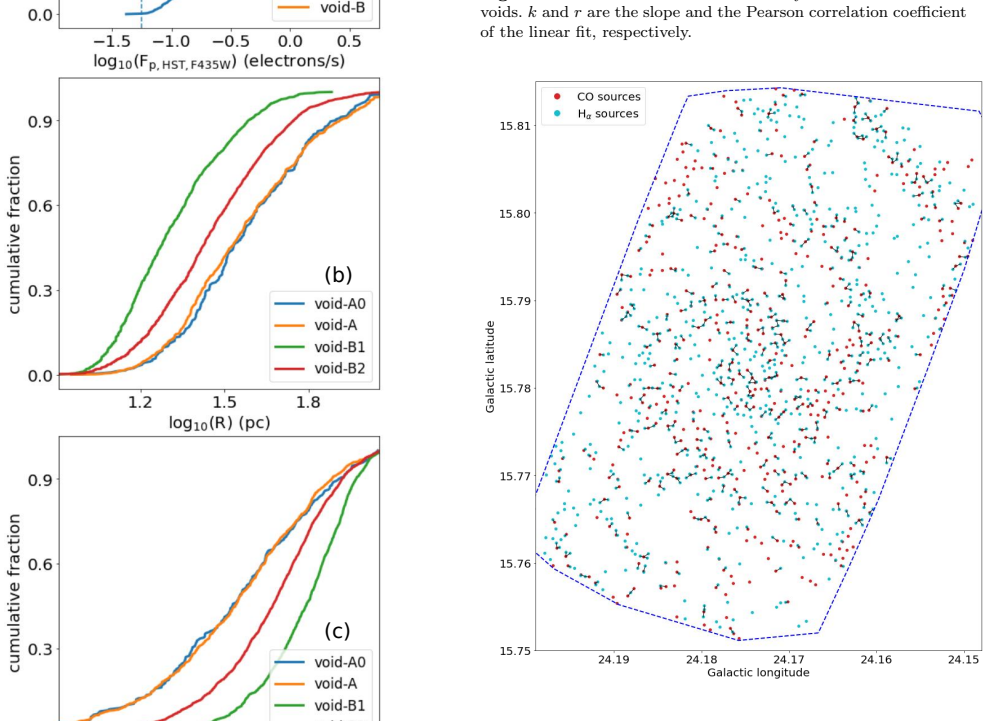
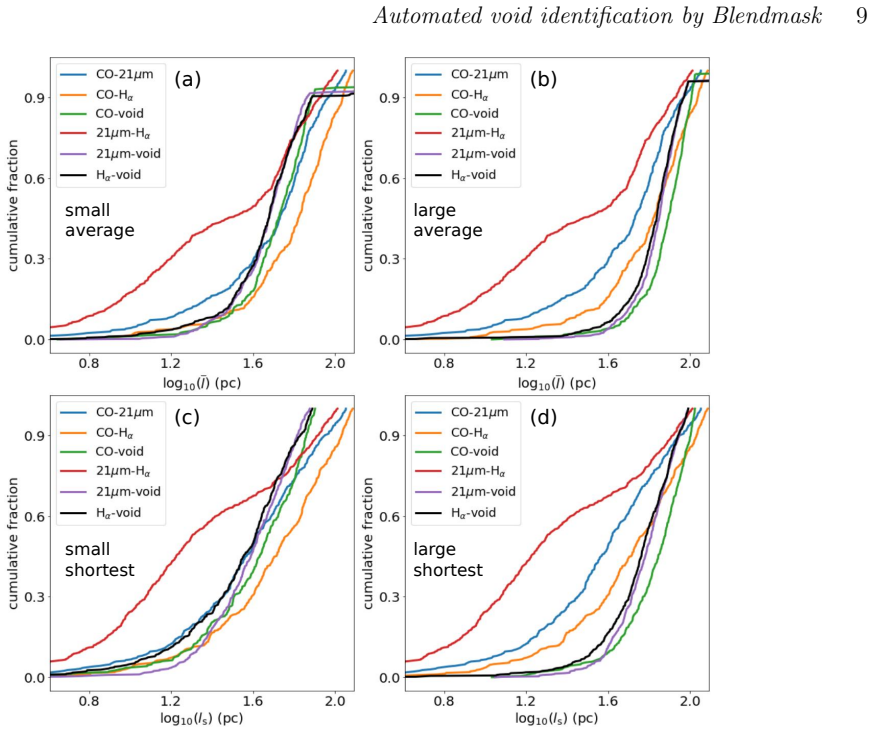
The central claim is that the nine constructed source-pair networks show 21μm and Hα sources with the strongest associations overall, while larger voids exhibit systematically increasing separations from CO to 21μm to Hα sources to voids; this sequence, together with the 68% overlap between void-associated clouds and 21μm sources and the greater mass of those clouds, indicates that voids originate within molecular clouds, grow through stellar feedback, and gradually detach from their parent structures.
What carries the argument
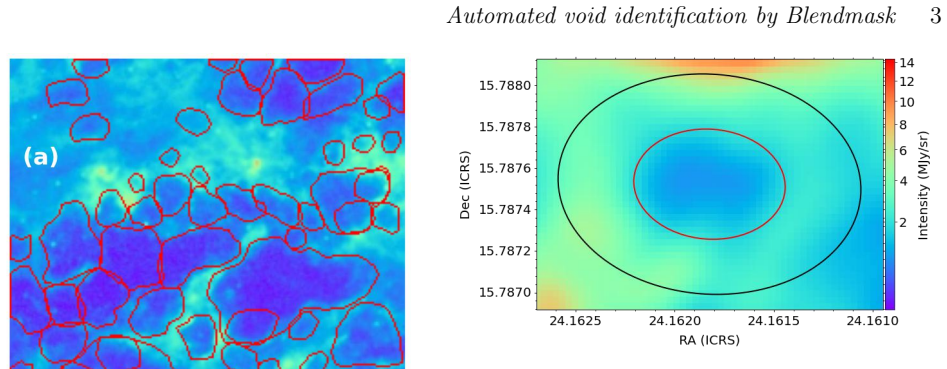
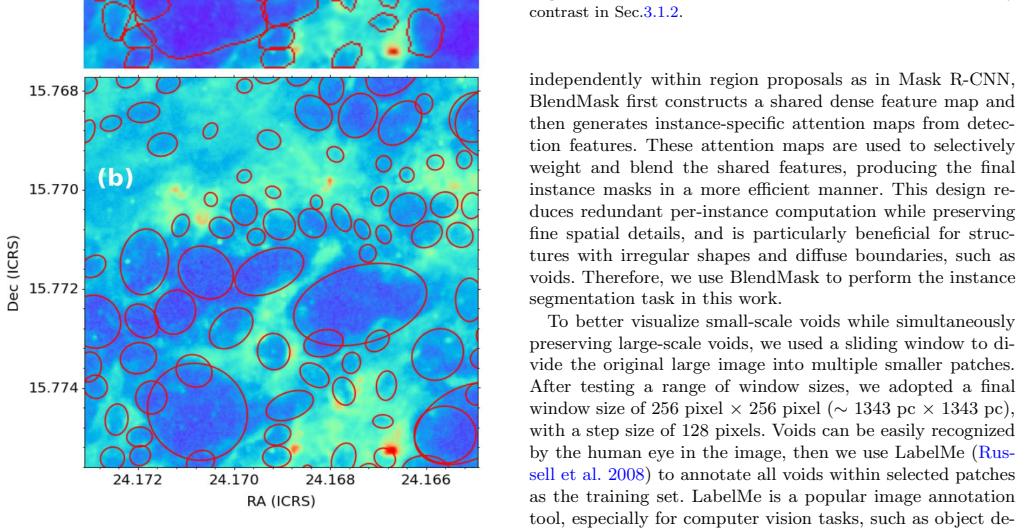
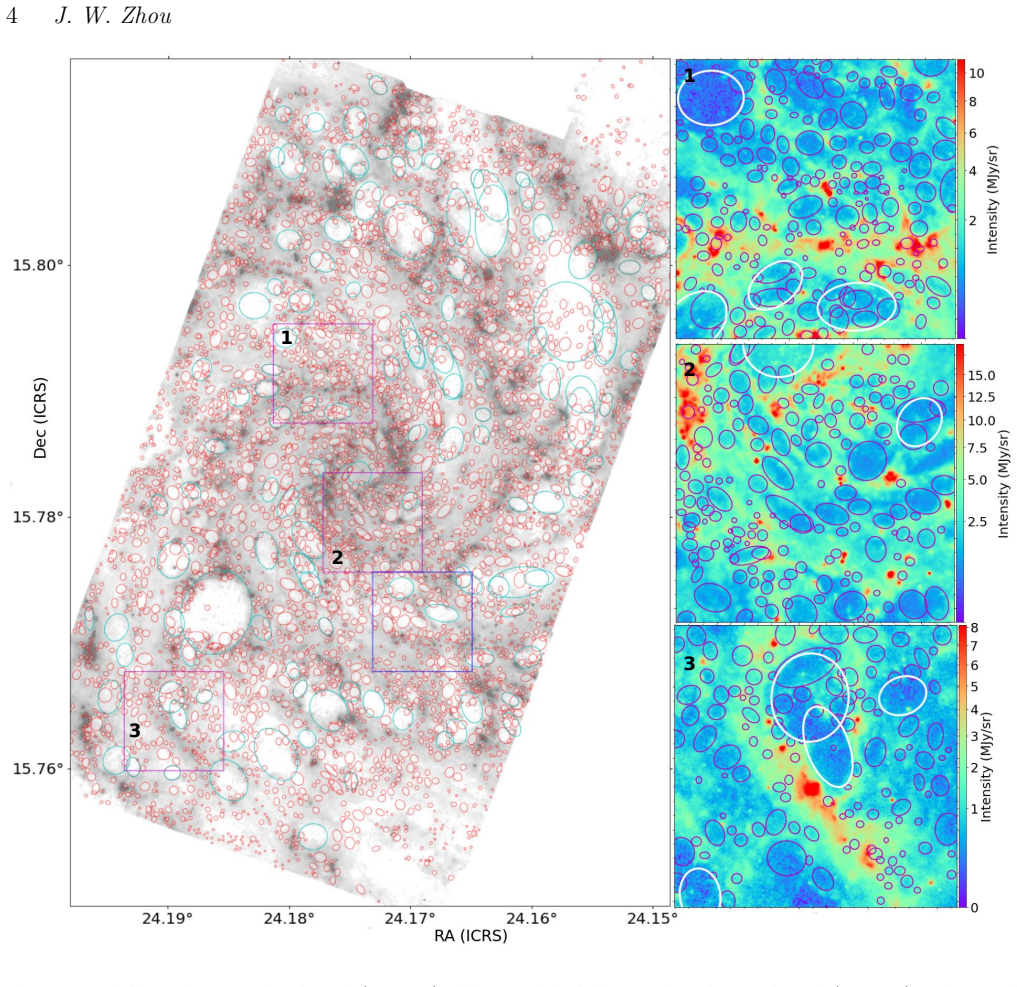
BlendMask automated void detection on the JWST MIRI F770W image, refined by intensity contrast, combined with network graphs that link each CO, 21μm, Hα, and void source pair to quantify spatial separations.
If this is right
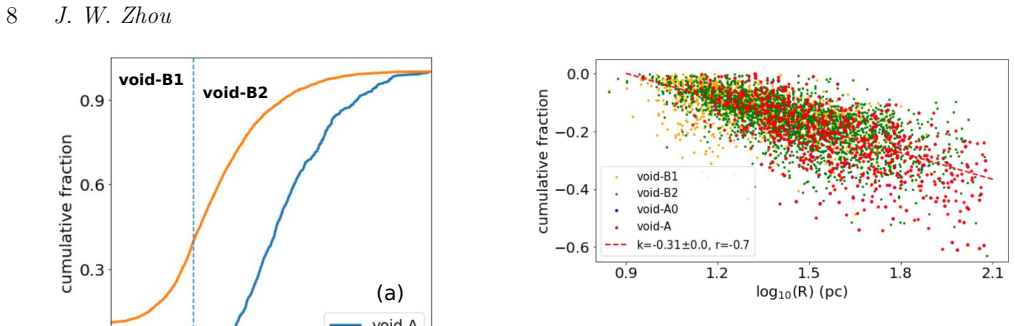
- Voids linked to star clusters or associations have lower intensity contrast and larger sizes than those without.
- Void size anticorrelates with intensity contrast, implying larger voids have emptier centers from stronger feedback.
- Molecular clouds associated with voids are significantly more massive and more evolved than clouds without voids.
- 68 percent of molecular clouds tied to voids are also tied to 21μm sources.
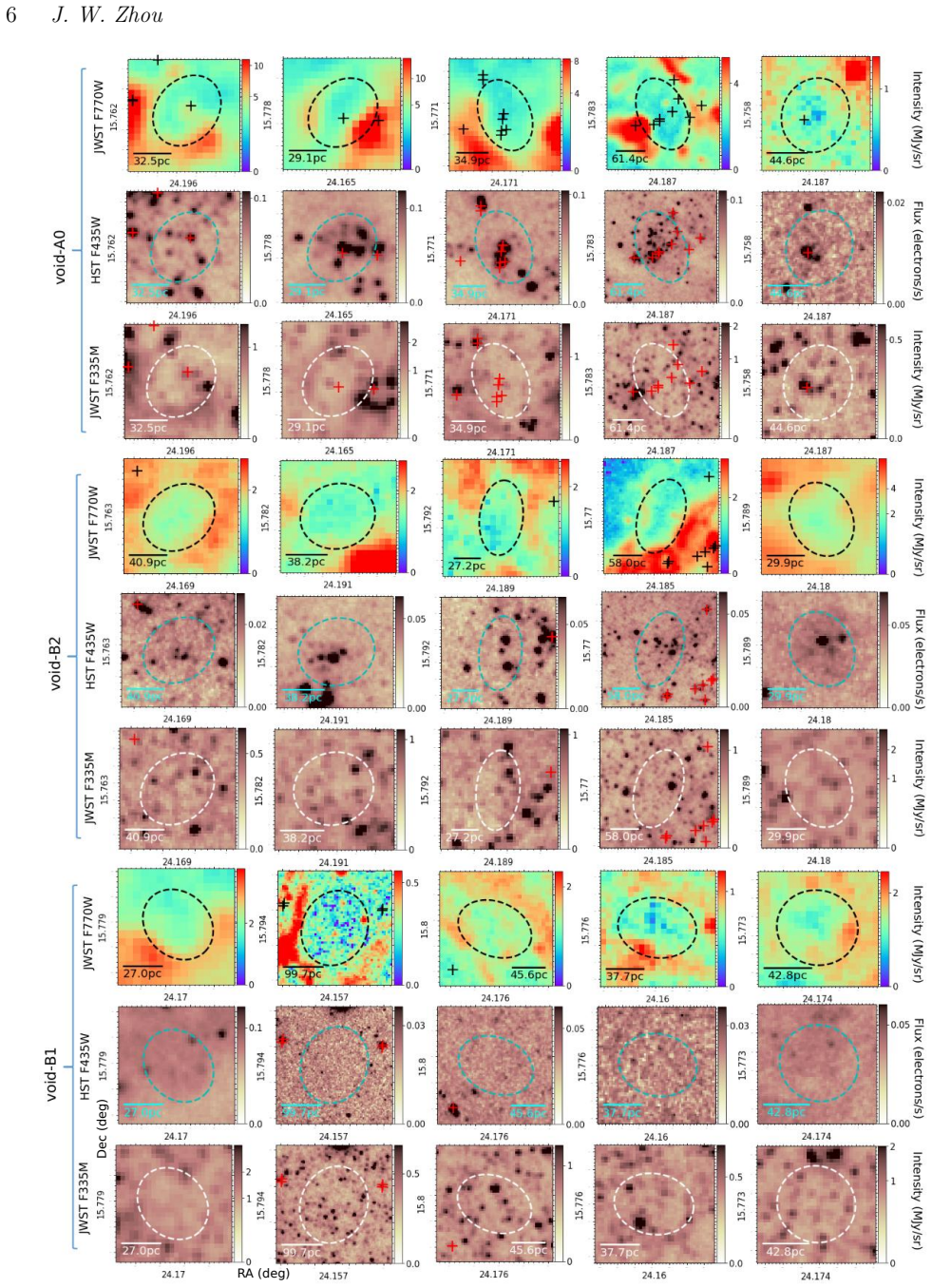
- Only up to 17.6 percent of voids coincide with catalogued star clusters or associations, with overlapping B-band flux distributions for the rest.
Where Pith is reading between the lines
- The same network method could map feedback timelines in galaxies where cluster catalogs are incomplete.
- Age-dating the stellar populations near voids would provide an independent test of the separation sequence.
- Void catalogs might help locate embedded clusters in high-extinction regions missed by optical surveys.
Load-bearing premise
The measured spatial separations in the networks reflect a causal temporal evolutionary sequence rather than static correlations or detection limits.
What would settle it
A calculation showing that randomly placed voids produce the same pattern of increasing separations from CO to 21μm to Hα sources would falsify the evolutionary interpretation.
Figures
read the original abstract
We identify voids in NGC 628 from the JWST MIRI F770W image using a deep_learning method (BlendMask) and refine them by intensity contrast. These voids may be feedback_driven bubbles or dynamically formed structures. Cross_matching with archival star cluster/association catalogs shows that only up to 17.6% of voids are associated with such stellar populations. HST B_band peak_flux distributions of voids with and without these populations overlap substantially, suggesting many related clusters/associations remain unidentified or misclassified. Voids associated with star clusters/associations tend to have lower intensity contrast and larger sizes. An anti_correlation between void size and intensity contrast indicates larger voids have emptier centers, possibly due to stronger feedback. Thus, voids may provide a complementary tracer for identifying stellar populations and constraining their physical properties. To quantify spatial relationships among CO, 21$\mu$m, H$_{\alpha}$ sources, and voids, we construct networks linking each source pair. Among the nine networks, 21$\mu$m and H$_{\alpha}$ sources show the strongest spatial association. Compared to small voids, large voids exhibit progressively increasing separations from CO to 21$\mu$m to H$_{\alpha}$ sources to voids, consistent with an evolutionary sequence in space and time. Smaller voids lie closer to molecular clouds, while larger voids are more displaced. Compared with molecular clouds not associated with voids, those associated with voids are significantly more massive and appear more evolved. Indeed, 68% of molecular clouds associated with voids are also associated with 21$\mu$m sources. These results support an evolutionary scenario where some voids originate within molecular clouds, grow through stellar feedback, and gradually detach from their parent clouds.
Editorial analysis
A structured set of objections, weighed in public.
Referee Report
Summary. The paper applies the BlendMask deep-learning algorithm to identify and refine voids in the JWST MIRI F770W image of NGC 628. It reports a 17.6% association rate with known star clusters/associations, substantial overlap in HST B-band flux distributions, an anti-correlation between void size and intensity contrast, and constructs nine spatial networks linking CO, 21 μm, Hα sources and voids. The networks show strongest associations between 21 μm and Hα sources; large voids exhibit progressively larger separations from CO to 21 μm to Hα to voids, while associated molecular clouds are more massive and evolved (68% also linked to 21 μm sources). These trends are interpreted as supporting an evolutionary sequence in which voids form inside molecular clouds, grow via stellar feedback, and detach over time.
Significance. If the temporal interpretation of the network separations can be secured, the work would supply a new, automated tracer for feedback-driven structures and the molecular-cloud-to-stellar-population lifecycle in nearby galaxies, complementing existing catalogs of clusters and H II regions.
major comments (2)
- [Abstract] Abstract / network-construction paragraph: the central claim that the observed increase in separations (CO → 21 μm → Hα → voids) for large versus small voids constitutes evidence of a causal evolutionary timeline is load-bearing, yet the manuscript provides no Monte Carlo null tests against random or clustered spatial distributions, no kinematic follow-up, and no explicit modeling of projection effects or differing completeness thresholds across tracers.
- [Abstract] Abstract: the statement that voids associated with star clusters/associations 'tend to have lower intensity contrast and larger sizes' and that associated clouds are 'significantly more massive and appear more evolved' lacks reported error bars, sample sizes, or statistical significance tests, making it impossible to assess whether these differences are robust or driven by selection.
minor comments (2)
- [Abstract] Notation: terms such as 'anti_correlation', 'feedback_driven', and 'star cluster/association' appear without consistent hyphenation or definition on first use.
- [Abstract] The 68% figure for molecular clouds associated with both voids and 21 μm sources is presented without a control sample or uncertainty estimate.
Simulated Author's Rebuttal
We thank the referee for the constructive report. The comments highlight important areas where the statistical support for our claims can be strengthened, and we have revised the manuscript accordingly.
read point-by-point responses
-
Referee: [Abstract] Abstract / network-construction paragraph: the central claim that the observed increase in separations (CO → 21 μm → Hα → voids) for large versus small voids constitutes evidence of a causal evolutionary timeline is load-bearing, yet the manuscript provides no Monte Carlo null tests against random or clustered spatial distributions, no kinematic follow-up, and no explicit modeling of projection effects or differing completeness thresholds across tracers.
Authors: We agree that Monte Carlo null tests and explicit discussion of projection effects and completeness would strengthen the evolutionary interpretation. In the revised manuscript we have added Monte Carlo simulations comparing observed separations to those drawn from random and clustered spatial distributions, together with a dedicated paragraph addressing projection effects and tracer completeness. Kinematic follow-up cannot be performed with the existing JWST MIRI, HST, and CO datasets, which lack the required velocity information for the voids. revision: partial
-
Referee: [Abstract] Abstract: the statement that voids associated with star clusters/associations 'tend to have lower intensity contrast and larger sizes' and that associated clouds are 'significantly more massive and appear more evolved' lacks reported error bars, sample sizes, or statistical significance tests, making it impossible to assess whether these differences are robust or driven by selection.
Authors: The referee correctly identifies that these comparative statements require quantitative support. We have updated the abstract and the corresponding results sections to report sample sizes (N = 142 voids with cluster associations, N = 663 without; N = 87 associated molecular clouds), mean values with uncertainties, and the outcomes of two-sample Kolmogorov-Smirnov tests confirming statistical significance of the differences in size, contrast, and cloud mass. revision: yes
- Kinematic follow-up data are unavailable in the current multi-wavelength dataset.
Circularity Check
No significant circularity in derivation chain
full rationale
The paper's central results follow from direct observational processing: BlendMask void detection on JWST imaging, intensity-contrast refinement, positional cross-matching against external catalogs, and construction of spatial networks whose edge lengths are computed from observed source coordinates. The reported trends (increasing separations CO→21μm→Hα→voids for larger voids, mass differences in associated clouds) are empirical metrics extracted from these data products. The evolutionary-sequence interpretation is an inference drawn from those metrics rather than a quantity that reduces to the inputs by definition, a fitted parameter renamed as a prediction, or a self-citation chain. No equations or steps in the provided text exhibit the self-definitional, fitted-input, or uniqueness-imported patterns required for a positive circularity finding.
Axiom & Free-Parameter Ledger
axioms (1)
- domain assumption Identified voids correspond to real physical structures shaped by stellar feedback rather than imaging artifacts or processing biases.
Reference graph
Works this paper leans on
-
[1]
Adamo, A., Ryon, J. E., Messa, M., et al. 2017, ApJ, 841, 131, doi:10.3847/1538-4357/aa7132
-
[2]
Ahmadzadeh, A., Mahajan, S. S., Kempton, D. J., Angryk, R. A., & Ji, S. 2019, arXiv e-prints, arXiv:1912.02743, doi:10.48550/ arXiv.1912.02743
-
[3]
2022, arXiv e- prints, arXiv:2205.00683, doi:10.48550/arXiv.2205.00683
Alina, D., Shomanov, A., & Baimukhametova, S. 2022, arXiv e- prints, arXiv:2205.00683, doi:10.48550/arXiv.2205.00683
-
[4]
2011, AJ, 141, 23, doi:10.1088/0004-6256/141/1/23
Bagetakos, I., Brinks, E., Walter, F., et al. 2011, AJ, 141, 23, doi:10.1088/0004-6256/141/1/23
-
[5]
Barnes, A. T., Glover, S. C. O., Kreckel, K., et al. 2021, MNRAS, 508, 5362, doi:10.1093/mnras/stab2958
-
[6]
T., Chandar, R., Kreckel, K., et al
Barnes, A. T., Chandar, R., Kreckel, K., et al. 2022, A&A, 662, L6, doi:10.1051/0004-6361/202243766
-
[7]
Barnes, A. T., Watkins, E. J., Meidt, S. E., et al. 2023, ApJ, 944, L22, doi:10.3847/2041-8213/aca7b9
-
[8]
Burke, C. J., Aleo, P. D., Chen, Y.-C., et al. 2019, MNRAS, 490, 3952, doi:10.1093/mnras/stz2845
-
[9]
2020, arXiv e-prints, arXiv:2001.00309, doi:10.48550/arXiv.2001.00309
Chen, H., Sun, K., Tian, Z., et al. 2020, arXiv e-prints, arXiv:2001.00309, doi:10.48550/arXiv.2001.00309
-
[10]
Seal: Safety-enhanced aligned llm fine-tuning via bilevel data selection
Chevance, M., Krumholz, M. R., McLeod, A. F., et al. 2023, in Astronomical Society of the Pacific Conference Series, Vol. 534, Protostars and Planets VII, ed. S. Inutsuka, Y. Aikawa, T. Muto, K. Tomida, & M. Tamura, 1, doi:10.48550/arXiv. 2203.09570
work page internal anchor Pith review doi:10.48550/arxiv 2023
-
[11]
Chevance, M., Kruijssen, J. M. D., Krumholz, M. R., et al. 2022, MNRAS, 509, 272, doi:10.1093/mnras/stab2938
-
[12]
Churchwell, E., Povich, M. S., Allen, D., et al. 2006, ApJ, 649, 759, doi:10.1086/507015
-
[13]
Journal of the Royal Statistical Soci- ety
Dale, J. E., Ercolano, B., & Bonnell, I. A. 2012, Monthly Notices of the Royal Astronomical Society, 424, 377, doi:10.1111/j. 1365-2966.2012.21205.x
work page doi:10.1111/j 2012
-
[14]
E., Ngoumou, J., Ercolano, B., & Bonnell, I
Dale, J. E., Ngoumou, J., Ercolano, B., & Bonnell, I. A. 2014, MNRAS, 442, 694, doi:10.1093/mnras/stu816 Ehlerov´ a, S., & Palouˇ s, J. 2005, A&A, 437, 101, doi:10.1051/ 0004-6361:20034389 —. 2013, A&A, 550, A23, doi:10.1051/0004-6361/201220341
-
[15]
Elmegreen, D. M., Elmegreen, B. G., Adamo, A., et al. 2014, ApJ, 787, L15, doi:10.1088/2041-8205/787/1/L15
-
[16]
2022, A&A, 659, A191, doi:10.1051/0004-6361/202141727
Emsellem, E., Schinnerer, E., Santoro, F., et al. 2022, A&A, 659, A191, doi:10.1051/0004-6361/202141727
-
[17]
A Dynamic Recursive Unified Internet Design (DRUID),
Farias, H., Ortiz, D., Damke, G., Jaque Arancibia, M., & Solar, M. 2020, Astronomy and Computing, 33, 100420, doi:10.1016/j. ascom.2020.100420
work page doi:10.1016/j 2020
-
[18]
2016, MNRAS, 456, 3432, doi:10.1093/mnras/stv2742
Girichidis, P., Walch, S., Naab, T., et al. 2016, MNRAS, 456, 3432, doi:10.1093/mnras/stv2742
-
[19]
Gouliermis, D. A., Thilker, D., Elmegreen, B. G., et al. 2015, MN- RAS, 452, 3508, doi:10.1093/mnras/stv1325 2 https://sites.google.com/view/phangs/home MNRAS000, 000–000 (2025) Automated void identification by Blendmask11
-
[20]
2017, ApJ, 840, 113, doi:10.3847/1538-4357/aa6f15 —
Grasha, K., Calzetti, D., Adamo, A., et al. 2017, ApJ, 840, 113, doi:10.3847/1538-4357/aa6f15 —. 2019, MNRAS, 483, 4707, doi:10.1093/mnras/sty3424
-
[21]
He, K., Gkioxari, G., Doll´ ar, P., & Girshick, R. 2017, arXiv e- prints, arXiv:1703.06870, doi:10.48550/arXiv.1703.06870
work page internal anchor Pith review Pith/arXiv arXiv doi:10.48550/arxiv.1703.06870 2017
-
[22]
1979, ApJ, 229, 533, doi:10.1086/156986
Heiles, C. 1979, ApJ, 229, 533, doi:10.1086/156986
-
[23]
Henshaw, J. D., Kruijssen, J. M. D., Longmore, S. N., et al. 2020, Nature Astronomy, 4, 1064, doi:10.1038/s41550-020-1126-z
-
[24]
F., Kereˇ s, D., O˜ norbe, J., et al
Hopkins, P. F., Kereˇ s, D., O˜ norbe, J., et al. 2014, MNRAS, 445, 581, doi:10.1093/mnras/stu1738
work page internal anchor Pith review doi:10.1093/mnras/stu1738 2014
-
[25]
S., & Lee, M
Jang, I. S., & Lee, M. G. 2014, ApJ, 792, 52, doi:10.1088/ 0004-637X/792/1/52
2014
-
[26]
Jeffreson, S. M. R., Krumholz, M. R., Fujimoto, Y., et al. 2021, MNRAS, 505, 3470, doi:10.1093/mnras/stab1536
-
[27]
Kim, J., Chevance, M., Kruijssen, J. M. D., et al. 2021, MNRAS, 504, 487, doi:10.1093/mnras/stab878 —. 2023, ApJ, 944, L20, doi:10.3847/2041-8213/aca90a
-
[28]
Kim, J.-G., Kim, W.-T., & Ostriker, E. C. 2016, ApJ, 819, 137, doi:10.3847/0004-637X/819/2/137 —. 2018, ApJ, 859, 68, doi:10.3847/1538-4357/aabe27
-
[29]
Kim, S., Staveley-Smith, L., Dopita, M. A., et al. 1998, ApJ, 503, 674, doi:10.1086/306030
-
[30]
2017, The Astrophysical Journal, 834, 174, doi:10.3847/1538-4357/834/2/174
Kreckel, K., Groves, B., Bigiel, F., et al. 2017, The Astrophysical Journal, 834, 174, doi:10.3847/1538-4357/834/2/174
-
[31]
Kruijssen, J. M. D., & Longmore, S. N. 2014, MNRAS, 439, 3239, doi:10.1093/mnras/stu098
-
[32]
Kruijssen, J. M. D., Schruba, A., Hygate, A. P. S., et al. 2018, MNRAS, 479, 1866, doi:10.1093/mnras/sty1128
-
[33]
Kruijssen, J. M. D., Schruba, A., Chevance, M., et al. 2019, Nature, 569, 519, doi:10.1038/s41586-019-1194-3
-
[34]
Krumholz, M. R., Bate, M. R., Arce, H. G., et al. 2014, in Pro- tostars and Planets VI, ed. H. Beuther, R. S. Klessen, C. P. Dullemond, & T. Henning, 243, doi:10.2458/azu_uapress_ 9780816531240-ch011
-
[35]
Kumar, M. S. N., Palmeirim, P., Arzoumanian, D., & Inutsuka, S. I. 2020, A&A, 642, A87, doi:10.1051/0004-6361/202038232
-
[36]
Lang, P., Meidt, S. E., Rosolowsky, E., et al. 2020, ApJ, 897, 122, doi:10.3847/1538-4357/ab9953
-
[37]
2023, Astronomy and Com- puting, 44, 100728, doi:10.1016/j.ascom.2023.100728
Lao, B., Jaiswal, S., Zhao, Z., et al. 2023, Astronomy and Com- puting, 44, 100728, doi:10.1016/j.ascom.2023.100728
-
[38]
M., Koda, J., Egusa, F., et al
Lee, J. C., Whitmore, B. C., Thilker, D. A., et al. 2022, ApJS, 258, 10, doi:10.3847/1538-4365/ac1fe5
-
[39]
Lee, J. C., Sandstrom, K. M., Leroy, A. K., et al. 2023, ApJ, 944, L17, doi:10.3847/2041-8213/acaaae
-
[40]
Leroy, A. K., Schinnerer, E., Hughes, A., et al. 2021a, ApJS, 257, 43, doi:10.3847/1538-4365/ac17f3
-
[41]
K., Hughes, A., Liu, D., et al
Leroy, A. K., Hughes, A., Liu, D., et al. 2021b, ApJS, 255, 19, doi:10.3847/1538-4365/abec80
-
[42]
K., Sun, J., Meidt, S., et al
Leroy, A. K., Sun, J., Meidt, S., et al. 2025, ApJ, 985, 14, doi:10. 3847/1538-4357/adbcab
2025
-
[43]
Lewis, S. C., McMillan, S. L. W., Low, M.-M. M., et al. 2023, ApJ, 944, 211, doi:10.3847/1538-4357/acb0c5
-
[44]
2023, Research in Astronomy and Astrophysics, 23, 115006, doi:10.1088/1674-4527/acd0ed
Liang, R., Deng, F., Yang, Z., et al. 2023, Research in Astronomy and Astrophysics, 23, 115006, doi:10.1088/1674-4527/acd0ed
-
[45]
Lopez, L. A., Krumholz, M. R., Bolatto, A. D., et al. 2014, ApJ, 795, 121, doi:10.1088/0004-637X/795/2/121 Mac Low, M.-M., & McCray, R. 1988, ApJ, 324, 776, doi:10.1086/ 165936
-
[46]
Maschmann, D., Lee, J. C., Thilker, D. A., et al. 2024, ApJS, 273, 14, doi:10.3847/1538-4365/ad3cd3
-
[47]
Matzner, C. D. 2002, ApJ, 566, 302, doi:10.1086/338030
-
[48]
Matzner, C. D., & Jumper, P. H. 2015, ApJ, 815, 68, doi:10.1088/ 0004-637X/815/1/68 Miville-Deschˆ enes, M.-A., Murray, N., & Lee, E. J. 2017, ApJ, 834, 57, doi:10.3847/1538-4357/834/1/57
-
[49]
2018, ARA&A, 56, 41, doi:10.1146/annurev-astro-091916-055235
Motte, F., Bontemps, S., & Louvet, F. 2018, ARA&A, 56, 41, doi:10.1146/annurev-astro-091916-055235
-
[50]
Nath, B. B., Das, P., & Oey, M. S. 2020, MNRAS, 493, 1034, doi:10.1093/mnras/staa336
-
[51]
2025, PASJ, 77, 403, doi:10.1093/pasj/psaf008
Nishimoto, S., Onishi, T., Nishimura, A., et al. 2025, PASJ, 77, 403, doi:10.1093/pasj/psaf008
-
[52]
Pokhrel, N. R., Simpson, C. E., & Bagetakos, I. 2020, AJ, 160, 66, doi:10.3847/1538-3881/ab9bfa
-
[53]
1992, AJ, 103, 1841, doi:10.1086/116199
Puche, D., Westpfahl, D., Brinks, E., & Roy, J.-R. 1992, AJ, 103, 1841, doi:10.1086/116199
-
[54]
2021, Sensors, 21, 3389, doi:10.3390/s21103389
Quan, L., Wu, B., Mao, S., Yang, C., & Li, H. 2021, Sensors, 21, 3389, doi:10.3390/s21103389
-
[55]
Rahner, D., Pellegrini, E. W., Glover, S. C. O., & Klessen, R. S. 2017, MNRAS, 470, 4453, doi:10.1093/mnras/stx1532
-
[56]
2021, MNRAS, 504, 1039, doi:10.1093/mnras/stab900
Rathjen, T.-E., Naab, T., Girichidis, P., et al. 2021, MNRAS, 504, 1039, doi:10.1093/mnras/stab900
-
[57]
2023, Astronomy and Com- puting, 42, 100682, doi:10.1016/j.ascom.2022.100682
Riggi, S., Magro, D., Sortino, R., et al. 2023, Astronomy and Com- puting, 42, 100682, doi:10.1016/j.ascom.2022.100682
-
[58]
Rogers, H., & Pittard, J. M. 2013, MNRAS, 431, 1337, doi:10. 1093/mnras/stt255
2013
-
[59]
Rosolowsky, E., Hughes, A., Leroy, A. K., et al. 2021, MNRAS, 502, 1218, doi:10.1093/mnras/stab085
-
[60]
R., Rahner, D., Beuther, H., et al
Rugel, M. R., Rahner, D., Beuther, H., et al. 2019, A&A, 622, A48, doi:10.1051/0004-6361/201834068
-
[61]
Russell, B. C., Torralba, A., Murphy, K. P., & Freeman, W. T. 2008, International Journal of Computer Vision, 77, 157, doi:10.1007/s11263-007-0090-8
-
[62]
Schinnerer, E., & Leroy, A. K. 2024, ARA&A, 62, 369, doi:10. 1146/annurev-astro-071221-052651
2024
-
[63]
Smith, M. C., Sijacki, D., & Shen, S. 2018, MNRAS, 478, 302, doi:10.1093/mnras/sty994
-
[64]
2023, Sensors, 23, 4261, doi:10.3390/s23094261
Su, E., Tian, Y., Liang, E., Wang, J., & Zhang, Y. 2023, Sensors, 23, 4261, doi:10.3390/s23094261
-
[65]
Urquhart, J. S., Wells, M. R. A., Pillai, T., et al. 2022, MNRAS, 510, 3389, doi:10.1093/mnras/stab3511 Van Oort, C. M., Xu, D., Offner, S. S. R., & Gutermuth, R. A. 2019, ApJ, 880, 83, doi:10.3847/1538-4357/ab275e V´ azquez-Semadeni, E., Palau, A., Ballesteros-Paredes, J., G´ omez, G. C., & Zamora-Avil´ es, M. 2019, MNRAS, 490, 3061, doi:10. 1093/mnras/stz2736
-
[66]
doi: 10.1111/j.1365-2966.2012.20768.x
Walch, S. K., Whitworth, A. P., Bisbas, T., W¨ unsch, R., & Hubber, D. 2012, MNRAS, 427, 625, doi:10.1111/j.1365-2966.2012. 21767.x
-
[67]
J., Peretto, N., Marsh, K., & Fuller, G
Watkins, E. J., Peretto, N., Marsh, K., & Fuller, G. A. 2019, A&A, 628, A21, doi:10.1051/0004-6361/201935277
-
[68]
J., Kreckel, K., Groves, B., et al
Watkins, E. J., Kreckel, K., Groves, B., et al. 2023a, A&A, 676, A67, doi:10.1051/0004-6361/202346075
-
[69]
Watkins, E. J., Barnes, A. T., Henny, K., et al. 2023b, ApJ, 944, L24, doi:10.3847/2041-8213/aca6e4
-
[70]
Williams, T. G., Lee, J. C., Larson, K. L., et al. 2024, ApJS, 273, 13, doi:10.3847/1538-4365/ad4be5
-
[71]
Xu, D., Offner, S. S. R., Gutermuth, R., & Oort, C. V. 2020, ApJ, 890, 64, doi:10.3847/1538-4357/ab6607
-
[72]
2024, Remote Sensing, 16, 368, doi:10.3390/rs16020368
Xu, J., Su, M., Sun, Y., et al. 2024, Remote Sensing, 16, 368, doi:10.3390/rs16020368
-
[73]
2017, A&A, 607, A126, doi:10.1051/0004-6361/201730987
Yan, Z., Jerabkova, T., & Kroupa, P. 2017, A&A, 607, A126, doi:10.1051/0004-6361/201730987
-
[74]
Zakardjian, A., Pety, J., Herrera, C. N., et al. 2023, A&A, 678, A171, doi:10.1051/0004-6361/202244520
-
[75]
E., Pillsworth, R., Robinson, H., & Wadsley, J
Zhao, B., Pudritz, R. E., Pillsworth, R., Robinson, H., & Wadsley, J. 2024, ApJ, 974, 240, doi:10.3847/1538-4357/ad67e2
-
[76]
2022, Remote Sensing, 14, 2626, doi:10.3390/rs14112626
Zhao, L., Niu, R., Li, B., Chen, T., & Wang, Y. 2022, Remote Sensing, 14, 2626, doi:10.3390/rs14112626
-
[77]
Zhou, J.-W., & Davis, T. 2024, Publ. Astron. Soc. Australia, 41, e076, doi:10.1017/pasa.2024.47
-
[78]
Zhou, J. W., Dib, S., & Davis, T. A. 2024a, MNRAS, 534, 683, doi:10.1093/mnras/stae2101
-
[79]
W., Dib, S., Juvela, M., et al
Zhou, J. W., Dib, S., Juvela, M., et al. 2024b, A&A, 686, A146, doi:10.1051/0004-6361/202449514
-
[80]
Zhou, J. W., Dib, S., & Kroupa, P. 2024c, PASP, 136, 094302, doi:10.1088/1538-3873/ad77f4 MNRAS000, 000–000 (2025) 12J. W. Zhou Figure A1.Voids in the merged catalog after removing duplicate voids, as described in Sec.3.1.2
discussion (0)
Sign in with ORCID, Apple, or X to comment. Anyone can read and Pith papers without signing in.