Overview over the first decade of LIMITS
Pith reviewed 2026-06-29 00:11 UTC · model grok-4.3
The pith
Review of 160 LIMITS papers finds rising degrowth mentions and modest global expansion since 2015.
A machine-rendered reading of the paper's core claim, the machinery that carries it, and where it could break.
Core claim
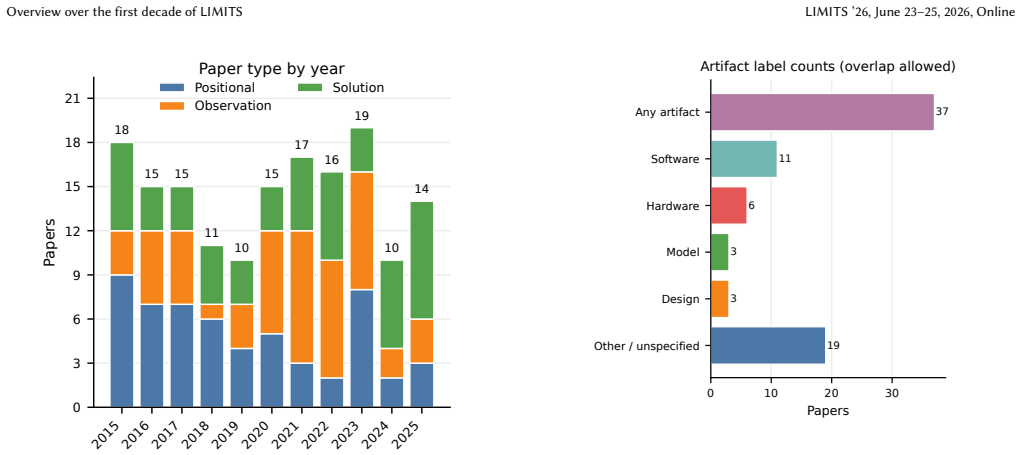
By examining 160 papers from the first decade of the LIMITS workshop the authors establish that the community has paid increasing attention to degrowth and post-growth ideas, expanded its geographic reach modestly beyond the Global North, and produced mostly positional and observational work rather than new artifacts, although solution-focused contributions have risen in recent years.
What carries the argument
A combination of programmatic analysis and manual review applied to 160 LIMITS publications to track trends against the field's core principles of questioning growth, addressing scarcity, and reducing consumption globally and over time.
If this is right
- The community can use the mapped trends to set priorities for future research that better matches core concerns.
- Continued growth in solution-oriented output could reduce the current scarcity of artifact-producing work.
- Efforts to broaden representation beyond the Global North may increase the field's relevance on a global scale.
- Rising references to degrowth and post-growth align the workshop more closely with wider ecological limits discussions.
Where Pith is reading between the lines
- The observed trends might be tested by applying the same review method to papers in related venues outside the workshop.
- Greater focus on artifact production could lead to concrete computing tools designed for scarcity conditions.
- Persistent concentration in the Global North could slow the spread of LIMITS ideas to regions facing acute resource limits.
Load-bearing premise
That the selection of 160 publications and the methods of programmatic analysis combined with manual review accurately reflect the developments in relation to the field's core concerns without significant bias in classification or coverage.
What would settle it
A re-analysis using a larger corpus of related papers outside the workshop or an alternative classification scheme that shows no rise in degrowth mentions after 2023 or no change in the share of work from beyond the Global North.
Figures

read the original abstract
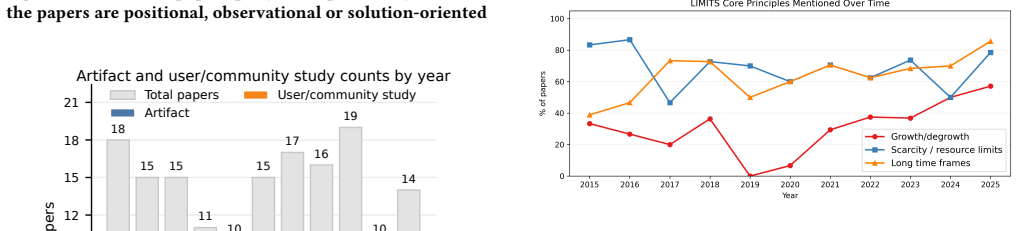
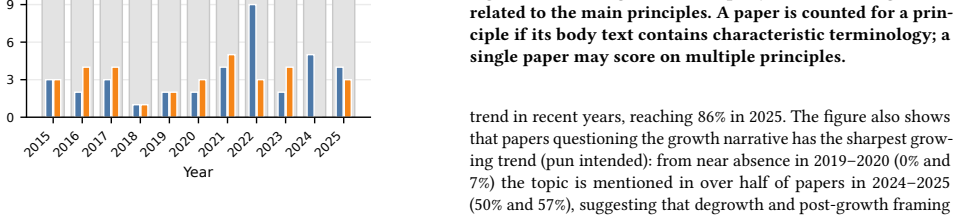
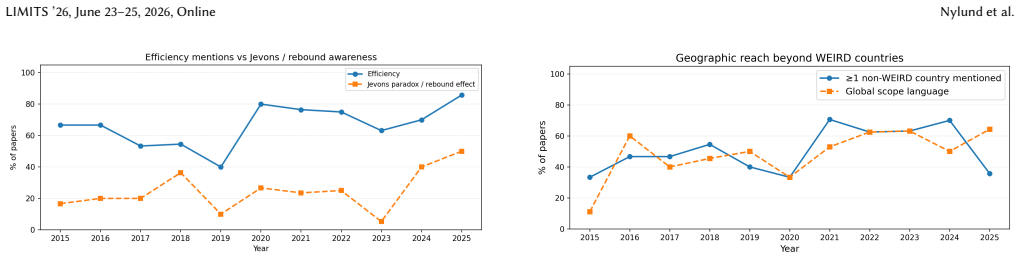
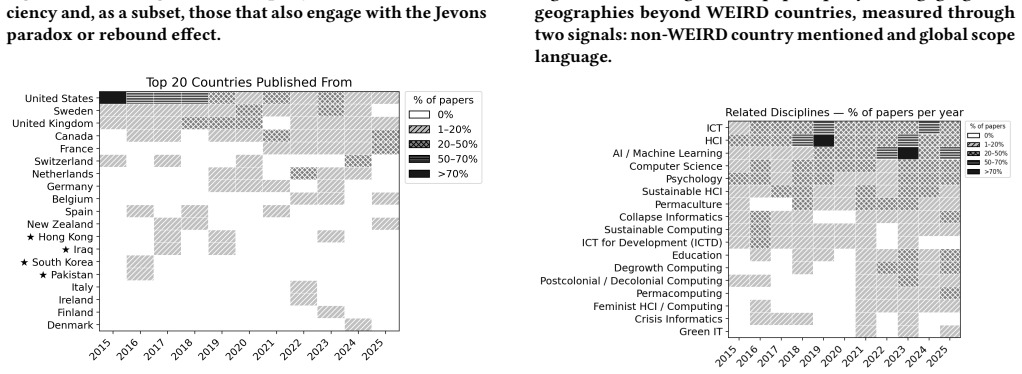
Computing within limits is a promising field, that follows principles of a) questioning endless growth narrative, b) considering and preparing for models of scarcity and c) reducing energy and material consumption, while considering d) a global spatial scale and e) long time frames. With computing's environmental impact growing and ecological limits becoming increasingly pressing, the LIMITS workshop has served as a central venue for this community since its inception in 2015, but an overview of the research published there has yet to be described. This paper addresses this gap by analyzing 160 publications from the LIMITS workshop in the period 2015 to 2025 to identify its international spread, contributions and developments in relation to field's core concerns, combining programmatic analysis with a manual review. Our findings indicate that the field has increasingly mentioned degrowth and post-growth, especially in 2024-2025. It has broadened its global perspective, with a growing, but still limited, representation of work beyond the Global North. The majority of papers are positional or observational, while artifact-producing research remains relatively scarce, though solution-oriented output has grown in recent years. This paper contributes to the LIMITS community by mapping its first decade and current trends to support future research and enhance its global impact.
Editorial analysis
A structured set of objections, weighed in public.
Referee Report
Summary. The paper analyzes 160 publications from the LIMITS workshop (2015–2025) via combined programmatic analysis and manual review to map the field's international spread, contributions, and developments relative to its core concerns (questioning growth, scarcity models, reduced consumption, global scale, long time frames). Key findings are an increase in degrowth/post-growth mentions (especially 2024–2025), broadened but still limited representation beyond the Global North, predominance of positional/observational papers with scarce artifact-producing work, and recent growth in solution-oriented output. The work positions itself as a community mapping to guide future research.
Significance. If the classification and coverage are robust, the overview provides a useful baseline for the LIMITS community by documenting temporal shifts toward degrowth themes and solution-oriented work while highlighting persistent Global-North dominance and the scarcity of artifact-producing research. This can inform priorities for broadening participation and output types. The paper does not include machine-checked proofs or parameter-free derivations, but its descriptive mapping of a decade of workshop output is a concrete contribution to field self-assessment.
major comments (3)
- [Methods] Methods section: The description of the combined programmatic analysis and manual review provides no details on classification criteria, decision rules for borderline cases, inter-rater reliability metrics, or validation procedures for assigning papers to types (positional/observational vs. artifact-producing) and themes (degrowth mentions, Global North vs. beyond). These omissions are load-bearing for the central claims on majority paper types, temporal growth in solution-oriented output, and degrowth mentions.
- [Data selection] Data selection subsection: The criteria used to arrive at exactly 160 publications, whether this constitutes complete coverage of all workshop papers, and any inclusion/exclusion rules are not stated. This directly affects the representativeness of the reported distributions and trends.
- [Findings] Findings on temporal trends (e.g., degrowth mentions in 2024–2025 and solution-oriented growth): These rest on the unvalidated manual classifications; without disclosed coding schemes or sensitivity checks, alternative reasonable classifications could alter the reported shifts.
minor comments (2)
- [Abstract/Introduction] The abstract and introduction could more explicitly define the five core principles (a–e) with citations to prior LIMITS literature for readers new to the field.
- [Results] Figure or table presenting the 160-paper breakdown by year, type, and theme would improve readability of the quantitative trends.
Simulated Author's Rebuttal
We thank the referee for their constructive comments, which identify key areas for improving transparency in our methods and data handling. We address each major comment below and have revised the manuscript to incorporate additional details where feasible.
read point-by-point responses
-
Referee: [Methods] Methods section: The description of the combined programmatic analysis and manual review provides no details on classification criteria, decision rules for borderline cases, inter-rater reliability metrics, or validation procedures for assigning papers to types (positional/observational vs. artifact-producing) and themes (degrowth mentions, Global North vs. beyond). These omissions are load-bearing for the central claims on majority paper types, temporal growth in solution-oriented output, and degrowth mentions.
Authors: We agree that greater detail on the classification process is needed. In the revised manuscript, we will expand the methods section to explicitly describe the criteria for assigning papers to types (positional/observational vs. artifact-producing) and themes (including degrowth mentions and geographic scope), along with decision rules for borderline cases. These were resolved through iterative discussion among the authors. As the review was performed by the core author team rather than independent raters, formal inter-rater reliability metrics were not computed; we will instead document the collaborative validation steps taken. This will directly support the robustness of the reported distributions and trends. revision: yes
-
Referee: [Data selection] Data selection subsection: The criteria used to arrive at exactly 160 publications, whether this constitutes complete coverage of all workshop papers, and any inclusion/exclusion rules are not stated. This directly affects the representativeness of the reported distributions and trends.
Authors: The original manuscript indicates analysis of 160 publications from the 2015–2025 LIMITS workshops but does not detail the selection process. We will add a dedicated data selection subsection explaining the sources used to compile the list (workshop proceedings and archives), confirmation that this represents the complete set of available publications meeting the scope, and any inclusion/exclusion rules applied (e.g., focusing on peer-reviewed or presented papers). This addition will clarify representativeness. revision: yes
-
Referee: [Findings] Findings on temporal trends (e.g., degrowth mentions in 2024–2025 and solution-oriented growth): These rest on the unvalidated manual classifications; without disclosed coding schemes or sensitivity checks, alternative reasonable classifications could alter the reported shifts.
Authors: The expanded methods section (addressing the first comment) will include the full coding schemes and decision rules, enabling readers to evaluate the classifications independently. We did not conduct formal sensitivity analyses on alternative codings, as the classifications were developed iteratively with author consensus; however, the added transparency will allow assessment of potential shifts. We believe this sufficiently addresses the concern without requiring new empirical checks. revision: partial
Circularity Check
No circularity: purely descriptive literature mapping with no derivations or fitted predictions
full rationale
The paper performs a descriptive overview of 160 LIMITS workshop publications via programmatic analysis plus manual review. It reports observed trends (degrowth mentions, Global North vs. beyond representation, positional/observational vs. artifact-producing papers) without any mathematical derivations, parameter fitting, predictions, or uniqueness theorems. No load-bearing steps reduce to self-definition, self-citation chains, or renaming of inputs as outputs. The analysis is self-contained against external benchmarks as a standard literature survey; classification choices affect validity but do not create circularity by construction.
Axiom & Free-Parameter Ledger
Reference graph
Works this paper leans on
-
[1]
2008–2025. GROBID. https://github.com/kermitt2/grobid. swh:1:dir:dab86b296e3c3216e2241968f0d63b68e8209d3c
2008
-
[2]
Anaëlle Beignon, Thomas Thibault, and Nolwenn Maudet. 2025. Imposing AI: Deceptive design patterns against sustainability. InProceedings of the Eleventh Workshop on Computing within Limits. ACM. doi:10.48550/arXiv.2409.07471
-
[3]
Christian Bogmans, Ganchimeg Ganpurev, Patricia Gomez-Gonzalez, Giovanni Melina, Andrea Pescatori, and Sneha Thube. 2026. Power hungry: How ai will drive energy demand.Energy Economics(2026), 109278
2026
-
[5]
2020.Design justice: Community-led practices to build the worlds we need
Sasha Costanza-Chock. 2020.Design justice: Community-led practices to build the worlds we need. MIT press
2020
-
[8]
David Franquesa and Leandro Navarro. 2018. Devices as a Commons: limits to premature recycling. InProceedings of the Fourth Workshop on Computing within Limits. ACM. doi:10.1145/nnnnnnn.nnnnnnn
-
[9]
Margarita Grinko, Tanja Ertl, Konstantin Aal, and Volker Wulf. 2021. Transitions by methodology in human-wildlife conflict-reflections on tech-based reorganiza- tion of social practices.Proceedings of the LIMITS21 (2021)
2021
-
[10]
mores", counter the
Xinning Gui and Bonnie Nardi. 2015. Foster the" mores", counter the" limits". First Monday(2015)
2015
-
[12]
David G Hendry. 2021. Transition Discourse, Food, and Computing within Limits. InSeventh Workshop on Computing within Limits 2021. LIMITS
2021
-
[13]
Joseph Henrich, Steven J. Heine, and Ara Norenzayan. 2010. The Weirdest People in the World?Behavioral and Brain Sciences33, 2-3 (June 2010), 61–83. doi:10.1017/S0140525X0999152X
-
[14]
Lara Houston and Cassie Thornton. 2022. The Richness of Designing for Eco- Social Change Creative Practice, Transformative Futures and Living within Limits. InProceedings of the Eighth Workshop on Computing within Limits. ACM. doi:10. 5210/fm.v21i5.6637
2022
-
[15]
Nidhal Jegham, Marwan Abdelatti, Chan Young Koh, Lassad Elmoubarki, and Abdeltawab Hendawi. 2025. How hungry is AI? Benchmarking energy, water, and carbon footprint of LLM inference.arXiv preprint arXiv:2505.09598(2025). Overview over the first decade of LIMITS LIMITS ’26, June 23–25, 2026, Online
-
[17]
Petra Jääskeläinen. 2022. On the environmental sustainability of Ai art(s). In Proceedings of the Eighth Workshop on Computing within Limits. ACM. doi:10. 1007/BF01405730
2022
-
[19]
Alexandra Sasha Luccioni, Emma Strubell, and Kate Crawford. 2025. From efficiency gains to rebound effects: The problem of jevons’ paradox in AI’s polarized environmental debate. InProceedings of the 2025 ACM conference on fairness, accountability, and transparency. 76–88
2025
-
[20]
Stephen Makonin, Laura U Marks, Radek Przedpełski, Alejandro Rodriguez-Silva, and Ramy ElMallah. 2022. Calculating the carbon footprint of streaming media: Beyond the myth of efficiency. InEighth workshop on computing within limits
2022
-
[22]
Jahaziel Osei Mensah and Aimee Van Wynsberghe. 2025. Where are the missing values: an exploration of the need to incorporate Ubuntu values into African AI policy.AI and Ethics5, 4 (2025), 4365–4375
2025
-
[23]
Bonnie Nardi, Bill Tomlinson, Donald J Patterson, Jay Chen, Daniel Pargman, Barath Raghavan, and Birgit Penzenstadler. 2018. Computing within limits. Commun. ACM61, 10 (2018), 86–93
2018
-
[24]
Greg Nelson. 2024. Towards symbiotic university-adjacent edge spaces for sustainability transitions and computing: a design imaginary with some material and financial feasibility. InProceedings of the Tenth Workshop on Computing within Limits. ACM. doi:10.1007/s13412-012-0086-8
-
[25]
Elisabet Nilsson, Rikke Jensen, Anne-Marie Hansen, Tilde Bekker, Daisy Yoo, Eva Eriksson, and Hagensby Jensen. 2024. What do we Teach when Teaching More- than-human Perspectives in Computing and Technology Design Education? -An Emerging Pedagogical Framework. InProceedings of the Tenth Workshop on Computing within Limits. ACM. doi:10.1145/3385010.3385016
-
[26]
Juliet Norton, Birgit Penzenstadler, Samantha McDonald, Emily Kang, Nora Koirala, Rieko Konishi, Gabriela Pena Carmona, Jainee Shah, Sebastian Troncoso, and Bill Tomlinson. 2019. The SAGE community coordinator: A demonstration. InProceedings of the Fifth Workshop on Computing within Limits. 1–10
2019
-
[27]
Sofie Nyström, Cecilia Katzeff, Miriam Börjesson, Rivera Arjun, Rajendran Menon, Miriam Rivera, Arjun Menon, and Björn Hedin. 2021. Challenging the image of the altruistic and flexible household in the smart grid using design fiction. In Proceedings of the Seventh Workshop on Computing within Limits. ACM. doi:10. 1016/j.eist.2020.11.002
2021
-
[28]
Barath Raghavan. 2015. Abstraction, Indirection, and Sevareid’s Law: Towards Benign Computing. InProceedings of the First Workshop on Computing within Limits. ACM
2015
-
[29]
Barath Raghavan and Daniel Pargman. 2016. Refactoring Society: Systems Com- plexity in an Age of Limits. InProceedings of the Second Workshop on Computing within Limits. ACM. doi:10.1145/2926676.2926677
- [30]
-
[31]
William J Ripple, Christopher Wolf, Michael E Mann, Johan Rockström, Jillian W Gregg, Chi Xu, Nico Wunderling, Sarah E Perkins-Kirkpatrick, Roberto Schaeffer, Wendy J Broadgate, et al. 2025. The 2025 state of the climate report: a planet on the brink
2025
-
[32]
Dmitry Scherbakov, Nina Hubig, Vinita Jansari, Alexander Bakumenko, and Leslie A Lenert. 2025. The Emergence of Large Language Models as Tools in Literature Reviews: A Large Language Model-Assisted Systematic Review. Journal of the American Medical Informatics Association32, 6 (June 2025), 1071–
2025
-
[33]
doi:10.1093/jamia/ocaf063
-
[34]
Paul Schmitt and Elizabeth Belding. 2017. Low On Air: Inherent Wireless Channel Capacity Limitations. InProceedings of the Third Workshop on Computing within Limits. ACM. doi:10.1145/3080556.3080558
-
[35]
Roy Schwartz, Jesse Dodge, Noah A Smith, and Oren Etzioni. 2020. Green ai. Commun. ACM63, 12 (2020), 54–63
2020
-
[37]
M Six Silberman. 2023. Information systems practice for the age of consequences. (2023)
2023
-
[38]
Brian Sutherland. 2022. Strategies for degrowth computing. InEighth Workshop on Computing within Limits, Vol. 6. LIMITS
2022
-
[40]
Roberto Verdecchia, June Sallou, and Luís Cruz. 2023. A systematic review of Green AI.WIREs Data Mining and Knowledge Discovery13, 4 (2023), e1507. arXiv:https://wires.onlinelibrary.wiley.com/doi/pdf/10.1002/widm.1507 doi:10. 1002/widm.1507
-
[41]
Huaxin Wei, Jeffrey CF Ho, Kenny KN Chow, Shunying An Blevis, and Eli Blevis
-
[42]
InProceedings of the Fifth Workshop on Computing Within Limits
Should do, can do, can know: Sustainability and other reflections on one hundred and one interaction design projects. InProceedings of the Fifth Workshop on Computing Within Limits. 1–18
-
[43]
Workshop on Computing within Limits. 2017. ACM LIMITS 2017: Third Work- shop on Computing within Limits. https://computingwithinlimits.org/2017/. Santa Barbara, CA, USA, 22–24 June 2017. Accessed: 2026-05-19
2017
-
[44]
Workshop on Computing within Limits. 2018. LIMITS 2018: Fourth Workshop on Computing within Limits. https://computingwithinlimits.org/2018/. Toronto, Canada, 13–14 May 2018. Accessed: 2026-05-19
2018
-
[45]
Workshop on Computing within Limits. 2019. LIMITS 2019: Fifth Workshop on Computing within Limits. https://computingwithinlimits.org/2019/. Lappeen- ranta, Finland, 10–11 June 2019. Accessed: 2026-05-19
2019
-
[46]
Workshop on Computing within Limits. 2020. LIMITS 2020: Sixth Workshop on Computing within Limits. https://computingwithinlimits.org/2020/. Virtual workshop, 21–22 June 2020. Accessed: 2026-05-19
2020
-
[47]
Workshop on Computing within Limits. 2021. LIMITS 2021: Seventh Workshop on Computing within Limits. https://computingwithinlimits.org/2021/. Virtual, distributed workshop, 14–15 June 2021. Accessed: 2026-05-19
2021
-
[48]
Workshop on Computing within Limits. 2022. LIMITS 2022: Eighth Workshop on Computing within Limits. https://computingwithinlimits.org/2022/. Virtual, distributed workshop, 21–22 June 2022. Accessed: 2026-05-19
2022
-
[49]
Workshop on Computing within Limits. 2023. LIMITS 2023: Ninth Workshop on Computing within Limits. https://computingwithinlimits.org/2023/. Online workshop, 14–15 June 2023. Accessed: 2026-05-19
2023
-
[50]
Workshop on Computing within Limits. 2024. LIMITS 2024: 10th Workshop on Computing within Limits. https://computingwithinlimits.org/2024/. Online workshop, 18–19 June 2024. Accessed: 2026-05-19
2024
-
[51]
Workshop on Computing within Limits. 2025. LIMITS 2025: 11th Workshop on Computing within Limits. https://computingwithinlimits.org/2025/. Online workshop, 26–27 June 2025. Accessed: 2026-05-19. Papers included in the review Note: Out of 162 papers published in the LIMITS workshop, we included 160 papers in our review. Two papers were excluded because the...
2025
-
[53]
Syed Ishtiaque Ahmed, Nova Ahmed, Faheem Hussain, and Neha Kumar
-
[54]
InProceedings of the Second Workshop on Computing within Limits
Computing beyond Gender-Imposed Limits. InProceedings of the Second Workshop on Computing within Limits. ACM, Irvine California, 1–7. doi:10.1145/2926676.2926681
-
[55]
Lorenzo Angeli, Özge Okur, Carlo Corradini, Marcel Stolin, Yilin Huang, Frances Brazier, and Maurizio Marchese. 2022. Conceptualising Resources-aware Higher Education DigitalInfrastructure through Self-hosting: A Multi-disciplinary View. InEighth Workshop on Computing within Limits 2022. LIMITS. doi:10.21428/ bf6fb269.8b989f2c
2022
-
[56]
Oliver Bates and Adrian Friday. 2018. Intangible Commodities with Free De- livery: Finding the Limit in Digitally Mediated e-Commerce and Workforce Injustice.. InProceedings of the 2018 Workshop on Computing within Limits. ACM, Toronto Ontario Canada, 1–8. doi:10.1145/3232617.3232622
-
[57]
Oliver Bates and Ben Kirman. [n. d.]. Sustainable Pla-orm Coopera3vism. ([n. d.])
-
[59]
Oliver Bates, Christian Remy, and Kieran Cutting. 2024. Exploring Post- Neoliberal Futures for Managing Commercial Heating and Cooling through Speculative Praxis. (2024)
2024
-
[61]
Anaëlle Beignon, Thomas Thibault, and Nolwenn Maudet. 2025. Imposing AI: Deceptive Design Patterns against Sustainability. (2025)
2025
-
[63]
Eshta Bhardwaj, Han Qiao, and Christoph Becker. 2024. Limits at a Distance: De- sign Directions to Address Psychological Distance in Policy Decisions Affecting Planetary Boundaries. (2024)
2024
-
[64]
Shunying An Blevi, Maryam Heidaripour, Shaowen Bardzell, and Eli Blevis
-
[65]
Advancing Non-Linear Design Thinking.LIMITS(2023)
2023
-
[66]
Eli Blevis, Chris Preist, Daniel Schien, and Priscilla Ho. 2017. Further Connecting Sustainable Interaction Design with Sustainable Digital Infrastructure Design. InProceedings of the 2017 Workshop on Computing Within Limits. ACM, Santa Barbara California USA, 71–83. doi:10.1145/3080556.3080568
-
[67]
Inès Moreno Boluda, Elizabeth Patitsas, and Peter McMahan. 2021. What Do Computer Scientists Know About Conflict Minerals?LIMITS Workshop on Computing within Limits(June 2021). doi:10.21428/bf6fb269.64063bd7
-
[68]
Nils Bonfils. 2025. An Empirical Inquiry into Surveillance Capitalism: Web Tracking. (2025)
2025
-
[69]
Alan Borning, Batya Friedman, and Deric Gruen. 2018. What Pushes Back from Considering Materiality in IT?. InProceedings of the 2018 Workshop on Computing within Limits. ACM, Toronto Ontario Canada, 1–6. doi:10.1145/3232617.3232627
-
[71]
Tega Brain, Alex Nathanson, and Benedetta Piantella. 2022. Solar protocol: Exploring energy-centered design. InEighth Workshop on Computing within Limits 2022. LIMITS
2022
-
[72]
Christina Bremer, Christian Remy, and Adrian Friday. 2024. Fake Data Leads to Fake Insights: The Challenges of Prototyping Energy Dashboards. (2024)
2024
-
[73]
John Brock and Donald J. Patterson. 2015. Cacophony: Building a Resilient Internet of Things.First Monday(July 2015). doi:10.5210/fm.v20i8.6130
-
[74]
Aurélie Bugeau and Anne-Laure Ligozat. 2024. How Digital Will the Future Be? Analysis of Prospective Scenarios. (2024)
2024
-
[75]
Edward Burnell. 2018. Design for Survivability: A Participatory Design Fiction Approach to Sustainability. InProceedings of the 2018 Workshop on Computing within Limits. ACM, Toronto Ontario Canada, 1–4. doi:10.1145/3232617.3232628
-
[76]
Simon Castellan, Jos Käfer, and Eric Tannier. 2023. Back to the Trees: Identifying Plants with Human Intelligence. InNinth Computing within Limits 2023. LIMITS, Virtual. doi:10.21428/bf6fb269.265c52ce
-
[77]
Teresa Cerratto Pargman and Somya Joshi. 2015. Understanding Limits from a Social Ecological Perspective.First Monday(July 2015). doi:10.5210/fm.v20i8. 6125
-
[78]
Jay Chen. 2015. Computing within Limits and ICTD.First Monday(July 2015). doi:10.5210/fm.v20i8.6124
-
[79]
Jay Chen. 2016. A Strategy for Limits-Aware Computing. InProceedings of the Second Workshop on Computing within Limits. ACM, Irvine California, 1–6. doi:10.1145/2926676.2926692
-
[81]
Rob Comber and Elina Eriksson. 2023. Computing as Ecocide. InNinth Comput- ing within Limits 2023. LIMITS, Virtual. doi:10.21428/bf6fb269.9fcdd0c0
-
[82]
Sarah Cooney. 2023. Imagining LIMITS: Can ChatGPT Radically Re-Imagine a New World?. InNinth Computing within Limits 2023. LIMITS, Virtual. doi:10. 21428/bf6fb269.dc071e80
2023
-
[83]
Sarah Cooney, Vishal Sharma, Joshua Palmer, Neha Kumar, and Barath Raghavan
-
[84]
InEighth Workshop on Computing within Limits 2022
Alternative Pathways to Caring for Limits:The Case of Ecospirituality. InEighth Workshop on Computing within Limits 2022. LIMITS. doi:10.21428/ bf6fb269.8bd78035
2022
-
[86]
Marloes De Valk. 2021. A Pluriverse of Local Worlds: A Review of Comput- ing within Limits Related Terminology and Practices.LIMITS Workshop on Computing within Limits(June 2021). doi:10.21428/bf6fb269.1e37d8be
-
[87]
Martin Deron. [n. d.]. Sprouting Technology Otherwise, Hospicing Negative Commons. ([n. d.])
-
[89]
Richard P Donovan. [n. d.]. What to Do with All These Bits? ([n. d.])
-
[90]
Callum Egan, Andrew O’Dowd, and Neil Fyffe. 2020. Hasten Slowly: Devel- oping an Interactive Sustainability Storytelling Chair. InProceedings of the 7th International Conference on ICT for Sustainability. ACM, Bristol United Kingdom, 321–329. doi:10.1145/3401335.3401817
-
[91]
Callum Egan, Richard Thompson, and Andrew O’Dowd. 2019. The Lions’ Gate: Towards a Permaculture-inspired Blended Space. InProceedings of the Fifth Workshop on Computing within Limits. ACM, Lappeenranta Finland, 1–8. doi:10.1145/3338103.3338110
-
[92]
Elina Eriksson and Daniel Pargman. 2018. Meeting the Future in the Past - Using Counterfactual History to Imagine Computing Futures. InProceedings of the 2018 Workshop on Computing within Limits. ACM, Toronto Ontario Canada, 1–8. doi:10.1145/3232617.3232621
-
[93]
Elina Eriksson and Daniel Pargman. 2023. Exploring Inner Transition: Expand- ing Computing forSustainability. InNinth Computing within Limits 2023. LIMITS, Virtual. doi:10.21428/bf6fb269.22dea4ad
-
[94]
Ylva Fernaeus and Andreas Lindegren. 2023. Celebration of Finitude as a Post- Industrial Aesthetics of Interaction. InNinth Computing within Limits 2023. LIMITS, Virtual. doi:10.21428/bf6fb269.cf43f46a
-
[95]
David Franquesa and Leandro Navarro. 2018. Devices as a Commons: Limits to Premature Recycling. InProceedings of the 2018 Workshop on Computing within Limits. ACM, Toronto Ontario Canada, 1–10. doi:10.1145/3232617.3232624
-
[96]
David Franquesa, Leandro Navarro, and Xavier Bustamante. 2016. A Circular Commons for Digital Devices: Tools and Services in Ereuse.Org. InProceedings of the Second Workshop on Computing within Limits. ACM, Irvine California, 1–9. doi:10.1145/2926676.2926684
-
[97]
Valentin Girard and Antoine Martin. 2025. A Protocol to Address Ecological Redirection for Digital Practices in Organizations. (2025)
2025
discussion (0)
Sign in with ORCID, Apple, or X to comment. Anyone can read and Pith papers without signing in.