Refining Word-Based Grammatical Error Annotation for L2 Korean
Pith reviewed 2026-06-29 07:22 UTC · model grok-4.3
The pith
Refined word-level m2 annotations and multi-reference targets improve Korean grammatical error correction by matching morphology and reducing single-reference penalties.
A machine-rendered reading of the paper's core claim, the machinery that carries it, and where it could break.
Core claim
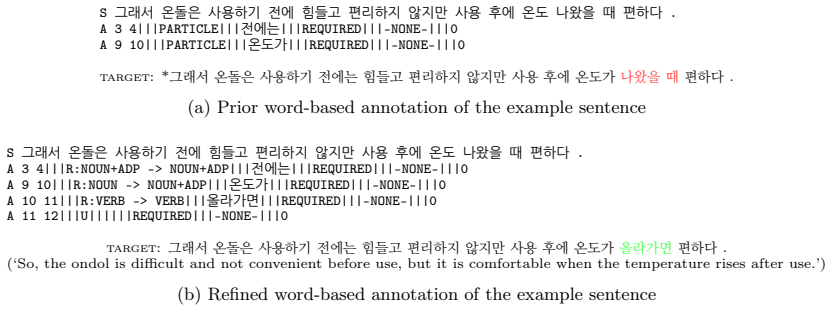
Reconstructing NIKL targets under morphologically constrained realization rules, converting morpheme annotations to word-level m2 edits via a Korean ERRANT-style scheme that distinguishes functional morpheme errors, spelling errors, word boundary errors, and word order errors, and augmenting KoLLA with a second reference yields lower perplexity, higher edit agreement, improved KoBART performance under fixed model settings, and reduced penalties for valid corrections that differ from a single reference.
What carries the argument
The Korean ERRANT-style annotation scheme that preserves the MRU core while distinguishing functional morpheme errors, spelling errors, word boundary errors, and word order errors, together with the morphologically constrained reconstruction of NIKL targets.
If this is right
- Refined NIKL targets produce lower perplexity than the original corpus targets.
- The converted m2 files achieve higher agreement with direct source-target edit representations.
- The refined resources raise KoBART-based correction performance under identical model settings.
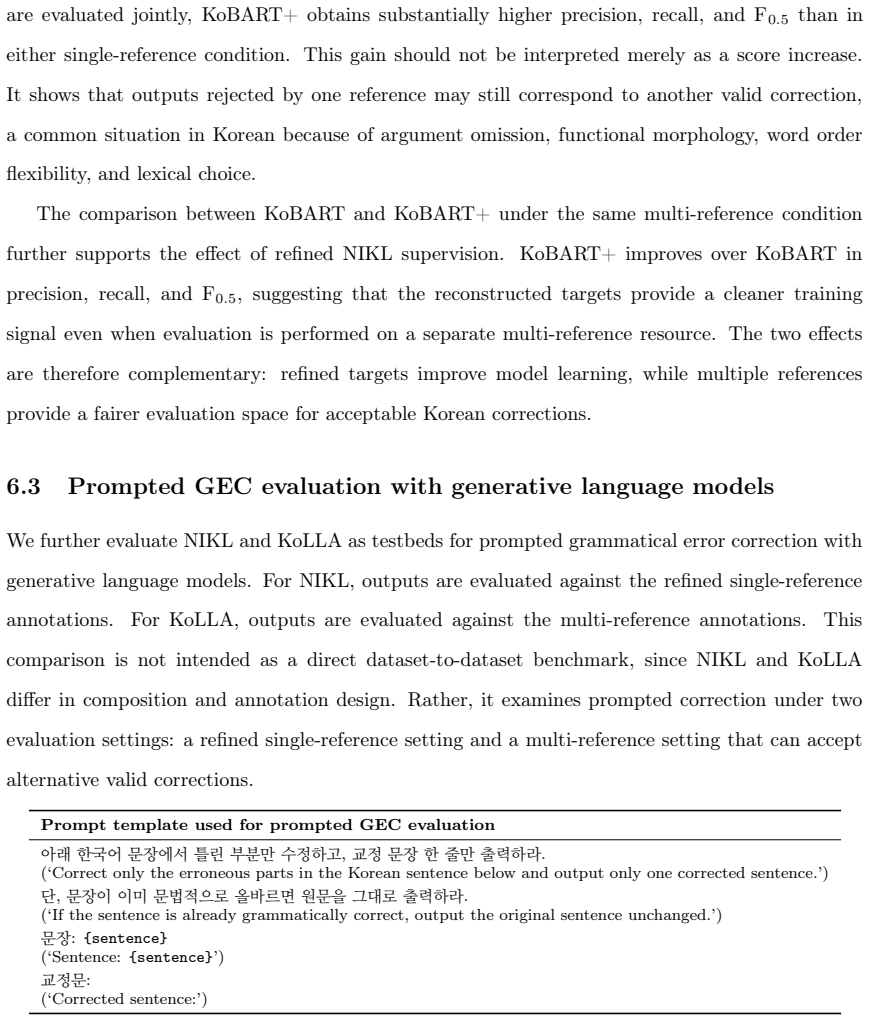
- Multi-reference evaluation on the augmented KoLLA corpus lowers the penalty assigned to valid corrections that diverge from a single reference.
Where Pith is reading between the lines
- The same reconstruction-plus-conversion pipeline could reduce evaluation noise in other languages where grammatical morphemes attach to lexical hosts.
- Multi-reference scoring may become standard for GEC tasks that exhibit high correction variability across native speakers.
- Explicit tagging of word-boundary and spacing errors may help models handle spacing-sensitive phenomena that current word-tokenizers treat as secondary.
Load-bearing premise
The morphologically constrained realization rules used to reconstruct target sentences from the NIKL corpus accurately represent the intended corrections without introducing new errors or biases.
What would settle it
A side-by-side check that shows the reconstructed NIKL targets contain more unintended changes than the original annotations, or that KoBART performance stays the same or drops when trained on the converted m2 files.
Figures


read the original abstract
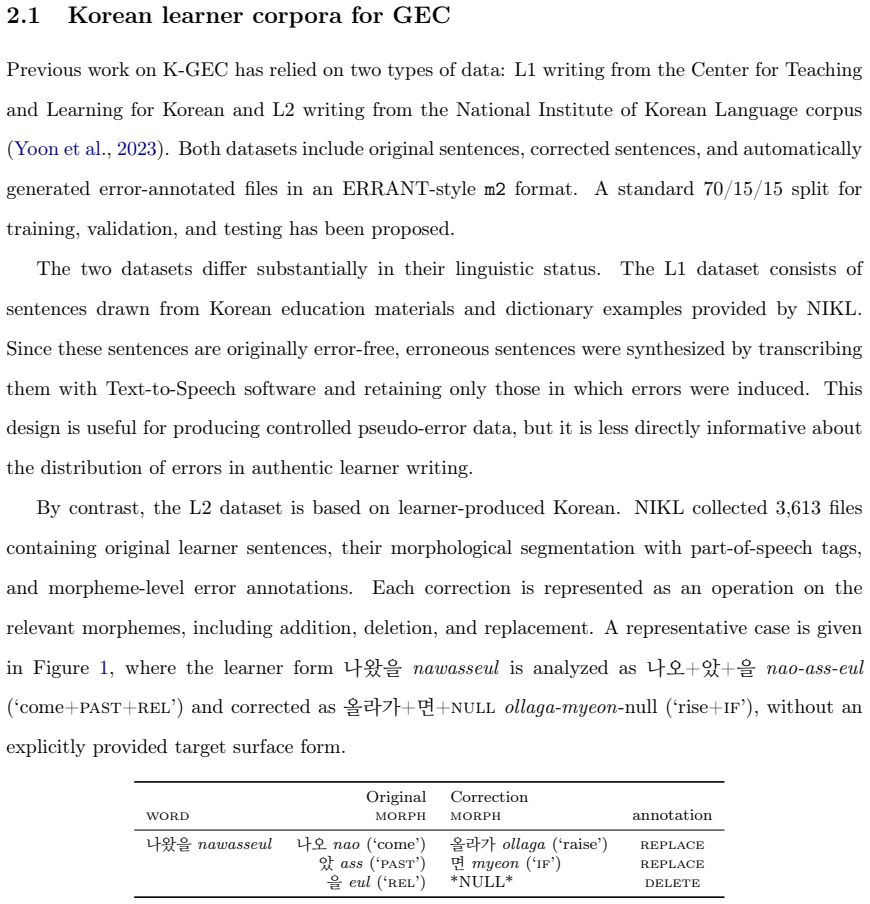
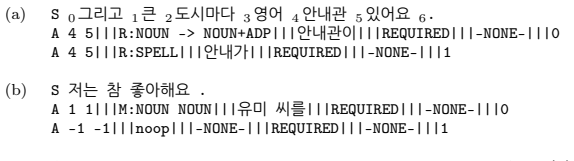
Korean grammatical error correction (K-GEC) presents a structural mismatch between word-based evaluation and the morpheme-level locus of many learner errors. Postpositions and verbal endings are bound to lexical hosts, but they encode grammatical relations that must be represented in correction and evaluation. This paper refines word-based grammatical error annotation for L2 Korean by addressing three connected problems in existing resources: surface target realization, Korean-specific edit annotation, and single-reference evaluation. We reconstruct target sentences from the National Institute of Korean Language (NIKL) L2 corpus under morphologically constrained realization rules and convert its morpheme-level annotations into word-level \texttt{m2} edits. We then define a Korean ERRANT-style annotation scheme that preserves the MRU core while distinguishing functional morpheme errors, spelling errors, word boundary errors, and word order errors. We also augment the KoLLA corpus with an additional reference correction, yielding a multi-reference evaluation setting for Korean GEC. Empirical validation shows that the refined NIKL targets yield lower perplexity, the converted \texttt{m2} files achieve higher agreement with source-target edit representations, and the refined resources improve KoBART-based correction under the same model setting. Multi-reference KoLLA evaluation further reduces the penalty imposed on valid corrections that diverge from a single reference, especially for neural and prompted GEC systems. These results show that Korean GEC evaluation depends not only on correction models, but also on reference data and edit annotations that reflect Korean morphology, spacing, and correction variability.
Editorial analysis
A structured set of objections, weighed in public.
Referee Report
Summary. The manuscript refines word-based grammatical error annotation for L2 Korean to address mismatches with morpheme-level errors. It reconstructs target sentences from the NIKL L2 corpus using morphologically constrained realization rules, converts morpheme annotations to word-level m2 edits via a Korean ERRANT-style scheme that distinguishes functional morpheme, spelling, boundary, and order errors, and augments the KoLLA corpus with a second reference for multi-reference evaluation. Empirical claims include lower perplexity on refined NIKL targets, higher agreement of converted m2 files with source-target edits, improved KoBART correction performance, and reduced penalties for valid but divergent corrections under multi-reference evaluation.
Significance. If the central claims hold, the work provides useful language-specific resources and evaluation practices for Korean GEC, where morphology, spacing, and postpositions create distinct challenges not well served by direct transfer of English-centric tools. The multi-reference augmentation is a clear strength, as it directly mitigates single-reference bias. The paper earns credit for grounding refinements in Korean linguistic properties rather than generic annotation conversion.
major comments (2)
- [Abstract] Abstract and reconstruction paragraph: the central empirical claims (lower perplexity, higher m2 agreement, improved KoBART results) rest on the morphologically constrained realization rules converting NIKL morpheme annotations into word-level targets. No coverage statistics, derivation of the rules, or fidelity check against original annotator intent is supplied; systematic bias in spacing, postposition attachment, or verbal endings would artifactually inflate the reported gains.
- [Results] Results section: the abstract states that refined targets yield lower perplexity and higher agreement, yet supplies no numerical values, baselines, error bars, or full experimental setup details. Without these, the magnitude and reliability of the improvements cannot be assessed.
minor comments (1)
- [Section 3] The description of the Korean ERRANT-style scheme would benefit from an explicit table contrasting the new categories (functional morpheme errors, word boundary errors) with standard ERRANT labels.
Simulated Author's Rebuttal
We thank the referee for the constructive comments highlighting the need for greater transparency in our methodology and results. We agree that the current presentation lacks sufficient detail on the realization rules and experimental outcomes, and we will revise the manuscript to address these gaps directly.
read point-by-point responses
-
Referee: [Abstract] Abstract and reconstruction paragraph: the central empirical claims (lower perplexity, higher m2 agreement, improved KoBART results) rest on the morphologically constrained realization rules converting NIKL morpheme annotations into word-level targets. No coverage statistics, derivation of the rules, or fidelity check against original annotator intent is supplied; systematic bias in spacing, postposition attachment, or verbal endings would artifactually inflate the reported gains.
Authors: We agree that the abstract and reconstruction paragraph do not supply coverage statistics, a derivation of the rules, or a fidelity check. In the revised manuscript we will add an expanded methods subsection that (1) lists the full set of morphologically constrained realization rules with their linguistic motivation drawn from Korean grammar, (2) reports coverage statistics on the NIKL corpus (percentage of annotations converted without manual intervention), and (3) presents a fidelity analysis comparing reconstructed targets against the original annotator intent to demonstrate absence of systematic bias in spacing, postposition attachment, or verbal endings. revision: yes
-
Referee: [Results] Results section: the abstract states that refined targets yield lower perplexity and higher agreement, yet supplies no numerical values, baselines, error bars, or full experimental setup details. Without these, the magnitude and reliability of the improvements cannot be assessed.
Authors: We acknowledge that the results section currently describes improvements only qualitatively and omits numerical values, baselines, error bars, and full experimental details. In the revision we will insert the concrete metrics (perplexity scores with baselines, m2 agreement percentages, KoBART F1/accuracy figures), include error bars or confidence intervals where appropriate, and provide the complete experimental setup (hyperparameters, data splits, evaluation scripts) so that the magnitude and reliability of the reported gains can be assessed. revision: yes
Circularity Check
No significant circularity; annotation conversion and empirical validation are self-contained
full rationale
The paper performs corpus refinement by converting morpheme-level NIKL annotations to word-level m2 edits via externally defined realization rules, augments KoLLA with an additional reference, and reports empirical metrics (perplexity, agreement, model performance) on the resulting resources. No equations, fitted parameters, or predictions appear; the central claims rest on external corpora and standard evaluation protocols rather than any self-definitional loop, fitted-input renaming, or load-bearing self-citation chain. The reconstruction rules are presented as a methodological choice without internal derivation that reduces to the reported outcomes by construction.
Axiom & Free-Parameter Ledger
Reference graph
Works this paper leans on
-
[1]
Automatic annotation of error types for grammatical error correction
Christopher Bryant. Automatic annotation of error types for grammatical error correction . PhD thesis, University of Cambridge, Churchill College, Cambridge, UK, 2019. URL https://doi.org/10.17863/CAM.40832
-
[2]
Automatic Annotation and Evaluation of Error Types for Grammatical Error Correction
Christopher Bryant, Mariano Felice, and Ted Briscoe. Automatic Annotation and Evaluation of Error Types for Grammatical Error Correction . In Regina Barzilay and Min-Yen Kan, editors, Proceedings of the 55th Annual Meeting of the Association for Computational Linguistics (Volume 1: Long Papers), pages 793--805, Vancouver, Canada, 7 2017. Association for C...
-
[3]
Better Evaluation for Grammatical Error Correction
Daniel Dahlmeier and Hwee Tou Ng. Better Evaluation for Grammatical Error Correction . In Eric Fosler-Lussier, Ellen Riloff, and Srinivas Bangalore, editors, Proceedings of the 2012 Conference of the North American Chapter of the Association for Computational Linguistics: Human Language Technologies, pages 568--572, Montr \' e al, Canada, 6 2012. Associat...
2012
-
[4]
Helping Our Own: The HOO 2011 Pilot Shared Task
Robert Dale and Adam Kilgarriff. Helping Our Own: The HOO 2011 Pilot Shared Task . In Claire Gardent and Kristina Striegnitz, editors, Proceedings of the 13th European Workshop on Natural Language Generation, pages 242--249, Nancy, France, 9 2011. Association for Computational Linguistics. URL https://aclanthology.org/W11-2838/
2011
-
[5]
Building a Korean Web Corpus for Analyzing Learner Language
Markus Dickinson, Ross Israel, and Sun-Hee Lee. Building a Korean Web Corpus for Analyzing Learner Language . In Proceedings of the 6th Workshop on the Web as Corpus (WAC-6), pages 8--16, Los Angeles, 2010. URL http://jones.ling.indiana.edu/ mdickinson/papers/dickinson-israel-lee10.html
2010
-
[6]
Towards a standard evaluation method for grammatical error detection and correction
Mariano Felice and Ted Briscoe. Towards a standard evaluation method for grammatical error detection and correction . In Rada Mihalcea, Joyce Chai, and Anoop Sarkar, editors, Proceedings of the 2015 Conference of the North American Chapter of the Association for Computational Linguistics: Human Language Technologies, pages 578--587, Denver, Colorado, 2015...
-
[7]
Improving Automatic Grammatical Error Annotation for Chinese Through Linguistically-Informed Error Typology
Yang Gu, Zihao Huang, Min Zeng, Mengyang Qiu, and Jungyeul Park. Improving Automatic Grammatical Error Annotation for Chinese Through Linguistically-Informed Error Typology . In Owen Rambow, Leo Wanner, Marianna Apidianaki, Hend Al-Khalifa, Barbara Di Eugenio, and Steven Schockaert, editors, Proceedings of the 31st International Conference on Computationa...
2025
-
[8]
Developing Learner Corpus Annotation for Korean Particle Errors
Sun-Hee Lee, Markus Dickinson, and Ross Israel. Developing Learner Corpus Annotation for Korean Particle Errors . In Proceedings of the Sixth Linguistic Annotation Workshop, pages 129--133, Jeju, Republic of Korea, 2012. Association for Computational Linguistics. URL http://www.aclweb.org/anthology/W12-3617
2012
-
[9]
The MultiGEC-2025 Shared Task on Multilingual Grammatical Error Correction at NLP4CALL
Arianna Masciolini, Andrew Caines, Orphée De Clercq, Joni Kruijsbergen, Murathan Kurfal i, Ricardo Mu \ n oz S \' a nchez, Elena Volodina, and Robert \" O stling. The MultiGEC-2025 Shared Task on Multilingual Grammatical Error Correction at NLP4CALL . In Ricardo Mu \ n oz S \' a nchez, David Alfter, Elena Volodina, and Jelena Kallas, editors, Proceedings ...
2025
-
[10]
Ground Truth for Grammatical Error Correction Metrics
Courtney Napoles, Keisuke Sakaguchi, Matt Post, and Joel Tetreault. Ground Truth for Grammatical Error Correction Metrics . In Chengqing Zong and Michael Strube, editors, Proceedings of the 53rd Annual Meeting of the Association for Computational Linguistics and the 7th International Joint Conference on Natural Language Processing (Volume 2: Short Papers)...
-
[11]
Courtney Napoles, Keisuke Sakaguchi, Matt Post, and Joel Tetreault. GLEU Without Tuning , 2016. URL https://arxiv.org/abs/1605.02592
work page internal anchor Pith review Pith/arXiv arXiv 2016
-
[12]
KLUE: Korean Language Understanding Evaluation
Sungjoon Park, Jihyung Moon, Sungdong Kim, Won Ik Cho, Ji Yoon Han, Jangwon Park, Chisung Song, Junseong Kim, Youngsook Song, Taehwan Oh, Joohong Lee, Juhyun Oh, Sungwon Lyu, Younghoon Jeong, Inkwon Lee, Sangwoo Seo, Dongjun Lee, Hyunwoo Kim, Myeonghwa Lee, Seongbo Jang, Seungwon Do, Sunkyoung Kim, Kyungtae Lim, Jongwon Lee, Kyumin Park, Jamin Shin, Seong...
2021
-
[13]
Multilingual Grammatical Error Annotation: Combining Language-Agnostic Framework with Language-Specific Flexibility
Mengyang Qiu, Tran Minh Nguyen, Zihao Huang, Zelong Li, Yang Gu, Qingyu Gao, Siliang Liu, and Jungyeul Park. Multilingual Grammatical Error Annotation: Combining Language-Agnostic Framework with Language-Specific Flexibility . In Ekaterina Kochmar, Bashar Alhafni, Marie Bexte, Jill Burstein, Andrea Horbach, Ronja Laarmann-Quante, Anaïs Tack, Victoria Yane...
2025
-
[14]
Enriching the Korean learner corpus for grammatical error correction and writing assessment
Jayoung Song, KyungTae Lim, and Jungyeul Park. Enriching the Korean learner corpus for grammatical error correction and writing assessment . Language Resources and Evaluation, 60 0 (1): 0 1--19, 2026. ISSN 1574-0218. doi:10.1007/s10579-025-09882-9. URL https://doi.org/10.1007/s10579-025-09882-9
-
[15]
Joint Evaluation of Morphological Segmentation and Syntactic Parsing
Reut Tsarfaty, Joakim Nivre, and Evelina Andersson. Joint Evaluation of Morphological Segmentation and Syntactic Parsing . In Proceedings of the 50th Annual Meeting of the Association for Computational Linguistics (Volume 2: Short Papers), pages 6--10, Jeju Island, Korea, 7 2012. Association for Computational Linguistics. URL http://www.aclweb.org/antholo...
2012
-
[16]
Towards standardizing Korean Grammatical Error Correction: Datasets and Annotation
Soyoung Yoon, Sungjoon Park, Gyuwan Kim, Junhee Cho, Kihyo Park, Gyu Tae Kim, Minjoon Seo, and Alice Oh. Towards standardizing Korean Grammatical Error Correction: Datasets and Annotation . In Proceedings of the 61st Annual Meeting of the Association for Computational Linguistics (Volume 1: Long Papers), pages 6713--6742, Toronto, Canada, 7 2023. Associat...
2023
-
[17]
MuCGEC: a Multi-Reference Multi-Source Evaluation Dataset for Chinese Grammatical Error Correction
Yue Zhang, Zhenghua Li, Zuyi Bao, Jiacheng Li, Bo Zhang, Chen Li, Fei Huang, and Min Zhang. MuCGEC: a Multi-Reference Multi-Source Evaluation Dataset for Chinese Grammatical Error Correction . In Proceedings of the 2022 Conference of the North American Chapter of the Association for Computational Linguistics: Human Language Technologies, pages 3118--3130,...
discussion (0)
Sign in with ORCID, Apple, or X to comment. Anyone can read and Pith papers without signing in.