Projected McKean--Vlasov Dynamics for Entropic Weak Optimal Transport
Pith reviewed 2026-06-29 05:19 UTC · model grok-4.3
The pith
A projected McKean-Vlasov dynamics converges in adapted Wasserstein topology to the minimizer of the entropic weak optimal transport problem.
A machine-rendered reading of the paper's core claim, the machinery that carries it, and where it could break.
Core claim
From the tangent structure of adapted Wasserstein space and the projection onto couplings with prescribed marginals, a coupled McKean-Vlasov SDE is obtained whose novel projection averages a weak-transport force that already depends on the conditional law of Y given X; under mild assumptions this flow converges in the adapted Wasserstein topology to the unique minimizer of the entropic weak optimal transport problem.
What carries the argument
The projected McKean-Vlasov SDE whose projection term averages the weak-transport force at each Y-location conditional on the law of Y given X, preserving both marginals and the nonlinear weak-transport structure.
If this is right
- The SDE supplies a dynamical characterization of the entropy-regularized weak transport problem in adapted Wasserstein geometry.
- Particle approximations of the dynamics yield a numerical method for computing the transport plans.
- Weak existence and uniqueness in law hold for the projected equation under the stated assumptions.
- The convergence result applies both to standard optimal transport and to martingale optimal transport examples.
Where Pith is reading between the lines
- The same projection device may extend to other gradient flows whose costs depend nonlinearly on conditional distributions.
- Adapted Wasserstein dynamics could be used to approximate solutions of related problems such as barycenters subject to martingale constraints.
- Efficient discretization of the conditional averaging step inside the projection could produce faster algorithms than direct particle simulation.
Load-bearing premise
Mild integrability and regularity assumptions on the cost function and initial data suffice for existence, uniqueness in law, and convergence.
What would settle it
A numerical trajectory of the projected SDE on a low-dimensional Gaussian example whose entropic weak transport minimizer is known in closed form, if it fails to approach that minimizer in adapted Wasserstein distance, would falsify the convergence claim.
Figures
read the original abstract
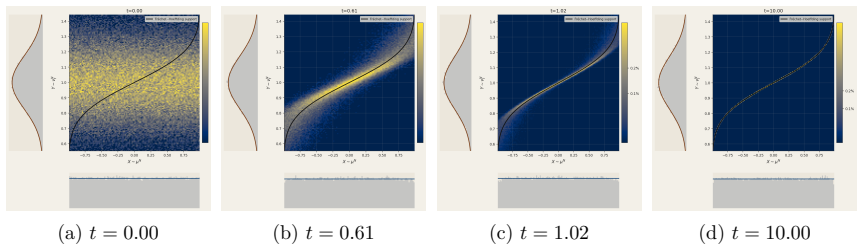
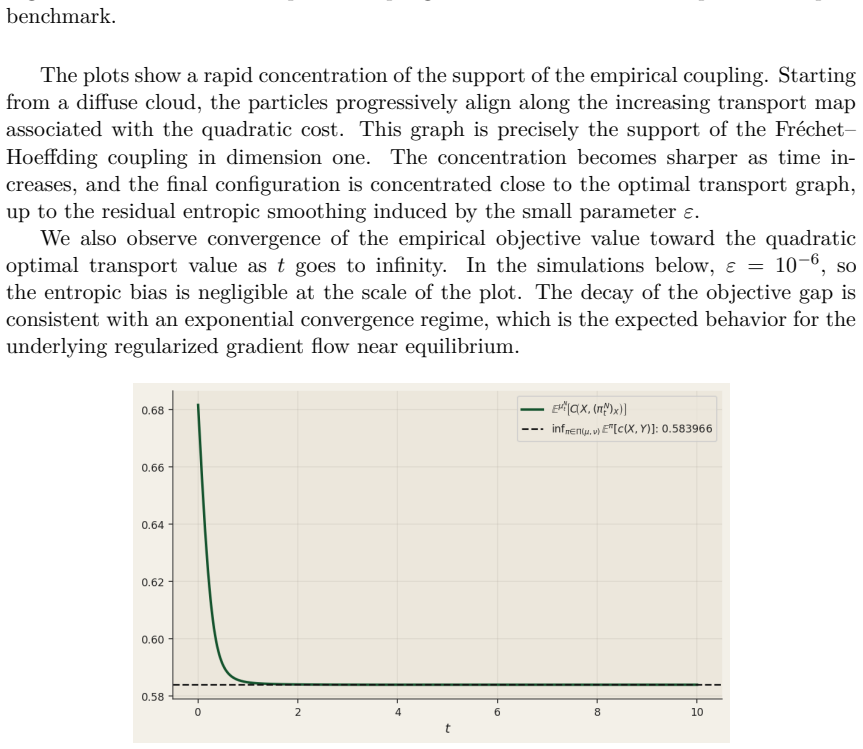
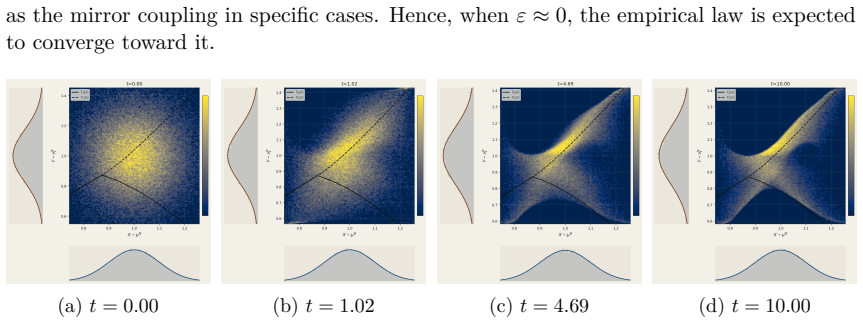
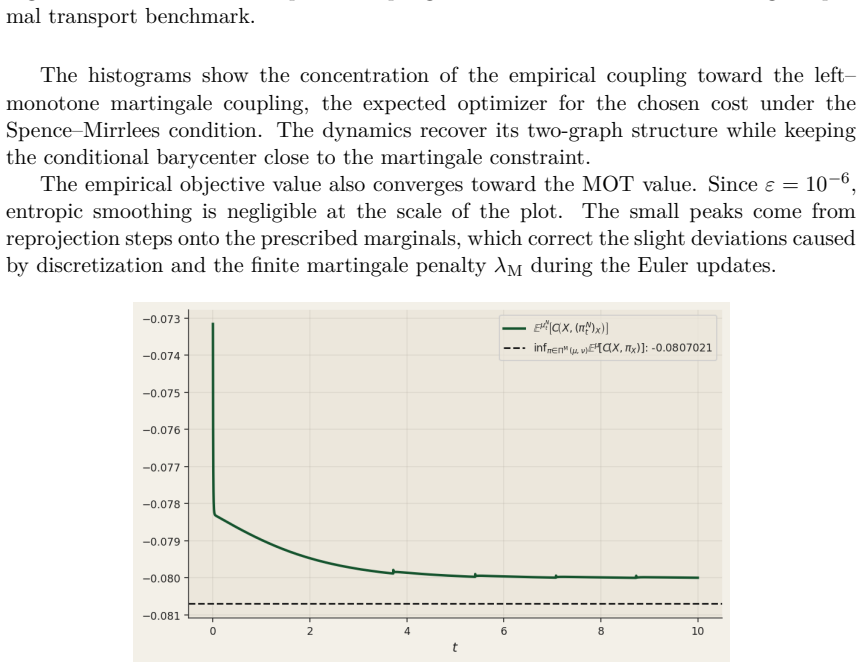
Unlike classical optimal transport, weak transport costs depend nonlinearly on the conditional law of couplings. This feature is essential in problems involving barycenter, conditional moments, and martingale-type constraints. Meanwhile, such conditional dependence makes ordinary Wasserstein geometry insufficient and calls instead for an adapted Wasserstein viewpoint. In this paper, we investigate the entropy-regularized weak optimal transport via gradient flows in adapted Wasserstein space. We derive, from the formal tangent structure of adapted Wasserstein space and the projection onto the set of couplings with prescribed marginals, a coupled McKean--Vlasov SDE. A novel and subtle term is a projection that, at each $Y$-location, averages a weak-transport force that already depends on the conditional law of $Y$ given $X$, thereby preserving marginals while retaining the nonlinear weak-transport structure. Under mild integrability and regularity assumptions, we prove weak existence and uniqueness in law for this projected McKean--Vlasov equation. We then prove that the flow converges, in the adapted Wasserstein topology, to the unique minimizer of the entropic weak optimal transport problem. We also describe a particle approximation and illustrate the dynamics on optimal transport and martingale optimal transport examples.
Editorial analysis
A structured set of objections, weighed in public.
Referee Report
Summary. The manuscript derives a projected McKean-Vlasov SDE from the formal tangent structure of adapted Wasserstein space and a projection onto couplings with prescribed marginals. Under mild integrability and regularity assumptions it establishes weak existence and uniqueness in law for the SDE, then proves that the resulting flow converges in the adapted Wasserstein topology to the unique minimizer of the entropic weak optimal transport problem. A particle approximation is described and the dynamics are illustrated on classical and martingale optimal transport examples.
Significance. If the well-posedness and convergence results hold, the work supplies a dynamical characterization of entropic weak OT via adapted Wasserstein gradient flows. This is potentially significant for problems with nonlinear conditional dependence, such as barycenters and martingale constraints, where standard Wasserstein geometry is insufficient. The explicit construction of the projection term that averages the conditional weak-transport force while preserving marginals is a technical contribution.
minor comments (3)
- [Abstract] The abstract states that the projection 'averages a weak-transport force that already depends on the conditional law of Y given X'; an explicit formula for this averaging operator (perhaps in the form of an integral against the conditional measure) would improve readability before the full derivation appears.
- Notation for the adapted Wasserstein distance and the tangent space is used from the outset; a short preliminary subsection recalling the relevant definitions and the precise form of the projection would aid readers unfamiliar with the adapted setting.
- The particle approximation is described but not claimed to be rigorously proved; if the authors intend this only as a numerical illustration, a brief remark clarifying its status relative to the main convergence theorem would prevent misinterpretation.
Simulated Author's Rebuttal
We thank the referee for the positive summary, recognition of the technical contribution, and recommendation of minor revision. No major comments were listed in the report.
Circularity Check
No significant circularity; derivation self-contained from tangent structure and standard well-posedness
full rationale
The paper derives the projected McKean-Vlasov SDE formally from the tangent structure of adapted Wasserstein space plus a marginal-preserving projection step. It then states and proves weak existence/uniqueness in law under explicit mild integrability/regularity assumptions, followed by a separate convergence argument to the entropic weak OT minimizer in adapted Wasserstein topology. No quoted step reduces the target minimizer or the flow equation to a fitted parameter or self-citation by construction; the projection is introduced to enforce the marginal constraint while retaining the nonlinear conditional structure. The particle approximation is described but not asserted as a rigorous theorem. This matches the default case of a self-contained derivation with no load-bearing circular reduction.
Axiom & Free-Parameter Ledger
axioms (2)
- domain assumption Existence of a tangent structure on adapted Wasserstein space allowing formal gradient flow derivation
- domain assumption Mild integrability and regularity conditions suffice for weak existence and uniqueness of the projected SDE
Reference graph
Works this paper leans on
-
[1]
Acciaio, J
B. Acciaio, J. Backhoff-Veraguas, and A. Zalashko , Causal optimal transport and its links to enlargement of filtrations and continuous-time stochastic optimization , Stochastic Processes and their Applications, 130 (2020), pp. 2918--2953
2020
-
[2]
B. Acciaio, D. Kr s ek, G. Pammer, and M. Rodrigues , Absolutely continuous curves of stochastic processes , arXiv preprint arXiv:2506.13634, (2025)
-
[3]
Ambrosio, N
L. Ambrosio, N. Gigli, and G. Savar \'e , Gradient Flows: In Metric Spaces and in the Space of Probability Measures , Birkh \"a user, Basel, 2 ed., 2008
2008
-
[4]
Backhoff, D
J. Backhoff, D. Bartl, M. Beiglb \"o ck, and J. Wiesel , Estimating processes in adapted Wasserstein distance , The Annals of Applied Probability, 32 (2022), pp. 529--550
2022
-
[5]
Backhoff-Veraguas, D
J. Backhoff-Veraguas, D. Bartl, M. Beiglb \"o ck, and M. Eder , Adapted Wasserstein distances and stability in mathematical finance , Finance and Stochastics, 24 (2020), pp. 601--632
2020
-
[6]
o ck, M. Huesmann, and S. K \
J. Backhoff-Veraguas, M. Beiglb \"o ck, M. Huesmann, and S. K \"a llblad , Martingale Benamou--Brenier : A probabilistic perspective , The Annals of Probability, 48 (2020), pp. 2258--2289
2020
-
[7]
Backhoff-Veraguas, M
J. Backhoff-Veraguas, M. Beiglb \"o ck, Y. Lin, and A. Zalashko , Causal transport in discrete time and applications , SIAM Journal on Optimization, 27 (2017), pp. 2528--2562
2017
-
[8]
Backhoff-Veraguas, M
J. Backhoff-Veraguas, M. Beiglb \"o ck, and G. Pammer , Existence, duality, and cyclical monotonicity for weak transport costs , Calculus of Variations and Partial Differential Equations, 58 (2019), p. 203
2019
-
[9]
J. D. Backhoff-Veraguas and G. Pammer , Applications of weak transport theory , Bernoulli, 28 (2022), pp. 370--394
2022
-
[10]
721--752
height 2pt depth -1.6pt width 23pt, Stability of martingale optimal transport and weak optimal transport , The Annals of Applied Probability, 32 (2022), pp. 721--752
2022
-
[11]
Bartl, M
D. Bartl, M. Beiglb \"o ck, and G. Pammer , The Wasserstein space of stochastic processes , Journal of the European Mathematical Society, 28 (2026), pp. 393--454
2026
- [12]
-
[13]
Bartl, S
D. Bartl, S. Drapeau, J. Ob \'o j, and J. Wiesel , Sensitivity analysis of Wasserstein distributionally robust optimization problems , Proceedings of the Royal Society A, 477 (2021), p. 20210176
2021
-
[14]
Bartl and J
D. Bartl and J. Wiesel , Sensitivity of multiperiod optimization problems with respect to the adapted wasserstein distance , SIAM Journal on Financial Mathematics, 14 (2023), pp. 704--720
2023
-
[15]
Beiglb \"o ck, P
M. Beiglb \"o ck, P. Henry-Labord \`e re, and F. Penkner , Model-independent bounds for option prices: A mass transport approach , Finance and Stochastics, 17 (2013), pp. 477--501
2013
-
[16]
Beiglb \"o ck, B
M. Beiglb \"o ck, B. Jourdain, W. Margheriti, and G. Pammer , Stability of the weak martingale optimal transport problem , The Annals of Applied Probability, 33 (2023), pp. 5382--5412
2023
-
[17]
M. Beiglb \"o ck, G. Pammer, L. Riess, and S. Schrott , The fundamental theorem of weak optimal transport , arXiv preprint arXiv:2501.16316, (2025)
-
[18]
M. Beiglb \"o ck, G. Pammer, S. Schrott, and X. Zhang , Representing general stochastic processes as martingale laws , arXiv preprint arXiv:2312.16725, (2023)
-
[19]
V. I. Bogachev, N. V. Krylov, M. R \"o ckner, and S. V. Shaposhnikov , Fokker--Planck--Kolmogorov Equations , vol. 207 of Mathematical Surveys and Monographs, American Mathematical Society, Providence, RI, 2022
2022
-
[20]
Bolley and C
F. Bolley and C. Villani , Weighted csisz \'a r--kullback--pinsker inequalities and applications to transportation inequalities , in Annales de la Facult \'e des Sciences de Toulouse: Math \'e matiques, vol. 14, 2005, pp. 331--352
2005
-
[21]
Br \'e zis , Functional Analysis, Sobolev Spaces and Partial Differential Equations , Universitext, Springer, New York, 2011
H. Br \'e zis , Functional Analysis, Sobolev Spaces and Partial Differential Equations , Universitext, Springer, New York, 2011
2011
-
[22]
Brunick and S
G. Brunick and S. Shreve , Mimicking an it \^o process by a solution of a stochastic differential equation , The Annals of Applied Probability, 23 (2013), pp. 1584--1628
2013
-
[23]
G. Carlier, H. Malamut, and M. Sylvestre , Weak optimal transport with moment constraints: Constraint qualification, dual attainment and entropic regularization , arXiv preprint arXiv:2511.16211, (2025)
-
[24]
F. Chen, G. Conforti, Z. Ren, and X. Wang , Convergence of sinkhorn's algorithm for entropic martingale optimal transport problem , Mathematics of Operations Research, (2026). Articles in Advance
2026
-
[25]
Y. Chen, T. T. Georgiou, and M. Pavon , On the relation between optimal transport and schr \"o dinger bridges: A stochastic control viewpoint , Journal of Optimization Theory and Applications, 169 (2016), pp. 671--691
2016
-
[26]
Conforti, D
G. Conforti, D. Lacker, and S. Pal , Projected langevin dynamics and a gradient flow for entropic optimal transport , Journal of the European Mathematical Society, (2025). Published online first
2025
-
[27]
Cuturi , Sinkhorn distances: Lightspeed computation of optimal transport , in Advances in Neural Information Processing Systems, vol
M. Cuturi , Sinkhorn distances: Lightspeed computation of optimal transport , in Advances in Neural Information Processing Systems, vol. 26, 2013, pp. 2292--2300
2013
-
[28]
Eckstein and G
S. Eckstein and G. Pammer , Computational methods for adapted optimal transport , The Annals of Applied Probability, 34 (2024), pp. 675--713
2024
-
[29]
Compactness in Adapted Weak Topologies
M. Eder , Compactness in adapted weak topologies , arXiv preprint arXiv:1905.00856, (2019)
work page internal anchor Pith review Pith/arXiv arXiv 1905
-
[30]
Gozlan and N
N. Gozlan and N. Juillet , On a mixture of brenier and strassen theorems , Proceedings of the London Mathematical Society, 120 (2020), pp. 434--463
2020
-
[31]
Gozlan, C
N. Gozlan, C. Roberto, P.-M. Samson, and P. Tetali , Kantorovich duality for general transport costs and applications , Journal of Functional Analysis, 273 (2017), pp. 3327--3405
2017
-
[32]
Henry-Labord \`e re , Model-Free Hedging: A Martingale Optimal Transport Viewpoint , Chapman and Hall/CRC Financial Mathematics Series, CRC Press, Boca Raton, FL, 2017
P. Henry-Labord \`e re , Model-Free Hedging: A Martingale Optimal Transport Viewpoint , Chapman and Hall/CRC Financial Mathematics Series, CRC Press, Boca Raton, FL, 2017
2017
-
[33]
C. Hern \'a ndez and L. Tangpi , Marginal flows of non-entropic weak schr " odinger bridges , arXiv preprint arXiv:2512.21261, (2025)
-
[34]
Huesmann and D
M. Huesmann and D. Trevisan , A Benamou--Brenier formulation of martingale optimal transport , Bernoulli, 25 (2019), pp. 2729--2757
2019
-
[35]
Y. Jiang and J. Ob \'o j , Sensitivity of causal distributionally robust optimization , arXiv preprint arXiv:2408.17109, (2024)
-
[36]
Jordan, D
R. Jordan, D. Kinderlehrer, and F. Otto , The variational formulation of the fokker--planck equation , SIAM Journal on Mathematical Analysis, 29 (1998), pp. 1--17
1998
-
[37]
Kr s ek and G
D. Kr s ek and G. Pammer , General duality and dual attainment for adapted transport , Applied Mathematics & Optimization, 91 (2025), p. 52
2025
-
[38]
Lacker, M
D. Lacker, M. Shkolnikov, and J. Zhang , Superposition and mimicking theorems for conditional mckean--vlasov equations , Journal of the European Mathematical Society, 25 (2023), pp. 3229--3288
2023
-
[39]
Causal transference plans and their Monge-Kantorovich problems
R. Lassalle , Causal transference plans and their monge--kantorovich problems , arXiv preprint arXiv:1303.6925, (2013)
work page internal anchor Pith review Pith/arXiv arXiv 2013
-
[40]
L \'e onard , A survey of the schr \"o dinger problem and some of its connections with optimal transport , Discrete and Continuous Dynamical Systems -- Series A, 34 (2014), pp
C. L \'e onard , A survey of the schr \"o dinger problem and some of its connections with optimal transport , Discrete and Continuous Dynamical Systems -- Series A, 34 (2014), pp. 1533--1574
2014
-
[41]
Mikami and M
T. Mikami and M. Thieullen , Optimal transportation problem by stochastic optimal control , SIAM Journal on Control and Optimization, 47 (2008), pp. 1127--1139
2008
-
[42]
M. Nutz and J. Wiesel , On the martingale schr \"o dinger bridge between two distributions , arXiv preprint arXiv:2401.05209, (2024)
-
[43]
Otto , The geometry of dissipative evolution equations: The porous medium equation , Communications in Partial Differential Equations, 26 (2001), pp
F. Otto , The geometry of dissipative evolution equations: The porous medium equation , Communications in Partial Differential Equations, 26 (2001), pp. 101--174
2001
-
[44]
Pammer , A note on the adapted weak topology in discrete time , Electronic Communications in Probability, 29 (2024), pp
G. Pammer , A note on the adapted weak topology in discrete time , Electronic Communications in Probability, 29 (2024), pp. 1--13
2024
-
[45]
Peyr \'e and M
G. Peyr \'e and M. Cuturi , Computational optimal transport with applications to data science , Foundations and Trends in Machine Learning, 11 (2019), pp. 355--607
2019
-
[46]
G. C. Pflug and A. Pichler , A distance for multistage stochastic optimization models , SIAM Journal on Optimization, 22 (2012), pp. 1--23
2012
-
[47]
height 2pt depth -1.6pt width 23pt, Multistage Stochastic Optimization , Springer Series in Operations Research and Financial Engineering, Springer, Cham, 2014
2014
-
[48]
Santambrogio , Optimal Transport for Applied Mathematicians: Calculus of Variations, PDEs, and Modeling , vol
F. Santambrogio , Optimal Transport for Applied Mathematicians: Calculus of Variations, PDEs, and Modeling , vol. 87 of Progress in Nonlinear Differential Equations and Their Applications, Birkh \"a user, Cham, 2015
2015
-
[49]
height 2pt depth -1.6pt width 23pt, Euclidean, metric, and wasserstein gradient flows: An overview , Bulletin of Mathematical Sciences, 7 (2017), pp. 87--154
2017
-
[50]
Sauldubois , Model risk static-hedging: A constrained distributionally robust optimization approach
N. Sauldubois , Model risk static-hedging: A constrained distributionally robust optimization approach . Working paper, 2026
2026
-
[51]
N. Sauldubois and N. Touzi , First order martingale model risk and semi-static hedging , arXiv preprint arXiv:2410.06906, (2024)
-
[52]
o dinger , \
E. Schr \"o dinger , \"U ber die umkehrung der naturgesetze , Sitzungsberichte der Preussischen Akademie der Wissenschaften, Physikalisch-Mathematische Klasse, (1931), pp. 144--153
1931
-
[53]
Shu , From hopf--lax formula to optimal weak transfer plan , SIAM Journal on Mathematical Analysis, 52 (2020), pp
Y. Shu , From hopf--lax formula to optimal weak transfer plan , SIAM Journal on Mathematical Analysis, 52 (2020), pp. 3052--3072
2020
-
[54]
Villani , Topics in Optimal Transportation , vol
C. Villani , Topics in Optimal Transportation , vol. 58 of Graduate Studies in Mathematics, American Mathematical Society, Providence, RI, 2003
2003
-
[55]
338 of Grundlehren der mathematischen Wissenschaften, Springer, Berlin, 2009
height 2pt depth -1.6pt width 23pt, Optimal Transport : Old and New , vol. 338 of Grundlehren der mathematischen Wissenschaften, Springer, Berlin, 2009
2009
discussion (0)
Sign in with ORCID, Apple, or X to comment. Anyone can read and Pith papers without signing in.