Mitigating Noise-Induced Barren Plateaus Using a Non-Unitary Ansatz: Application to Molecular Electronic Transport
Pith reviewed 2026-06-29 06:22 UTC · model grok-4.3
The pith
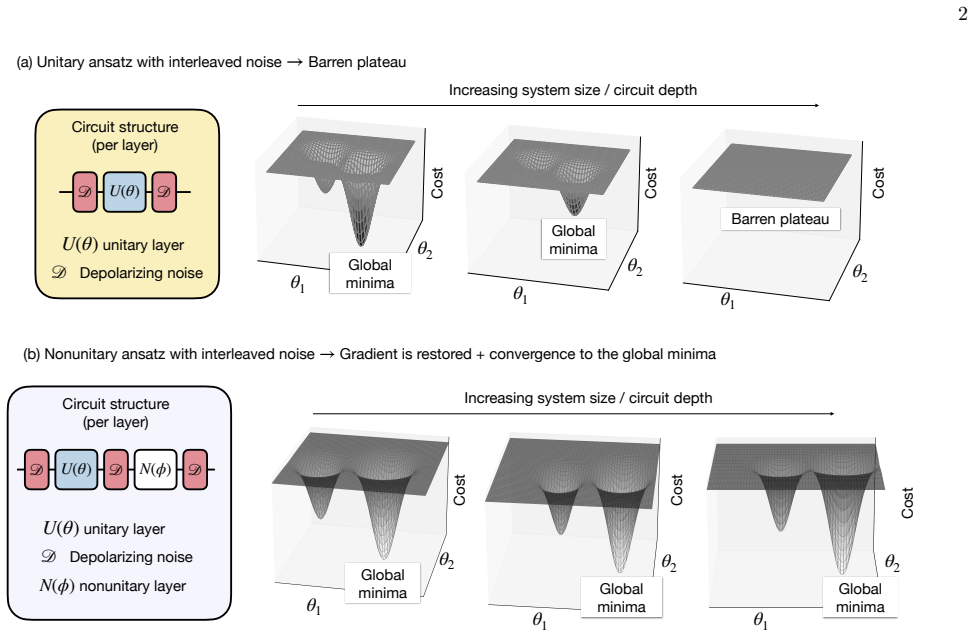
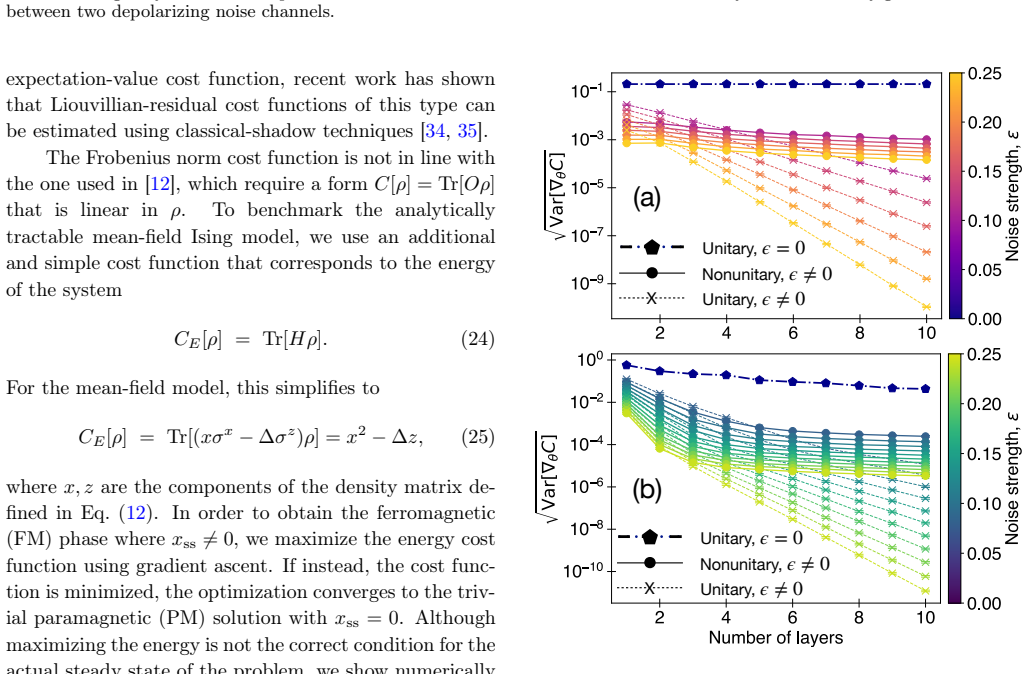
Non-unitary elements in variational ansatze restore finite gradients under depolarizing noise for open quantum systems.
A machine-rendered reading of the paper's core claim, the machinery that carries it, and where it could break.
Core claim
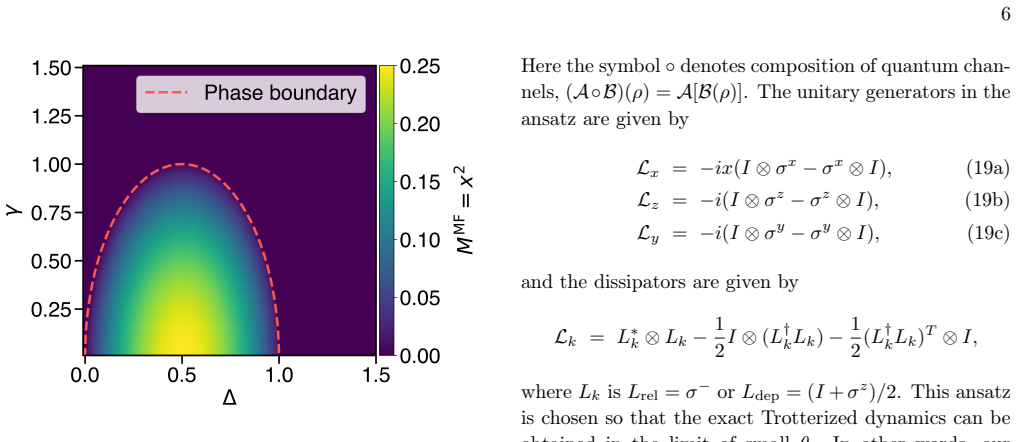
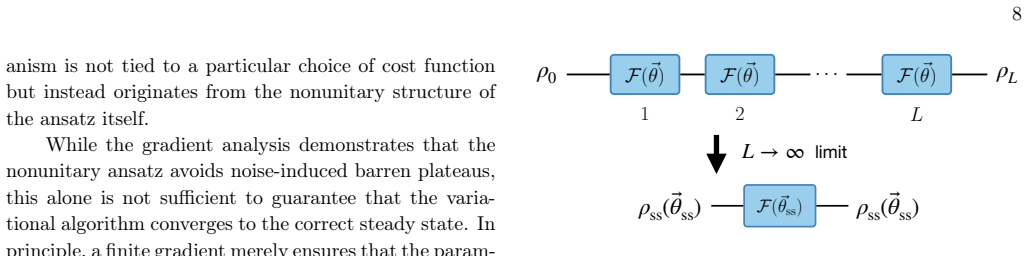
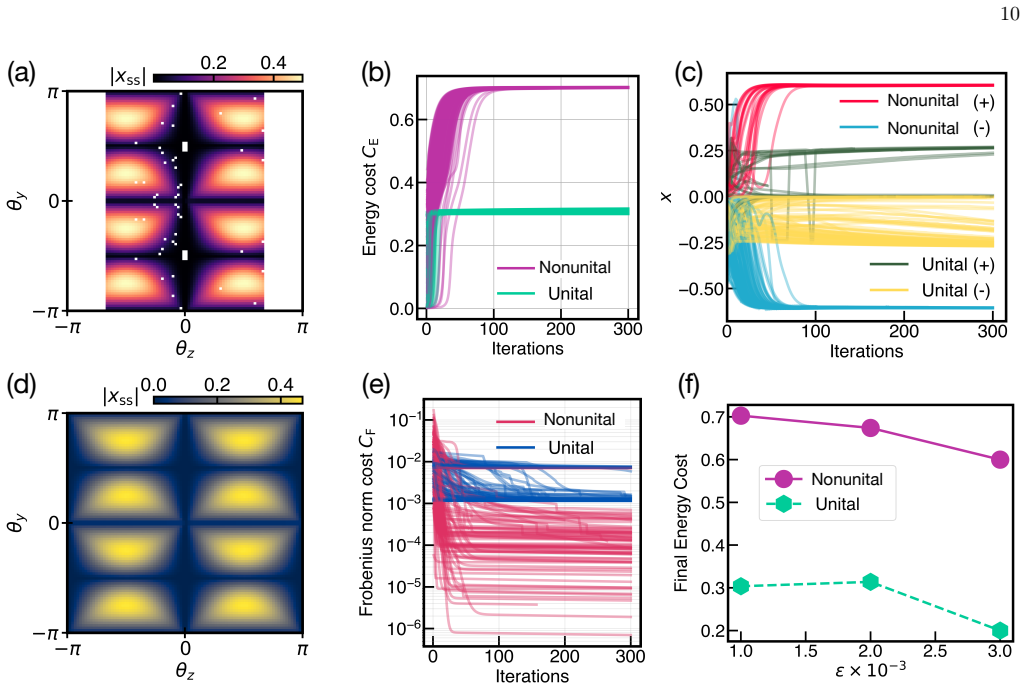
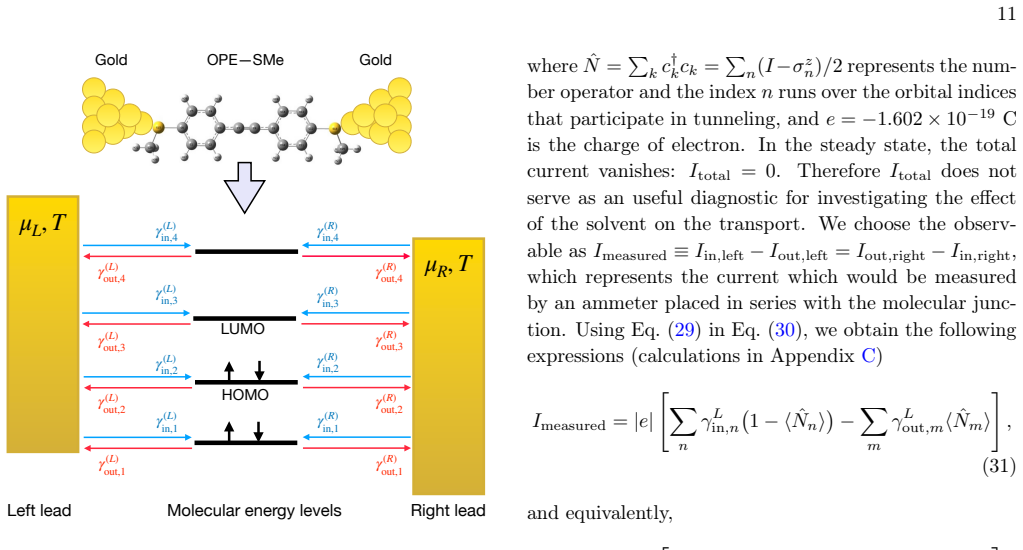
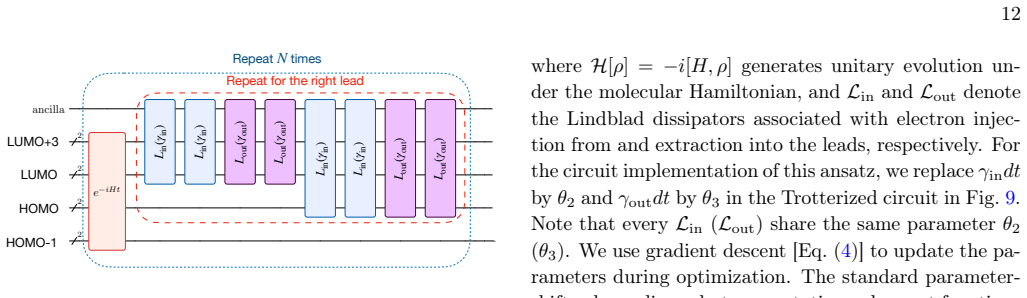
The central claim is that a nonunitary ansatz restores finite gradients in the presence of depolarizing noise, enabling convergence to the correct symmetry-broken steady state in open quantum systems. Using an analytically tractable infinite-range dissipative Ising model, the nonunitary ansatz succeeds where unitary ones fail. A Floquet-type ansatz with repeated parameters reduces the circuit to an effective quantum channel for analysis. Extension to OPE-SMe molecular transport with first-principles Hamiltonians and jump operators shows the method works for realistic systems.
What carries the argument
The non-unitary variational ansatz, which incorporates non-unitary elements to mitigate noise-induced barren plateaus by maintaining finite gradients.
If this is right
- Finite gradients allow optimization to the symmetry-broken steady state in the dissipative Ising model despite noise.
- The Floquet-type ansatz enables direct analysis of fixed points as an effective quantum channel.
- Non-unitary ansatze enable simulation of electron transport in OPE-SMe on NISQ hardware.
- Provides a scalable route for open-system steady states on noisy hardware.
Where Pith is reading between the lines
- The method might generalize to other open quantum chemistry problems beyond the tested models.
- Combining non-unitary ansatze with error mitigation could further improve performance on real devices.
- Testing on larger molecular systems would check if the gradient restoration scales.
- Exploring different types of non-unitary operations could optimize the approach for specific noise models.
Load-bearing premise
That success on the infinite-range Ising model and the specific OPE-SMe system means the non-unitary mitigation will work for general open quantum chemistry problems.
What would settle it
If a non-unitary ansatz applied to a different open quantum system or noise model still shows exponentially vanishing gradients with depth, the claim would be falsified.
Figures

read the original abstract
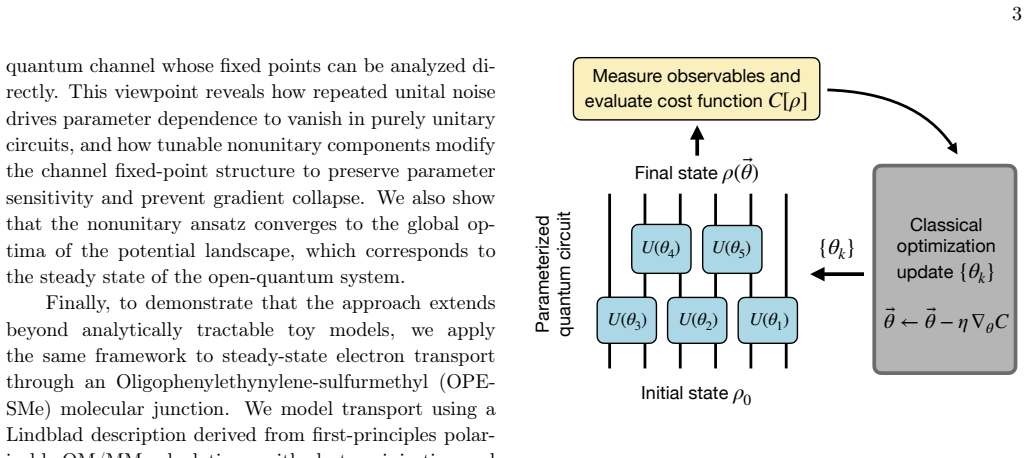
Variational quantum algorithms (VQAs) offer a promising route toward simulating many-body quantum systems on noisy intermediate-scale quantum (NISQ) hardware. However, their scalability is severely limited by noise-induced barren plateaus (NIBPs), where hardware noise causes the gradients of the cost function to vanish exponentially with circuit depth, rendering optimization impossible. In this work, we demonstrate that introducing nonunitary elements into the variational ansatz can mitigate NIBPs in open-quantum systems. Using an analytically tractable infinite-range dissipative Ising model, we show that a nonunitary ansatz restores finite gradients in the presence of depolarizing noise, enabling convergence to the correct symmetry-broken steady state. We also develop a Floquet-type variational ansatz in which each layer repeats the same parameters, reducing the deep variational circuit to an effective quantum channel whose fixed points can be analyzed directly. We then extend these ideas to a realistic quantum-chemistry system by simulating electron transport through Oligophenylethynylene-sulfurmethyl (OPE-SMe) using Hamiltonians and jump operators of the model derived from first-principles polarizable QM/MM calculations. Our results show that nonunitary variational ans\"atze provide a scalable and physically grounded route for simulating open-system steady states on NISQ hardware, offering a pathway to overcoming one of the limitations of current quantum hardware.
Editorial analysis
A structured set of objections, weighed in public.
Referee Report
Summary. The paper claims that non-unitary elements in the variational ansatz mitigate noise-induced barren plateaus (NIBPs) for open quantum systems on NISQ hardware. Using an analytically tractable infinite-range dissipative Ising model with depolarizing noise, a non-unitary ansatz is shown to restore finite gradients and enable convergence to the symmetry-broken steady state. A Floquet-type ansatz with repeated parameters reduces the circuit to an effective quantum channel for fixed-point analysis. The approach is extended to first-principles simulation of electron transport through OPE-SMe using derived Hamiltonians and jump operators, with results indicating that non-unitary ansatze offer a scalable route for open-system steady states.
Significance. If the central claim holds, the work provides a concrete strategy for overcoming NIBPs in variational simulations of open quantum systems, with direct relevance to quantum chemistry applications such as molecular electronic transport. The analytic demonstration on the Ising model and the use of a parameter-sharing Floquet structure are strengths that could generalize if supported by broader evidence.
major comments (2)
- [Abstract and paragraph on model choice/extension to realistic system] The claim that non-unitary ansatze provide a 'scalable and physically grounded route' for general open quantum chemistry problems (Abstract) is load-bearing but rests only on the infinite-range dissipative Ising model and the specific OPE-SMe geometry/jump operators. No scaling argument, locality analysis, or counter-example is supplied to show the gradient-restoration mechanism is insensitive to interaction range or the form of the dissipators, as required for the broad applicability asserted.
- [Section on infinite-range dissipative Ising model] In the Ising-model section, the analytic restoration of gradients under depolarizing noise is asserted to enable convergence to the correct steady state, but the manuscript provides no explicit gradient expression or error bound showing that the non-unitary modification avoids the exponential vanishing independent of the infinite-range assumption (which may artificially suppress NIBPs).
minor comments (2)
- [Abstract] The abstract contains a typographical artifact ('ans"atze'); this should be corrected for clarity.
- [Section introducing Floquet-type variational ansatz] Notation for the Floquet-type ansatz and the effective quantum channel should be introduced with an explicit equation reference when first defined, to aid readability.
Simulated Author's Rebuttal
We thank the referee for their constructive comments, which have helped us clarify the scope and strengthen the presentation of our results. We address each major comment below and indicate the corresponding revisions.
read point-by-point responses
-
Referee: [Abstract and paragraph on model choice/extension to realistic system] The claim that non-unitary ansatze provide a 'scalable and physically grounded route' for general open quantum chemistry problems (Abstract) is load-bearing but rests only on the infinite-range dissipative Ising model and the specific OPE-SMe geometry/jump operators. No scaling argument, locality analysis, or counter-example is supplied to show the gradient-restoration mechanism is insensitive to interaction range or the form of the dissipators, as required for the broad applicability asserted.
Authors: We agree that the original abstract phrasing overstated the generality. In the revised manuscript we have changed the abstract to state that non-unitary ansatze 'offer a promising route' for open-system steady states. We have also added a dedicated paragraph in the Discussion section that (i) explains how the Floquet parameter-sharing structure and effective-channel fixed-point analysis provide a mechanism that does not explicitly rely on infinite range, and (ii) explicitly notes the absence of a general locality or scaling proof, identifying this as an important direction for future work. revision: partial
-
Referee: [Section on infinite-range dissipative Ising model] In the Ising-model section, the analytic restoration of gradients under depolarizing noise is asserted to enable convergence to the correct steady state, but the manuscript provides no explicit gradient expression or error bound showing that the non-unitary modification avoids the exponential vanishing independent of the infinite-range assumption (which may artificially suppress NIBPs).
Authors: We have inserted the explicit gradient formula (new Eq. (X) in the Ising-model section) obtained from the effective quantum channel. The derivation shows that the non-unitary term prevents the gradient from decaying exponentially with depth because the variational state retains a finite overlap with the target steady state. We have added a clarifying sentence acknowledging that this expression is derived under the infinite-range assumption and that a general bound independent of interaction range lies beyond the present scope. revision: yes
Circularity Check
No significant circularity; derivation self-contained
full rationale
The paper introduces a non-unitary ansatz and a Floquet-type variational form, then demonstrates finite gradients and convergence on an analytically tractable infinite-range dissipative Ising model under depolarizing noise and on first-principles jump operators for the OPE-SMe system. No quoted equations reduce a claimed prediction to a fitted parameter by construction, no load-bearing uniqueness theorem is imported from self-citation, and no ansatz is smuggled via prior author work. The reported mitigation is shown via direct simulation on the chosen models rather than being forced by the input definitions or parameter choices.
Axiom & Free-Parameter Ledger
Reference graph
Works this paper leans on
-
[1]
The second CNOT produces |a, b⊕a, c⊕b⊕a, d⟩
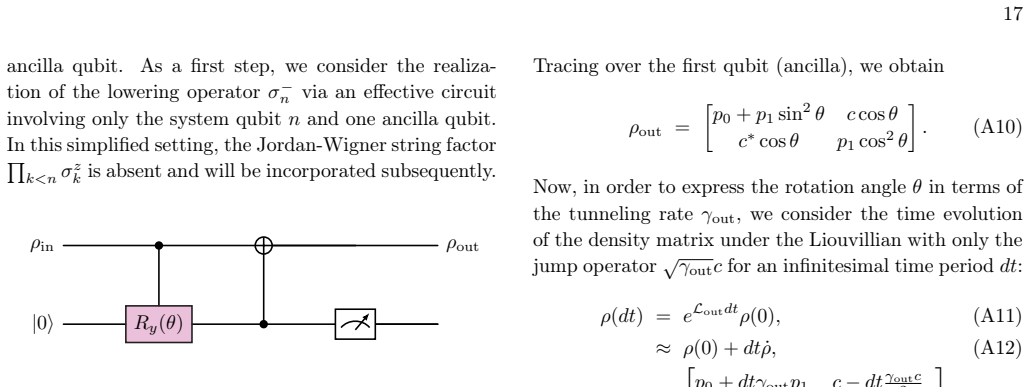
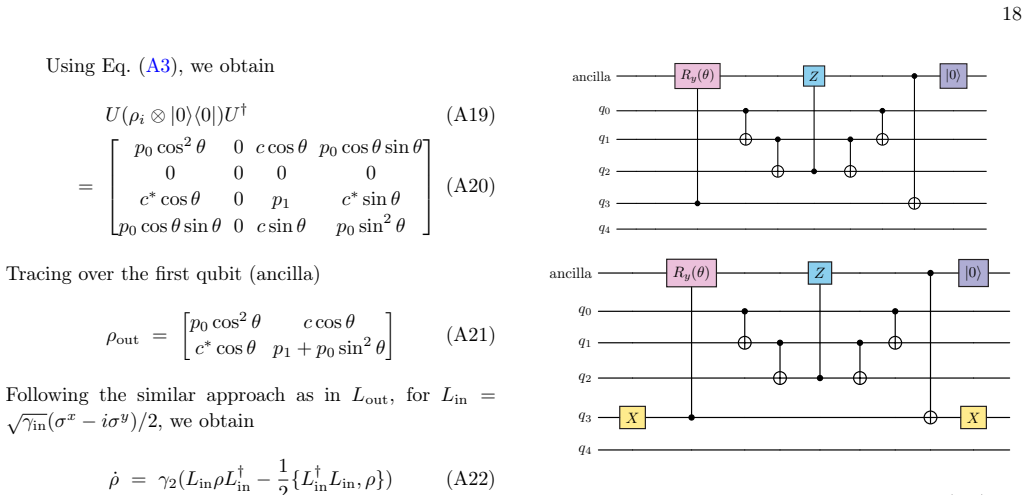
Starting from a computational basis state|q 0q1q2q3⟩=|a, b, c, d⟩, the first CNOT produces|a, b⊕a, c, d⟩. The second CNOT produces |a, b⊕a, c⊕b⊕a, d⟩. Thus, the qubitq 2 stores the parity of the first three qubitsq2 =a⊕b⊕c. After this a controlled-Z gate is applied between the ancilla qubit and the qubitq2. This gate introduces a phase(−1)aanc(a⊕b⊕c). In ...
-
[2]
The couplingJ k describes tunneling between the molecular orbital and the lead statek
The lead operatorsc† k (ck) create (annihilate) an elec- tron in a single-particle eigenstatekwith energyϵ k of the metallic lead, which is treated as a noninteracting fermionic reservoir, and they satisfy{ck, c† k′}=δ kk′. The couplingJ k describes tunneling between the molecular orbital and the lead statek. The interaction Hamil- tonian contains two phy...
-
[3]
The parameters are updated according to the gra- dient ascent rule θ(n+1) k =θ (n) k +η ∂C ∂θk .(D1) Hereη >0is the learning rate
Gradient ascent for a general ansatz In this section, we discuss the calculation of the gra- dient for the two cost functions:(1)Energy(2)Frobenius norm. The parameters are updated according to the gra- dient ascent rule θ(n+1) k =θ (n) k +η ∂C ∂θk .(D1) Hereη >0is the learning rate. (1)Energy cost function— The energy cost function isC[ρ f] = Tr[H f ρf],...
-
[4]
Avariationaleigenvaluesolveronapho- tonicquantumprocessor
A. Peruzzo, J. McClean, P. Shadbolt, M.-H. Yung, X.-Q. Zhou, P. J. Love, A. Aspuru-Guzik, and J. L. O’Brien, A variational eigenvalue solver on a photonic quantum processor, Nature Communications5, 10.1038/ncomms5213 (2014)
-
[5]
J. R. McClean, J. Romero, R. Babbush, and A. Aspuru-Guzik, The theory of variational hybrid quantum-classical algo- rithms, New Journal of Physics18, 023023 (2016)
2016
-
[6]
Cerezo, A
M. Cerezo, A. Arrasmith, R. Babbush, S. C. Benjamin, S. Endo, K. Fujii, J. R. McClean, K. Mitarai, X. Yuan, L. Cincio, and P. J. Coles, Variational quantum algorithms, Nature Reviews Physics3, 625–644 (2021)
2021
-
[7]
Tilly, H
J. Tilly, H. Chen, S. Cao, D. Picozzi, K. Setia, Y. Li, E. Grant, L. Wossnig, I. Rungger, G. H. Booth, and J. Tennyson, The variational quantum eigensolver: A review of methods and best practices, Physics Reports986, 1–128 (2022)
2022
-
[8]
Tilly, H
J. Tilly, H. Chen, S. Cao, D. Picozzi, K. Setia, Y. Li, E. Grant, L. Wossnig, I. Rungger, G. H. Booth, and J. Tennyson, The variational quantum eigensolver: A review of methods and best practices, Physics Reports986, 1 (2022), the Variational Quantum Eigensolver: a review of methods and best practices
2022
-
[9]
Kandala, A
A. Kandala, A. Mezzacapo, K. Temme, M. Takita, M. Brink, J. M. Chow, and J. M. Gambetta, Hardware-efficient variational quantum eigensolver for small molecules and quantum magnets, Nature549, 242 (2017)
2017
-
[10]
P. J. J. O’Malley, R. Babbush, I. D. Kivlichan, J. Romero, J. R. McClean, R. Barends, J. Kelly, P. Roushan, A. Tranter, N. Ding, B. Campbell, Y. Chen, Z. Chen, B. Chiaro, A. Dunsworth, A. G. Fowler, E. Jeffrey, E. Lucero, A. Megrant, J. Y. Mutus, M. Neeley, C. Neill, C. Quintana, D. Sank, A. Vainsencher, J. Wenner, T. C. White, P. V. Coveney, P. J. Love, ...
2016
-
[11]
J.-M.Reiner, F.Wilhelm-Mauch, G.Schön,andM.Marthaler,Findingthegroundstateofthehubbardmodelbyvariational methods on a quantum computer with gate errors, Quantum Science and Technology4, 035005 (2019)
2019
-
[12]
Kokail, C
C. Kokail, C. Maier, R. van Bijnen, T. Brydges, M. K. Joshi, P. Jurcevic, C. A. Muschik, P. Silvi, R. Blatt, C. F. Roos, and P. Zoller, Self-verifying variational quantum simulation of lattice models, Nature569, 355 (2019)
2019
-
[13]
J. R. McClean, S. Boixo, V. N. Smelyanskiy, R. Babbush, and H. Neven, Barren plateaus in quantum neural network training landscapes, Nature Communications9, 4812 (2018)
2018
-
[14]
Cerezo, A
M. Cerezo, A. Sone, T. Volkoff, L. Cincio, and P. J. Coles, Cost function dependent barren plateaus in shallow parametrized quantum circuits, Nature Communications12, 1791 (2021)
2021
-
[15]
S. Wang, E. Fontana, M. Cerezo, K. Sharma, A. Sone, L. Cincio, and P. J. Coles, Noise-induced barren plateaus in variational quantum algorithms, Nature Communications12, 6961 (2021)
2021
-
[16]
Grant, L
E. Grant, L. Wossnig, M. Ostaszewski, and M. Benedetti, An initialization strategy for addressing barren plateaus in parametrized quantum circuits, Quantum3, 214 (2019)
2019
-
[17]
Skolik, J
A. Skolik, J. R. McClean, M. Mohseni, P. van der Smagt, and M. Leib, Layerwise learning for quantum neural networks, Quantum Machine Intelligence3, 5 (2021)
2021
-
[18]
Huggins, P
W. Huggins, P. Patil, B. Mitchell, K. B. Whaley, and E. M. Stoudenmire, Towards quantum machine learning with tensor networks, Quantum Science and Technology4, 024001 (2019). 28
2019
-
[19]
Larocca, S
M. Larocca, S. Thanasilp, S. Wang, K. Sharma, J. Biamonte, P. J. Coles, L. Cincio, J. R. McClean, Z. Holmes, and M. Cerezo, Barren plateaus in variational quantum computing, Nature Reviews Physics7, 174 (2025)
2025
-
[20]
S. Wang, P. Czarnik, A. Arrasmith, M. Cerezo, L. Cincio, and P. J. Coles, Can error mitigation improve trainability of noisy variational quantum algorithms?, Quantum8, 1287 (2024)
2024
-
[21]
Verstraete, M
F. Verstraete, M. M. Wolf, and J. Ignacio Cirac, Quantum computation and quantum-state engineering driven by dissipa- tion, Nature Physics5, 633 (2009)
2009
-
[22]
E. Zapusek, I. Rojkov, and F. Reiter, Scaling quantum algorithms via dissipation: Avoiding barren plateaus (2025), arXiv:2507.02043 [quant-ph]
-
[23]
Sannia, F
A. Sannia, F. Tacchino, I. Tavernelli, G. L. Giorgi, and R. Zambrini, Engineered dissipation to mitigate barren plateaus, npj Quantum Information10, 81 (2024)
2024
-
[24]
A. A. Mele, A. Angrisani, S. Ghosh, S. Khatri, J. Eisert, D. Stilck França, and Y. Quek, Noise-induced shallow circuits and the absence of barren plateaus, Nature Physics 10.1038/s41567-026-03245-z (2026)
-
[25]
Mitarai, M
K. Mitarai, M. Negoro, M. Kitagawa, and K. Fujii, Quantum circuit learning, Phys. Rev. A98, 032309 (2018)
2018
-
[26]
L. H. Delgado-Granados, T. J. Krogmeier, L. M. Sager-Smith, I. Avdic, Z. Hu, M. Sajjan, M. Abbasi, S. E. Smart, P. Narang, S. Kais, A. W. Schlimgen, K. Head-Marsden, and D. A. Mazziotti, Quantum algorithms and applications for open quantum systems, Chemical Reviews125, 1823 (2025)
2025
-
[27]
T. Watad and N. H. Lindner, Variational quantum algorithms for simulation of lindblad dynamics (2023), arXiv:2305.02815 [quant-ph]
-
[28]
J.-C. Huang, H.-E. Li, Y.-C. Wang, G.-Z. Zhang, J. Li, and H.-S. Hu, Towards robust variational quantum simulation of lindblad dynamics via stochastic magnus expansion, PRX Quantum6, 10.1103/yyln-q22s (2025)
-
[29]
J. Luo, K. Lin, and X. Gao, Variational quantum simulation of lindblad dynamics via quantum state diffusion, The Journal of Physical Chemistry Letters15, 3516 (2024)
2024
-
[30]
Santos, X
S. Santos, X. Song, and V. Savona, Low-Rank Variational Quantum Algorithm for the Dynamics of Open Quantum Systems, Quantum9, 1620 (2025)
2025
-
[31]
Y. Liu, Z. Hu, X. Zheng, and Z. Li, Variational-quantum-eigensolver solution for lindblad-driven nonequilibrium electron- transport problems, Phys. Rev. A112, 062438 (2025)
2025
-
[32]
Liu, T.-P
H.-Y. Liu, T.-P. Sun, Y.-C. Wu, and G.-P. Guo, Variational quantum algorithms for the steady states of open quantum systems, Chinese Physics Letters38, 080301 (2021)
2021
-
[33]
Bittel and M
L. Bittel and M. Kliesch, Training variational quantum algorithms is np-hard, Phys. Rev. Lett.127, 120502 (2021)
2021
- [34]
-
[35]
A Quantum Approximate Optimization Algorithm
E. Farhi, J. Goldstone, and S. Gutmann, A quantum approximate optimization algorithm (2014), arXiv:1411.4028 [quant- ph]
work page internal anchor Pith review Pith/arXiv arXiv 2014
-
[36]
M. A. Nielsen and I. L. Chuang,Quantum Computation and Quantum Information: 10th Anniversary Edition(Cambridge University Press, 2010)
2010
- [37]
-
[38]
Huang, R
H.-Y. Huang, R. Kueng, and J. Preskill, Predicting many properties of a quantum system from very few measurements, Nature Physics16, 1050–1057 (2020)
2020
-
[39]
A. A. Mele, A. Angrisani, S. Ghosh, S. Khatri, J. Eisert, D. S. França, and Y. Quek, Noise-induced shallow circuits and absence of barren plateaus (2024), arXiv:2403.13927 [quant-ph]
work page internal anchor Pith review Pith/arXiv arXiv 2024
-
[40]
Temme, S
K. Temme, S. Bravyi, and J. M. Gambetta, Error mitigation for short-depth quantum circuits, Phys. Rev. Lett.119, 180509 (2017)
2017
-
[41]
Li and S
Y. Li and S. C. Benjamin, Efficient variational quantum simulator incorporating active error minimization, Phys. Rev. X 7, 021050 (2017)
2017
-
[42]
Z. Tang, S. Hou, Q. Wu, Z. Tan, J. Zheng, R. Li, J. Liu, Y. Yang, H. Sadeghi, J. Shi, I. Grace, C. J. Lambert, and W. Hong, Solvent-molecule interaction induced gating of charge transport through single-molecule junctions, Science Bulletin65, 944 (2020)
2020
-
[43]
Schuld, V
M. Schuld, V. Bergholm, C. Gogolin, J. Izaac, and N. Killoran, Evaluating analytic gradients on quantum hardware, Phys. Rev. A99, 032331 (2019)
2019
-
[44]
Qiskit Community, Trotter qrte tutorial (2026), accessed: 2026-04-10
2026
-
[45]
E. G. Kratz, A. R. Walker, L. Lagardère, F. Lipparini, J.-P. Piquemal, and G. Andrés Cisneros, Lichem: A qm/mm program for simulations with multipolar and polarizable force fields, Journal of Computational Chemistry37, 1019 (2016)
2016
-
[46]
Gökcan, E
H. Gökcan, E. G. Kratz, T. A. Darden, J.-P. Piquemal, and G. A. Cisneros, LICHEM 1.1: Recent improvements and new capabilities, J. Chem. Theory Comput.15, 3056 (2019). 29
2019
-
[47]
M. J. Frisch, G. W. Trucks, H. B. Schlegel, G. E. Scuseria, M. A. Robb,et al., Gaussian 16, Revision C.01 (2016)
2016
-
[48]
J. W. Ponder, TINKER: Software tools for molecular design,https://dasher.wustl.edu/tinker/(2023), version 8.0, Washington University in St. Louis
2023
-
[49]
Moreover, while representing quantum states, Qiskit follows the convention of counting from right to left—the rightmost qubit is the zeroth qubit
Toseetheequivalenceofthesetworepresentationsofthesamestate, notethatJordanWignertransformationinQiskitmaps the orbitals in fermionic representation(69,70,71,72)to the qubits representation(69α,70α,71α,72α,69β,70β,71β,72β), whereαandβrepresents the two spins of the electron [see documentation from Qiskit website on how this mapping works]. Moreover, while ...
-
[50]
IBM Quantum, Fake provider (qiskit ibm runtime api) (2026), accessed: 2026-04-10
2026
-
[51]
Schwarz, M
F. Schwarz, M. Goldstein, A. Dorda, E. Arrigoni, A. Weichselbaum, and J. von Delft, Lindblad-driven discretized leads for nonequilibrium steady-state transport in quantum impurity models: Recovering the continuum limit, Phys. Rev. B94, 155142 (2016)
2016
-
[52]
Breuer and F
H.-P. Breuer and F. Petruccione, Bibliography, inThe Theory of Open Quantum Systems(Oxford University Press, 2007)
2007
-
[53]
A. J. Stone, Distributed multipole analysis: Stability for large basis sets, J. Chem. Theory Comput.1, 1128 (2005)
2005
-
[54]
J. W. Ponder, C. Wu, P. Ren, V. S. Ponde, J. D. Chodera, M. J. Schnieders, I. Haque, D. L. Mobley, D. S. Lambrecht, J. DiStasio, Robert A., M. Head-Gordon, G. N. I. Clark, M. E. Johnson, and T. Head-Gordon, Current status of the AMOEBA polarizable force field, J. Phys. Chem. B114, 2549 (2010)
2010
-
[55]
Martínez, R
L. Martínez, R. Andrade, E. G. Birgin, and J. M. Martínez, PACKMOL: A package for building initial configurations for molecular dynamics simulations, J. Comput. Chem.30, 2157 (2009)
2009
-
[56]
Bussi, D
G. Bussi, D. Donadio, and M. Parrinello, Canonical sampling through velocity rescaling, J. Chem. Phys.126, 014101 (2007)
2007
-
[57]
Chow and D
K.-H. Chow and D. M. Ferguson, Isothermal-isobaric molecular dynamics simulations with monte carlo volume sampling, Comput. Phys. Commun.91, 283 (1995)
1995
-
[58]
Essmann, L
U. Essmann, L. Perera, M. L. Berkowitz, T. Darden, H. Lee, and L. G. Pedersen, A smooth particle mesh Ewald method, J. Chem. Phys.103, 8577 (1995)
1995
-
[59]
Tuckerman, B
M. Tuckerman, B. J. Berne, and G. J. Martyna, Reversible multiple time scale molecular dynamics, J. Chem. Phys.97, 1990 (1992)
1990
-
[60]
Brehm and B
M. Brehm and B. Kirchner, TRAVIS — A free analyzer and visualizer for Monte Carlo and molecular dynamics trajectories, J. Chem. Inf. Model.51, 2007 (2011)
2007
-
[61]
Brehm, M
M. Brehm, M. Thomas, S. Gehrke, and B. Kirchner, TRAVIS — A free analyzer for trajectories from molecular simulation, J. Chem. Phys.152, 164105 (2020)
2020
-
[62]
D. Fang, R. E. Duke, and G. A. Cisneros, A new smoothing function to introduce long-range electrostatic effects in QM/MM calculations, J. Chem. Phys.143, 044103 (2015)
2015
-
[63]
E. G. Kratz, R. E. Duke, and G. A. Cisneros, Long-range electrostatic corrections in multipolar/polarizable QM/MM simulations, Theor. Chem. Acc.135, 166 (2016)
2016
-
[64]
Ratner, A brief history of molecular electronics, Nat
M. Ratner, A brief history of molecular electronics, Nat. Nanotechnol.8, 378 (2013)
2013
-
[65]
Nitzan and M
A. Nitzan and M. A. Ratner, Electron transport in molecular wire junctions, Science300, 1384 (2003)
2003
-
[66]
Q. Sun, T. C. Berkelbach, N. S. Blunt, G. H. Booth, S. Guo, Z. Li, J. Liu, J. D. McClain, E. R. Sayfutyarova, S. Sharma, S. Wouters, and G. K.-L. Chan, PySCF: The Python-based simulations of chemistry framework, WIREs Comput. Mol. Sci.8, e1340 (2018)
2018
-
[67]
Q. Sun, X. Zhang, S. Banerjee, P. Bao, M. Barbry, N. S. Blunt, N. A. Bogdanov, G. H. Booth, J. Chen, Z.-H. Cui, J. J. Eriksen, Y. Gao, S. Guo, J. Hermann, M. R. Hermes, K. Koh, P. Koval, S. Lehtola, Z. Li, J. Liu, N. Mardirossian, J. D. McClain, M. Motta, B. Mussard, H. Q. Pham, A. Pulkin, W. Purwanto, P. J. Robinson, E. Ronca, E. R. Sayfutyarova, M. Sche...
2020
-
[68]
The Qiskit Nature developers and contributors, Qiskit Nature (2023)
2023
discussion (0)
Sign in with ORCID, Apple, or X to comment. Anyone can read and Pith papers without signing in.