AI for Monitoring and Classifying Data Used in Research Literature
Pith reviewed 2026-06-29 07:10 UTC · model grok-4.3
The pith
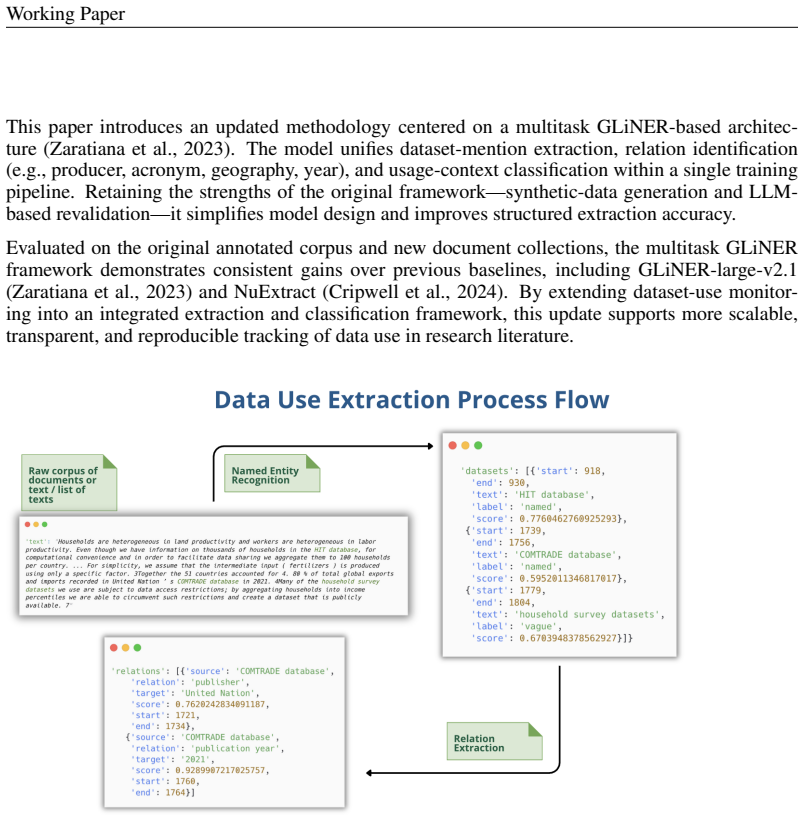
A multitask GLiNER framework extracts dataset mentions, relations, and usage contexts from papers by training on synthetic data validated by LLMs.
A machine-rendered reading of the paper's core claim, the machinery that carries it, and where it could break.
Core claim
The paper claims that a multitask GLiNER-based framework jointly performing dataset mention extraction, relation identification, and usage-context classification, when trained via synthetic data generation followed by LLM-based revalidation to remove incorrect mentions and enforce labeling consistency, yields improved reliability, coverage, and output consistency for monitoring dataset usage in real research literature.
What carries the argument
The multitask GLiNER-based framework that jointly extracts dataset mentions, identifies relations, and classifies usage contexts, powered by synthetic data generation and LLM revalidation to handle label scarcity.
If this is right
- Open-source tools become available for scalable dataset citation tracking across literature.
- Transparency and reproducibility improve through systematic monitoring of data use.
- Coverage of dataset mentions rises because the pipeline handles ambiguous references better.
- Labeling consistency across outputs increases due to the revalidation step.
- The method generalizes to unconstrained tracking of dataset citations in new papers.
Where Pith is reading between the lines
- Similar pipelines could monitor usage of code repositories or pretrained models in papers.
- Integration with existing scholarly search engines might allow users to query by dataset.
- Field-level patterns in dataset adoption could become visible once large-scale runs are performed.
- The same synthetic-plus-revalidation loop might reduce annotation costs for other information-extraction tasks in scientific text.
Load-bearing premise
Inconsistent citation practices, scarce labeled data, and ambiguous dataset references in papers can be overcome by synthetic data generation plus LLM revalidation to create training sets that produce reliable results on real literature.
What would settle it
Collect a new set of manually annotated real research papers for dataset mentions, relations, and usage contexts, then measure whether the trained model matches the manual labels at high accuracy and consistency.
Figures
read the original abstract
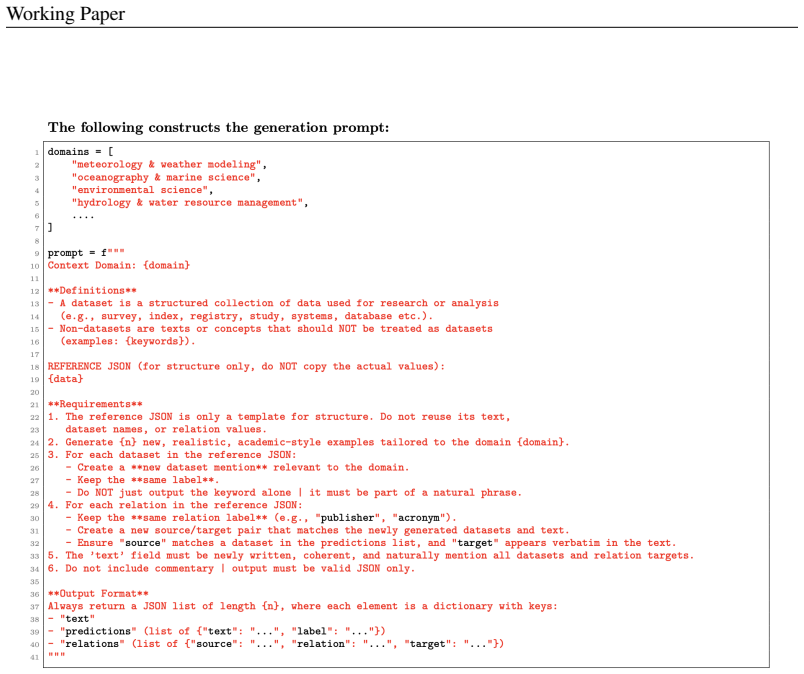
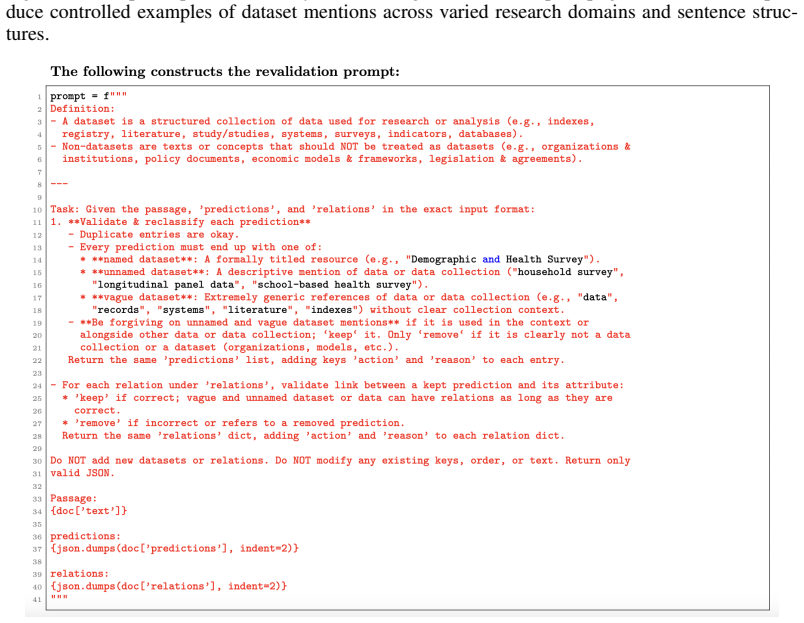
While platforms like Google Scholar and Semantic Scholar track citations for academic papers, no comparable infrastructure exists for monitoring dataset usage in research literature, leaving the landscape of data use largely opaque. Addressing this gap is critical for transparency, reproducibility, and monitoring of impact, yet progress is hindered by inconsistent citation practices, scarce labeled data, and ambiguous references to datasets in the wild. Traditional NLP approaches struggle with these challenges, motivating the shift toward more adaptive, semantically rich models. Building on prior work using LLMs for data mention detection and synthetic data for bootstrapping training, this paper presents an updated methodology for scalable dataset monitoring. We introduce a multitask GLiNER-based framework that jointly performs dataset mention extraction, relation identification, and usage-context classification. To address label scarcity, the pipeline leverages synthetic data generation to produce training examples and LLM-based revalidation to filter incorrect mentions and enforce labeling consistency, together improving reliability, coverage, and output consistency across the training pipeline. This work advances the development of open-source tools for monitoring data use in research literature, contributing to the broader goal of generalizable, unconstrained dataset citation tracking.
Editorial analysis
A structured set of objections, weighed in public.
Referee Report
Summary. The paper claims to introduce a multitask GLiNER-based framework that jointly performs dataset mention extraction, relation identification, and usage-context classification in research literature. To address label scarcity and inconsistent citation practices, it employs synthetic data generation combined with LLM-based revalidation to filter mentions and enforce consistency, with the goal of improving reliability, coverage, and output consistency for scalable dataset usage monitoring.
Significance. If the claimed improvements were demonstrated, the work would address a genuine gap in scholarly NLP infrastructure by providing open-source tools for dataset citation tracking, supporting reproducibility and impact assessment. The multitask formulation and synthetic+LLM bootstrapping represent a practical engineering response to real-world annotation challenges.
major comments (1)
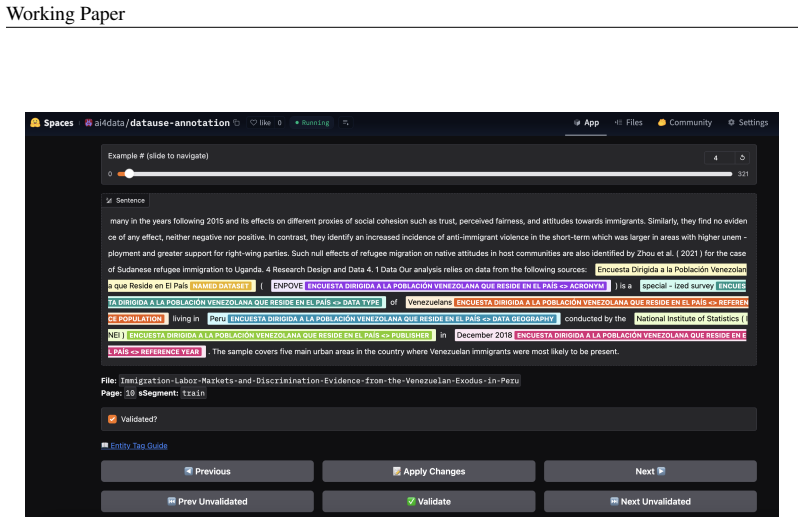
- [Abstract] Abstract: The central claim that synthetic data generation and LLM-based revalidation 'together improving reliability, coverage, and output consistency across the training pipeline' is unsupported by any evaluation. No precision/recall metrics, baseline comparisons, error analysis, or results on held-out real research literature are reported, nor is a human-annotated test set described. This absence is load-bearing because the entire contribution rests on the pipeline's ability to generalize to ambiguous, inconsistent dataset references in the wild.
Simulated Author's Rebuttal
We thank the referee for their review and the opportunity to respond. We address the single major comment below.
read point-by-point responses
-
Referee: [Abstract] Abstract: The central claim that synthetic data generation and LLM-based revalidation 'together improving reliability, coverage, and output consistency across the training pipeline' is unsupported by any evaluation. No precision/recall metrics, baseline comparisons, error analysis, or results on held-out real research literature are reported, nor is a human-annotated test set described. This absence is load-bearing because the entire contribution rests on the pipeline's ability to generalize to ambiguous, inconsistent dataset references in the wild.
Authors: We agree that the current manuscript does not report quantitative evaluations of the claimed improvements. The abstract and methodology sections describe the multitask GLiNER framework and the synthetic data + LLM revalidation pipeline but contain no precision/recall figures, baseline comparisons, error analysis, or results on held-out real literature, nor do they describe a human-annotated test set. This is a substantive limitation. In revision we will add a dedicated Experiments section that includes (1) a human-annotated test set drawn from recent research papers, (2) precision, recall, and F1 scores for mention extraction, relation identification, and usage-context classification, (3) comparisons against strong baselines, and (4) qualitative error analysis on ambiguous dataset references. revision: yes
Circularity Check
No circularity: engineering pipeline with no self-referential reductions
full rationale
The paper presents a multitask GLiNER framework for dataset mention extraction, relation identification, and usage-context classification, relying on synthetic data generation and LLM revalidation to address label scarcity. No equations, fitted parameters renamed as predictions, or load-bearing self-citations appear in the abstract or described full text. The central claims concern practical improvements in an applied NLP pipeline rather than any derivation that reduces by construction to its own inputs or prior self-referential results. The method is self-contained as an engineering contribution without invoking uniqueness theorems or ansatzes from the authors' prior work in a circular manner.
Axiom & Free-Parameter Ledger
Reference graph
Works this paper leans on
-
[1]
URLhttps://doi.org/10.1162/qss_a_00166
doi: 10.1162/qss a 00166. URLhttps://doi.org/10.1162/qss_a_00166. Tom Cripwell, Kartik Ramesh, David Salinas, Chengrun Luo, Grace Ong, Nan Yao, Yihong Zhang, Xiaodong Li, Edward Xie, and Jerry Wei. Nuextract: Structured information extraction at scale with large language models,
-
[2]
arXiv preprint arXiv:2409.15619
URLhttps://arxiv.org/abs/2409.15619. arXiv preprint arXiv:2409.15619. Anna Heddes, Ansgar Scherp, and Rihab Younes. The automatic detection of dataset names in scientific articles.Data, 6(8):84,
-
[3]
doi: 10.3390/data6080084. URLhttps://www. mdpi.com/2306-5729/6/8/84. Muhammad Hussain, Rihab Younes, and Ansgar Scherp. Extracting dataset references from scholarly publications using transformer models.Applied Sciences, 15(17):9331,
-
[4]
URLhttps://www.mdpi.com/2076-3417/15/17/9331
doi: 10.3390/app15179331. URLhttps://www.mdpi.com/2076-3417/15/17/9331. Hailey Mooney and Mark P. Newton. The anatomy of a data citation: Discovery, reuse, and credit.Journal of Librarianship and Scholarly Communication, 1(1):eP1035,
-
[5]
URLhttps://doi.org/10.7710/2162-3309.1035
doi: 10.7710/2162-3309.1035. URLhttps://doi.org/10.7710/2162-3309.1035. Heather A. Piwowar and Todd J. Vision. Data reuse and the open data citation advantage.PeerJ, 1: e175,
-
[6]
URLhttps://peerj.com/articles/175
doi: 10.7717/peerj.175. URLhttps://peerj.com/articles/175. Nancy Potok, Sebastian Szymczak, and Michal Grabowski. Automated extraction of dataset men- tions in scientific publications using weak supervision. InProceedings of the 13th International Conference on Knowledge Engineering and Ontology Development (KEOD 2022), pp. 163–
-
[7]
doi: 10.5220/0011580300003335. URLhttps://doi.org/10. 5220/0011580300003335. Gianmaria Silvello. Theory and practice of data citation.Journal of the Association for Information Science and Technology, 69(1):6–20,
-
[8]
Theory and Practice of Data Citation
doi: 10.1002/asi.23917. URLhttps://arxiv. org/abs/1706.07976. Aivin V . Solatorio and Rafael Macalaba. Ai for monitoring and classifying data used in re- search literature,
work page internal anchor Pith review Pith/arXiv arXiv doi:10.1002/asi.23917
-
[9]
arXiv preprint arXiv:2502.10263
URLhttps://arxiv.org/abs/2502.10263. arXiv preprint arXiv:2502.10263. World Bank. Documents & reports – all documents.https://documents.worldbank. org/en/publication/documents-reports,
-
[10]
Urchade Zaratiana, Nadi Tomeh, Pierre Holat, and Thierry Charnois
Accessed: 2025-10-30. Urchade Zaratiana, Nadi Tomeh, Pierre Holat, and Thierry Charnois. Gliner: Generalist model for named entity recognition using bidirectional transformer.arXiv preprint,
2025
-
[11]
URLhttp: //arxiv.org/abs/2311.08526. A APPENDIX A. Data details, B. Annotation schema, C. Prompt templates, D. Manual annotation interface, E. Metric definitions, F. Additional results. 10 Working Paper A.1 A. DATASOURCES This section provides additional details on the datasets used for training and evaluation. •World Bank Documents and Reports– repositor...
discussion (0)
Sign in with ORCID, Apple, or X to comment. Anyone can read and Pith papers without signing in.