Deterministic fabrication of large-area, high-crystallinity oxide moire superlattices
Pith reviewed 2026-06-29 06:03 UTC · model grok-4.3
The pith
A scalable method fabricates millimeter-scale oxide moire superlattices with twist angles controlled to 0.1 degrees.
A machine-rendered reading of the paper's core claim, the machinery that carries it, and where it could break.
Core claim
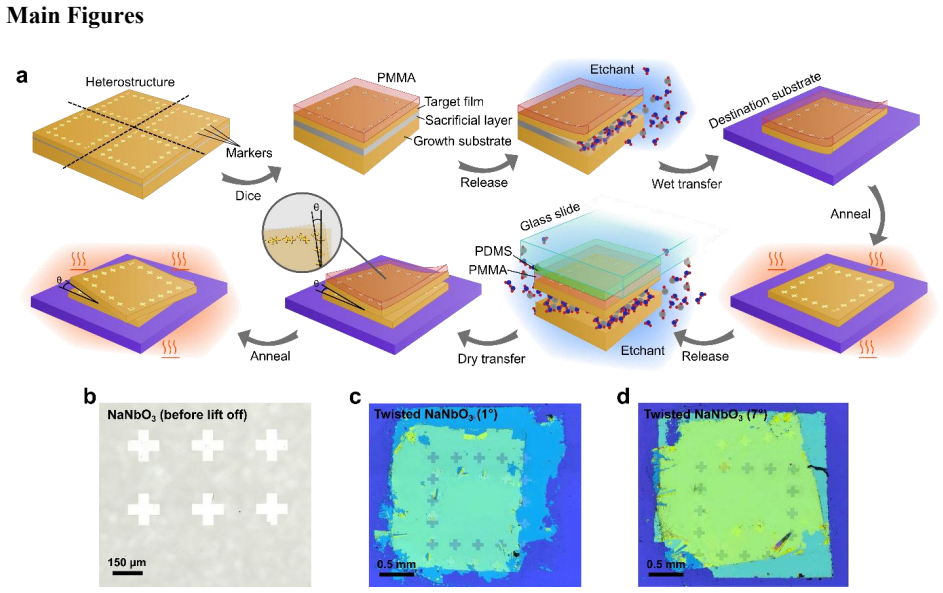
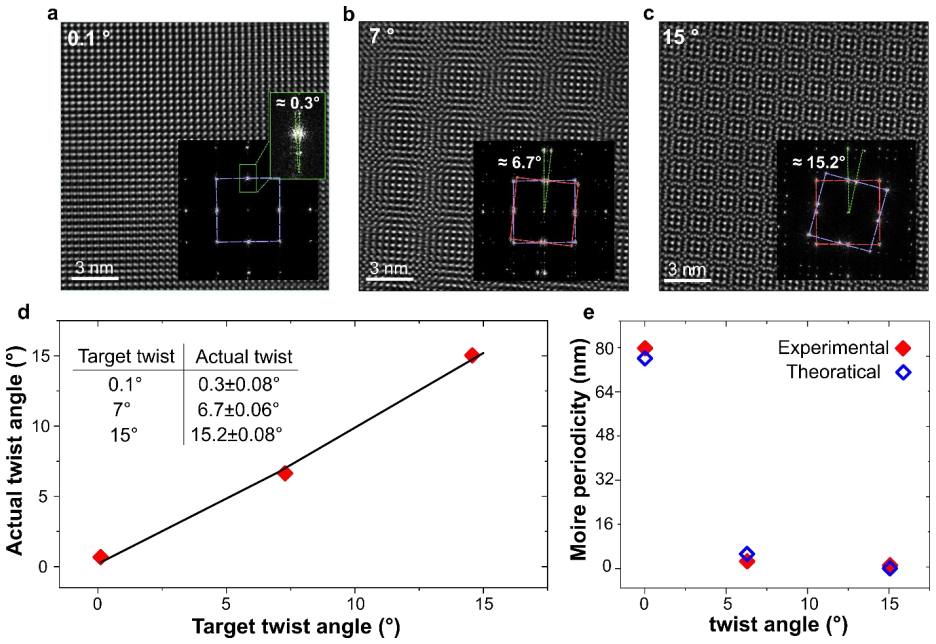
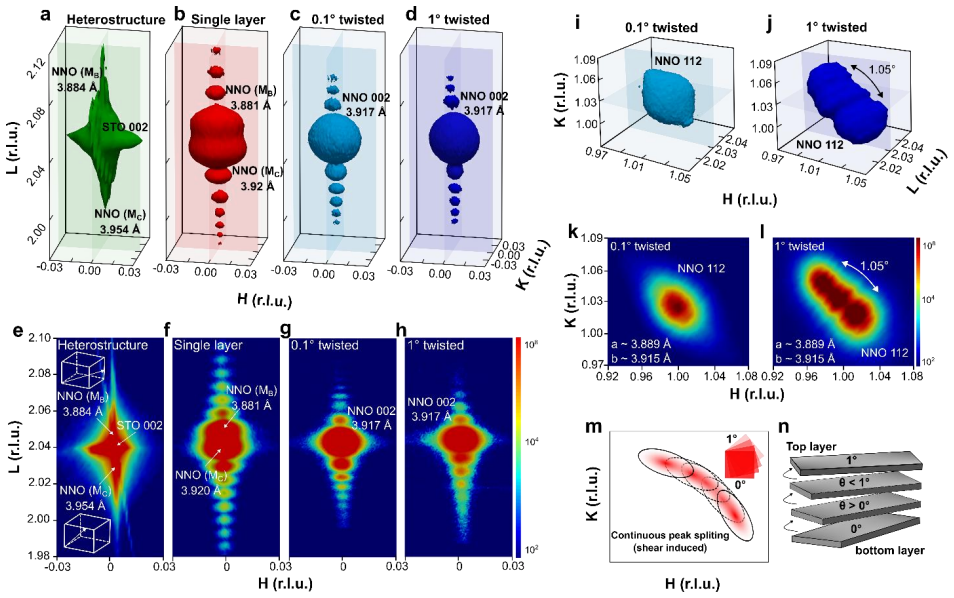
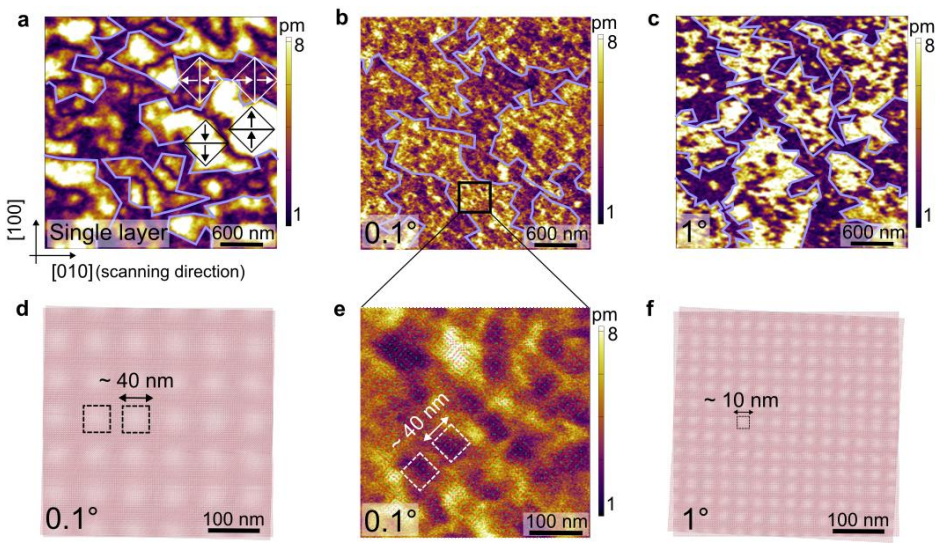
A deterministic fabrication strategy produces high-crystallinity oxide moire superlattices with clean chemically bonded interfaces and twist angles controlled down to nominal values of 0.1 degree across contiguous areas approaching the millimeter scale. In NaNbO3 twisted bilayers the interlayer coupling induces a single-phase state and gradual lattice rotation distributed through the thickness that accommodates shear strain, in contrast to mixed-phase structures in single-layer membranes and to in-plane rearrangements typical of van der Waals moire systems. These structural changes correlate with twist-dependent nanoscale electromechanical modulations observed by piezoresponse force microsco
What carries the argument
Twist-angle-controlled assembly of oxide membranes that forms chemically bonded interfaces and drives thickness-distributed lattice rotation and phase reconstruction.
Load-bearing premise
The single-phase state and lattice rotation signatures arise from the controlled interlayer twist rather than from defects or transfer-induced strain.
What would settle it
Synchrotron 3D reciprocal space maps of the twisted bilayers showing the same mixed-phase structure as the pre-twist single-layer membranes, or direct measurements showing twist-angle errors larger than the claimed sub-degree accuracy.
Figures
read the original abstract
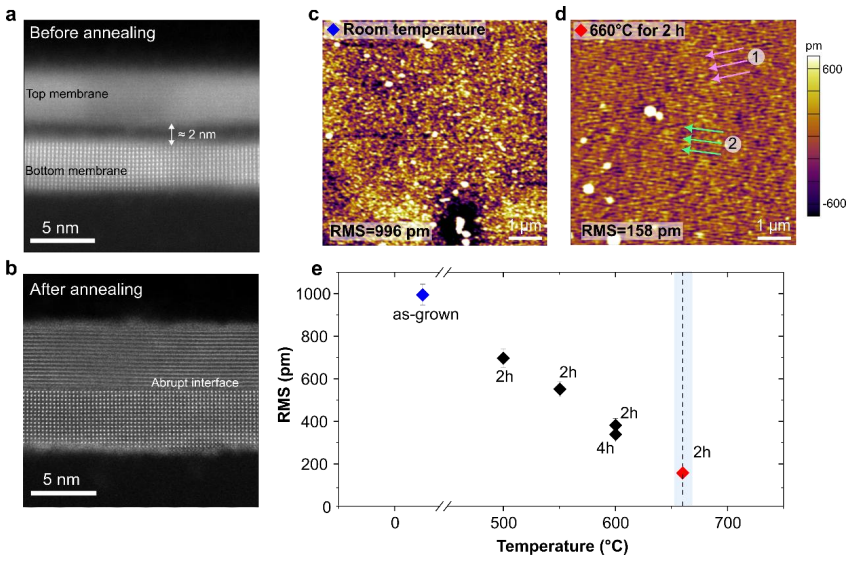
Oxide twistronics extends moire engineering beyond van der Waals materials, offering a promising platform for accessing emergent interfacial phenomena arising from the strong coupling of lattice, charge, and orbital degrees of freedom in complex oxides. However, deterministic fabrication of high-crystallinity oxide moire superlattices over large lateral dimensions remains challenging due to the three-dimensional bonding network of oxides. Here, we demonstrate a scalable, generalized fabrication strategy that enables the formation of high-crystallinity oxide moire superlattices with clean, chemically bonded interfaces and precisely controlled twist angles down to nominal values of 0.1 degree, achieving sub-degree twist-angle accuracy across large contiguous lateral dimensions approaching the millimeter scale. Using NaNbO3 as a model system, we show that the resulting interlayer coupling drives pronounced structural reconstruction that modifies both the phase structure and ferroelectric domain configuration. Synchrotron-based X-ray 3D reciprocal space mapping reveals the emergence of a single-phase state in twisted bilayers, in contrast to the mixed-phase structure observed in single-layer membranes prior to twist assembly. The structural signatures are further consistent with gradual lattice rotation distributed along the thickness direction that may accommodate interfacial shear strain, distinct from reconstruction observed in van der Waals moire systems, which primarily occurs through in-plane stacking rearrangement. This collective lattice response is correlated with twist-dependent nanoscale electromechanical modulations observed by piezoresponse force microscopy. These results establish a scalable materials platform for oxide twistronics and open new pathways towards integrating twist-engineered complex oxides into practical, macroscale device architectures.
Editorial analysis
A structured set of objections, weighed in public.
Referee Report
Summary. The manuscript presents a scalable fabrication strategy for deterministic assembly of large-area (mm-scale), high-crystallinity oxide moiré superlattices using NaNbO3 bilayers with sub-degree twist-angle control down to nominal 0.1°. It claims that the resulting interlayer coupling produces clean chemically bonded interfaces, drives emergence of a single-phase state (contrasting mixed-phase single-layer membranes), induces distributed lattice rotation along the thickness to accommodate interfacial shear, and yields twist-dependent nanoscale electromechanical modulations, as characterized by synchrotron 3D reciprocal space mapping and piezoresponse force microscopy.
Significance. If the attribution of the observed structural and electromechanical signatures specifically to twist-controlled interlayer coupling holds after appropriate controls, the work would establish a practical platform for oxide twistronics. This extends moiré engineering beyond van der Waals systems to complex oxides with strong lattice-charge-orbital coupling and enables macroscale device integration, addressing a key fabrication bottleneck.
major comments (1)
- [Abstract] Abstract and characterization sections: the central claim that the single-phase state and distributed lattice rotation arise from interlayer coupling due to the controlled twist (rather than residual strain, defects, or chemical changes from the membrane transfer process) is load-bearing. No control samples with identical transfer but zero nominal twist or random stacking are described to isolate the twist effect; without them, the attribution to twist-dependent coupling cannot be distinguished from fabrication artifacts to which the synchrotron mapping and PFM are sensitive.
minor comments (2)
- [Abstract] The abstract states 'sub-degree twist-angle accuracy' and 'approaching the millimeter scale' but provides no quantitative error bars, histograms of measured angles, or lateral uniformity metrics across the claimed area.
- [Abstract] The distinction from van der Waals moiré reconstruction (in-plane stacking vs. thickness-direction rotation) is noted but would benefit from a direct side-by-side comparison or quantitative metric of the rotation gradient.
Simulated Author's Rebuttal
We thank the referee for their thorough review and for highlighting the significance of our scalable fabrication approach for oxide moiré superlattices. We address the major comment regarding the need for additional controls to strengthen attribution of the observed effects specifically to twist-controlled interlayer coupling.
read point-by-point responses
-
Referee: [Abstract] Abstract and characterization sections: the central claim that the single-phase state and distributed lattice rotation arise from interlayer coupling due to the controlled twist (rather than residual strain, defects, or chemical changes from the membrane transfer process) is load-bearing. No control samples with identical transfer but zero nominal twist or random stacking are described to isolate the twist effect; without them, the attribution to twist-dependent coupling cannot be distinguished from fabrication artifacts to which the synchrotron mapping and PFM are sensitive.
Authors: We agree that isolating the twist effect from potential fabrication artifacts is critical for the central claims. The single-layer membranes, which experience identical transfer and handling, provide a baseline showing mixed-phase structure, while twisted bilayers exhibit single-phase reconstruction and distributed lattice rotation. The twist-dependent electromechanical modulations observed across multiple controlled twist angles further correlate the response with the nominal twist rather than uniform artifacts. Nevertheless, we acknowledge that explicit zero-twist (aligned) bilayer controls fabricated under identical conditions would provide stronger isolation of the interlayer coupling. In the revised manuscript we will add such control data and associated discussion to directly address this point. Random stacking controls are more challenging to realize deterministically but will be noted as a limitation. revision: yes
Circularity Check
No circularity: experimental fabrication and characterization with external controls
full rationale
This is a purely experimental paper on oxide membrane transfer, stacking, and synchrotron/PFM characterization. No equations, fitted parameters, derivations, or predictions appear in the provided text. Central claims rest on direct comparison of twisted bilayers to single-layer controls and on external measurement techniques, none of which reduce to self-definition or self-citation chains. The attribution of single-phase state and lattice rotation to interlayer coupling is presented as an interpretation of observed data rather than a mathematical result derived from prior inputs. Standard experimental workflow; no load-bearing circular steps identified.
Axiom & Free-Parameter Ledger
Reference graph
Works this paper leans on
-
[1]
Pryds et al., Twisted oxide membranes: A perspective
N. Pryds et al., Twisted oxide membranes: A perspective. APL Mater. 12, 010901 (2024)
2024
-
[2]
Choo et al
S. Choo et al. , From oxide epitaxy to freestanding membranes: Opportunities and challenges. Sci. Adv. 10, eadq8561 (2024)
2024
-
[3]
Catalan, The birth of oxide twistronics
G. Catalan, The birth of oxide twistronics. Matter 8, 1-2 (2025)
2025
-
[4]
Cao et al
Y. Cao et al. , Unconventional superconductivity in magic -angle graphene superlattices. Nature 556, 43-50 (2018)
2018
-
[5]
Sánchez -Santolino et al
G. Sánchez -Santolino et al. , A 2D ferroelectric vortex pattern in twisted BaTiO 3 freestanding layers. Nature 626, 529-534 (2024)
2024
-
[6]
Sha et al., Polar vortex hidden in twisted bilayers of paraelectric SrTiO3
H. Sha et al., Polar vortex hidden in twisted bilayers of paraelectric SrTiO3. Nat. Commun. 15, 10915 (2024)
2024
-
[7]
N. A. Shahed et al., Prediction of polarization vortices, charge modulation, flat bands, and moiré magnetism in twisted oxide bilayers. Phys. Rev. B 111, 195420 (2025)
2025
-
[8]
Lee et al., Moiré polar vortex, flat bands, and Lieb lattice in twisted bilayer BaTiO3
S. Lee et al., Moiré polar vortex, flat bands, and Lieb lattice in twisted bilayer BaTiO3. Sci. Adv. 10, eadq0293 (2024)
2024
-
[9]
Prosandeev et al., Understanding and controlling dipolar Moiré pattern in ferroelectric perovskite oxide nanolayers
S. Prosandeev et al., Understanding and controlling dipolar Moiré pattern in ferroelectric perovskite oxide nanolayers. Phys. Rev. B 111, L180103 (2025)
2025
-
[10]
D. T. Larson et al., Stacking-dependent electronic structure of ultrathin perovskite bilayers. Phys. Rev. B 111, 125131 (2025)
2025
-
[11]
Xu et al., Strain-induced room-temperature ferroelectricity in SrTiO 3 membranes
R. Xu et al., Strain-induced room-temperature ferroelectricity in SrTiO 3 membranes. Nat. Commun. 11, 3141 (2020)
2020
-
[12]
Pesquera et al., Beyond substrates: strain engineering of ferroelectric membranes
D. Pesquera et al., Beyond substrates: strain engineering of ferroelectric membranes. Adv. Mater. 32, 2003780 (2020)
2020
-
[13]
Han et al., Freestanding perovskite oxide membranes: a new playground for novel ferroic properties and applications
L. Han et al., Freestanding perovskite oxide membranes: a new playground for novel ferroic properties and applications. Adv. Funct. Mater. 34, 2309543 (2024)
2024
-
[14]
Li et al
B. Li et al. , Emergent Freestanding Complex Oxide Membranes for Multifunctional Applications. Adv. Mater., e21388 (2026)
2026
-
[15]
Ji et al., Freestanding crystalline oxide perovskites down to the monolayer limit
D. Ji et al., Freestanding crystalline oxide perovskites down to the monolayer limit. Nature 570, 87-90 (2019)
2019
-
[16]
Lu et al., Synthesis of freestanding single -crystal perovskite films and heterostructures by etching of sacrificial water-soluble layers
D. Lu et al., Synthesis of freestanding single -crystal perovskite films and heterostructures by etching of sacrificial water-soluble layers. Nat. Mater. 15, 1255-1260 (2016). 23
2016
-
[17]
Wu et al
P.-C. Wu et al. , Twisted oxide lateral homostructures with conjunction tunability. Nat. Commun. 13, 2565 (2022)
2022
-
[18]
Harbola et al
V. Harbola et al. , Experimental progress in freestanding oxide membranes designed by epitaxy. Adv. Phys. X 10, 2450538 (2025)
2025
-
[19]
Kim et al., Charge Disproportionation at Twisted SrTiO3 Bilayer Interface Driven by Local Atomic Registry
M.-S. Kim et al., Charge Disproportionation at Twisted SrTiO3 Bilayer Interface Driven by Local Atomic Registry. ACS Nano 19, 39714-39724 (2025)
2025
- [20]
-
[21]
Wang et al
H. Wang et al. , Interface Design beyond Epitaxy: Oxide Heterostructures Comprising Symmetry‐Forbidden Interfaces. Adv. Mater. 36, 2405065 (2024)
2024
-
[22]
Kim et al., Establishing Atomic Coherence in Twisted Oxide Membranes Containing Volatile Elements
Y.-H. Kim et al., Establishing Atomic Coherence in Twisted Oxide Membranes Containing Volatile Elements. arXiv:2601.20108 (2026)
-
[23]
Tear‐And‐Stack
Y. Zhang et al. , “Tear‐And‐Stack” Twisted SrTiO 3 Moiré Superlattices for Precise Interfacial Reconstruction and Polar Topology. Adv. Mater. 38, e19300 (2025)
2025
-
[24]
Kamba et al., Incipient ferroelectric properties of NaTaO3
S. Kamba et al., Incipient ferroelectric properties of NaTaO3. Ferroelectrics 426, 206-214 (2012)
2012
-
[25]
He et al., Moiré patterns in 2D materials: a review
F. He et al., Moiré patterns in 2D materials: a review. ACS Nano 15, 5944-5958 (2021)
2021
-
[26]
Lopes dos Santos et al., Graphene bilayer with a twist: Electronic structure
J. Lopes dos Santos et al., Graphene bilayer with a twist: Electronic structure. Phys. Rev. Lett. 99, 256802 (2007)
2007
-
[27]
Ghanbari et al., Strain-induced lead-free morphotropic phase boundary
R. Ghanbari et al., Strain-induced lead-free morphotropic phase boundary. Nat. Commun. 16, 7766 (2025)
2025
-
[28]
J. S. Alden et al., Strain solitons and topological defects in bilayer graphene. Proc. Natl. Acad. Sci. U.S.A. 110, 11256-11260 (2013)
2013
-
[29]
N. N. Nam, M. Koshino, Lattice relaxation and energy band modulation in twisted bilayer graphenes. Phys. Rev. B 96, 075311 (2017)
2017
-
[30]
Carr et al
S. Carr et al. , Relaxation and domain formation in incommensurate two -dimensional heterostructures. Phys. Rev. B 98, 224102 (2018)
2018
-
[31]
Yoo et al., Atomic and electronic reconstruction at the van der Waals interface in twisted bilayer graphene
H. Yoo et al., Atomic and electronic reconstruction at the van der Waals interface in twisted bilayer graphene. Nat. Mater. 18, 448-453 (2019)
2019
-
[32]
Xu et al
R. Xu et al. , Size‐Induced Ferroelectricity in Antiferroelectric Oxide Membranes. Adv. Mater. 35, 2210562 (2023). 24
2023
-
[33]
KP et al ., Electron ptychography reveals a ferroelectricity dominated by anion displacements
H. KP et al ., Electron ptychography reveals a ferroelectricity dominated by anion displacements. Nat. Mater. 24.9, 1433-1440 (2025)
2025
discussion (0)
Sign in with ORCID, Apple, or X to comment. Anyone can read and Pith papers without signing in.