REVIEW 2 major objections 2 minor 3 references
Diffusion Models Preferentially Memorize Prototypical Examples or: Why Does My Diffusion Model Love Slop?
T0 review · 2 major / 2 minor · reviewed 2026-06-29 · grok-4.3
Pith's one-line read Diffusion models memorize samples built from common substrings first, even when all training examples are unique.
desk verdict RHM string experiments show diffusion models memorize common-substring samples first even when unique, but the link to real diffusion slop is untested. read the letter →
The pith
A machine-rendered reading of the paper's core claim, the machinery that carries it, and where it could break.
The reading
What carries the argument
The Random Hierarchy Model production rules, which create hierarchical strings whose substring frequencies can be controlled independently of sample uniqueness.
What would settle it
Train a diffusion model on a dataset engineered so that atypical samples outnumber typical ones at every hierarchy level, then check whether atypical samples are still memorized later than typical ones.
Extended reading notes
Core claim
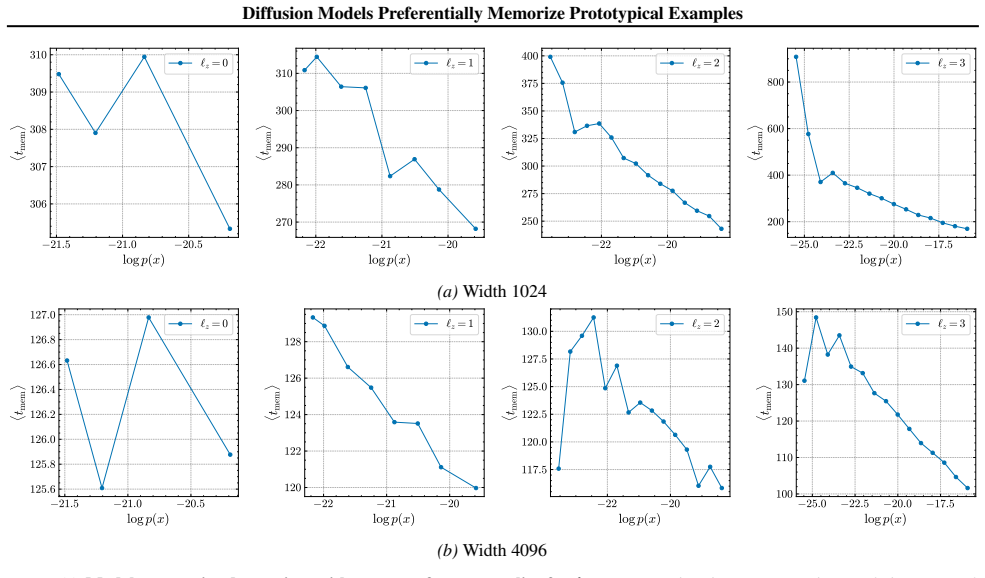
Samples composed of common substrings are preferentially memorized by diffusion models, even when the training set consists entirely of unique samples; fat-tailed distributions delay memorization overall, and an intermediate partial-memorization regime causes models to overproduce common patterns during generation.
Load-bearing premise
The memorization patterns observed in Random Hierarchy Model data transfer to the real-world datasets used to train diffusion models.
Editorial extensions
If this is right
- Deduplication at the individual sample level does not prevent memorization of common substrings.
- Reducing diversity at higher abstraction levels increases the speed and extent of memorization.
- Stopping training before full convergence produces models that overgenerate prototypical patterns.
- Dataset diversity at multiple hierarchy levels is required to postpone memorization.
Reading between the lines
- The same substring-frequency bias may appear in other generative architectures trained on hierarchically structured data.
- Early-stopped models could be deliberately tuned to avoid the partial-memorization regime by monitoring substring reproduction rates.
- Real datasets with natural long-tail statistics at abstract levels may already exhibit the delayed-memorization effect without explicit construction.
Editorial analysis
A structured set of objections, weighed in public.
Referee Report
Summary. The paper claims that diffusion models preferentially memorize samples composed of common substrings (prototypical examples) when trained on strings from the Random Hierarchy Model (RHM), even if all training samples are unique. It predicts and observes delayed memorization in fat-tailed regimes (especially when fat tails appear in high-level production rules), and identifies an intermediate partial-memorization regime in which common substrings are overproduced, producing the reversion-to-the-mean outputs termed 'slop'.
Significance. If the RHM results generalize, the work supplies a controlled, mechanistic account of memorization order and its link to output blandness, with the prediction-then-observation of delayed memorization in fat-tailed data constituting a clear strength. The hierarchical generative process isolates the role of substring frequency and abstraction level, offering concrete guidance on dataset diversity that could be tested in other settings.
major comments (2)
- [§4 (RHM diffusion experiments)] §4 (RHM diffusion experiments): all quantitative results and the central claim rest on discrete diffusion models trained exclusively on RHM-generated strings; no experiments, ablations, or controls are reported on continuous or discrete diffusion models trained on image, audio, or natural-language corpora, so the extrapolation to deployed diffusion models stated in the title and abstract remains unsupported.
- [§5 (partial-memorization regime)] §5 (partial-memorization regime): the identification of an 'intermediate regime' in which common substrings are learned first and then overproduced is described qualitatively; no quantitative metric for overproduction, no statistical tests across random seeds, and no comparison against a null model of uniform generation are provided, weakening the link to observed 'slop'.
minor comments (2)
- [Abstract and §2] Abstract and §2: the phrase 'we predict, then observe' should be accompanied by an explicit statement of the a-priori prediction (e.g., a specific functional form or ordering) so readers can assess how closely the later observation matches it.
- [Notation throughout] Notation throughout: 'prototypical examples' is used interchangeably with 'samples composed of common substrings'; a short formal definition or mapping to RHM production-rule frequencies would remove ambiguity.
Simulated Author's Rebuttal
We thank the referee for the positive evaluation of the work's significance and for the detailed comments. We address the two major comments point by point below.
read point-by-point responses
-
Referee: §4 (RHM diffusion experiments): all quantitative results and the central claim rest on discrete diffusion models trained exclusively on RHM-generated strings; no experiments, ablations, or controls are reported on continuous or discrete diffusion models trained on image, audio, or natural-language corpora, so the extrapolation to deployed diffusion models stated in the title and abstract remains unsupported.
Authors: The RHM was selected as a controlled generative process that isolates the effects of substring frequency and abstraction level while reproducing compositional structure and frequency variation found in many real datasets. This design permits causal statements about memorization order that are otherwise confounded by unknown statistics in natural corpora. We nevertheless agree that the title and abstract frame the results in general terms. In revision we will (i) qualify the abstract and introduction to state that the preferential memorization of prototypical examples is demonstrated on RHM data, (ii) add an explicit limitations paragraph discussing the modeling assumptions, and (iii) outline concrete predictions that could be tested on image or text diffusion models. These changes will make the scope of the claims precise without requiring new large-scale experiments. revision: partial
-
Referee: §5 (partial-memorization regime): the identification of an 'intermediate regime' in which common substrings are learned first and then overproduced is described qualitatively; no quantitative metric for overproduction, no statistical tests across random seeds, and no comparison against a null model of uniform generation are provided, weakening the link to observed 'slop'.
Authors: We accept that the current presentation of the partial-memorization regime is primarily qualitative. In the revised manuscript we will introduce a concrete overproduction metric (the ratio of the empirical frequency of high-frequency substrings in generated samples to their frequency in the training distribution) and report means and standard deviations across five independent random seeds. We will also add a uniform-generation null model baseline and perform a statistical comparison showing that the observed bias is significantly larger than the null expectation. These additions will provide a quantitative anchor for the connection to reversion-to-the-mean outputs. revision: yes
Circularity Check
No circularity: claims rest on direct experiments within RHM setup
full rationale
The paper reports empirical results from training diffusion models on strings generated by the Random Hierarchy Model (RHM) production rules. The central observation—that samples with common substrings are preferentially memorized even when all training points are unique—is presented as an experimental finding, not derived from any fitted parameter or self-referential definition. The 'predict then observe' statement for delayed memorization in fat-tailed regimes is a hypothesis tested inside the same controlled generative process rather than a quantity forced by construction. No equations, self-citations, or ansatzes are shown to reduce the reported effects to the inputs. The work is self-contained as an experimental study on a synthetic hierarchical model; absence of real-world diffusion experiments on images or text is a limitation of scope, not a circularity.
Assumptions & free parameters
assumptions (1)
- domain assumption Random Hierarchy Model production rules generate strings whose substring statistics control memorization order in diffusion models
Cite this review
Pith. "Pith review of Diffusion Models Preferentially Memorize Prototypical Examples or: Why Does My Diffusion Model Love Slop?." pith.science (2026). https://pith.science/paper/HK2SEFI7
@misc{pith2026260530642,
  author       = {Pith},
  title        = {Pith review of: Diffusion Models Preferentially Memorize Prototypical Examples or: Why Does My Diffusion Model Love Slop?},
  year         = {2026},
  howpublished = {\url{https://pith.science/paper/HK2SEFI7}},
  note         = {Machine review of arXiv:2605.30642}
}
read the original abstract
Generative models have a persistent limitation: their tendency to memorize training data can create legal liabilities and erode creative diversity. Understanding which samples are memorized in whole or in part, and under what conditions, therefore remains an important open problem. Here we answer the question "Are atypical or rare samples memorized first?" in the negative. We train diffusion models on strings generated according to the production rules of the Random Hierarchy Model (RHM), and find that samples composed of common substrings are preferentially memorized. This holds true even if the training data consists of entirely unique samples, indicating that deduplication at the data point level does not provide a meaningful privacy guarantee. Correspondingly we predict, then observe, delayed memorization for fat-tailed datasets (i.e., those with more atypical samples). This effect is amplified when fat-tails are introduced into high-level production rules. These together suggest that dataset diversity, particularly at higher levels of abstraction, plays an important role in staving off memorization. Finally, we identify an intermediate regime of partial memorization in which common substrings are learned first and subsequently overproduced during generation. If training is stopped in this regime, models will exhibit the reversion-to-the-mean blandness often derided as "slop".
Figures


Figures from the paper (16 more)




Reference graph
Works this paper leans on
-
[1]
URLhttps://doi.org/10.18653/ v1/2022.acl-long.577
URL https://arxiv.org/abs/2605.2 7734. Lee, K., Ippolito, D., Nystrom, A., Zhang, C., Eck, D., Callison-Burch, C., and Carlini, N. Deduplicating train- ing data makes language models better. In Muresan, S., Nakov, P., and Villavicencio, A. (eds.),Proceedings of the 60th Annual Meeting of the Association for Compu- tational Linguistics (Volume 1: Long Pape...
-
[2]
Hierarchical Text-Conditional Image Generation with CLIP Latents
doi: 10.48550/arXiv.2204.06125. Rombach, R., Blattmann, A., Lorenz, D., Esser, P., and Ommer, B. High-Resolution Image Synthesis with Latent Diffusion Models . In2022 IEEE/CVF Conference on Computer Vision and Pattern Recognition (CVPR). IEEE Computer Society, June 2022. doi: 10.1109/CVPR52688. 2022.01042. URL https://doi.ieeecomputer society.org/10.1109/...
work page Pith review arXiv doi:10.48550/arxiv.2204.06125 2022
-
[3]
bald”) and some of which have strong correlations (e.g. “red hair
doi: 10.48550/arXiv.2407.19262. Tirumala, K., Markosyan, A. H., Zettlemoyer, L., and Agha- janyan, A. Memorization without overfitting: Analyzing the training dynamics of large language models. In Oh, A. H., Agarwal, A., Belgrave, D., and Cho, K. (eds.),Ad- vances in Neural Information Processing Systems, 2022. URL https://openreview.net/forum?id= u3vEuRr...
Reviewed June 29, 2026 · model on record in the stance chip above.
Discussion (0). Continue with ORCID to comment.