Optimized basis of covariant density functional theory: point coupling functionals and excited states
Pith reviewed 2026-06-28 20:54 UTC · model grok-4.3
The pith
Optimizing the oscillator frequency in the harmonic oscillator basis substantially improves accuracy for binding energies, fission barriers, and single-particle states in point-coupling covariant density functionals with truncated bases.
A machine-rendered reading of the paper's core claim, the machinery that carries it, and where it could break.
Core claim
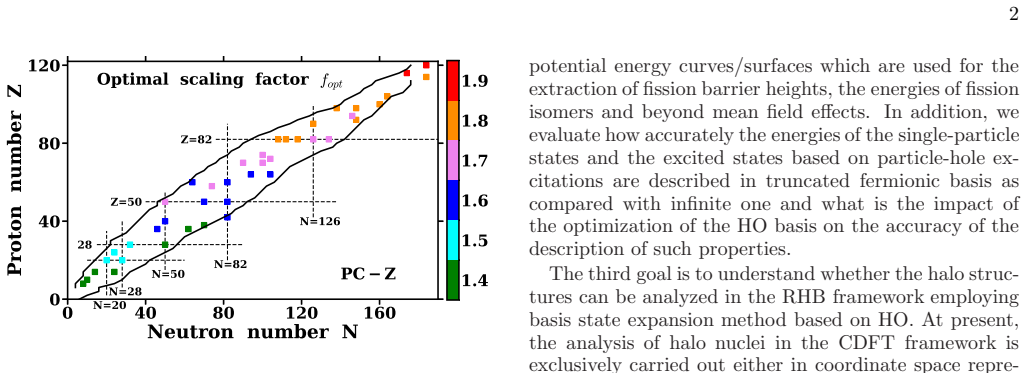
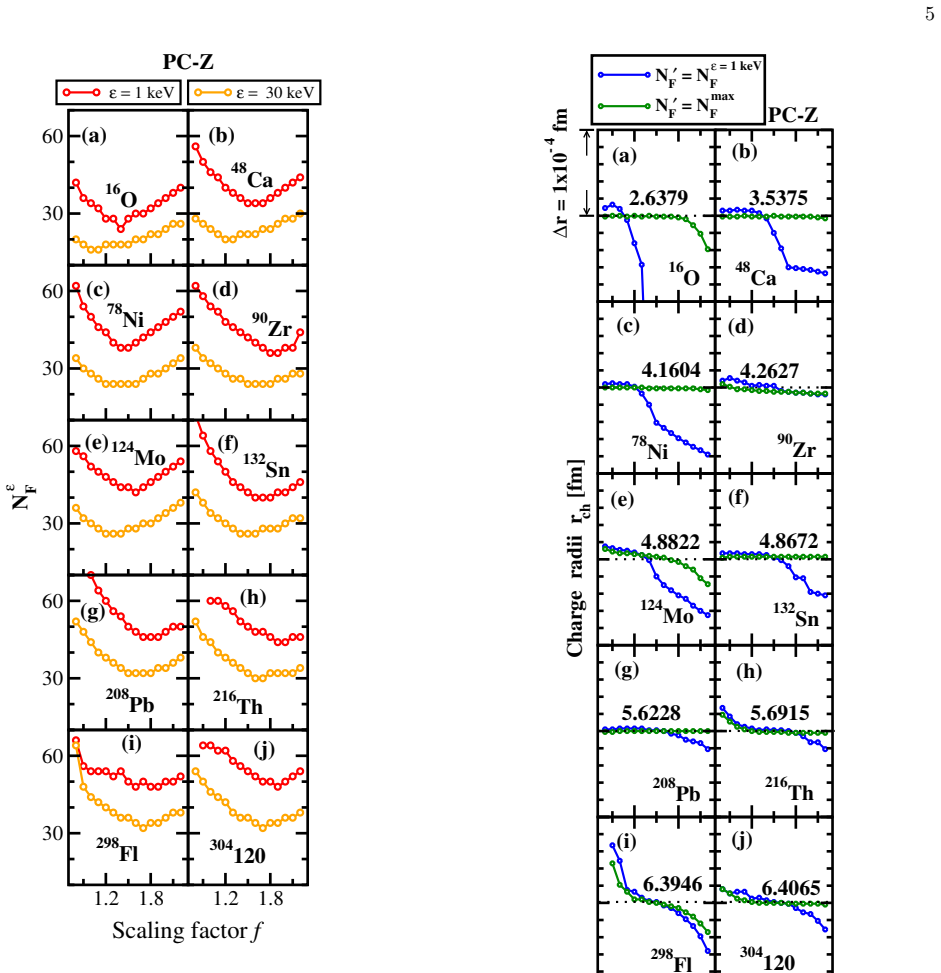
Using infinite-basis or extrapolated solutions as benchmarks, optimization of the oscillator frequency ħω₀ leads to substantial improvement in the description of binding energies, fission potential energy curves, and single-particle energies for point-coupling CEDFs in bases truncated at N_F; the same optimization also reproduces halo densities in very large HO bases.
What carries the argument
The mass-dependent scaling factors f_opt(A) that set the optimal oscillator frequency ħω₀ for a chosen basis size N_F in point-coupling covariant energy density functionals.
If this is right
- Fission barriers and isomers in actinides and superheavy nuclei are described more accurately once the basis size reaches N_F = 20.
- Binding energies reach a target accuracy ε with smaller bases after global optimization of f_opt(A).
- Energies of bound single-particle states improve except for weakly bound neutron states with l = 0, 1, or 2.
- Neutron halo densities obtained in coordinate-space calculations are reproduced once very large HO bases are used.
Where Pith is reading between the lines
- The same optimization procedure could lower computational cost for systematic surveys of deformed or exotic nuclei.
- Extension to time-odd fields or time-dependent calculations might reveal further gains in accuracy for collective excitations.
- The approach could be tested on other classes of covariant or non-relativistic functionals to check transferability.
Load-bearing premise
That infinite-basis or extrapolated solutions provide sufficiently accurate benchmarks against which to judge and optimize the finite-basis results.
What would settle it
Direct comparison of the optimized finite-N_F results against independent coordinate-space calculations for binding energies or fission barriers across a range of nuclei would falsify the improvement if large systematic discrepancies remain.
Figures
read the original abstract
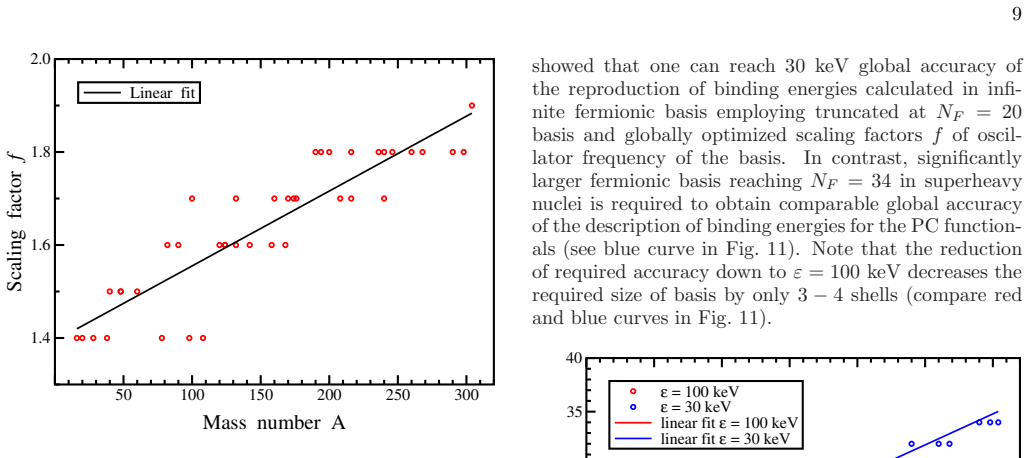
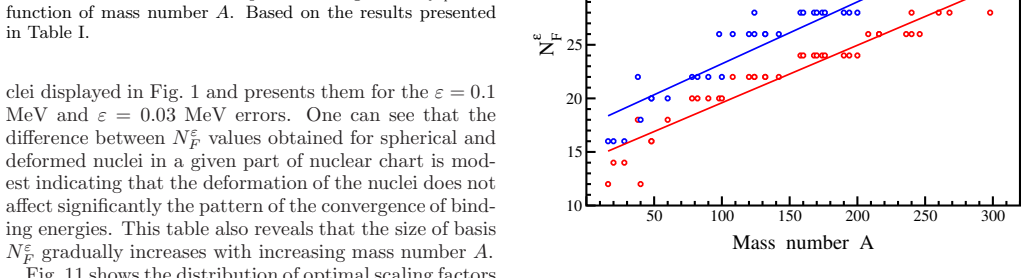
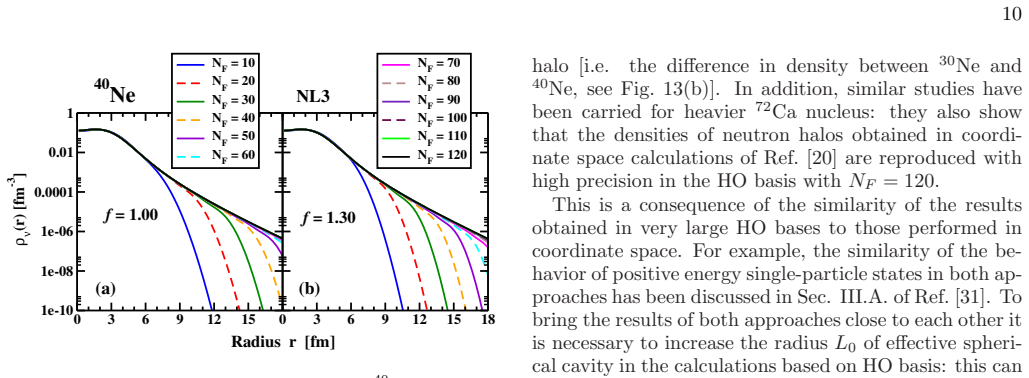
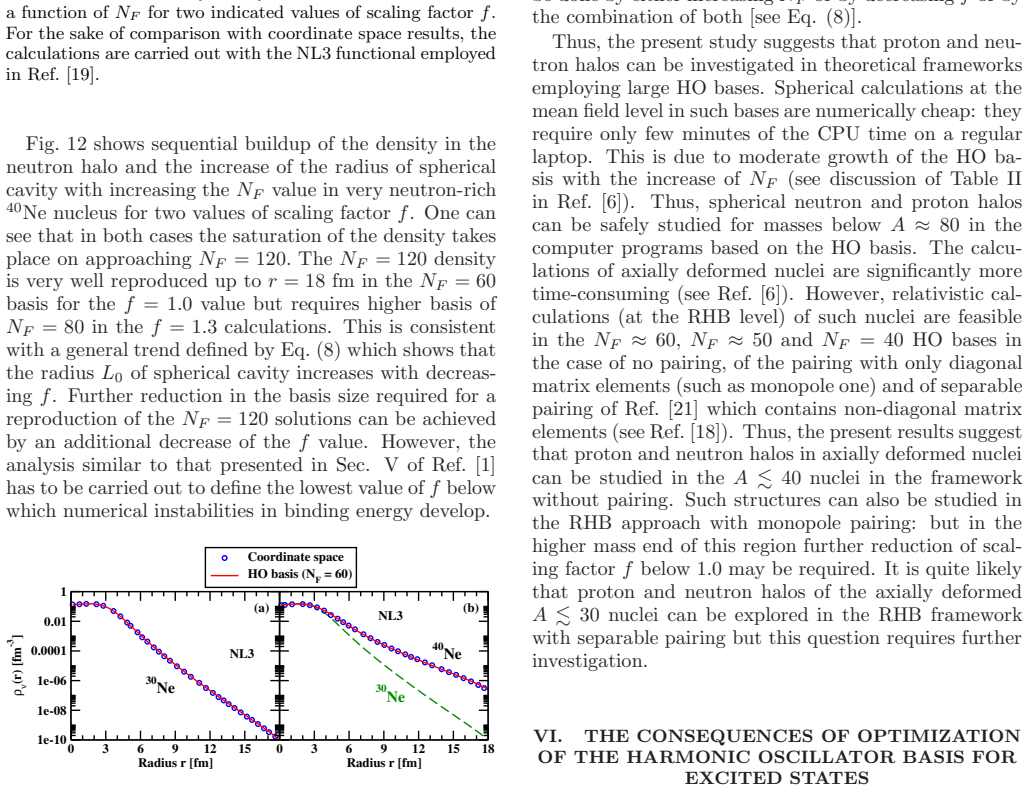
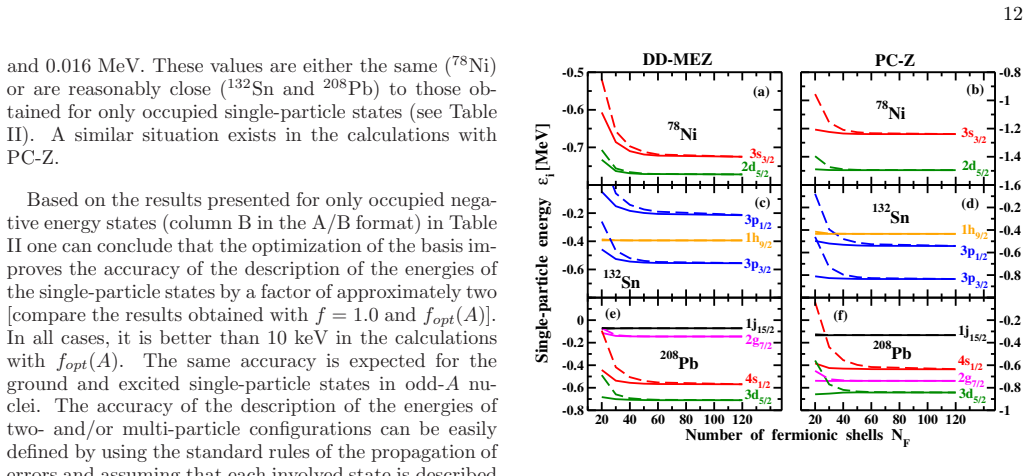
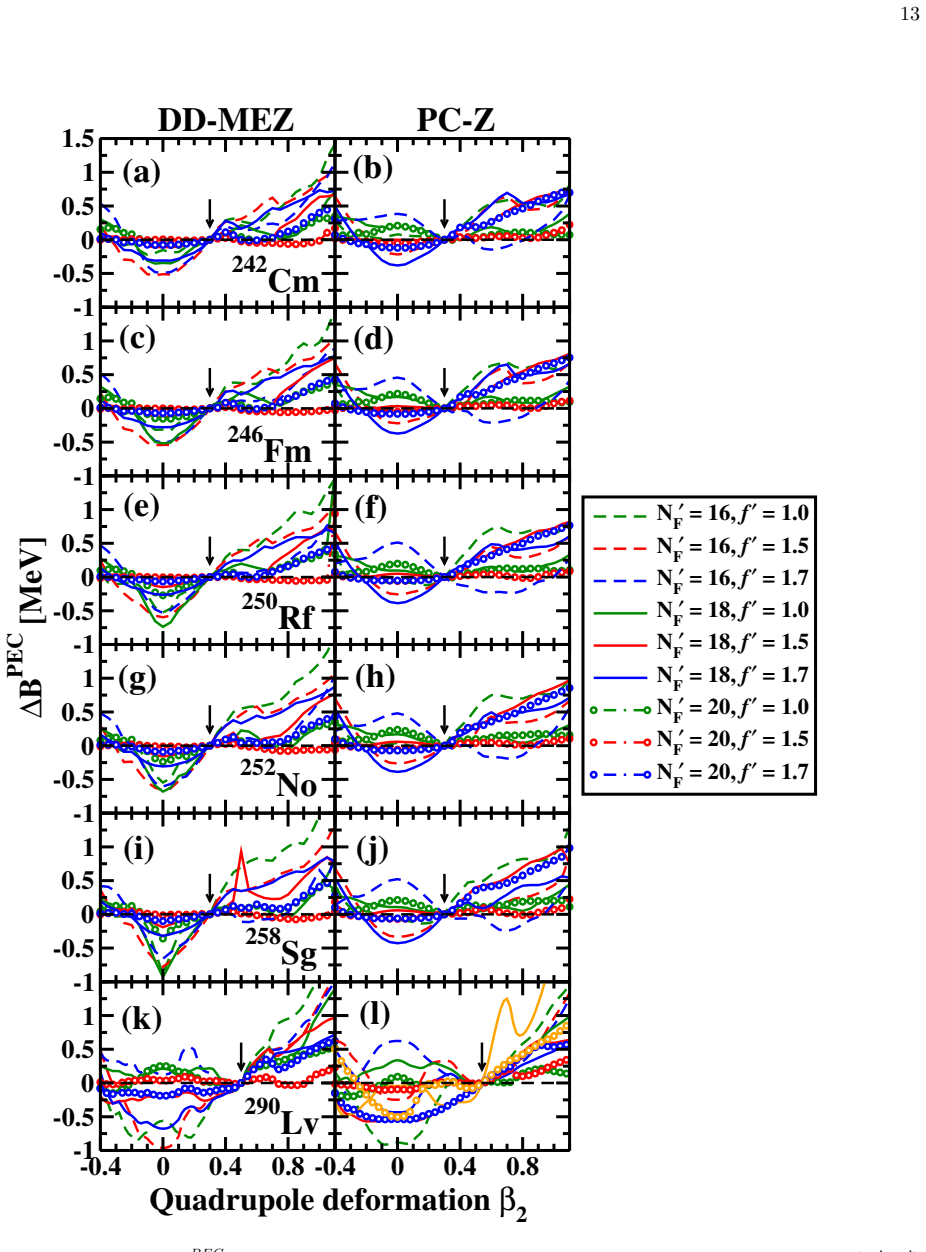
The present investigation focuses on the improvement of the accuracy of the description of physical observables of interest in moderately sized fermionic basis within the framework of covariant density functional theory. It extends previous study of Ref. [1] to point coupling (PC) covariant energy density functionals (CEDFs) and to excited states. Using as a benchmark the solutions corresponding either to infinite fermionic basis or those extrapolated to such a basis it is shown that the optimization of oscillator frequency $\hbar\omega_0$ of the harmonic oscillator (HO) basis leads to a substantial improvement in the description of different physical observables in the fermionic basis truncated at $N_F$. Globally optimized scaling factors $f_{opt}(A)$ of the oscillator frequency and the sizes $N_F^{\varepsilon}$ of the HO bases providing the required accuracy $\varepsilon$ in the calculations of the binding energies are generated for the PC functionals. The optimization of the basis also significantly improves the accuracy of the description of potential energy curves, defining the fission barriers and fission isomers in actinides and superheavy nuclei, provided that the size of the basis is at least equal to $N_F=20$. The optimization of the HO basis improves the accuracy of the description of the energies of bound single-particle states: the only exceptions are weakly bound neutron states with low orbital momenta $l=0$, 1 and 2. It is demonstrated for the first time that the halo densities of neutron halo nuclei generated in the coordinate space calculations are well reproduced in the calculations with very large fermionic HO bases.
Editorial analysis
A structured set of objections, weighed in public.
Referee Report
Summary. The manuscript extends prior work on optimizing the harmonic oscillator basis in covariant density functional theory (Ref. [1]) to point-coupling CEDFs. It claims that globally optimized mass-dependent scaling factors f_opt(A) for the oscillator frequency ħω₀, together with recommended basis sizes N_F^ε, yield substantial improvements in binding energies, fission potential-energy surfaces, single-particle energies, and neutron-halo densities when finite bases (truncated at N_F) are compared against infinite-basis or extrapolated solutions.
Significance. If the central claims hold, the work supplies concrete, transferable prescriptions (f_opt(A) and N_F^ε tables) that improve the practical accuracy of PC-CEDF calculations for ground-state, fission, and excited-state observables without enlarging the basis. This is particularly useful for computationally intensive applications such as fission in actinides and superheavy nuclei, and it provides the first explicit demonstration that very large HO bases can reproduce coordinate-space halo densities.
major comments (2)
- [Abstract and benchmark section] Abstract and the section describing the benchmark procedure: the optimization is performed against infinite-basis or extrapolated solutions, yet the manuscript does not quantify the uncertainty or possible systematic bias of the extrapolation itself for fission barriers or near-continuum single-particle states. Because the reported improvements are measured exclusively relative to these benchmarks, any truncation or fitting bias in the extrapolation would be absorbed into f_opt(A) rather than corrected; this is load-bearing for the central claim that the optimized finite-basis results are more accurate.
- [Single-particle states section] Section on single-particle states and excited states: the paper notes exceptions for weakly bound neutron states with l = 0, 1, 2, but does not provide a quantitative breakdown (e.g., rms deviation or percentage of states affected) showing how these exceptions impact the overall accuracy claim for excited states. Without such statistics, it is unclear whether the improvement remains substantial once the exceptional cases are included.
minor comments (2)
- Notation: the definition and range of applicability of f_opt(A) should be stated explicitly in a dedicated equation or table rather than only in the text, to avoid ambiguity when readers apply the factors to new nuclei.
- The manuscript should include a short comparison table (or reference to supplementary material) showing the numerical improvement in binding energies or barrier heights before and after optimization for at least one representative set of nuclei.
Simulated Author's Rebuttal
We are grateful to the referee for the detailed and insightful comments on our manuscript. Below we provide point-by-point responses to the major comments. We believe these clarifications and proposed revisions will strengthen the paper.
read point-by-point responses
-
Referee: [Abstract and benchmark section] Abstract and the section describing the benchmark procedure: the optimization is performed against infinite-basis or extrapolated solutions, yet the manuscript does not quantify the uncertainty or possible systematic bias of the extrapolation itself for fission barriers or near-continuum single-particle states. Because the reported improvements are measured exclusively relative to these benchmarks, any truncation or fitting bias in the extrapolation would be absorbed into f_opt(A) rather than corrected; this is load-bearing for the central claim that the optimized finite-basis results are more accurate.
Authors: We acknowledge the importance of assessing the reliability of the extrapolation procedure used as benchmark. In the original manuscript, the benchmarks are either direct infinite-basis calculations where feasible or extrapolations based on standard methods in the field. To address this, we will revise the manuscript to include a dedicated discussion on the extrapolation method, its convergence properties, and estimated uncertainties, particularly for fission barriers and single-particle states near the continuum. This will be supported by additional comparisons in cases where both infinite basis and extrapolated results are available. We agree that this strengthens the central claim. revision: yes
-
Referee: [Single-particle states section] Section on single-particle states and excited states: the paper notes exceptions for weakly bound neutron states with l = 0, 1, 2, but does not provide a quantitative breakdown (e.g., rms deviation or percentage of states affected) showing how these exceptions impact the overall accuracy claim for excited states. Without such statistics, it is unclear whether the improvement remains substantial once the exceptional cases are included.
Authors: The manuscript identifies these exceptions explicitly to provide a balanced view. However, we agree that quantitative statistics would better contextualize the overall improvement. In the revised version, we will add a quantitative analysis, including rms deviations for the single-particle energies across the dataset, with a breakdown separating the weakly bound low-l states from the others. This will demonstrate that the improvement is substantial for the majority of states, while transparently reporting the exceptions. revision: yes
Circularity Check
No circularity: optimization validated against independent infinite-basis benchmarks
full rationale
The paper's central procedure optimizes ħω₀ of the HO basis by matching finite-N_F results to solutions in the infinite fermionic basis (or extrapolations to it), which function as external model references rather than outputs of the optimization itself. This benchmark is independent of the finite-basis calculations being tuned, and the resulting f_opt(A) scaling factors are derived from that comparison. The extension of Ref. [1] to PC functionals and excited states uses the same external benchmark without any load-bearing self-citation that reduces the claim to prior work by definition. No self-definitional relations, fitted inputs renamed as predictions, or ansatz smuggling appear in the derivation; the improvements in binding energies, fission barriers, and single-particle states are measured against the stated benchmarks.
Axiom & Free-Parameter Ledger
free parameters (2)
- f_opt(A) =
various per A
- N_F^ε =
various per ε
axioms (2)
- domain assumption Covariant point-coupling energy density functionals provide a valid description of nuclear ground and excited states.
- domain assumption Infinite or extrapolated fermionic bases yield reference solutions accurate enough to serve as optimization targets.
Reference graph
Works this paper leans on
-
[1]
Panel (b) shows the results in enhanced scale
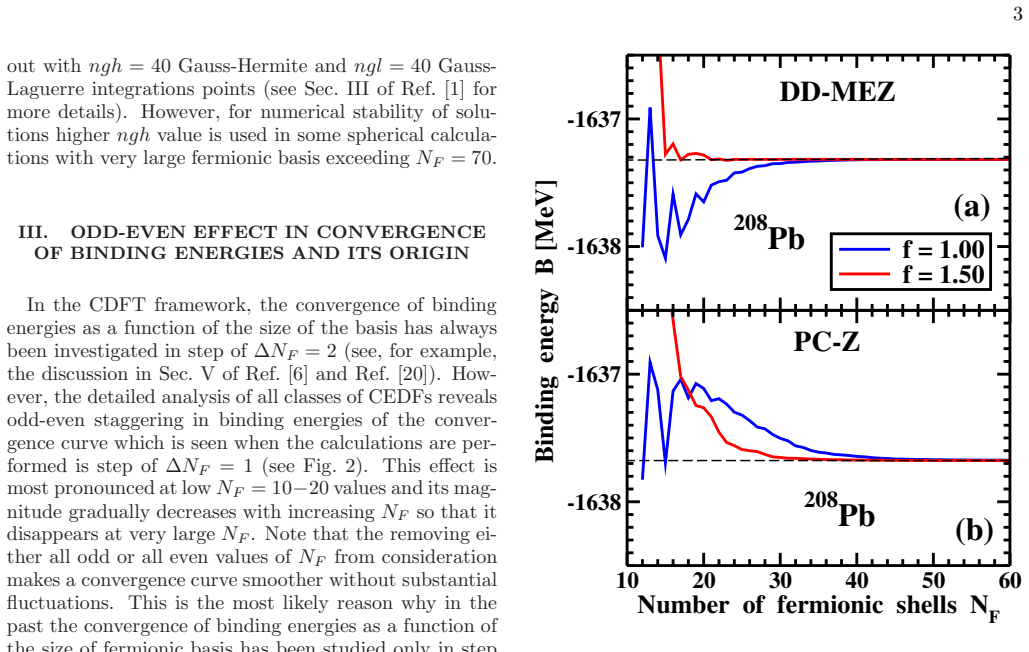
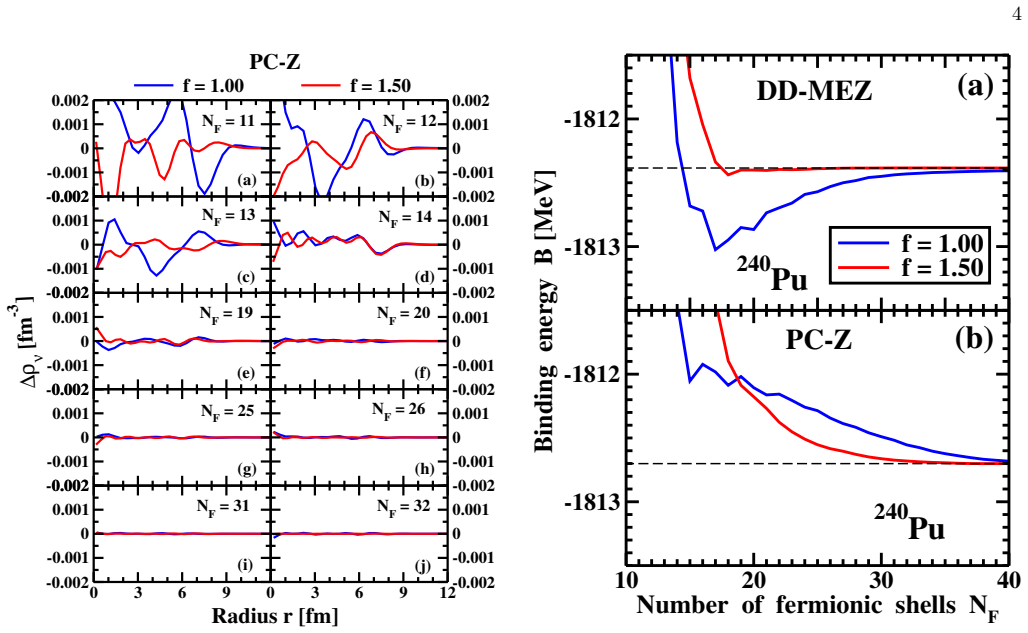
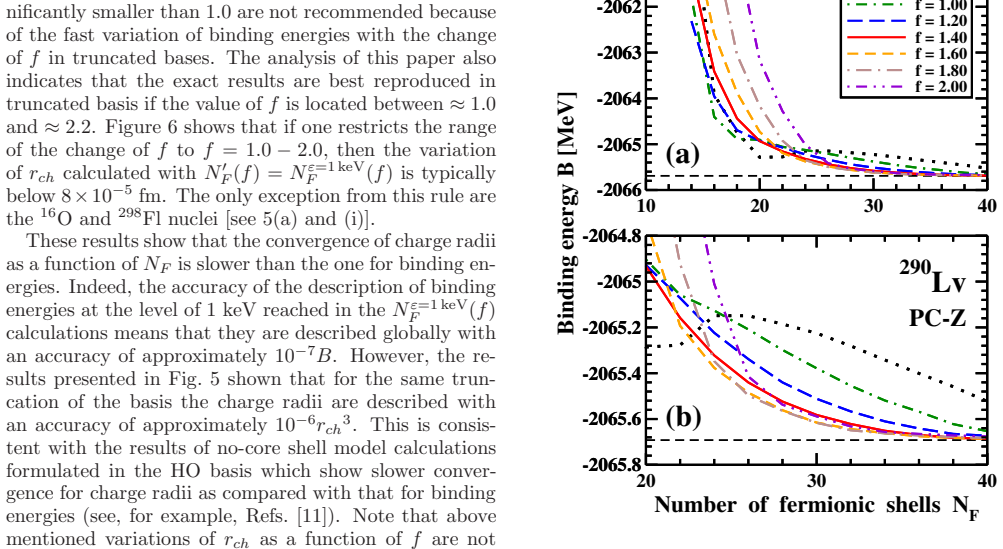
55) minimum of the 290Lv nucleus as a function of NF for different values of scaling factor f . Panel (b) shows the results in enhanced scale. Thin dashed line shows the extrapolated value of binding energy corresponding to infinite basis. Thus, some extrapolation procedure to infinite basis has to be employed to obtain extrapolated value of bind- ing energy...
-
[2]
8 case of Fig
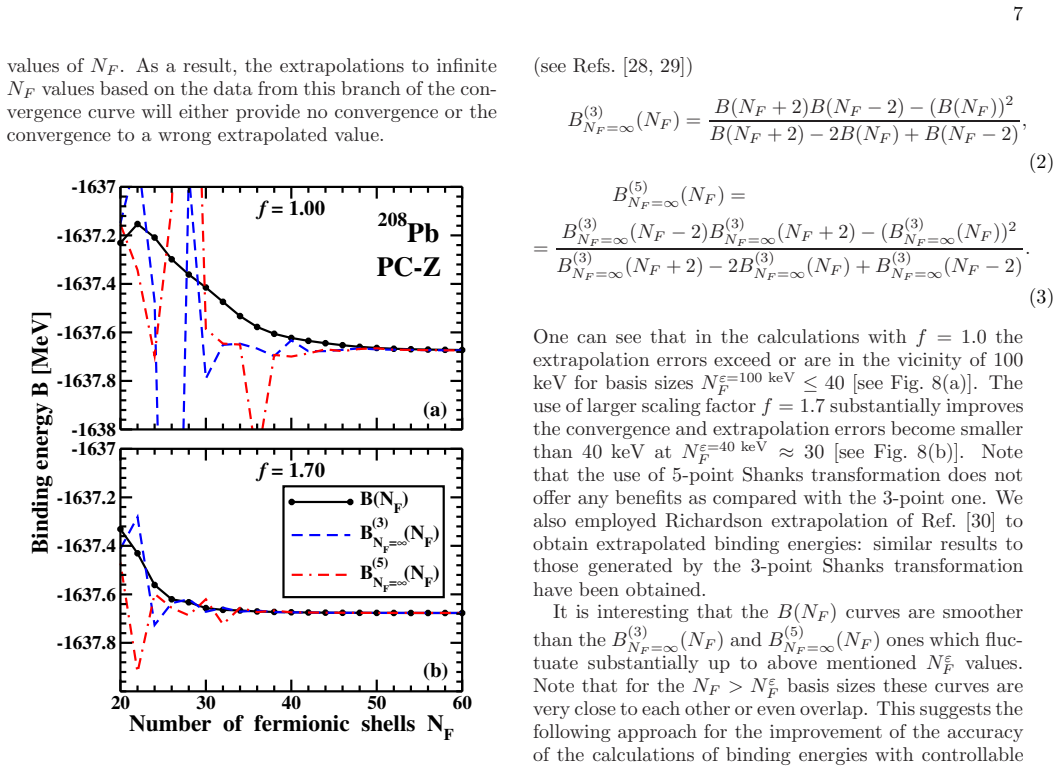
and in the f = 0 . 8 case of Fig. 7 is a general feature of the PC functionals in the calculations with low values of f = 0 . 8, 1. 0, and 1.2. The same analysis reveals that the convergence curves behave monotonically for higher values of f (see, for example, Fig. 7). However, these curves are strongly down-sloping at low and moderate 7 values of NF . As...
-
[3]
This approach is illustrated for deformed nuclei in Fig
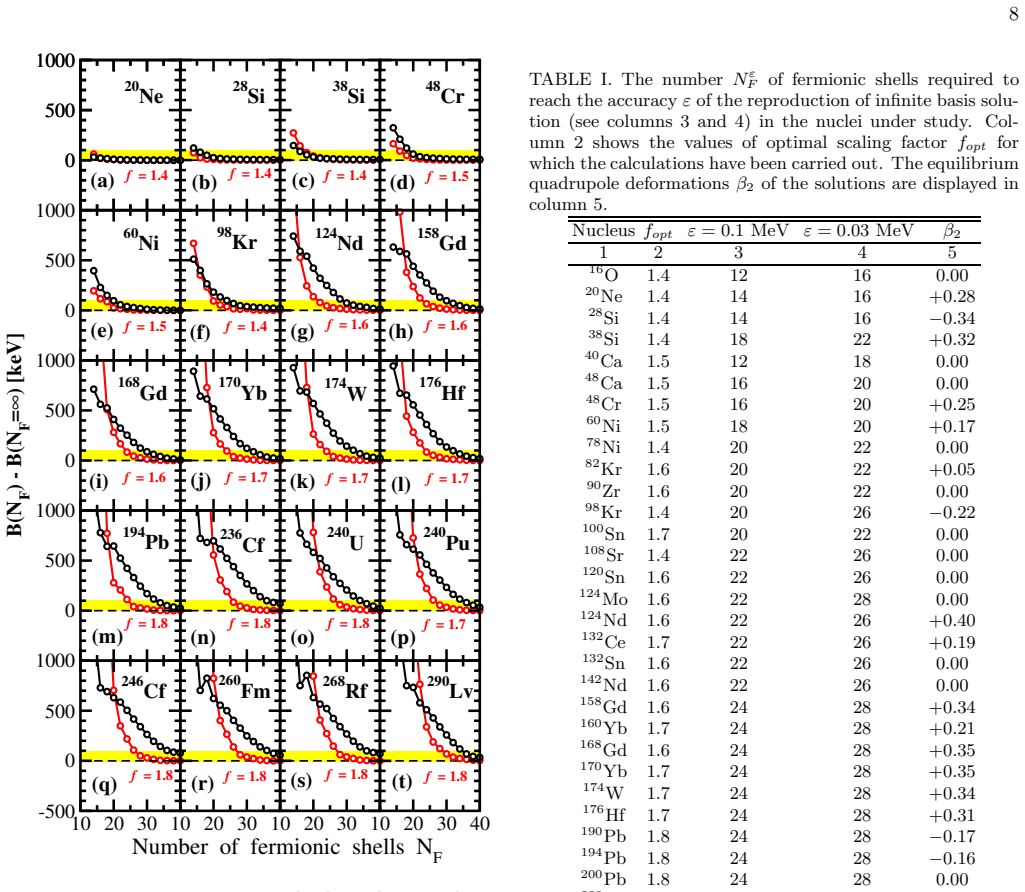
for meson exchange functionals which show rea- sonably smooth variation of fopt with mass number A. This approach is illustrated for deformed nuclei in Fig. 9 which compares convergence curves calculated with f = 1 . 0 and fopt. One can see that the value of fopt 8 0 500 1000 0 500 1000 0 500 1000B(NF) - B(NF=∞) [keV] 0 500 1000 10 20 30-500 0 500 1000 10...
-
[4]
substantially depends on two factors. First, these neutron states are located in the energy range which is characterized by a larger radius of the neutron potential as compared with that for more bound single-particle states (see, for example, Figs. 5(c) and (d) and Figs. 8(c) and (d) in Ref. [23]). As a result, their accurate de- scription requires a lar...
-
[5]
B. Osei, A. V. Afanasjev, and A. Dalbah, Global opti- mization of harmonic oscillator basis in covariant density functional theory, Phys. Rev. C 112, 054321 (2025)
2025
-
[6]
S. A. Coon, M. I. Avetian, M. K. G. Kruse, U. van Kolck, P. Maris, and J. P. Vary, Convergence properties of ab initio calculations of light nuclei in a harmonic oscillator basis, Phys. Rev. C 86, 054002 (2012)
2012
-
[7]
Y. K. Gambhir, P. Ring, and A. Thimet, Relativistic mean field theory for finite nuclei, Ann. Phys. (N.Y.) 198, 132 (1990)
1990
-
[8]
S. G. Nilsson and I. Ragnarsson, Shapes and shells in nuclear structure, Shapes and shells in nuclear structure , (Cambridge University Press, 1995)
1995
-
[9]
Kvaal, Harmonic oscillator eigernfunction expansion, quantum dots, and effective interactions, Phys
S. Kvaal, Harmonic oscillator eigernfunction expansion, quantum dots, and effective interactions, Phys. Rev. B 88, 045321 (2009)
2009
-
[10]
Taninah, B
A. Taninah, B. Osei, A. V. Afanasjev, U. C. Perera, and S. Teeti, Toward accurate nuclear mass tables in covari- ant density functional theory, Phys. Rev. C 109, 024321 (2024)
2024
-
[11]
R. N. Furnstahl, G. Hagen, and T. Papenbrock, Cor- rections to nuclear energies and radii in finite oscillator spaces, Phys. Rev. C 86, 031301(R) (2012)
2012
-
[12]
S. More, A. Ekstr¨ om, R. J. Furnstahl, G. Hagen, and T. Papenbrock, Universal properties of infrared oscillato r basis extrapolations, Phys. Rev. C 87, 044326 (2013)
2013
-
[13]
Binder, A
S. Binder, A. Ekstr¨ om, G. Hagen, T. Papenbrock, and K. A. Wendt, Effective filed theory in the harmonic os- cillator basis, Phys. Rev. C 93, 044332 (2016)
2016
-
[14]
S. A. Coon and M. K. G. Kruse, Properties of infrared extrapolations in a harmonic oscillator basis, Int. J. Mod. Phys. E 25, 1641011 (2016)
2016
- [15]
-
[16]
M. Kn¨ oll, M. Lockner, P. Maris, R. J. McCarty, R. Roth, J. P. Vary, and T. Wolfgruber, Benchmarking ann ex- trapolations of the ground-state energies and radii of li isotopes, nuclear theory archieve arXiv:2501.18252v2 (2025)
-
[17]
Dobaczewski and J
J. Dobaczewski and J. Dudek, Solution of the skyrme- hartree-fock equations in the cartesian deformed har- monic oscillator basis. i. the method, Comp. Phys. Comm. 102, 166 (1997)
1997
-
[18]
Pillet and S
N. Pillet and S. Hilaire, Towards an extended gogny force, Eur. Phys. J. A 53, 193 (2017). 16
2017
-
[19]
A. V. Afanasjev, J. K¨ onig, and P. Ring, Superdeformed rotational bands in the a ∼ 140 − 150 mass region: A cranked relativistic mean field description, Nucl. Phys. A 608, 107 (1996)
1996
-
[20]
P. Ring, Y. K. Gambhir, and G. A. Lalalzissis, Computer program for the relativistic mean field description of the ground state properties of even-even axially deformed nu- clei, Comp. Phys. Comm. 105, 77 (1997)
1997
-
[21]
Nikˇ si´ c, N
T. Nikˇ si´ c, N. Paar, D. Vretenar, and P. Ring, Dirhb - a relativistic self-consistent mean-field framework for atomic nuclei, Comp. Phys. Comm. 185, 1808 (2014)
2014
-
[22]
B. Osei, A. V. Afanasjev, A. Taninah, A. Dalbah, U. C. Perera, V. A. Dzuba, and V. V. Flambaum, Further steps toward the next generation of covariant energy density functionals, Phys. Rev. C 112, 044304 (2025)
2025
-
[23]
P¨ oschl, D
W. P¨ oschl, D. Vretenar, G. A. Lalazissis, and P. Ring, Relativistic hartree-bogoliuobov theory with finite range pairing forces in coordinate space: Neutron halo in light nuclei, Phys. Rev. Lett. 79, 3841 (1997)
1997
-
[24]
S.-G. Zhou, J. Meng, and P. Ring, Spherical relativistic hartree theory in a woods-saxon basis, Phys. Rev. C 68, 034323 (2003)
2003
-
[25]
Y. Tian, Z. Y. Ma, and P. Ring, A finite range pairing force for density functional theory in superfluid nuclei, Phys. Lett. B 676, 44 (2009)
2009
-
[26]
Teeti and A
S. Teeti and A. V. Afanasjev, Global study of separable pairing interaction in covariant density functional theor y, Phys. Rev. C 103, 034310 (2021)
2021
-
[27]
U. C. Perera and A. V. Afanasjev, Bubble nuclei: Single- particle versus coulomb interaction effects, Phys. Rev. C 106, 024321 (2022)
2022
-
[28]
U. C. Perera and A. V. Afanasjev, Differential charge radii: Proton-neutron interaction effects, Phys. Rev. C 107, 064321 (2023)
2023
-
[29]
P. W. Zhao, Z. P. Li, J. M. Yao, and J. Meng, New parametrization for the nuclear covariant energy density functional with a point-coupling interaction, Phys. Rev. C 82, 054319 (2010)
2010
-
[30]
Nikˇ si´ c, D
T. Nikˇ si´ c, D. Vretenar, and P. Ring, Relativistic nuclear energy density functionals: adjusting parameters to bind- ing energies, Phys. Rev. C 78, 034318 (2008)
2008
-
[31]
Angeli and K
I. Angeli and K. P. Marinova, Table of experimental nu- clear ground state charge radii: An update, At. Data Nucl. Data Tables 99, 69 (2013)
2013
-
[32]
Shanks, Non-linear transformation of divergent and slowly convergent sequences, J
D. Shanks, Non-linear transformation of divergent and slowly convergent sequences, J. of Math. and Phys. 34, 1 (1955)
1955
-
[33]
Wynn, On a device for computing the em(sn) trans- formation, Mathematical Tables and Other Aids to Com- putation 190, 91 (1956)
P. Wynn, On a device for computing the em(sn) trans- formation, Mathematical Tables and Other Aids to Com- putation 190, 91 (1956)
1956
-
[34]
P. J. Roache and P. M. Knupp, Completed richardson ex- trapolation, Comm. in Num. Meth. in Eng. 9, 365 (1993)
1993
- [35]
-
[36]
E. V. Litvinova and A. V. Afanasjev, Dynamics of nuclear single-particle structure in covariant theory of particle - vibration coupling: From light to superheavy nuclei, Phys. Rev. C 84, 014305 (2011)
2011
-
[37]
A. V. Afanasjev and H. Abusara, From cluster structures to nuclear molecules: The role of nodal structure of the single-particle wave functions, Phys. Rev. C 97, 024329 (2018)
2018
-
[38]
Baran, M
A. Baran, M. Kowal, P.-G. Reinhard, L. M. Robledo, A. Staszczak, and M. Warda, Fission barriers and prob- abilities of spontaneous fission for elements with z ≥ 100, Nucl. Phys. A 944, 442 (2015)
2015
-
[39]
Schunck and L
N. Schunck and L. M. Robledo, Microscopic theory of nuclear fission: A review, Rep. Prog. Phys. 79, 116301 (2016)
2016
-
[40]
Taninah, S
A. Taninah, S. E. Agbemava, and A. V. Afanasjev, Co- variant density functional theory input for r-process sim- ulations in actinides and superheavy nuclei: The ground state and fission properties, Phys. Rev. C 102, 054330 (2020)
2020
discussion (0)
Sign in with ORCID, Apple, or X to comment. Anyone can read and Pith papers without signing in.