Neuron-Level Interventions for Gendered and Gender-Neutral Generation in Language Models
Pith reviewed 2026-06-28 22:56 UTC · model grok-4.3
The pith
Activating or masking specific neurons steers language model output toward masculine, feminine, or neutral gender forms while preserving sentence meaning.
A machine-rendered reading of the paper's core claim, the machinery that carries it, and where it could break.
Core claim
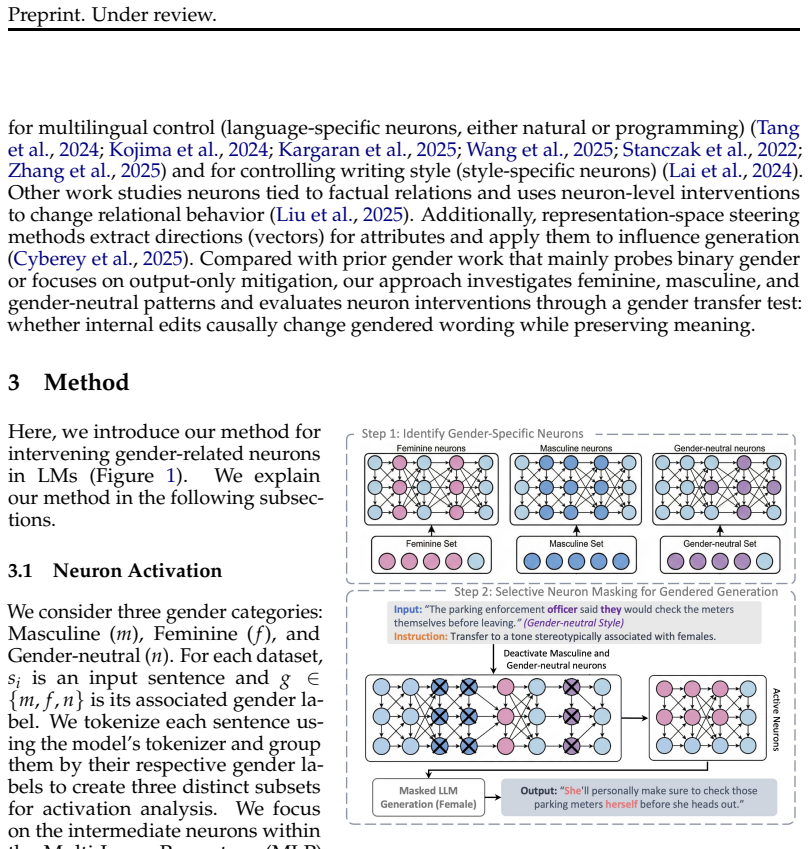
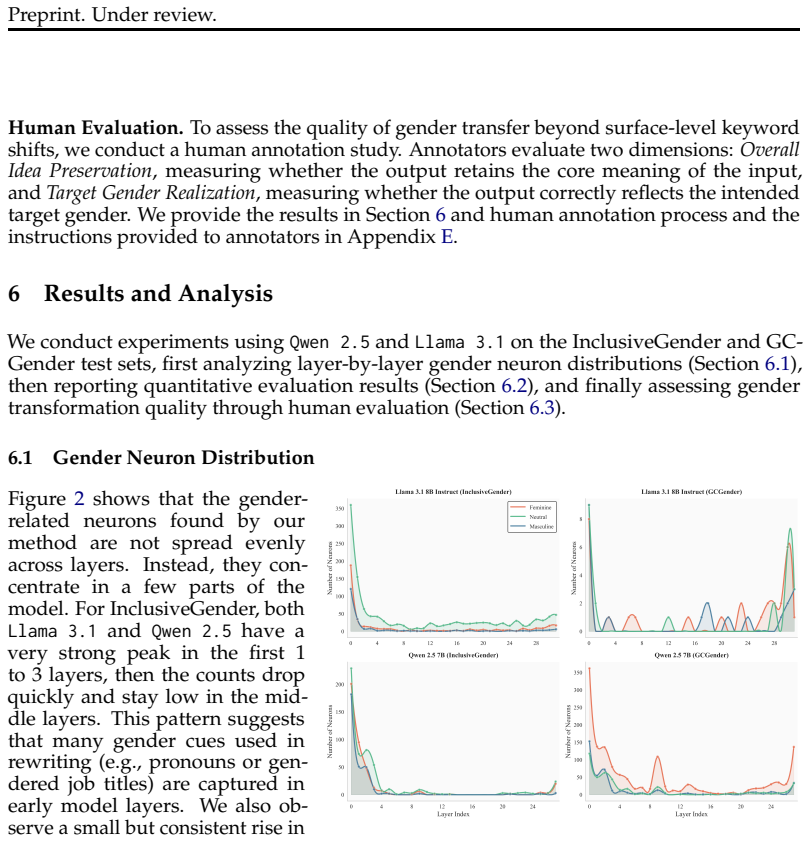
Gender-specific neurons can be located via a neuron-level intervention procedure; activating or masking them directs generation to a target gender category among feminine, masculine, and neutral while the original meaning stays intact, and these neurons concentrate in the earliest layers with smaller roles later in the model.
What carries the argument
Neuron-level intervention method that isolates units tied to each gender category and tests their effect by activation or masking during controlled sentence generation.
If this is right
- Gender neurons are not evenly distributed but concentrate in the earliest layers.
- The intervention achieves more precise control with less leakage to non-target gender categories than existing methods.
- Output quality remains stable according to the two evaluation criteria used.
- The curated datasets cover all three gender categories and support consistent human-validated testing.
Where Pith is reading between the lines
- Early-layer concentration suggests gender encoding may tie to surface lexical choices that later layers build upon.
- The same identification technique could be tested on other attributes such as sentiment or named-entity style to check for similar localization.
- Precise neuron edits might support targeted bias reduction in deployed models without full retraining.
Load-bearing premise
The selection process isolates neurons whose activity directly causes the gender form rather than units that merely correlate with gender in the data.
What would settle it
Applying the activation or masking intervention to the identified neurons produces no reliable shift in the gender category of generated sentences across the controlled test sets.
Figures
read the original abstract
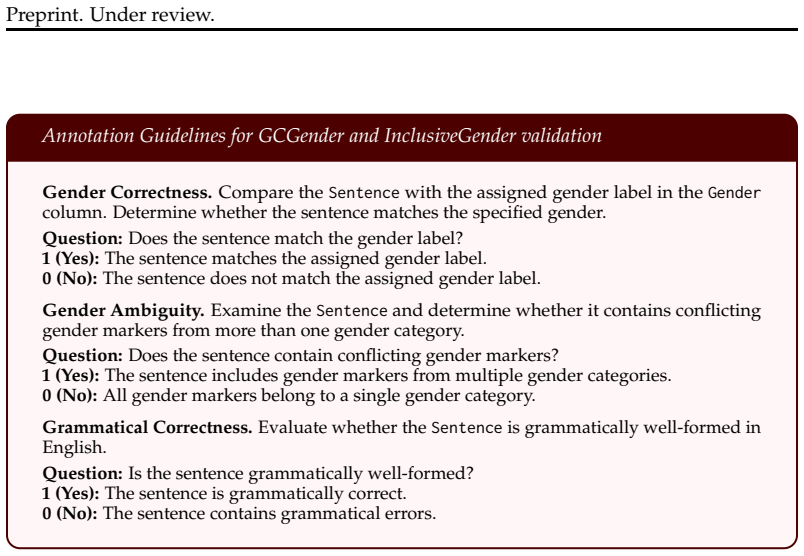
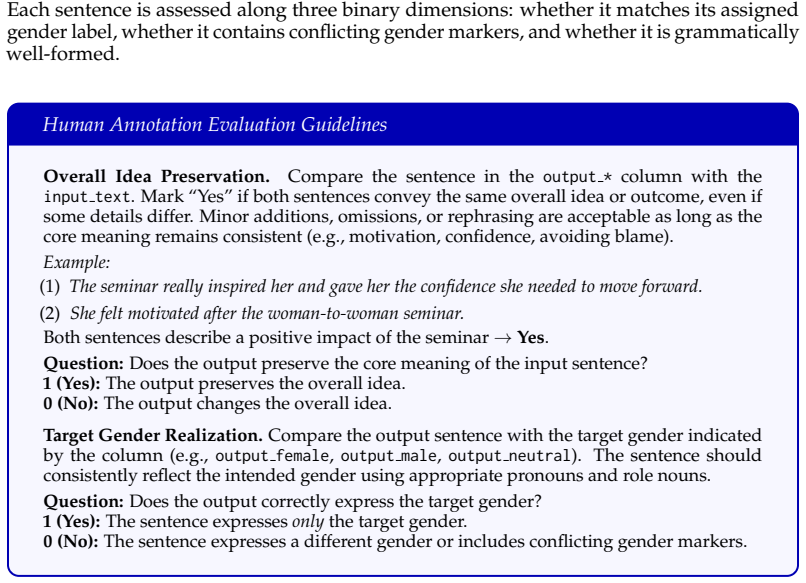
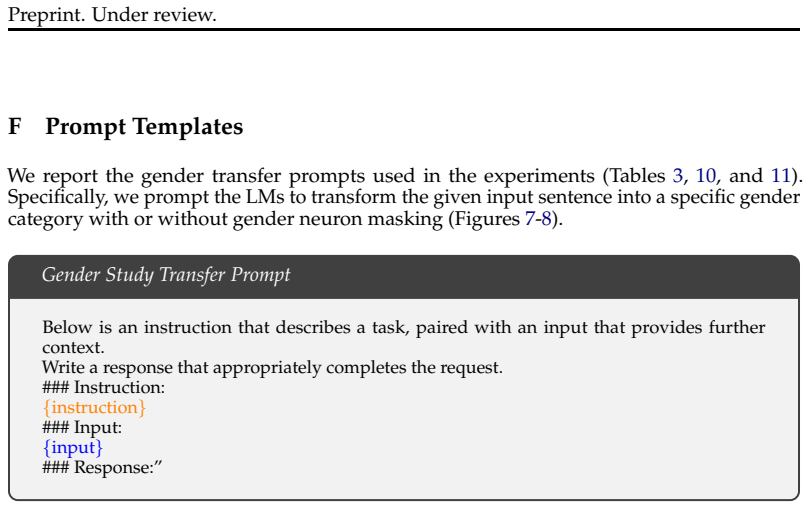
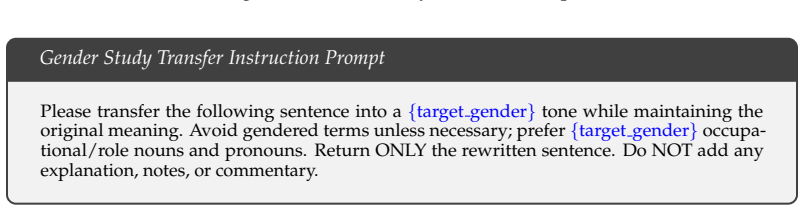
Language models (LMs) can produce gendered language and stereotypes even when given neutral prompts. Most prior work on gender bias in LMs primarily examines gender through a binary lens (feminine vs. masculine), with limited attention to gender-neutral forms, such as they/them pronouns or neutrally phrased job titles. How gender-related signals are encoded in the internal representations of LMs remains an open question. In this work, we study gender-specific neurons in LMs across three categories: feminine, masculine, and gender-neutral. We propose a neuron-level intervention method to identify neurons that are strongly tied to each gender category. We then test these neurons through controlled generation, showing that activating or masking gender-related neurons can steer a sentence toward a target gender form while preserving its original meaning. To evaluate the effectiveness of our gender-intervention approach, we curate two datasets with controlled sentences labeled across all three gender categories and validate the data quality through human evaluation. Experiments on two open-source LMs show that gender-specific neurons are not evenly distributed across model layers; instead, they concentrate heavily in the earliest layers with smaller contributions from later layers. Compared to existing methods, our method achieves more precise gender control, with less leakage into non-target gender categories and stable output quality through two evaluation criteria. Overall, our work examines how gender is encoded in LMs and provides a simple yet effective approach toward controlled gender intervention for both neuron intervention evaluation and gender bias mitigation. Code and datasets are available at: https://github.com/zhiwenyou103/Gender-Neuron-Intervention
Editorial analysis
A structured set of objections, weighed in public.
Referee Report
Summary. The paper proposes a neuron-level intervention method to identify neurons strongly associated with feminine, masculine, and gender-neutral categories in language models. It reports that activating or masking these neurons steers generated sentences toward a target gender form while preserving original meaning. Experiments on two open-source LMs show gender-specific neurons concentrate heavily in the earliest layers, with the approach achieving more precise control and less leakage than baselines. Two curated datasets with human validation support the evaluation, and code/datasets are released.
Significance. If the identification procedure isolates causally relevant neurons, the work advances mechanistic understanding of gender encoding beyond binary categories and supplies a practical intervention technique for controlled generation and bias mitigation. Public release of code and datasets is a clear strength for reproducibility.
major comments (3)
- [§3] §3 (Neuron Identification): The method is described at a high level without equations, pseudocode, or explicit selection criterion (e.g., activation difference, mutual information, or per-neuron causal test). This leaves open whether selected units are causal drivers of gender form or downstream correlates, directly undermining the central steering claim.
- [§4.3] §4.3 (Intervention Experiments): The preservation-of-meaning claim after activation/masking requires quantitative metrics (e.g., semantic similarity scores or entailment checks) beyond human validation of the datasets; without them, it is unclear whether interventions succeed only on gender or also alter non-gender content.
- [§5] §5 (Layer Distribution): The assertion that gender neurons 'concentrate heavily in the earliest layers' is stated qualitatively; layer-wise counts, percentages, or statistical comparisons across all layers are needed to support the distribution claim and its contrast with later layers.
minor comments (2)
- [Abstract] The two models used in experiments should be named explicitly in the abstract and §4 rather than referred to only as 'open-source LMs'.
- [§4] Baseline methods and the precise definitions of 'precision' and 'leakage' metrics should be stated with citations in the evaluation section.
Simulated Author's Rebuttal
We thank the referee for the constructive feedback. We address each major comment below and will revise the manuscript to incorporate the suggested improvements.
read point-by-point responses
-
Referee: [§3] §3 (Neuron Identification): The method is described at a high level without equations, pseudocode, or explicit selection criterion (e.g., activation difference, mutual information, or per-neuron causal test). This leaves open whether selected units are causal drivers of gender form or downstream correlates, directly undermining the central steering claim.
Authors: We will expand §3 with the full equations for neuron identification, which compute per-neuron activation differences between gender-specific prompt sets, followed by a threshold-based selection. Pseudocode for the full procedure will be added. The causal status is established through the subsequent intervention experiments, where targeted activation or masking produces measurable shifts in generated gender forms; we will explicitly distinguish this from correlational analysis in the revision. revision: yes
-
Referee: [§4.3] §4.3 (Intervention Experiments): The preservation-of-meaning claim after activation/masking requires quantitative metrics (e.g., semantic similarity scores or entailment checks) beyond human validation of the datasets; without them, it is unclear whether interventions succeed only on gender or also alter non-gender content.
Authors: We agree that quantitative metrics will strengthen the evaluation. The revised manuscript will report sentence-level cosine similarities using a sentence embedding model between original and intervened outputs, plus NLI-based entailment scores to verify that non-gender content remains unchanged. These will be presented alongside the existing human validation results. revision: yes
-
Referee: [§5] §5 (Layer Distribution): The assertion that gender neurons 'concentrate heavily in the earliest layers' is stated qualitatively; layer-wise counts, percentages, or statistical comparisons across all layers are needed to support the distribution claim and its contrast with later layers.
Authors: We will revise §5 to include a table listing the exact count and percentage of gender-specific neurons per layer for both models and all three categories. A bar chart of the layer-wise distribution will be added, together with a statistical test comparing the proportion of neurons in the earliest layers versus later layers. revision: yes
Circularity Check
No circularity: empirical method with external validation
full rationale
The paper describes an empirical procedure for identifying gender-related neurons via intervention, followed by controlled generation tests on curated datasets validated by human evaluation. No equations, fitted parameters, or derivations are presented that reduce to self-defined targets by construction. No self-citation chains or uniqueness theorems are invoked to justify core claims. The work is self-contained against its own benchmarks and external human validation, with no load-bearing steps that collapse into the inputs.
Axiom & Free-Parameter Ledger
Reference graph
Works this paper leans on
-
[1]
Hillary Dawkins, Isar Nejadgholi, and Chi-Kiu Lo
URLhttps://aclanthology.org/2025.emnlp-main.1439/. Hillary Dawkins, Isar Nejadgholi, and Chi-Kiu Lo. Gender-neutral machine translation strategies in practice. In Jani c ¸a Hackenbuchner, Luisa Bentivogli, Joke Daems, Chiara Manna, Beatrice Savoldi, and Eva Vanmassenhove (eds.),Proceedings of the 3rd Workshop on Gender-Inclusive Translation Technologies (...
-
[2]
ISSN 0893-6080. doi: https://doi.org/10.1016/j.neunet.2017.12.012. URL https: //www.sciencedirect.com/science/article/pii/S0893608017302976. Special issue on deep reinforcement learning. Danielle Gaucher, Justin Friesen, and Aaron C Kay. Evidence that gendered wording in job advertisements exists and sustains gender inequality.Journal of personality and s...
work page internal anchor Pith review Pith/arXiv arXiv doi:10.1016/j.neunet.2017.12.012 2017
-
[3]
Association for Computational Linguistics. ISBN 979-8-89176-256-5. doi: 10.18653/ v1/2025.findings-acl.1379. URLhttps://aclanthology.org/2025.findings-acl.1379/. Takeshi Kojima, Itsuki Okimura, Yusuke Iwasawa, Hitomi Yanaka, and Yutaka Matsuo. On the multilingual ability of decoder-based pre-trained language models: Finding and controlling language-specif...
-
[4]
European Association for Machine Translation. ISBN 978-2-9701897-4-9. URL https://aclanthology.org/2025.gitt-1.1/. Meta AI. Llama 3.1 8b instruct. https://huggingface.co/meta-llama/Llama-3. 1-8B-Instruct, 2024a. Meta AI. Llama 3.3 70b (ollama library).https://ollama.com/library/llama3.3:70b, 2024b. Accessed: 2026-03. Nafiseh Nikeghbal, Amir Hossein Kargar...
work page internal anchor Pith review Pith/arXiv arXiv doi:10.18653/v1/2025.emnlp-main.84 2025
-
[5]
- Number each sentence clearly from 1 to 40
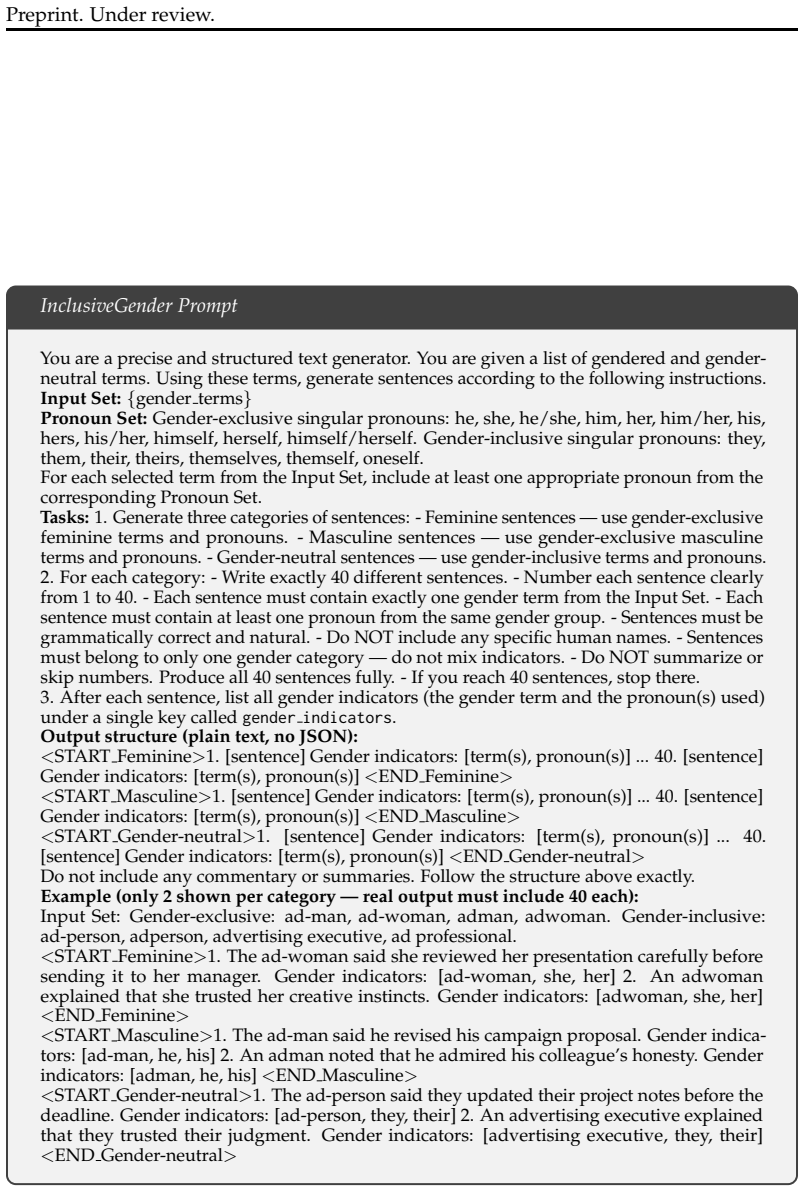
For each category: - Write exactly 40 different sentences. - Number each sentence clearly from 1 to 40. - Each sentence must contain exactly one gender term from the Input Set. - Each sentence must contain at least one pronoun from the same gender group. - Sentences must be grammatically correct and natural. - Do NOT include any specific human names. - Se...
-
[6]
The police said she would take care of her duties,
After each sentence, list all gender indicators (the gender term and the pronoun(s) used) under a single key calledgender indicators. Output structure (plain text, no JSON): <START Feminine>1. [sentence] Gender indicators: [term(s), pronoun(s)] ... 40. [sentence] Gender indicators: [term(s), pronoun(s)]<END Feminine> <START Masculine>1. [sentence] Gender ...
discussion (0)
Sign in with ORCID, Apple, or X to comment. Anyone can read and Pith papers without signing in.