A Convenient Sealing Method Using Boron Nitride Capping for Reactive Reactions
Pith reviewed 2026-06-28 22:17 UTC · model grok-4.3
The pith
Boron nitride caps seal ampules for reactive metal reactions without quartz failures, yielding higher-quality crystals.
A machine-rendered reading of the paper's core claim, the machinery that carries it, and where it could break.
Core claim
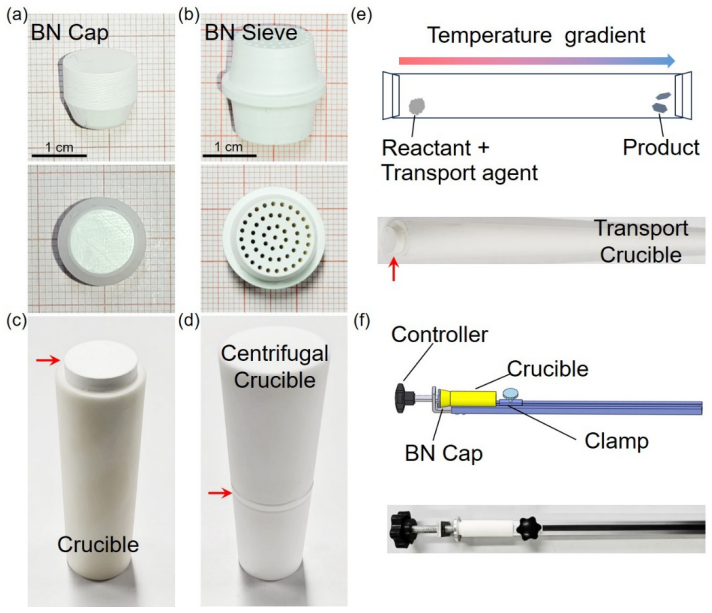
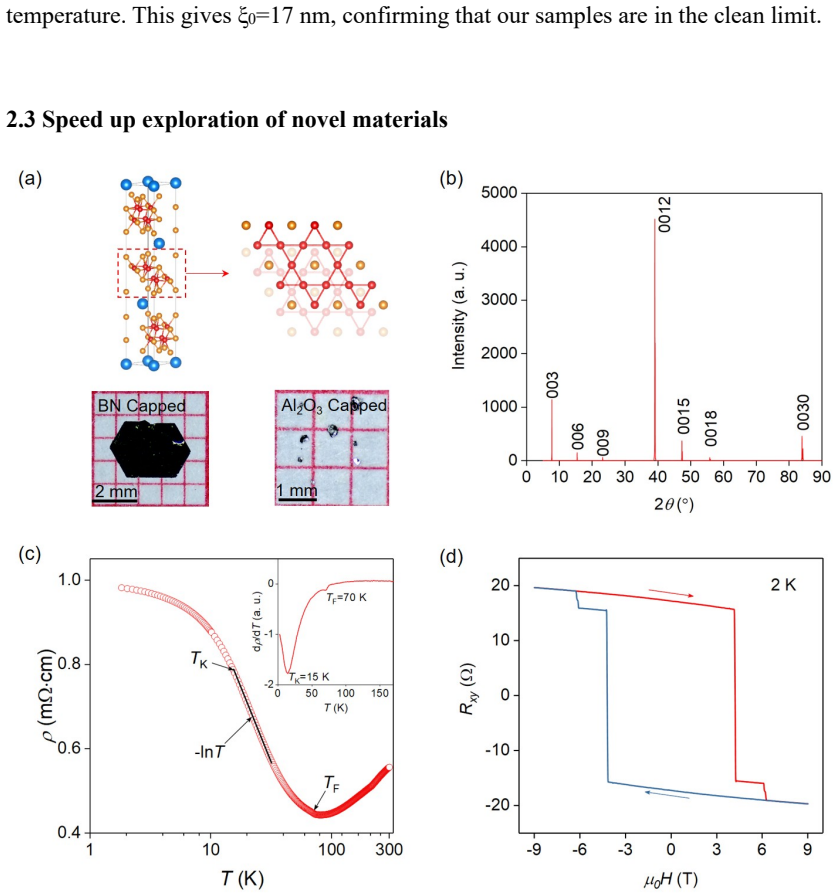
We introduce an inexpensive boron nitride (BN) cap sealing technique. This approach is readily adaptable to centrifugal separation and flux transport growth and yields superior sample quality. We demonstrate its efficacy by growing KFe2As2 and CsCr6Sb6 single crystals, the former exhibiting record-high quality, with a residual resistivity ratio (RRR) exceeding 2500, and the latter achieving significantly larger crystal dimensions than other methods.
What carries the argument
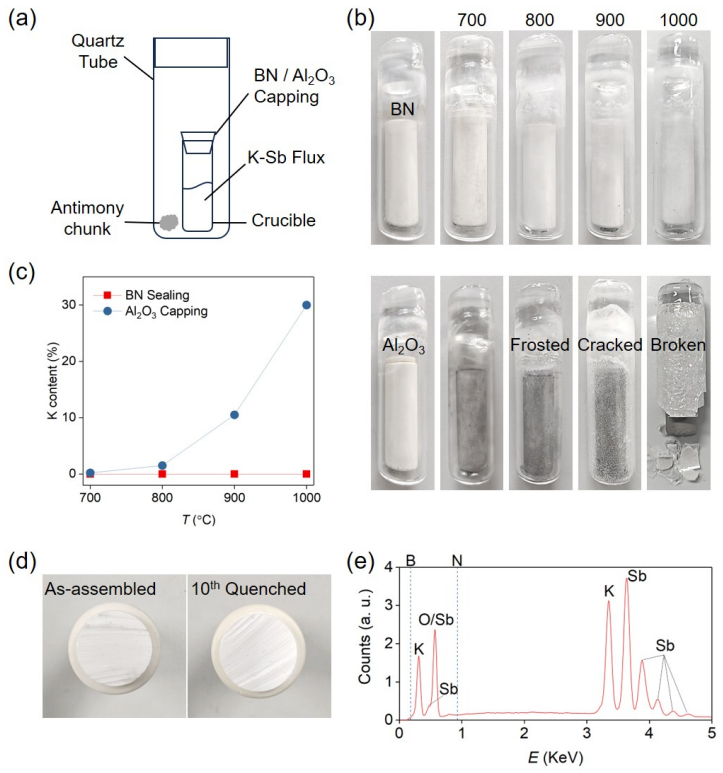
The boron nitride (BN) cap sealing technique, which creates an inert barrier to prevent reactions between reactive elements and the ampule at elevated temperatures.
If this is right
- Reactions with alkali, alkaline-earth, and rare-earth metals proceed without quartz tube failures or compositional loss.
- Single-crystal quality reaches record levels, such as RRR exceeding 2500 for KFe2As2.
- Crystal dimensions increase for compounds like CsCr6Sb6 relative to conventional sealing approaches.
- The technique works with centrifugal separation and flux transport growth without added complexity.
- Novel materials containing reactive elements become easier to prepare consistently.
Where Pith is reading between the lines
- Higher-purity samples from this method could expose intrinsic properties in these materials that impurities previously obscured.
- The approach might reduce lab-to-lab variability in results for reactive syntheses.
- It opens a route to test previously inaccessible compositions that react too strongly with quartz.
- Adoption could lower the barrier for exploring new phases in alkali-metal and rare-earth containing systems.
Load-bearing premise
The observed gains in crystal quality and size come from the BN capping itself rather than differences in other growth variables or post-processing steps.
What would settle it
Repeating the KFe2As2 and CsCr6Sb6 growths with and without BN caps under matched conditions and finding no difference in RRR values or crystal sizes would falsify the superiority of the method.
Figures
read the original abstract
While quartz (SiO2) ampule sealing is commonly used in laboratories to prevent sample oxidation during synthesis, its application is limited for reactions involving highly reactive elements such as alkali, alkaline-earth, and rare-earth metals. These elements can react with SiO2 at elevated temperatures, causing compositional loss, tube failure, and experimental inconsistencies. Here, we introduce an inexpensive boron nitride (BN) cap sealing technique. This approach is readily adaptable to centrifugal separation and flux transport growth and yields superior sample quality. We demonstrate its efficacy by growing KFe2As2 and CsCr6Sb6 single crystals, the former exhibiting record-high quality, with a residual resistivity ratio (RRR) exceeding 2500, and the latter achieving significantly larger crystal dimensions than other methods. This accessible and economical method promises to accelerate the discovery of novel materials that contain reactive elements.
Editorial analysis
A structured set of objections, weighed in public.
Referee Report
Summary. The manuscript describes an inexpensive boron nitride (BN) cap sealing technique as an alternative to quartz ampules for preventing oxidation and reactions with highly reactive elements (alkali, alkaline-earth, rare-earth metals) during high-temperature synthesis. It claims the method is readily adaptable to centrifugal separation and flux transport growth, yields superior sample quality, and demonstrates this via growth of KFe2As2 single crystals with residual resistivity ratio (RRR) exceeding 2500 and CsCr6Sb6 crystals with significantly larger dimensions than prior methods.
Significance. If the improvements in crystal quality and size are shown to result from the BN capping rather than uncontrolled variables, the technique could offer a practical, low-cost solution for materials synthesis involving reactive elements, potentially improving reproducibility in flux growth experiments. The work is a methods contribution without mathematical derivations or parameter-free claims.
major comments (2)
- [Abstract and results sections] Abstract and results sections: The central claim of 'superior sample quality' and 'record-high quality' (RRR exceeding 2500 for KFe2As2; larger CsCr6Sb6 crystals) rests on two example crystals but supplies no quantitative comparisons to prior quartz-sealed or other methods, no error bars, no details on RRR measurement protocol (e.g., contact geometry, temperature range), and no control experiments holding precursor batches, temperature profiles, and post-growth handling constant with vs. without BN cap.
- [Growth procedures section] Growth procedures section: No side-by-side experiments are described to attribute observed gains specifically to BN capping; the manuscript reports final metrics without quantifying how much each variable (precursor purity, flux composition, handling) was controlled, leaving open alternative explanations for the RRR and size improvements.
minor comments (1)
- [Abstract] The abstract states the method 'yields superior sample quality' without defining the metric or providing baseline data; this should be clarified with explicit comparison tables if controls are added.
Simulated Author's Rebuttal
We thank the referee for the constructive comments. We address the major points below and will revise the manuscript to strengthen the evidence presentation.
read point-by-point responses
-
Referee: [Abstract and results sections] Abstract and results sections: The central claim of 'superior sample quality' and 'record-high quality' (RRR exceeding 2500 for KFe2As2; larger CsCr6Sb6 crystals) rests on two example crystals but supplies no quantitative comparisons to prior quartz-sealed or other methods, no error bars, no details on RRR measurement protocol (e.g., contact geometry, temperature range), and no control experiments holding precursor batches, temperature profiles, and post-growth handling constant with vs. without BN cap.
Authors: We agree that quantitative comparisons to prior literature and additional protocol details would improve the manuscript. In revision we will add explicit comparisons of the RRR >2500 value to previously reported KFe2As2 results (typically several hundred) and note the larger CsCr6Sb6 dimensions relative to earlier reports. We will also specify the four-probe contact geometry and temperature range used for RRR measurements. Direct side-by-side controls with identical batches were not performed in this methods demonstration, as the BN approach targets reactions infeasible in quartz; we will acknowledge this limitation explicitly. This is a partial revision. revision: partial
-
Referee: [Growth procedures section] Growth procedures section: No side-by-side experiments are described to attribute observed gains specifically to BN capping; the manuscript reports final metrics without quantifying how much each variable (precursor purity, flux composition, handling) was controlled, leaving open alternative explanations for the RRR and size improvements.
Authors: We acknowledge the absence of side-by-side experiments. The BN cap primarily enables syntheses with highly reactive elements that damage quartz, inherently limiting identical controls. In the revised growth procedures section we will expand quantification of controls over precursor purity, flux ratios, and handling consistency. We will also discuss why the achieved metrics are unlikely to arise solely from other variables. This constitutes a partial revision to improve clarity on experimental controls. revision: partial
Circularity Check
No circularity: experimental methods paper with no derivations or fitted predictions
full rationale
The manuscript is a purely experimental description of a BN capping technique for reactive-element synthesis. It reports growth procedures, crystal metrics (RRR > 2500 for KFe2As2, larger dimensions for CsCr6Sb6), and claims of adaptability to centrifugal/flux methods. No equations, no first-principles derivations, no parameter fitting, and no predictions that reduce to inputs by construction appear anywhere. The central claim is an empirical assertion about method efficacy; its validity hinges on experimental controls (absent per the skeptic note), not on any self-referential mathematical step. Self-citations, if present, are irrelevant because no load-bearing uniqueness theorem or ansatz is invoked. This is the normal case of a methods paper that is self-contained against external benchmarks and receives score 0.
Axiom & Free-Parameter Ledger
Reference graph
Works this paper leans on
-
[1]
D.; Scott, D
Good, W. D.; Scott, D. W.; Waddington, G. Combustion calorimetry of organic fluorine compounds by a rotating- bomb method. J. Phys. Chem. 1956, 60, 1080– 1089
1956
-
[2]
Rudolph, F.M
P. Rudolph, F.M. Kiessling The horizontal Bridgman method. Cryst. Res. Technol. 1988, 23, 1207-1224
1988
-
[3]
Crystal growth from the melt: a review
Kirkpatrick, R. Crystal growth from the melt: a review. Am. Mineral. 1975, 60, 798– 814
1975
-
[4]
Chemistry and crystal growth
Hulliger, J. Chemistry and crystal growth. Angew. Chem., Int. Ed. 1994, 33, 143– 162,
1994
-
[5]
Guo, J. G.; Jin, S. F.; Wang, G.; Wang, S. C.; Zhu, K. X.; Zhou, T. T.; He, M.; Chen, X. L. Phys. Rev. B: Condens. Matter Mater. Phys. 2010, 82, 180520 DOI: 10.1103/PhysRevB.82.180520
-
[6]
Ying, T. P.; Chen, X. L.; Wang, G.; Jin, S. F.; Zhou, T. T.; Lai, X. F.; Zhang, H.; Wang, W. Y . Sci. Rep. 2012, 2, 426 DOI: 10.1038/srep00426
-
[7]
Ying, T. P.; Chen, X. L.; Wang, G.; Jin, S. F.; Lai, X. F.; Zhou, T. T.; Zhang, H.; Shen, S. J.; Wang, W. Y . J. Am. Chem. Soc. 2013, 135, 2951– 2954 DOI: 10.1021/ja312705x
-
[8]
J.; Ohgushi, K
Takahashi, H.; Sugimoto, A.; Nambu, Y .; Yamauchi, T.; Hirata, Y .; Kawakami, T.; Avdeev, M.; Matsubayashi, K.; Du, F.; Kawashima, C.; Soeda, H.; Nakano, S.; Uwatoko, Y .; Ueda, Y .; Sato, T. J.; Ohgushi, K. Pressure-induced superconductivity in the iron-based ladder material BaFe 2S3. Nat.Mater. 2015, 14, 1008−1012
2015
-
[9]
B.; Misra, S
Zhou,B. B.; Misra, S. E.; Neto, H. da Silva; Aynajian, P.; Baumbach, R. E.; Thompson, J. D.; Bauer, E. D.; Yazdani, A. Visualizing nodal heavy fermion superconductivity in CeCoIn5. Nat. Phys. 2013, 9, 474
2013
-
[10]
Strange-metal behaviour in a pure ferromagnetic Kondo lattice
Shen, B.; Zhang, Y .; Komijani, Y .; Nicklas, M.; Borth, R.; Wang, A.; Chen, Y .; Nie, Z.; Li, R.; Lu, X.; Lee, H.; Smidman, M.; Steglich, F.; Coleman, P.; Yuan, H. Strange-metal behaviour in a pure ferromagnetic Kondo lattice. Nature 2020, 579, 51– 55, DOI: 10.1038/s41586-020-2052-z
-
[11]
Kliemt, K. et al. Crystal growth of materials with the ThCr2Si2 structure type. Cryst. Res. Technol. 55, 1900116 (2020)
2020
-
[12]
Bao, J.- K.; Liu, J.- Y. ; Ma, C. -W.; Meng, Z.- H.; Tang, Z.-T.; Sun, Y .-L.; Zhai, H.- F.; Jiang, H.; Bai, H.; Feng, C.- M. Superconductivity in Quasi -One-Dimensional K2Cr3As3 with Significant Electron Correlations. Phys. Rev. X 2015, 5, 011013 DOI: 10.1103/PhysRevX.5.011013
-
[13]
Superconductivity under pressure in a chromium -based kagome metal
Yi Liu et al. Superconductivity under pressure in a chromium -based kagome metal. Nature 632, 1032–1037 (2024)
2024
-
[14]
Wang, Z.- C.; He, C. -Y. ; Wu, S.- Q.; Tang, Z.- T.; Liu, Y .; Ablimit, A.; Feng, C.- M.; Cao, G. -H. Superconductivity in KCa 2Fe4As4F2 with Separate Double Fe2As2 Layers. J. Am. Chem. Soc. 2016, 138, 7856–7859, DOI: 10.1021/jacs.6b04538
-
[15]
Meng, K.; Zhang, X.; Song, B.; Li, B.; Kong, X.; Huang, S.; Yang, X.; Jin, X.; Wu, Y. ; Nie, J. Layer -Dependent Superconductivity in Iron -Based Superconductors Ca2Fe4As4F2 and CaKFe 4As4. Nano Lett. 2024, 24, 6821– 6827, DOI: 10.1021/acs.nanolett.4c01725
-
[16]
Thermal and chemical stability of hexagonal boron nitride (h- BN) nanoplatelets
Kostoglou, N.; Polychronopoulou, K.; Rebholz, C. Thermal and chemical stability of hexagonal boron nitride (h- BN) nanoplatelets. Vacuum 2015, 112, 42– 45, DOI: 10.1016/j.vacuum.2014.11.009
-
[17]
& Schmalian, J
Fernandes, R., Chubukov, A. & Schmalian, J. What drives nematic order in iron- based superconductors? Nat. Phys. 2014, 10, 97–104
2014
-
[18]
Borisov, V ., Fernandes, R. M. & Valentí, R. Evolution from B2g nematics to B1g nematics in heavily hole -doped iron -based superconductors. Phys. Rev. Lett. 2019, 123, 146402
2019
-
[19]
Moroni, M. et al. Charge and nematic orders in AFe 2As2 (A = Rb, Cs) superconductors. Phys. Rev. B 2019, 99, 235147
2019
-
[20]
Liu, X., Tao, R., Ren, M. et al. Evidence of nematic order and nodal superconducting gap along [110] direction in RbFe 2As2. Nat. Commun. 2019, 10, 1039
2019
-
[21]
Yuta Mizukami, Ohei Tanaka, Kousuke Ishida, Asato Onishi, Yoichi Kageyama, Masaya Tsujii, Ryotaro Ohno, Noriaki Kimura, Takaya Mitsui, Shinji Kitao, Masayuki Kurokuzu, Makoto Seto, Shigeyuki Ishida, Akira Iyo, Hiroshi Eisaki, Kenichiro Hashimoto, Takasada Shibauchi, Thermodynamic signatures of diagonal nematicity in RbFe2As2 superconductor, PNAS 2025, 4, pgaf060
2025
-
[22]
N. Ni, S. L. Bud’ko, A. Kreyssig, S. Nandi, G. E. Rustan, A. I. Goldman, S. Gupta, J. D. Corbett, A. Kracher, and P. C. Canfield Anisotropic thermodynamic and transport properties of single-crystalline Ba 1−xKxFe2As2 (x=0 and 0.45). Phys. Rev. B 2008, 78, 014507
2008
-
[23]
X. F. Wang, T. Wu, G. Wu, H. Chen, Y . L. Xie, J. J. Ying, Y . J. Yan, R. H. Liu, and X. H. Chen Anisotropy in the Electrical Resistivity and Susceptibility of Superconducting BaFe2As2 Single Crystals. Phys. Rev. Lett. 2009, 102, 117005
2009
-
[24]
Ito, T.; Uchida, S.; Iyo, A.; Lee, C
Kihou, K.; Saito, T.; Ishida, S.; Nakajima, M.; Tomioka, Y .; Fukazawa, H.; Kohori, Y. ; Ito, T.; Uchida, S.; Iyo, A.; Lee, C. -H.; Eisaki, H. Single Crystal Growth and Characterization of the Iron -Based Superconductor KFe2As2 Synthesized by KAs Flux Method J. Phys. Soc. Jpn. 2010, 79, 124713 DOI: 10.1143/JPSJ.79.124713
-
[25]
J. K. Dong, S. Y . Zhou, T. Y . Guan, H. Zhang, Y . F. Dai, X. Qiu, X. F. Wang, Y . He, X. H. Chen, and S. Y . Li Quantum Criticality and Nodal Superconductivity in the FeAs-Based Superconductor KFe2As2. Phys. Rev. Lett. 2010, 104,087005
2010
-
[26]
Song, B., Xie, Y ., Li, WJ. et al. Realization of Kagome Kondo lattice. Nat. Commun. 2025, 16, 5643
2025
-
[27]
Ye, L. D. et al. Massive Dirac fermions in a ferromagnetic kagome metal. Nature 2018, 555, 638–642
2018
-
[28]
Yin, J. X. et al. Giant and anisotropic many-body spin–orbit tunability in a strongly correlated kagome magnet. Nature 2018, 562, 91–95
2018
-
[29]
Morali, N. et al. Fermi -arc diversity on surface terminations of the magnetic Weyl semimetal Co3Sn2S2. Science 2019, 365, 1286–1291
2019
-
[30]
Liu, D. F. et al. Magnetic Weyl semimetal phase in a Kagomé crystal. Science 2019, 365, 1282–1285
2019
-
[31]
Ortiz, B. R. et al. CsV3Sb5: a z2 topological kagome metal with a superconducting ground state. Phys. Rev. Lett. 2020, 125, 247002
2020
-
[32]
Song, B., Ying, T., Wu, X. et al. Anomalous enhancement of charge density wave in kagome superconductor CsV3Sb5 approaching the 2D limit. Nat. Commun. 2023, 14, 2492
2023
-
[33]
Yang, H., Ye, Y ., Zhao, Z. et al. Superconductivity and nematic order in a new titanium-based kagome metal CsTi 3Bi5 without charge density wave order. Nat. Commun. 2024, 15, 9626
2024
-
[34]
Superconductivity under pressure in a chromium-based Kagome metal
Yi Liu et al. Superconductivity under pressure in a chromium-based Kagome metal. Nature 2024, 632, 1032–1037
2024
-
[35]
Energy Landscape and Phase Competition of CsV3Sb5, CsV6Sb6 and TbMn6Sn6- Type Kagome Materials
Cai G, Jiang Y , Zhou H, et al. Energy Landscape and Phase Competition of CsV3Sb5, CsV6Sb6 and TbMn6Sn6- Type Kagome Materials. Chin. Phys. Lett. 2023, 40, 117101. For Table of Contents Use Only A convenient sealing method using boron nitride capping for reactive reactions Boqin Song1, Tianping Ying1,*
2023
discussion (0)
Sign in with ORCID, Apple, or X to comment. Anyone can read and Pith papers without signing in.