Generating Graph-Like Logical Rules for Knowledge Graph Reasoning via Diffusion Models
Pith reviewed 2026-06-28 22:36 UTC · model grok-4.3
The pith
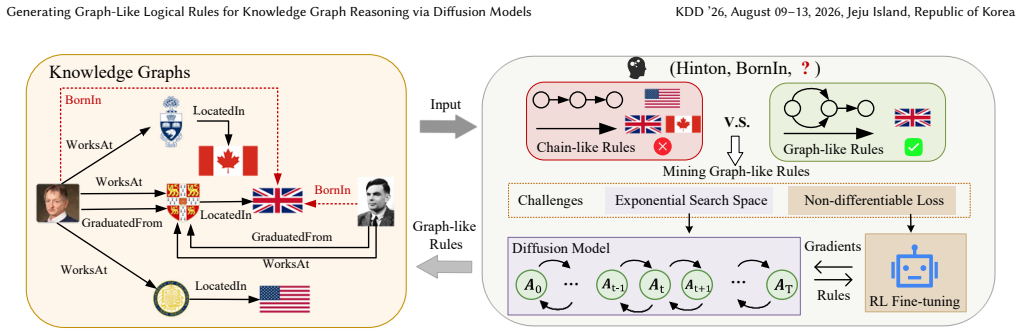
GRiD reformulates graph-like rule discovery as a diffusion-based generative process with two-phase training to produce cycles and branches that complement chain rules in knowledge graph completion.
A machine-rendered reading of the paper's core claim, the machinery that carries it, and where it could break.
Core claim
GRiD reformulates graph-like rule discovery as a discrete generative process conditioned on the target relation. It employs a two-phase training strategy: supervised pre-training on subgraphs sampled from the KG meta-graph to capture structural priors, followed by reinforcement learning fine-tuning via policy gradient optimization guided by non-differentiable rule-quality metrics. This produces graph-like rules that complement chain-like rules and deliver competitive performance on KG completion tasks.
What carries the argument
Two-phase training strategy of supervised pre-training on KG meta-graph subgraphs followed by reinforcement learning fine-tuning with policy gradients driven by rule-quality metrics.
If this is right
- Graph-like rules containing cycles and branches become discoverable without exhaustive enumeration of the combinatorial search space.
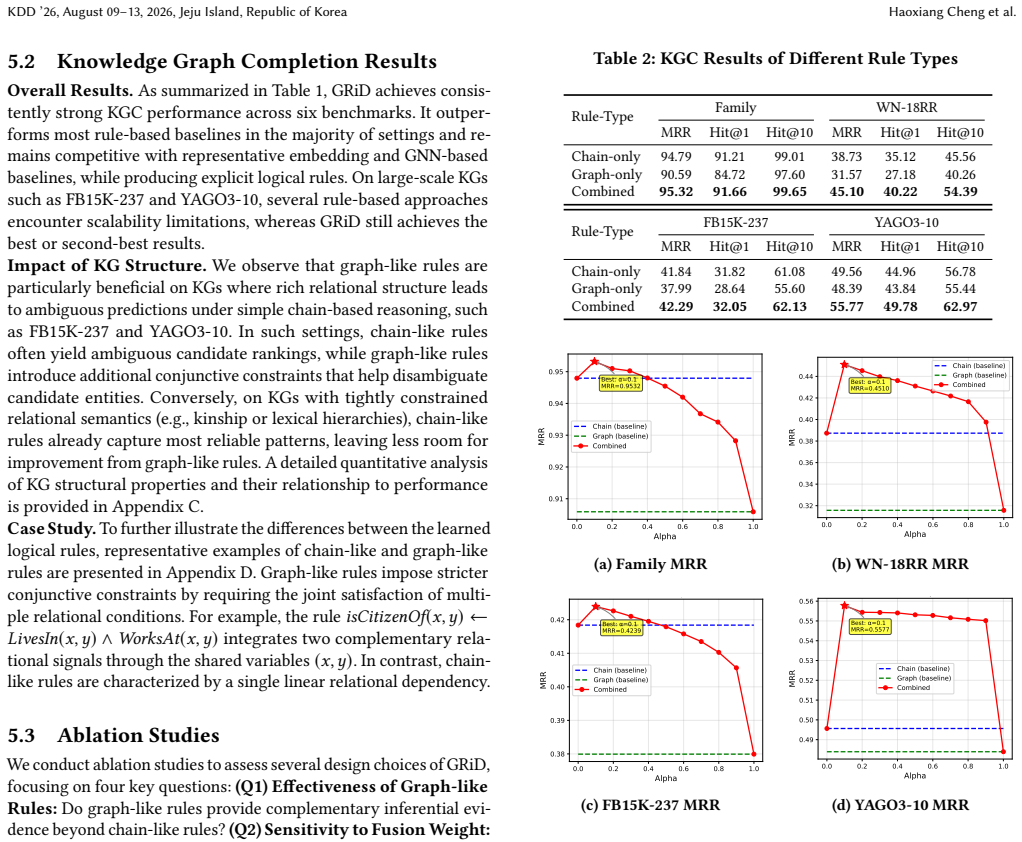
- The generated rules supply relational patterns that chain-like rules do not cover, raising overall completion accuracy when both types are used together.
- Competitive performance holds across six benchmark datasets for knowledge graph completion.
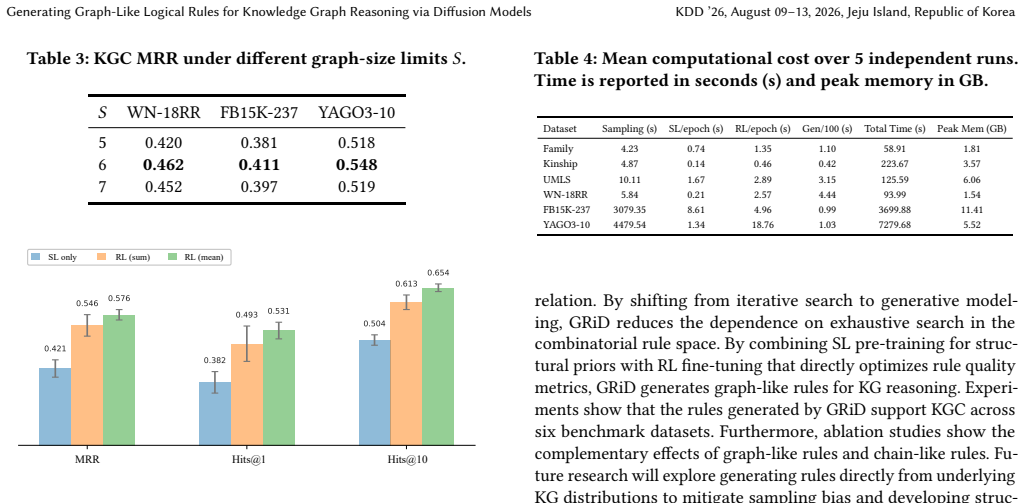
- Ablation results establish that both the pre-training and reinforcement learning stages contribute measurably to rule quality and training stability.
Where Pith is reading between the lines
- The same two-phase generative approach could be tested on other relational datasets whose patterns include branching or cyclic structures, such as biological interaction networks.
- If the learned structural priors prove domain-general, the method might reduce reliance on hand-crafted rule templates in symbolic reasoning systems.
- Combining the generated graph-like rules with existing embedding-based models could improve both accuracy and human-interpretable explanations without retraining the embeddings.
Load-bearing premise
The supervised pre-training on subgraphs sampled from the KG meta-graph actually encodes structural priors that transfer to high-quality rule generation after reinforcement learning fine-tuning.
What would settle it
If ablating the supervised pre-training phase produces rules whose quality scores and downstream completion accuracy fall to the level of random generation or standard chain-rule miners on the same six benchmarks, the transfer of structural priors would be falsified.
Figures

read the original abstract
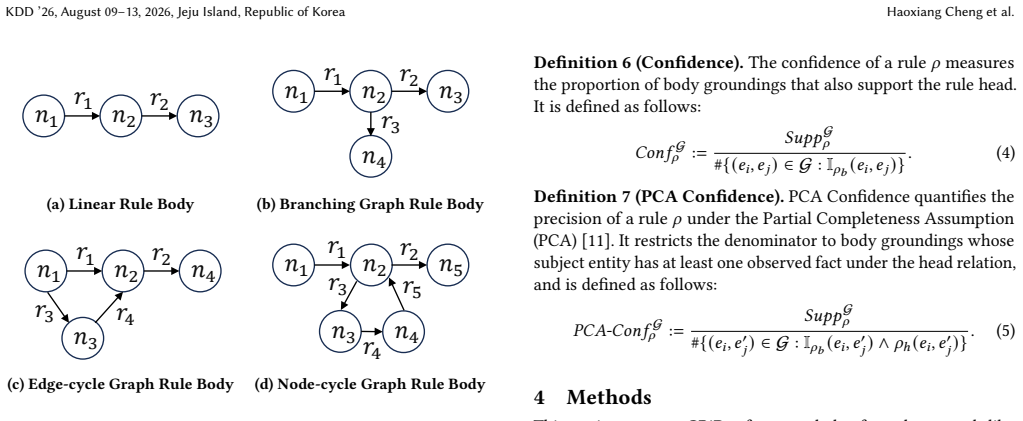
Logical rules constitute a cornerstone of knowledge graph (KG) reasoning, valued for their interpretability and ability to model relational patterns. However, existing rule mining methods predominantly focus on simple chain-like rules and therefore neglect the richer relational information encoded in graph-like structures, such as cycles and branches. This limitation is further exacerbated by computational bottlenecks caused by the combinatorial explosion of the search space, which is especially challenging for graph-like rules. Meanwhile, generative approaches such as diffusion models, despite their success in other domains, cannot be directly applied to rule mining because their training objectives are not aligned with the goal of learning high-quality rules, and non-differentiable KG rule quality metrics cannot directly guide model optimization. To address these limitations, we propose GRiD, a framework that reformulates graph-like rule discovery as a discrete generative process conditioned on the target relation. GRiD employs a two-phase training strategy. First, supervised pre-training enables GRiD to capture structural priors from subgraphs sampled from the KG meta-graph. Subsequently, reinforcement learning is applied to fine-tune GRiD through policy gradient optimization guided directly by non-differentiable rule-quality metrics. Experiments on six benchmark datasets show that GRiD achieves competitive performance on KG completion tasks. Ablation studies confirm the efficiency and robustness of GRiD and further show that graph-like rules complement chain-like rules in KG completion. Our code and datasets are available in https://github.com/Haoxiang-Cheng/GRiD.
Editorial analysis
A structured set of objections, weighed in public.
Referee Report
Summary. The paper proposes GRiD, a diffusion-model framework that reformulates discovery of graph-like logical rules (cycles, branches) for KG reasoning as a discrete generative process conditioned on a target relation. It employs a two-phase strategy—supervised pre-training on subgraphs sampled from the KG meta-graph to capture structural priors, followed by policy-gradient RL fine-tuning that directly optimizes non-differentiable rule-quality metrics—and reports competitive KG-completion results on six benchmarks together with ablations showing that graph-like rules complement chain-like rules.
Significance. If the two-phase pipeline demonstrably transfers useful structural priors from the meta-graph pre-training into the RL stage, the work would meaningfully extend rule mining beyond chain-like patterns, improving both expressivity and interpretability in KG reasoning while addressing combinatorial search bottlenecks. The open-source code and datasets constitute a clear reproducibility strength.
major comments (2)
- [Abstract] Abstract (two-phase strategy paragraph): the central claim that supervised pre-training on meta-graph subgraphs encodes transferable structural priors enabling high-quality graph-like rule generation after RL fine-tuning is load-bearing for the reported complementarity and performance gains, yet no ablation isolating the pre-training contribution (e.g., RL-only baseline) or distributional analysis of generated rules is described; without such evidence the gains could be attributable to the RL component alone.
- [Abstract] Abstract (experiments paragraph): no quantitative details are supplied on training stability, run-to-run variance, or the precise definition of the discrete diffusion process (forward/reverse steps, noise schedule, discretization), which directly affects the soundness of the competitive KG-completion claims and the robustness conclusions drawn from the ablations.
Simulated Author's Rebuttal
We thank the referee for the constructive feedback on our manuscript. The comments highlight important aspects of evidence presentation and experimental detail that we will address. We respond point-by-point to the major comments below.
read point-by-point responses
-
Referee: [Abstract] Abstract (two-phase strategy paragraph): the central claim that supervised pre-training on meta-graph subgraphs encodes transferable structural priors enabling high-quality graph-like rule generation after RL fine-tuning is load-bearing for the reported complementarity and performance gains, yet no ablation isolating the pre-training contribution (e.g., RL-only baseline) or distributional analysis of generated rules is described; without such evidence the gains could be attributable to the RL component alone.
Authors: We agree that an explicit RL-only baseline would more directly isolate the contribution of the supervised pre-training phase and strengthen the central claim regarding transferable structural priors. Our current ablations demonstrate overall performance, efficiency, robustness, and complementarity with chain-like rules, but do not include this specific comparison or a distributional analysis of generated rules. We will add an RL-only baseline experiment and a distributional analysis of the generated rules to the revised manuscript. revision: yes
-
Referee: [Abstract] Abstract (experiments paragraph): no quantitative details are supplied on training stability, run-to-run variance, or the precise definition of the discrete diffusion process (forward/reverse steps, noise schedule, discretization), which directly affects the soundness of the competitive KG-completion claims and the robustness conclusions drawn from the ablations.
Authors: The abstract is written for brevity, but we acknowledge that additional specifics would improve transparency. The precise definition of the discrete diffusion process (forward/reverse steps, noise schedule, and discretization) is provided in Section 3 of the full manuscript. Our experiments were conducted with multiple random seeds to assess stability; we will incorporate quantitative details on run-to-run variance (e.g., standard deviations) into the abstract and expand the discussion of training stability in the experiments section of the revised version. revision: yes
Circularity Check
No significant circularity; empirical claims rest on external benchmarks
full rationale
The paper's central claims rest on empirical results from training a diffusion model via supervised pre-training on KG meta-graph subgraphs followed by policy-gradient RL against non-differentiable external rule-quality metrics, then evaluating KG completion performance on six held-out benchmark datasets. No derivation step reduces a reported prediction or uniqueness result to a fitted parameter or self-citation by construction; the RL stage explicitly optimizes quantities defined outside the model. The two-phase strategy is presented as a standard engineering pipeline without load-bearing self-citations or ansatzes that collapse the output to the input.
Axiom & Free-Parameter Ledger
axioms (1)
- domain assumption Subgraphs sampled from the KG meta-graph encode structural priors that are useful for generating high-quality graph-like rules after RL fine-tuning.
Reference graph
Works this paper leans on
-
[1]
Johnson, Jonathan Ho, Daniel Tarlow, and Rianne van den Berg
Jacob Austin, Daniel D. Johnson, Jonathan Ho, Daniel Tarlow, and Rianne van den Berg. 2021. Structured Denoising Diffusion Models in Discrete State-Spaces. In Advances in Neural Information Processing Systems (NeurIPS), Vol. 34. 17981– 17993
2021
-
[2]
Serguei Barannikov, Ilya Trofimov, Grigorii Sotnikov, Ekaterina Trimbach, Alexander Korotin, Alexander Filippov, and Evgeny Burnaev. 2021. Manifold Topology Divergence: A Framework for Comparing Data Manifolds. InAdvances in Neural Information Processing Systems (NeurIPS), Vol. 34. 7294–7305
2021
-
[3]
Antoine Bordes, Nicolas Usunier, Alberto Garcia-Duran, Jason Weston, and Ok- sana Yakhnenko. 2013. Translating Embeddings for Modeling Multi-Relational Data. InAdvances in Neural Information Processing Systems (NeurIPS), Vol. 26. 2787–2795
2013
-
[4]
Yuxiang Cai, Qiao Liu, Yanglei Gan, Changlin Li, Xueyi Liu, Run Lin, Da Luo, and JiayeYang JiayeYang. 2024. Predicting the Unpredictable: Uncertainty-Aware Rea- soning over Temporal Knowledge Graphs via Diffusion Process. InFindings of the Association for Computational Linguistics: ACL 2024 (ACL Findings). Association for Computational Linguistics, 5766–5778
2024
-
[5]
Zheng Chen, Chuan Zhou, Fengxiang Cheng, Yip Tin Po, Fenrong Liu, Yisen Wang, Jiajun Chai, Xiaohan Wang, Guojun Yin, Wei Lin, Bo Li, Haoxuan Li, and Zhouchen Lin. 2026. LogiConBench: Benchmarking Logical Consistencies of LLMs. InThe Fourteenth International Conference on Learning Representations
2026
-
[6]
Fengxiang Cheng, Haoxuan Li, Fenrong Liu, Robert Van Rooij, Kun Zhang, and Zhouchen Lin. 2025. Empowering LLMs with logical reasoning: a comprehen- sive survey. InProceedings of the Thirty-Fourth International Joint Conference on Artificial Intelligence. 10400–10408
2025
-
[7]
Ahmed, and Yizhou Sun
Kewei Cheng, Nesreen K. Ahmed, and Yizhou Sun. 2023. Neural Compositional Rule Learning for Knowledge Graph Reasoning. InProceedings of the International Conference on Learning Representations (ICLR). KDD ’26, August 09–13, 2026, Jeju Island, Republic of Korea Haoxiang Cheng et al
2023
-
[8]
Kewei Cheng, Jiahao Liu, Wei Wang, and Yizhou Sun. 2022. RLogic: Recursive Logical Rule Learning from Knowledge Graphs. InProceedings of the 28th ACM SIGKDD Conference on Knowledge Discovery and Data Mining (KDD). ACM, 179– 189
2022
-
[9]
Tim Dettmers, Pasquale Minervini, Pontus Stenetorp, and Sebastian Riedel. 2018. Convolutional 2D Knowledge Graph Embeddings. InProceedings of the AAAI Conference on Artificial Intelligence (AAAI), Vol. 32
2018
-
[10]
Wenfei Fan, Xin Wang, Yinghui Wu, and Jingbo Xu. 2015. Association Rules with Graph Patterns.Proceedings of the VLDB Endowment (PVLDB)8, 12 (2015), 1502–1513
2015
-
[11]
Luis Antonio Galárraga, Christina Teflioudi, Katja Hose, and Fabian Suchanek
-
[12]
InProceedings of the 22nd International Conference on World Wide Web (WWW)
AMIE: Association Rule Mining under Incomplete Evidence in Ontological Knowledge Bases. InProceedings of the 22nd International Conference on World Wide Web (WWW). ACM, 413–422
-
[13]
Geoffrey E. Hinton. 1986. Learning Distributed Representations of Concepts. InProceedings of the Eighth Annual Conference of the Cognitive Science Society. Lawrence Erlbaum Associates, 1–12
1986
-
[14]
Han Huang, Leilei Sun, Bowen Du, and Weifeng Lv. 2023. Conditional diffusion based on discrete graph structures for molecular graph generation. InProceedings of the AAAI Conference on Artificial Intelligence, Vol. 37. 4302–4311
2023
-
[15]
Han Huang, Leilei Sun, Bowen Du, and Weifeng Lv. 2024. Learning Joint 2- D and 3-D Graph Diffusion Models for Complete Molecule Generation.IEEE Transactions on Neural Networks and Learning Systems35, 9 (2024), 11857–11871
2024
-
[16]
Shaoxiong Ji, Shirui Pan, Erik Cambria, Pekka Marttinen, and Philip S. Yu. 2022. A Survey on Knowledge Graphs: Representation, Acquisition, and Applications. IEEE Transactions on Neural Networks and Learning Systems33, 2 (2022), 494–514
2022
-
[17]
Stanley Kok and Pedro Domingos. 2007. Statistical Predicate Invention. InPro- ceedings of the 24th International Conference on Machine Learning (ICML). ACM, 433–440
2007
- [18]
-
[19]
Shixuan Liu, Haoxiang Cheng, Yunfei Wang, Yue He, Changjun Fan, and Zhong Liu. 2025. EvoPath: Evolutionary Meta-Path Discovery with Large Language Mod- els for Complex Heterogeneous Information Networks.Information Processing & Management62, 1 (2025), 103920
2025
-
[20]
Shixuan Liu, Changjun Fan, Kewei Cheng, Yunfei Wang, Peng Cui, Yizhou Sun, and Zhong Liu. 2024. Inductive meta-path learning for schema-complex het- erogeneous information networks.IEEE Transactions on Pattern Analysis and Machine Intelligence(2024)
2024
-
[21]
Xiao Long, Liansheng Zhuang, Aodi Li, Houqiang Li, and Shafei Wang. 2024. Fact Embedding through Diffusion Model for Knowledge Graph Completion. In Proceedings of the ACM Web Conference (WWW). ACM, 2020–2029
2024
-
[22]
Xiao Long, Liansheng Zhuang, Aodi Li, Jiuchang Wei, Houqiang Li, and Shafei Wang. 2024. KGDM: A Diffusion Model to Capture Multiple Relation Semantics for Knowledge Graph Embedding. InProceedings of the AAAI Conference on Artificial Intelligence, Vol. 38. 8850–8858
2024
-
[23]
Linhao Luo, Jiaxin Ju, Bo Xiong, Yuan-Fang Li, Gholamreza Haffari, and Shirui Pan. 2025. ChatRule: Mining Logical Rules with Large Language Models for Knowledge Graph Reasoning. InProceedings of the Pacific-Asia Conference on Knowledge Discovery and Data Mining (PAKDD). Springer, 342–355
2025
-
[24]
Christian Meilicke, Melisachew Wudage Chekol, Patrick Betz, Manuel Fink, and Heiner Stuckenschmidt. 2024. Anytime bottom-up rule learning for large-scale knowledge graph completion: C. Meilicke et al.The VLDB Journal33, 1 (2024), 131–161
2024
-
[25]
Pasquale Minervini, Matko Bošnjak, Tim Rocktäschel, and Sebastian Riedel. 2018. Towards Neural Theorem Proving at Scale. InProceedings of the ICML Workshop on Neural Abstract Machines and Program Induction (NAMPI)
2018
-
[26]
Pasquale Minervini, Sebastian Riedel, Pontus Stenetorp, Edward Grefenstette, and Tim Rocktäschel. 2020. Learning Reasoning Strategies in End-to-End Differ- entiable Proving. InProceedings of the 37th International Conference on Machine Learning (ICML). PMLR, 6938–6949
2020
-
[27]
Aleksandar Pavlović and Emanuel Sallinger. 2024. SpeedE: Euclidean Geomet- ric Knowledge Graph Embedding Strikes Back. InFindings of the Association for Computational Linguistics: NAACL 2024 (NAACL Findings). Association for Computational Linguistics, 89–98
2024
-
[28]
Ethan Perez, Florian Strub, Harm de Vries, Vincent Dumoulin, and Aaron Courville. 2018. FiLM: Visual Reasoning with a General Conditioning Layer. InProceedings of the AAAI Conference on Artificial Intelligence (AAAI), Vol. 32
2018
-
[29]
Tianle Pu, Chao Chen, Li Zeng, Shixuan Liu, Rui Sun, and Changjun Fan. 2024. Solving Combinatorial Optimization Problem over Graph through QUBO Trans- formation and Deep Reinforcement Learning. InProceedings of the IEEE Interna- tional Conference on Data Mining (ICDM). IEEE, 390–399
2024
-
[30]
Meng Qu, Junkun Chen, Louis-Pascal Xhonneux, Yoshua Bengio, and Jian Tang
-
[31]
In Proceedings of the International Conference on Learning Representations (ICLR)
RNNLogic: Learning Logic Rules for Reasoning on Knowledge Graphs. In Proceedings of the International Conference on Learning Representations (ICLR)
-
[32]
Ross Quinlan
J. Ross Quinlan. 1990. Learning Logical Definitions from Relations.Machine Learning5 (1990), 239–266
1990
-
[33]
Tim Rocktäschel and Sebastian Riedel. 2017. End-to-End Differentiable Proving. InAdvances in Neural Information Processing Systems (NeurIPS), Vol. 30
2017
-
[34]
Ali Sadeghian, Mohammadreza Armandpour, Patrick Ding, and Daisy Zhe Wang
-
[35]
In Advances in Neural Information Processing Systems (NeurIPS), Vol
DRUM: End-to-End Differentiable Rule Mining on Knowledge Graphs. In Advances in Neural Information Processing Systems (NeurIPS), Vol. 32
-
[36]
Apoorv Saxena, Adrian Kochsiek, and Rainer Gemulla. 2022. Sequence-to- Sequence Knowledge Graph Completion and Question Answering. InProceedings of the 60th Annual Meeting of the Association for Computational Linguistics (ACL). Association for Computational Linguistics, 2814–2828
2022
-
[37]
Suchanek, Gjergji Kasneci, and Gerhard Weikum
Fabian M. Suchanek, Gjergji Kasneci, and Gerhard Weikum. 2007. YAGO: A Core of Semantic Knowledge. InProceedings of the 16th International Conference on World Wide Web (WWW). ACM, 697–706
2007
-
[38]
Yushi Sun, Kai Sun, Yifan Ethan Xu, Xiao Yang, Xin Luna Dong, Nan Tang, and Lei Chen. 2025. KERAG: Knowledge-Enhanced Retrieval-Augmented Generation for Advanced Question Answering. InFindings of the Association for Computational Linguistics: EMNLP 2025. 6194–6216
2025
-
[39]
Zhiqing Sun, Zhi-Hong Deng, Jian-Yun Nie, and Jian Tang. 2019. RotatE: Knowl- edge Graph Embedding by Relational Rotation in Complex Space. InProceedings of the International Conference on Learning Representations (ICLR)
2019
-
[40]
Kristina Toutanova and Danqi Chen. 2015. Observed versus Latent Features for Knowledge Base and Text Inference. InProceedings of the 3rd Workshop on Continuous Vector Space Models and their Compositionality (CVSC). Association for Computational Linguistics, 57–66
2015
-
[41]
Théo Trouillon, Johannes Welbl, Sebastian Riedel, Éric Gaussier, and Guillaume Bouchard. 2016. Complex Embeddings for Simple Link Prediction. InProceedings of the 33rd International Conference on Machine Learning (ICML). PMLR, 2071– 2080
2016
-
[42]
Shikhar Vashishth, Soumya Sanyal, Vikram Nitin, and Partha Talukdar. 2020. Composition-Based Multi-Relational Graph Convolutional Networks. InProceed- ings of the International Conference on Learning Representations (ICLR)
2020
-
[43]
Clément Vignac, Igor Krawczuk, Antoine Siraudin, Bohan Wang, Volkan Cevher, and Pascal Frossard. 2023. DiGress: Discrete Denoising Diffusion for Graph Gen- eration. InProceedings of the International Conference on Learning Representations (ICLR)
2023
-
[44]
Joseph L Watson, David Juergens, Nathaniel R Bennett, Brian L Trippe, Jason Yim, Helen E Eisenach, Woody Ahern, Andrew J Borst, Robert J Ragotte, Lukas F Milles, et al. 2023. De novo design of protein structure and function with RFdiffusion. Nature620, 7976 (2023), 1089–1100
2023
-
[45]
Bishan Yang, Wen-tau Yih, Xiaodong He, Jianfeng Gao, and Li Deng. 2015. Em- bedding Entities and Relations for Learning and Inference in Knowledge Bases. InProceedings of the International Conference on Learning Representations (ICLR)
2015
-
[46]
Fan Yang, Zhilin Yang, and William W. Cohen. 2017. Differentiable Learning of Logical Rules for Knowledge Base Reasoning. InAdvances in Neural Information Processing Systems (NeurIPS), Vol. 30. 2316–2325
2017
-
[47]
Haocheng Yang, Fengxiang Cheng, Tianjun Yao, Mengyue Yang, Jiajun Chai, Xiaohan Wang, Guojun Yin, Wei Lin, Soummya Kar, Fenrong Liu, Haoxuan Li, and Yisen Wang. 2026. MAD-Logic: Multi-Agent Debate Enhances Symbolic Translation and Reasoning. InThe Fourteenth International Conference on Learning Representations
2026
-
[48]
Ling Yang, Zhilong Zhang, Yang Song, Shenda Hong, Runsheng Xu, Yue Zhao, Wentao Zhang, Bin Cui, and Ming-Hsuan Yang. 2023. Diffusion Models: A Comprehensive Survey of Methods and Applications.Comput. Surveys56, 4 (2023), 1–39
2023
-
[49]
Hang Yin, Zihao Wang, Weizhi Fei, and Yangqiu Song. 2025. EFO 𝑘 -CQA: To- wards Knowledge Graph Complex Query Answering beyond Set Operation. In Proceedings of the 31st ACM SIGKDD Conference on Knowledge Discovery and Data Mining. ACM, 5876–5887
2025
-
[50]
Yu Zhang, Kehai Chen, Xuefeng Bai, Zhao Kang, Quanjiang Guo, and Min Zhang
-
[51]
InFindings of the Association for Computational Linguistics: EMNLP 2024
Question-guided knowledge graph re-scoring and injection for knowl- edge graph question answering. InFindings of the Association for Computational Linguistics: EMNLP 2024. 8972–8985
2024
-
[52]
Cai Zhou, Xiyuan Wang, and Muhan Zhang. 2024. Unifying Generation and Pre- diction on Graphs with Latent Graph Diffusion. InAdvances in Neural Information Processing Systems (NeurIPS), Vol. 37. 61963–61999
2024
-
[53]
Zhaocheng Zhu, Xinyu Yuan, Michael Galkin, Louis-Pascal Xhonneux, Ming Zhang, Maxime Gazeau, and Jian Tang. 2023. A*Net: A Scalable Path-Based Reasoning Approach for Knowledge Graphs. InAdvances in Neural Information Processing Systems (NeurIPS), Vol. 36. 59323–59336
2023
-
[54]
Zhaocheng Zhu, Zuobai Zhang, Louis-Pascal Xhonneux, and Jian Tang. 2021. Neural Bellman-Ford Networks: A General Graph Neural Network Framework for Link Prediction. InAdvances in Neural Information Processing Systems (NeurIPS), Vol. 34. 29476–29490. Generating Graph-Like Logical Rules for Knowledge Graph Reasoning via Diffusion Models KDD ’26, August 09–1...
2021
discussion (0)
Sign in with ORCID, Apple, or X to comment. Anyone can read and Pith papers without signing in.